

“Orchestration” was named the project management word of the year for 2025. This is not a coincidence. It reflects a shift in how leading organisations are approaching the complexity of managing multiple changes simultaneously, moving from a model where initiatives are planned, delivered, and evaluated in isolation to one where the entire portfolio of change is coordinated as a single, dynamic system.
The older model, where each change programme has its own change manager, its own engagement plan, and its own go-live date, was designed for a world where organisations ran two or three major changes a year. Most large enterprises now run far more than that. Smartsheet’s 2025 Project and Portfolio Management Priorities Report, surveying 1,488 professionals at companies with more than 200 employees, found that 70% dealt with more change in 2024 than in any previous year, and 98% said those changes required them to alter their work priorities. A further 71% said constant workplace shifts make it difficult to stay productive.
The volume problem is not going away. Change orchestration is the discipline that addresses it.
What change orchestration actually means
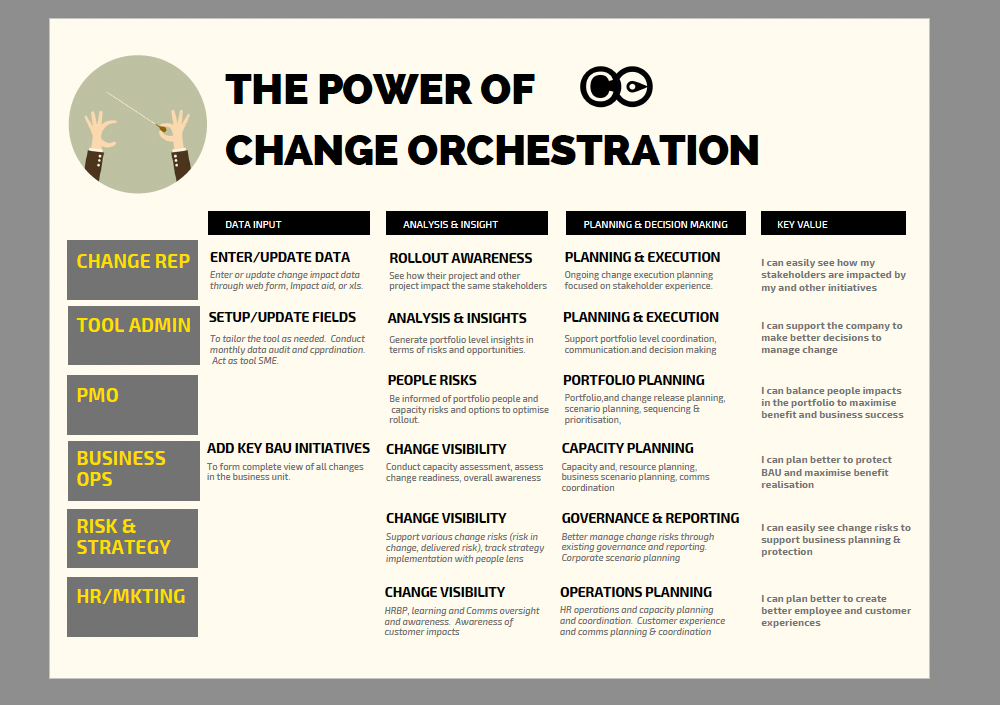
Change orchestration is the practice of coordinating multiple concurrent change initiatives at the portfolio level, sequencing and resourcing them to maximise adoption across the organisation rather than optimising each in isolation.
The distinction from traditional change management is important. Traditional change management, done well, delivers a single initiative effectively. Change orchestration asks a different and harder question: given everything this organisation is changing simultaneously, what is the sequence, timing, and resource allocation that gives us the best chance of adoption across all of it?
This is fundamentally a portfolio management capability. It requires visibility of the full change landscape, a consistent methodology for assessing and comparing impact across initiatives, and governance structures that allow portfolio-level decisions to override programme-level preferences when necessary.
The OCM Solution 2025-2026 OCM Trends Report identifies three forces reshaping change management: the rapid rise of AI, growing change fatigue, and the demand for portfolio visibility. All three converge in the case for change orchestration. AI is accelerating the pace of change initiatives. Change fatigue is the consequence of uncoordinated delivery. Portfolio visibility is the prerequisite for orchestration to work.
The problems that only orchestration can solve
There are two failure modes that are structural to single-programme change management and that only portfolio orchestration addresses.
Change collision
Change collision occurs when two or more initiatives simultaneously demand significant behavioural change from the same employee group, without coordination of messaging, timing, or support. The employees receive conflicting or contradictory demands, or are simply overwhelmed by the volume of things they are being asked to change at once.
Change collision is most common at the intersection of large-scale technology programmes and organisational restructuring. Both require employees to change how they work. When they land in the same quarter, neither lands well. The technology adoption suffers. The structural change generates more resistance than it would in isolation. The organisation pays the cost twice.
Orchestration prevents collision by giving change leaders visibility of what is landing when and for which employee groups, enabling them to negotiate timing adjustments, stagger go-lives, or allocate additional support resources to groups carrying disproportionate load.
Change saturation
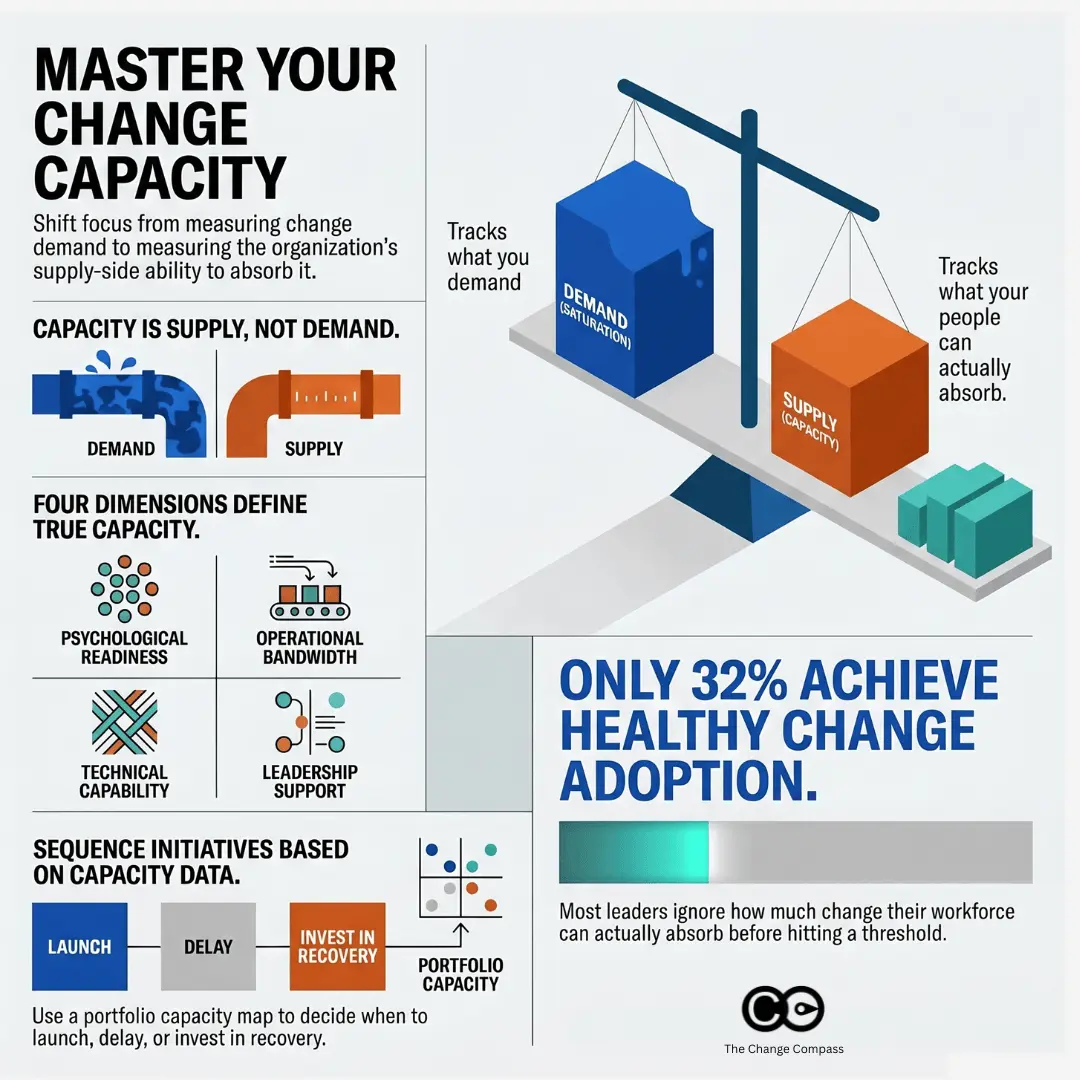
Change saturation is the cumulative effect of sustained high change load over time. It differs from collision in that it does not require two changes to land simultaneously. It occurs when an employee group has been absorbing continuous change for an extended period, and their capacity to engage meaningfully with new initiatives has been depleted.
Saturated employee groups show characteristic patterns: declining engagement survey scores, increasing resistance to new initiatives even when those initiatives are well-designed, higher-than-expected support demand post go-live, and slower adoption curves across the board. These patterns are often misread as specific programme problems when they are actually portfolio problems.
Orchestration addresses saturation by tracking cumulative change load over time, not just point-in-time impact. A programme that looks low-impact in isolation may be the fifth significant change landing on a specific team in 18 months. Without portfolio visibility, this risk is invisible. With it, the change team can flag saturation risk and advocate for sequencing adjustments before the problem materialises.
An orchestration maturity model
Change orchestration capability develops in recognisable stages. Most organisations sit at level one or two; the most sophisticated are at level four or five.
Level 1: Inventory. The change function maintains a list of active change programmes, but there is no systematic analysis of interaction effects or cumulative load. Orchestration is ad hoc, driven by individual change manager relationships rather than portfolio governance.
Level 2: Scheduling. The portfolio view includes timeline data, and there are informal conversations about scheduling conflicts. Go-live dates are occasionally adjusted to reduce obvious collisions. Impact data is inconsistent and not aggregated.
Level 3: Impact aggregation. Impact assessments use consistent methodology across programmes, enabling cumulative load to be calculated by employee group. The portfolio view shows not just what is changing, but how much change is landing on each part of the organisation and when. Regular portfolio reviews identify risk.
Level 4: Active sequencing. Portfolio-level decisions actively sequence initiatives based on change capacity and strategic priority. Programmes are deliberately staged, spaced, or consolidated based on orchestration analysis. Executive governance supports sequencing decisions even when they conflict with individual programme timelines.
Level 5: Predictive orchestration. AI-assisted analysis of historical adoption data informs capacity modelling. The change function can predict, with meaningful confidence, which groups are at risk of saturation given the current portfolio plan, and propose adjustments before risk materialises. This is where the field is heading.
How technology enables change orchestration
Manual orchestration at portfolio scale is difficult. The data management challenge alone, maintaining current, consistent impact data across 20 or more concurrent programmes, is substantial. More importantly, the analytical work of aggregating impact by role group, calculating cumulative load, and identifying risk patterns across the portfolio is time-consuming if done manually and prone to the blind spots that come from working in spreadsheets.
Purpose-built change portfolio management platforms, such as The Change Compass, address this directly. The platform’s core capability is change portfolio visualisation: seeing cumulative impact by business unit, role, or geography across all active initiatives simultaneously. This transforms orchestration from an aspiration into a practical process. Instead of a change leader spending a day preparing a portfolio view, the view is always current and accessible. Analysis that previously required significant effort becomes routine.
The Change Automator, as part of The Change Compass platform, further extends this capability by automating the coordination of change activities across programmes, reducing the administrative burden on change teams and enabling them to focus on the strategic sequencing decisions that human judgment is required for.
Making the business case for change orchestration
For change leaders who need to make an internal case for investing in orchestration capability, the most compelling argument is loss quantification. What does poor orchestration cost the organisation?
If a major technology programme misses its adoption targets by 20% because the user group it targets was simultaneously absorbing a structural reorganisation and a policy change, the cost is the delayed benefits realisation of the programme. In a typical enterprise technology implementation with a $50 million total project cost and a 30% productivity improvement target, a 20% shortfall in adoption could represent millions of dollars in unrealised benefit over the first year.
The Smartsheet research found that 92% of PPM professionals struggle to adapt to workplace changes, and 23% of organisations lack a standardised process for adapting to change at all. In organisations running complex change portfolios, the absence of orchestration capability is a significant and quantifiable source of value loss.
Where to start with orchestration
For organisations at level one or two on the maturity model, the most practical entry point is to start with visibility. Map all active change initiatives. Identify the five employee groups bearing the highest cumulative change load. Review whether the timeline for any current or planned initiative creates collision or saturation risk for those groups.
This diagnostic takes days, not months, and typically surfaces at least one critical risk that was not visible before the exercise. That visibility, and the conversation it enables with business leadership, is the first value that orchestration delivers. From there, the capability can be built progressively: a consistent impact methodology, a regular portfolio review, and eventually a governance structure that gives the change function the authority to make sequencing recommendations that stick.
Frequently asked questions
What is change orchestration?
Change orchestration is the practice of coordinating multiple concurrent change initiatives at the portfolio level, ensuring they are sequenced, resourced, and delivered in a way that maximises adoption across the whole organisation rather than optimising each initiative in isolation. It addresses the change collision and change saturation problems that arise when multiple significant changes land simultaneously on the same employee groups.
How is change orchestration different from change management?
Change management focuses on a single initiative: helping employees understand, adopt, and sustain a specific change. Change orchestration operates above this level, managing the interaction effects and cumulative impact of all changes across the portfolio. Both are necessary: orchestration without execution quality at the programme level fails to deliver, and strong programme-level change management without portfolio coordination creates avoidable collision and saturation.
Why is change orchestration more important now than five years ago?
Three trends have made it more critical: the volume of concurrent change initiatives in large organisations has increased substantially, the pace of AI-driven transformation is compressing timelines, and the evidence on change fatigue shows that employee change capacity is finite and can be depleted. All three make the cost of uncoordinated change higher, and the value of orchestration greater.
What data do you need to start orchestrating change?
At minimum: a complete inventory of active and planned change initiatives, a consistent impact assessment methodology that captures which employee groups are affected and to what degree, and timeline data for each initiative. This is enough to identify collision and saturation risks at a basic level. More sophisticated orchestration requires adoption tracking data and historical benchmarks, but visibility starts with the inventory.
What tools support change orchestration?
Portfolio-level change management platforms such as The Change Compass are purpose-built for this challenge. They aggregate impact data across programmes, visualise cumulative load by employee group, and enable the portfolio-level governance conversations that orchestration requires. General project management tools can support basic inventory management but typically lack the change-specific impact and adoption analytics that mature orchestration requires.
References
- PMC Lounge. Project Management Word of the Year 2025: Orchestration. https://www.pmclounge.com/project-management-word-of-the-year-2025-orchestration/
- Smartsheet. Navigating Change in 2025: Strategies for Project and Portfolio Managers (2025 PPM Priorities Report). https://www.smartsheet.com/content-center/inside-smartsheet/research/2025-ppm-priorities-report-key-takeaways
- OCM Solution. 2025-2026 Organizational Change Management Trends Report. https://www.ocmsolution.com/organizational-change-management-ocm-trends-report/
- Gartner. Gartner HR Research Finds Just 32% of Business Leaders Report Achieving Healthy Change Adoption by Employees (2025). https://www.gartner.com/en/newsroom/press-releases/2025-07-08-gartner-hr-research-finds-just-32-percent-of-business-leaders-report-achieving-healthy-change-adoption-by-employees
- ResearchGate. Global Trends in Change Management: Insights and Key Takeaways for 2025. https://www.researchgate.net/publication/389707029_Global_Trends_in_Change_Management_Insights_and_Key_Takeaways_for_2025