

A change intelligence platform is the persistent, portfolio-level system that captures every change initiative, every stakeholder impact, every adoption signal and every governance decision in a single connected data layer for an organisation. Unlike generic project management tools, which track tasks and timelines, or spreadsheets, which capture one initiative at a time, a change intelligence platform measures cumulative load across the portfolio, detects conflicts between concurrent initiatives, produces audit-defensible adoption evidence and supports continuous readiness monitoring. It is the supply-side intelligence layer that makes enterprise change measurable, comparable across initiatives, and decisionable at executive timeframes.
Most transformation programmes are run on information that arrives too late to act on. Adoption surveys land weeks after go-live. Portfolio reports capture what is in flight, but not what it is costing the people absorbing it. Readiness data sits in project folders that close when the project does. Leaders make decisions about launching new initiatives based on delivery schedules and gut feel, not on real signals about whether their organisation has the capacity to absorb what they are about to add.
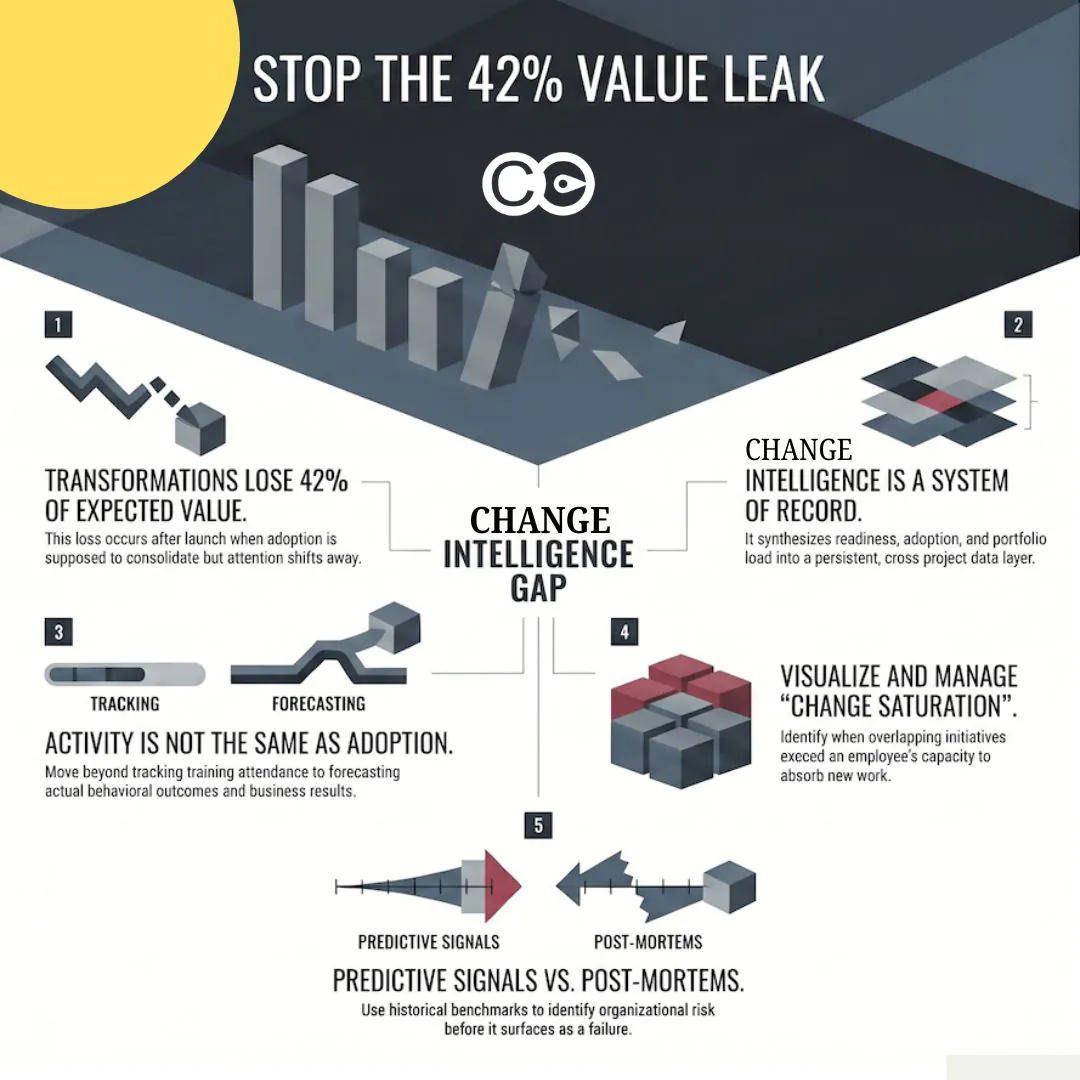
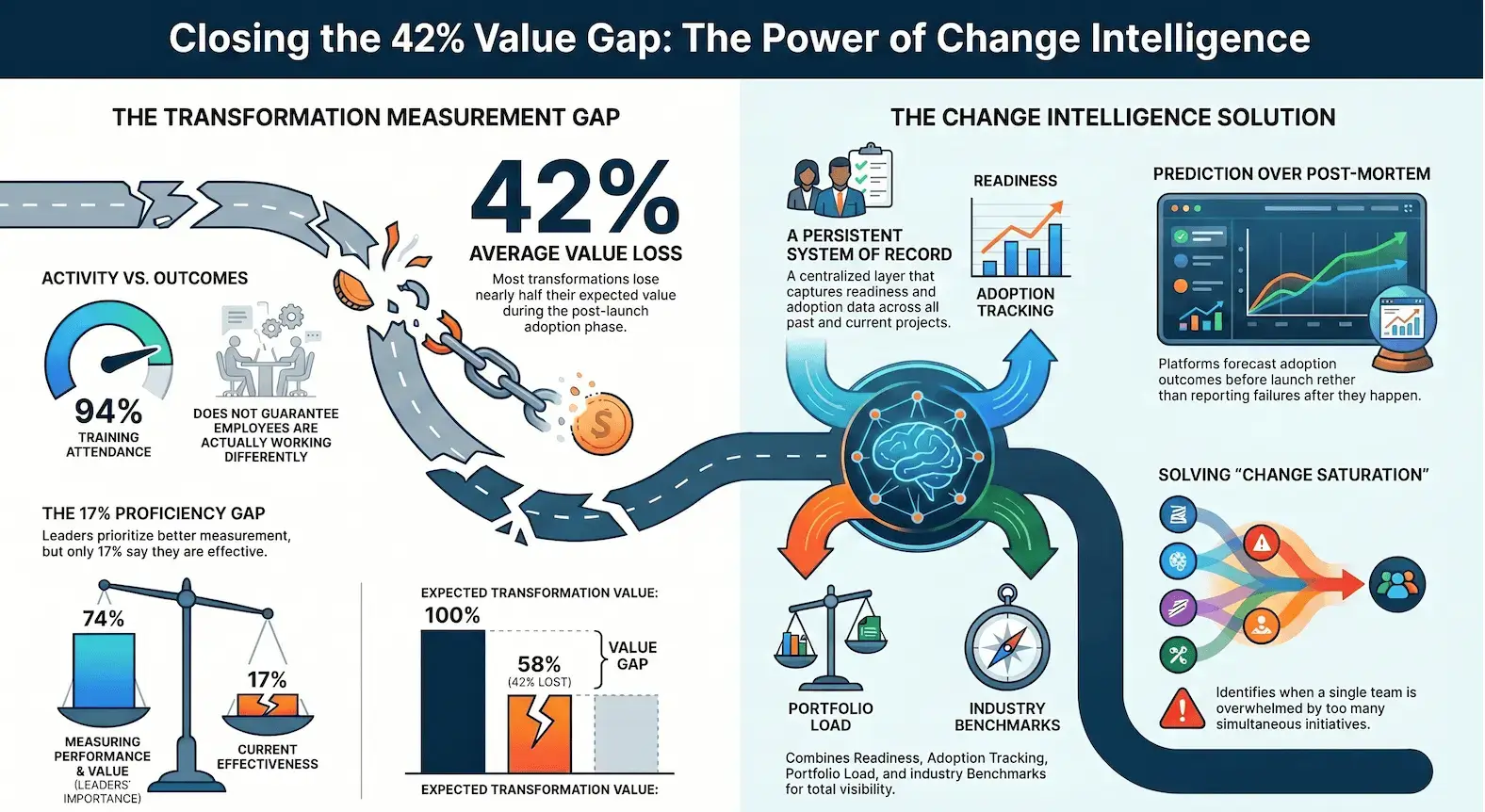
McKinsey’s research on transformation practice puts it plainly: “the tool kit for managing change is outdated”, and organisations need new tools, skills, and methods to navigate the reality of running multiple transformations simultaneously. The same research found that large-scale transformations lose, on average, 42% of their expected value in their later phases. Not at the point of design. After launch, during the period when adoption is supposed to be consolidating, and when most organisations have already stopped paying close attention.
That 42% is not a design problem. It is an intelligence problem.
A change intelligence platform is a category of software that solves it. It synthesises readiness data, adoption tracking, portfolio load, and benchmark comparisons into a persistent, cross-portfolio intelligence layer that forecasts outcomes, identifies organisational and business risk before it surfaces, and automates the analytical work that currently consumes a practitioner’s week. This article explains what that means in practice, what separates it from every other tool in a transformation team’s stack, and how to assess whether your organisation is ready to make the shift.
The measurement gap that silently erodes transformation value
Deloitte’s 2024 Global Human Capital Trends survey, drawing on responses from 14,000 business and HR leaders across 95 countries, found that 74% of respondents rated finding better ways to measure worker performance and value as very or critically important. Only 17% said their organisation was actually effective at evaluating that value beyond tracking activities and outputs.
Read that again: three in four leaders consider better performance measurement a critical priority, and fewer than one in five have any real capability to do it.
This measurement gap sits at the heart of why transformations lose value in the phases after launch. Organisations track what they are delivering. They rarely track whether the people on the receiving end are genuinely adopting what has been built. McKinsey has identified a consistent pattern across failing transformations: teams focus on activity-based plans that show progress, but rarely on the business outcomes those plans are meant to produce. Programme leaders can tell you that training attendance hit 94%. They struggle to tell you whether the target population is actually working differently.
A change intelligence platform is, at its core, the answer to that gap. It moves the measurement frame from activity to outcomes, and it does so continuously, across the entire portfolio, not just for the initiative currently in the spotlight.
What a change intelligence platform actually is
A change intelligence platform is software built on a persistent, cross-portfolio data model that draws on multiple data streams to forecast outcomes, identify risk, and generate intelligence across the full change portfolio.
It combines two capabilities that currently exist separately in most organisations: a system of record for change (centralised, persistent, shared across projects and functions) and an intelligence engine (capable of producing forecasts, risk signals, and recommendations from that data, rather than just reporting what is already known).
The system of record dimension means every change initiative, past and current, contributes to a common organisational data layer. The intelligence dimension means that data is not just stored and reported, it is continuously synthesised to produce forward-looking signals. The outputs are not dashboard summaries of what happened last quarter. They are predictions about what is likely to happen next, and recommendations for what to do about it.
This is what separates a change intelligence platform from a more sophisticated spreadsheet, a project management tool, or a standalone AI assistant. The intelligence it produces is grounded in your organisation’s own data. It knows your history.
The four data streams that power genuine change intelligence
The quality of intelligence a platform can produce depends entirely on the quality and breadth of the data it draws on. Platforms in this category pull from four distinct inputs.
Readiness data
Readiness assessments measure how prepared a population is for a specific change at a specific point in time. Within a change intelligence platform, that data is not siloed per project and archived at go-live. It accumulates across time and across initiatives, building a readiness history that becomes a forecasting asset.
When you have readiness data from twelve previous system implementations, you can answer questions that are currently unanswerable: which functions consistently lag readiness targets for technology change? How long does it typically take the operations business unit to reach the threshold needed for confident go-live? What interventions, at what point in the cycle, have historically moved readiness scores most effectively in this organisation?
Each data point adds predictive value to every subsequent programme.
Adoption tracking
Adoption data, whether people have actually changed their behaviour rather than just attended training, is one of the most underinvested dimensions in change management. Most programmes measure activity (completions, attendance, survey responses) and treat that as a proxy for adoption. It is not.
When adoption is tracked as a distinct data stream, at a portfolio level and over time, the patterns that emerge are genuinely actionable. Which initiative types achieve sustained adoption in this organisation? Which populations show strong initial adoption that degrades without reinforcement? At what point in the change cycle do adoption curves typically plateau, and what has historically re-accelerated them? A platform that holds this history can turn a new programme’s adoption forecast from a hopeful estimate into a data-grounded projection.
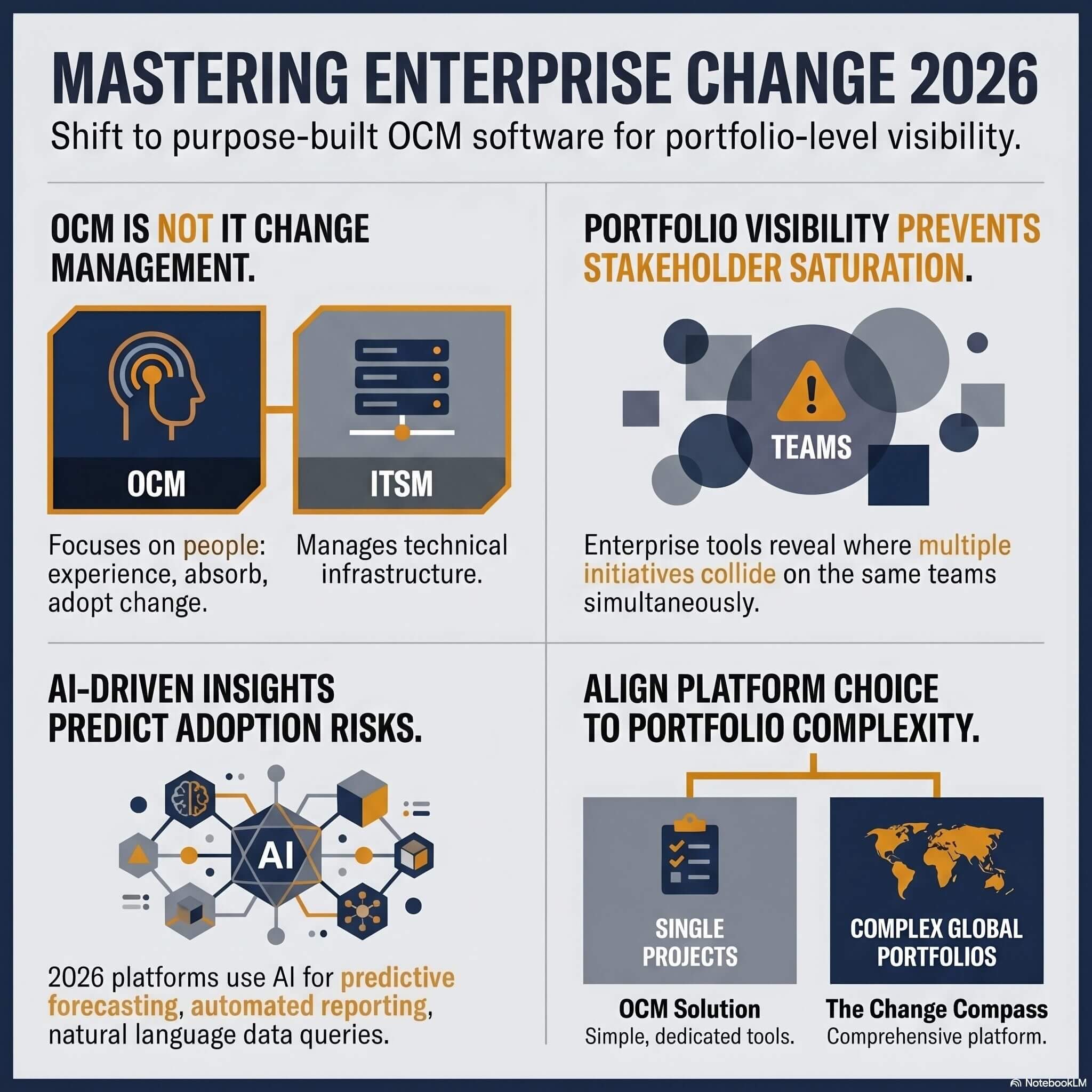
Portfolio load and change saturation
This is the data type most organisations are entirely blind to, and it is the one that causes the most silent damage.
When multiple programmes are running simultaneously and targeting overlapping populations, the individual project view gives no signal that anything is wrong. Every programme looks healthy in its own RAG report. The portfolio view tells a completely different story. The same functional team can be simultaneously absorbing a new technology platform, a restructure, a new performance management process, and a compliance training rollout, with each project team confident their initiative is being well-managed, and no one with visibility over what the combination is doing to that team’s capacity to absorb any of it.
McKinsey notes that the average employee now experiences ten planned change programmes per year, a fivefold increase from a decade ago. Without a shared portfolio data model, organisations have no mechanism to see that accumulation, let alone manage it.
Benchmark data
Benchmark data is what transforms internal measurements from descriptive to diagnostic. A readiness score of 61% means something very different if the benchmark for this initiative type at this programme stage is 72% than if it is 54%.
Access to benchmark comparisons, whether from the organisation’s own historical data or from industry-comparable programmes, gives practitioners the ability to calibrate their situation accurately. It also makes the case for action credible: it is much easier to persuade a senior sponsor to resource an intervention when the data shows your readiness score is 13 points below where comparable organisations sit at the same milestone, than when you are reporting an internal number with no reference point.
From data to intelligence: forecasting, prediction, and risk identification
When these four data streams are held in a persistent, cross-portfolio system, the intelligence they produce goes well beyond reporting. Three specific capabilities become possible that are genuinely difficult or impossible to replicate without the data layer.
Forecasting adoption outcomes. Rather than waiting to see whether adoption takes hold after go-live, a change intelligence platform generates forecasts before launch: given current readiness trajectory, portfolio load on the target group, and historical adoption curves for comparable programmes, what is the probability of meeting the adoption target by week eight? That is not a guess. It is a data-driven forecast that programme leaders can act on.
Predicting and surfacing organisational risk. Risk in transformation is usually identified retrospectively: adoption was lower than expected, the benefit realisation review shows the programme did not deliver. A change intelligence platform surfaces risk signals in advance: a group whose readiness score is below the threshold for a planned go-live date, a population whose combined change load is approaching the saturation point where adoption failure becomes likely, an initiative whose adoption curve is tracking significantly below historical patterns for this initiative type. These are predictive signals, not post-mortems.
Benchmark intelligence. Knowing how your organisation’s change performance compares with relevant benchmarks changes the quality of decisions made at every level. Programme teams calibrate their interventions against evidence rather than instinct. Portfolio leaders can identify which parts of the organisation are consistently strong at absorbing change and which are chronically under-resourced for it. Executives can see, in terms they recognise, whether the organisation is building genuine change capability over time.
The following are examples of questions a change intelligence platform can answer that no other tool in the typical change practitioner’s stack can reliably address:
- Given current readiness and adoption data, what is the forecast adoption rate at week twelve for this initiative?
- Which populations are currently at or approaching change saturation across the portfolio?
- How does our typical readiness trajectory for technology change compare with our benchmark, and where do we habitually fall behind?
- Based on our portfolio history, which planned Q3 launch carries the higher adoption risk if launched simultaneously with the current programme?
- What pattern of reinforcement activities has historically been most effective in re-accelerating adoption in this functional group?
Why AI in silo cannot answer these questions
There is a version of AI in change management that is genuinely productive: using a large language model to draft communications, build change plans, summarise stakeholder notes, generate impact assessment frameworks. Prosci’s 2024 research found that more than half of change professionals were already using AI tools regularly. That adoption is not the problem.
The problem is treating general-purpose AI as a substitute for a data-grounded intelligence layer, when the two are doing fundamentally different things.
When a change practitioner prompts a general-purpose AI tool, they are asking it to reason about a situation it does not actually know. The model has no access to your readiness survey history. It does not know that the operations function in your organisation has historically required seven weeks longer than planned to reach technology readiness thresholds. It does not know that the current portfolio has three major programmes all targeting the same 400-person business unit in Q3. It cannot see that your adoption curves for mandatory compliance change consistently plateau at 69% without a specific type of reinforcement in weeks five to seven.
Your organisational data knows all of that. A change intelligence platform is what makes it possible for AI to reason from that data rather than from generic patterns, and that distinction is the difference between advice that sounds reasonable and intelligence that is actually specific to your situation.
Automation: from analytical grind to decision-making
A change intelligence platform does not only produce better intelligence. It removes the manual analytical work required to produce any portfolio-level view at all.
Senior change practitioners regularly spend significant time on tasks that are fundamentally data processing: consolidating stakeholder registers from multiple project spreadsheets, aggregating impact data across programmes into a portfolio view, pulling readiness reports from separate survey exports, tracking adoption metrics across a dozen workstreams. This work is important. It is also time-consuming, error-prone when done manually, and a poor use of people who were hired for their judgement, not their spreadsheet skills.
Automation in a change intelligence platform shifts where that time goes. Impact assessments generate automatically as new initiatives are added. Readiness reporting is produced from live data on demand. Portfolio-level capacity calculations update in real time as timelines shift. Risk flags surface without anyone running a manual cross-initiative analysis.
The practical effect is a fundamental shift in how change teams work: less time on data compilation, more time on interpretation, advocacy, and the high-judgement work that actually moves the needle on adoption.
Using digital tools to build change portfolio intelligence
Change Compass is one of the most established platforms in the change intelligence category. It provides the persistent cross-portfolio data model, multi-stream data inputs spanning readiness, adoption, and portfolio load, benchmark intelligence, AI-assisted forecasting and risk identification, and the automation that eliminates manual analytical grind. For transformation leaders and PMOs managing complex, high-volume change portfolios, it is the infrastructure layer that makes the shift from activity reporting to intelligence-led decision-making operationally viable.
Where the shift actually starts
The case for a change intelligence platform is ultimately a business case. Transformation programmes fail to realise their intended value not because they were poorly designed, but because the people dimension of change is managed on incomplete, delayed, and fragmented data. McKinsey’s research showing that large-scale transformations lose an average of 42% of expected value in the phases after launch is a direct description of what happens when the intelligence gap is not closed.
The shift starts with a decision to treat change data as an organisational asset rather than a project artefact: something that should be captured consistently, held persistently, and used to make decisions across the portfolio rather than discarded when each project closes.
From that decision, the rest follows: a shared data model, consistent measurement of readiness and adoption, portfolio-level visibility, and eventually, the forecasting and prediction capabilities that transform change management from a reactive discipline into a proactive one. That is what a change intelligence platform makes possible. And for any organisation running significant transformation at scale, it is the capability gap that matters most.
For a comprehensive view of how AI reshapes the discipline at both project and portfolio level, see our complete guide to AI in change management.
Frequently asked questions
What is a change intelligence platform?
A change intelligence platform is software that synthesises readiness data, adoption tracking, portfolio change load, and benchmark comparisons into a persistent, cross-portfolio intelligence layer. It forecasts adoption outcomes, identifies organisational and business risk before it surfaces, and automates the analytical work that currently consumes change practitioners’ time. Unlike project management tools or standalone AI assistants, it operates on your organisation’s own historical data to produce intelligence specific to your context.
How is a change intelligence platform different from a project management tool?
Project management tools track the delivery of work: tasks, milestones, budgets, and timelines. A change intelligence platform tracks the impact of that work on the people who must adopt it, and forecasts whether adoption is likely to succeed based on readiness data, current portfolio load, and historical performance patterns. The two are complementary: project management manages what is being built; change intelligence manages whether it will land.
What data does a change intelligence platform draw on?
The most capable platforms draw on four data types: readiness assessment data, adoption tracking data, portfolio load data (the cumulative change burden across all concurrent initiatives), and benchmark data for comparison against historical or industry-relevant reference points. Together, these inputs make forecasting and predictive risk identification possible in ways no single-initiative tool can replicate.
How is a change intelligence platform different from using AI for change management?
General-purpose AI tools can accelerate many tasks but operate without access to your organisational data. When prompted, they reason from generic patterns, not from your organisation’s change history, readiness trends, or adoption benchmarks. A change intelligence platform uses AI that is grounded in your actual portfolio data: the forecasts and risk signals it produces are specific to your organisation, not derived from generalised models.
Which organisations benefit most from a change intelligence platform?
Organisations running ten or more significant concurrent change initiatives, or those with a history of post-go-live adoption failure, missed benefit realisation targets, or high change fatigue, are typically the strongest candidates. PMOs leading enterprise transformation programmes, and HR functions managing large-scale workforce transitions, see the most immediate value from the move to intelligence-led change portfolio management.
References
- Change Is Changing: How to Meet the Challenge of Radical Reinvention, McKinsey & Company
- In It for the Long Haul, McKinsey & Company
- Common Pitfalls in Transformations, McKinsey & Company
- As Human Performance Takes Centre Stage, Are Traditional Productivity Metrics Enough?, Deloitte 2024 Global Human Capital Trends
- Change Management Trends 2024 and Beyond, Prosci