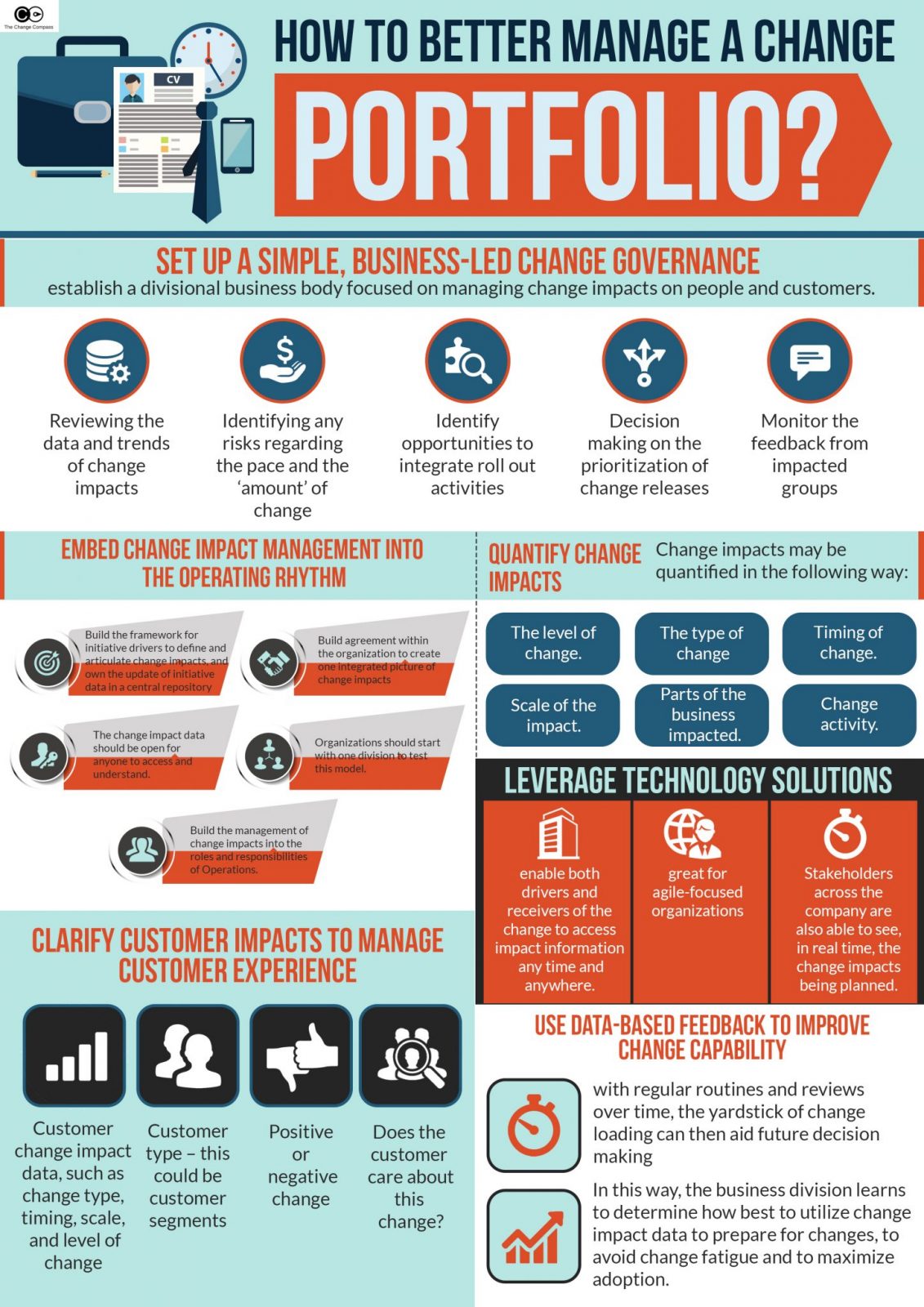


Most organisations have become reasonably competent at managing individual change programmes. Project sponsors are appointed, change managers are assigned, stakeholder plans are drafted, and communications are issued on schedule. Yet despite this programme-level discipline, many organisations still find themselves in a state of chronic change fatigue, with employees overwhelmed, adoption rates disappointing, and initiative benefits failing to materialise. The reason is almost always the same: while individual programmes are managed in relative isolation, nobody is managing the portfolio as a whole.
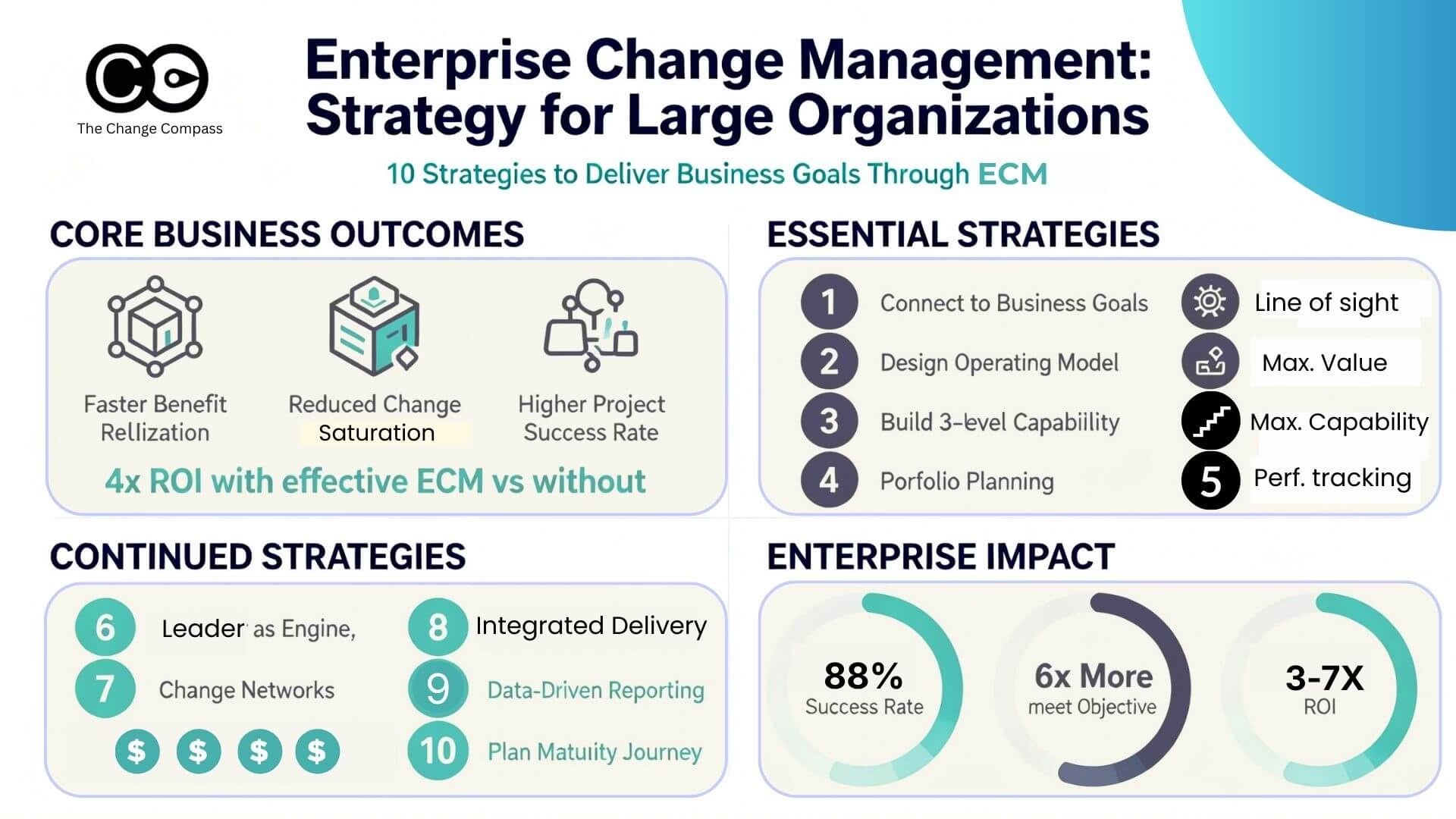
The distinction matters enormously. A single restructuring programme may be well-designed and well-resourced, but if it lands on a workforce that is simultaneously absorbing a new ERP system, a revised performance framework, and a regulatory compliance uplift, the cumulative impact on any one employee group can be severe. Research by Prosci consistently shows that projects with excellent change management are six times more likely to meet objectives than those with poor change management, yet even excellent individual programme management cannot compensate for a portfolio that is uncoordinated and overloaded. The collective view is the missing ingredient.
Building that collective view requires a fundamentally different discipline – one that sits above the programme level and looks across all concurrent initiatives simultaneously. It requires agreed inventory, shared data, visual tools that surface cumulative load, and governance structures empowered to make sequencing and prioritisation decisions. This article sets out a practical framework for doing exactly that, drawing on what leading organisations have learned about managing change at the portfolio level.

What makes change portfolio management different
Programme management is concerned with delivering a defined scope of change within agreed time and budget constraints. Portfolio management, by contrast, is concerned with the aggregate effect of all concurrent change activity on the organisation’s capacity to absorb and sustain that change. These are qualitatively different problems. A programme manager needs to know whether their initiative is on track. A portfolio manager needs to know whether the organisation as a whole can absorb everything being asked of it simultaneously.
This difference in scope creates a difference in the data required. Programme managers work with project plans, milestone trackers, and stakeholder registers. Portfolio managers need a consolidated view of which employee groups are affected by which initiatives, what the timing of each wave of change looks like across the calendar, and where cumulative load is likely to exceed organisational capacity. McKinsey research on large-scale transformations has identified that managing the human side of change at the portfolio level – rather than initiative by initiative – is one of the most significant differentiators between transformations that deliver their intended value and those that fall short.
Change portfolio management also involves a different set of decision rights. At the programme level, decisions are largely about how to execute. At the portfolio level, decisions are about which initiatives to progress, in what sequence, and with what timing adjustments to protect the organisation’s change capacity. These are strategic decisions that typically require executive sponsorship and cross-functional governance, which is why portfolio management cannot be delegated entirely to a project management office.
Building a complete inventory of concurrent initiatives
The starting point for any change portfolio management capability is a complete and accurate inventory of all current and planned change initiatives. This sounds straightforward but is frequently more difficult than organisations expect. Change activity is often scattered across business units, each with its own programme governance, its own terminology, and its own relationship with a central project management office. Technology change, process change, structural change, and regulatory change are often tracked in separate registers by separate teams, and there is rarely a single owner responsible for maintaining a consolidated view.
An effective portfolio inventory needs to capture several dimensions for each initiative: the affected employee groups or business units, the nature of the change (process, technology, structure, culture, or a combination), the planned timeline including key deployment milestones, the estimated change impact level on each affected group, and the current status of change readiness activities. Without these dimensions, it is impossible to compare initiatives meaningfully or to assess cumulative load on any given part of the organisation.
The inventory also needs to be maintained dynamically rather than as a point-in-time snapshot. Timelines shift, scope changes, new initiatives are added and others are deprioritised. A portfolio register that is updated quarterly quickly becomes unreliable as a basis for decision-making. The organisations that manage this best tend to integrate their portfolio inventory with existing project governance rhythms, requiring initiative leads to update key data points as part of their regular reporting rather than through a separate process.
Visualising the collective change load on employee groups
Once an inventory is in place, the next challenge is making the data meaningful for decision-makers who do not have time to work through rows of a spreadsheet. Visualisation is critical here. The most useful visualisation for change portfolio management is a heatmap that shows, for each employee group, the volume and intensity of change they are experiencing across a given time horizon – typically a rolling 12 to 18 months. When leadership can see at a glance that a particular business unit faces intense change across six concurrent initiatives in the same quarter, the conversation about sequencing and resourcing becomes much easier to have.
Effective visualisation needs to account for both the breadth of change impact and its depth. Breadth refers to how many initiatives affect a given group; depth refers to how significantly those initiatives change the way people work. A technology upgrade that changes a few screen layouts is fundamentally different from a restructuring that changes reporting lines, role definitions, and work processes simultaneously. A portfolio visualisation that treats these as equivalent will systematically understate risk in the groups facing the most complex changes.
Gartner has noted that organisations which develop data-driven views of employee change load are better positioned to make proactive rather than reactive sequencing decisions. The shift from reactive to proactive is significant: rather than discovering that a particular team is overwhelmed after adoption has failed, portfolio visualisation creates the conditions for intervening before the problem occurs. This is the core operational value of building a genuine portfolio view.
Using portfolio data for risk assessment and planning
A consolidated portfolio view provides the data foundation for a more rigorous approach to change risk assessment. Individual programme risk assessments typically focus on risks within the initiative itself – unclear requirements, insufficient sponsor engagement, inadequate training resources. Portfolio-level risk assessment adds a further category: the risk that the cumulative change load on key employee groups will exceed their capacity to absorb and adopt, regardless of how well each individual initiative is managed.
Identifying this risk requires comparing the projected change load on each employee group against a realistic estimate of their change capacity. Change capacity is influenced by several factors: the organisation’s current performance baseline, the degree to which change management resources are available to support affected groups, the history of recent change activity and any residual fatigue from prior programmes, and the complexity of employees’ existing workload. Where projected load exceeds estimated capacity, a risk flag should trigger a deliberate conversation about whether the timeline, scope, or resourcing of one or more initiatives needs to be adjusted.
Portfolio risk assessment also supports planning decisions about where to concentrate change management resources. In most organisations, change management capability is a constrained resource. A portfolio view enables that resource to be allocated to the initiatives and employee groups where the risk of failed adoption is highest, rather than distributed evenly across all programmes regardless of their actual risk profile. This kind of evidence-based resource allocation can significantly improve the overall return on change investment across the portfolio.
Making sequencing and prioritisation decisions
Sequencing and prioritisation are among the most consequential decisions in change portfolio management, and they are also among the most politically difficult. Every initiative sponsor believes their programme is strategically critical and should proceed on its planned timeline. Portfolio management creates the conditions for a more objective conversation about sequencing by grounding the discussion in data about cumulative load and capacity rather than in competing claims about strategic importance.
There are several practical levers available when portfolio data indicates that a particular employee group is facing excessive change load in a given period. The first is timeline adjustment, shifting the deployment of one or more initiatives to a period when the affected group has greater capacity. The second is scope reduction, reducing the breadth or depth of change delivered in a single release to reduce the initial adoption burden. The third is phased deployment, rolling out the same change to different sub-groups at different times to spread the load. The fourth is enhanced support, increasing the change management resources available to the affected group to lift their effective capacity without changing the delivery timeline.
The choice between these levers will depend on the strategic urgency of each initiative, the flexibility in their delivery timelines, and the availability of additional change management resources. What matters is that these are explicit, deliberate decisions made with full visibility of the portfolio picture, rather than emergent outcomes of individual programme timelines colliding without coordination. Harvard Business Review research on transformation success has highlighted that organisations which treat sequencing as a strategic capability, rather than an operational convenience, achieve materially better outcomes from their change investments.
Portfolio-level governance structures that work
Effective portfolio management requires governance structures that have both the visibility to see the full portfolio picture and the authority to make sequencing and prioritisation decisions that affect individual programme timelines. This is a meaningful requirement: many organisations have portfolio oversight bodies that can see the portfolio but lack the mandate to intervene in programme timelines, or have executive bodies with the authority to intervene but without sufficient visibility or data to do so in a systematic way.
A working portfolio governance structure typically operates at two levels. The first is a portfolio review forum that meets regularly – often monthly or at each major programme gate – to review the current portfolio heatmap, flag emerging capacity risks, and assess proposed adjustments to initiative timelines or scope. This forum needs representation from the business units bearing the change load, from the initiative leads delivering the change, and from a central change function responsible for maintaining the portfolio data. The second level is a senior leadership or executive forum that makes decisions about sequencing and prioritisation when the data indicates a capacity breach that cannot be resolved at the operational level.
The governance structure also needs clear decision protocols that specify what triggers escalation to the senior forum, what data is required to support a sequencing decision, and how programme leads are notified of adjustments to their timelines. Without these protocols, portfolio governance can degenerate into ad hoc discussions that do not produce clear decisions or accountabilities. The protocols do not need to be elaborate, but they do need to be documented, agreed, and consistently applied.
How The Change Compass enables portfolio management at scale
Implementing the framework described above manually – through spreadsheets, slide decks, and periodic manual consolidation – is possible for organisations with small portfolios, but quickly becomes unworkable as the number of concurrent initiatives grows. The data maintenance burden alone can become prohibitive, and the lag between portfolio data being updated and decisions being made can undermine the timeliness of the insights generated.
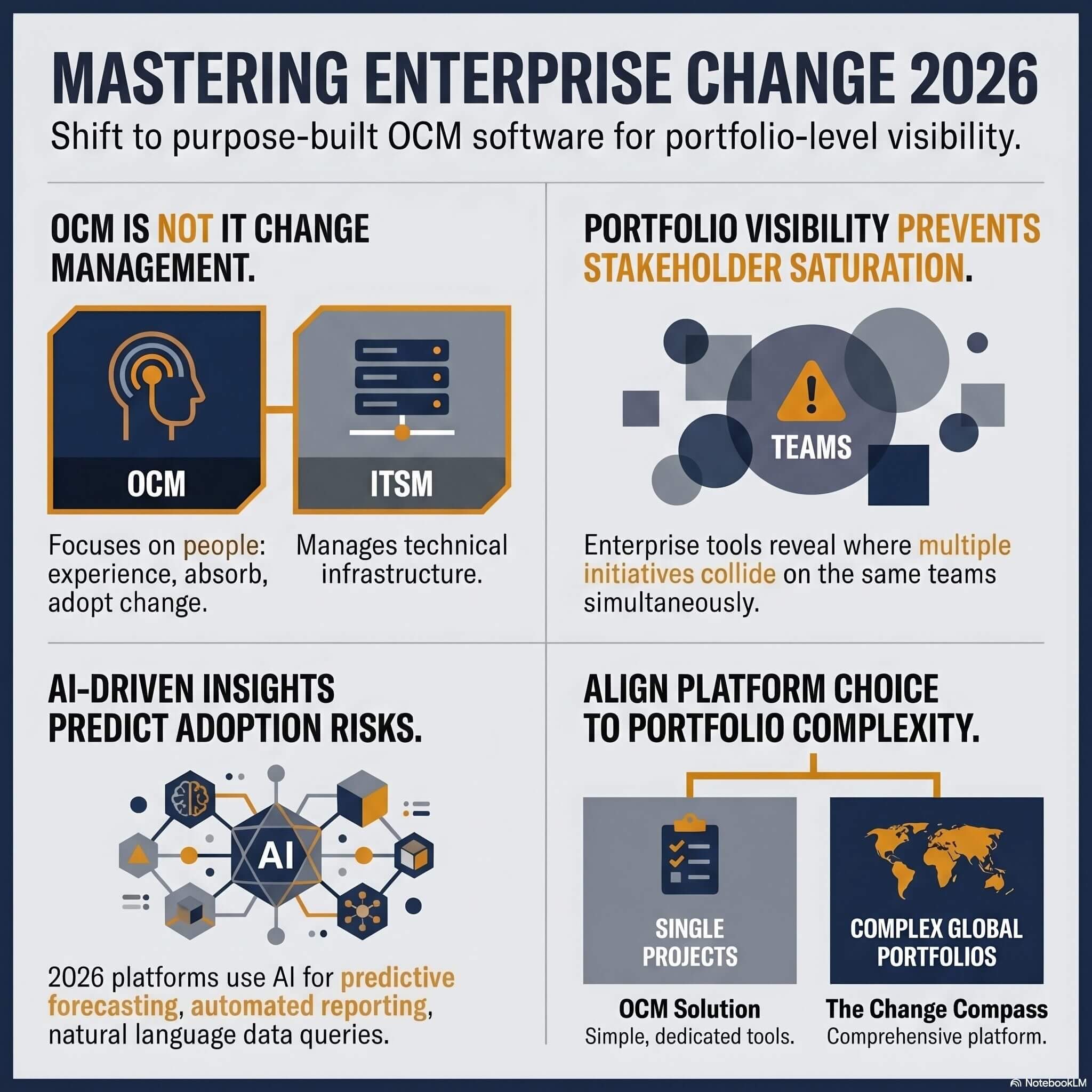
The Change Compass is a purpose-built platform for change portfolio management that addresses this scaling challenge. It provides a centralised register for capturing initiative data across all concurrent programmes, with a data model specifically designed for change management rather than project management. Initiative data is structured around the employee groups affected, the nature and intensity of the change, and the timeline of key impact events – exactly the dimensions needed to build a meaningful portfolio view.
The platform generates visual heatmaps that display cumulative change load by employee group across a configurable time horizon, making it straightforward to identify periods and groups where load is likely to exceed capacity. These views can be filtered by business unit, change type, initiative status, or any combination of dimensions, enabling portfolio managers and executive sponsors to interrogate the data in the way most relevant to their decision-making context. The Change Compass also supports scenario modelling, allowing teams to test the portfolio impact of proposed timeline adjustments before committing to a sequencing decision – a capability that significantly improves the quality and speed of portfolio governance discussions. For organisations managing portfolios of ten or more concurrent initiatives, the platform makes portfolio management genuinely sustainable rather than a periodic exercise that competes with other demands for a central change team’s time.
Frequently asked questions
What is the difference between a change portfolio and a change programme? A change programme is a structured group of related projects or workstreams managed together to deliver a defined set of outcomes. A change portfolio is the totality of all change programmes and initiatives active within an organisation at any given time. Portfolio management looks across all programmes to assess their collective impact on the organisation’s people and their capacity to absorb change, whereas programme management focuses on delivering the outcomes of one specific programme.
How do you assess change capacity for an employee group? Change capacity for an employee group is best assessed by considering several factors together: the group’s current workload and performance baseline, the volume and recency of change they have already experienced (and any residual fatigue), the availability of leadership support and change management resources to assist their adoption, and any known operational constraints such as peak business periods or roster limitations. Formal change impact and readiness assessments, combined with portfolio heatmap data, provide the evidence base for these capacity judgements.
Who should own the change portfolio management function? Change portfolio management typically sits within a central change management or transformation office, with a senior leader – often the Chief People Officer, Chief Operating Officer, or a dedicated Head of Transformation – holding accountability for portfolio-level decisions. The function needs strong working relationships with both the programme delivery community and the executive leadership team. It works best when it is positioned as a strategic enabler rather than a compliance or reporting function, which requires both the data capability to generate meaningful portfolio insights and the organisational authority to act on them.
How often should the change portfolio be reviewed? The frequency of portfolio reviews depends on the pace of change activity in the organisation. For organisations with large, fast-moving portfolios, a monthly portfolio review cycle is typical, supplemented by exception-based escalation when a significant timeline or scope change in one programme materially affects the portfolio picture. For organisations with more stable programme environments, a quarterly review cycle may be sufficient. What matters most is that the cadence is regular enough to catch emerging capacity risks before they become adoption failures, and that the data underpinning the review is current enough to be reliable.
References
Prosci (2023). Best Practices in Change Management – 12th Edition. Prosci Inc. Available at: https://www.prosci.com/resources/articles/change-management-best-practices
McKinsey & Company (2023). Losing from day one: Why even successful transformations fall short. McKinsey & Company. Available at: https://www.mckinsey.com/capabilities/transformation/our-insights/losing-from-day-one-why-even-successful-transformations-fall-short
Gartner (2022). How to Build a Change-Ready Organisation. Gartner Research. Available at: https://www.gartner.com/en/human-resources/insights/organizational-change-management
Kotter, J.P. (2012). Accelerate: Building Strategic Agility for a Faster-Moving World. Harvard Business Review Press. Available at: https://hbr.org/2012/11/accelerate