

Most organisations running more than three simultaneous change initiatives are not managing change, they are managing collisions. A new enterprise resource planning system lands at the same time as a workforce restructure and a cultural transformation programme. Each stream has its own change manager, its own communications plan, and its own timeline, and none of them knows what the others are asking of the same group of frontline employees. The result is not failed change, exactly. It is change that technically “lands” by project metrics while producing confusion, fatigue, and quiet resistance in the people it was meant to shift.
This problem is more common than most organisations admit. Prosci’s research on change saturation consistently identifies the volume and pace of simultaneous change as one of the top obstacles to successful adoption, yet the dominant response remains treating each initiative as its own contained project. Change practitioners are asked to be excellent within their lane while the organisation fails to manage the road. Individual programme excellence is necessary, but not sufficient. What is missing is a portfolio-level discipline for landing multiple changes simultaneously.
This article draws on frameworks developed for the ACMP (Association of Change Management Professionals) conference and unpacks what it actually takes to land multiple change initiatives well. The answer is not simply more resources or better project management. It requires a systems thinking approach, a clear-eyed view of cumulative employee load, deliberate sequencing decisions, and governance structures that can make cross-programme calls in real time.
Download the ACMP conference slides on landing multiple changes for the full presentation framework.
Why landing multiple changes requires a different approach
The traditional change management model is built around a single initiative. You assess the impact, identify the stakeholders, design the engagement plan, and manage resistance along the journey from current state to future state. That model is coherent and well-supported by decades of research and practice. It is also structurally blind to what happens when five versions of it are running simultaneously across the same organisation.
The problem is not that individual change managers are doing their work poorly. It is that the unit of analysis is wrong. When multiple programmes compete for the same leadership attention, the same communication channels, and the same employee bandwidth, the interactions between those programmes become more consequential than the design of any single one. A well-crafted communications plan for Programme A becomes noise when Programme B sends three emails to the same audience on the same day. A training schedule for Programme C creates conflict when Programme D pulls team leaders into workshops during the same fortnight.
McKinsey research on organisational change has repeatedly found that one of the most significant barriers to successful transformation is the failure to coordinate across parallel workstreams. Organisations that treat each initiative as an isolated effort consistently underestimate the cumulative demands placed on the same pools of people. The fix is not project management discipline within each stream. It is a deliberate shift in perspective to the portfolio level, where the interactions between initiatives can be seen and managed.
A systems thinking lens for change portfolio management
Systems thinking offers a more honest way to look at a change portfolio. Rather than treating each initiative as a bounded input-output process, systems thinking asks: what are the interdependencies, feedback loops, and unintended consequences that emerge from the whole? Applied to change management, it means asking not just “will this programme land?” but “what does the system look like when all programmes are running simultaneously, and where are the points of overload or conflict?”
The practical starting point is mapping the portfolio as a system rather than a list. This means identifying which employee groups are touched by each initiative, at what intensity, and over what time period. It means tracing which senior leaders are sponsors of multiple programmes and therefore have divided attention. It means understanding which communication channels are shared across initiatives, and how often those channels are already saturated. This kind of mapping is not an abstract exercise. It surfaces the concrete conflicts that will derail adoption before they happen, rather than after.
A systems lens also changes how you think about success. In a single-programme model, success means the programme achieves its stated outcomes. In a portfolio model, success means the organisation moves forward across all initiatives without destroying the human capacity it needs to sustain them. Gartner’s research on organisational change fatigue found that employees who experience high volumes of change are significantly more likely to report intention to leave, reduced discretionary effort, and lower wellbeing, all of which undermine the very outcomes the change programmes are trying to achieve. Managing the system means managing those risks, not just the project plans.
Understanding cumulative change load on employee groups
The concept of cumulative change load is central to landing multiple initiatives well. Change load refers to the total volume, complexity, and pace of change being asked of a particular employee group at a given point in time. It is not the same as the number of initiatives running in the organisation. It is specific to the experience of a defined group of people, and it varies enormously depending on which programmes touch that group and how intensively.
Frontline team leaders are almost always the most overloaded group in a change portfolio, and they are also the most critical to adoption success. They are typically the key conduit through which every initiative reaches employees on the ground. They attend programme briefings, model new behaviours, coach their teams through transitions, and handle the questions and resistance that employees bring to them. When three programmes ask this of them simultaneously, the cumulative load does not add up linearly. It compounds. Attention splits. Credibility with their teams is at risk if they cannot answer questions about changes they have only partially understood themselves.
Mapping change load by employee group requires moving beyond the programme-level view to an employee-centric view. For each group, you need to understand the total number of active changes affecting them, the degree to which those changes require active behavioural shift versus passive awareness, the timing of key milestones across all programmes, and the existing workload context. This is not a one-time assessment. Change load is dynamic. It shifts as programmes progress, as timelines slip, and as new initiatives are added to the portfolio. Practitioners who treat it as a snapshot rather than a live measure will always be working with outdated information.
Sequencing and timing: the critical decisions
Once you have a clear view of cumulative change load across employee groups, sequencing becomes a strategic tool rather than a scheduling exercise. The question is not just “when can we start?” but “when is this group ready to absorb this change, given everything else they are navigating?” These are different questions, and they lead to different decisions.
Sequencing decisions at the portfolio level typically involve trade-offs that no single programme team is positioned to make. Delaying the go-live of one initiative by six weeks might significantly reduce the load on a critical employee group during a peak period for another programme. But that decision has cost and timeline implications that affect the business case for the delayed programme. Making that call requires a view across the portfolio and authority to act on it. In most organisations, that view and that authority sit in different places, which is why sequencing decisions rarely get made proactively. They get made retrospectively, when something breaks.
Timing also matters at the level of change saturation within the annual cycle. Most organisations have predictable patterns of peak operational demand, whether driven by financial year cycles, product launches, regulatory reporting periods, or seasonal factors. Layering major change activity on top of those peaks is a common and avoidable mistake. A portfolio-level view that maps change milestones against operational calendars gives leaders the information they need to avoid the most predictable collisions. Harvard Business Review has noted that organisations which deliberately pace change, rather than accelerating every initiative simultaneously, achieve significantly better adoption outcomes even if individual programmes take longer to complete.
Building cross-programme stakeholder coordination
Stakeholder management in a portfolio context is categorically different from stakeholder management within a single programme. The same senior leaders appear as sponsors, champions, or key influencers across multiple initiatives. The same middle managers are being asked to role-model change, communicate updates, and embed new processes across several programmes at once. And the same employees are receiving messages from multiple directions about what they need to do differently and why.
Effective cross-programme stakeholder coordination requires a deliberate effort to understand the total demands being placed on shared stakeholders. This means change teams across programmes regularly sharing their stakeholder engagement plans, identifying where they are drawing on the same people, and making collective decisions about how to sequence and rationalise those demands. It sounds straightforward, but in practice it requires a level of transparency and collaboration between programme teams that organisational siloes make difficult.
One practical mechanism is a shared stakeholder engagement calendar that all programme change managers can view and contribute to. This does not eliminate competition for attention, but it makes the competition visible. When a senior leader’s assistant can see that five programmes have each independently scheduled a 90-minute engagement session with their principal in the same month, they can flag the problem. Without that visibility, each session gets booked as if it were the only one. The calendar is a simple tool, but its value is in the shared picture it creates, not the scheduling function it performs.
Cross-programme communication coordination is equally important. Employees receiving multiple streams of change communication need a coherent narrative, not a collection of disconnected announcements. Where possible, programme teams should agree on a shared change story that contextualises each initiative within the broader direction the organisation is moving. This does not mean homogenising all messaging. It means ensuring that when employees ask “why are we doing all of this at once?”, there is a credible answer that connects the dots rather than leaving them to construct their own, often pessimistic, interpretation.
Governance structures that enable portfolio decisions
All of the practices described above, whether mapping change load, making sequencing decisions, or coordinating stakeholder engagement, require a governance structure that can see across the portfolio and act on what it sees. Most organisations do not have this. They have programme steering committees, each of which has a mandate to deliver its own initiative as efficiently as possible. Those committees have no structural incentive to delay or modify their programme for the benefit of another. And so, even when individual programme leaders recognise that the portfolio is overloaded, the governance architecture makes it nearly impossible to do anything about it.
A portfolio change governance function, whether a formal Change Advisory Board or a lighter-touch change portfolio forum, provides the cross-programme view and the decision-making authority to manage the portfolio as a whole. Its mandate is explicitly different from any individual programme’s steering committee. It is not accountable for the delivery of a single initiative. It is accountable for the organisation’s capacity to absorb change across all initiatives, and for protecting the human and leadership resources that every programme depends on.
The critical design question is not what to call this forum, but what authority it has and who sits in it. A portfolio change governance body without authority to delay, re-sequence, or scale back individual programmes is merely a reporting mechanism. It can describe the problem but cannot fix it. Effective portfolio governance requires executives who have accountability across the change portfolio, not just within their own business unit’s initiatives. Prosci’s best practices research consistently finds that active and visible executive sponsorship is the single greatest contributor to change success, and in a portfolio context, that sponsorship must extend to the portfolio level, not just the programme level.
How The Change Compass supports practitioners managing multiple initiatives
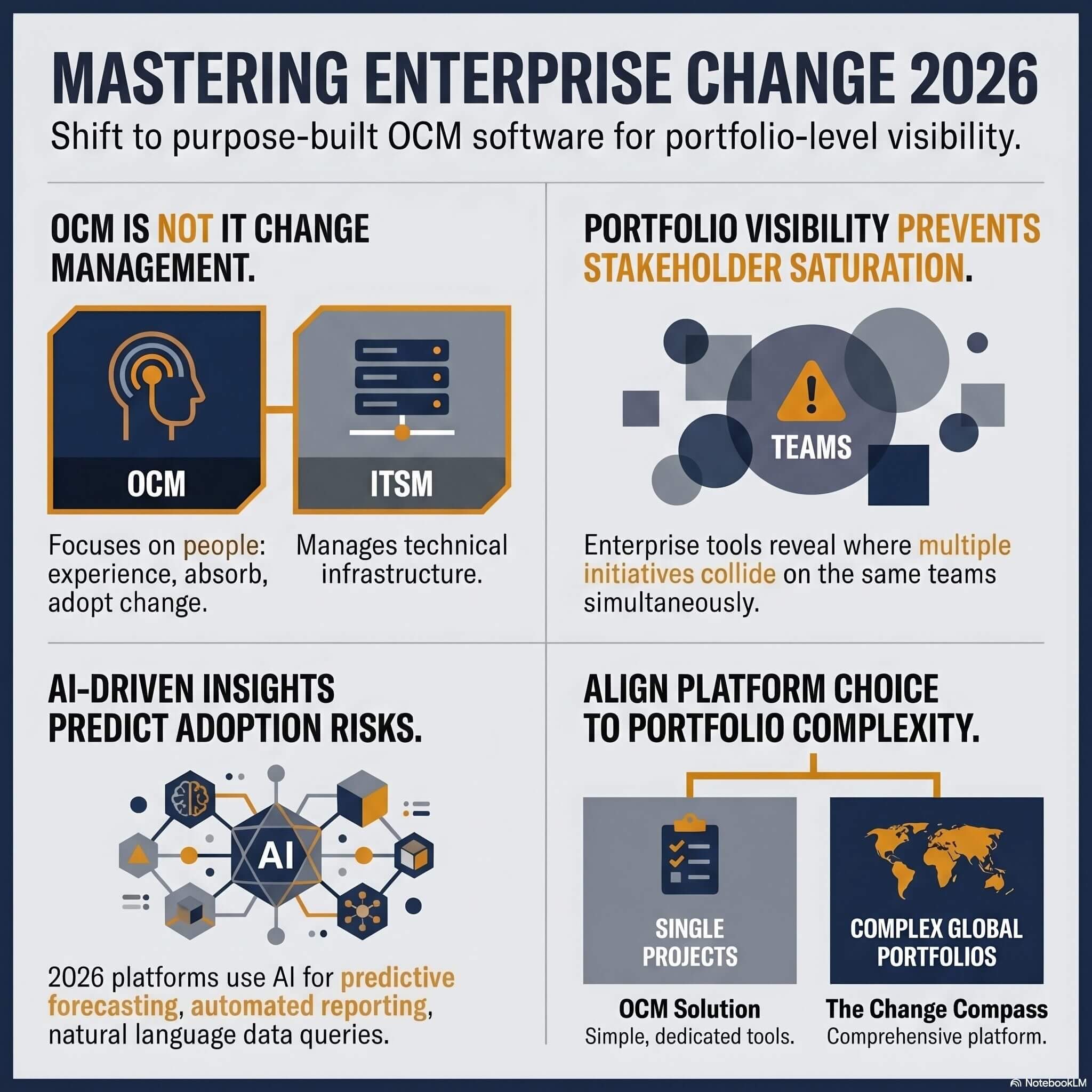
Practitioners who are trying to build a portfolio-level view of change often find that the data they need is scattered across multiple project plans, spreadsheets, and stakeholder maps, each maintained by a different programme team and formatted differently. Aggregating that information manually is time-consuming and almost always out of date by the time it is compiled. The Change Compass is a digital platform built specifically to solve this problem. It enables change practitioners to map the change portfolio across employee groups in real time, visualise cumulative change load, and identify the timing conflicts and saturation risks that individual programme views cannot reveal. Rather than replacing the judgement of experienced practitioners, it gives them the information infrastructure to exercise that judgement at the right level. For organisations managing complex, multi-initiative portfolios, having a shared, live view of the change landscape is not a nice-to-have. It is the operational foundation that makes portfolio-level decisions possible.
Frequently asked questions
What is change portfolio management and how is it different from programme management?
Change portfolio management is the discipline of overseeing and coordinating all active change initiatives across an organisation simultaneously, rather than managing each programme in isolation. Where programme management focuses on delivering a defined scope on time and on budget, change portfolio management focuses on the organisation’s total capacity to absorb change and the interactions between initiatives. It asks questions that no single programme team can answer: which employee groups are most overloaded, which sequencing decisions will reduce collision risk, and which governance structures can make cross-programme calls.
How do you measure cumulative change load on employee groups?
Measuring cumulative change load starts with identifying every active change initiative that affects a defined employee group, then assessing the intensity and timing of that impact. Intensity can be measured across dimensions such as the degree of behavioural change required, the volume of training, the frequency of communication, and the level of disruption to existing workflows. These assessments are then aggregated across all initiatives to produce a load profile for the group over time. The key challenge is maintaining this view dynamically, since change load shifts as programmes progress, timelines change, and new initiatives are added.
What governance structure works best for managing a change portfolio?
The most effective governance structure is one that has a cross-portfolio mandate and real decision-making authority, rather than a purely advisory or reporting function. This typically takes the form of a Change Advisory Board or Change Portfolio Forum that meets regularly, includes executives who own accountability across multiple programmes, and has the authority to re-sequence, delay, or modify initiatives based on portfolio-level capacity considerations. The critical factor is that membership and authority must cross business unit boundaries, since portfolio conflicts almost always involve competing priorities from different parts of the organisation.
How should change practitioners prioritise when multiple initiatives compete for the same resources?
Prioritisation in a change portfolio context should be based on a combination of strategic importance, time sensitivity, employee group impact, and dependency sequencing. Where two initiatives compete for the same leadership attention or employee bandwidth, the portfolio governance body should assess which programme’s momentum is more critical to protect at that point in time, and which can absorb delay or reduced intensity without jeopardising its outcomes. Practitioners can support this decision by providing clear data on the impact of delay for each initiative, as well as the cost to employee wellbeing and adoption quality of proceeding with both simultaneously.
References
Prosci. Change Saturation: How to Manage Too Much Change. Prosci Research.
McKinsey & Company. Change management that works. McKinsey & Company.
Gartner. Organisational Change Management Insights. Gartner Human Resources Research.
Harvard Business Review. The Case for Slowing Down When Your Organization Is Overwhelmed. Harvard Business Review, January 2020.
Prosci. Best Practices in Change Management. Prosci Research.