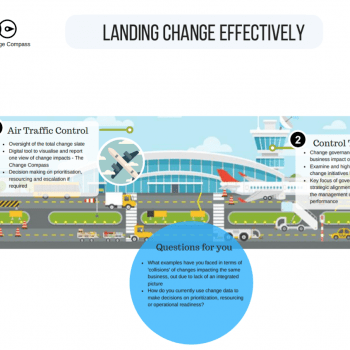


Picture a busy international airport on a Friday afternoon. Dozens of aircraft are airborne simultaneously, each on a different flight path, each carrying its own cargo, crew, and schedule. Without the air traffic control tower, those aircraft would have no shared awareness of one another. Pilots would make independent decisions based on incomplete information, and the risk of collision, delay, and catastrophic failure would be overwhelming. The control tower does not fly any of the planes. Instead, it holds the picture of the whole sky, coordinates safe separation, sequences landings, and ensures that each aircraft reaches the runway in the right order and at the right time.
Organisations undergoing significant transformation face a remarkably similar challenge. At any given moment, a large enterprise may be running dozens of concurrent change initiatives, from technology implementations and process redesigns to cultural transformation programmes and regulatory compliance projects. Each of those initiatives has its own sponsor, its own timeline, and its own demands on the same finite pool of people, attention, and goodwill. Without a centralised change governance function that holds the picture of the whole portfolio, those initiatives collide in the day-to-day experience of employees, creating the change fatigue, adoption failure, and disengagement that derail even the best-designed programmes.
The control tower metaphor offers change leaders something more than a vivid image. It provides a practical framework for thinking about what a mature change portfolio governance capability actually does, who must sit inside it, and what instruments it needs to do its job. This article unpacks that framework in full, drawing on research from across the change management discipline, and explains how The Change Compass provides the instrument panel that makes a change control tower operationally effective.
Download the Control Tower Change Management infographic for a visual overview of the control tower approach to change portfolio management.
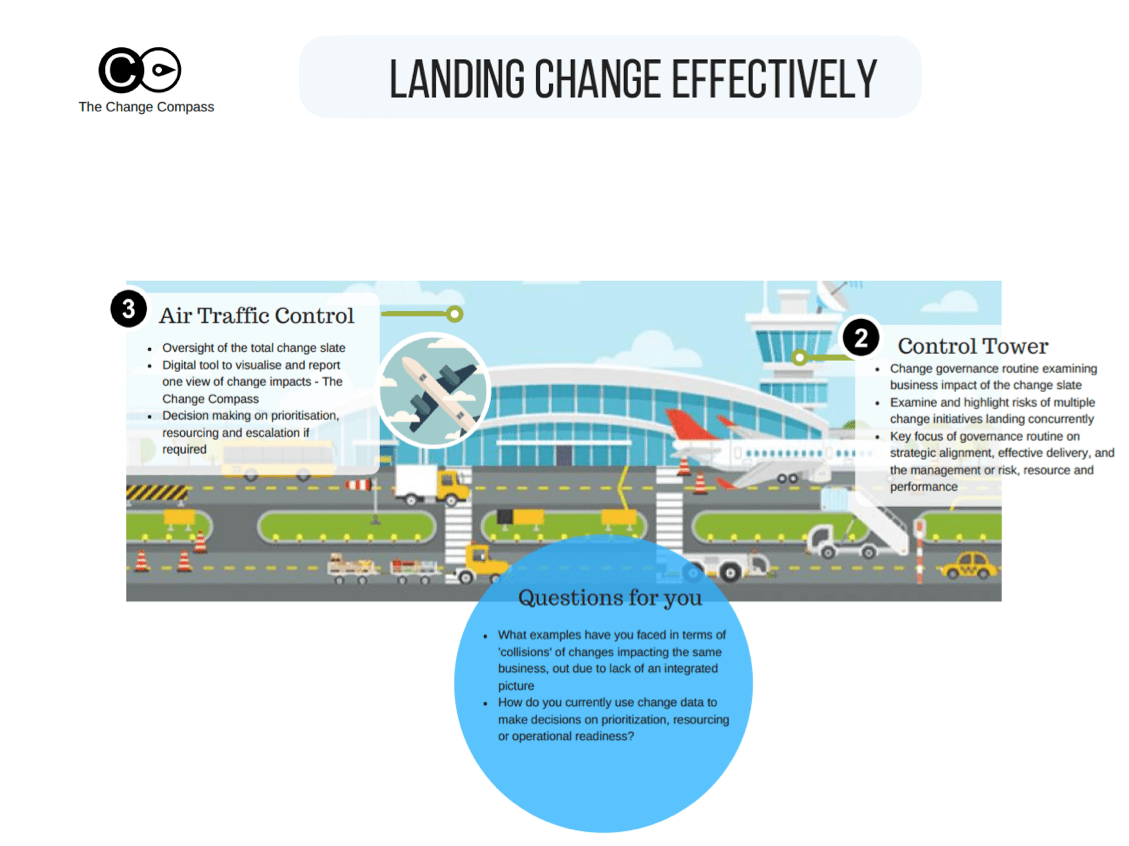
What the control tower metaphor reveals about change management
The air traffic control metaphor is useful precisely because it reframes the problem of change portfolio management in operational rather than strategic terms. Strategic conversations about change portfolios tend to stay at the level of investment decisions, programme charters, and governance structures. Those conversations are necessary, but they do not address the lived reality of change saturation, where the same team is simultaneously asked to adopt a new ERP system, shift to a new operating model, comply with revised regulatory requirements, and absorb the implications of a restructure. The control tower metaphor brings the conversation down to the operational level, where the real damage occurs.
In aviation, air traffic control is not an optional enhancement to safe flying. It is a fundamental infrastructure requirement. No responsible aviation authority would permit commercial aircraft to operate in shared airspace without it. The metaphor invites us to apply the same logic to organisational change: coordinated oversight of the change portfolio is not a nice-to-have governance layer, it is a prerequisite for safe operation. Research from Prosci consistently finds that active and visible executive sponsorship and structured change management are among the strongest predictors of change success, and a centralised portfolio view is foundational to both. According to Prosci’s research on change management ROI, projects with excellent change management are six times more likely to meet their objectives than those with poor change management.
The metaphor also clarifies the appropriate scope of central authority. Air traffic control does not decide where aircraft are going or how they are configured. It controls the airspace. A change governance function similarly does not own the content of individual programmes. It owns the sequencing, the separation, and the overall picture of load on the organisation. This is a politically important distinction in most enterprises, where programme sponsors guard their autonomy jealously. The control tower model gives the central function a clearly bounded but genuinely authoritative mandate.
The consequences of change without a control tower
The consequences of operating a complex change portfolio without centralised oversight are well documented. McKinsey research has found that roughly 70 per cent of large-scale transformation programmes fail to achieve their intended outcomes, and a significant proportion of that failure is attributable not to poor programme design but to organisational overload and implementation clashes. When multiple programmes compete for the same people and the same window of implementation activity, the cumulative impact on employees far exceeds what any single programme’s impact assessment would predict. Each programme looks manageable in isolation. Together, they become unmanageable. The McKinsey research on transformation success points directly to the importance of employee energy and capacity as a critical resource that must be actively managed.
Without a control tower, several characteristic failure patterns emerge. Initiatives collide in the calendar, with multiple go-lives scheduled in the same quarter for the same business unit. Communication fatigue sets in as employees receive disconnected messages from different programme teams with no coherent narrative about what is changing and why. Change champions and business leads are pulled in multiple directions, diluting their effectiveness on every programme. Adoption rates fall across the board, not because any single programme is badly managed, but because the cumulative cognitive and emotional load on employees is simply too great. Gartner research on employee change fatigue found that as of recent years, the average employee has experienced ten or more planned organisational changes in the preceding three years, and that the willingness to support change has declined sharply as a result. The full analysis is available in Gartner’s organisational change management research.
These patterns are not random. They are the predictable result of operating a complex system without coordination infrastructure. Just as aircraft without air traffic control would converge on the same runway approaches at the same time, change initiatives without portfolio oversight converge on the same people at the same time. The result is not a smooth set of parallel landings, it is a queue of frustrated pilots and a set of very unhappy passengers.
Core functions of the change control tower
A change control tower performs five core functions that map directly onto the responsibilities of an aviation air traffic control operation. The first is situational awareness: the control tower must hold an accurate, real-time picture of every change initiative currently in flight, its phase, its affected population, its implementation timeline, and its resource demands. Without this picture, all other functions are impossible. The second function is separation: just as aircraft must be kept at safe distances from one another, change initiatives must be sequenced so that they do not simultaneously saturate the same teams or the same business units.
The third function is prioritisation and sequencing. When multiple programmes want to land in the same window, the control tower must make authoritative decisions about which goes first, which holds, and which is rerouted. This requires both a clear set of prioritisation criteria and the organisational authority to enforce them. The fourth function is load management. The control tower must track the cumulative change load on each part of the organisation, just as an airport manages the overall throughput of its runways. When load approaches a threshold that risks adoption failure, the control tower must intervene. The fifth function is communication: the control tower is the source of the single, integrated narrative about what is changing across the organisation, ensuring that employees receive coherent and sequenced messages rather than a cacophony of competing programme communications.
These five functions require both structural authority and analytical capability. The control tower cannot perform them through goodwill and informal influence alone. It needs mandate, data, and tools. An article in the Harvard Business Review on making change happen notes that successful transformation requires building the organisational muscle for change management as a discipline, not treating it as a project-by-project ad hoc activity. The control tower model is precisely the institutionalisation of that muscle at the portfolio level.
Air traffic separation: sequencing change initiatives safely
Air traffic separation is the most operationally specific of the control tower’s responsibilities, and it has a direct and precise analogue in change portfolio management. In aviation, separation standards define the minimum safe distance between aircraft, measured in time, altitude, and lateral position. These standards are not arbitrary. They are calculated based on the performance characteristics of the aircraft involved, the turbulence wake that large aircraft generate, and the capacity of the runway system to absorb sequential arrivals. The separation standard for a heavy jet following another heavy jet is substantially greater than for a light aircraft, because the wake turbulence risk is commensurately greater.
In change management, separation standards should be calculated based on the profile of each initiative and the characteristics of the affected populations. A large-scale ERP implementation that touches every operational process in a business unit generates a change wake, in the form of process uncertainty, skill gaps, and employee anxiety, that substantially affects the organisation’s capacity to absorb the next wave of change. Scheduling a major operating model redesign into the same business unit within months of the ERP go-live is the change management equivalent of landing a heavy jet in the wake of another: the turbulence risk is very high. The change control tower must establish sequencing rules that account for this wake effect, building in recovery time between major implementations for each affected population.
The practical implication is that separation decisions require quantitative data about change load and recovery capacity, not just qualitative judgements from programme teams. Programme teams have an inherent optimism bias about their timelines and their ability to land change successfully. The control tower must apply a portfolio-level lens that corrects for this bias, using data on historical adoption rates, engagement levels, and change saturation indicators to set realistic separation standards for each part of the organisation.
Real-time visibility as the foundation of control tower capability
An air traffic control tower that cannot see its aircraft is not a control tower. It is a building. Visibility is not one feature of the system, it is the foundational prerequisite for every other function. In a modern radar-equipped tower, controllers have a real-time picture of every aircraft in their airspace: its position, altitude, speed, call sign, and intended flight path. This picture is continuously updated as conditions change. Decisions are made based on current data, not on the flight plans filed three days ago.
The equivalent requirement for a change control tower is a live, integrated view of the entire change portfolio, updated as programmes progress and conditions evolve. This is where most organisations fall short. Change portfolio data is typically fragmented across programme management tools, risk registers, HR systems, and the personal spreadsheets of individual change practitioners. The picture that governance bodies receive is assembled manually, with significant time lag, and reflects the state of programmes as reported by programme teams rather than as observed independently. By the time the data reaches the governance forum, it may be weeks out of date and filtered through layers of optimism bias.
Real-time visibility requires a dedicated platform that aggregates change portfolio data, calculates cumulative impact by business unit and team, and presents the result in a format that enables fast, informed decision-making. It requires that change data be entered and maintained by programme teams in a consistent format, so that the portfolio view reflects comparable data across initiatives rather than apples and oranges. And it requires that the platform surface not just what is planned but what is actually happening, drawing on pulse survey data, adoption metrics, and engagement indicators to give the control tower a live read on how the organisation is actually experiencing the change load.
Who sits in the control tower? Governance roles and authority
In aviation, air traffic controllers are trained specialists with clearly defined authority. They do not advise pilots, they instruct them. The captain of the aircraft retains authority over the safety of the aircraft once airborne, but within the airspace, the controller’s sequencing and separation instructions are binding. This clear delineation of authority is what makes the system work. A control tower that can only recommend and cannot compel is a fundamentally different, and far less effective, kind of institution.
The governance structure of a change control tower must reflect this lesson. At the senior level, the control tower requires a portfolio change authority with genuine decision-making power over sequencing, prioritisation, and load management. This authority must sit at a level in the organisation that can override individual programme sponsors when portfolio-level considerations require it. In most large enterprises, this means positioning the change portfolio governance function at the executive leadership team level or with a direct reporting line to it, rather than burying it within a project management office that lacks the authority to make binding decisions about programme timelines.
Below the senior governance level, the control tower requires dedicated change portfolio analysts who maintain the visibility picture, identify emerging conflicts and risks, and prepare the analysis that governance decision-makers need. These roles are distinct from programme-level change managers, who are embedded in individual initiatives and naturally focused on their programme’s success. The control tower analysts maintain the portfolio view, which requires a different orientation and a different set of analytical skills. They are the equivalent of the radar operators who track the full picture of the airspace, rather than the pilots who are focused on flying their own aircraft.
How The Change Compass serves as the change control tower
The Change Compass is purpose-built to serve as the instrument panel of the change control tower. Just as a radar system gives air traffic controllers the real-time positional data they need to maintain separation and sequence landings, The Change Compass gives change governance functions the portfolio-level data they need to manage change load, identify conflicts, and make informed sequencing decisions.
The platform aggregates change data from across the portfolio into a single, visual representation of the change landscape. Programme teams input their initiative data, including affected populations, implementation phases, change activity volumes, and go-live dates, and The Change Compass automatically calculates the cumulative change load on each business unit and team across the portfolio. This gives the control tower an integrated view that no individual programme team can provide, because no programme team has visibility of the full portfolio. Where load exceeds safe thresholds for a particular population, the platform flags the risk, giving the governance function the early warning it needs to intervene before the collision occurs rather than after.
Beyond the aggregated load view, The Change Compass supports the sequencing function of the control tower by enabling scenario planning. Governance decision-makers can model the impact of moving a go-live date, splitting a rollout into phases, or deprioritising an initiative, and see immediately how each decision changes the change load profile across the organisation. This transforms sequencing decisions from instinctive judgements into evidence-based choices, grounded in data about where the organisation has capacity and where it is already saturated. For organisations managing complex, multi-year transformation portfolios, this analytical capability is the difference between a control tower that can genuinely manage the airspace and one that can merely observe it.
Frequently asked questions
What is a change control tower in an organisational context?
A change control tower is a centralised governance function that holds an integrated, real-time view of all concurrent change initiatives across the organisation. Drawing on the air traffic control metaphor, it coordinates the sequencing and separation of change initiatives to prevent overload on any single part of the organisation, manages cumulative change capacity, and maintains the single authoritative picture of the change portfolio. It does not manage individual programmes, but it does have the authority to make binding decisions about sequencing, prioritisation, and load management at the portfolio level.
How does the air traffic control metaphor apply to change portfolio management?
The metaphor maps closely onto the realities of change portfolio management. Aircraft in shared airspace correspond to change initiatives operating across the same organisation. The control tower corresponds to the central change governance function. Air traffic separation standards correspond to sequencing rules that prevent change initiatives from saturating the same populations simultaneously. The radar system corresponds to a portfolio data platform that gives the governance function real-time visibility. And the landing sequence corresponds to the prioritised, phased implementation plan that the governance function manages across the full portfolio.
What authority does a change control tower need to be effective?
A change control tower requires genuine decision-making authority, not merely advisory influence. It must be positioned at or near the executive leadership level to be capable of overriding individual programme sponsors when portfolio-level considerations require a change to sequencing or timing. Without this authority, the control tower can identify conflicts and risks but cannot resolve them, which limits its effectiveness to reporting rather than governing. The analogy with aviation is instructive: an advisory body that can only recommend separation adjustments to pilots, rather than instruct them, would not constitute safe air traffic management.
How does The Change Compass support change control tower governance?
The Change Compass functions as the instrument panel of the change control tower, providing the real-time portfolio data that governance decision-makers need. It aggregates change initiative data from across the portfolio, calculates cumulative change load by business unit and team, flags overload risks before they materialise, and supports scenario planning so that sequencing decisions can be tested against data before they are made. It replaces the fragmented, manually assembled spreadsheets that most governance functions rely on with an integrated, continuously updated view of the full change landscape, enabling the control tower to operate with the kind of situational awareness that makes safe, effective portfolio management possible.
References
Prosci. (2023). Change Management ROI: The Business Case for Change Management. Retrieved from https://www.prosci.com/blog/roi-change-management
McKinsey and Company. (2023). The People Power of Transformations. Retrieved from https://www.mckinsey.com/capabilities/people-and-organizational-performance/our-insights/the-people-power-of-transformations
Gartner. (2023). Organisational Change Management Research and Insights. Retrieved from https://www.gartner.com/en/human-resources/insights/organizational-change-management
Harvard Business Review. (2020). How to Actually Make Change Happen. Retrieved from https://hbr.org/2023/04/the-most-successful-approaches-to-leading-organizational-change