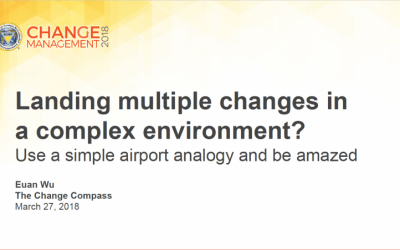


At the ACMP (Association of Change Management Professionals) Global Conference in Las Vegas, a recurring theme surfaced across sessions and hallway conversations alike: most organisations are no longer managing one or two significant changes at a time. They are managing dozens, sometimes scores, of concurrent initiatives, each with its own timeline, sponsor, and change team, and very few have a coherent way to think about that complexity at a portfolio level. The conference brought together some of the sharpest practitioners in the field, and what became clear was that the profession’s frameworks, mostly designed for individual change programmes, are straining under the weight of modern organisational reality.
A presentation at the conference tackled this directly using an analogy that landed with unusual force in the room: the airport. Picture a busy international airport on a peak travel day. Dozens of aircraft are inbound at any given moment, each on its own flight path, each carrying its own crew and passengers, each with its own landing requirements. The air traffic control tower does not manage one plane at a time in isolation. It holds a real-time picture of the entire airspace, sequences arrivals to avoid collision, manages runway capacity, and reroutes aircraft when conditions change. That picture, the presentation argued, is precisely what most change functions are missing. They are flying individual planes without a control tower.
The analogy is deceptively simple, and that is exactly what makes it powerful. It gives executives and change leaders a shared mental model for a problem that is genuinely difficult to describe in the abstract. This article unpacks the key insights from that ACMP Conference presentation, explores why the aviation framework resonates so strongly with practitioners, and sets out the practical implications for organisations that are serious about building portfolio-level change capability.
Download the ACMP presentation slides for the full conference framework on landing multiple changes.
The aviation analogy and why it works for change management
Change management has no shortage of analogies. Burning platforms, navigating white water, unfreezing and refreezing: the field has long relied on metaphor to make abstract concepts tangible. But most of those metaphors describe the experience of a single change initiative. The aviation analogy is different because it captures the system-level problem: what happens when many changes are competing for the same runway at the same time.
In the airport model, each aircraft represents a change initiative. The runway represents the finite change absorption capacity of the organisation, specifically the bandwidth that employees, managers, and business units have to take on new ways of working. The air traffic control tower represents the change portfolio function: the team or mechanism that holds a view across all inbound changes, sequences them intelligently, and makes active decisions about which initiatives land when, which go into a holding pattern, and which need to be redirected entirely.
What makes this analogy particularly useful in conversations with senior executives is that it makes the capacity constraint visceral. Every experienced traveller knows what happens when too many aircraft try to land at once: delays, near-misses, diversions to other airports, and occasionally, catastrophic failure. When a chief executive or a chief operating officer hears that framing applied to their change portfolio, the message lands with a clarity that a spreadsheet of initiative timelines rarely achieves. The analogy also introduces the concept of sequencing as a professional discipline, not a scheduling afterthought. Air traffic controllers are highly trained, deeply respected professionals. The suggestion that change portfolio management deserves the same rigour is exactly the reframing many change functions need when making the case for investment.
Key insights on change portfolio complexity from ACMP
One of the central observations from the conference presentation was that the complexity of a change portfolio is not simply additive. Ten simultaneous initiatives are not just ten times harder to manage than one. They are exponentially harder, because each new initiative interacts with every other one. A technology rollout in one division affects the change capacity of managers who are simultaneously being asked to support a restructure, a new performance framework, and a shift to agile ways of working. The interactions between initiatives create compounding demands on the same people, and those demands are invisible unless someone is actively mapping them.
Research supports this observation. A Prosci benchmarking study found that one of the most frequently cited barriers to successful change is inadequate organisational capacity, with change saturation among employees and managers identified as a primary cause of initiative failure. When multiple changes land simultaneously on the same employee population without coordination, the result is not just fatigue, it is active disengagement. Employees who are asked to absorb too much too quickly tend to comply superficially with the most visible demands while quietly abandoning the rest.
The conference presentation also highlighted the role of interdependencies between initiatives as a source of underestimated risk. When Initiative A depends on the completion of Initiative B, and Initiative B is running three months late, the downstream effects ripple through the portfolio in ways that no individual project team can see or manage. Portfolio-level visibility is the only defence against this kind of systemic risk. Without it, organisations are essentially flying blind in a crowded airspace.
From individual change programmes to coordinated portfolio management
The shift from managing individual change programmes to managing a portfolio of concurrent changes is not merely a scaling exercise. It requires a different mindset, different tools, and a different organisational structure. At the individual programme level, the change manager’s primary orientation is toward a specific group of stakeholders affected by a specific initiative. At the portfolio level, the orientation must shift to the organisation as a whole, with the change function acting as a steward of overall change capacity rather than an advocate for any single initiative.
This shift mirrors a well-documented evolution in project management. The discipline of project portfolio management emerged precisely because organisations recognised that managing projects in silos produced suboptimal results at the organisational level, even when individual projects were executed well. According to Gartner research on portfolio management, organisations with mature portfolio management capabilities consistently deliver better strategic alignment and resource utilisation than those managing initiatives independently. Change management is now at the same inflection point that project management reached a decade ago.
The practical implication is that the change function needs to develop two distinct competencies in parallel: the ability to deliver high-quality support to individual initiatives, and the ability to manage the portfolio as a system. Neither competency substitutes for the other. An organisation that is excellent at individual change management but lacks portfolio coordination will still suffer from change saturation and sequencing failures. An organisation that has a sophisticated portfolio view but weak initiative-level change capability will plan well and execute poorly. Both are required.
The role of change data in multi-initiative environments
One of the most striking themes to emerge from the ACMP Conference was the degree to which effective portfolio change management depends on data. Not opinion, not intuition, and not the loudest programme sponsor’s view of how their initiative is tracking. Actual data: about the volume of change hitting specific employee populations, about the pace at which those populations are absorbing change, about which parts of the organisation are approaching saturation and which have capacity to absorb more.
The aviation analogy maps directly onto this data requirement. Air traffic controllers operate with real-time data feeds covering aircraft position, speed, altitude, weather conditions, and runway status. They do not guess. They do not rely on reports that are three weeks old. They have a live picture of the airspace and they act on it continuously. For change portfolio management to function with comparable rigour, change functions need access to current, structured data about the state of every initiative in the portfolio and its impact on the people it is touching.
A Harvard Business Review analysis of change analytics found that organisations using data-driven approaches to managing change were significantly more likely to achieve their intended outcomes, particularly in environments where multiple initiatives were running simultaneously. The discipline of building change impact data, tracking adoption metrics across initiatives, and using that data to make sequencing decisions is still nascent in most organisations, but it is the direction the profession is clearly moving. The ACMP Conference made this trajectory unmistakably clear.
Building organisational capability for portfolio change management
Developing portfolio change management capability is a long-term investment, not a quick structural fix. Organisations that do it well tend to build it through a deliberate sequence of steps, rather than attempting to implement a fully mature model overnight. The ACMP presentation outlined several building blocks that are consistently present in organisations with mature portfolio change capability.
The first is governance. Effective portfolio change management requires a forum where decisions about sequencing, resourcing, and initiative prioritisation are made with visibility across the full portfolio. This is typically a change governance committee or equivalent body, with representation from HR, programme management, and senior business leaders. Without this forum, even the best data and frameworks will sit unused, because there is no mechanism to act on them.
The second building block is a shared language. The aviation analogy itself is a tool for building this shared language. When executives, programme managers, and change practitioners all use the same framework to describe portfolio dynamics, conversations about sequencing and capacity become markedly more productive. Shared language reduces the friction of cross-functional portfolio decisions and makes it easier to surface conflicts early, when they are still manageable.
The third building block is standardised change impact assessment. For a portfolio view to be meaningful, there needs to be a consistent way of measuring and describing the change load that each initiative places on each part of the organisation. Without that consistency, aggregating data across initiatives is like trying to add apples and oranges. McKinsey’s research on organisational change effectiveness consistently points to the importance of structured, comparable assessment methods as a foundation for portfolio-level decision making.
Practical frameworks for coordinating concurrent initiatives
The ACMP presentation offered a set of practical framings for change portfolio coordination that practitioners can apply directly in their own organisations. At its core, the portfolio coordination challenge has three distinct dimensions: volume, velocity, and interdependency. Volume refers to the total number of initiatives and the aggregate change load they represent. Velocity refers to the pace at which changes are being introduced, and specifically whether that pace exceeds the organisation’s absorption rate. Interdependency refers to the relationships between initiatives, including shared stakeholder populations, sequential dependencies, and resource conflicts.
Effective portfolio coordination requires active management of all three dimensions simultaneously. On volume, the key discipline is maintaining a complete and current inventory of all active change initiatives, mapped to the employee populations they affect. This sounds straightforward, but in large organisations with multiple business units and dozens of concurrent programmes, maintaining that inventory is a significant undertaking in its own right. Many organisations discover, when they first attempt this exercise, that they have considerably more active initiatives than anyone realised.
On velocity, the key discipline is establishing explicit thresholds for change absorption capacity and using those thresholds to drive sequencing decisions. This is the runway management function from the aviation analogy. Just as a runway has a fixed throughput capacity, the organisation’s change absorption capacity is finite. When planned initiative timelines would breach that capacity, something has to give: either the timeline adjusts, the scope of an initiative reduces, or a deliberate decision is made to accept higher risk in a specific part of the organisation.
On interdependency, the key discipline is mapping the relationships between initiatives before they create conflicts, not after. This requires a portfolio view that extends at least twelve months forward, with enough granularity to identify where two or more initiatives will be making simultaneous demands on the same teams or the same managers. Catching those conflicts in the planning stage, when adjustments are relatively cheap, is far preferable to discovering them during delivery, when the cost of adjustment is typically much higher.
How The Change Compass supports change portfolio coordination
Translating these frameworks from presentation slides into day-to-day practice requires tools that can hold the portfolio view and make it accessible to the people who need to act on it. The Change Compass is a digital platform designed specifically for this purpose. It enables change functions to build a consolidated view of all active and planned initiatives, mapped against the employee populations they affect, so that portfolio-level patterns, capacity constraints, and sequencing conflicts become visible before they become problems. The platform supports the kind of data-driven portfolio coordination that the ACMP Conference highlighted as the next frontier for the change management profession, giving change leaders the equivalent of an air traffic control system for their organisation’s change airspace.
Frequently asked questions
What is change portfolio management?
Change portfolio management is the discipline of overseeing all active and planned change initiatives across an organisation as an integrated portfolio, rather than managing each programme in isolation. It involves assessing the aggregate change load on different parts of the organisation, sequencing initiatives to avoid overloading specific teams or employee groups, and making active governance decisions about the timing and prioritisation of concurrent changes.
Why do organisations struggle with managing multiple concurrent change initiatives?
Most change management frameworks and tools were developed for single-initiative contexts. When multiple changes run simultaneously, they compete for the same finite change absorption capacity within the organisation, and their interactions create compounding complexity that no individual programme team can see or manage. Without a portfolio-level view, organisations tend to discover sequencing conflicts and capacity breaches only after they have already caused problems.
How does the aviation analogy help explain change portfolio management to executives?
The airport and air traffic control analogy gives executives a concrete and intuitive picture of a problem that is otherwise difficult to communicate in the abstract. It makes the capacity constraint visible (the runway), establishes the role of active coordination (the control tower), and frames sequencing as a professional discipline rather than an administrative function. Executives who travel frequently find the analogy immediately resonant and often use it themselves once they have encountered it.
What data does a change portfolio management function need to operate effectively?
At minimum, an effective change portfolio function needs a current inventory of all active and planned initiatives, a consistent assessment of the change load each initiative places on each affected employee group, and forward visibility of at least twelve months to identify where initiative timelines will create capacity conflicts. Over time, organisations also benefit from tracking actual adoption rates across the portfolio, to compare planned versus real absorption and adjust future sequencing decisions accordingly.
References
Prosci. Change management benchmarking research. Prosci Inc.
Gartner. Build a portfolio management office. Gartner Inc.
Harvard Business Review. The analytics organisations need to manage change. HBR, March 2019.
McKinsey & Company. Change management that works. McKinsey & Company.