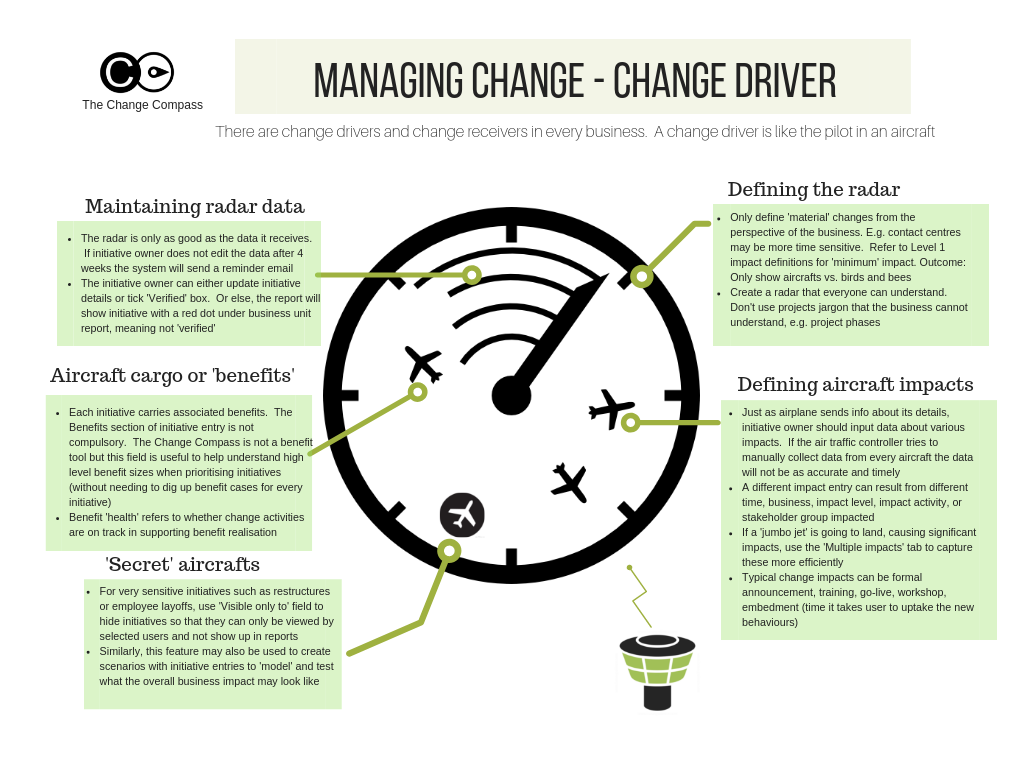


In every organisational change, there are two fundamentally different experiences unfolding simultaneously. Some people are change drivers – those who initiate, design, or lead the change. Others are change receivers – those who are asked to adopt it, adapt to it, and absorb its consequences in their daily work. These two experiences are so different that they might as well belong to different transformations. And yet, in most organisations, the people in the driver seat rarely stop to consider what the passenger seat actually feels like.
The challenge runs deeper than a lack of empathy, though empathy certainly matters. The structural reality of most large organisations is that the distinction between driver and receiver is far less clean than it appears on an organisational chart. A general manager leading a major technology transformation for their division is simultaneously a change driver – setting direction, allocating resources, communicating the vision – and a change receiver, absorbing a new enterprise strategy handed down from the executive team. Middle managers occupy this dual role even more acutely. They are expected to champion changes they had no hand in designing while simultaneously managing their own uncertainty about what those changes mean for their role, their team, and their future.
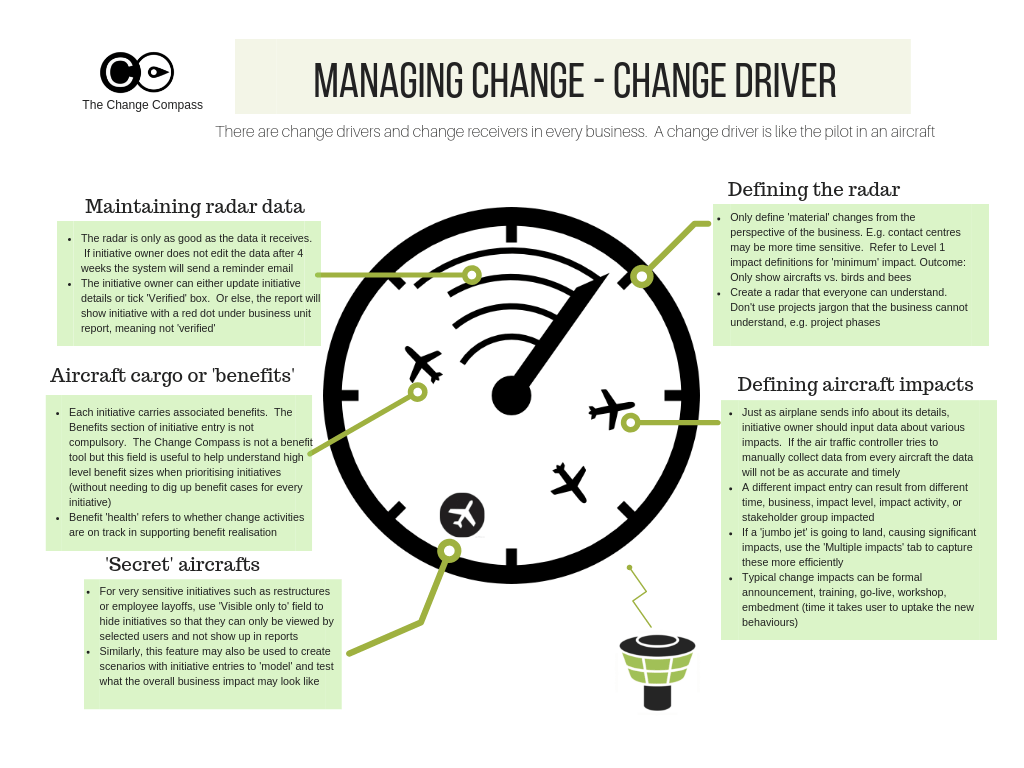
Understanding this driver-receiver dynamic is not merely an academic exercise. It is one of the most practical lenses available for diagnosing why change programmes generate resistance, why implementation falters at the middle management layer, and why even well-designed changes land differently than their architects intended. Download the Managing Change as a Change Driver infographic for a visual summary of the key concepts explored in this article.
What it means to be a change driver
Being a change driver means having some degree of ownership over the design, direction, or delivery of a change. This ownership comes in different forms. Senior leaders who commission a transformation are change drivers at the strategic level – they have defined the why and the what, allocated the resources, and set the success criteria. Programme managers and change practitioners who design the implementation approach are change drivers at the execution level – they translate the strategic intent into a delivery plan, a stakeholder engagement approach, and a benefits realisation framework. Business unit leaders who sponsor a change within their division are change drivers at the operational level – they are accountable for whether the change lands in their part of the organisation.
What these different forms of change driver role have in common is a sense of agency – the feeling, accurate or not, that one has some control over what is happening and why. This sense of agency is psychologically significant. Research on the psychology of control published in Harvard Business Review consistently finds that perceived agency – the belief that one’s actions matter and that outcomes are at least partially within one’s influence – is one of the strongest predictors of how well people tolerate uncertainty and change. Change drivers, by virtue of their role, typically have more of this than change receivers.
This agency advantage creates a blind spot. The change driver’s experience of a transformation – one of purposeful action, problem-solving, and progress – is so different from the change receiver’s experience of the same transformation that it is genuinely difficult for drivers to accurately model what receivers are experiencing. They know the rationale, have rehearsed the answers to likely questions, and understand the endgame. Receivers, particularly in the early stages of a change, have none of these advantages.
The change receiver experience: what drivers consistently underestimate
The experience of being a change receiver is defined primarily by uncertainty and limited agency. Unlike the change driver who has been working on the programme for months and has internalised its logic, the change receiver typically encounters the change through a communication – a town hall, an email, a team meeting – that gives them a fraction of the context the driver has accumulated over weeks or months of planning.
The questions that immediately arise for most change receivers are intensely personal and practical: What does this mean for my role? Will my team still exist? Am I being asked to learn something I am not sure I can learn? Do I have a say in any of this? These questions are not unreasonable. They are the natural cognitive response to being told that the way one has been working – perhaps for years – is being replaced. Yet they are often precisely the questions that change communications fail to answer, because the change driver’s instinct is to communicate at the level of organisational rationale rather than individual impact.
Prosci’s research on employee experience during change consistently finds that the most common reason employees resist change is not disagreement with the change’s strategic rationale but rather uncertainty about what it means for them personally. The receiver’s primary concern is not “is this change good for the organisation?” It is “is this change good for me, and do I have the support I need to navigate it?” Change drivers who communicate only to the first question and neglect the second consistently generate more resistance than those who address both.
The dual-role challenge: when drivers are also receivers
The most complex and under-examined position in any change programme is the one occupied by people who are simultaneously change drivers and change receivers. This is the standard condition for middle managers and business unit leaders in large organisations. They are asked to lead their teams through a change they did not design, often in a context where they themselves are uncertain about the direction and may have significant reservations about the approach. They are expected to be visible champions of a change while processing their own reactions to it – often without adequate support or acknowledgment that their situation is genuinely more difficult than either pure driver or pure receiver.
The consequences of this dual-role tension play out in predictable ways. Leaders in this position often communicate the change with less conviction than the programme requires, because they are transmitting a message they have not fully internalised. They are more likely to signal their own ambivalence – through body language, through qualifications in how they present the change, through the questions they choose not to answer – than leaders who genuinely believe in what they are championing. Employees are highly attuned to this authenticity gap, and an ambivalent manager is frequently more damaging to change adoption than no communication at all.
McKinsey research on the drivers of transformation success identifies leader commitment as one of the most powerful predictors of change outcomes. But commitment cannot simply be mandated. Leaders who are themselves experiencing significant uncertainty about a change – who have not been adequately informed, engaged, or supported in processing their own receiver experience – cannot credibly project commitment. Addressing the receiver experience of leaders is not a luxury. It is a precondition for effective change sponsorship at the level where change actually lives or dies: the middle of the organisation.
Practical strategies for managing well from the driver seat
For those in the change driver role – whether as senior sponsors, programme leaders, or business unit champions – there are specific practices that consistently improve the receiver experience and increase the likelihood of sustainable adoption.
The first is deliberate perspective-taking. Before launching any major change communication or engagement activity, effective change drivers systematically ask: what does this look like from the receiver’s perspective? What is the most important question someone in this role or this team will ask when they hear this news, and does our communication answer it? This sounds straightforward, but it requires actively suppressing the driver’s instinct to lead with the strategic rationale and instead leading with the personal impact. The business case matters, but it is not what moves people. What moves them is a clear, honest answer to “what does this mean for me?”
The second practice is creating genuine two-way engagement – not the performative consultation that many change programmes offer, where feedback is solicited but rarely influences the design, but the kind of engagement where receiver input actually shapes decisions. When employees see that the concerns they raised in a listening session have been visibly reflected in how the change has been adjusted, their relationship to the change shifts from passive recipient to active participant. This shift in psychological ownership is one of the most powerful accelerators of adoption available to any change driver.
The third practice is explicit support for leaders in the dual-role. This means giving business unit leaders and middle managers sufficient advance notice and context to process their own receiver experience before they are asked to communicate to their teams. It means creating forums where they can ask the difficult questions, express genuine concerns, and receive honest answers – rather than being handed a communication pack and asked to cascade key messages they may not believe. It means recognising that asking someone to lead others through change while they are still navigating their own is an extraordinary ask, and structuring the programme to provide the support that makes it possible.
How change load shapes the driver-receiver experience
The driver-receiver dynamic does not exist in a vacuum. It is powerfully shaped by the total volume of change that an organisation’s people are absorbing at any given time. In organisations with multiple concurrent change programmes, the same team that is being asked to receive and adopt several simultaneous changes is also likely to have leaders who are driving some of those changes while receiving others. The cognitive and emotional load of managing both roles across multiple changes is substantial – and it compounds in ways that organisations with only programme-level visibility consistently fail to detect.
Gartner’s research on change fatigue found that employees experiencing high levels of concurrent change show dramatically reduced willingness to engage with any individual change, even those they might otherwise have supported. The mechanism is the depletion of adaptive capacity – the cognitive and emotional resources required to absorb, process, and act on change-related demands. When those resources are exhausted by simultaneous changes, even a well-designed change with clear rationale and strong sponsorship will land poorly.
For change drivers, this has a critical practical implication: the effectiveness of any individual change is not solely a function of how well that change is designed and communicated. It is also a function of how much other change the receivers are simultaneously absorbing. A change that would land smoothly if it were the only thing happening to a team may generate significant resistance if it is the fourth major change hitting that team in six months. Managing the driver-receiver dynamic therefore requires portfolio-level visibility into the cumulative change load on specific employee groups – something that no single programme team can produce for itself.
Using data to bridge the driver-receiver gap
One of the most consequential improvements a change driver can make is developing access to objective data about the receiver experience. This goes beyond the anecdotal feedback that naturally reaches programme leaders – which is systematically biased towards either extreme positive or extreme negative responses – and towards structured measurement of where in the organisation receivers are struggling with the change and why.
Platforms like The Change Compass provide change drivers with exactly this kind of portfolio-level visibility. By tracking change impact data across all concurrent programmes, and aggregating it by team or role group, change drivers can see which parts of the organisation are experiencing the highest cumulative change load – and can use that data to make informed decisions about sequencing, pacing, and where to concentrate additional support. Rather than relying on intuition about what the receiver experience looks like, they can navigate the programme with evidence about where the pressure is greatest and where additional intervention is likely to make the most difference.
This data-informed approach does not replace the human skills of empathy, communication, and leadership that the driver-receiver dynamic demands. But it provides the factual foundation that makes those skills more targeted and more effective. A change driver who knows that a specific team is at or near its absorption capacity can make a different engagement decision than one who is guessing. A sponsor who can see adoption indicators disaggregated by business unit can target their visible commitment where it will have the greatest impact on momentum and morale.
Building organisational capability across both roles
The most resilient change capability in an organisation is one where the distinction between driver and receiver is not treated as fixed. People who have had deep experience as change receivers – who have navigated significant uncertainty, absorbed major changes to their role and their way of working, and come through the experience intact – bring insight to the driver role that cannot be acquired any other way. And change drivers who deliberately create conditions that allow receivers to understand, question, and contribute to change design are building the kind of organisational trust that makes future changes land more smoothly.
Prosci’s change management maturity model identifies the highest levels of organisational change maturity as those where change capability is not concentrated in a specialist team but embedded broadly – where managers at all levels understand the receiver experience and actively manage it as part of their leadership responsibility. Reaching this level of maturity requires deliberate investment in building empathy across the driver-receiver boundary: structured listening, honest communication about what is known and unknown, visible responsiveness to receiver feedback, and genuine recognition that the people being asked to change are doing something genuinely difficult.
Organisations that treat their change receivers as passive subjects of transformation – rather than as active participants whose experience and engagement is the primary determinant of whether the transformation succeeds – consistently underperform. Those that invest in closing the driver-receiver gap, through better data, better communication, better leader preparation, and more honest engagement, build something more durable than any individual change programme: an organisational culture where change is managed as a shared endeavour rather than imposed from above.
Frequently asked questions
What is the difference between a change driver and a change receiver?
A change driver is someone who initiates, designs, or leads a change – they have some degree of agency over what is happening and why. A change receiver is someone who is asked to adopt and adapt to a change they did not design. The key insight is that these roles frequently overlap: most leaders and managers are simultaneously driving change downward through their teams while receiving change from above, creating a dual-role challenge that requires specific support and preparation.
Why do change drivers and change receivers experience transformation so differently?
Change drivers typically have accumulated context, understand the rationale, and have a sense of agency over the process. Change receivers encounter the change with less information, experience more uncertainty, and have limited influence over what is happening. This asymmetry of information and control creates fundamentally different psychological experiences of the same change, and it is the primary reason that change drivers frequently underestimate the difficulty of the receiver experience.
How should change drivers manage the dual-role challenge?
Leaders in the dual-role – simultaneously driving and receiving change – need specific support to perform effectively in both dimensions. This includes advance notice and context to process their own receiver experience before they are asked to communicate to their teams, forums to raise genuine questions and concerns, and honest acknowledgment of the complexity of their position. Without this support, dual-role leaders frequently communicate change with insufficient conviction, which damages adoption outcomes at exactly the level where change succeeds or fails.
How does portfolio-level change load affect the driver-receiver dynamic?
When employees are absorbing multiple concurrent changes, their adaptive capacity – the cognitive and emotional resources available for change – becomes depleted. This makes even well-designed changes land more poorly than they would in isolation. Change drivers need portfolio-level visibility into the cumulative change load on their receivers to make informed decisions about timing, pacing, and where to concentrate support. Programme-level measurement alone cannot provide this view.