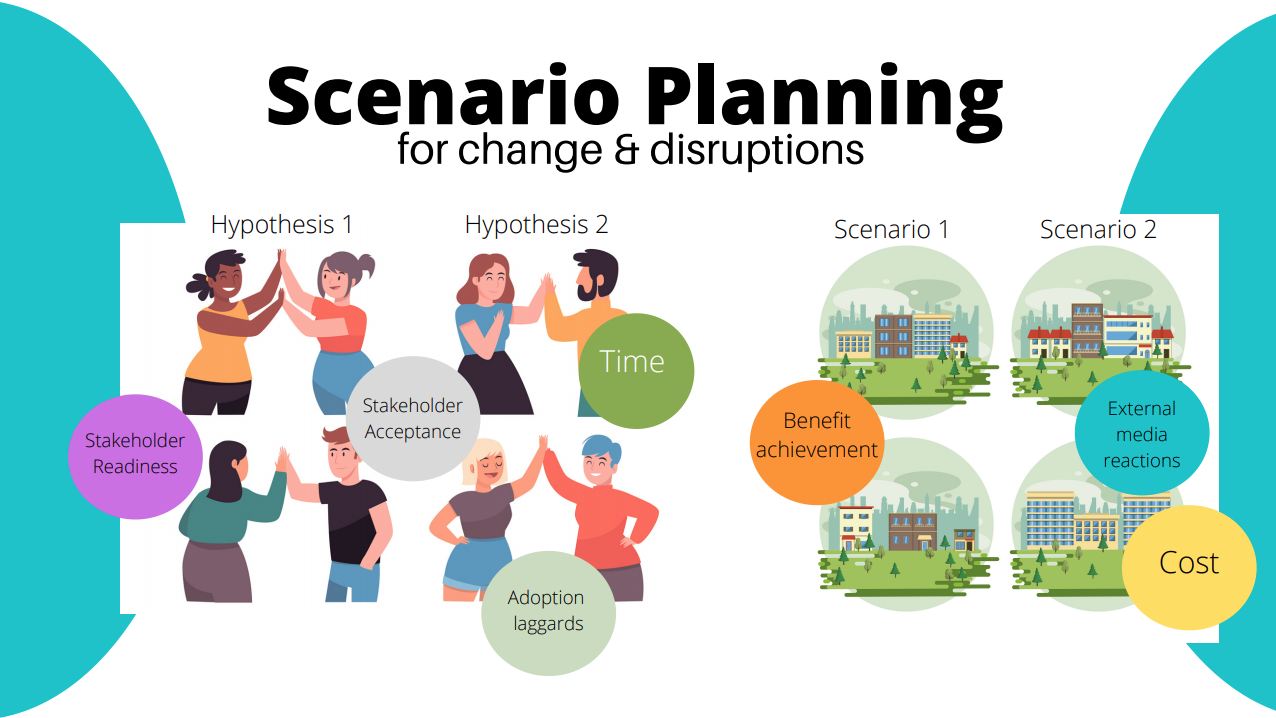


Most change programmes are built around a single implementation plan. The team agrees on a timeline, designs the training and communication approach around it, and executes. When reality diverges from the plan — and it usually does — the response is reactive: escalations, emergency rescheduling, scope cuts under pressure. The alternative is scenario planning: building multiple plausible futures into the programme design before commitment, so that when conditions shift, there is already a prepared response rather than an improvised one.
Scenario planning originated in military strategy and was adapted for business by Shell in the 1970s, where it helped the company anticipate the 1973 oil crisis and respond more effectively than competitors who had planned for a single future. In change management, the same logic applies. The organisations that navigate disruption well are rarely those that predicted the exact form it would take. They are those that had considered a range of possibilities and knew in advance how they would respond to each.
This article explains how to apply scenario planning specifically to change management and organisational transformation, with practical frameworks and examples.
Why single-path change planning fails under disruption
The fundamental problem with single-path planning is that it treats uncertainty as a temporary state that will resolve into a known future. In practice, the conditions affecting a change programme — stakeholder alignment, external environment, organisational capacity, technology stability — are genuinely uncertain throughout delivery. A change plan built on a single set of assumptions becomes increasingly unreliable as those assumptions are tested by events.
Research published in Harvard Business Review on risk management in complex programmes found that the most common cause of large-scale programme failures was not technical problems but planning rigidity: the inability to adjust when the programme environment changed in ways that had not been anticipated. Scenario planning addresses this by explicitly building in anticipated variation and pre-designing responses to it.
In change management specifically, the variables most likely to invalidate a single-path plan are: stakeholder readiness (whether affected groups are prepared to adopt at the planned pace), external disruption (regulatory changes, market events, or organisational crises that shift priorities), and change capacity (whether the organisation’s ability to absorb change remains constant across the programme timeline). All three are highly variable and largely outside the programme team’s control. Scenario planning is the mechanism for managing this variability deliberately.
The four-step scenario planning framework for change
Applying scenario planning to change management does not require a dedicated strategy team or elaborate modelling tools. The core process is straightforward and can be conducted in a facilitated workshop with the programme leadership team.
Step 1: Identify the critical uncertainties
Begin by identifying the two or three variables that are most uncertain and most consequential for the programme’s success. These are different from risks — risks are known negative events with probabilities attached. Uncertainties are genuinely unknown: you do not know whether they will materialise, and if they do, in what form. For most change programmes, the most significant uncertainties fall into two categories:
- Stakeholder readiness and acceptance: Will the affected groups be ready and willing to adopt at the planned pace, or will resistance, capacity constraints, or comprehension gaps slow adoption?
- External environment stability: Will the broader organisational and market context remain stable enough to support the planned timeline, or will competing priorities, regulatory changes, or external disruption force reprioritisation?
Step 2: Build the scenario matrix
Take the two most critical uncertainties and treat each as an axis, with two poles (high/low, favourable/unfavourable). This creates a 2×2 matrix with four distinct scenarios — four plausible futures for the programme. Each quadrant represents a coherent combination of conditions:
- Scenario A (benefit achievement): High stakeholder readiness, stable environment. The programme proceeds broadly as planned, with good adoption and manageable issues.
- Scenario B (adoption laggard): Low stakeholder readiness, stable environment. The technology or process change lands on time but adoption is slow. Benefits are delayed.
- Scenario C (external disruption): High stakeholder readiness, unstable environment. People are ready but external events force timeline or scope changes.
- Scenario D (compounded challenge): Low readiness, unstable environment. The most demanding scenario, requiring significant replanning and stakeholder intervention.
Step 3: Develop response strategies for each scenario
For each scenario, define in advance: what early signals would indicate you are moving toward this scenario, what the adapted change approach would look like, and what decisions would need to be made. This is the step most scenario planning exercises skip, and it is the most valuable. Having a pre-designed response to Scenario B (adoption laggard) means that when the early signals appear — lower-than-expected training engagement, manager feedback suggesting confusion, delays in process sign-off — the change team can activate the prepared response rather than entering a reactive planning cycle.
McKinsey’s guidance on scenario planning emphasises that the value of scenario planning is not prediction but preparation: building the decision-making capacity to respond effectively when conditions shift, regardless of which scenario materialises.
Step 4: Define the monitoring and trigger points
Scenario planning is only useful if the programme team is actively monitoring for the early signals that indicate which scenario is developing. Define specific, observable indicators for each scenario and assign responsibility for monitoring them. Build a regular review point into programme governance — typically monthly — where the team assesses which scenario the programme is tracking toward and whether a response strategy needs to be activated.
Applying scenario planning to specific change contexts
Technology transformation programmes
Technology transformations are particularly vulnerable to single-path planning failures because they combine technical uncertainty (the system may not perform as specified) with human uncertainty (users may not adopt as planned). The most common failure mode is a technically successful go-live followed by poor adoption: the system works but people do not use it correctly, resulting in data quality problems, workarounds, and delayed benefits realisation.
Scenario planning for a technology transformation should explicitly include an adoption laggard scenario and pre-design the hypercare and remediation approach for that eventuality. This means having additional training resources, business process specialists, and floor-walking support ready to deploy if early adoption indicators fall below threshold — rather than trying to mobilise these resources reactively after the adoption problem has already been identified in a post-implementation review.
Organisational restructures
Restructures are the change context where external disruption scenarios are most consequential. A restructure announced in one set of market conditions may need to be significantly modified if those conditions change during implementation. Key leadership departures, regulatory interventions, or sudden competitive pressure can shift the rationale for the restructure in ways that require mid-programme replanning.
Scenario planning for a restructure should include explicit consideration of what triggers would cause the programme team to recommend pausing, accelerating, or descoping, and what the communication approach would be for each of those decisions. Having this pre-designed does not commit the organisation to a particular course of action, but it means that when the decision point arrives, the governance forum has a framework for making it rather than starting from scratch.
Using portfolio data to inform scenario assumptions
One of the most common weaknesses in change scenario planning is that the scenarios are built on qualitative assumptions rather than evidence. The stakeholder readiness axis, for example, is often defined by the programme sponsor’s optimism rather than by any objective data on the affected groups’ current change load, recent adoption history, or capacity.
Platforms like The Change Compass provide the portfolio-level change impact data that makes scenario assumptions evidence-based. By showing the cumulative change load on the groups most affected by a programme, alongside their adoption performance on recent changes, the platform provides a factual baseline for scenario planning: whether the adoption laggard scenario is a theoretical possibility or a near-certainty based on current capacity data. This data-grounded approach makes scenario planning significantly more useful to governance forums that are accustomed to making decisions based on evidence rather than professional intuition.
You can also download our scenario planning for change infographic for a visual summary of the framework.
Making scenario planning a governance habit
The organisations that get the most value from scenario planning are those that build it into their standard programme governance rather than treating it as an ad hoc exercise for high-risk programmes. When scenario planning is a standard agenda item in programme initiation — alongside the business case, risk register, and change impact assessment — it becomes a normal part of how the organisation thinks about change, not an exceptional response to exceptional circumstances.
Prosci’s best practice research on change management maturity consistently identifies proactive planning — including contingency planning and scenario development — as a hallmark of high-maturity change organisations. The investment in scenario planning at the outset of a programme is consistently lower than the cost of reactive replanning mid-delivery when the single-path plan breaks down.
Frequently asked questions
What is scenario planning in change management?
Scenario planning in change management is the practice of developing multiple plausible futures for a change programme and pre-designing response strategies for each, rather than building a single implementation plan. It is particularly valuable in complex or uncertain environments where stakeholder readiness, external disruption, or organisational capacity are likely to vary from initial assumptions.
How is scenario planning different from risk management?
Risk management focuses on known negative events and their probabilities. Scenario planning addresses genuine uncertainty — situations where you do not know whether a condition will materialise or what form it will take. Scenario planning is not about listing what might go wrong but about mapping the range of possible futures and preparing considered responses to each, including positive scenarios as well as challenging ones.
How many scenarios should a change programme develop?
Most change programmes benefit from four scenarios, built from a 2×2 matrix of the two most critical uncertainties. This number is practical for governance forums to understand and monitor. Fewer than four scenarios tends to collapse into a best-case/worst-case binary, which loses the nuance of the most common middle-ground situations. More than four scenarios tends to create analysis paralysis without proportionate benefit.
When in the programme lifecycle should scenario planning happen?
Scenario planning is most valuable at programme initiation, when options are still open and response strategies can be genuinely built into the programme design. It should be reviewed at major milestone points — typically at the end of each phase — to assess whether conditions have shifted and whether the programme is tracking toward a different scenario than initially anticipated. A rapid scenario review should also be triggered whenever a significant external disruption occurs that could affect the programme.
References
- Harvard Business Review, “Managing Risks: A New Framework”
- McKinsey, “How to Use Scenario Planning”
- Prosci, “Change Management Best Practices Guide”