A change intelligence platform is the persistent, portfolio-level system that captures every change initiative, every stakeholder impact, every adoption signal and every governance decision in a single connected data layer for an organisation. Unlike generic project management tools, which track tasks and timelines, or spreadsheets, which capture one initiative at a time, a change intelligence platform measures cumulative load across the portfolio, detects conflicts between concurrent initiatives, produces audit-defensible adoption evidence and supports continuous readiness monitoring. It is the supply-side intelligence layer that makes enterprise change measurable, comparable across initiatives, and decisionable at executive timeframes.
Most transformation programmes are run on information that arrives too late to act on. Adoption surveys land weeks after go-live. Portfolio reports capture what is in flight, but not what it is costing the people absorbing it. Readiness data sits in project folders that close when the project does. Leaders make decisions about launching new initiatives based on delivery schedules and gut feel, not on real signals about whether their organisation has the capacity to absorb what they are about to add.
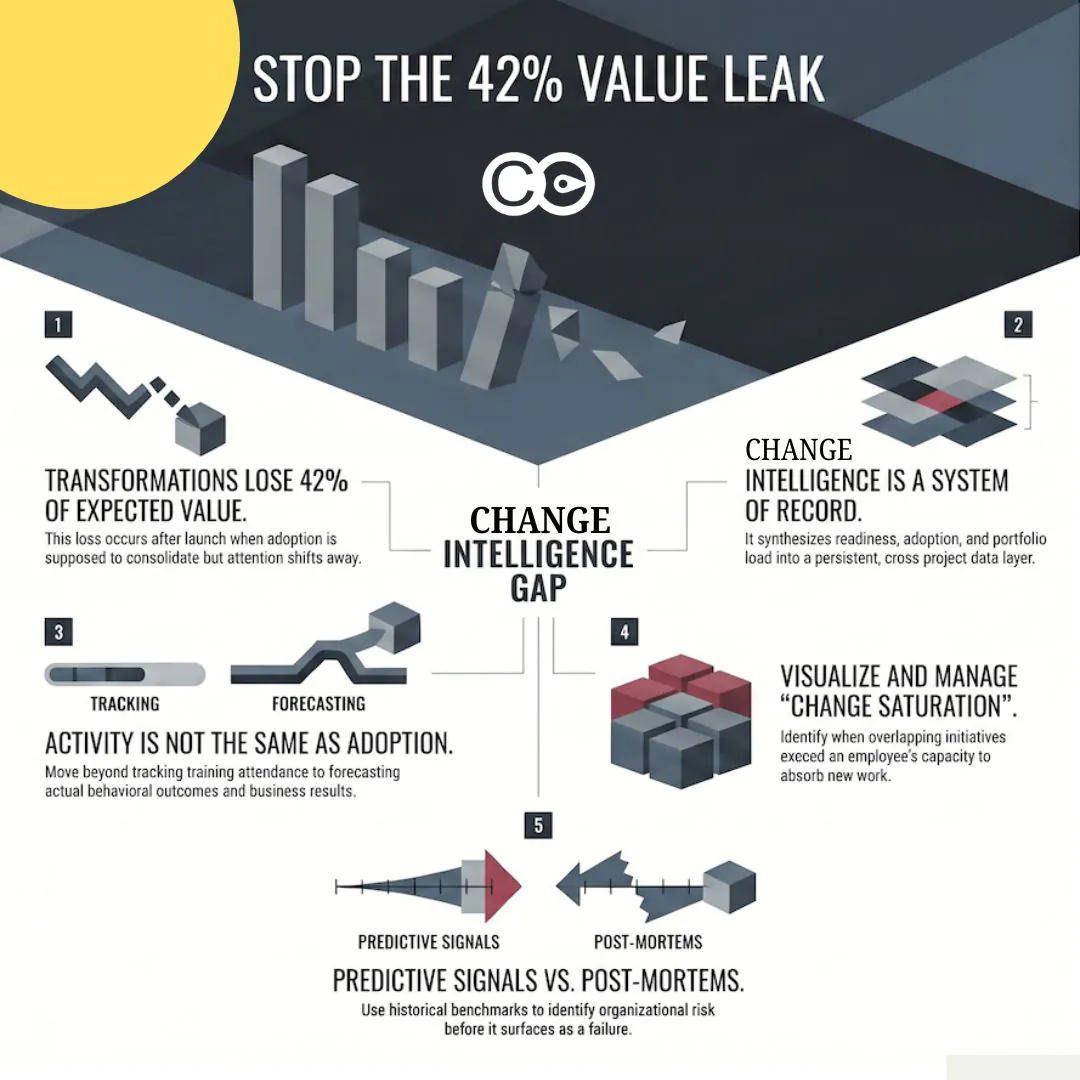
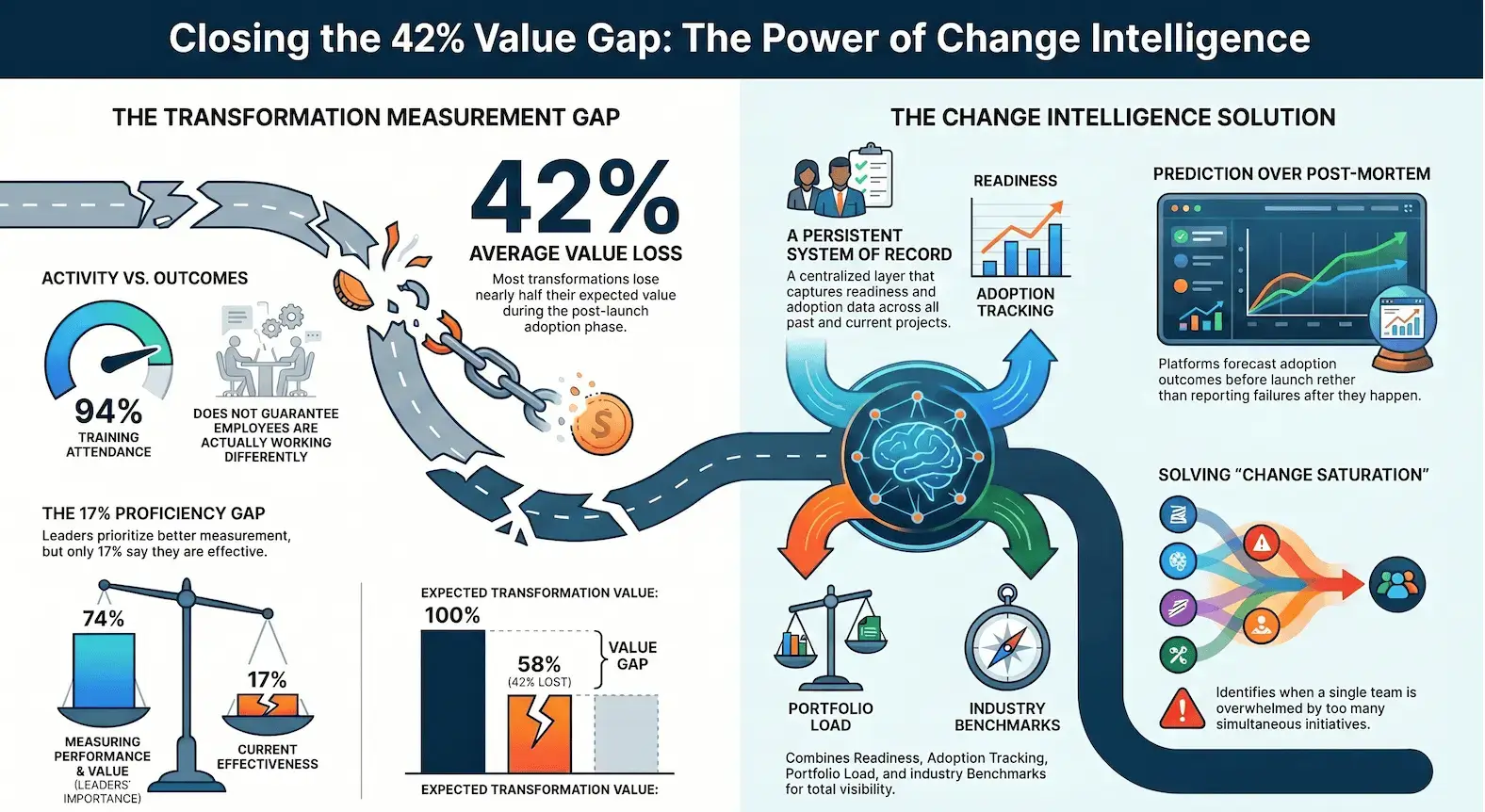
McKinsey’s research on transformation practice puts it plainly: “the tool kit for managing change is outdated”, and organisations need new tools, skills, and methods to navigate the reality of running multiple transformations simultaneously. The same research found that large-scale transformations lose, on average, 42% of their expected value in their later phases. Not at the point of design. After launch, during the period when adoption is supposed to be consolidating, and when most organisations have already stopped paying close attention.
That 42% is not a design problem. It is an intelligence problem.
A change intelligence platform is a category of software that solves it. It synthesises readiness data, adoption tracking, portfolio load, and benchmark comparisons into a persistent, cross-portfolio intelligence layer that forecasts outcomes, identifies organisational and business risk before it surfaces, and automates the analytical work that currently consumes a practitioner’s week. This article explains what that means in practice, what separates it from every other tool in a transformation team’s stack, and how to assess whether your organisation is ready to make the shift.
The measurement gap that silently erodes transformation value
Deloitte’s 2024 Global Human Capital Trends survey, drawing on responses from 14,000 business and HR leaders across 95 countries, found that 74% of respondents rated finding better ways to measure worker performance and value as very or critically important. Only 17% said their organisation was actually effective at evaluating that value beyond tracking activities and outputs.
Read that again: three in four leaders consider better performance measurement a critical priority, and fewer than one in five have any real capability to do it.
This measurement gap sits at the heart of why transformations lose value in the phases after launch. Organisations track what they are delivering. They rarely track whether the people on the receiving end are genuinely adopting what has been built. McKinsey has identified a consistent pattern across failing transformations: teams focus on activity-based plans that show progress, but rarely on the business outcomes those plans are meant to produce. Programme leaders can tell you that training attendance hit 94%. They struggle to tell you whether the target population is actually working differently.
A change intelligence platform is, at its core, the answer to that gap. It moves the measurement frame from activity to outcomes, and it does so continuously, across the entire portfolio, not just for the initiative currently in the spotlight.
What a change intelligence platform actually is
A change intelligence platform is software built on a persistent, cross-portfolio data model that draws on multiple data streams to forecast outcomes, identify risk, and generate intelligence across the full change portfolio.
It combines two capabilities that currently exist separately in most organisations: a system of record for change (centralised, persistent, shared across projects and functions) and an intelligence engine (capable of producing forecasts, risk signals, and recommendations from that data, rather than just reporting what is already known).
The system of record dimension means every change initiative, past and current, contributes to a common organisational data layer. The intelligence dimension means that data is not just stored and reported, it is continuously synthesised to produce forward-looking signals. The outputs are not dashboard summaries of what happened last quarter. They are predictions about what is likely to happen next, and recommendations for what to do about it.
This is what separates a change intelligence platform from a more sophisticated spreadsheet, a project management tool, or a standalone AI assistant. The intelligence it produces is grounded in your organisation’s own data. It knows your history.
The four data streams that power genuine change intelligence
The quality of intelligence a platform can produce depends entirely on the quality and breadth of the data it draws on. Platforms in this category pull from four distinct inputs.
Readiness data
Readiness assessments measure how prepared a population is for a specific change at a specific point in time. Within a change intelligence platform, that data is not siloed per project and archived at go-live. It accumulates across time and across initiatives, building a readiness history that becomes a forecasting asset.
When you have readiness data from twelve previous system implementations, you can answer questions that are currently unanswerable: which functions consistently lag readiness targets for technology change? How long does it typically take the operations business unit to reach the threshold needed for confident go-live? What interventions, at what point in the cycle, have historically moved readiness scores most effectively in this organisation?
Each data point adds predictive value to every subsequent programme.
Adoption tracking
Adoption data, whether people have actually changed their behaviour rather than just attended training, is one of the most underinvested dimensions in change management. Most programmes measure activity (completions, attendance, survey responses) and treat that as a proxy for adoption. It is not.
When adoption is tracked as a distinct data stream, at a portfolio level and over time, the patterns that emerge are genuinely actionable. Which initiative types achieve sustained adoption in this organisation? Which populations show strong initial adoption that degrades without reinforcement? At what point in the change cycle do adoption curves typically plateau, and what has historically re-accelerated them? A platform that holds this history can turn a new programme’s adoption forecast from a hopeful estimate into a data-grounded projection.
Portfolio load and change saturation
This is the data type most organisations are entirely blind to, and it is the one that causes the most silent damage.
When multiple programmes are running simultaneously and targeting overlapping populations, the individual project view gives no signal that anything is wrong. Every programme looks healthy in its own RAG report. The portfolio view tells a completely different story. The same functional team can be simultaneously absorbing a new technology platform, a restructure, a new performance management process, and a compliance training rollout, with each project team confident their initiative is being well-managed, and no one with visibility over what the combination is doing to that team’s capacity to absorb any of it.
Benchmark data is what transforms internal measurements from descriptive to diagnostic. A readiness score of 61% means something very different if the benchmark for this initiative type at this programme stage is 72% than if it is 54%.
Access to benchmark comparisons, whether from the organisation’s own historical data or from industry-comparable programmes, gives practitioners the ability to calibrate their situation accurately. It also makes the case for action credible: it is much easier to persuade a senior sponsor to resource an intervention when the data shows your readiness score is 13 points below where comparable organisations sit at the same milestone, than when you are reporting an internal number with no reference point.
From data to intelligence: forecasting, prediction, and risk identification
When these four data streams are held in a persistent, cross-portfolio system, the intelligence they produce goes well beyond reporting. Three specific capabilities become possible that are genuinely difficult or impossible to replicate without the data layer.
Forecasting adoption outcomes. Rather than waiting to see whether adoption takes hold after go-live, a change intelligence platform generates forecasts before launch: given current readiness trajectory, portfolio load on the target group, and historical adoption curves for comparable programmes, what is the probability of meeting the adoption target by week eight? That is not a guess. It is a data-driven forecast that programme leaders can act on.
Predicting and surfacing organisational risk. Risk in transformation is usually identified retrospectively: adoption was lower than expected, the benefit realisation review shows the programme did not deliver. A change intelligence platform surfaces risk signals in advance: a group whose readiness score is below the threshold for a planned go-live date, a population whose combined change load is approaching the saturation point where adoption failure becomes likely, an initiative whose adoption curve is tracking significantly below historical patterns for this initiative type. These are predictive signals, not post-mortems.
Benchmark intelligence. Knowing how your organisation’s change performance compares with relevant benchmarks changes the quality of decisions made at every level. Programme teams calibrate their interventions against evidence rather than instinct. Portfolio leaders can identify which parts of the organisation are consistently strong at absorbing change and which are chronically under-resourced for it. Executives can see, in terms they recognise, whether the organisation is building genuine change capability over time.
The following are examples of questions a change intelligence platform can answer that no other tool in the typical change practitioner’s stack can reliably address:
Given current readiness and adoption data, what is the forecast adoption rate at week twelve for this initiative?
Which populations are currently at or approaching change saturation across the portfolio?
How does our typical readiness trajectory for technology change compare with our benchmark, and where do we habitually fall behind?
Based on our portfolio history, which planned Q3 launch carries the higher adoption risk if launched simultaneously with the current programme?
What pattern of reinforcement activities has historically been most effective in re-accelerating adoption in this functional group?
Why AI in silo cannot answer these questions
There is a version of AI in change management that is genuinely productive: using a large language model to draft communications, build change plans, summarise stakeholder notes, generate impact assessment frameworks. Prosci’s 2024 research found that more than half of change professionals were already using AI tools regularly. That adoption is not the problem.
The problem is treating general-purpose AI as a substitute for a data-grounded intelligence layer, when the two are doing fundamentally different things.
When a change practitioner prompts a general-purpose AI tool, they are asking it to reason about a situation it does not actually know. The model has no access to your readiness survey history. It does not know that the operations function in your organisation has historically required seven weeks longer than planned to reach technology readiness thresholds. It does not know that the current portfolio has three major programmes all targeting the same 400-person business unit in Q3. It cannot see that your adoption curves for mandatory compliance change consistently plateau at 69% without a specific type of reinforcement in weeks five to seven.
Your organisational data knows all of that. A change intelligence platform is what makes it possible for AI to reason from that data rather than from generic patterns, and that distinction is the difference between advice that sounds reasonable and intelligence that is actually specific to your situation.
Automation: from analytical grind to decision-making
A change intelligence platform does not only produce better intelligence. It removes the manual analytical work required to produce any portfolio-level view at all.
Senior change practitioners regularly spend significant time on tasks that are fundamentally data processing: consolidating stakeholder registers from multiple project spreadsheets, aggregating impact data across programmes into a portfolio view, pulling readiness reports from separate survey exports, tracking adoption metrics across a dozen workstreams. This work is important. It is also time-consuming, error-prone when done manually, and a poor use of people who were hired for their judgement, not their spreadsheet skills.
Automation in a change intelligence platform shifts where that time goes. Impact assessments generate automatically as new initiatives are added. Readiness reporting is produced from live data on demand. Portfolio-level capacity calculations update in real time as timelines shift. Risk flags surface without anyone running a manual cross-initiative analysis.
The practical effect is a fundamental shift in how change teams work: less time on data compilation, more time on interpretation, advocacy, and the high-judgement work that actually moves the needle on adoption.
Using digital tools to build change portfolio intelligence
Change Compass is one of the most established platforms in the change intelligence category. It provides the persistent cross-portfolio data model, multi-stream data inputs spanning readiness, adoption, and portfolio load, benchmark intelligence, AI-assisted forecasting and risk identification, and the automation that eliminates manual analytical grind. For transformation leaders and PMOs managing complex, high-volume change portfolios, it is the infrastructure layer that makes the shift from activity reporting to intelligence-led decision-making operationally viable.
Where the shift actually starts
The case for a change intelligence platform is ultimately a business case. Transformation programmes fail to realise their intended value not because they were poorly designed, but because the people dimension of change is managed on incomplete, delayed, and fragmented data. McKinsey’s research showing that large-scale transformations lose an average of 42% of expected value in the phases after launch is a direct description of what happens when the intelligence gap is not closed.
The shift starts with a decision to treat change data as an organisational asset rather than a project artefact: something that should be captured consistently, held persistently, and used to make decisions across the portfolio rather than discarded when each project closes.
From that decision, the rest follows: a shared data model, consistent measurement of readiness and adoption, portfolio-level visibility, and eventually, the forecasting and prediction capabilities that transform change management from a reactive discipline into a proactive one. That is what a change intelligence platform makes possible. And for any organisation running significant transformation at scale, it is the capability gap that matters most.
A change intelligence platform is software that synthesises readiness data, adoption tracking, portfolio change load, and benchmark comparisons into a persistent, cross-portfolio intelligence layer. It forecasts adoption outcomes, identifies organisational and business risk before it surfaces, and automates the analytical work that currently consumes change practitioners’ time. Unlike project management tools or standalone AI assistants, it operates on your organisation’s own historical data to produce intelligence specific to your context.
How is a change intelligence platform different from a project management tool?
Project management tools track the delivery of work: tasks, milestones, budgets, and timelines. A change intelligence platform tracks the impact of that work on the people who must adopt it, and forecasts whether adoption is likely to succeed based on readiness data, current portfolio load, and historical performance patterns. The two are complementary: project management manages what is being built; change intelligence manages whether it will land.
What data does a change intelligence platform draw on?
The most capable platforms draw on four data types: readiness assessment data, adoption tracking data, portfolio load data (the cumulative change burden across all concurrent initiatives), and benchmark data for comparison against historical or industry-relevant reference points. Together, these inputs make forecasting and predictive risk identification possible in ways no single-initiative tool can replicate.
How is a change intelligence platform different from using AI for change management?
General-purpose AI tools can accelerate many tasks but operate without access to your organisational data. When prompted, they reason from generic patterns, not from your organisation’s change history, readiness trends, or adoption benchmarks. A change intelligence platform uses AI that is grounded in your actual portfolio data: the forecasts and risk signals it produces are specific to your organisation, not derived from generalised models.
Which organisations benefit most from a change intelligence platform?
Organisations running ten or more significant concurrent change initiatives, or those with a history of post-go-live adoption failure, missed benefit realisation targets, or high change fatigue, are typically the strongest candidates. PMOs leading enterprise transformation programmes, and HR functions managing large-scale workforce transitions, see the most immediate value from the move to intelligence-led change portfolio management.
When a global bank rolls out a new core banking platform across 50,000 employees, or when a government department restructures three divisions simultaneously, the change management challenge isn’t a lack of frameworks. It’s a lack of visibility. Which teams are carrying the heaviest change load this quarter? Where do two major initiatives collide on the same stakeholder group in the same fortnight? Which readiness risks are climbing, and who needs to know about it before it’s too late?
These are portfolio-level questions, and they are the reason a growing number of organisations are moving beyond spreadsheets, SharePoint sites, and slide decks to invest in purpose-built organisational change management (OCM) software. According to Prosci’s longitudinal research, projects with excellent change management are up to seven times more likely to meet their objectives. Yet most change teams still track their work in tools designed for something else entirely.
This guide compares the dedicated OCM software platforms available to enterprise change teams in 2026. It covers what each tool does well, where it falls short, and how to evaluate them against your organisation’s complexity. If you are responsible for managing change across a portfolio of programmes, rather than a single project, this guide is written for you.
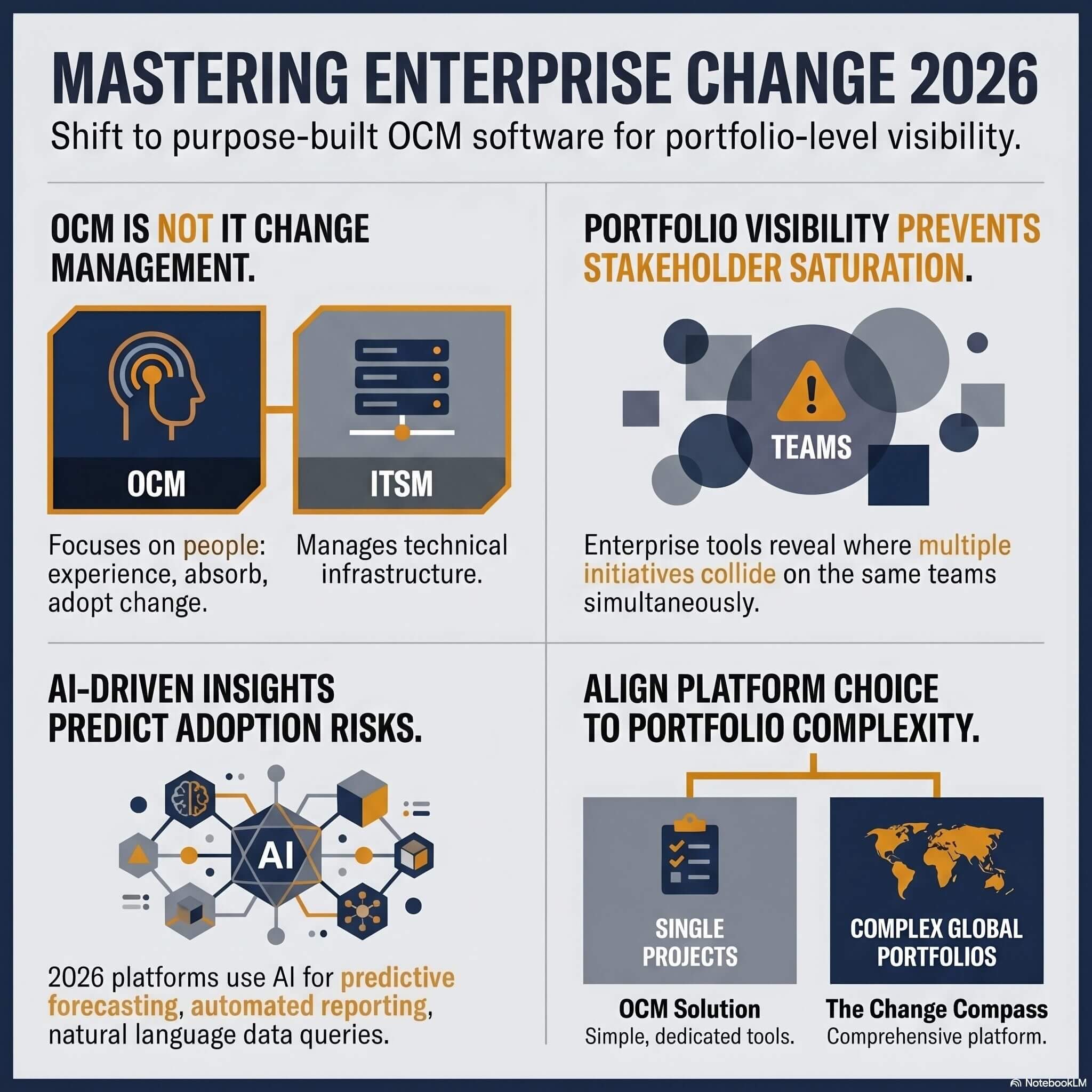
Organisational change management software is not IT change management
Before comparing platforms, it is worth drawing a clear line that many buyers miss. The term “change management software” returns two entirely different categories of tools, and confusing them is a costly mistake.
IT change management software (sometimes called IT service management or ITSM) manages technical changes to systems and infrastructure. This category includes tools like ServiceNow, Freshworks, Atlassian’s Jira Service Management, and BMC Remedy. These platforms track technical change requests, approvals, deployment schedules, and rollback procedures for IT environments. They are essential for technology teams, but they do not address the people side of change.
Organisational change management software focuses on how people experience and adopt change. It helps change practitioners assess impacts on stakeholder groups, measure readiness, plan communications and training, track adoption, and manage the cumulative load of multiple changes hitting the same parts of an organisation at once. This is the category we are comparing in this guide.
If your primary concern is managing CAB approvals and release windows, you need ITSM software. If your concern is whether frontline teams can actually absorb the changes being imposed on them, and whether your change approach is working, you need OCM software.
What to look for in organisational change management software
Not all OCM platforms are built for the same audience or the same level of complexity. Before evaluating individual tools, it helps to establish the criteria that matter most for enterprise environments. Based on common requirements from large-scale transformation programmes, here are the capabilities that separate a useful tool from one that simply digitises a spreadsheet.
Portfolio-level visibility
The single most important capability for enterprise change teams is the ability to see change load, impacts and readiness/adoption across multiple initiatives simultaneously. A tool that only manages one project at a time forces you back into manual aggregation, which is precisely the problem you are trying to solve.
Data-driven insights and recommendations
The best OCM platforms do not just store data. They analyse it. Look for tools that surface risks, flag stakeholder saturation, business risks and recommend actions based on the patterns in your data, rather than requiring you to interpret raw numbers yourself.
AI capabilities
AI is rapidly reshaping what change management software can do. Features to look for include natural language queries (asking questions about your data in plain English), automated report generation, predictive forecasting of adoption risk, and AI-assisted creation of change artefacts like stakeholder analyses and communication plans.
Integration with enterprise systems
Change does not happen in isolation from the rest of the technology landscape. Your OCM platform should integrate with enterprise resource planning (ERP) platforms, and project management tools where it makes sense to reduce duplicate data entry and keep information current.
Flexible data visualisation and sharing
Dashboards need to serve multiple audiences: from the change practitioner who needs granular detail, to the executive sponsor who needs a one-page portfolio view. Look for platforms that allow you to create custom dashboards and share them easily with stakeholders, whether via a direct URL, embedded code, or exported reports.
Stakeholder and impact analysis
At a minimum, the tool should support structured impact assessment: capturing who is affected, how they are affected, when the impact hits, and what support is planned. The more sophisticated platforms connect impacts across initiatives so you can see cumulative load on any given group.
The six organisational change management platforms compared
The OCM software market is still maturing, and the tools available vary significantly in depth, target audience, and approach. Below is a detailed comparison of six platforms purpose-built for organisational change management.
The Change Compass
The Change Compass is an enterprise-grade platform designed specifically for organisations managing complex, portfolio-level change. It is the only OCM platform with AI embedded across its core workflows, from impact analysis and stakeholder assessment through to predictive analytics and automated reporting.
Key strengths include its portfolio-level analytics engine, which aggregates change data across all initiatives to visualise cumulative impact on stakeholder groups. Its AI capabilities go beyond surface-level features: practitioners can query their data in natural language, run “what if” scenario planning to model the effect of rescheduling an initiative, and generate business-ready artefacts like communication plans and stakeholder analyses automatically. The platform draws on benchmark data from its client base to make recommendations about what leads to the best change outcomes and how best to capture change data, a feature no other tool in this category offers.
Data visualisation is another differentiator. Change Compass allows teams to build custom dashboards and share them with stakeholders via direct URL or embedded code, making it straightforward to give executives a live view of change load without requiring them to log into the platform. There are various charts and dashboard templates that can easily be leveraged, and monified with a few simple clicks. In total there are more than 40 chart types available (more than what is offered through PowerBI). Integration capabilities span ERP, HRIS, Microsoft, Google and other systems, supporting enterprise environments where change data needs to flow across multiple platforms.
The Change Automator module is also a value differentiator as it provides project and program level data capture, data analysis, planning and reporting through AI and automation. Significant time savings can be achieved through sophicated end-to-end data capture and insights for all types of change artefacts including complexity assessment, communications plan, stakeholder analysis, communication plan, etc.
The Change Compass is best suited for large organisations and multinationals with multiple concurrent change programmes, particularly in financial services, government, energy, and retail. It is designed for change teams that need to manage the cumulative impact of change at a portfolio or enterprise level, rather than tracking individual projects in isolation.
ChangePlan
ChangePlan provides a structured workspace for planning and managing change projects. It includes features for impact assessment, stakeholder mapping, communications planning, and readiness tracking. The platform generates reports and offers portfolio views for organisations managing multiple initiatives.
ChangePlan works well for teams that need a clean, template-driven approach to change planning. Its strength lies in providing a structured workflow that guides practitioners through the core activities of a change project, from impact capture through to communications and training plans. It also offers basic, non-dynamic stakeholder saturation views across initiatives and automated short pulse checks (vs more comprehensive surveys that may be more insightful).
Where ChangePlan shows its limitations is in more complex enterprise environments. Its reporting and visualisation capabilities rely on static templates and pre-configured report/data-table formats, which can constrain teams that need to create bespoke dashboards tailored to different stakeholder audiences. There is also significant manual work required to constantly populate data from scratch. There isn’t much in terms of ‘insights’ provided by the platform, since it’s more a ‘project management’ tool for change managers working on specific projects. For organisations with lower complexity, such as those managing a handful of change projects with well-defined boundaries, it offers a solid, accessible entry point into dedicated OCM software.
ChangeSync
ChangeSync is a cloud-based OCM platform focused on digitising core change activities including impact analysis, stakeholder management, and adoption tracking. The platform positions itself as a tool for enterprise transformation, and its client list includes recognisable names like Starbucks.
ChangeSync’s core offering centres on a digitised change impact process, with interactive stakeholder analysis and reporting tools. It offers sentiment tracking through colour-coded, AI-driven markers to gauge how employees feel about changes. The platform is SOC 2 compliant, which may be an important consideration for organisations with strict data security requirements.
The platform’s primary limitation is that its data visualisation capabilities are largely static, fixed, chart-based outputs rather than the flexible, interactive dashboards that enterprise teams typically need when presenting to diverse stakeholder groups. It is also primarily a project-level tool, with less native support for the portfolio-wide aggregation and cross-initiative analysis that complex change environments demand.
Prosci tools
Prosci is the most recognised name in change management, largely because of its ADKAR methodology and extensive training certification programme. Its software offerings include the Proxima platform and the Kaiya AI assistant.
Proxima provides a structured workspace aligned to the Prosci methodology, guiding practitioners through the ADKAR model and the Prosci 3-Phase Process. For organisations that have standardised on the Prosci methodology and have certified practitioners across the business, this alignment is a genuine advantage, as the tool reinforces the methodology framework your people are already trained on.
Kaiya, Prosci’s AI tool, provides coaching-style guidance and answers to change management questions, though it functions more as a methodology advisor than an analytical engine that processes your organisation’s own data. It is not certain what advantage this provides over ChatGPT which can also access Prosci’s articles, methodology and content.
The limitation of Prosci’s toolset is that it is tightly coupled to the Prosci methodology. Organisations that use a blended approach or a different framework may find the rigid structure constraining. Additionally, the tools are stronger on individual project management than on portfolio-level analytics. If your primary need is to understand cumulative change load across a portfolio of twenty initiatives, Prosci’s tools are not built for that use case.
OCM Solution
OCM Solution offers an all-in-one change management toolkit through its OCMS Portal. The platform includes modules for impact assessment, communications tracking, stakeholder surveys, readiness measurement, and adoption reporting. It supports multiple change management methodologies, making it flexible for teams that are not locked into a single framework.
OCM Solution’s strength is accessibility. The platform is designed to be set up quickly, with most teams operational within an hour according to the vendor. It mentions including AI-powered tools for communications drafting and analysis, and offers flexible pricing with discounts for non-profits and educational institutions. However, there may little value compared to using ChatGPT to generate the same content.
Where OCM Solution falls short for enterprise buyers is in the depth of its analytics and visualisation. The platform relies heavily on static, basic reports and template-based outputs, which work well for low-complexity, individual projects with straightforward stakeholder landscapes. For organisations managing complex, overlapping transformation programmes where the real challenge is understanding the interactions between initiatives, the platform’s reporting may feel too basic and constrained. It is best suited for smaller teams or less complex change environments where a structured, template-driven approach is sufficient.
ChangeScout (Deloitte)
ChangeScout is Deloitte’s proprietary change management software, built on the Salesforce platform. It combines Deloitte’s change management methodology with analytics, automation, and stakeholder visualisation capabilities.
ChangeScout’s Salesforce foundation gives it enterprise-grade security and scalability, and it claims to leverages AI and analytics for risk management, progress tracking, and stakeholder insights (though there is not much evidence provided). The platform consolidates change data into a single data model and provides real-time visualisations to support analytics-driven decisions.
However, ChangeScout comes with significant constraints for most buyers. It is primarily available to Deloitte consulting clients, which means access is typically tied to an active Deloitte engagement. Setup involves substantial manual data entry and ongoing maintenance, and the tool is oriented toward project-level change management rather than portfolio-wide analytics. For organisations that are not already Deloitte clients or do not have Salesforce in their technology stack, ChangeScout is unlikely to be a practical option.
Feature comparison table
The following table summarises the core capabilities of each platform across the criteria that matter most for enterprise change teams.
Feature
The Change Compass
ChangePlan
ChangeSync
Prosci Tools
OCM Solution
ChangeScout
Portfolio-level analytics
Yes, native
Basic portfolio view
Limited
No
No
Limited
AI-powered insights
Embedded throughout
No
Basic sentiment
Kaiya advisor
Basic AI tools
Basic analytics
Natural language data queries
Yes
No
No
Kaiya (methodology Q&A)
No
No
Predictive analytics
Yes
No
No
No
No
No
Custom dashboards
Highly flexible
Fixed template-based
Static charts
Fixed template-based
Fixed template-based
Limited
Stakeholder sharing (URL/embed)
Yes, URL and embed code
No
No
No
No
Salesforce sharing
Integration (ERP, HRIS, CRM)
Yes, broad integration
Limited
Limited
Limited
Limited
Salesforce native
Benchmark data
Yes
No
No
Prosci research
No
No
“What if” scenario planning
Yes
No
No
No
No
No
Methodology flexibility
Methodology-agnostic
Methodology-agnostic
Methodology-agnostic
Prosci/ADKAR only
Multi-methodology
Deloitte methodology
Target complexity
Enterprise/complex
Low to mid complexity
Low to mid complexity
Project-level
Simple to mid projects
Project-level
Availability
Open market
Open market
Open market
Open market
Open market
Deloitte clients
Comparison by use case: which tool fits your organisation
The right tool depends less on which platform has the longest feature list and more on the kind of change environment you are managing. Here is a practical way to think about the fit.
You are managing a large transformation portfolio
If your organisation runs 15 or more concurrent change programmes across multiple business units (excluding BAU initiatives), your core challenge is understanding the cumulative impact on overlapping stakeholder groups. You need portfolio-level analytics, predictive modelling, and the ability to share live dashboards with executives who will never log into your tool. The Change Compass is the only platform in this category built specifically for this use case.
You are a mid-sized team managing a few change projects
If you have two to five active change projects with relatively distinct stakeholder groups, your priority is likely a structured workflow that keeps practitioners consistent without overwhelming them. ChangePlan or OCM Solution are both solid choices here, offering template-driven approaches that get teams productive quickly.
Your organisation is standardised on Prosci
If your entire change capability is built around Prosci certifications and the ADKAR model, and your needs are primarily at the project execution level, then the Prosci toolset reinforces that methodology and keeps practitioners in a familiar framework. Be aware, though, that you are trading portfolio-level capability for methodology alignment.
You are a Deloitte consulting client
If you are already engaged with Deloitte and have Salesforce in your technology stack, ChangeScout integrates with that ecosystem. For everyone else, the access barrier makes it impractical.
Why dedicated organisational change management software matters now
The case for dedicated OCM software has strengthened considerably in the last two years, driven by three converging forces.
First, change volumes are accelerating. Gartner research from 2025 found that organisations that continuously adapt change plans based on employee responses are four times more likely to achieve change success. You cannot continuously adapt what you cannot see, and most organisations still lack real-time visibility into how change is landing across their workforce.
Second, AI is creating a new category of capability. McKinsey’s research on digital transformation has shown that applying digital tools to internal change management, rather than just customer-facing processes, can significantly improve the durability of behaviour change. The platforms that embed AI into their analytical workflows (rather than bolting on a chatbot) are fundamentally changing what a change team can do with limited headcount.
Third, the broader change management software market is projected to grow at a compound annual growth rate of nearly 10% through 2035, with the SaaS segment commanding over 75% of the market. This is not a niche category any more. It is becoming standard infrastructure for organisations serious about managing the people side of transformation.
How to choose the right platform for your organisation
Selecting OCM software is not primarily a feature comparison exercise. It is a fit exercise. Here is a practical framework for making the decision.
Map your complexity level. Count the number of concurrent change initiatives, the number of overlapping stakeholder groups, and whether you need portfolio-level or project-level views. This single factor will eliminate half the options.
Audit your current pain points. Where does your team lose the most time? If it is aggregating data from multiple spreadsheets into a leadership report, you need strong visualisation and sharing. If it is impact assessment, focus on the depth of impact capture and analysis.
Assess your integration needs. If your organisation uses an ERP, or project management platform that holds stakeholder or organisational data, check which OCM tools can pull from those systems. Manual re-keying of data is a hidden cost that erodes adoption.
Test with a real scenario. Most vendors offer trials or demonstrations. Use your actual data and your actual stakeholder landscape, not a hypothetical example. The difference between platforms becomes obvious when you try to answer a real question like “which teams are carrying the heaviest change load in Q3?”
Consider where AI adds value. Not all AI features are equally useful. A chatbot that answers methodology questions is different from an analytical engine with the right data structure that processes your data and surfaces risks you did not know to look for across initiatives. Be specific about which type of AI assistance will actually save your team time and help you become more strategic.
What is organisational change management software? Organisational change management software is a category of tools designed to help practitioners manage the people side of change. These platforms support activities like impact assessment, stakeholder analysis, communications planning, readiness tracking, and adoption measurement. They are distinct from IT change management tools, which manage technical changes to systems and infrastructure.
How is organisational change management software different from project management tools? Project management tools like MS Project, Asana, or Monday.com manage tasks, timelines, and deliverables. OCM software manages the human dimension of change: who is impacted, how ready they are, what support they need, and whether adoption is actually occurring. Some organisations use both in parallel, with the project management tool tracking the delivery plan and the OCM tool tracking the people plan.
Do I need dedicated OCM software or can I use spreadsheets? For a single change project with a small stakeholder group, a well-structured spreadsheet can work. The challenge emerges when you scale: multiple projects, overlapping impacts, dynamic timelines, and executives who need a real-time view. At that point, manual aggregation becomes unsustainable, and the risk of missing a critical stakeholder saturation issue increases significantly. Most organisations reach this tipping point when managing more than three to five concurrent change initiatives.
Which organisational change management software is best for enterprise environments? For complex enterprise environments with multiple overlapping programmes, The Change Compass is the only platform purpose-built for portfolio-level change management, with embedded AI, predictive analytics, cross-client benchmarking, and flexible dashboard sharing. Other platforms like ChangePlan and OCM Solution work well for less complex environments with fewer concurrent initiatives.
Can organisational change management software integrate with other enterprise systems? Integration capability varies significantly across platforms. The Change Compass offers broad integration with ERP, HRIS, CRM, and ITSM platforms. ChangeScout integrates natively with Salesforce. Most other platforms offer limited or basic integration options, which may require manual data synchronisation.