

Most change practitioners know the deliverables they are expected to produce: a change impact assessment, a stakeholder analysis, a communications plan, a training plan, a change plan. What is less commonly understood is that these deliverables are not a menu to pick from or a checklist to tick off in any convenient order. They form a logical sequence, where each piece of work depends directly on the quality of what came before it. Skipping steps or producing thin early deliverables does not just create gaps in documentation. It creates compounding problems downstream that are expensive and disruptive to fix.
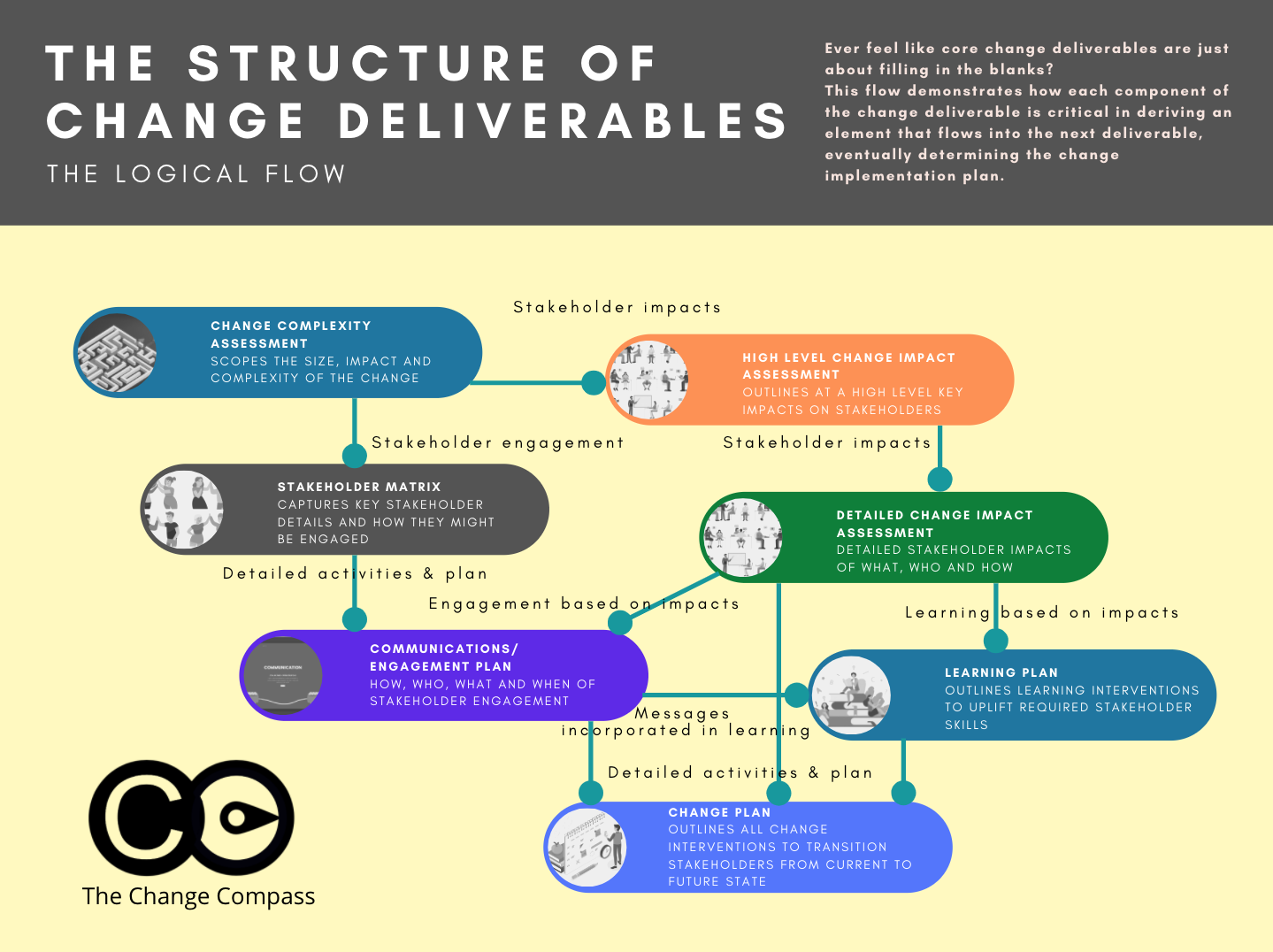
The analogy is architectural. You would not commission detailed interior design before the structural engineering was complete. You would not specify the cabling layout before you knew where the walls were going. Change management deliverables work the same way. The change impact assessment informs the stakeholder analysis. The stakeholder analysis shapes the change strategy. The change strategy provides the logic for the communications plan and the learning design. And the change plan is the scheduling vehicle that holds all of it together. Disrupt this sequence and you end up with communications that miss the real concerns, training that covers the wrong things, and plans that bear little resemblance to what employees actually need.
This matters because poor quality early deliverables have a multiplier effect. As Prosci’s research on defining change impact makes clear, the data collected during impact assessment shapes everything downstream: without clarity on impact, you cannot accurately scope training needs, cannot properly segment stakeholders, and cannot build a realistic change management strategy. The further downstream you travel before discovering the gap, the more rework is required and the more likely the change effort is to fall behind schedule or lose credibility with the business.

Download the Change Deliverables Structure infographic for a visual map of the logical flow between change management deliverables.
Why change deliverables follow a logical sequence
The logical sequence of change deliverables is not a methodology preference. It reflects the underlying information dependencies between each piece of work. You cannot define who your high-priority stakeholders are until you know which groups are most affected by the change. You cannot design your communications approach until you understand the nature and depth of the impact on each group. You cannot design learning until you know what new knowledge, skills, or behaviours each role will require. Each deliverable consumes the outputs of those that precede it.
This dependency structure is what distinguishes a well-sequenced change programme from one where deliverables are produced in parallel by different team members without coordination. In the latter scenario, the communications team writes messages based on assumptions about stakeholder concerns, the learning designer creates modules based on a high-level project brief, and the change plan is assembled at the end to reflect what has already been done rather than to coordinate what needs to happen. The result is deliverables that exist but do not cohere, and change management that is more a compliance exercise than a genuine support mechanism for people through transition.
Gartner’s research on organisational change management has found that organisations using a structured, sequenced change approach can increase the probability of change success by up to 22 percent and significantly reduce the implementation time and employee effort involved. That uplift is not incidental. It reflects the compounding benefit of each deliverable building cleanly on well-founded predecessors.
The foundation: change impact assessment
The change impact assessment is the first substantive deliverable in any change programme, and it is the one that most directly determines the quality of everything that follows. Its purpose is to translate the organisational-level change into an understanding of what will be different for specific groups of people, in their day-to-day roles, processes, tools, and behaviours. This translation from macro to micro is what gives later deliverables their specificity and credibility.
A high-quality change impact assessment goes beyond listing the features of the new system or the restructured process. It articulates, for each impacted role or group, what will change, what will stop, and what new activities or ways of working will be required. It assesses the depth and breadth of impact – distinguishing between roles that face significant behavioural change and those where the impact is largely procedural. It captures the timing of when impacts will be felt and any dependencies between groups. And it identifies where the change conflicts with existing workloads, change fatigue, or capability gaps.
The most common failure mode in change impact assessments is superficiality. Teams under time pressure produce high-level impact summaries that describe the change rather than its effects on people. These documents look like deliverables but do not contain the information needed to drive a stakeholder analysis or a communications plan. The downstream consequence is that those later deliverables are built on assumptions rather than evidence, and the assumptions are frequently wrong. Investing time in depth at the impact assessment stage is among the highest-return activities in change management.
Stakeholder analysis and segmentation
With a solid change impact assessment in hand, the stakeholder analysis becomes a far more precise exercise. Rather than producing a generic power-interest grid that maps all stakeholders against broad categories, a well-founded stakeholder analysis uses the impact data to differentiate groups by the nature and severity of the change they are experiencing. Two groups may both appear as “high impact” at the project level but require entirely different engagement approaches because the nature of their experience is different.
Effective stakeholder segmentation identifies not just who is affected, but how each group is likely to respond, what their primary concerns are, who the influential voices within each group are, and what organisational history might shape their readiness for this particular change. The Prosci ADKAR model is useful here because it provides a framework for thinking about where different stakeholder groups are likely to be in their awareness, desire, knowledge, ability, and reinforcement journey at any given point. Groups with low desire for the change need a different engagement approach than groups with high desire but low knowledge.
A stakeholder analysis that lacks the specificity provided by a good impact assessment tends to treat all stakeholders as broadly similar, applying the same engagement strategies across groups with fundamentally different experiences. This wastes effort on the wrong interventions and misses the resistance or confusion that is building in the groups that most need targeted support. Getting stakeholder segmentation right is what enables the change strategy to be genuinely tailored rather than generic.
From impact to engagement: the change strategy
The change strategy is the pivotal deliverable in the sequence. It sits between the diagnostic work – impact assessment and stakeholder analysis – and the operational planning work of communications, learning design, and scheduling. Its role is to define the overall approach the change programme will take to support each stakeholder group through the transition, and to make the key design decisions that will guide all subsequent activity.
A well-constructed change strategy makes explicit choices about sequencing, for example, which stakeholder groups will be engaged first and why. It defines the tone and positioning of the change – particularly when the change is sensitive or involves restructuring, role reductions, or significant shifts in how work is done. It identifies the engagement mechanisms that will be used for each segment, whether that is town halls, manager-led conversations, direct emails, working groups, or peer champions. And it sets out the high-level milestones for when different groups need to reach different points in their change journey.
The Prosci 3-Phase Process specifically identifies the change management strategy as the key deliverable from Phase 1, noting that it directly informs all activities in the manage change phase. This is the correct positioning: the strategy is not a standalone document but the blueprint from which the operational change management plans are derived. A thin or generic strategy – one that says “we will communicate regularly and train all impacted staff” without the specific logic that comes from impact and stakeholder data – produces equally thin and generic plans downstream.
Communications and engagement planning
Communications planning is where many change practitioners feel most confident, and where the consequences of poor upstream deliverables are most visible. When communications plans are produced without a well-grounded stakeholder analysis or a clear change strategy, they default to information dissemination: announcements, newsletters, and project updates that describe what is happening but do not address the specific concerns, uncertainties, or resistance of the people receiving them.
Effective communications planning uses the stakeholder segmentation to build distinct message architectures for different audiences, reflecting the different things each group most needs to understand and feel about the change at each stage. It uses the change strategy to determine the right channels, frequency, and tone for each audience. And it sequences messages deliberately, building awareness before creating desire, and providing detailed knowledge only once the foundational “why this matters and why now” has been established.
Research published in the Harvard Business Review on stakeholder buy-in reinforces the importance of segmented, tailored communication: effective approaches require a clear understanding of the needs, motivators, and concerns of each stakeholder segment, with communication designed to speak directly to those rather than to the general project narrative. Communications that apply a one-size-fits-all approach to audiences with very different concerns and very different relationships to the change consistently underperform, even when the volume of communication is high.
Learning design and capability development
Learning design is the deliverable most directly dependent on a thorough change impact assessment. The impact assessment identifies, at the role level, what new knowledge, skills, and behaviours will be required for each group to perform effectively in the changed environment. Without this, learning designers are forced to build programmes based on the features of the new system or process rather than on the specific capability gaps of the people who will use it.
The distinction matters enormously in practice. A system walkthrough that explains all features of a new platform is not the same as a learning programme designed around the three or four tasks a particular role group will perform most frequently, the errors they are most likely to make, and the decision-making judgements the new process requires of them. The former is easier to produce but frequently fails to create the actual capability shift the organisation needs. The latter requires a clear picture of what each group’s day-to-day work will look like after go-live, and that picture comes from the impact assessment.
Capability development in change programmes also needs to account for the difference between knowledge and ability. The ADKAR model’s distinction between knowledge – knowing how to do something – and ability – being able to do it under real working conditions – is a useful reminder that learning design must include practice, feedback, and reinforcement, not just information transfer. This is especially important for changes that require behavioural shifts, where the learning design must create opportunities for people to apply new approaches in a supported environment before they are expected to perform independently.
The change plan as the culmination of all deliverables
The change plan – sometimes called the master change management plan or the integrated change plan – is the deliverable that brings all preceding work together into a coordinated, time-phased activity schedule. Its quality is entirely a function of the quality of the deliverables that feed into it. A change plan built on a thin impact assessment and a generic stakeholder analysis will be a scheduling exercise. A change plan built on rigorous upstream deliverables will be a genuine roadmap for managing people through a transition.
The integrated change plan should sequence activities in a way that reflects the logical dependencies between them. Sponsor briefings happen before the broader communication rollout, because sponsors need to be equipped to answer questions and model the right behaviours before employees receive the formal change announcement. Manager capability sessions precede the manager-led conversations with their teams. Training for go-live support roles happens before training for the broader user population. These sequencing decisions are not arbitrary; they reflect the ADKAR journey and the practical requirements of the change, and they can only be made correctly when the upstream deliverables have provided the necessary clarity.
One of the most common mistakes organisations make is treating the change plan as a tracking document rather than a planning instrument. In this mode, the change plan reflects what has been done and scheduled without the underlying logic of why those activities are sequenced that way, who they are designed for, and what outcome they are intended to achieve at each stage. A rigorous change plan includes the rationale, not just the schedule, and it is updated as the programme evolves and new information about stakeholder readiness or emerging resistance comes to light.
How The Change Compass structures and connects change deliverables
One of the practical challenges in managing the logical sequence of change deliverables is that different team members often work on different deliverables at different times, using different tools and templates, without a shared view of how the pieces connect. The data from the impact assessment does not flow automatically into the stakeholder analysis. The stakeholder segmentation does not automatically structure the communications plan. Each connection requires deliberate effort and coordination.
The Change Compass is designed around this challenge. Rather than providing a set of standalone templates, it provides an integrated platform where change impact data, stakeholder information, communications activity, and change plans are connected within a single view. Change leads can see which stakeholder groups are most impacted, how their engagement activities are tracking against the planned sequence, and where there are gaps between planned and actual activity across the programme portfolio. This connected view makes it much harder for the logical dependencies between deliverables to be lost in the day-to-day pressures of programme delivery.
For organisations running multiple concurrent change programmes, this integration is particularly valuable. The cumulative impact on any given stakeholder group is visible across all programmes rather than assessed in isolation, which means the communications and engagement planning for each programme can account for the total load that group is experiencing. This is the kind of visibility that prevents the coordination failures that so often erode employee confidence and programme outcomes during periods of significant organisational change.
Frequently asked questions
What is a change deliverables structure and why does it matter?
A change deliverables structure is the defined set of outputs that a change management programme produces, arranged in the logical sequence in which they should be developed. It matters because each deliverable builds on the quality of those that precede it: the change impact assessment informs the stakeholder analysis, the stakeholder analysis shapes the change strategy, and so on through to the communications plan, learning design, and integrated change plan. Understanding this sequence helps practitioners prioritise investment in early deliverables and helps organisations avoid the compounding problems that result from shortcutting foundational work.
What happens if the change impact assessment is low quality?
A low-quality change impact assessment produces a cascade of problems downstream. Without specific, role-level impact data, the stakeholder analysis defaults to broad categorisation rather than meaningful segmentation. Communications plans address assumed concerns rather than actual ones. Learning design covers system features rather than targeted capability gaps. The result is a change programme with technically complete deliverables that fail to support people effectively through the transition, increasing resistance, reducing adoption, and often requiring costly rework after go-live. Prosci’s research consistently identifies impact assessment quality as a predictor of overall programme success.
How does stakeholder analysis feed into the communications plan?
The stakeholder analysis provides the segmentation logic that makes a communications plan genuinely targeted rather than generic. It identifies which groups are most impacted, what their primary concerns and motivators are, how likely they are to support or resist the change, and who the influential voices within each group are. The communications plan then uses this information to build distinct message architectures, select appropriate channels, and sequence communications so that each group receives the right messages at the right points in their change journey. A communications plan produced without this grounding tends to default to project announcements that describe the change rather than addressing the human experience of going through it.
Can change management deliverables be produced in parallel to save time?
Some parallelism is possible and often necessary under programme timelines, but it carries risk that must be managed carefully. The core dependency is informational: each deliverable consumes outputs from those before it, so producing them simultaneously requires that the team make assumptions about those inputs, and assumptions that turn out to be wrong create rework. A practical approach is to complete the change impact assessment before beginning the stakeholder analysis in earnest, and to have at least a draft stakeholder analysis in place before finalising the change strategy. Communications planning and learning design can often begin in parallel once the strategy is set, but both should be revisited and refined as the impact and stakeholder work matures. Shortcuts at the front end of the sequence consistently create more time lost later than they save at the start.
References
Prosci. Defining Change Impact. Prosci Blog.
Prosci. The Prosci ADKAR Model. Prosci Methodology.
Prosci. How to Start Managing Change When the Change is Unclear. Prosci Blog.
Gartner. Organisational Change Management. Gartner HR Insights.
Harvard Business Review. A Guide for Getting Stakeholder Buy-In for Your Agenda. January 2024.
McKinsey & Company. Change Is Changing: How to Meet the Challenge of Radical Reinvention. McKinsey People & Organisational Performance.