

Most change management frameworks claim to be human-centred. They use words like “empathy”, “engagement”, and “co-design” in their principles. But look at how change is actually delivered in most large organisations, and what you find is something closer to process management with human-sounding vocabulary. Impact assessments measure disruption to workflows, not to people’s sense of identity and agency. Readiness surveys ask whether training has been completed, not whether people actually understand the why. Stakeholder engagement plans focus on who needs to be communicated to, rather than who needs to be listened to.
Human-centred design (HCD) is a discipline that offers change practitioners something genuinely different: a set of specific methods for grounding design decisions in direct observation of human experience, rather than in assumptions about what people need. Originally developed in product and service design, HCD has a growing body of application in organisational transformation. The organisations that use it well do not just talk about putting people first. They have a structured approach to finding out what that actually means for the specific people affected by a specific change.
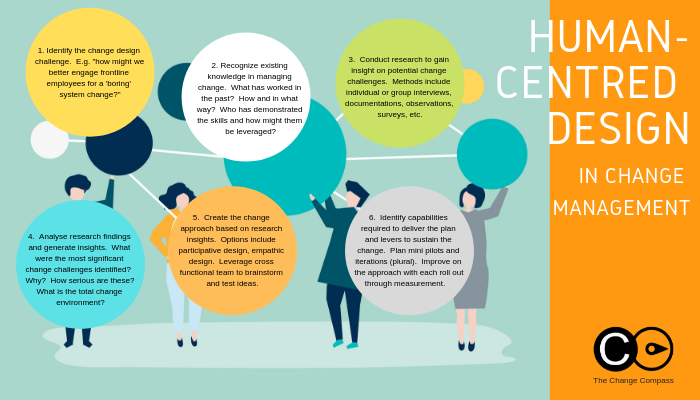
This article outlines six steps for applying human-centred design in change management practice, drawing on established methods from the design discipline and grounding them in the realities of large-scale organisational change.
Why change management needs a different approach to understanding people
The dominant change management frameworks, including Kotter’s 8-step model and Prosci’s ADKAR, were developed at a time when the primary challenge of organisational change was execution: getting people to comply with decisions that had already been made. They are essentially communication and adoption frameworks, designed to move people from resistance to acceptance. They are good at what they were designed for. But they were not designed to help change practitioners understand how a proposed change intersects with the lived experience of the people it affects.
Human-centred design starts from a different premise. Rather than asking “how do we get people to adopt this change?”, it asks “what is this change like for the people experiencing it, and how should that shape what we design?” IDEO’s foundational work on design thinking established three lenses for this inquiry: desirability (what do people actually want?), viability (what is sustainable for the organisation?), and feasibility (what is technically possible?). Most change management prioritises the second and third while treating the first as a secondary concern. HCD reverses that order, treating desirability as the starting point.
Research published in Harvard Business Review on design thinking applied to change management found that organisations using design methods to develop change interventions reported substantially higher employee satisfaction with the change process and stronger sustained adoption compared to those using conventional change approaches. The difference was not in the quality of communication or training, but in whether the design of the change itself was based on genuine understanding of the employee experience.
Step 1: Define the human problem, not just the business problem
Every change programme starts with a business problem: a process inefficiency to fix, a system to replace, a structure to reorganise. Human-centred design adds a second problem statement alongside the business one: what is the human problem that this change creates, and what would a good outcome actually look like for the people experiencing it?
This is not a rhetorical exercise. It requires a specific framing discipline. Business problem statements typically describe the current state in terms of costs, risks, or performance gaps. Human problem statements describe the experience of the people involved: the friction they feel, the workarounds they have built, the things they value that are at risk. A technology replacement programme might have a business problem statement about reducing maintenance costs for a legacy system. The corresponding human problem statement might be: “Experienced staff have built deep expertise in the current system over years, and they are uncertain how that expertise will be valued when the system changes.”
Articulating both problem statements at the outset ensures that the change design is accountable to both dimensions throughout the programme, not just the business case.
Step 2: Conduct discovery research with affected people
The most common form of “discovery” in change management is a stakeholder interview or workshop. These are valuable, but they have a significant limitation: people tend to describe what they think rather than what they do. Human-centred design uses observational research methods that reveal the gap between the two.
Key discovery methods for change practitioners
Three methods are particularly useful in the change management context:
- Contextual inquiry: Spending time observing people doing their actual work in their actual environment, rather than asking them to describe it in a meeting room. This surfaces the workarounds, informal processes, and tacit knowledge that people rely on and rarely mention explicitly.
- Experience journeys: Mapping the end-to-end experience of completing a key task or process from the employee’s perspective, including the emotional highs and lows. This identifies the moments that matter most and the points where a change is most likely to cause disruption.
- Empathy interviews: In-depth conversations focused on stories and experiences rather than opinions and preferences. The goal is to understand the context behind what people value, not just what they say they want.
The output of discovery research is not a report. It is a set of specific, grounded insights about the human experience that will shape the design decisions to follow. McKinsey’s research on the business value of design found that companies in the top quartile for design thinking practices significantly outperformed industry benchmarks, partly because they invested in understanding users before designing solutions rather than after.
Step 3: Build a rich picture of the affected experience
The output of discovery research needs to be synthesised into a shared understanding that the change team can use to make decisions. In HCD, this synthesis step produces artefacts that represent the human experience in a tangible, accessible form. Three artefacts are particularly useful in change management:
Personas represent distinct groups of affected employees, characterised not just by their role but by their relationship to the change. A useful change persona goes beyond job title to describe what the person values, what they are worried about, what their daily work actually looks like, and what would make this change feel acceptable or even positive to them.
As-is journey maps document the current experience of key processes or workflows that the change will affect. They reveal the pain points, moments of pride, and critical dependencies that the change design needs to account for.
Insight statements distil the most important discoveries from the research into clear, actionable observations. A good insight statement describes a tension or unmet need, not just a preference: “Long-serving staff have deep system knowledge that is not documented anywhere. When the system changes, this knowledge disappears unless it is deliberately captured and transferred.”
These artefacts serve a practical function throughout the programme: they give the change team a shared reference point for evaluating whether proposed approaches are genuinely responsive to the human experience, rather than just technically correct.
Step 4: Co-design change interventions with the people affected
Co-design is perhaps the most misunderstood element of human-centred design when applied in organisational settings. It does not mean consulting employees on decisions that have already been made, which is the form most change “engagement” actually takes. It means involving employees in generating and testing potential solutions before they are finalised.
In practice, co-design workshops for change management might involve employees in designing how a new process should work (not just what it should achieve), what training would actually be useful to them (not just what the compliance function requires), or how communication should be structured so that it feels relevant rather than generic.
What co-design is not
A common concern from programme managers is that co-design creates false expectations, giving employees the impression that they have more control over the change than they actually do. This concern is legitimate but manageable. The solution is to be explicit about what is and is not within scope for co-design. The decision to implement a new system is typically not negotiable. The way the transition is managed, how training is structured, and how the support model is designed often are. Being clear about this boundary at the outset of co-design activities prevents the expectation gap that programme managers worry about.
The Design Council’s Double Diamond framework provides a useful structure for co-design in change contexts: diverge broadly to understand the problem space, converge on key insights, diverge again to generate potential solutions, then converge on the most promising approach to develop and test. This structure prevents co-design from becoming an open-ended conversation with no clear output.
Step 5: Prototype and test before rolling out
One of the most powerful habits from design practice that change management has largely not adopted is rapid prototyping: testing a low-fidelity version of a proposed approach with a small group before investing in full-scale delivery.
In change management, prototyping might look like running a draft training module with a small group of employees before finalising the curriculum, testing a communication format with a pilot audience before distributing it organisation-wide, or running a new support model in one business unit before scaling it. The goal is to identify problems early, when fixing them is cheap, rather than discovering them at full deployment when they are expensive.
This approach requires a shift in mindset from many programme managers, who see a “test” as a delay to the schedule. The reframe is that a pilot is not a delay to full delivery but rather a risk mitigation step that reduces the likelihood of a costly full-scale failure. Prosci’s research on change management effectiveness consistently shows that programmes with strong employee engagement and iterative design significantly outperform those that move directly from design to full delivery without any testing phase.
Step 6: Build feedback loops into implementation
The sixth step is the one most commonly skipped: building structured feedback loops into the implementation that allow the change design to be continuously refined based on how it is actually landing.
Most change programmes collect feedback through post-implementation surveys. This is too late to be useful. By the time a survey is designed, distributed, analysed, and reported, the programme has typically moved on to its next phase, and the findings sit in a report that influences the next programme rather than the current one.
Feedback loops in a human-centred approach are more frequent and more immediate: short pulse checks after key milestones, rapid feedback sessions with frontline managers, direct observation of how employees are using new tools or processes in the first weeks after go-live. The purpose is not to measure satisfaction but to identify friction quickly enough to respond to it. When a change manager has access to this kind of real-time signal, they can escalate issues to the programme team before they compound, rather than documenting them for a lessons-learned report.
Digital tools that support human-centred change design
Applying human-centred design at scale requires supporting infrastructure. Managing discovery insights, persona libraries, journey maps, and feedback data across a complex portfolio is difficult to do in documents and spreadsheets. Platforms like The Change Compass help change practitioners track the cumulative impact of change on specific employee groups, providing the portfolio-level visibility needed to understand whether the aggregate load on any particular group has reached a level that would undermine even well-designed change interventions. This is particularly relevant in organisations running multiple concurrent programmes, where individual team-level human-centred design cannot account for the combined effect across the portfolio.
Moving from human-centred language to human-centred practice
The six steps above are not a new change management framework. They are a set of methods that complement existing frameworks by grounding them in direct evidence about the human experience. A change manager who conducts genuine discovery research, builds accurate personas, co-designs interventions with affected employees, prototypes before scaling, and maintains real-time feedback loops is not doing something fundamentally different from change management. They are doing it with better information.
The most accessible starting point is step two: before the next change programme you are supporting moves into communication planning, spend two or three days observing the people most affected by it doing their actual work. What you learn will change how you approach every subsequent step. That is the practical test of what it means to be genuinely human-centred, rather than just human-sounding.
Frequently asked questions
What is human-centred design in change management?
Human-centred design in change management is the application of design research methods, including contextual inquiry, journey mapping, and co-design, to ground change interventions in direct understanding of the employee experience rather than assumptions about what people need. It differs from conventional change management by treating discovery of the human experience as a prerequisite for designing the change approach, rather than as an input to communication planning.
How is HCD different from stakeholder engagement?
Conventional stakeholder engagement focuses on informing people about a change and managing their reactions. Human-centred design goes further by using structured research methods to understand the lived experience of affected employees before and during the change. The difference is between managing people’s response to decisions already made and designing the change itself based on what you learn about people’s needs and experience.
What is co-design in change management?
Co-design involves bringing affected employees into the process of designing change interventions, such as training approaches, support models, and communication formats, before they are finalised. It is distinct from consultation, where people are asked to comment on decisions already made. Effective co-design is bounded: it is clear which elements of the change are open for co-design and which are fixed, preventing the expectation management issues that programme managers often worry about.
Can human-centred design work within tight timelines?
Yes, though it requires prioritisation. Even two or three days of contextual observation with a small group of affected employees will yield more actionable insight than a week of stakeholder interviews. Rapid prototyping and pulse-check feedback loops are inherently faster than traditional survey-and-report cycles. The methods scale to fit the time available, and even lightweight application is significantly more effective than designing change based purely on assumptions.
How do you measure whether a human-centred design approach worked?
The primary measures are adoption quality and sustained behaviour change, rather than awareness or training completion. Secondary indicators include the speed at which issues are surfaced and resolved during implementation, the volume and nature of escalations, and employee sentiment data collected at more frequent intervals than end-of-programme surveys. A human-centred approach should produce fewer surprises during implementation because the discovery phase has already surfaced most of the likely friction points.