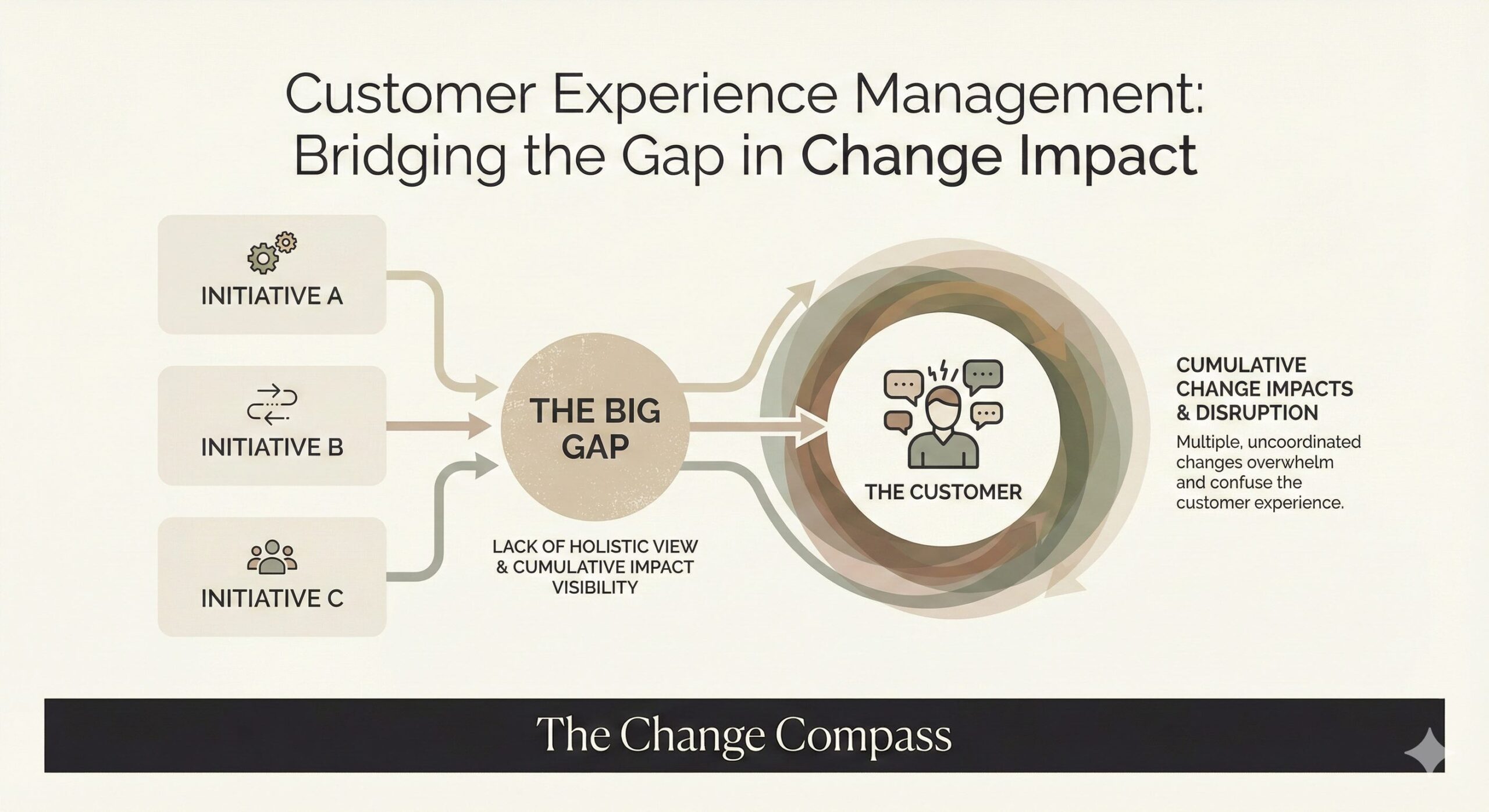


Customer experience management dominates strategic conversations across banking, utilities, telecoms, and retail. Companies invest heavily in CRM systems, digital channels, and customer journey mapping. Yet a fundamental gap persists: the lack of integrated visibility into how company-wide change initiatives shape customer perceptions.
This guide reveals why traditional approaches fall short, quantifies the risks of disconnected change efforts, and provides a practical roadmap for creating a true single view of the customer through change impact integration.
What Prevents Companies from Achieving a Single View of the Customer?
Recent research confirms persistent challenges in customer experience management. A 2024 Forrester study found 48% of enterprises still struggle with unified customer data across channels and departments. Similarly, Gartner reports 52% cite building cohesive new experiences as their top barrier.
The core issue lies beyond siloed CRM data. Companies lack visibility into the cumulative impact of concurrent initiatives—product changes, pricing adjustments, IT rollouts, regulatory communications—that collectively define customer reality.
Why Traditional CRM Approaches Fall Short
CRM systems excel at marketing automation, sales tracking, and contact centre efficiency. However, they capture only transactional interactions, missing the broader context of organisational change.
Traditional CRM Focus Limitations
- Marketing campaign data
- Sales conversion metrics
- Service interaction logs
- Customer segmentation profiles
These systems overlook how product updates, pricing shifts, or compliance communications alter customer perceptions between tracked touchpoints.
The Missing Piece: Change Impact Tracking
The critical gap involves mapping all customer-impacting initiatives into a unified view. This includes marketing campaigns plus operational changes affecting service delivery.
Change Initiatives Shaping Customer Experience
- Product lifecycle changes (end-of-life, new features)
- Pricing and billing adjustments
- IT system rollouts impacting service access
- Regulatory compliance communications
- Employee training initiatives influencing service quality
- Partner or supplier changes affecting delivery
Without this integrated picture, companies cannot anticipate cumulative customer confusion or frustration.
Traditional CRM vs Change Impact Data vs Integrated CX View
| Data Source | Focus | Customer Insight | Strategic Value |
|---|---|---|---|
| CRM Systems | Marketing, sales, service transactions | Individual touchpoints | Tactical optimisation |
| Change Impact Data | Company initiatives affecting customers | Planned experience shifts | Risk anticipation |
| Integrated View | Combined datasets | Holistic customer reality | Strategic CX orchestration |
This table illustrates why isolated CRM investments yield incomplete results.
Risks of Disconnected Change Initiatives
Without integrated change visibility, companies create conflicting customer signals that erode trust and satisfaction. Real-world examples illustrate the consequences.
Common Customer Confusion Scenarios
- One department ends a credit card product while sales teams push aggressive uptake targets
- IT rollout disrupts online banking while marketing promotes digital-first convenience
- Pricing changes coincide with loyalty program promotions, confusing value messaging
- Regulatory communications clash with personalised marketing campaigns
These disconnects compound across multiple initiatives, overwhelming customers.
Financial Impact of Poor CX Coordination
The stakes are substantial. Recent studies quantify the cost:
- Forrester 2024: Companies lose $1,200+ per negative customer experience
- Gartner 2025: 42% of telecom households report negative experiences from conflicting communications
- McKinsey: Utilities face 28% churn risk from uncoordinated service disruptions
Cumulative impact across customer bases represents millions in lost revenue annually.
The Solution: Integrated Customer Change Impact Management
Create a unified view combining CRM data with change impact analytics for holistic CX orchestration.
Core Components of Integrated CX Visibility
- Centralised Change Repository: Track all customer-impacting initiatives across departments
- Customer Segmentation Mapping: Align change impacts with specific personas and journeys
- Timing & Volume Analysis: Visualise change saturation by customer segment over time
- Impact Correlation Engine: Link initiatives to expected CX outcomes and risks
- Strategy Alignment Dashboard: Compare planned changes against customer experience goals
5 Strategic Benefits
- Anticipate cumulative customer confusion before rollout
- Optimise change sequencing to minimise disruption peaks
- Align departmental initiatives with unified CX strategy
- Quantify ROI from coordinated vs siloed change efforts
- Enable proactive service recovery planning
Customer Change Impact Matrix Example
| Customer Segment | Product Change | Pricing Shift | IT Rollout | Regulatory Comm. | Total Impact Score |
|---|---|---|---|---|---|
| Premium Banking | Medium | High | Low | Medium | High |
| Mass Market | Low | High | High | Low | High |
| Digital Native | High | Low | High | Low | High |
This matrix reveals saturation risks by segment.
Implementation Roadmap for Integrated CX Change Management
Phase 1: Foundation (0-3 Months)
- Inventory all customer-impacting initiatives across departments
- Map initiatives to customer segments and journey touchpoints
- Establish cross-functional CX governance council
- Build baseline change impact repository
Phase 2: Integration (3-6 Months)
- Connect change data with existing CRM/customer systems
- Deploy change saturation dashboards by segment
- Implement automated conflict detection alerts
- Launch pilot optimisation for high-risk periods
Phase 3: Optimisation (6-12 Months)
- Embed CX alignment reviews in initiative approval processes
- Scale predictive impact modelling across portfolio
- Establish continuous improvement feedback loops
- Benchmark against industry CX leaders
Governance and Success Factors
Essential Governance Elements
- Executive sponsorship with direct profit/loss accountability
- Cross-departmental representation in change review forums
- Standardised change impact assessment templates
- Monthly portfolio saturation reporting to leadership
Critical Success Metrics
- Reduction in customer confusion complaints (25% target)
- Improved Net Promoter Score during change periods
- 30% faster issue resolution through proactive planning
- Higher departmental collaboration scores
Frequently Asked Questions (FAQ)
What is the biggest gap in customer experience management?
Lack of integrated visibility into how company-wide change initiatives collectively shape customer perceptions and experiences.
Why do CRM systems alone fail to deliver unified CX?
CRM captures transactions but misses operational changes like product updates, pricing shifts, and IT rollouts that define customer reality.
How much do poor CX experiences cost companies?
Recent studies show $1,200+ lost per negative experience, with millions annually across customer bases in banking and utilities.
What does integrated CX change management look like?
Centralised change repositories, customer segmentation mapping, saturation dashboards, and strategy alignment analytics working together.
How do you identify customer change saturation risks?
Use impact matrices showing concurrent initiatives by segment, highlighting high-risk periods needing sequencing adjustments.
What is the first step toward CX change integration?
Conduct an inventory of all customer-impacting initiatives across departments to establish baseline visibility.