

Most organisations now compete on how much change they can push through the system. Very few compete on how well they design focus.
Travelling through Japan, visiting zen temples and the art islands of Teshima and Naoshima, I was struck by how intentional design changes how you feel and what you notice. Many exhibitions are minimalist. They strip everything away until only one thing remains to focus on.
One installation in Naoshima called Minamidera crystallised this. You enter a wooden house completely devoid of sound and light. For several minutes you sit in total darkness. No phone, no notifications, no visual stimulus. This invoked a sense of fear. Fear of unfamiliarity, and loss of control through the senses. Then a faint horizontal bar of light appears and you are invited to stand and walk towards it.
Nothing “happens” in a conventional sense. Yet it is a powerful lesson in design and focus. Remove noise, introduce a single clear stimulus, and the mind locks on. That bar of light becomes everything.
It made me think about how we design the focus of employees’ working lives during change.
From zen rooms to inbox overload
In most organisations, employees already juggle multiple focus areas in their business-as-usual roles. Customer issues, team responsibilities, metrics, projects, performance expectations. That complexity is normal and, for many roles, manageable.
Then change arrives.
During change, we add new focus demands on top of existing BAU:
- New systems to learn
- New processes to follow
- New KPIs and reporting
- New behaviours and expectations
- New governance or risk controls
Change is technically “part of work”, but the cognitive load it demands is different. Learning, unlearning, experimenting, troubleshooting and making sense of ambiguity all draw on high-order attention. Research shows that performance deteriorates significantly when complex tasks are combined with frequent switching and divided attention.
In other words, complex change competes directly with complex BAU for the same limited attention budget. When you stack multiple complex changes, you do not just add more work. You fragment focus and degrade performance.
Why divided attention is so expensive in complex change
Cognitive psychology has been clear for decades: multitasking and task switching carry measurable costs. Studies consistently show that:
- Reaction times and error rates increase when people switch between demands compared to focusing on a single demand.
- Divided attention and frequent switching degrade performance even when total workload does not increase dramatically.
Now map this to organisational life. A team lead might, in a single day:
- Respond to customer escalations in a legacy process
- Attend training for a new system
- Review impact of an upcoming regulatory change
- Complete a risk assessment for another initiative
- Report on metrics impacted by yet another change
Each of these requires a different “mental mode”. In isolation, each is manageable. Combined, especially when complexity is high, the brain is constantly reconfiguring. Research on task switching highlights that each reconfiguration has a cost that accumulates over the day.
This is exactly what many change portfolios unintentionally create: high complexity plus constant switching across initiatives, without any design of where attention should be concentrated at any point in time.
The result is familiar:
- Slower adoption of every initiative
- More errors and rework
- Lower engagement and higher fatigue
- Change saturation, where employees feel unable to give anything their full attention.
Complex change demands concentrated focus
Not all change requires the same depth of focus. Updating a minor reporting template is not the same as shifting a core operating model. Rolling out a minor policy tweak does not demand the same cognitive effort as embedding a new risk framework.
Complex change, by definition, requires:
- Deep understanding of new concepts and language
- Behaviour shifts that must become habitual
- New decision rules that are not yet automatic
- Coordinated changes across multiple teams or systems
This is closer to the experience of sitting in that darkened room in Naoshima and then orienting towards a single bar of light. You are not processing ten stimuli in parallel. You are committing fully to one.
Now imagine the “zen room” equivalent of most corporate portfolios. Instead of darkness and one bar of light, the space is filled with:
- Multiple screens showing different dashboards
- Three competing audio tracks promoting different initiatives
- A handful of managers each pointing at a different “must win” change
- A constant stream of notifications from collaboration tools
Complex change needs the opposite: fewer focus points at any given moment, presented through channels designed to support depth, not just awareness.
This is where change portfolio management and tools like The Change Compass become crucial. They allow you to see not just how many initiatives exist, but how much complex attention each demands, and how they collide in the lived experience of teams.

The hidden layers of focus: corporate, departmental, team
Once you add organisational structure, the focus problem becomes multi-layered.
At the corporate level, there might be three to five strategic priorities. Leaders often assume this gives clarity. On paper it does.
At the departmental level, each function translates corporate priorities into its own portfolio:
- Technology has its own roadmap
- HR runs its own transformation program
- Finance has regulatory and process changes
- Operations has efficiency and service initiatives
At the team level, local leaders overlay their own focus areas:
- Performance targets
- Local improvement efforts
- Staff development and engagement work
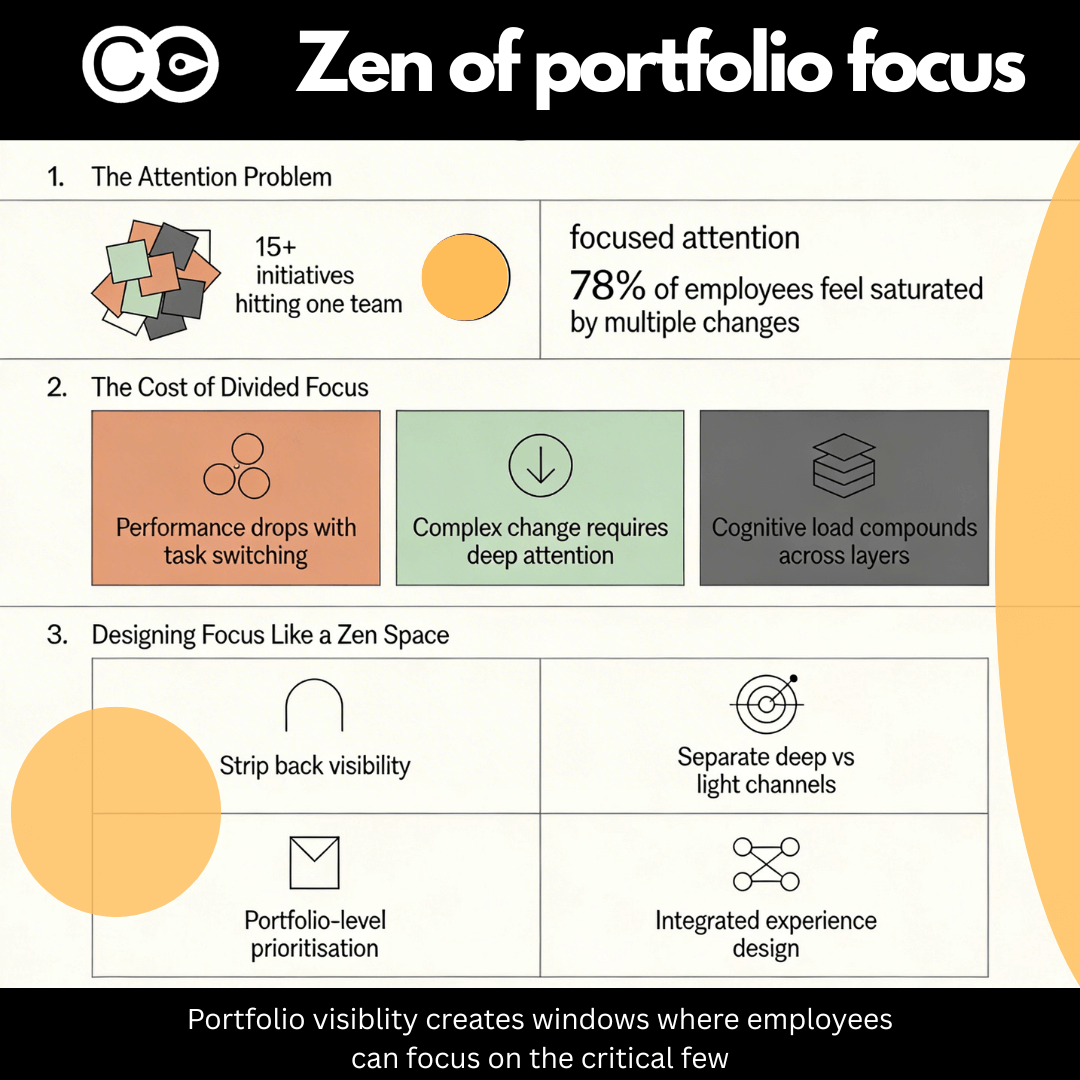
An employee sitting in a branch, a contact centre, a distribution centre, or a shared service hub does not experience “three to five priorities”. They experience all of these layers at once. Each initiative thinks it is in the top three. Collectively, they become the top fifteen.
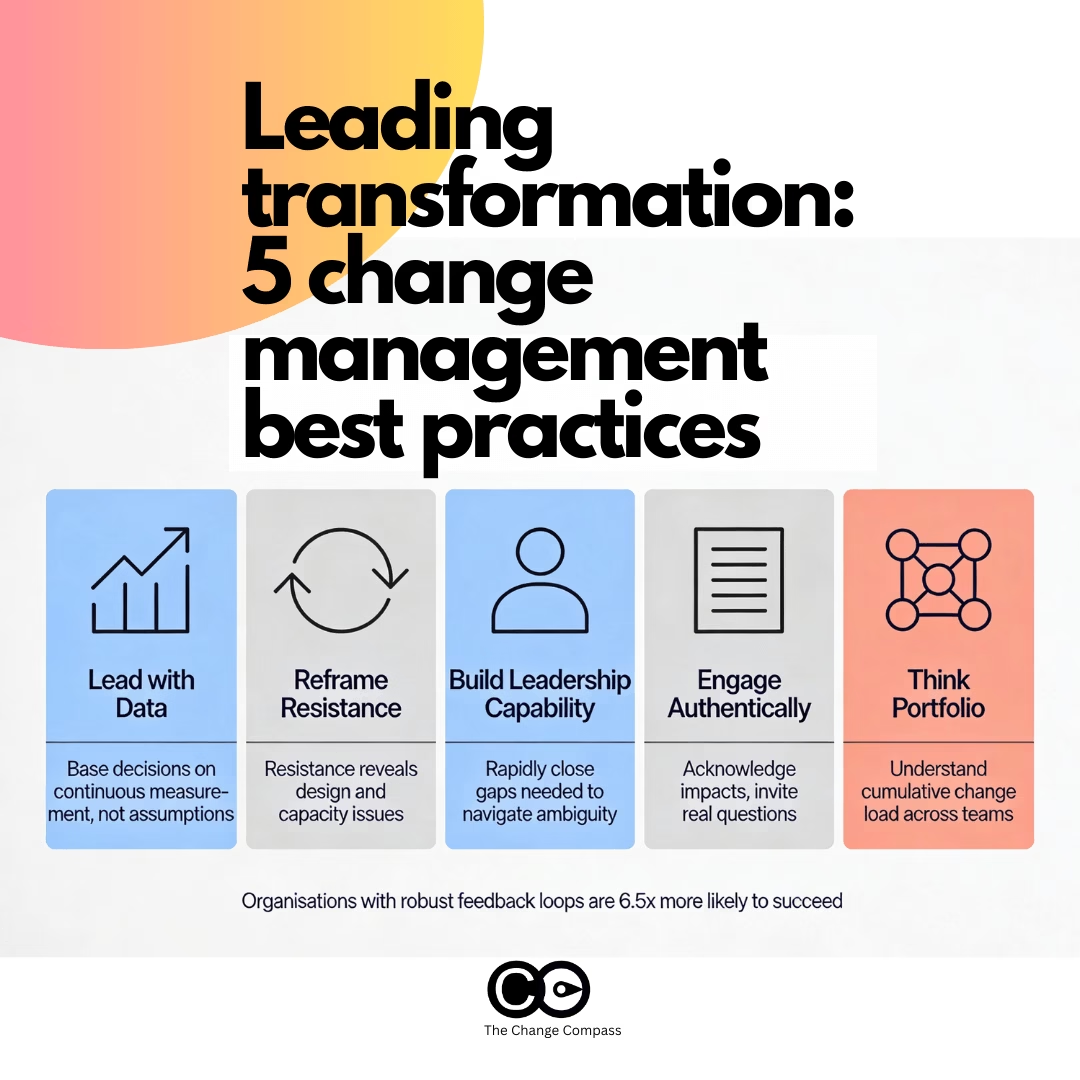
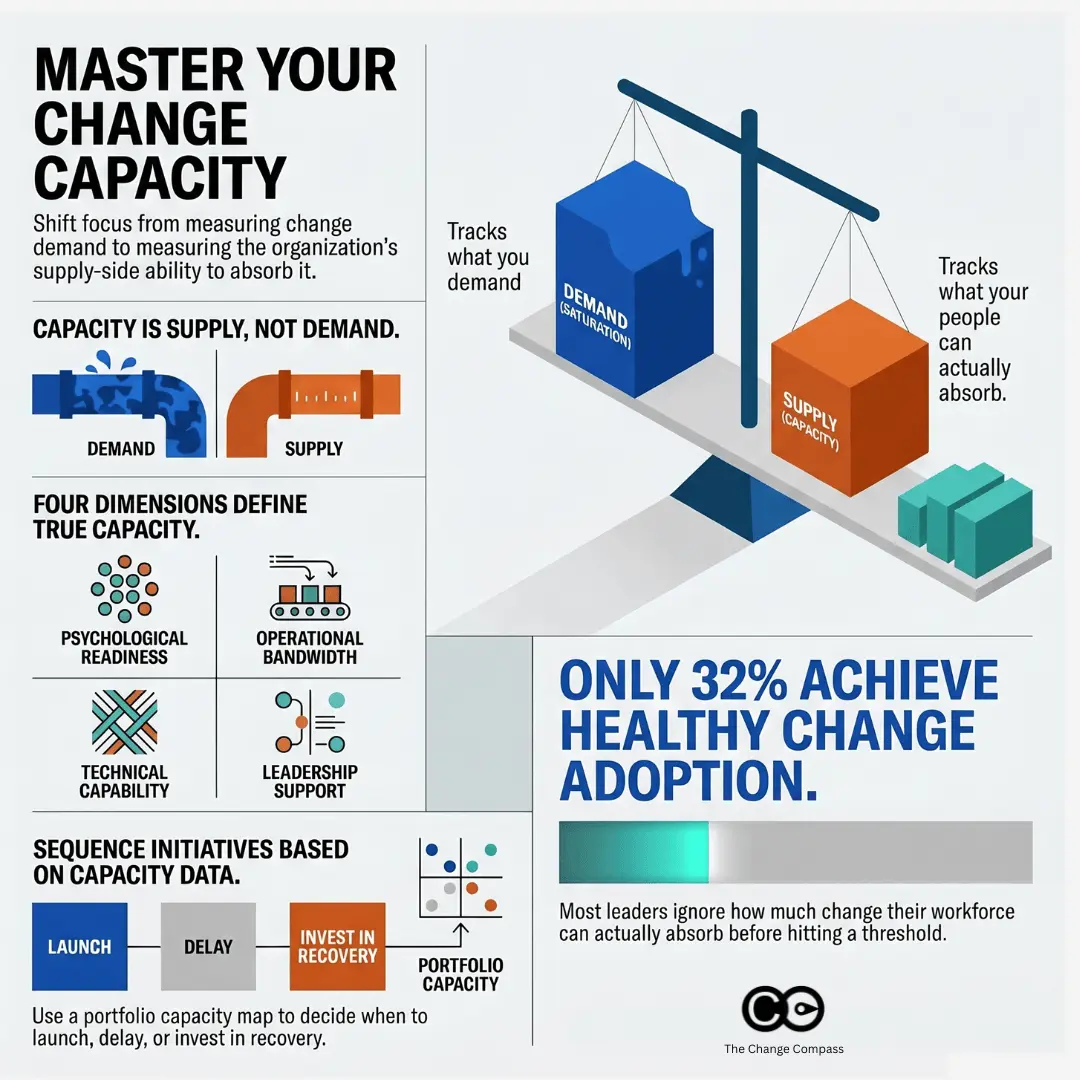
Prosci and other research bodies have shown that organisations struggle because they underestimate how many changes are underway at the same time and how those accumulate on individuals. Portfolio-level studies confirm that unmanaged accumulation leads to change saturation, which then drives fatigue, lower productivity, and higher turnover.
The job of change leaders, therefore, is not just to manage each initiative well. It is to cut through this layered complexity and design focus across levels.
Designing focus like a zen space, not a crowded noticeboard
If we take the Naoshima experience as a metaphor, there are several principles we can apply to portfolio-level change.
1. Strip back what is visible at any one time
In the art installation, everything non-essential is removed so that one element can dominate experience.
In change terms, this means:
- Not every initiative gets equal airtime in every channel.
- At any point in time, each role should have a small number of clearly signposted focus changes.
- Organisation-wide channels should highlight only the handful of complex, behaviour-changing initiatives that truly require deep attention.
The rest can move into lighter touch channels designed for awareness rather than behaviour shift.
Change portfolio tools can support this by showing, for each role or team, how many initiatives are active in a period and how heavy their impacts are. This allows you to actively design “focus windows” where only one or two complex initiatives hit that population at depth.
2. Separate “deep change” channels from “background noise”
We often treat all communication channels as equal, which means critical change messages compete with general updates and noise.
Instead, consider:
- Deep-focus channels for complex change. These might include structured workshops, leadership-led sessions, immersive simulations, or well-designed learning journeys. These are the equivalent of the darkened room and single bar of light. When employees are in these channels, they know “this is where I need to concentrate fully”.
- Light-touch channels for background or ongoing awareness. These can be newsletters, intranet updates, short videos, or social posts that keep other initiatives visible without demanding deep focus.
By consciously assigning initiatives to the right channel type, you avoid clouding focus. High-complexity changes are not diluted by being mixed in with dozens of minor updates.
Research on change saturation emphasises the importance of managing not just volume, but the perceived intensity and cognitive load of communication and demands.
3. Prioritise across the whole portfolio, not just within silos
Prioritisation is often done within portfolios: technology prioritises its roadmap, HR prioritises its programs, operations prioritises its improvement work. The result is multiple “top fives” that collide.
Portfolio-level prioritisation asks a different question:
“For this specific group of people, across all sources of change, what truly matters most over the next quarter?”
This requires:
- A single view of all initiatives and their impacts on each group
- A way to compare intensity and complexity of impact
- The courage to pause, cancel, or delay lower-value changes, even if they are important in isolation
Research on change saturation and portfolio management consistently recommends portfolio-level prioritisation and sequencing to avoid overloading stakeholders and to improve adoption outcomes.
McKinsey and other studies have shown that organisations that prioritise and sequence change at portfolio level can realise significantly more value from transformation, in some cases 40% more, precisely because people can focus on fewer things at a time.
4. Design the integrated employee experience across initiatives
Different initiatives naturally craft their own messaging, content, leader narratives, and release plans. Left alone, this produces a fragmented experience. Messages collide, tones differ, and employees receive multiple “number one priorities” in the same week.
A portfolio lens lets you weave an integrated experience across initiatives:
- Messaging: Align language, avoid contradictory slogans, and show how different initiatives connect to a coherent story.
- Content design: Sequence learning so that foundational knowledge for one initiative supports another, rather than overloads.
- Leader messages: Equip leaders to speak to “the whole change story” for their teams, not just the initiative they sponsor.
- Release packaging: Bundle related changes where it makes sense, so employees experience one combined release instead of a series of disjointed tweaks.
- Adoption reinforcement: Use shared reinforcement mechanisms that support multiple initiatives, such as integrated coaching, common dashboards, or combined recognition programs.
This is the portfolio equivalent of designing a curated art experience instead of hanging every artwork the museum owns in one room. Research on enterprise change management shows that organisations with integrated, portfolio-level approaches achieve significantly higher change success than those managing initiatives in isolation.
Making this practical with change portfolio data
All of this is only possible if you have data on:
- How many initiatives touch each role
- The complexity and depth of impact for each initiative
- Timing and sequencing across the year
- The channels being used and their cognitive load
- Readiness, saturation, and adoption measures across the portfolio
This is precisely the problem The Change Compass is designed to solve. By quantifying change impacts and visualising them across initiatives and time, it gives leaders the equivalent of that darkened room and single bar of light: a clear view of what truly needs to be in focus, for whom, and when.
With that view, you can:
- Identify teams with too many complex initiatives landing simultaneously
- Re-sequence releases to create focus windows
- Simplify or postpone lower-value changes for overloaded groups
- Design channel strategies that separate deep change from background updates
- Align messaging and reinforcement across initiatives
In short, you can design focus, not just deliver activity.
Bringing zen discipline into modern change leadership
The lesson from Japanese minimalist art is not to do less for its own sake. It is to make deliberate choices about what fills the frame.
In change and transformation, that means:
- Being ruthless about what you ask people to focus on now versus later
- Reducing visual and cognitive clutter in your change communications
- Using portfolio data to create clarity in environments that are inherently complex
- Treating employee attention as a scarce and strategic resource, not an elastic one
Change leaders today are not just managing timelines and training plans. They are curating the attention of an organisation under pressure from continuous transformation, competing priorities, and constant noise.
Those who do this well will not simply “land more initiatives”. They will build organisations where people can focus deeply on the critical few changes that truly matter, embed them well, and be ready for what comes next.
And that, in a noisy world, is a genuine competitive advantage.
Frequently Asked Questions
What is change portfolio focus and why does it matter?
Change portfolio focus refers to intentionally designing employee attention across multiple initiatives, ensuring complex changes receive deep concentration rather than competing for divided attention. Without it, performance drops, adoption suffers, and employees experience saturation.
How does divided attention affect complex change adoption?
Cognitive research shows task switching between complex demands increases errors and reaction times. When multiple initiatives layer on top of BAU work, employees cannot embed new behaviours effectively, leading to fragmented adoption and fatigue.
How can zen principles apply to change management?
Zen minimalism teaches removing noise to highlight one clear focus point. In portfolios, this means stripping back competing messages, using dedicated channels for deep change, and creating “focus windows” where employees concentrate on 1-2 critical initiatives.
What are the main causes of change saturation across organisational layers?
Saturation occurs when corporate, departmental, and team-level priorities collide. Each layer adds its “top priorities,” overwhelming employees. Portfolio visibility reveals these overlaps, enabling prioritisation and sequencing.
How does The Change Compass help with portfolio focus design?
The Change Compass provides role-level impact heatmaps, saturation alerts, and sequencing analysis, helping leaders design integrated experiences, reduce cognitive load, and create focus windows across initiatives.
What are practical steps to implement portfolio-level focus?
- Map all initiatives and their complexity by role
- Prioritise across the portfolio, not just within silos
- Sequence releases to avoid concurrent peaks
- Separate deep-focus channels from awareness channels
- Align messaging and reinforcement across initiatives.