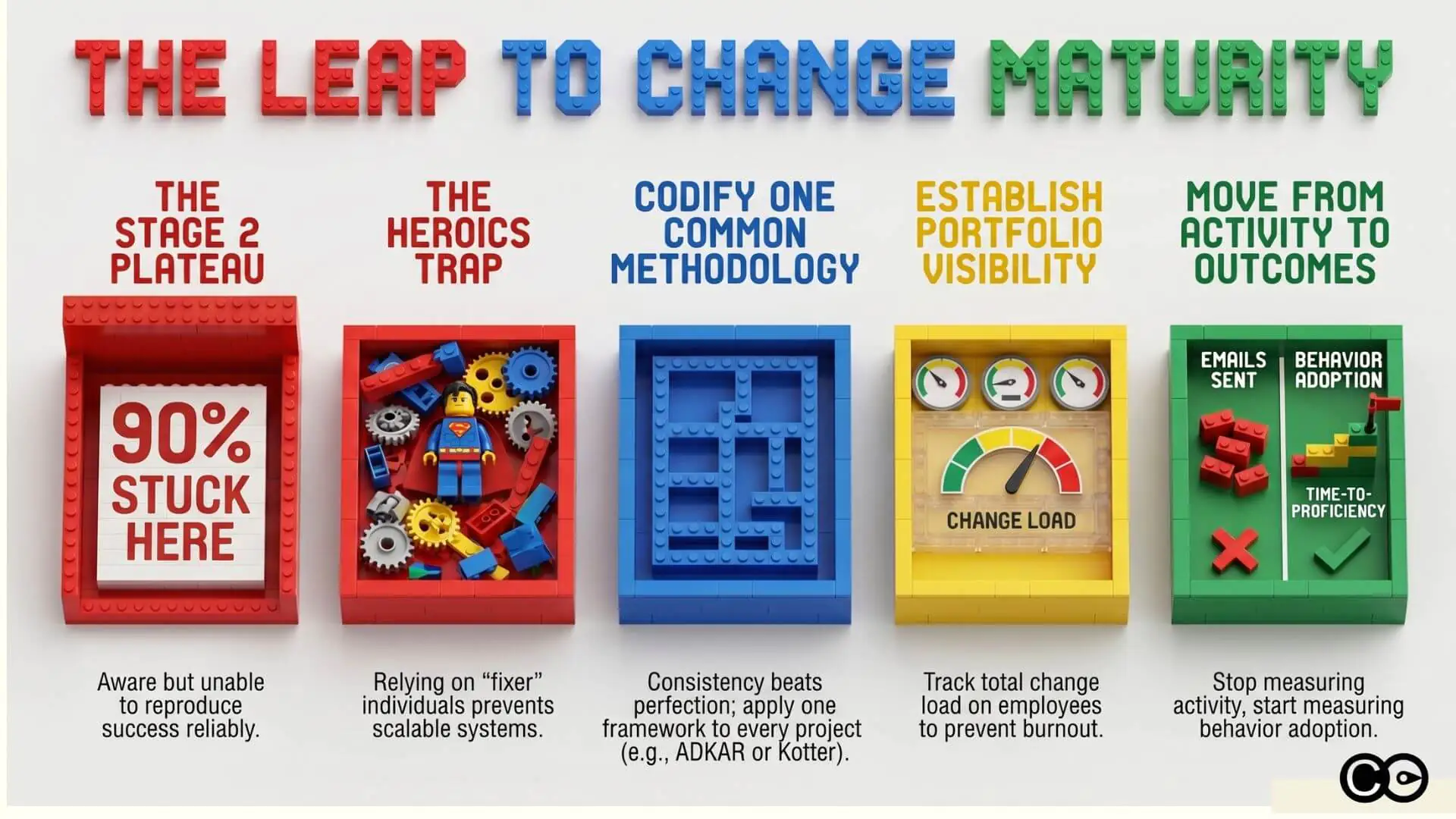


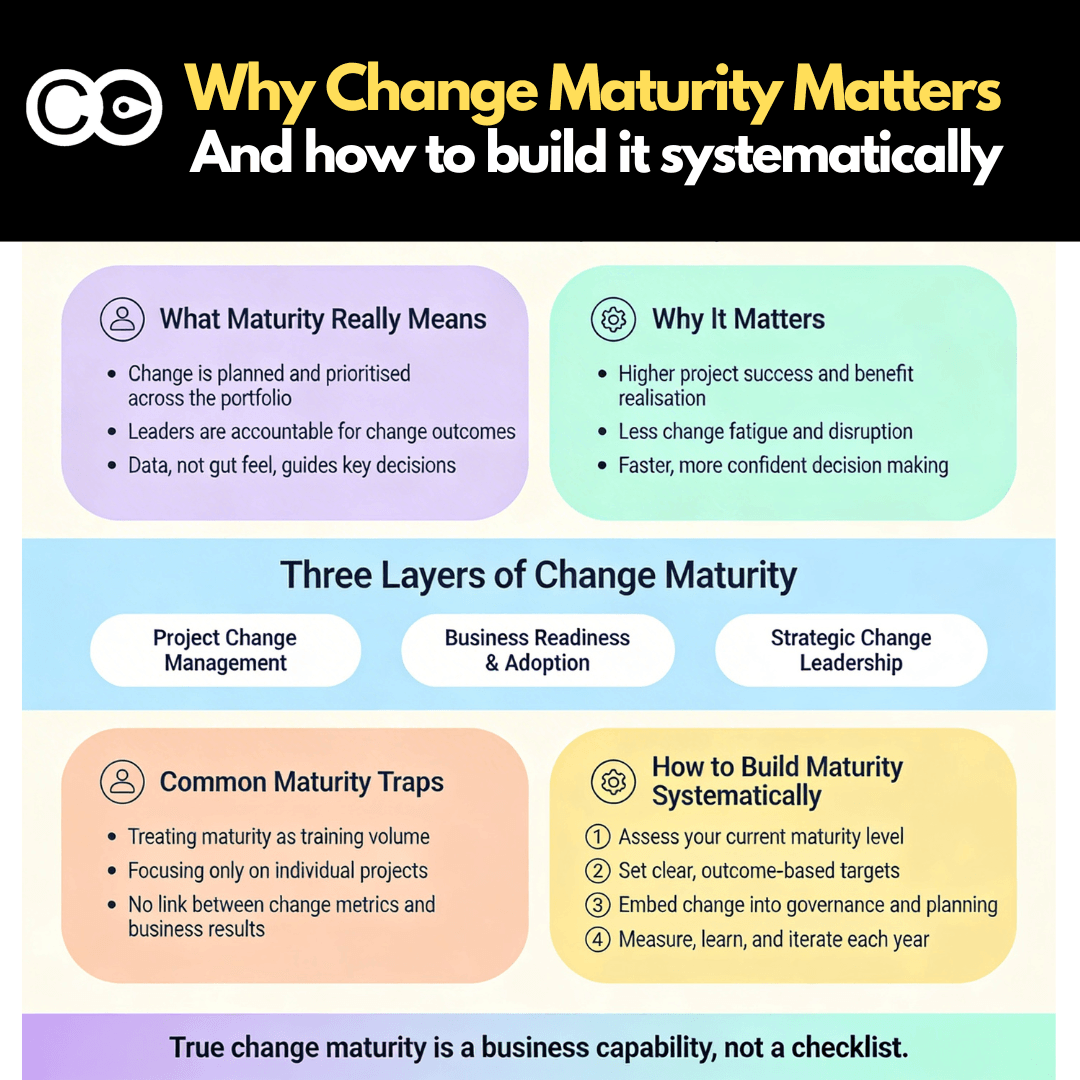
Change management maturity is the degree to which an organisation has institutionalised change capability so it is repeatable, consistent and improving over time, rather than dependent on individual practitioners or isolated programmes. A mature change function has a defined methodology applied across initiatives, embedded practitioners across business units, governance that connects change activity to portfolio decisions, measurement infrastructure that tracks adoption and benefit realisation, and leaders who model the behaviour change required of others. Maturity matters because it is the difference between an organisation that succeeds at change because of who is in role, and one that succeeds because of how it operates.
Most organisations approach change maturity the same way they approach most capability gaps: they send people on training courses, roll out a methodology, and distribute a set of templates. It is a reasonable instinct. But after working with organisations across industries and geographies, a consistent pattern emerges that challenges this assumption. The teams that made the biggest leaps in change maturity were not the ones with the most comprehensive training programmes or the most elaborately designed toolkits. They were the ones who first learned to see the change happening around them.
That distinction matters enormously. Visibility and measurement do something that training alone rarely achieves: they create intrinsic motivation. When a business leader can look at a dashboard and see that their team is absorbing seven concurrent initiatives, the conversation about change management stops being abstract. It becomes urgent, personal, and practical. And organisations that reach that point of urgency tend to improve their change capability faster than any classroom intervention could achieve.
This article makes the case that building genuine change management maturity requires three things working in concert: meaningful visibility of change across the organisation, robust governance structures that bring discipline to how change is planned and sequenced, and a portfolio-level view that treats change capacity as a finite resource to be managed. Training has a role, but it is further down the list than most organisations assume.
The training-and-templates assumption
Ask a senior HR or transformation leader how their organisation is building change capability, and the answer is usually some version of the same story. A cohort of change practitioners has been trained in a recognised methodology, perhaps Prosci’s ADKAR model or Kotter’s eight-step framework. A standard set of templates has been created and made available on an intranet. Sponsor briefings are scheduled. A change network has been formed.
These are not bad things. But they share a common limitation: they treat change management as a skill to be acquired by specialists, rather than as a discipline to be embedded across the business. The result is that change management remains something that happens to business teams rather than something they actively participate in. Leaders nod along to change plans prepared by dedicated practitioners, but rarely feel enough ownership of the data to ask hard questions or push back on the change load being placed on their people.
Prosci’s research across more than 2,600 organisations reveals the cost of this gap. Projects with excellent change management are 88% likely to meet or exceed their objectives. Projects with poor change management: 13%. That is a nearly seven-fold difference in outcomes, driven largely by the quality of how the people side of change is managed. And yet the majority of organisations still treat the methodology as the destination, rather than as a starting point.
The deeper problem is that training programmes and templates are, by design, disconnected from real-time data. They equip people with frameworks for thinking about change. What they do not do is give business teams a clear, current picture of what is actually being asked of their people, how ready those people are for upcoming changes, or whether adoption is actually occurring once changes go live.
What actually accelerates change maturity
Visibility as the first catalyst
The most reliable accelerant for change maturity is the moment a business leader first sees their team’s change load visualised in a meaningful way. Not a list of projects. Not a status report. A genuine picture of cumulative change impact: how many initiatives are hitting which business units, in which timeframes, and what that means for the people doing the day-to-day work.
Something shifts when that visibility arrives. Leaders who previously treated change management as a compliance exercise start asking different questions. How does this new initiative land on top of what my team is already absorbing? Are we sequencing this sensibly? Who is most at risk of overload? What does our readiness data actually show? These are exactly the right questions, and they rarely get asked without data to prompt them.
This matters because sustainable change capability is built on habit and ownership, not on awareness. A business unit leader who has seen the visual representation of their team’s change load, and who has experienced the relief of better sequencing or the cost of poor planning, will prioritise change management in ways that no training course can instil. The motivation is intrinsic, grounded in something they have directly witnessed.
When business teams can see the data, behaviour shifts
The pattern repeats across organisations of different sizes and sectors. Business teams that engage regularly with change impact data, readiness assessments, and adoption tracking begin to mature much faster than teams where change management remains the exclusive domain of the change team. They start using the language. They ask for assessments before agreeing to new project timelines. They flag risks earlier, because the data gives them the language and the evidence to do so.
Readiness data is particularly powerful in this regard. When business leaders can see that their team’s readiness scores are lagging behind the go-live date of a major system change, the conversation about additional support shifts from a change practitioner’s recommendation to a business leader’s decision. That shift in ownership is the difference between change management as a service and change management as a capability.
Adoption metrics complete the picture. Tracking whether people are actually using new systems, following new processes, or behaving differently after a change goes live tells the organisation something that no impact assessment or readiness survey can: whether the change has truly landed. Mature change organisations do not close out initiatives when they go live. They close them out when adoption targets are met.
This is not simply a technology observation. It is a behavioural one. Data creates accountability. When change impact, readiness, and adoption are all visible, the full lifecycle of change becomes manageable rather than aspirational.
What research tells us about mature change organisations
The performance gap is significant
The case for investing in change maturity is not just philosophical. The performance differential between mature and immature change organisations is measurable, and it is substantial.
Prosci’s maturity model research found that more than half of organisations (54%) operate at Level 1 or Level 2 on the five-level maturity scale, meaning change management is either absent, ad hoc, or applied only on isolated projects. Only 11% had reached Level 4 or Level 5, where change management is embedded into organisational standards and has become a genuine organisational competency. The gap between these groups is not marginal: at higher maturity levels, change management occurs across more initiatives, is applied more consistently, and produces significantly better outcomes in terms of benefits realisation and achievement of strategic goals.
McKinsey’s research reinforces this picture. Organisations with excellent change management practices are six times more likely to meet or exceed their performance expectations. The research also found that putting equal emphasis on performance and organisational health during transformations is what separates the 30% success rate from a 79% success rate.
More recently, Deloitte’s research on organisational agility found that organisations leading the way in agility are approximately twice as likely as their peers to report better financial results. Change maturity and organisational agility are not the same thing, but they are deeply connected: an organisation that has built genuine change capability can move faster, absorb more change with less disruption, and recover more quickly when things do not go to plan.
The ability to undergo more rapid change without burning out the workforce is precisely what high-maturity organisations develop. They are not necessarily running more changes. They are running changes better, sequencing them more carefully, tracking readiness more rigorously, and building the organisational muscle to do it repeatedly.
The saturation problem most organisations overlook
One of the most consistent findings in change management research is how severely most organisations underestimate the cumulative burden of change on their people. Prosci’s research found that more than 73% of respondents reported their organisations were near, at, or beyond the saturation point. Yet most change governance conversations focus on individual initiative delivery, not on the total change load being absorbed by any given team or role group.
Change saturation is not simply a question of too many changes happening at once. It is a question of whether the organisation has the structures to see the problem coming, and the authority to do something about it. Without visibility and governance, saturation is invisible until it becomes a crisis. By the time leaders notice the symptoms, including rising resistance, disengagement and initiative stalling, the damage is already done. Readiness scores that were adequate six months earlier have deteriorated. Adoption rates have plateaued. And the change team is firefighting rather than building capability.
The structural foundations of change maturity
Visibility alone is necessary but not sufficient. Organisations that sustain high levels of change maturity over time tend to have three structural elements in place that give their change capability a backbone.
Change governance
Change governance refers to the formal structures, decision rights, and accountability mechanisms that determine how change is planned, approved, and overseen at an organisational level. Without governance, change management remains advisory. Individual practitioners can produce excellent assessments and plans, but if there is no mechanism for those assessments to influence decisions about timelines, sequencing, resourcing, or priority, they sit in folders and gather dust.
Effective change governance typically includes:
- An executive-level sponsor or committee with explicit accountability for the change portfolio
- A defined escalation path for change conflicts and capacity constraints
- Regular rhythms for reviewing the cumulative change load across business units
- Clear criteria for what triggers a change impact assessment, a readiness review, or an adoption audit
- Governance checkpoints that require adoption evidence before an initiative can be formally closed
Governance does not need to be bureaucratic. But it does need to be real. The organisations that build genuine change maturity are the ones where change governance carries actual weight in project and portfolio decisions.
Business change processes
Alongside governance structures, mature change organisations embed change management into their core business processes rather than treating it as a parallel activity. This means change impact assessment is a standard part of the project initiation process. It means change readiness data is a standing item on portfolio review agendas, not a one-time survey conducted in the final weeks before go-live. It means adoption measurement is built into the benefit realisation framework from the outset, not bolted on after the fact. And it means business unit leaders have a defined role in the change process, not just as recipients of communications but as active participants in planning, readiness tracking, and adoption accountability.
The practical effect of this integration is significant. When business change processes are built into how the organisation already works, change management becomes part of the operating rhythm rather than an add-on. The cognitive load on individual practitioners reduces. Consistency improves. And the organisation begins to build a shared vocabulary around change impact, readiness, and adoption that reaches well beyond the change team.
Change portfolio management as air traffic control
Perhaps the most critical structural element for organisations managing high volumes of concurrent change is the practice of change portfolio management, sometimes described using the air traffic control metaphor. Just as an air traffic control tower tracks all flights in the air and on the ground, managing runway capacity and issuing ground stops when necessary, an effective change portfolio function tracks all active and planned initiatives, assesses their cumulative impact on affected populations, monitors readiness and adoption status across the portfolio, and has the authority to sequence, defer, or prioritise accordingly.
Protiviti’s analysis of change saturation describes this function well: a change management centre of excellence operating like an air traffic control tower, monitoring what is planned, assessing capacity, and implementing “ground stops” on lower-priority projects when the organisation cannot absorb more change. Without this function, competing projects land on the same business units simultaneously, readiness is assumed rather than measured, and adoption rates become a post-project surprise rather than an in-flight metric.
The air traffic control metaphor is useful precisely because it frames change capacity as a finite resource. Runways have limits. So do people. An organisation that treats change capacity as effectively unlimited will consistently over-commit, under-deliver, and wonder why its change programmes keep stalling.
A practical roadmap for building change maturity
Building change maturity is not a linear process, but there is a practical sequence that tends to produce the fastest results. Organisations that skip directly to governance structures without first establishing data visibility often find that governance lacks teeth, because there is nothing concrete for it to act on. Conversely, organisations that invest in visualisation without governance tend to produce interesting data that does not translate into changed behaviour.
A sequenced approach looks like this:
- Start with change impact data. Before investing in methodology training or governance frameworks, get a clear picture of the change currently hitting your business. Which teams are most affected? What is the cumulative load across key role groups? This baseline is the foundation for everything that follows.
- Add readiness and adoption tracking. Impact data tells you what is coming. Readiness data tells you whether your people are prepared for it. Adoption data tells you whether it has actually taken hold. Building all three into your measurement framework early means you are managing the full change lifecycle, not just the delivery phase.
- Make the data visible to business leaders. Do not present change load, readiness, or adoption data only to the change team. Bring it into the room with general managers, operational leaders, and executives. The goal is to create the shared awareness that makes governance conversations real rather than theoretical.
- Establish lightweight governance. Once leaders can see the data, the case for governance is self-evident. Start with a simple portfolio review rhythm and clear decision rights for managing conflicts and sequencing. Governance does not need to be complex to be effective.
- Embed change into business processes. Identify two or three core business processes, such as project initiation, business case approval, or benefit realisation reviews, and integrate change impact assessment, readiness gates, and adoption milestones into them. This is where change management moves from advisory to mandatory.
- Build capability where it is needed most. Only at this point does targeted training become highly effective, because it is being delivered to people who already understand why it matters. Training disconnected from real change context rarely sticks. Training delivered to leaders who are already engaged with impact, readiness, and adoption data lands differently.
- Measure and improve. Use your baseline data to track maturity progress over time. Mature organisations treat change capability as a measured outcome, not an aspiration.
How digital tools support the journey
Building the kind of change visibility that accelerates maturity requires more than spreadsheets. Platforms like Change Compass are designed specifically to help organisations aggregate change impact data across initiatives, visualise the cumulative load on business units and role groups, and track readiness and adoption in a single portfolio view. When business leaders can see a real-time picture of what their teams are absorbing, how prepared they are, and whether previous changes have genuinely been adopted, the conversations about sequencing, prioritisation, and capacity shift from abstract to concrete. That shift, from gut feel to governed data, is often the turning point in an organisation’s maturity journey.
Where the journey actually starts
The organisations that build genuine change management maturity are not necessarily the ones with the most comprehensive training programmes or the most sophisticated methodologies. They are the ones that first make change visible across its full lifecycle, from impact through to readiness and adoption, then put governance structures in place to act on what they see, and then build the portfolio management discipline to treat change capacity as something to be managed deliberately rather than consumed carelessly.
The research is clear: mature change organisations outperform their peers significantly, can absorb more change with less disruption, and are far more likely to achieve the outcomes their transformation programmes set out to deliver. The path to that level of maturity is more practical than most organisations expect. It starts not with a training calendar, but with a dashboard.
To read more about Change Maturity check out our other article here.
Frequently asked questions
What is change management maturity? Change management maturity refers to how consistently and effectively an organisation applies change management principles, processes, and governance across its initiatives. Prosci’s five-level maturity model ranges from Level 1 (absent or ad hoc) to Level 5 (organisational competency), where change management is a strategic capability embedded across the enterprise. Mature organisations apply change management systematically across impact, readiness, and adoption, not just on high-profile projects and not just during the delivery phase.
How does change management maturity affect business performance? The performance evidence is significant. Prosci’s research shows that projects with excellent change management are nearly seven times more likely to meet their objectives than those with poor change management. McKinsey’s research found that organisations with strong change capabilities are six times more likely to outperform their peers. At an organisational level, greater maturity translates directly into higher transformation success rates, better adoption outcomes, and faster realisation of strategic benefits.
What is change portfolio management and why does it matter? Change portfolio management is the practice of tracking and coordinating all active and planned change initiatives across an organisation, assessing their cumulative impact on affected teams, monitoring readiness and adoption across the portfolio, and sequencing them to prevent saturation and conflict. It is sometimes described using the air traffic control metaphor: like managing runway capacity, it ensures initiatives land without collision. More than 73% of organisations are operating at or near change saturation, which makes portfolio management one of the highest-leverage investments a mature change function can make.
What is the difference between change readiness and change adoption? Readiness measures whether people have the awareness, knowledge, and capability to change before a go-live event. Adoption measures whether they are actually using new ways of working after it. Both matter, and both are frequently under-measured. Organisations that track only readiness often mistake pre-launch preparation for sustained behaviour change. Organisations that track only adoption often find that poor readiness caused the low adoption rates they are now scrambling to fix. Mature change organisations track both, sequentially and in relation to each other.
What is the fastest way to build change management maturity? Based on observed patterns and available research, the fastest path to maturity begins with making change visible to business leaders across its full lifecycle, covering impact, readiness, and adoption, rather than starting with training. When leaders can see concrete data on what their teams are absorbing and whether change is actually sticking, they develop an intrinsic motivation to manage it better. Governance structures and embedded business processes then give that motivation a formal channel. Targeted capability building is more effective once leaders already understand why it matters.
References
- Prosci. The Correlation Between Change Management and Project Success. https://www.prosci.com/blog/the-correlation-between-change-management-and-project-success
- Prosci. 5 Levels of Change Management Maturity. https://www.prosci.com/blog/change-management-maturity-model
- Prosci. Change Saturation. https://www.prosci.com/change-saturation
- McKinsey and Company. How to Double the Odds That Your Change Programme Will Succeed. https://www.mckinsey.com/capabilities/people-and-organizational-performance/our-insights/how-to-double-the-odds-that-your-change-program-will-succeed
- Deloitte Insights. Orchestrating for Agility (2026 Human Capital Trends). https://www.deloitte.com/us/en/insights/topics/talent/human-capital-trends/2026/orchestrating-for-agility.html
- Protiviti. Prevent Change Saturation by Establishing Air Traffic Control for Change Management (2023). https://blog.protiviti.com/2023/05/23/prevent-change-saturation-by-establishing-air-traffic-control-for-change-management/
- The Change Compass. Managing Change Saturation. https://thechangecompass.com/managing-change-saturation-how-to-prevent-initiative-fatigue-and-portfolio-failure/