

Ask a senior change manager in a large organisation whether their portfolio contains change conflicts and the honest answer is usually some version of “probably, but I couldn’t tell you exactly where”. That is not a failure of effort. It is a failure of visibility. In a portfolio of fifteen to forty concurrent initiatives, each governed in its own steering committee with its own definition of success, conflicts between initiatives are the default condition, not the exception. The harder problem is that the conflicts only become obvious in hindsight: in next quarter’s engagement dip, in a softening adoption curve, in a manager’s exit interview that mentions “too much change at once” without naming the specific collisions that caused it.
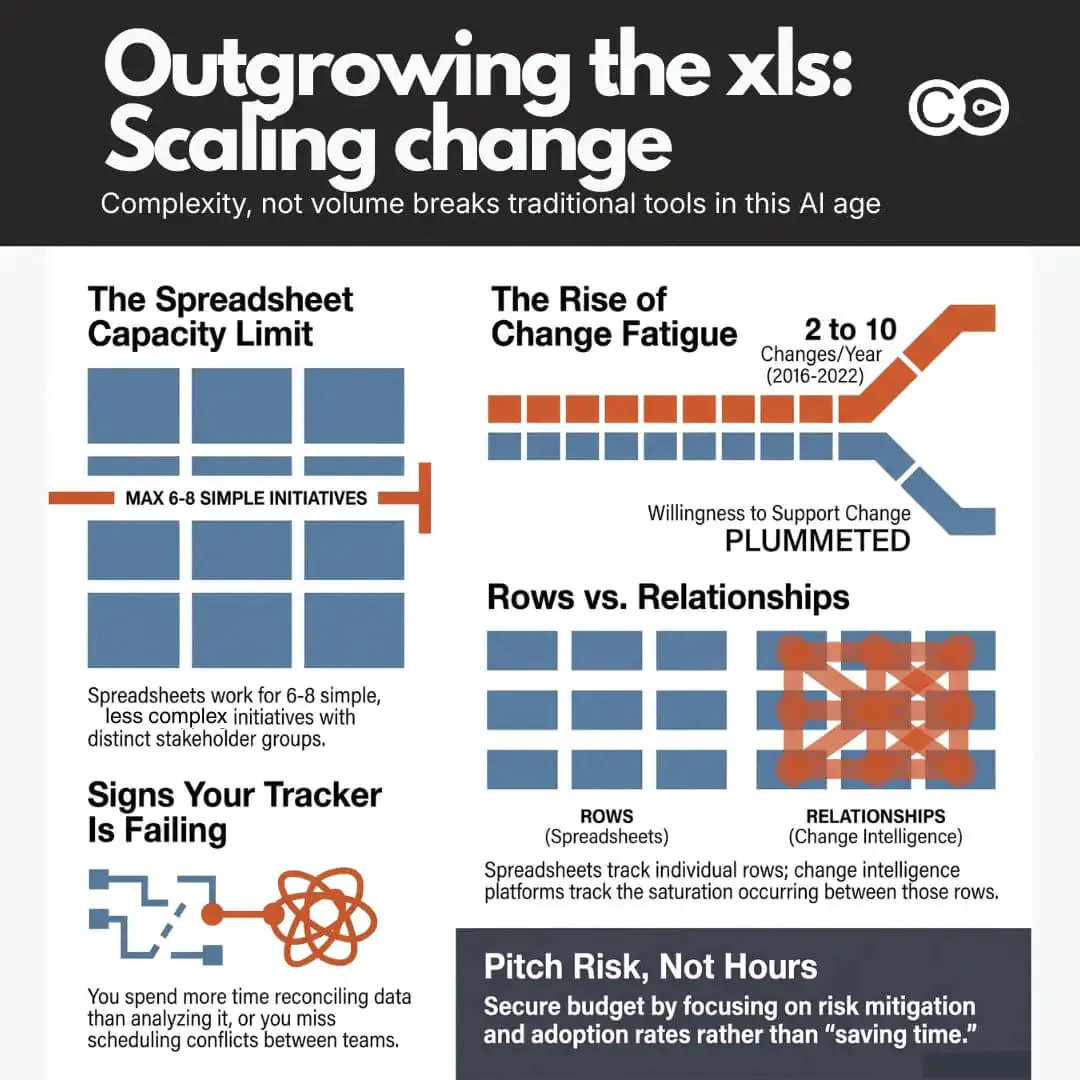
This is the gap that change conflict detection is supposed to close. The volume of organisational change has roughly doubled in the past five years, with Gartner finding the average employee experiences ten enterprise changes per year in 2023, up from two in 2016, while employee willingness to support new enterprise change has fallen from 74% in 2016 to 38% in 2022. At that volume, collisions between initiatives are a structural feature of the portfolio rather than an unlucky exception. The question is no longer whether your portfolio contains change conflicts. The question is whether you can detect them in time to do something about them, and whether your detection method scales beyond a quarterly spreadsheet exercise that ages out the moment any initiative replans.
What change conflict actually is
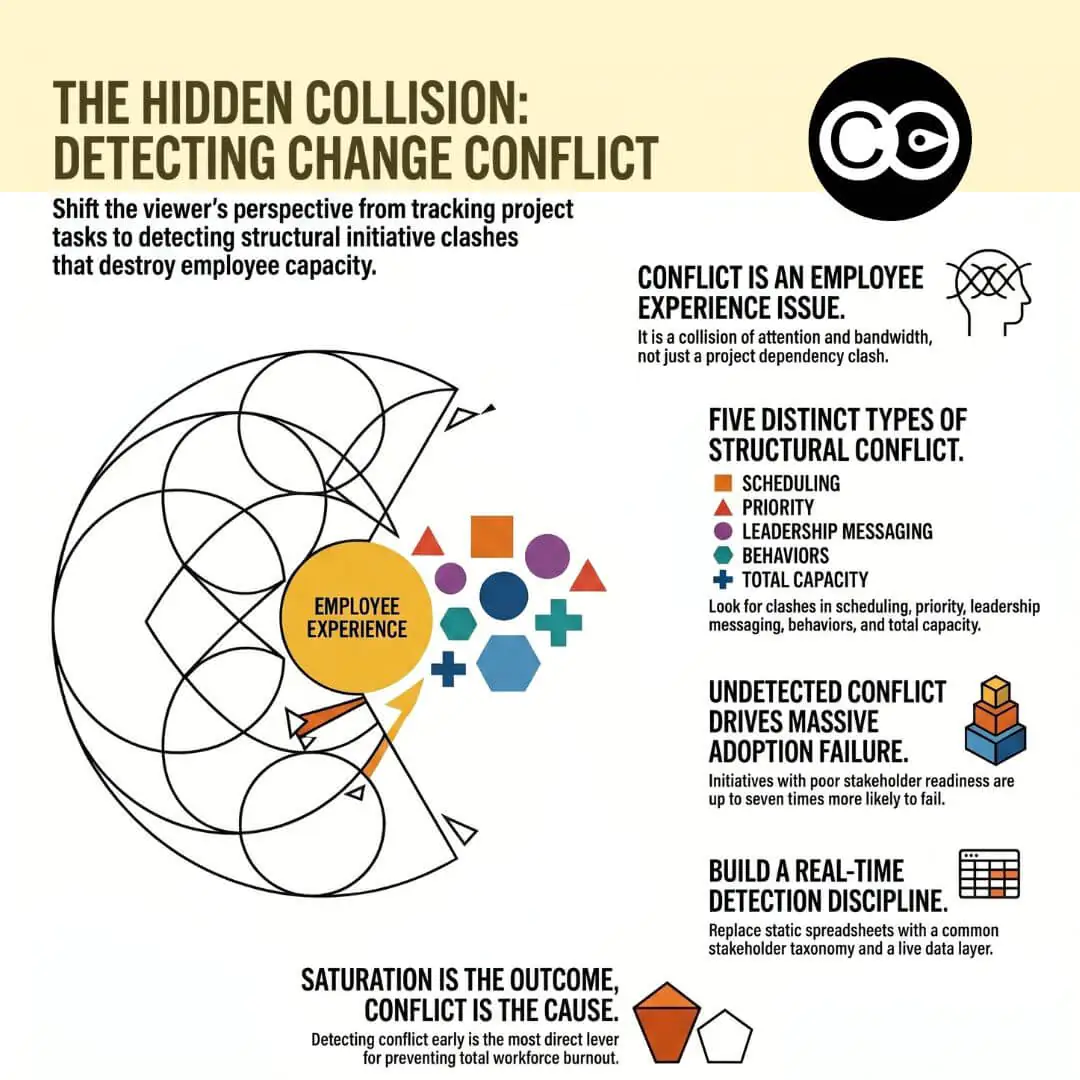
Change conflict, in the portfolio sense, is any structural collision between two or more change initiatives that competes for the same finite resource inside the impacted employee’s experience. The resource might be attention, time, behavioural bandwidth, leadership credibility, training capacity, or system stability. The conflict is rarely deliberate. It is the predictable consequence of running multiple initiatives that were each designed in isolation, governed in isolation, and measured in isolation.
This is a different concept from interpersonal conflict on a team, and different again from project portfolio dependency conflict in the PMO sense (where the unit of analysis is the deliverable, and the conflict is over scope, schedule, budget, or sequencing of project outputs). Change conflict sits between the two. The unit of analysis is the impacted employee, and the resource being competed for is their absorption capacity. A portfolio with zero project-dependency conflicts can still saturate the workforce in ways that destroy adoption, because the project view does not look sideways at the employee experience.
Change conflict is also one of the principal mechanisms that produces change saturation at the portfolio level. Saturation is the state in which the workforce can no longer absorb additional change. Conflict is one of the underlying drivers, because it draws on the same finite resource from multiple directions at once. Detecting conflict early is one of the most direct levers an organisation has for preventing saturation. Saturation is the outcome. Conflict is one of the causes you can actually do something about.
Why change conflicts are structurally hard to detect
Change conflicts are not hard to detect because they hide. They are hard to detect because the systems we use to govern change portfolios were never designed to see them.
Each initiative has its own sponsor, steering committee, status report, and definition of success. Every one of those artefacts looks inward at the initiative. None of them looks sideways at the other initiatives sharing the workforce. The PMO sees deliverables. The change team sees their initiative’s stakeholders. The HR business partner sees engagement scores. The line manager sees their day. No node in standard project governance is responsible for the intersection.
The result is that conflicts can only be diagnosed retrospectively: in the engagement survey that lands two quarters later, in the adoption metric that softens without obvious cause, in the spike of mid-level attrition, or in the post-implementation review that traces failure to “change fatigue” without naming the specific collisions that caused it. By that point, the cost has compounded, the conflicts that produced it have moved on, and the next portfolio cycle repeats the pattern.
Change conflict detection, as a discipline, is the deliberate work of closing this gap. It treats portfolio collision as a discoverable, classifiable, real-time signal rather than a retrospective story. To do that, you need three things: a named taxonomy of conflict types so you know what you are looking for, a method for surfacing each type before it manifests, and a data layer that can aggregate impact across initiatives without depending on spreadsheets that age out within a fortnight.
The five types of change conflict you need to detect
Change conflict shows up in five distinct, recognisable forms. The categories are not academic. Each has its own diagnostic signal and its own characteristic failure mode when undetected.
Scheduling conflict
The most familiar type, and the only one most PMOs actively manage. Scheduling conflict occurs when two or more initiatives require the same group of employees to engage with major change events in the same window. Two go-lives in the same fortnight. A system cutover the same week as a structural reorganisation announcement. A mandatory training module landing in the same sprint as a performance-review cycle change.
Scheduling conflict is the easiest to spot, because dates are visible, but it is the most underestimated. Resolving it by sliding events apart by a week declares the problem solved without addressing the cumulative cognitive load on the same group across a six-week absorption window.
Priority conflict
Priority conflict occurs when two initiatives ask the same employee, manager, or team to treat their initiative as the top priority for the same period. Operations excellence asks branch managers to focus on cost reduction. The customer experience programme asks them to focus on relationship deepening. The risk culture initiative asks them to focus on conduct and escalation discipline. Each is a legitimate priority on its own. Together, in the same quarter, they are a contradiction.
This is the most corrosive of the five, because it cannot be resolved by sequencing. Employees and middle managers eventually pick one, usually the one whose owner has the most political weight, and the others quietly fail. Detection requires you to compare not just calendars but stated priorities, by stakeholder group.
Leadership and management messaging conflict
Leadership messaging conflict happens when the senior leaders associated with different initiatives say things that contradict each other, or use language that signals different cultures, values, or behavioural expectations. The CFO writes that “speed of execution” is the strategic priority. The CHRO writes that “psychological safety” is the cultural shift. The COO emails about “doing more with less”. The CEO speaks about investing in capability. Together, in the same eight-week period, they tell the employee that leadership does not know what it wants.
Prosci’s 12th Edition Best Practices in Change Management (drawing on more than 10,800 practitioners) repeatedly identifies active and visible sponsorship as the single largest predictor of change success. The corollary, that contradictory sponsorship is a primary predictor of failure, is the part most organisations under-instrument. Management messaging conflict is the line-manager version of the same problem: when middle managers are asked to coach contradictory behaviours, they default to delivering neither.
Behavioural conflict across initiatives
Behavioural conflict is distinct from messaging conflict. Messaging conflict is what leaders say. Behavioural conflict is what initiatives require employees to actually do. Two initiatives can have aligned leadership messaging and still ask employees to perform contradictory behaviours on the ground.
A common example sits in regulated contact-centre environments. A regulatory change programme implements a new disclosure obligation requiring agents to disclose additional product or risk information to customers and to actively prompt for follow-up questions before closing the call. At the same time, the operational leadership team is running an efficiency initiative aimed at reducing the average handle time per call. Both initiatives are legitimate, both have executive sponsors, and both are being delivered correctly within their own scope. From the agent’s seat, they are mutually exclusive instructions arriving in the same week from different parts of the organisation, with no forum in which the contradiction can be raised. A second common pattern: a risk-conduct programme asks bankers to escalate any uncertainty, while a sales productivity programme rewards closing in-meeting.
Behavioural conflict is structurally invisible to most change methodologies because most impact assessments capture process and system changes but not behavioural shifts. Detection requires extending stakeholder impact analysis to include the behavioural request explicitly, and aggregating those requests at the stakeholder-group level.
Resource and capacity conflict
The fifth type is often confused with scheduling conflict. Resource and capacity conflict occurs when multiple initiatives draw on the same finite pool of human capacity, even if their events are not scheduled in the same week. The pool may be the change team itself, the training function, the technology platform team, or, most commonly, a single critical stakeholder group whose absorption capacity is being drawn on for months at a stretch.
Capacity conflict has a cumulative signature. It looks fine in any given week. It produces burnout, error rates, and decision fatigue over a quarter. The diagnostic question is “what is the cumulative draw on this group over a rolling twelve-week window?” not “is there a clash this fortnight?”.
The cost of undetected change conflict
The cost shows up in four observable ways, all measurable if you instrument for them.
The first is collapsed adoption. Prosci’s research consistently shows that initiatives with poor stakeholder readiness are six to seven times more likely to miss their objectives than those with strong readiness, and conflict is a primary driver of poor readiness because stakeholders forced to choose between competing demands will protect their own day-to-day function. The second is leadership credibility erosion. Employees who experience contradictory leadership signals across initiatives stop trusting the strategic narrative itself, and that loss of trust compounds across future changes. The third is attrition. Workplace Intelligence research found that 53% of employees report experiencing too much change at once, with 71% feeling overwhelmed by the volume of change. Employees in saturated, conflict-heavy environments leave at materially higher rates than employees in coherent ones. The fourth, and most often missed, is middle-manager capacity collapse: the layer of the organisation that absorbs portfolio conflict by translating contradictions into a workable narrative for their teams. Over time they stop translating, behavioural change quietly stops across the portfolio, and no project sponsor sees it.
In every one of those failure modes, the underlying conflict was technically detectable at the point of portfolio planning. The cost is not the conflict. The cost is the delay between when the conflict became real and when anyone in the organisation noticed.
How to detect change conflict: a five-step method
Detection is a discipline, not a tool. Whether you do it manually or with platform support, the method is the same.
- Establish a common stakeholder taxonomy. Every initiative must categorise impact against the same set of stakeholder groups, defined consistently across the portfolio. Without this you cannot aggregate. Most organisations discover that their initiatives use overlapping but non-identical group names (“branch managers” in one, “frontline leaders” in another, “RMs” in a third), which makes aggregation impossible.
- Overlay every initiative on a single calendar at the stakeholder-group level. Not at the project-milestone level. The output should show, for each stakeholder group, every event that touches them across the next twelve weeks, colour-coded by intensity. The eye picks up scheduling and capacity conflicts immediately when the data is visualised this way. This is the function of a change saturation heatmap.
- Audit the leadership and management messaging across initiatives. Pull the last eight weeks of all-hands communications, sponsor videos, and manager talking-point packs across every active initiative. Read them as a single corpus. Look for contradictory framing, mismatched language about culture or pace, and gaps where one initiative implicitly contradicts another.
- Map behavioural requests at the group level. For each stakeholder group, list every behaviour each initiative is asking them to perform or stop performing. Identify the contradictions. This is the step almost no organisation does, and it is the one that surfaces behavioural conflict.
- Compute cumulative draw per stakeholder group. For each group, calculate the volume of impact, training, communication touches, and behavioural requests across a rolling twelve-week window. Mark groups exceeding their absorption ceiling. This is the capacity conflict view, and it requires a defined capacity model to make sense of the numbers.
These five steps together produce a portfolio conflict picture rather than a project conflict picture. The output usually reveals that several initiatives have been quietly damaging each other for months. That discomfort is the entry point to actually managing them.
Why spreadsheets, project management tools, and generic AI cannot detect change conflict
Most organisations attempt change conflict detection with the tools they already have. The attempts fail in predictable ways, and the failure is structural rather than a question of effort.
Spreadsheets can hold the data, but they cannot keep it current. The moment any initiative replans (which happens weekly in a real portfolio), the spreadsheet ages out. A spreadsheet rebuilt monthly is detecting conflicts that have already manifested. A spreadsheet rebuilt weekly consumes a half-time analyst and still trails reality.
Project management tools (Monday, Smartsheet, Jira, MS Project) are designed to track deliverables, not impacts. Their unit of analysis is the project task, not the impacted employee. They have no native model of stakeholder groups, no aggregation across initiatives by group, no behavioural-request layer, and no capacity ceiling against which to compare. You can build extensions, but you end up building a change intelligence platform inside a project tool, badly.
Generic AI assistants (ChatGPT, Copilot, Gemini) have a deeper limitation: they have no access to the organisation’s portfolio data. A ChatGPT prompt about whether initiatives A, B, and C are in conflict can only produce a plausible-sounding generic answer drawn from training data. It cannot know that initiative B has just slipped two weeks, that stakeholder group X is also being touched by initiative D, or that the behavioural request in initiative C contradicts the messaging in A. Conflict detection requires cross-initiative organisational data aggregated in real time, structured against a common taxonomy. That is not a prompt problem. It is a data infrastructure problem.
This is why a purpose-built change intelligence platform sits in a different category from the alternatives. Detection at portfolio scale is not a feature you can bolt onto a general-purpose tool. It is the data architecture or it is nothing.
How Change Compass’s Conflict Detection Engine works
Change Compass implements change conflict detection as a continuously-running engine across the live portfolio, not a periodic spreadsheet exercise. The platform aggregates impact data from every active initiative against a common stakeholder taxonomy, then evaluates each stakeholder group against five conflict signals in real time.
What triggers an alert
The engine surfaces a conflict alert when one or more of these conditions is met for a given stakeholder group within a defined window:
- Concentration: the cumulative volume of impact events exceeds the group’s defined absorption threshold within a rolling window.
- Overlap: two or more high-intensity events from different initiatives fall within the same fortnight for the same group.
- Behavioural contradiction: two initiatives are requesting opposing behaviours from the same group within the same window.
- Messaging divergence: sponsor or manager communications across initiatives are flagged as inconsistent in framing or stated priority.
- Capacity draw: the group is being drawn on continuously across a twelve-week or longer horizon by three or more initiatives, with no recovery gap.
Each alert is tied back to the specific initiatives causing it, the affected stakeholder group, and the window in which the conflict will manifest. The aim is to give portfolio decision-makers a signal early enough to act on, not after the fact.
How conflicts get resolved
Detection only matters if it leads to action. The engine pairs alerts with resolution options: sequencing recommendations (which initiative to slip and to when, to minimise cumulative load), absorption modelling (what the load picture would look like under each resolution scenario), and escalation triggers when the conflict cannot be resolved at the working level. Resolution is owned by the portfolio change forum, which has the authority to defer, reshape, or, where required, decline an initiative that would breach absorption thresholds. The platform does not make the call. It surfaces the trade-off in a form the executive can decide on.
Case study: detecting and resolving a four-initiative conflict
A mid-market Australian financial services organisation had four concurrent initiatives touching its branch network in Q3: a teller-system upgrade (cutover week 8), a new customer onboarding process (rollout weeks 6 and 10), a risk culture programme (manager workshops weeks 4 to 12), and an efficiency initiative (handle-time targets reset week 7). Each was governed by its own programme team. Each had reported green status. The portfolio change forum had been convened only quarterly.
When the Conflict Detection Engine ran across the live portfolio data, it surfaced four overlapping alerts on the branch-manager group within weeks 6 to 10: a concentration alert (cumulative impact intensity at 1.4x the defined ceiling), an overlap alert (system cutover and onboarding go-live within nine days), a behavioural contradiction alert (risk programme asking for slower deliberation while efficiency programme reduced handle-time targets), and a capacity draw alert (continuous manager workshop attendance across the same twelve-week window).
The resolution, agreed at a portfolio forum convened on the strength of the alerts, sequenced the onboarding rollout into Q4, paired the system cutover with a structured two-week absorption buffer, and reframed the risk and efficiency messaging into a single integrated narrative under the operating committee. None of the four initiatives missed their delivery commitments. Branch adoption of the teller-system upgrade landed twenty-one points above the organisation’s prior cutover average. The detection event paid for the entire engagement in a single intervention.
The pattern is generalisable: detection alone exposes the problem; the value is unlocked when detection feeds a forum that has the authority to act on what it sees.
Common mistakes in change conflict detection
Detection programmes fail in characteristic ways. The most common are:
- Treating detection as a one-off mapping exercise. Conflict is a dynamic state. A map built once at the start of the quarter is detecting yesterday’s conflicts. Detection has to refresh continuously.
- Detecting only scheduling conflicts. This handles the easiest type and misses the four that matter more. Priority, leadership messaging, behavioural, and capacity conflicts will not show up in a calendar overlay.
- Letting detection sit at the change-manager level. Change managers can flag conflicts but cannot resolve priority, leadership, or capacity conflicts on their own authority. Detection without an executive forum to act on alerts is detection that goes nowhere.
- Optimising each initiative’s runway over portfolio coherence. Resolution requires individual projects to accept a shape less convenient for them in exchange for a portfolio that lands as a whole. Without that trade, every alert is contested.
- Detecting conflict without a capacity model. Conflict only matters relative to capacity. Without a defined model of how much change each group can absorb, every conflict argument becomes a clash of opinions about whether “this group can handle it”.
Where to start
Pick three stakeholder groups that sit at the intersection of the most initiatives in your current portfolio. Spend a fortnight mapping every initiative event, message, and behavioural request hitting each group across the next twelve weeks. Resist the temptation to act before you have the picture. Once you can see it, ask the executive sponsors of those initiatives to review it together. The conversation that follows is almost always the first time anyone in your organisation has tried to manage the portfolio rather than the projects. That conversation, repeated quarterly with a continuously-refreshed data view rather than a static map, is how change conflict detection becomes a governed capability rather than the invisible force quietly compounding adoption risk across every transformation you run.
If you want to see how change conflict detection works against your own portfolio data, book a demo to see how Change Compass detects change conflicts automatically.
For a comprehensive view of how AI is reshaping the discipline at both project and portfolio level, see our complete guide to AI in change management.
Frequently asked questions
What is change conflict detection? Change conflict detection is the discipline of identifying collisions between change initiatives before they derail delivery, by aggregating impact, behavioural, messaging, and capacity data across the portfolio against a common stakeholder taxonomy. It is distinct from project dependency tracking (which looks at deliverables) and from interpersonal conflict management (which looks at people). The unit of analysis is the impacted employee, and the goal is to surface collision early enough to resolve.
How do you manage conflicting change initiatives? Conflicting change initiatives are managed by detecting the collision early (through a continuously-refreshed portfolio view), classifying the conflict type (scheduling, priority, leadership messaging, behavioural, or capacity), and resolving it through a portfolio change forum with the authority to sequence, reshape, or decline initiatives that would breach absorption thresholds. Resolution is a portfolio governance act, not a project-level one.
What are the main types of change conflict to look for? There are five recognisable types: scheduling conflict (initiative events colliding in time), priority conflict (initiatives competing for the same top-priority slot), leadership and management messaging conflict (sponsors contradicting each other), behavioural conflict across initiatives (employees being asked to perform contradictory behaviours), and resource and capacity conflict (cumulative draw on a single stakeholder group’s absorption ceiling).
Why can’t generic AI or spreadsheets detect change conflicts? Detection requires cross-initiative organisational data, structured against a common stakeholder taxonomy, aggregated in real time. Spreadsheets age out the moment any initiative replans. Project management tools track deliverables, not employee-level impacts. Generic AI tools have no access to the organisation’s portfolio data and cannot reason about cumulative load on specific stakeholder groups. Detection is a data architecture problem, not a prompt problem.
What’s the difference between change conflict and change saturation? Change saturation is the state in which the workforce can no longer absorb additional change. Change conflict is one of the principal mechanisms that causes saturation, by drawing on the same finite resource from multiple directions at once. Saturation is the outcome; conflict is one of the causes. Detecting and resolving conflict is one of the most direct levers an organisation has for preventing saturation.
References
- Gartner, Employees Are Losing Patience With Change Initiatives
- Gartner, Managing Organisational Change
- Prosci, Change Management Best Practices: 12th Edition Findings
- Visier / Workplace Intelligence, State of Organisational Change 2024
- The Change Compass, What is change saturation?
- The Change Compass, How to measure change saturation in your organisation
- The Change Compass, How to use a change saturation heatmap