

Most change management software on the market is not built for enterprise scale. It is built for a single project manager running a single initiative, then marketed up-market with the addition of a few user seats and a “team” pricing tier. When a global business with thirty active initiatives, twelve business units, and a regulator looking over its shoulder tries to deploy these tools, the gaps appear within weeks.
The procurement question for enterprise change leaders is not “which tool has the best features?” It is “which tool was actually designed for the operating environment we work in?” Those are different questions, and they produce different shortlists.
This guide is written for PMOs, Heads of Change, and HR leaders who are actively evaluating enterprise change management software in 2026. It sets out the seven non-negotiable features that distinguish enterprise-grade platforms from scaled-up SMB tools, the questions that should appear on every vendor scorecard, the red flags that disqualify a vendor regardless of how good the demo looks, and a structured compliance checklist for procurement and risk teams.
The goal is to help you make a decision that will hold up two years from now, not just to the first contract renewal.
Why enterprise change management software is a different category
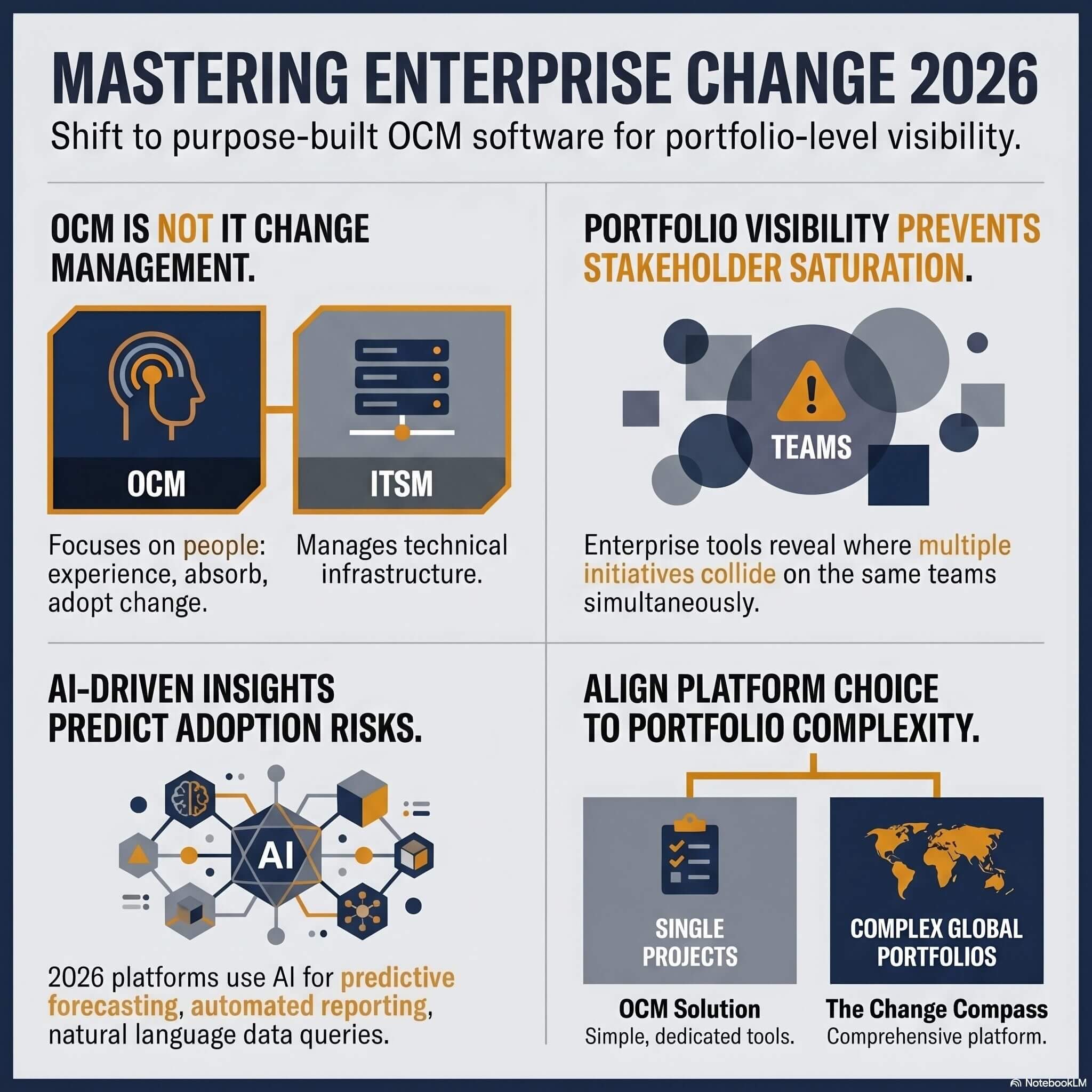
The change management software market is broad and crowded, but it splits cleanly into two segments once you look past the marketing. SMB tools are designed around a single change manager working through a single initiative at a time. They optimise for ease of use, lightweight templates, and quick onboarding. For a small organisation running one or two changes a year, they are entirely adequate.
Enterprise change management software solves a fundamentally different problem. Enterprise organisations are running a portfolio of changes, often dozens at a time, against the same employee base. They have compliance obligations that constrain how data is handled and audited. They have integration requirements with HRIS, ITSM, and identity systems that the procurement team will not budge on. They need reporting that satisfies the board, not just the project sponsor.
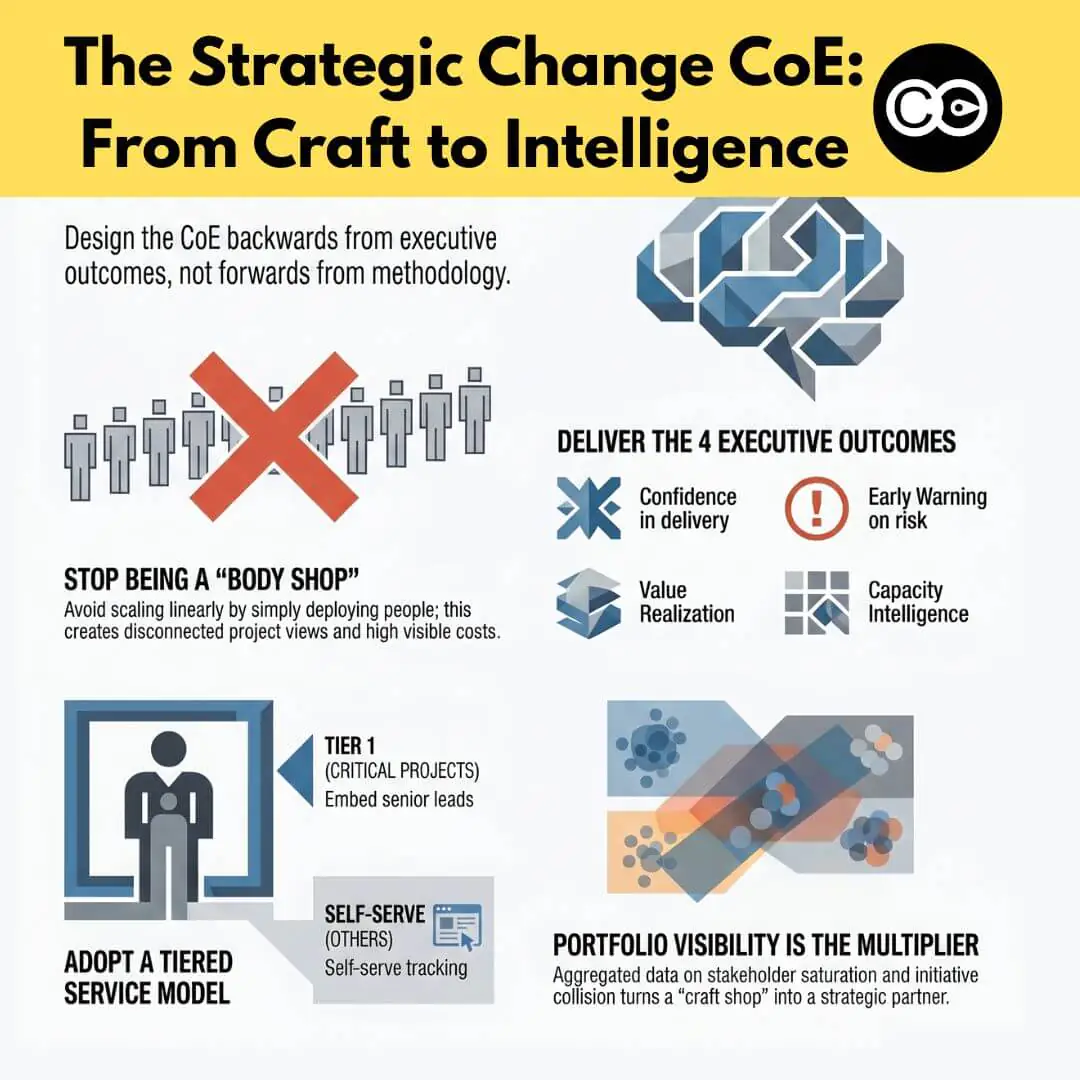
The cost of treating these as the same category is significant. According to the Prosci 12th Edition Best Practices in Change Management report, the most mature change management functions are characterised by enterprise-wide integration, standardisation, and measurable adoption tracking across the portfolio. None of those capabilities are achievable when each project team is working in a separate tool with no aggregated view, or when a tool that was designed for one initiative gets stretched across thirty.
If your organisation is genuinely operating at enterprise scale, the seven features in the next section are not nice-to-haves. They are the criteria that determine whether the platform will be useful in eighteen months or whether it will be the tool nobody opens.
The seven features enterprise change management software must have
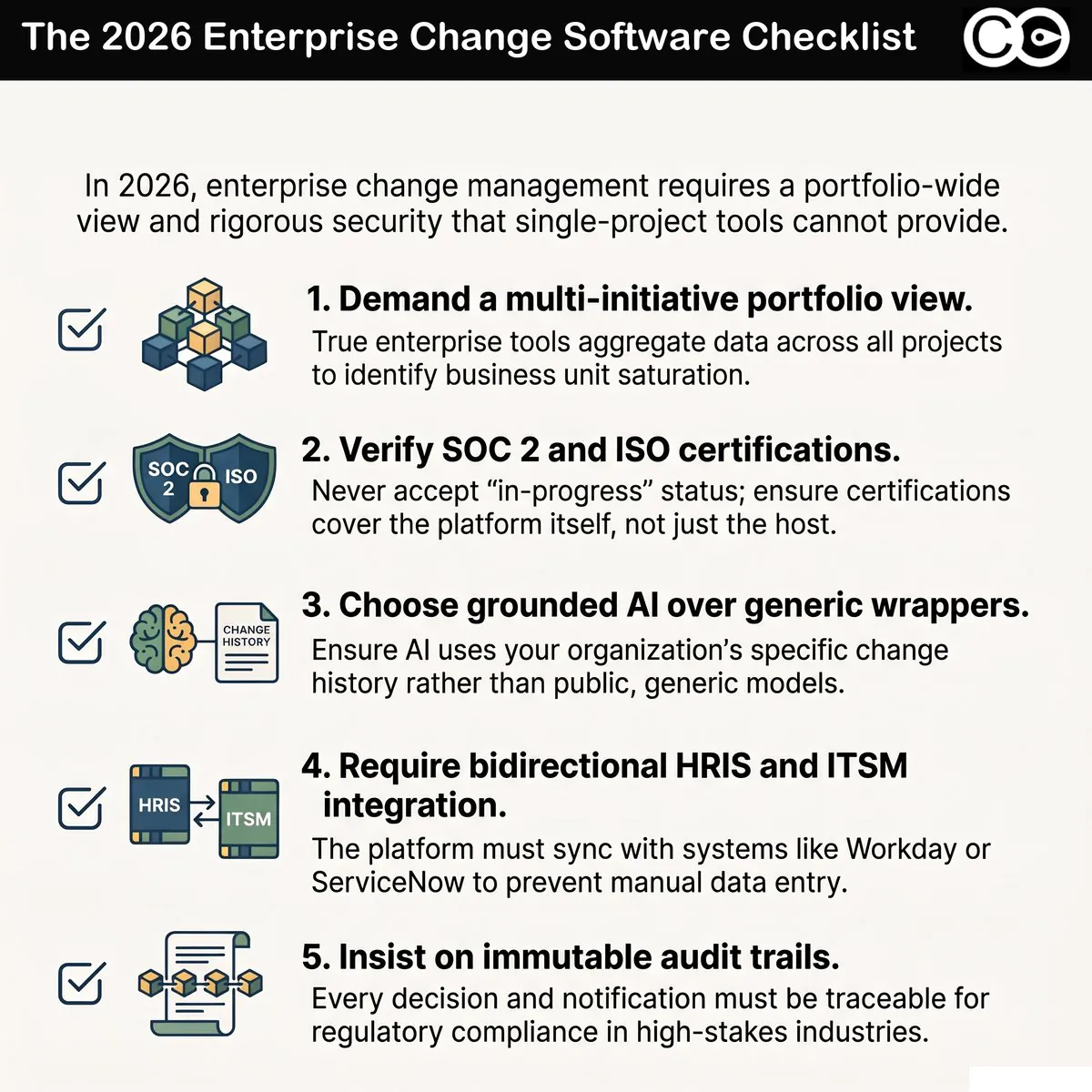
1. Multi-initiative portfolio view
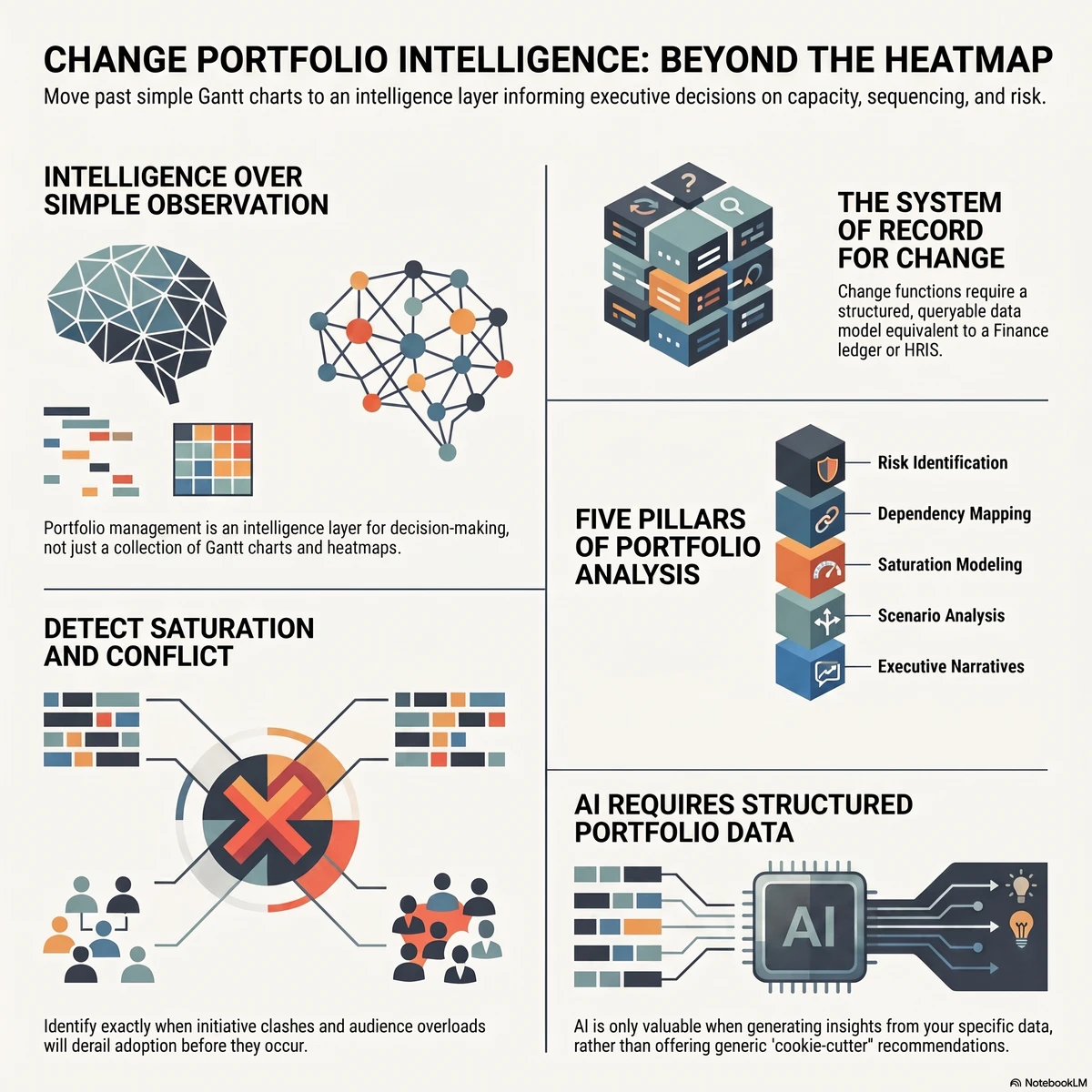
The defining capability of enterprise change management software is the ability to aggregate change activity across every active initiative and present it as a single, coherent portfolio view.
This sounds obvious, but it is the feature most commonly missing. Many tools positioned as “enterprise” are still architecturally single-project. Each initiative lives in its own workspace, with its own data, its own stakeholders, and its own dashboard. Aggregation across initiatives is achieved, if at all, through manual export and consolidation.
The practical test: ask the vendor to show you, in their tool, the total change load on a single business unit across all currently active initiatives. If the demo path involves opening multiple project files and combining them by hand, you are looking at a single-project tool with enterprise pricing.
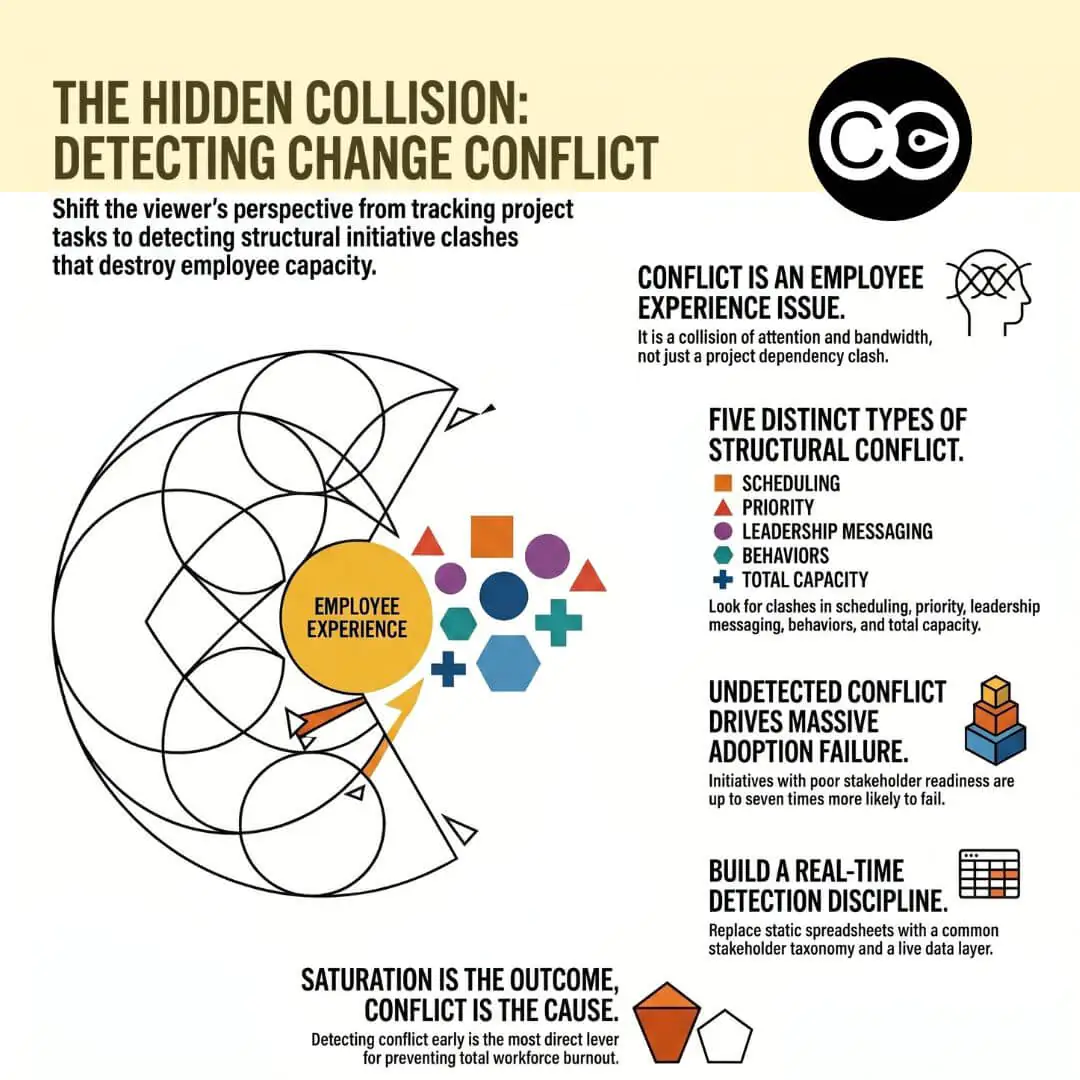
A genuine portfolio view shows initiatives, business units, and time on the same axes. It allows leaders to see immediately where saturation is approaching, where capacity is available, and where two initiatives are about to land on the same group at the same time. This capability is the foundation everything else depends on. Without it, executive reporting, sequencing decisions, and risk management all collapse back to the project level. For a PMO-focused evaluation framework covering this capability in depth, see our change management portfolio tools buyer’s guide.
2. Role-based access and governance
Enterprise organisations cannot operate on a model where every user sees every piece of data. There are sponsor groups who need executive views, project teams who need their own initiative data, business unit leaders who need their unit’s load profile, and external partners who may need limited read-only access.
A genuine role-based access control system supports configurable roles, granular permission scopes, delegated administration, and the ability to audit who changed what and when. This is not a feature that can be retrofitted. It has to be built into the data architecture from the start.
When evaluating vendors, ask how their access model handles four scenarios:
- An external consultant needs read-only access to two specific initiatives but not the rest of the portfolio
- A business unit leader needs write access for their division’s data but read-only access for organisation-wide reports
- A senior sponsor needs the executive dashboard but no editing rights anywhere
- A regulator or auditor needs a structured export of changes affecting a regulated function over a date range
If any of these scenarios produces a “we can configure that” rather than a clear demonstration in the live product, treat that as a signal that the access model is brittle.
3. Audit trail for compliance and reporting
In regulated industries, every material decision affecting the workforce or the operating model has to be traceable. When a regulator asks what change was implemented, who approved it, when employees were notified, and what evidence exists of the rollout, the answer cannot be “let me check our shared drive.”
Enterprise change management software provides a complete, immutable audit trail of changes to initiatives, decisions logged, communications issued, and stakeholder actions taken. This is a compliance requirement in financial services, healthcare, energy, government, and increasingly in any industry subject to operational resilience regulation.
The audit trail must include the user, the timestamp, the action, and the prior state. It must be exportable in a structured format. It must be retained according to the organisation’s data retention policy, and the platform must be able to demonstrate that it has not been tampered with.
This is not the kind of feature that gets demonstrated in a sales call. It needs to be verified during procurement diligence, and the vendor’s response should be a documented audit logging specification, not a verbal assurance.
4. Enterprise SSO and security standards
The procurement team will not approve a platform that requires users to maintain a separate password. Single sign-on integration with the organisation’s identity provider, typically through SAML 2.0 or OpenID Connect, is a baseline requirement. Multi-factor authentication, session management, and integration with the corporate identity lifecycle (so that when an employee leaves, their access is revoked automatically) are non-negotiable.
Beyond SSO, the platform should hold current independent certifications. The two that consistently appear in enterprise procurement requirements are SOC 2 Type II (which demonstrates ongoing operational controls over a sustained period, not just a point-in-time assessment) and ISO 27001 (which certifies the information security management system as a whole). For organisations operating in the EU, GDPR compliance and a published Data Processing Agreement are mandatory. For Australian organisations, alignment with the Australian Privacy Principles and consideration of data residency are essential.
The vendor should be able to provide their current SOC 2 report and ISO 27001 certificate on request, under NDA where appropriate. If the response involves vague language about being “in the process of certification” or relying on the certifications of underlying cloud providers (AWS or Azure being SOC 2 compliant does not make a SaaS platform built on them SOC 2 compliant), the platform is not yet enterprise-ready.
5. AI features that use your organisation’s data, not generic models
This is the feature where vendor differentiation in 2026 has shifted most significantly. Almost every change management platform now claims AI capabilities. The substantive question is what data those AI features are operating on.
Generic AI features that wrap a public large language model and prompt it with the contents of the user’s current screen are not enterprise AI. They produce generic outputs. They cannot reference the organisation’s specific change history, its previous adoption patterns, the impact profile of the affected stakeholder groups, or the load context of other in-flight initiatives. Worse, they introduce data residency and confidentiality concerns that the procurement team will scrutinise heavily.
Purpose-built AI for change management, by contrast, is grounded in the organisation’s own portfolio data, augmented with anonymised industry benchmark data, and constrained to use cases where its outputs are verifiable. It can generate executive narratives that reference real portfolio metrics, suggest sequencing options based on actual capacity data, and produce stakeholder analyses that reflect the organisation’s specific structure.
When evaluating AI features, ask three questions:
- What data does the AI feature have access to, and what data is it explicitly excluded from?
- Where is the inference happening, and how is the data handled in transit and at rest?
- How does the vendor protect against the AI generating outputs that look authoritative but are not grounded in real organisational data?
If the answers are vague, the AI capability is most likely a wrapper, not an integrated system.
6. Executive reporting with one-click export
Senior leaders do not log into change management platforms. They read board packs, executive summaries, and one-page status reports. The platform’s value at the executive level is realised through its ability to produce these artefacts on demand, with high-quality data and minimal manual work.
Enterprise platforms provide pre-built executive reporting templates that pull live data from the portfolio, can be exported to PDF and PowerPoint with formatting intact, and can be configured to match the organisation’s branding and reporting cadence. Critically, the export should be one click, not a manual rebuild.
For a deeper treatment of the executive reporting problem and the questions executives actually need answered, the companion article on the ultimate guide to change management reports sets out a practical framework.
The diagnostic when evaluating: ask the vendor to produce a board-ready report from their tool, using real data, in front of you. If they cannot, or if the output requires manual cleanup in PowerPoint to be presentable, the platform will not save the time it claims to.
7. HRIS and ITSM integration
Enterprise change management software does not exist in isolation. The data needed to identify affected stakeholders, route notifications, and track adoption typically lives in the HRIS (Workday, SAP SuccessFactors, BambooHR) and the ITSM (ServiceNow, Jira Service Management). If the change platform cannot integrate with these systems, the change team becomes a permanent intermediary copying data back and forth.
A genuine integration is bidirectional, configurable, and supported. The vendor publishes the integration capabilities, supports common authentication patterns (OAuth 2.0, API tokens with scoped permissions), provides webhooks for event-driven workflows, and offers either pre-built connectors or a documented API for custom integration work.
The questions to ask: what HRIS integrations are pre-built and supported in production? What ITSM integrations? Is the API rate-limited in ways that would constrain enterprise use? Are integration assets owned by the customer or by the vendor (which matters at contract renewal)?
A platform without serious integration capability will become an island. The data quality will degrade, the manual reconciliation overhead will accumulate, and within a year, the change function will be working around the tool rather than through it.
Questions to ask every vendor before you sign
Vendor sales cycles are designed to highlight the platform’s strongest features. Procurement diligence has to surface the weak ones. The following questions are deliberately uncomfortable, and the quality of the responses tells you more than the polished demo.
- Show me a live customer environment with at least twenty active initiatives. Can I see the portfolio view?
- What is your average implementation timeline for an enterprise customer? What proportion of customers go live on or before that timeline?
- Walk me through a recent enterprise customer churn. Why did they leave, and what would have prevented it?
- What is your current SOC 2 Type II report period? Can your security team meet with mine before contract?
- Provide three customer references at organisations of similar scale and complexity to ours, including at least one we can call without you on the line.
- What does your product roadmap look like for the next twelve months, and how do enterprise customers influence it?
- If we need to extract all our data from your platform, how would we do it? In what format, and how long would it take?
- What is your incident response process? Show me your last status page outage report.
The answers to these questions tell you whether the vendor has been operating at enterprise scale or whether they are about to learn what that means using your organisation as the case study.
Red flags that should disqualify a vendor for enterprise use
Some signals during evaluation are reliable disqualifiers. Each of these has cost organisations significant amounts of remediation work after the contract was signed:
- The product cannot demonstrate a working portfolio view across multiple initiatives in a live environment
- The vendor cannot produce a current SOC 2 Type II report on request, under NDA
- The data export capability is described in marketing terms but not demonstrated, or produces unstructured output
- The reference customers are all SMBs, with no enterprise-scale deployments to point to
- The implementation timeline is “weeks” with no enterprise-scale customisation or integration work scoped
- The contract terms include automatic data ownership transfer to the vendor, or limit the customer’s ability to extract their own data
- The AI capability is presented as a major differentiator but the underlying model and data flow are not disclosed
- The integration story is “we have an API” without documented, supported integrations to specific HRIS or ITSM platforms
- The pricing model penalises usage growth steeply enough that adopting the tool widely creates significant cost risk
If two or more of these are present, the platform is not ready for enterprise procurement. Polite withdrawal during evaluation is significantly less expensive than discovering the gaps during deployment.
The enterprise compliance checklist
For procurement and risk teams, the following structured checklist captures the controls that should be verified before contract signature. Each item should be evidenced through documentation, not just verbal confirmation.
Information security
- [ ] Current SOC 2 Type II report covering a minimum 6-month observation period
- [ ] Current ISO 27001 certificate with scope statement covering the platform
- [ ] Documented incident response plan and 12-month incident history
- [ ] Penetration testing programme with most recent test report available under NDA
- [ ] Data encryption in transit (TLS 1.2+) and at rest (AES-256 minimum)
Identity and access
- [ ] SAML 2.0 and/or OpenID Connect SSO support
- [ ] SCIM 2.0 user provisioning and deprovisioning
- [ ] Configurable role-based access control with audit logging
- [ ] Multi-factor authentication enforcement options
Data and privacy
- [ ] Documented data residency options aligned to regulatory requirements
- [ ] GDPR-compliant Data Processing Agreement
- [ ] Documented data retention and deletion policies
- [ ] Customer-controlled data export in structured, machine-readable format
- [ ] Right to audit clause in master agreement
Operational resilience
- [ ] Documented Recovery Time Objective and Recovery Point Objective
- [ ] Disaster recovery testing programme with annual evidence
- [ ] Public status page with historical uptime data
- [ ] Defined Service Level Agreement with credit mechanism
Vendor stability
- [ ] Financial stability evidence (audited accounts, funding history, customer growth)
- [ ] Three or more reference customers at comparable scale
- [ ] Documented business continuity plan covering vendor failure scenarios
- [ ] Source code escrow arrangement available for mission-critical use cases
This checklist is designed to be handed to procurement and security teams as a structured assessment artefact, not just a vendor conversation guide.
How Change Compass meets enterprise change management software requirements
Change Compass was built specifically for the enterprise change management software requirements set out in this guide.
The platform’s portfolio view aggregates change activity across all active initiatives and presents it at the business unit, role, and stakeholder group level, with no manual consolidation required. Role-based access control is configurable to enterprise governance models, with delegated administration and full audit logging. The audit trail meets the requirements of regulated industries, with immutable logging and structured export.
On security and compliance, Change Compass holds SOC 2 Type II and ISO 27001 certifications, supports SAML SSO and SCIM provisioning, and offers data residency options aligned to Australian, US, and EU requirements. The platform’s AI capabilities are purpose-built for change management, grounded in customer portfolio data and anonymised industry benchmarks, with documented data handling and no exposure to public model training.
Executive reporting is one-click export to PDF and PowerPoint with branded formatting. Pre-built integrations cover Workday, SuccessFactors, ServiceNow, and Jira, with a documented API for custom work. The platform is currently used by more than 50 enterprise customers, including FINRA, Northwestern Mutual, and Insurance Australia Group.
For organisations evaluating enterprise change management software in 2026, book an enterprise demo to see the platform working with portfolio data at scale.
Making the final decision
Enterprise change management software procurement is rarely about picking the platform with the most features. It is about picking the platform that will still be useful in two years, when the organisation has scaled its change function, signed up to additional regulatory regimes, and integrated change management more deeply into its operating cadence.
The decision rests on three questions. First, has the platform actually been built for enterprise scale, or is it a single-project tool with enterprise pricing? Second, will it pass the procurement and security diligence that a mature enterprise applies to any SaaS purchase? Third, will the change function be working through it or around it in eighteen months?
The vendors that survive that scrutiny are not always the ones with the slickest marketing. If you are building a shortlist, our overview of organisational change management software sets out how The Change Compass approaches these requirements. They are the ones whose product, security posture, and customer base demonstrate that they understand the operational reality of enterprise change management. That is the shortlist worth investing diligence in.
For a comprehensive overview of AI in change management
Enterprise change management software is most powerful when it includes AI capabilities grounded in your organisation’s change data. To understand how AI integrates with platform selection and fits into the broader strategy of AI adoption in change management, see our complete guide: AI in change management: the complete guide (2026).
Frequently asked questions
What is enterprise change management software?
Enterprise change management software is a platform purpose-built to manage organisational change at scale, across a portfolio of concurrent initiatives, in environments with significant compliance, security, and integration requirements. It differs from SMB change management tools by providing aggregated portfolio views, role-based access control, audit trails for regulatory compliance, enterprise SSO, AI features grounded in organisational data, and pre-built integrations with HRIS and ITSM systems.
How is enterprise change management software different from project management software?
Project management software focuses on task delivery: scope, timeline, dependencies, and resourcing for individual projects. Enterprise change management software focuses on the people side of change across the entire portfolio: stakeholder impact, adoption, capacity, sequencing across initiatives, and the cumulative load on the workforce. The two categories are complementary, not interchangeable, and most enterprise organisations need both.
What features should enterprise change management software include?
At minimum: multi-initiative portfolio view, role-based access control, immutable audit trail, enterprise SSO and current security certifications (SOC 2 Type II and ISO 27001), AI features grounded in organisational data rather than generic models, executive reporting with one-click export, and pre-built integrations with major HRIS and ITSM platforms. Tools missing any of these are not yet enterprise-ready, regardless of marketing positioning.
How long does enterprise change management software take to implement?
Typical enterprise implementations run between 8 and 16 weeks, depending on the integration scope, data migration requirements, and the maturity of the organisation’s existing change management practices. Vendors quoting “weeks” without scoping integration work or organisational change adoption are usually describing a software activation, not an enterprise implementation. The implementation is also a change initiative in its own right and should be planned accordingly.
How do you choose between enterprise change management software vendors?
Run a structured evaluation that goes beyond the demo. Insist on a live working session with real data, request reference customers at comparable scale, complete the security and compliance diligence (SOC 2, ISO 27001, audit trail, data export), test the integration capability against your specific HRIS and ITSM environment, and pressure-test the AI capability with questions about data flow and grounding. The vendor that engages substantively with all of these is the vendor that has built for enterprise.
References
- Prosci: 12th Edition Best Practices in Change Management
- Australian Government OAIC: Australian Privacy Principles
- AICPA: SOC 2 Type II reports
- ISO/IEC 27001 information security management standard
- Gartner: HR leaders can reduce employee fatigue with proactive change management (2023)