

There is an uncomfortable irony at the heart of most change management practices. Change managers are trained to help organisations plan for the human side of transition, measure adoption, track readiness, and manage stakeholder resistance. They can tell you precisely which business units are most exposed to a given change, which employee groups are furthest from readiness, and which initiatives are competing for the same people’s attention at the same time.
What most of them cannot tell you is what their function is worth in dollars.
Change management ROI (the measurable financial return that structured change management delivers relative to its cost) is the business case gap that change leaders have struggled to close for decades. Not because the value is not there, but because the data is rarely collected in a way that makes it legible to finance or the executive team. The business case gets written once, at the start of a programme, and then quietly shelved while the real work begins. By the time a senior leader asks “what did we actually get from the change team?”, the answer has to be reconstructed from memory, output logs, and adoption survey scores that nobody can connect to a dollar figure.
This article makes the case that the problem is not a lack of value. It is a lack of measurement infrastructure. And it provides a practical framework for closing that gap, one that practitioners can apply to their current programmes without waiting for a new mandate or a new budget.
Why change management is one of the few business functions that struggles to quantify its own value
Finance teams measure return on every capital investment. Marketing tracks cost per acquisition and customer lifetime value. IT reports on system uptime, incident rates, and cost per transaction. HR has moved decisively toward workforce analytics in the last decade, with turnover costs, time-to-productivity, and engagement scores now standard inputs into boardroom conversations.
Change management, by contrast, has relied primarily on activity metrics: training completion rates, communications sent, stakeholder engagement sessions held, survey scores at go-live. These are outputs, not outcomes. They measure what the change team did, not what the organisation gained as a result.
The business case problem
The typical change management business case is written before the work begins. It makes the case for investment by projecting the cost of failure: failed adoption, delayed benefit realisation, productivity loss during transition, attrition. These projections are often compelling. They are also speculative, because they are written in advance of the data.
The problem is structural. Most change managers do not control the financial data that would allow them to validate those projections later. Benefit realisation sits with the project sponsor. Productivity data sits with HR or operations. Adoption rates get reported to the project board but rarely get connected back to the financial case. By the time the programme closes, the change team has produced a substantial body of work, and has no mechanism to tie it to the outcomes the executive team cares about.
Why the data disappears
There are three reasons the ROI data gets lost:
- Benefit tracking is assigned to the wrong team. Projects own the financial case. Change teams own the people case. When these are managed separately, the connection between adoption and benefit realisation is never made explicit.
- The measurement points are front-loaded. Organisations invest in readiness assessment and go-live surveys, but rarely in systematic 60, 90, or 180-day post-implementation tracking. The data that would demonstrate sustained adoption, and connect it to financial outcomes, simply is not collected.
- The business case is treated as a document, not a process. Once the investment is approved, the business case is filed. Nobody updates it as the programme delivers. The opportunity to demonstrate value in real time is missed.
What change management ROI actually means
Change management ROI, properly defined, is the net financial benefit delivered by structured change management investment across a programme or portfolio of change initiatives, expressed as a percentage of the cost of that investment.
The formula is conceptually straightforward:
Change management ROI = (Financial benefit delivered by change management / Cost of change management investment) x 100
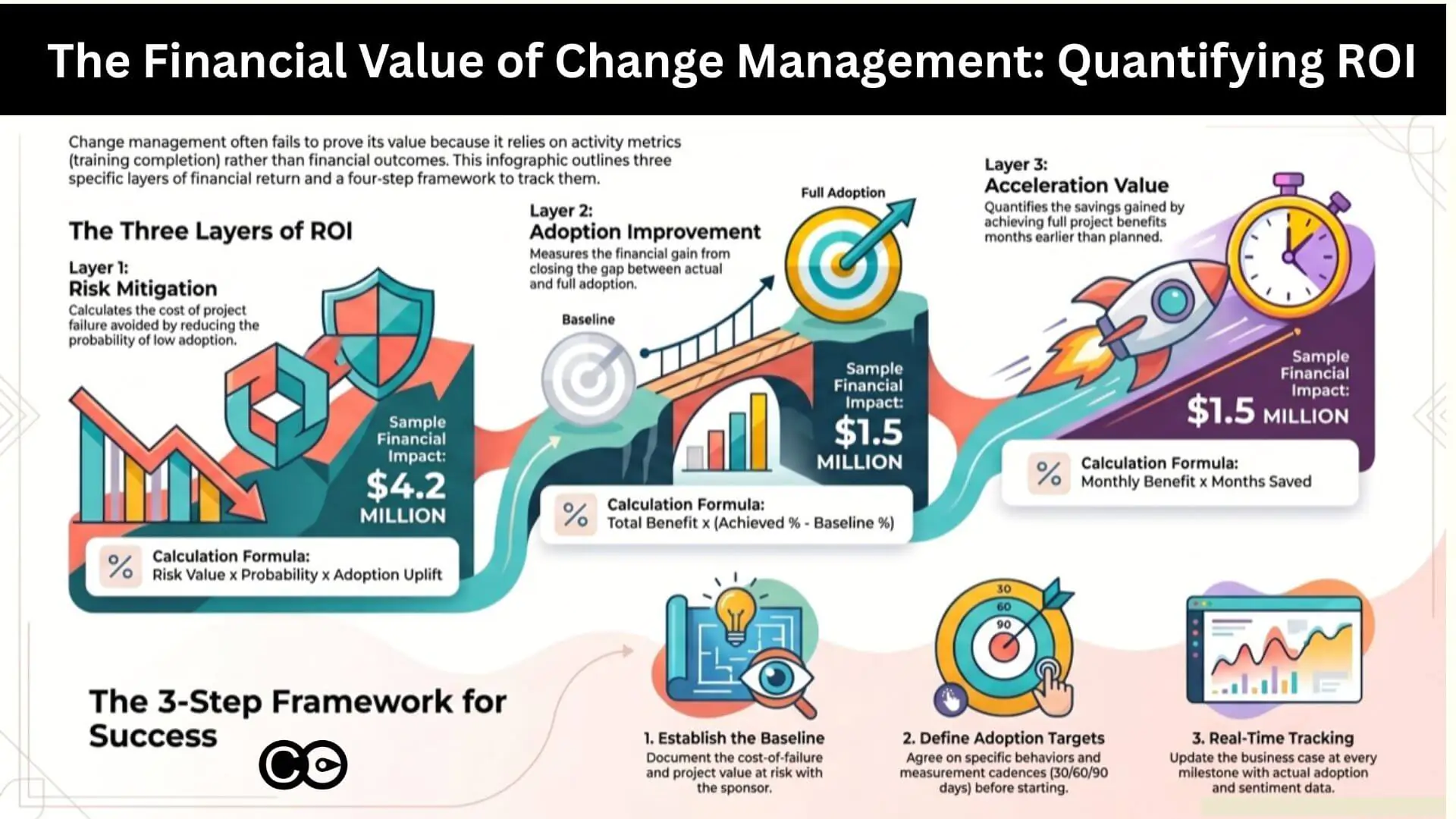
The challenge is populating the numerator. Unlike a marketing campaign where you can track revenue from a specific channel, the financial benefit of change management is distributed across three layers, each of which requires a different measurement approach.
The three layers of change management ROI
Layer 1: risk mitigation and the cost of failure avoided
The first and most immediately legible ROI layer is risk mitigation: the financial cost that structured change management prevents, relative to what would have happened without it.
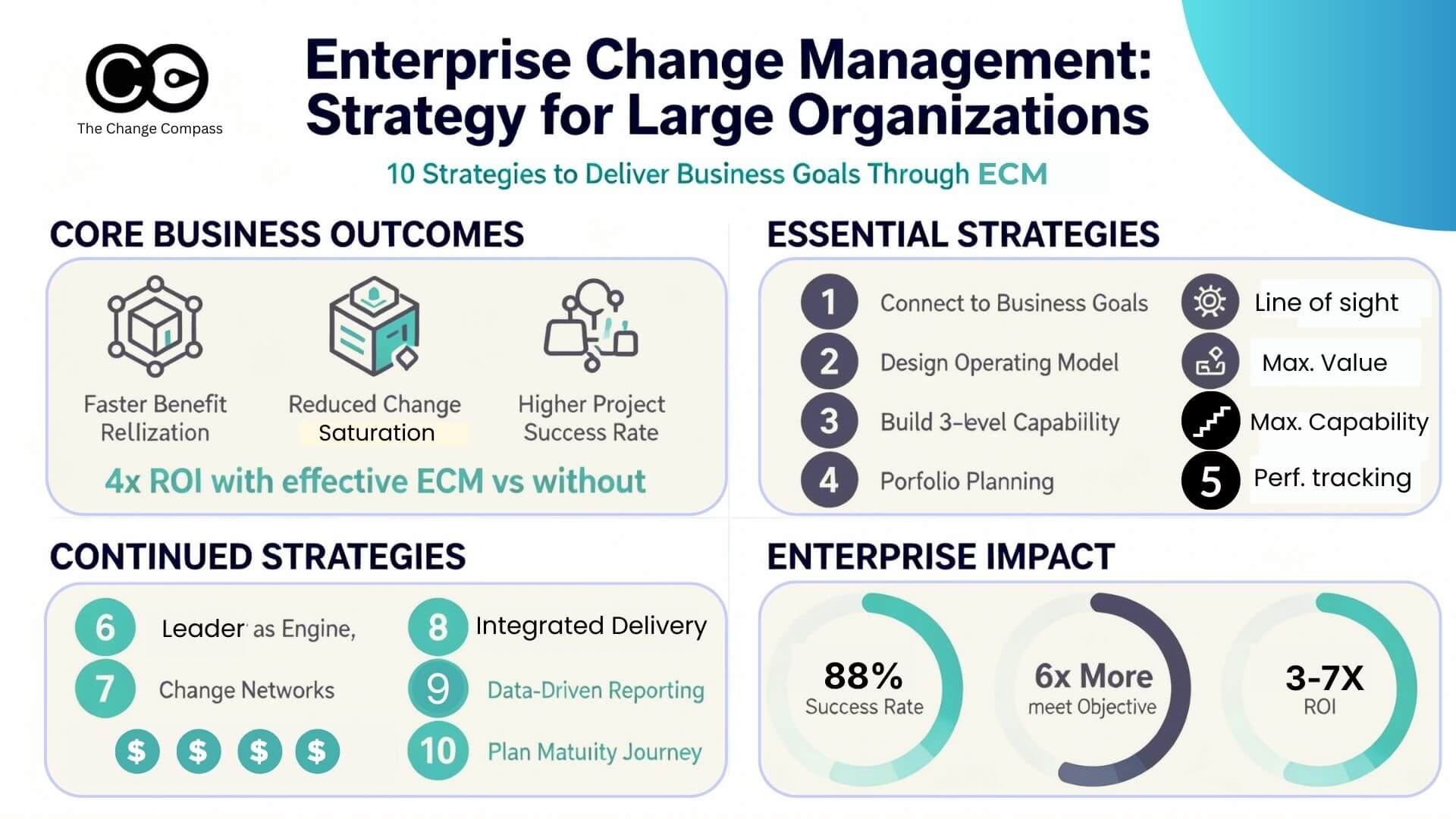
The research here is clear. According to Prosci’s 12th Edition Best Practices in Change Management, organisations with excellent change management are six times more likely to meet project objectives than those with poor change management. Willis Towers Watson’s Business Case for Change Management research found that organisations managing change well are 2.5 times more likely to outperform their peers financially and achieve 3.5 times more revenue growth than those that do not.
The risk mitigation value is calculated as:
Risk mitigation value = Project value at risk x Probability of failure without change management x Adoption uplift attributable to change management
For a $20 million ERP implementation with a historically observed 30% risk of low adoption without structured change management, and where change management is estimated to reduce that risk by 70%, the risk mitigation value is: $20M x 0.30 x 0.70 = $4.2 million.
This is a conservative approach. It does not require you to prove that change management delivered the outcome. It only requires you to quantify what was at risk and apply a defensible estimate of the change management contribution. Most project sponsors will accept this framing, because it mirrors how they think about insurance: you buy it to reduce the cost of failure, and you measure its value by what did not happen.
Layer 2: adoption rate improvement and benefit realisation
The second ROI layer is adoption rate improvement. Every change programme has a gap between theoretical benefit (what the change would deliver at 100% adoption) and realised benefit (what it actually delivers at actual adoption rates). Change management’s direct contribution is to close that gap.
This connection between adoption and financial outcomes is often treated as obvious in principle and ignored in practice. McKinsey’s analysis of large transformation programmes found that 42% of projected value is typically lost in the implementation and adoption phases, not because the technology failed, but because people did not use it consistently or at all.
The adoption value calculation is:
Adoption value = Programme benefit at full adoption x (Achieved adoption rate – Baseline adoption rate without structured change management)
If a new sales system is projected to deliver $5 million in productivity gains at 100% adoption, and your change management programme moves adoption from an estimated 55% baseline to 85% achieved, the adoption value is: $5M x (0.85 – 0.55) = $1.5 million.
The baseline adoption rate is the hardest variable to establish. The best approach is to use historical data from comparable programmes in your organisation where change management was minimal or absent. If that data does not exist, Prosci’s research provides sector benchmarks. Alternatively, model it as a sensitivity range (optimistic, base, conservative) and present the range to executives rather than a single point estimate.
Layer 3: benefit realisation acceleration and time-to-value
The third ROI layer is benefit realisation acceleration. Programmes with effective change management do not just achieve higher adoption. They achieve it faster. Every month that a programme runs at partial adoption is a month of benefit that is not being realised.
The acceleration value calculation is:
Acceleration value = Monthly programme benefit x Number of months of acceleration
If a programme is expected to deliver $500,000 per month in operational savings at full adoption, and effective change management accelerates time-to-full-adoption by three months, the acceleration value is: $500K x 3 = $1.5 million.
This calculation is particularly compelling for executives who think in terms of payback periods and net present value. A programme expected to break even at month 18 that breaks even at month 15 has materially better financial performance. Change management’s contribution to that acceleration is both quantifiable and credible, because it is directly connected to the adoption data collected throughout delivery.
The change management ROI calculation framework
The three layers above give you the components. The four-step framework below gives you the structure for assembling them into a business case that executives can interrogate and validate.
Step 1: Establish the cost-of-failure baseline
Before you can claim ROI, you need a denominator: what is this programme worth if things go wrong? Work with the project sponsor to document the total programme investment, the projected benefit at full adoption, the historical failure rate for comparable programmes in your organisation, and the known risk factors such as saturation, leadership misalignment, and competing initiatives.
This baseline is what makes your risk mitigation calculation credible. It also forces an honest conversation at the start of the programme about what is actually at stake.
Step 2: Define the adoption target and measurement approach
Agree in writing with the project sponsor and executive sponsor on what “full adoption” means for this programme (behaviours, not just system logins), how adoption will be measured, what the measurement cadence will be (go-live, 30 days, 90 days, 6 months), and who owns the adoption tracking.
This step is where most business cases fail. The measurement approach is left vague, and when adoption data is not collected systematically, there is nothing to put into the ROI calculation later.
Step 3: Track and update the business case in real time
As the programme delivers, update the business case with actual data: adoption rates at each measurement point, any acceleration or delay relative to the benefit realisation schedule, incidents or productivity dips that the risk mitigation value was designed to prevent, and stakeholder sentiment data that indicates future adoption trajectory.
The business case is a living document, not a filing artefact. If your change team cannot update the financial projections with real adoption data at each governance meeting, the business case has no credibility at programme close.
Step 4: Calculate and report total change management ROI at milestones
At programme close, or at significant milestones for longer programmes, aggregate the three layers:
Total change management value = Risk mitigation value + Adoption value + Acceleration value
Net ROI % = (Total value – Cost of change management) / Cost of change management x 100
Using the worked examples above: $4.2M + $1.5M + $1.5M = $7.2 million in change management value against $800,000 in change management investment. That is an ROI of 800%.
These numbers will vary significantly by programme. The point of the framework is not to produce an impressive-looking figure. It is to produce a number that is defensible, documented, and connected to data collected throughout the programme rather than reconstructed after the fact.
Five common mistakes when building the change management business case
Even practitioners who understand the three-layer model make predictable errors that undermine the credibility of their business case. These are the most common:
- Writing the business case for investment approval, then never updating it. This is the single biggest failure mode. The business case becomes a sales document rather than a measurement tool. Any ROI calculation at programme close is regarded as self-serving, because there is no audit trail of data to support it.
- Using adoption metrics that do not connect to outcomes. Training completion rates and email open rates are easy to collect but hard to connect to financial value. Define adoption in terms of the behaviour change that leads to outcomes, not proxy metrics that measure activity.
- Failing to establish a counterfactual. A claim that “the programme delivered $5 million in value” is not the same as “change management delivered $5 million in value.” You need a credible baseline for what would have happened without structured change management. Without it, executives will rightly attribute the value to the technology or the project team.
- Treating benefit realisation as someone else’s job. Change managers often hand off to the business at go-live and stop tracking. The adoption data that would close the ROI loop gets abandoned precisely when it becomes most valuable: in the 90 to 180 days post-implementation when sustained adoption either consolidates or erodes.
- Building the business case in isolation. The strongest change management ROI cases are co-developed with finance, the project sponsor, and the executive sponsor. A number endorsed by the CFO carries substantially more weight than a number produced by the change team alone, even if the underlying methodology is identical.
How Change Compass measures and reports change management ROI
One reason change management ROI has historically been so difficult to demonstrate is the fragmentation of the data. Adoption surveys live in one system. Benefit realisation tracking lives in another. Stakeholder sentiment data, if it exists at all, lives in a spreadsheet that gets emailed around and then lost.
Change Compass addresses this by collecting the data throughout the programme rather than requiring you to reconstruct it at the end. The platform aggregates adoption tracking, stakeholder impact analysis, saturation measurement, and readiness scores across the entire portfolio, and surfaces them in reporting that connects the human side of change to programme outcomes in a format executives can act on.
For one enterprise client, this approach identified over $10 million in operational risk being carried silently across five concurrent initiatives, none of which had visibility into what the others were demanding from the same employee groups. Surfacing that risk early, and enabling the portfolio team to sequence and resource more intelligently, is precisely the kind of risk mitigation value that Layer 1 of the ROI framework is designed to capture.
Rather than assembling the change management ROI calculation retrospectively, Change Compass provides the data architecture to make it a running report throughout the programme. Adoption rates, readiness indicators, and saturation scores update in real time. When the executive team asks what the change function has delivered, the answer is already in the system.
For practitioners who want to understand how to structure that data for executive consumption, the Northwestern Mutual case study on elevating change data to executive level illustrates how a large financial services organisation made this shift from retrospective reporting to real-time portfolio intelligence. And for the mechanics of presenting that output in a format executives will actually read, the guide on creating executive-ready change management reports covers the practical steps in detail.
Making the business case a continuous practice
The change management business case is not a document you write at the start of a programme to secure investment. It is a measurement practice you maintain throughout the programme to demonstrate value, course-correct when adoption is lagging, and hold the organisation accountable for the commitments it made when it approved the investment.
This is a different operating model for many change practitioners. It requires agreement with the project sponsor on what will be measured and how. It requires access to the benefit realisation data that typically sits with finance or the business owner. And it requires a discipline of updating the business case at each governance milestone, not just at the end.
The organisations that do this consistently are the ones where change management has genuine executive sponsorship, not because the change team advocated for their own function, but because the data made the case. An adoption rate that moves from 55% to 85% over 90 days, tracked in a dashboard that the executive sponsor reviews every fortnight, is its own argument.
Start with one programme. Agree the measurement approach with the project sponsor before the work begins. Collect the adoption data at every defined milestone. Build an executive change management dashboard that shows the benefit case updating in real time. At programme close, calculate the return on investment using the three-layer framework and present it with the data that supports every number.
Done once, this gives you a template. Done consistently across a portfolio, it gives you the argument that change management is not a cost centre but a return-generating investment, with the evidence to prove it.
Frequently asked questions
What is change management ROI?
Change management ROI is the measurable financial return delivered by structured change management investment, expressed as a percentage of the cost of that investment. It is calculated across three value layers: risk mitigation (the financial cost of failed adoption avoided), adoption rate improvement (higher adoption rates connected to greater benefit realisation), and benefit realisation acceleration (faster time-to-value). Each layer requires a different measurement approach and its own calculation.
How do you calculate change management ROI?
Use a four-step framework: first, establish the cost-of-failure baseline by quantifying what is financially at risk if adoption is low; second, define the adoption target and agree the measurement approach with the project sponsor before delivery begins; third, track and update the business case in real time with actual adoption data at each governance milestone; fourth, aggregate the three ROI layers at programme close to produce a total value figure and a net ROI percentage.
How do you build a change management business case?
An effective change management business case starts with a clear articulation of what is financially at risk if the change delivers low adoption. It then quantifies the likely impact of structured change management on three dimensions: risk reduction, adoption rate improvement, and benefit realisation acceleration. Critically, the business case must be co-developed with the project sponsor and updated throughout the programme with real adoption data, not written once and filed.
What is the typical return on investment for change management?
Research by Prosci and Willis Towers Watson consistently finds that organisations with effective change management are two to six times more likely to meet project objectives than those without it. The financial ROI varies significantly by programme size and sector, but a disciplined three-layer calculation framework typically demonstrates returns well above 100% for structured change management investment on large transformation programmes where the value at risk is high.
How do you justify change management investment to executives?
The most effective justification frames change management as risk reduction rather than a people process. Executives respond to financial risk arguments: if this programme delivers at 55% adoption instead of 90%, what is the cost of that gap? What has happened on comparable programmes in this organisation? A co-developed business case, endorsed by the project sponsor and finance, that quantifies risk mitigation, adoption improvement, and benefit acceleration in dollar terms is substantially more persuasive than activity metrics or anecdotal claims about the value of people-side support.
References
- Prosci. (2023). Best Practices in Change Management, 12th Edition. Prosci.
- Willis Towers Watson. (2023). The Business Case for Change Management. WTW.
- McKinsey & Company. (2018). Unlocking success in digital transformations. McKinsey & Company.
- Prosci. (2023). Why Change Management Matters: The Business Case. Prosci.