

A change management centre of excellence is usually busy, well-liked, and quietly vulnerable. It runs the methodology, maintains the templates, trains the practitioners, and deploys change managers onto whichever projects shout loudest. Everyone who works with it says good things. And then a new CFO arrives, asks what measurable difference the function makes to the outcomes the board cares about, and the honest answer turns out to be a list of activities rather than a line of evidence. Within two budget cycles the centre is reframed as a cost, its people are redistributed into the business, and the organisation goes back to doing change one project at a time.
This is a common occurance of a change management centre of excellence built on the wrong premise. Most are built as one of two things: a methodology/learning team to improve ‘capability’, or a body shop of change managers. The library version owns standards, templates, and training, and measures itself by adoption of the method. The body-shop version is a pool of change practitioners deployed to projects, measured by utilisation. Both are operationally useful. Neither is strategic, and neither survives serious scrutiny, because both answer the question “are we doing change management well?” when the question executives are actually asking is “will the things we are betting the company on actually land, and can we see the risk in time to act?”
The centres that endure are designed backwards from that second question. They are aligned to executive outcomes, they allocate their scarce resources by strategic importance rather than by who asked first, and they offer differentiated levels of service rather than spreading a thin layer of support evenly across every initiative. Most importantly, they sit on an intelligence layer that lets them see the whole portfolio, which is what separates a strategic capability from a craft shop. This article lays out what that actually requires.
What a change management centre of excellence is actually for
The purpose of a change management centre of excellence is not to do change management well in the ‘theory’. It is to increase the probability that the organisation’s portfolio of change lands, and to give leadership visibility of the risk to that portfolio while there is still time to act. Everything else, the standards, the tooling, the coaching, is in service of that outcome, not an end in itself. When a centre forgets this, it optimises its craft and loses its mandate.
The two default models and why they plateau
The methodology-capability model treats the centre as the custodian of “how we do change here”. It standardises the approach, builds templates, accredits practitioners, and runs a community of practice. This is genuinely valuable, and it is where most centres should start. But it plateaus, because a library is a fixed asset that depreciates. Once the method is published and people are trained, the marginal value of the library falls, while its visible cost stays the same. A library or a distributed change capability improvement at some level cannot tell an executive anything about whether the portfolio is at risk.
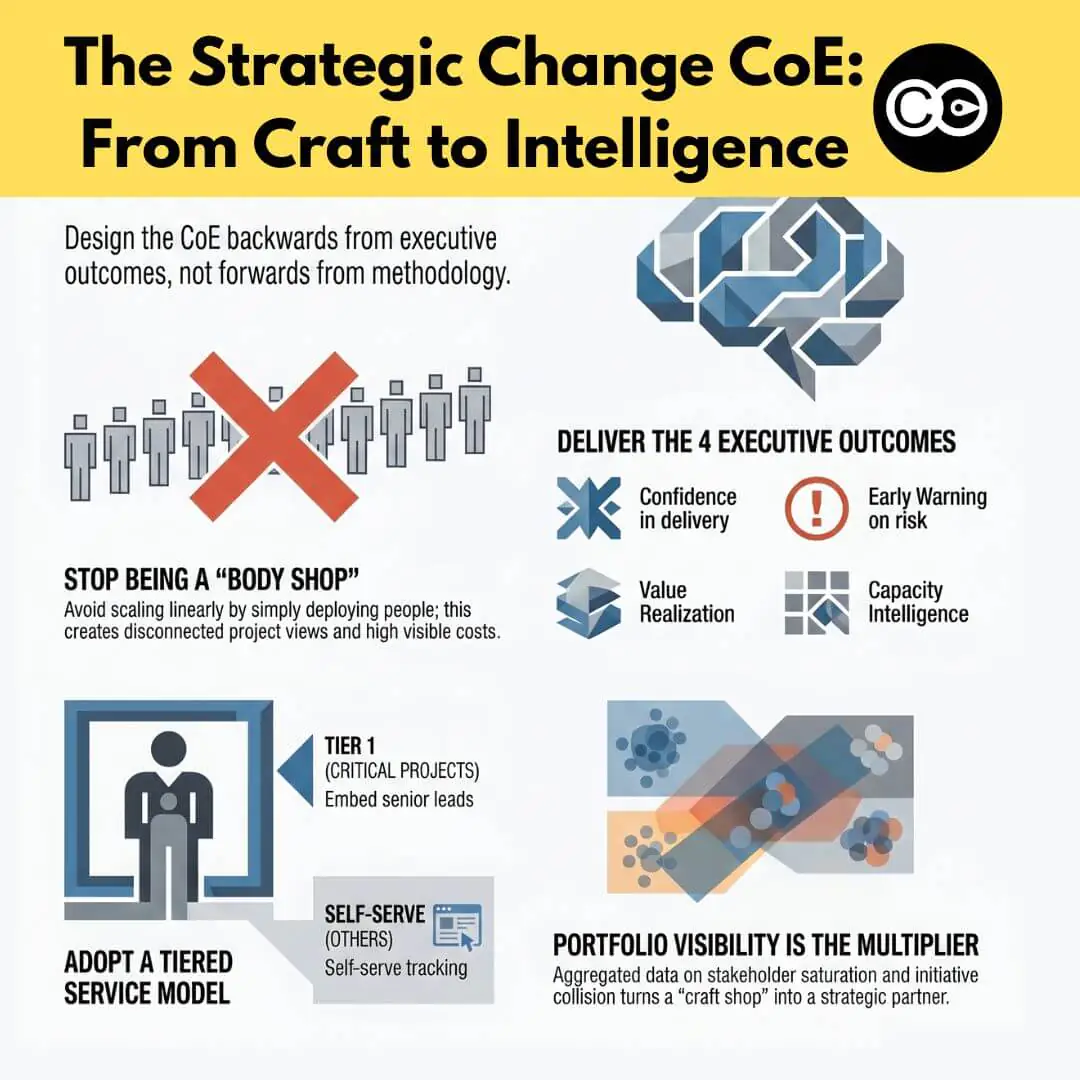
The body-shop model treats the centre as a resourcing pool. It hires change managers centrally and deploys them to projects on demand, billing time and measuring utilisation. This feels strategic because it is operationally indispensable, but it is the more dangerous trap of the two. A body shop scales linearly: more change requires more people, costs rise in lockstep with demand, and the function is permanently one efficiency drive away from being outsourced. Worse, because each practitioner is embedded in a single project, no one in the body shop sees across the portfolio. The function that should hold the enterprise view instead holds dozens of disconnected project views.
The strategic reframe: design backwards from outcomes
The reframe that escapes both traps is to design the centre from executive outcomes backwards. Instead of asking “what does good change management look like and how do we deliver it everywhere”, ask “what do our executives need to be confident about to run successful change and transformation, and what would the centre have to see, know, and do to give them that confidence”. The answer reorganises the whole function. It makes portfolio visibility a core capability rather than an afterthought. It makes prioritisation a deliberate act rather than a queue. And it makes the centre a source of intelligence about enterprise risk, not just a supplier of change-management labour.
Start with the outcomes executives actually want
Executives do not want better change management … necessarily. They want a small number of outcomes, and a change management centre of excellence earns its mandate by being demonstrably the function that improves them. In practice, senior leaders are looking for four things from the change portfolio:
- Confidence that the critical initiatives will land. Not activity reports, but a credible read on whether the changes the strategy depends on will actually be adopted.
- Early warning on risk. The ability to see an adoption problem, a capacity breach, or a conflict between initiatives early enough to do something about it, rather than in a post-implementation review.
- Value realisation. Evidence that the benefits in the business case are being captured, and a clear account of where they are leaking. This is the territory of the return on investment of change management, and it is the language that wins executive sponsorship.
- Capacity/adoption intelligence for decisions. A defensible answer to “can the organisation absorb this on top of everything else and how are we on track to fully adopt the changes”, so that portfolio and investment decisions are made against real capacity/adoption rather than optimism.
Notice what is not on that list: methodology adoption, template usage, practitioner accreditation, utilisation. Those are means, and a centre that reports them to executives is answering a question no one asked. Design the centre so that its core reporting speaks directly to the four outcomes above, and the conversation about its value changes entirely.
The capabilities a strategic change CoE needs
A strategic centre needs five core capabilities. The first three are what most centres already have or aspire to. The last two are what separate a strategic capability from a methodology library, and they are the ones most often missing.
| Capability | What it delivers | Executive outcome it serves | Maturity signal |
|---|---|---|---|
| Standards and method | A consistent, fit-for-purpose change approach | Confidence in delivery quality | The method is used because it helps, not mandated |
| Tools and templates | Reusable artefacts that lower the cost of good practice | Efficiency and consistency | Practitioners reach for them by default |
| Coaching and capability building | Skilled change practitioners and change-capable leaders | Confidence the critical initiatives will land | Business leaders run change competently with light support |
| Portfolio visibility and intelligence | A live, aggregated view of change load, risk, and conflict across the enterprise | Early warning on risk; capacity intelligence | Leadership consults the centre before approving new initiatives |
| Governance and prioritisation | Disciplined allocation of scarce change resource to what matters most | Value realisation; capacity intelligence | The centre can say no, or not yet, with evidence |
The capability that does the most to make a centre strategic is portfolio visibility. A centre that can see across every active initiative, where the load is concentrated, where initiatives collide, which stakeholder groups are saturated, is a centre that can answer the executive’s real questions. Without it, even a well-run centre is, in effect, a methodology library with a coaching service attached. This is also the capability that benefits most from AI-supported change automation, because aggregating and interpreting portfolio data at scale is precisely the kind of work that is impractical to do manually across dozens of initiatives.
Prioritise by strategic importance, not by who asks first (or is more influential)
The defining constraint of every change centre is that change resource is scarce and demand is effectively unlimited. Every initiative wants a change manager. The body-shop response is to ration by availability and seniority, which means resource flows to the loudest sponsors rather than the most important initiatives. The strategic response is to allocate deliberately, by strategic importance.
This requires the centre to hold an explicit view of which initiatives matter most to the enterprise, and to be willing to differentiate. Not every initiative deserves a dedicated change lead, and pretending otherwise is how centres spread themselves so thin that they add little anywhere. The uncomfortable truth is that a centre trying to support everything equally is implicitly deprioritising the initiatives that matter most, by denying them the depth of support their importance warrants. Prioritisation is not bureaucracy. It is the mechanism by which a scarce resource is pointed at the highest-value work, and it is impossible to do credibly without the portfolio visibility described above.
The shift is easier to see with a concrete picture. Consider a centre with six change practitioners facing a portfolio of thirty initiatives. The body-shop instinct is to spread those six across as many initiatives as possible, giving each a fraction of a change manager and none of them enough. Every initiative gets a name against it, and almost none get real support. The strategic alternative is to look at the thirty through the lens of strategic importance, identify the three that the corporate strategy genuinely depends on, and place a dedicated senior lead on each. The remaining three practitioners then run a coaching model across the next tier of important initiatives, while the rest are served by self-serve enablement and portfolio tracking. The same six people now create disproportionate value on the initiatives that matter, instead of uniform mediocrity across all thirty. The only thing that changed was the willingness to differentiate, backed by a clear view of which initiatives sit where.
A tiered service model for limited change resources
The practical expression of prioritisation is a tiered service model. Rather than offering one undifferentiated service (a change manager on your project) to whoever secures one, a strategic centre offers different levels of service matched to the strategic importance and complexity of each initiative. This is the single most effective move a centre can make to escape the body-shop trap, because it breaks the assumption that the centre’s only product is one-to-one practitioner deployment.
A workable four-tier model looks like this:
| Tier | Who it is for | What the centre provides | Resource intensity |
|---|---|---|---|
| Tier 1: Embedded | The handful of enterprise-critical, high-complexity initiatives | A dedicated, senior change lead working full-time on the initiative | High |
| Tier 2: Guided | Important initiatives with a business-side change owner | A centre consultant who coaches the embedded owner, reviews artefacts, and assures quality on a regular cadence | Medium |
| Tier 3: Enabled | Standard initiatives run by capable business teams | Self-serve toolkit, templates, training, and scheduled office hours; the business runs its own change | Low |
| Tier 4: Tracked | Everything else with a change footprint | No direct support, but the initiative is captured in the portfolio view for load, conflict, and saturation monitoring | Minimal |
Three things make this model work. First, the tier is assigned by strategic importance and complexity, not by who asks, which is what enforces the prioritisation discipline. Second, every initiative gets something, even if it is only Tier 4 portfolio tracking, which means the centre retains enterprise-wide visibility rather than only seeing the projects it staffs. That visibility is what lets the centre answer portfolio-level questions no body shop can. Third, the model scales without scaling headcount linearly, because most initiatives sit in the lighter tiers, and the centre’s scarce senior practitioners are concentrated where they create the most value.
The tiered model also reframes the centre’s identity. It is no longer “the place you get a change manager”. It is the function that decides, on evidence, how much and what kind of change support each initiative warrants, and that holds the only complete view of change across the enterprise. That is a strategic position. A body shop can never occupy it.
The intelligence layer that makes a centre strategic
Every capability above depends on one thing the traditional centre lacks: a live, aggregated view of change across the whole portfolio. Without it, prioritisation is guesswork, the tiered model cannot see what sits in Tier 4, and the executive outcomes about risk and capacity cannot be answered at all. This is why a change management centre of excellence without portfolio data is, in the end, a methodology library with good intentions.
This is the role a change intelligence platform plays for the centre. Change Compass aggregates impact, load, and risk data across every initiative in the portfolio, giving the centre the enterprise-wide view that turns it from a craft function into a strategic one. It is what lets the centre tell an executive, with evidence, that a stakeholder group is saturated, that two initiatives are about to collide, or that the portfolio is carrying more change than it can absorb. The platform does not replace the centre’s people or method. It gives them the intelligence layer that makes their judgement visible and credible at the enterprise level. For centres evaluating how to build this, the criteria are the same ones covered in any serious assessment of change portfolio management tools.
The maturity journey from informal to embedded
No centre arrives fully formed, and trying to stand up all five capabilities at once is a common way to fail. The journey runs through three broad stages.
Informal
Change is done project by project, with no shared method and no central function. Some practitioners are good, some are not, and there is no enterprise view. The first move is to establish standards and a small core team: the methodology-library foundation, which is a legitimate and necessary starting point.
Functional
The centre exists, owns the method, builds capability, and deploys or coaches practitioners. This is where most centres stall, because it is comfortable and visibly useful. The risk is mistaking this stage for the destination. A functional centre is still answering “are we doing change well”, not “will the portfolio land”.
Strategic and embedded
The centre operates the tiered service model, allocates by strategic importance, holds the portfolio intelligence, and reports to executives in the language of risk, capacity, and value. At this stage the centre is consulted before initiatives are approved, not just after they are funded. It has moved from supporting change to shaping the change agenda, and its mandate is secure because its value is visible in the outcomes leaders care about.
Where to start
If your centre today is a library, a body shop, or both, the highest-value first move is not to add people. It is to build the portfolio view and reframe what the centre reports. Start tracking every initiative with a change footprint, even the ones you do not staff, so you can see the enterprise picture. Then introduce the tiered service model, so your scarce senior practitioners are concentrated on the initiatives that matter most rather than spread evenly across all of them. Finally, change what you report to executives, from activity and utilisation to portfolio risk, capacity, and value realisation. A change management centre of excellence becomes strategic the moment it can answer the question executives actually ask, which is not whether change is being managed, but whether the things the organisation is betting on will land, and whether anyone can see the risk in time. Build the centre that answers that, and it will not be the function that gets cut in the next review. It will be the one the board asks for more of.
Frequently asked questions
What is a change management centre of excellence? A change management centre of excellence is a central function that raises the probability the organisation’s change portfolio succeeds, by owning the change method, building capability, allocating scarce change resource, and holding an enterprise-wide view of change risk and capacity. The strongest centres are defined by their portfolio intelligence and executive alignment, not just by the methodology and templates they maintain.
What does a change COE actually do? At maturity, a change COE does five things: it sets standards and method, provides tools and templates, builds change capability through coaching, maintains portfolio visibility across all initiatives, and runs the governance and prioritisation that directs limited change resource to the most important work. The first three are common; the last two are what make a COE genuinely strategic rather than a methodology library.
How do you structure a change COE with limited resources? Use a tiered service model that matches the level of support to each initiative’s strategic importance and complexity. A typical model has four tiers: a dedicated change lead for enterprise-critical initiatives, a coaching and assurance model for important ones, a self-serve toolkit for standard ones, and portfolio tracking only for the rest. This concentrates scarce senior practitioners where they add the most value and keeps every initiative visible.
How is a change COE different from a project management office? A PMO is generally concerned with delivery of projects: scope, schedule, budget, and dependencies. A change COE is concerned with adoption of the changes those projects create, and with the cumulative impact of change on the workforce. The two are complementary, but a change COE answers questions a PMO cannot, particularly about stakeholder load, change saturation, and whether the organisation can absorb what it is delivering.
How do you measure the value of a change COE? Measure it in the language executives use: confidence that critical initiatives will land, early warning on portfolio risk, value realisation against business cases, and capacity intelligence for investment decisions. Avoid reporting only activity metrics such as methodology adoption or practitioner utilisation, because they describe effort rather than the outcomes leadership actually cares about.
References
- Prosci, Change Management Best Practices: 12th Edition Findings
- Gartner, Employees Are Losing Patience With Change Initiatives
- McKinsey & Company, Losing from day one: Why even successful transformations fall short
- Visier / Workplace Intelligence, State of Organisational Change 2024
- The Change Compass, What is a change intelligence platform?
- The Change Compass, The ROI of change management
- The Change Compass, AI change management automation
- The Change Compass, Change management portfolio tools: a buyer’s guide for PMOs