

Change management maturity is the degree to which an organisation has made change management a consistent, measured and continuously improving capability, rather than something each project invents for itself. On that definition, most organisations are not mature: Prosci’s benchmark research places 54% of participants at Levels 1 or 2 (absent or confined to isolated projects) and only 11% at Levels 4 or 5 (organisation-wide standards or a true competency). The remaining third sit in the middle, applying change management on several projects without an organisation-wide system behind it.
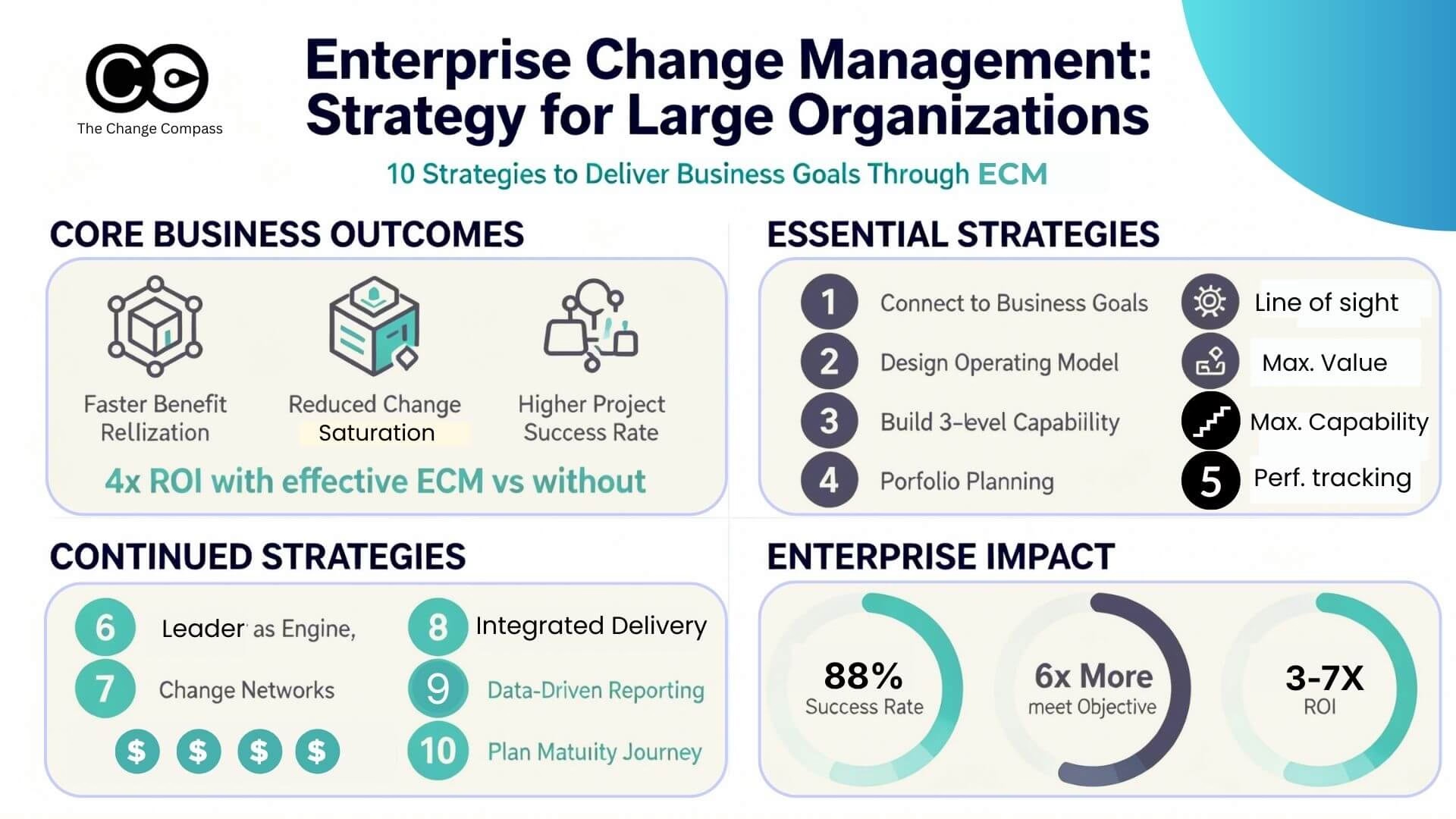
That gap has a price. A sponsor is appointed, a communication plan is written, training is delivered, and the programme closes. Then the next initiative starts from a blank page, with the same debates about method and the same missing data about what the last one learned. The cost shows up in outcomes: Prosci found that 88% of projects with excellent change management met or exceeded their objectives, against 13% with poor change management, and WTW found that organisations with the strongest change effectiveness delivered markedly better revenue and margin results.
This guide is for change, HR and transformation leaders who need to answer three questions: where does our organisation actually sit, what should we target, and what do we do in the next 90 days? It sets out the two main maturity models, a five-level scale with evidence-based diagnostics, the commercial case, the traps that stall progress, and a level-by-level roadmap.
What change management maturity means, and how the main models measure it
Change management maturity describes how reliably an organisation delivers the people side of change without depending on individual heroics. A mature organisation can name who owns change capability, show the standards it applies, and produce data on whether change is landing, all without asking which project team is involved.
Two established models shape the field.
The Prosci model: Five levels and five capability areas
Prosci’s maturity model runs from Level 1 (ad hoc or absent change management) through Level 2 (change management on isolated projects), Level 3 (change management on multiple projects) and Level 4 (organisational standards) to Level 5 (organisational competency). It pairs that scale with five capability areas:
- Leadership: Visible senior support, sponsorship, vision and resourcing for change capability.
- Application: How widely the methodology and tools are used across projects and divisions.
- Competencies: Training and development for practitioners, leaders, managers and employees.
- Standardisation: Common approaches, tools and curricula built into organisational processes.
- Socialisation: Shared understanding and commitment to change management at every level.
The CMI model: Three domains and five levels
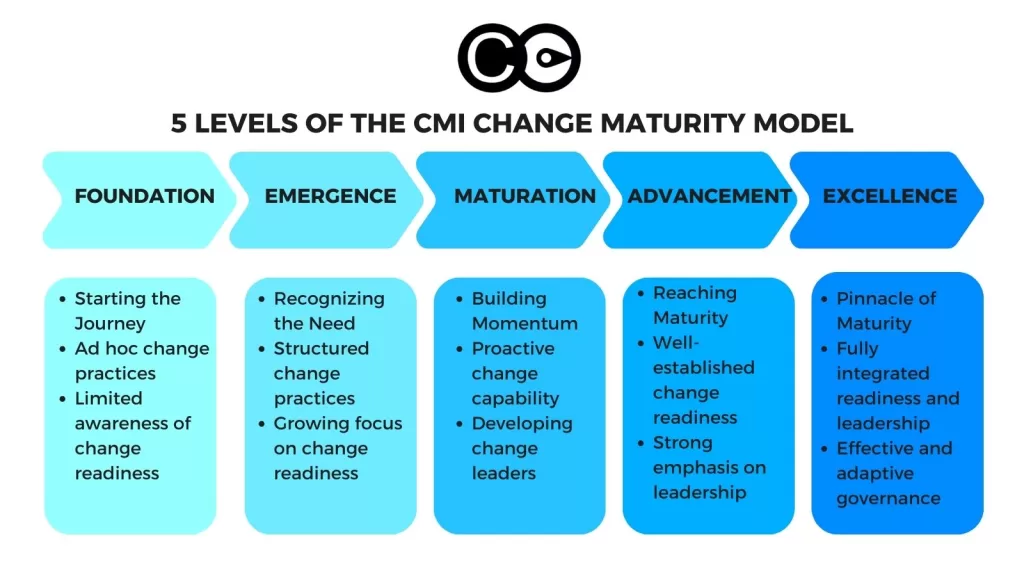
The Change Management Institute’s Organisational Change Maturity Model also uses five levels, but it assesses three domains: strategic change leadership (how leaders set direction, sponsor and prioritise), business change readiness (how the business prepares to receive and sustain change) and project change management. Its framing is useful for senior audiences because it ties maturity to connecting change to strategy, sequencing it and understanding its cumulative impact.
Maturity, readiness and assessment: What is the difference?
These terms are often mixed up. Maturity describes the organisation’s standing capability. Readiness asks whether a specific group is prepared for one specific change. Impact assessment maps what a given change does to roles and teams. A maturity assessment is the one that evaluates the capability itself, and it should draw on readiness and impact data rather than replace them. For how the three fit together, see our guide to change management assessments.
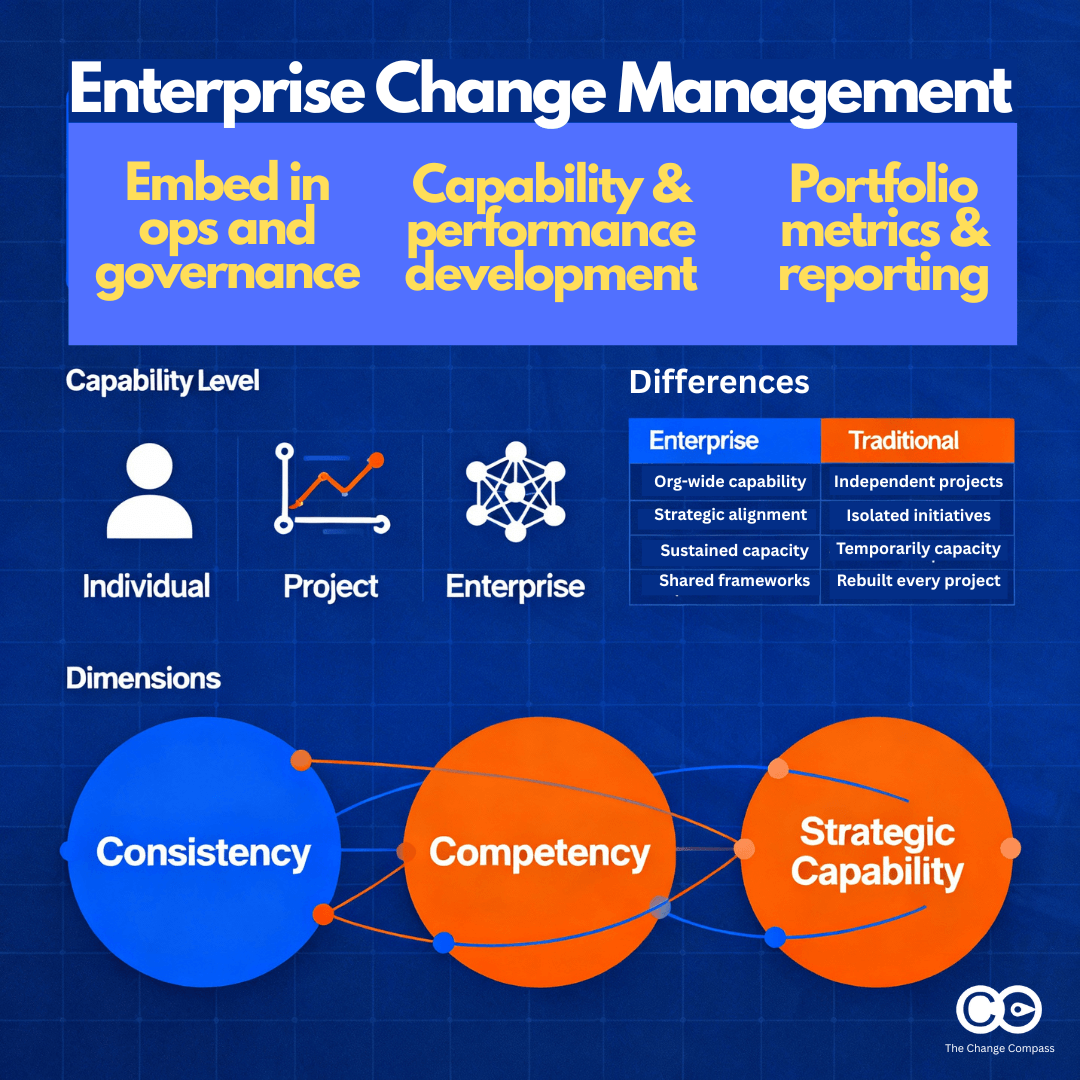
The shared insight across the models: maturity does not mean doing change management on more projects. It means building the governance, leadership behaviours, standards and measurement that make good change management the default.
The five levels of change management maturity, and how to diagnose yours
The framework below synthesises the Prosci and CMI approaches into a five-level scale you can use for self-assessment. It broadly corresponds to Prosci’s levels, with more emphasis on governance and measurement at Levels 4 and 5.
| Level | Name | What it looks like | Broadly equivalent Prosci level | Typical pain point |
|---|---|---|---|---|
| 1 | Ad hoc | No consistent approach. Success depends on individuals. | Ad hoc or absent | Repeated mistakes, no institutional learning, uneven stakeholder experience |
| 2 | Emerging | Some projects apply a method, but quality varies widely. | Isolated projects | Pockets of excellence beside projects with no change support; no shared tools |
| 3 | Standardised | Organisation-wide standards, tools and training exist. | Multiple projects, moving to standards | Standards on paper but unevenly enforced |
| 4 | Managed | Change is built into project governance. Metrics are reported. Portfolio-level visibility. | Organisational standards | Governance can feel bureaucratic and become a checkbox |
| 5 | Optimised | Core competency. Continuous improvement, data-driven, enterprise-wide. | Organisational competency | Sustaining momentum; adapting to new kinds of change such as AI |
Two rules make the scale more useful than a single score.
- Score the capability areas separately. Maturity is rarely uniform. An organisation may have strong leadership support (Level 4) but weak standardisation (Level 2), or high maturity on technology change where project methods enforce it and low maturity on structural or cultural change. Present the result as a profile across the five areas, and use the lowest area to decide where to invest.
- Ask for evidence, not opinion. For each level, the test is whether you can produce the artefact or behaviour on request, such as a standard that was actually applied, a gate review that stopped a project, or a report an executive used to change a decision.
Most organisations will find they are at Level 1 or 2, which matches the Prosci benchmark. Gartner’s 2025 research points the same way: only 32% of business leaders said the last change they led achieved healthy employee adoption.
Level 1 diagnostic: Ad hoc
- Is change management applied inconsistently, with some projects having dedicated support and others none?
- Do project teams create their own approach from scratch each time?
- Is there no central function, community of practice or shared methodology?
- Evidence test: Can you find two projects in the last year that used the same change approach?
If you answered yes to most, you are at Level 1. The priority is to establish a baseline method and show value on a small number of visible projects.
Level 2 diagnostic: Emerging
- Do some project teams use a recognised methodology while others do not?
- Are there pockets of expertise but no organisation-wide standard?
- Is change management seen as a project activity rather than an organisational capability?
- Evidence test: Can you show that the projects using the method performed better than those that did not?
Level 2 organisations need to standardise, building shared tools, templates and training that create consistency across the portfolio.
Level 3 diagnostic: Standardised
- Is there a documented methodology, standard templates and training programmes?
- Are practitioners trained in a common approach?
- Is change management expected on all significant projects, even if enforcement is inconsistent?
- Evidence test: When a project skips the standard, does anything happen?
Level 3 organisations have the foundations. The challenge is moving from standards that exist to standards that are enforced and integrated into governance, which is where a structured assessment capability starts to matter.
Level 4 diagnostic: Managed
- Is change formally integrated into governance (gate reviews, investment decisions, steering committees)?
- Are change metrics tracked, reported and used to inform decisions?
- Does the organisation assess change at portfolio level, not initiative by initiative?
- Is there executive accountability for change effectiveness?
Level 4 organisations perform well. The opportunity is to move from managed process to embedded culture.
Level 5 diagnostic: Optimised
- Is change management treated as a strategic competency rather than a project support function?
- Does the organisation improve its practices continuously, based on data and lessons learned?
- Are leaders at every level competent in change leadership, not only practitioners?
- Is change management part of strategic planning, not just project delivery?
Level 5 is rare. Organisations that reach it treat change capability as a competitive advantage and fund it accordingly.
Which level should you target?
Not every organisation needs Level 5. A realistic target for most large enterprises is a solidly evidenced Level 4 across leadership, application and standardisation, with Level 3 acceptable for socialisation. A nominal Level 5 built on thin evidence is worse than an honest Level 4, because leaders stop asking whether the system still works.
The business case for investing in change management maturity
The evidence linking capability to performance is consistent across independent sources, although each measures something slightly different.
- Project outcomes (Prosci): 88% of projects with excellent change management met or exceeded objectives, against 13% with poor change management, in a study of more than 2,600 practitioners. That is roughly a seven-fold difference.
- Financial results (WTW): In a study of 600 organisations, WTW found “change accelerators” posted one-year revenue change of 6% versus -30%, three-year revenue growth of 4% versus -7%, and gross profit margin of 19% versus -13%, compared with less effective peers.
- Revenue growth (Gartner): Organisations reporting better than average healthy change adoption had about twice the year-over-year revenue growth rate of those that did not.
- Transformation success (McKinsey): only 26% of transformations succeed at both improving performance and sustaining it, while organisations using a rigorous, structured approach report success rates of 79%.
Caution is warranted. These are correlations from survey data, and organisations that manage change well may also run better in other respects. What the pattern does show is that the differences are large, and they come from consistency across the portfolio rather than from excellence on one flagship project. That is the compounding effect maturity produces.
Common maturity traps to avoid
Progress from Level 1 to Level 5 is not linear. Several mistakes stall it or create the appearance of maturity without the substance.
Over-investing in training without governance
Sending 200 people through certification does not build maturity if no governance requires them to apply what they learned. Training builds individual competency; maturity needs organisational systems that activate and sustain it.
Confusing activity with capability
An organisation that produces impact assessments, communication plans and training schedules for every project can look mature. If those artefacts are produced by rote and never influence a decision, they are documentation, not capability. The test is whether the organisation makes different decisions because of change data. The stakes are higher than they look: Gartner found that 79% of 2,850 employees surveyed in April 2025 had low trust in organisational change, which paperwork alone will not repair.
Trying to jump levels
Organisations at Level 1 sometimes attempt to leap to Level 4 by imposing enterprise governance before building the methodology and skills beneath it. This usually produces a bureaucratic framework that practitioners resent and circumvent. Each level builds on the one below.
Treating maturity as a destination
Level 5 is not a finish line. High maturity has to be maintained as experienced practitioners move on and as new kinds of change arrive, including AI-driven transformation, continuous delivery models and distributed workforces. In the AI era the main risk is not a lack of method but a lack of capacity data: organisations that cannot see how much concurrent change each team is absorbing will keep approving one more initiative.
How to advance from your current level
Moving up a level takes sustained effort. As a planning heuristic (not a research finding), allow 12 to 24 months per level, and two to four years to get from Level 1 to Level 3. Compressing that by skipping levels usually backfires.
Moving from Level 1 to Level 2
Focus on demonstrating value. Select two or three high-visibility projects and apply a structured method rigorously. Document outcomes and build an internal evidence base. Establish a small community of practice to share approaches and lessons learned.
Moving from Level 2 to Level 3
Standardise the methodology. Create organisation-wide templates, tools and training. Set minimum change requirements for every project above a defined threshold. Build or hire a central capability that supports project teams.
Moving from Level 3 to Level 4
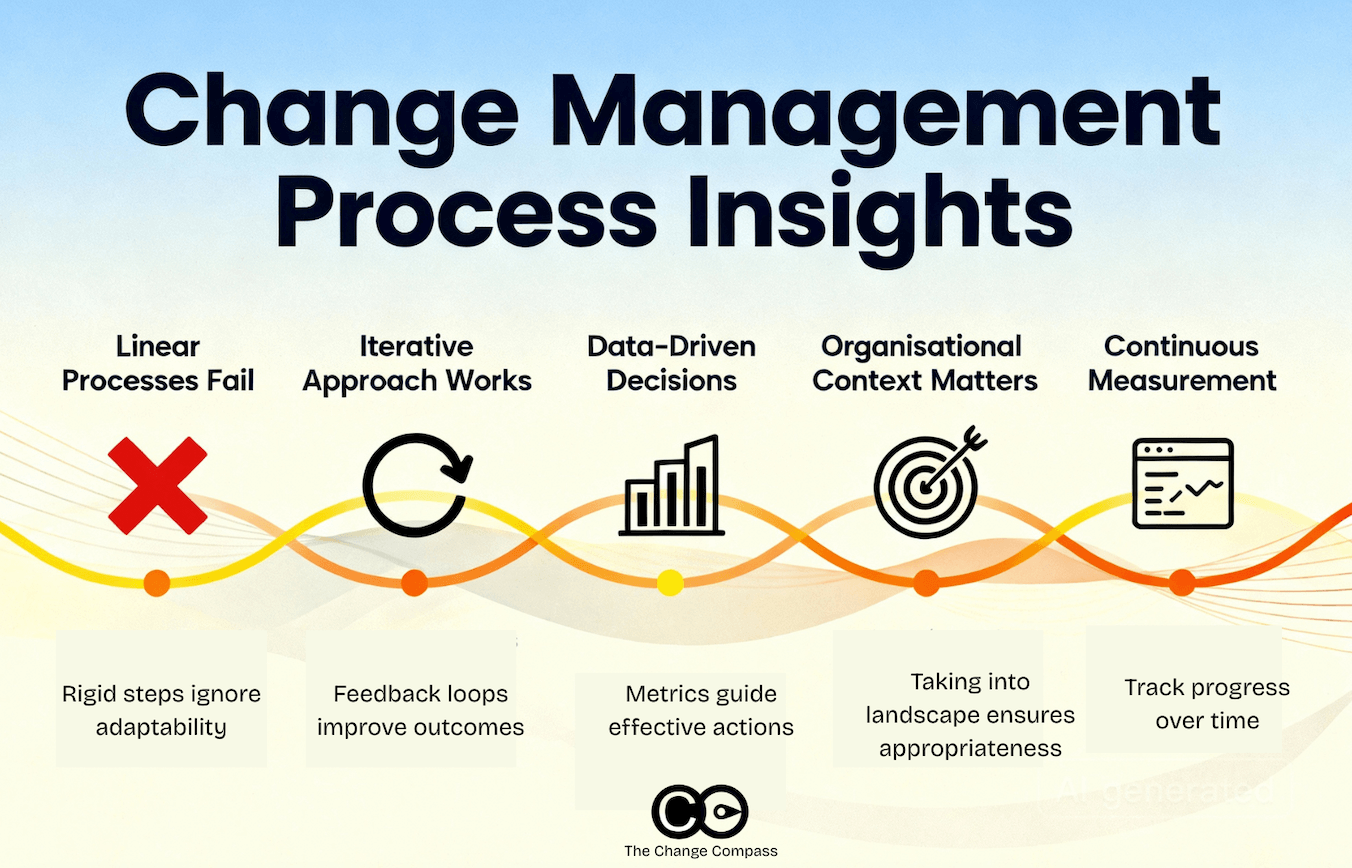
Integrate change management into governance. Add change criteria to gate reviews and investment decisions. Build portfolio-level visibility of change load and adoption. Establish metrics and reporting that reach executive leadership. Measurement is the lever that separates the levels: Prosci’s 2025 ERP study reported a 28% success rate for organisations with mature measurement against 7% for those with poor metrics. See our guide to measuring change management outcomes for frameworks, and our piece on moving beyond change heatmaps for portfolio views.
Moving from Level 4 to Level 5
Embed change management in culture. Build change leadership competency at every management level, not only among practitioners. Create continuous improvement loops that use data to refine practice, and integrate change management into strategic planning. Gartner’s recommendation that leaders routinise change rather than rely on inspiration fits this stage: the aim is to make adopting change second nature.
A 90-day starter sequence
Whatever your level, a first quarter can be organised like this.
- Weeks 1 to 3: Score the five capability areas with evidence tests, and name the weakest area.
- Weeks 4 to 6: List every initiative in flight and the teams each one affects, so the first portfolio view exists.
- Weeks 7 to 10: Pick one governance hook (a gate review, an investment form or a steering agenda) and add a single change criterion to it.
- Weeks 11 to 13: Report one change metric, such as adoption, to the executive team and record which decision it influenced.
For why this sequencing works and how to sustain it, see our companion piece on why maturity matters and how to build it systematically, and for the limits of training-led approaches, rethinking capability building.
What digital platforms add at Levels 3 to 5
Beyond Level 3, maturity depends on data that manual methods cannot provide. Portfolio-level visibility, adoption tracking, cumulative impact analysis and measurement dashboards all need tooling. Spreadsheets and slide decks can describe a single initiative, but they cannot keep a live view of dozens of concurrent changes and the teams they hit.
Digital change management platforms such as The Change Compass let organisations manage change at portfolio level, visualise cumulative impact across stakeholder groups and track adoption in near real time. This matters most at Level 3 and above, where the shift from project-level to portfolio-level capability requires data that spreadsheets and consultant-built decks cannot sustain.
Closing: Start with an honest score, then fix the weakest area
Change management maturity is not about earning a high score on a model. It is about building the capability to manage change consistently, measure its impact and improve over time. Start by scoring your five capability areas against evidence, and accept that the result will probably show an uneven profile. Pick the weakest area and the next level, not the top of the scale. Invest in the governance hooks, skills and leadership habits that close that specific gap, and report one change metric to the executive team within a quarter. The organisations that do this do not just deliver better individual projects. They build an advantage that makes each subsequent transformation more likely to succeed.
Frequently asked questions
What is change management maturity?
Change management maturity is the degree to which an organisation has embedded change management as a consistent, scalable and continuously improving capability rather than an activity done differently on each project. It is usually measured on a five-level scale, from ad hoc project support to a core organisational competency built into governance, leadership behaviour and strategic planning.
How long does it take to advance change management maturity?
As a planning heuristic, moving up one level takes 12 to 24 months of sustained effort, and moving from Level 1 to Level 3 often takes two to four years. The pace depends on executive sponsorship, funding for capability and whether change criteria are written into project governance. Attempting to skip levels usually produces process that practitioners work around.
How do you measure change management maturity?
Score your organisation against a five-level model across several capability areas, such as leadership, application, competencies, standardisation and socialisation in the Prosci model, and ask for evidence at each level rather than opinion. Repeat the assessment annually and compare against a published benchmark such as Prosci or the Change Management Institute model. Report the result as a profile across areas, not a single number.
Do you need a consultant to build change management maturity?
External advisers can speed up methodology design and benchmarking against peers. Lasting maturity has to be owned internally, because it depends on governance, leadership habits and data that the organisation runs every day. The most effective pattern is to use outside expertise to set foundations and transfer skills, then sustain the capability with internal teams and systems.
What is the relationship between change management maturity and culture?
They reinforce each other. A culture where leaders model adaptive behaviour makes it easier to adopt shared methods and governance, and those practices in turn normalise change as an expected way of working. Neither can be built alone, so a maturity roadmap should include leadership behaviours as well as tools and templates.
References
- 5 levels of change management maturity, Prosci
- The 5 areas that define your organizational change capability, Prosci
- The correlation between change management and project success, Prosci
- Built to change: measuring what actually predicts ERP success, Prosci
- Organisational change maturity model framework, Change Management Institute
- Successful change management pivotal to achieving higher revenue growth, WTW research finds, WTW, 2023
- Gartner HR research finds just 32% of business leaders report achieving healthy change adoption by employees, Gartner, 2025
- The science behind successful organizational transformations, McKinsey & Company