Change programmes rarely unfold exactly as planned. Strategies shift, budgets are cut, key sponsors move on, and external forces – from economic downturns to global disruptions – render original plans obsolete before they have even been fully executed. The COVID-19 pandemic made this reality impossible to ignore: organisations that had invested months in detailed change roadmaps found themselves ripping those plans apart and starting again almost overnight. Yet the experience also revealed something equally important – the organisations that responded most effectively were not those that simply abandoned their plans, but those that had a disciplined process for re-planning.
Effective change re-planning is not the same as crisis management or improvisation. It is a structured reassessment of the assumptions, sequencing, capacity, and stakeholder landscape that underpinned the original plan – followed by deliberate decisions about what to pause, what to accelerate, what to restructure, and what to abandon altogether. Prosci research consistently shows that projects with excellent change management are six times more likely to meet objectives than those with poor change management. Re-planning, done well, is an extension of that discipline – it is change management applied to the change portfolio itself.
This guide draws on frameworks and lessons developed during periods of significant disruption – including the COVID-19 period – but is designed to be relevant whenever an organisation faces a significant shift in its operating environment. Whether you are navigating a merger, a regulatory overhaul, a leadership transition, or a broad economic reset, the principles and steps outlined here will help your change team re-establish direction, rebuild stakeholder confidence, and deliver outcomes that matter in the new context. Platforms like The Change Compass can play a pivotal role in making these re-planning decisions data-driven rather than reactive.
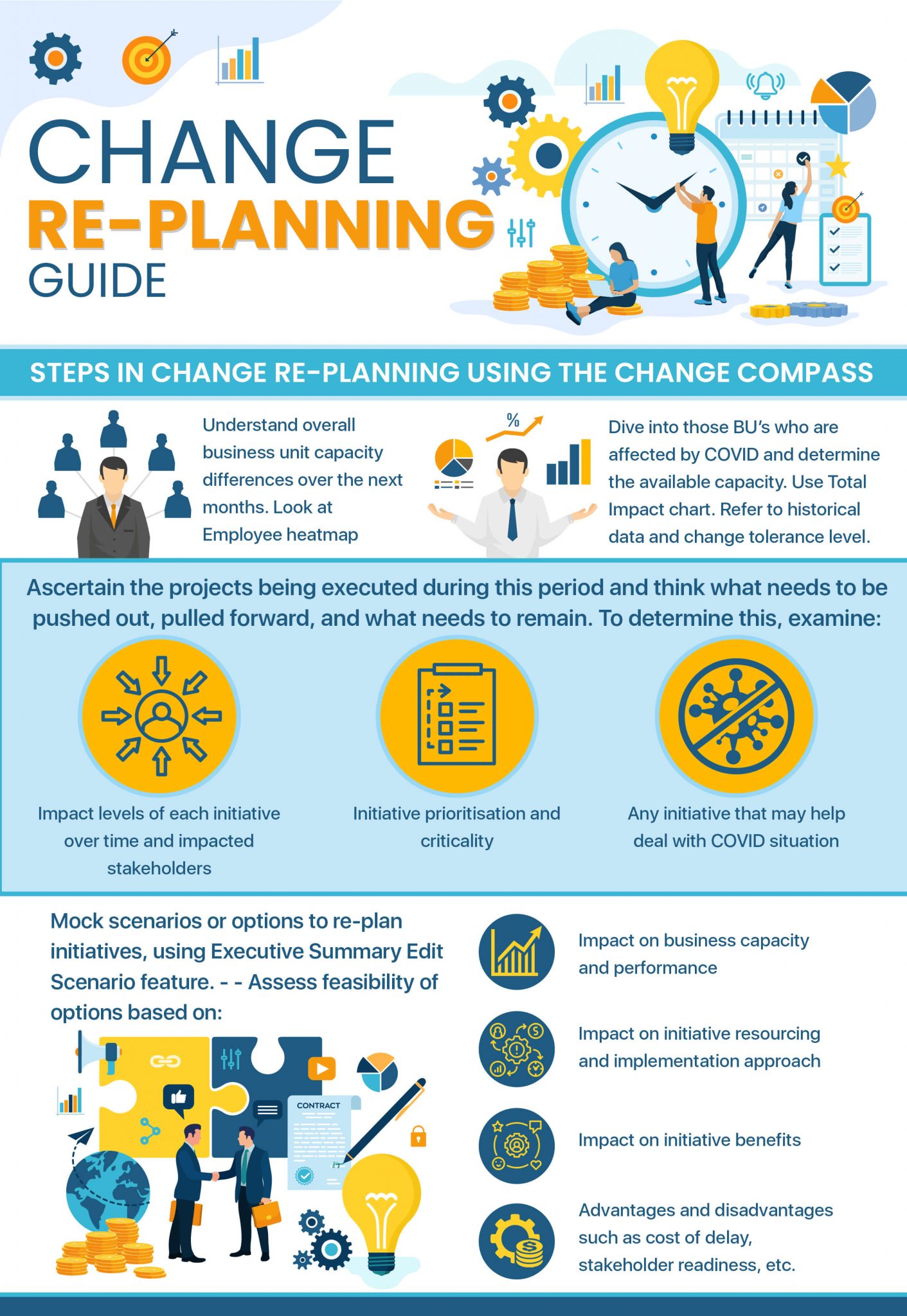
Download the Change Re-Planning infographic for a visual summary of the key re-planning steps covered in this guide.
What triggers a change re-plan
Not every bump in the road warrants a full re-plan. Change leaders need to distinguish between minor schedule slippage – which can be managed through normal programme governance – and the kind of fundamental environmental shift that makes the original plan structurally unsound. The latter is what demands a proper re-planning process. Common triggers include a significant reduction in available change capacity (through redundancies, restructures, or budget cuts), a material change in the strategic priorities of the business, the loss of a key sponsor or executive champion, a regulatory change that alters the compliance timeline, or a broad external disruption that affects the organisation’s ability to absorb change.
According to Gartner research on change management, one of the most common failure modes in organisational change is persisting with an outdated plan rather than acknowledging that the operating context has fundamentally shifted. Leaders can be reluctant to admit that original assumptions no longer hold, partly because re-planning feels like an admission of failure. In reality, the ability to recognise when a re-plan is needed – and to act on that recognition quickly – is a mark of mature change leadership. The question is not whether a re-plan is warranted, but whether the organisation has the processes and data to execute it well.
Core principles of effective change re-planning
Before diving into the process steps, it is worth articulating the principles that should guide any re-planning effort. The first is that re-planning must be grounded in reality, not aspiration. This sounds obvious, but many re-plans simply compress the original timeline or reduce scope without genuinely interrogating whether the underlying conditions for successful change are in place. A re-plan that ignores reduced stakeholder readiness or depleted change capacity is likely to fail for the same reasons the original plan was struggling.
The second principle is that re-planning is a collaborative process, not a top-down directive. The change teams, business leads, and affected employees who will implement the revised plan need to be meaningfully involved in shaping it. John Kotter’s foundational research on transformation, published in Harvard Business Review, identified the failure to build a sufficiently broad guiding coalition as one of the primary reasons change efforts fail – and that principle applies equally to re-planning efforts. The third principle is that re-planning decisions should be informed by data wherever possible. Gut feel and political momentum are not reliable guides when hard choices need to be made about which programmes to pause and which to prioritise. This is where change portfolio data becomes especially valuable.
The re-planning process: a step-by-step approach
The first step in any re-planning process is to conduct a rapid but thorough stocktake of the current state of the change portfolio. This means documenting every active change initiative – its current status, its scheduled milestones, its resource requirements, its dependencies, and its strategic rationale. The goal is to create a complete picture of what is in flight before making any decisions about what to change. Without this baseline, re-planning decisions are likely to be made in silos, with individual programme leads optimising for their own initiatives rather than the health of the overall portfolio.
The second step is to reassess the organisation’s actual change capacity in the new environment. Capacity is not just about the number of change practitioners available – it encompasses the bandwidth of leaders to sponsor and communicate change, the readiness of frontline employees to absorb new ways of working, and the availability of the operational time needed to support training, transition, and embedding activities. Many organisations dramatically overestimate their change capacity under normal conditions; in a disrupted environment, that gap between assumed and actual capacity can be even more pronounced.
The third step is to revalidate the strategic case for each initiative in the portfolio against the new operating context. Some initiatives that were critical six months ago may now be lower priority given a shift in strategy. Others that were on hold may have become urgent. This is fundamentally a strategic conversation – one that needs to involve senior leaders, not just the change team – but it should be structured around clear criteria: strategic alignment, employee impact, dependency risk, and return on investment. Once the portfolio has been assessed against these criteria, the change team can move to the fourth step: sequencing and scheduling the revised portfolio in a way that matches available capacity and minimises change fatigue.
Re-engaging stakeholders during a re-plan
One of the most critical – and most often underestimated – elements of change re-planning is the stakeholder re-engagement process. When a plan changes significantly, stakeholders who had been aligned with the original direction can quickly become disengaged, confused, or actively resistant. Sponsoring executives who made commitments based on the original timeline may feel exposed. Middle managers who had begun communicating the change to their teams may feel embarrassed. Employees who had started preparing for new ways of working may feel that the goalposts have shifted again.
Effective stakeholder re-engagement during a re-plan requires honest, timely communication that acknowledges what has changed and why, rather than attempting to paper over the disruption. McKinsey research on organisational transformation has consistently found that transparent communication – even when the news is difficult – is more effective at maintaining trust than managing information carefully to avoid alarm. Stakeholders who understand the genuine reasons for a re-plan are far better positioned to support it than those who sense something has changed but have not been told what or why.
Re-engagement also needs to be targeted. Different stakeholder groups have different concerns and different information needs. Senior sponsors need to understand the revised strategic rationale and their renewed commitments. Middle managers need practical guidance on what to tell their teams. Frontline employees need clarity about what is changing for them and what is not. The Change Compass platform can support this process by providing change impact data that makes stakeholder conversations more concrete and evidence-based – moving them away from abstract debates about priority towards a shared view of impact and timing.
Rebuilding change capacity after disruption
Disruption typically erodes change capacity in ways that are not immediately visible. Change practitioners may have been redeployed to crisis response activities. Leaders who were previously available for change sponsorship may be consumed by operational demands. Employees who had been building momentum around a particular change may have lost confidence or motivation in the intervening period. Before the revised change portfolio can be delivered effectively, this depleted capacity needs to be recognised and addressed.
Rebuilding capacity starts with an honest assessment of what has been lost and what can realistically be restored in the available timeframe. This may involve re-scoping the change team’s responsibilities to focus on the highest-priority initiatives, investing in renewed leader capability building, or redesigning employee-facing change activities to be more targeted and less time-intensive. It is also important to recognise that change fatigue – the cumulative exhaustion that results from prolonged exposure to change – can significantly reduce the organisation’s receptivity to new initiatives, even well-designed ones. Prosci’s research on change fatigue highlights that addressing it requires not just better pacing of change, but also explicit acknowledgement of the burden that change places on people and genuine efforts to reduce unnecessary complexity.
Using data to inform re-planning decisions
One of the greatest challenges in change re-planning is the tendency for decisions to be driven by politics and advocacy rather than evidence. In a portfolio of twenty or thirty change initiatives, every programme lead will argue that their initiative is critical and cannot be deferred. Without objective data, re-planning conversations can become exhausting negotiations in which the loudest voice or the most senior sponsor wins, regardless of the actual merits of the case. A data-informed approach changes this dynamic significantly.
The most useful data for re-planning decisions includes: the volume and timing of change impacts by employee group, the cumulative change load being experienced by different parts of the business, the dependencies between initiatives that create sequencing constraints, the current state of stakeholder readiness and sponsor commitment, and the degree to which each initiative is tracking against its original milestones and outcomes. When this data is available in a consolidated, visual format – rather than scattered across dozens of project status reports – it becomes far easier to have productive conversations about sequencing, prioritisation, and trade-offs. This is precisely what a well-configured change portfolio platform enables.
How The Change Compass supports change re-planning
The Change Compass is designed specifically to give change leaders the portfolio-level visibility they need to make confident re-planning decisions. Rather than managing change in individual project silos, The Change Compass aggregates data across the entire change portfolio – showing, in a single view, how much change different employee groups are experiencing, where the highest-risk collision points are, and how the portfolio as a whole is tracking against organisational capacity.
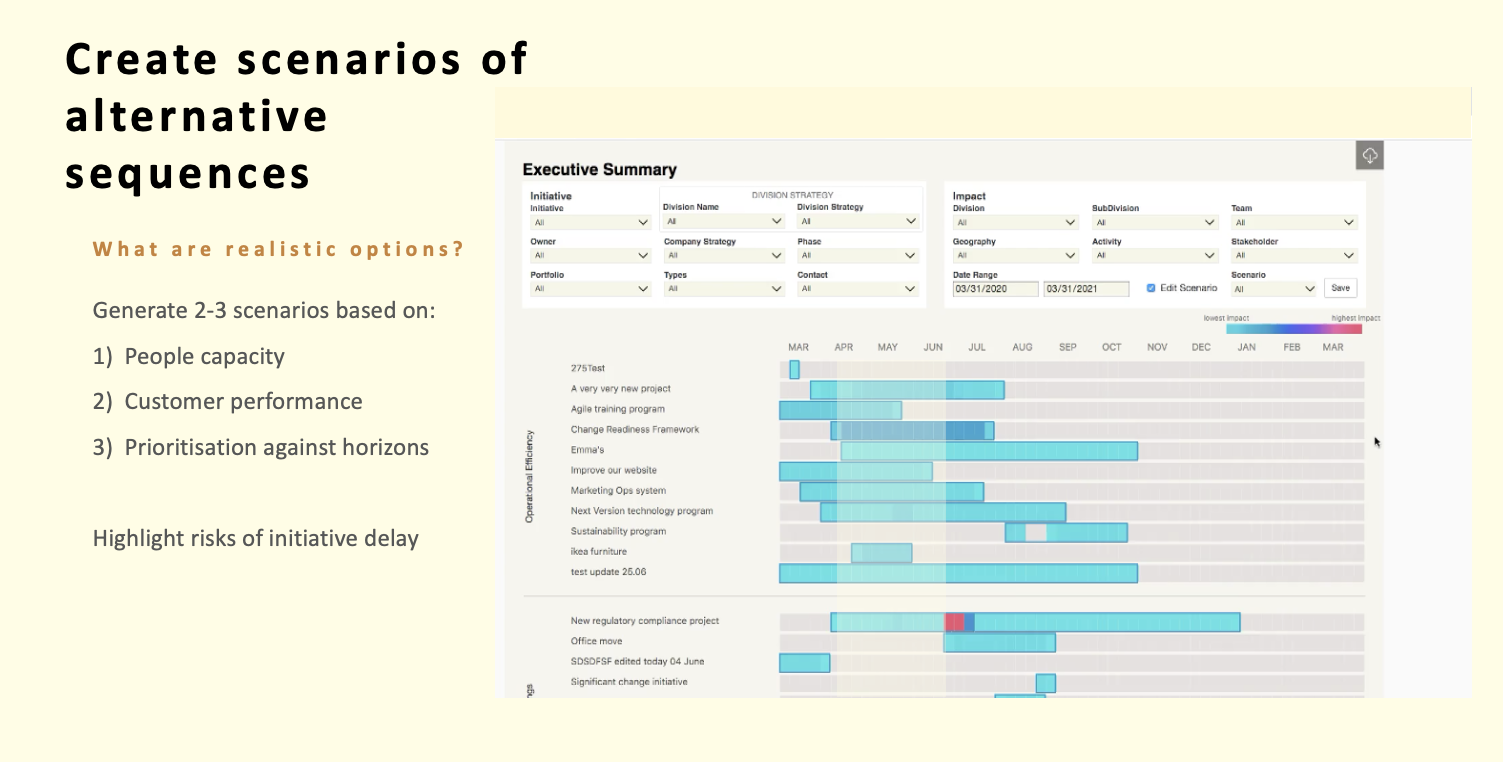
During a re-plan, this kind of portfolio view is invaluable. It allows change leaders to move quickly from gut feel to evidence when deciding which programmes to pause, which to sequence earlier, and which to redesign. It also makes the conversation with senior stakeholders much more credible: rather than asking executives to make difficult trade-off decisions based on anecdote, change leaders can present a data-rich picture of what is happening across the business and what the likely consequences of different re-planning scenarios would be. The result is faster, better-informed decisions and a revised plan that has a much stronger chance of being successfully executed.
Beyond the re-planning exercise itself, The Change Compass provides ongoing monitoring capability that allows organisations to detect early warning signs of future disruption – changes in programme status, emerging capacity constraints, or shifts in stakeholder sentiment – before they escalate into the kind of crisis that demands a full re-plan. In this way, the platform supports not just reactive re-planning but a more proactive approach to change portfolio management that reduces the frequency and severity of disruption in the first place.
Frequently asked questions
How do we know when a re-plan is truly necessary versus simply managing normal programme variance?
A re-plan is warranted when the original assumptions underpinning the change portfolio are no longer valid – not just when timelines slip or budgets are under pressure. The key indicators are a significant shift in strategic priorities, a material reduction in change capacity, the loss of critical sponsorship, or an external disruption that fundamentally alters the organisation’s ability to absorb change. If any of these conditions apply, a structured re-plan is almost certainly needed. Normal programme variance, by contrast, can usually be managed through existing governance mechanisms without requiring a portfolio-level reassessment.
How long should a change re-planning process take?
The duration depends on the size and complexity of the change portfolio, but most organisations can complete the core re-planning steps – stocktake, capacity reassessment, strategic revalidation, and revised sequencing – within two to four weeks if the process is properly resourced and led. The risk of taking longer is that uncertainty persists in the organisation, eroding stakeholder confidence and creating a vacuum that rumour and anxiety will fill. It is better to move quickly to a revised plan, even if that plan is not perfect, than to delay in pursuit of an ideal solution that takes months to produce.
What is the most common mistake organisations make when re-planning change initiatives?
The most common mistake is treating the re-plan as a purely technical exercise – adjusting timelines and resources – without addressing the human and organisational dimensions of the disruption. Stakeholders who have been left without clear communication about why the plan has changed, and what the new plan means for them, will not re-engage effectively regardless of how well the portfolio has been resequenced. Equally common is the mistake of re-planning in a silo, with the change team making decisions that should involve senior leaders and business owners. A re-plan that lacks genuine executive ownership is likely to encounter the same sponsorship gaps that can undermine the original programme.
Can change re-planning be done effectively without a dedicated change portfolio tool?
It is possible to conduct a re-plan using spreadsheets and manual reporting, but the limitations of that approach become acute when the portfolio is large and complex. Without a consolidated data view, it is very difficult to assess cumulative change load across employee groups, identify dependency conflicts, or model the likely impact of different re-planning scenarios. As a result, re-planning decisions are more likely to be based on advocacy than evidence, and the revised plan is more likely to recreate the capacity and sequencing problems that caused the original plan to struggle. A purpose-built platform like The Change Compass significantly reduces these risks by making portfolio data visible, comparable, and actionable.
References
- Prosci – Change Management and Project Management: The Critical Connection
- Prosci – Understanding and Addressing Change Fatigue
- Gartner – Change Management Insights and Research
- Kotter, J.P. (2012) – Leading Change: Why Transformation Efforts Fail, Harvard Business Review
- McKinsey & Company – The People Power of Transformations