

Most large organisations are now somewhere in the process of deploying AI across their operations. Many are discovering, often painfully, that the change management challenge of AI adoption is categorically different from the change management challenges they have navigated before.
The difference is not scale, though AI initiatives are often large. It is speed, depth, and ambiguity. AI changes how work is done, not just which tools people use. It shifts decision-making processes, redistributes responsibilities, and in some cases eliminates roles entirely. And it keeps changing: the capabilities that are state of the art today are different from those of 12 months ago. Managing AI transformation through standard change management frameworks, built for discrete, definable changes, often produces poor results.
McKinsey’s research on change management in the age of gen AI is direct on this point: for CEOs, the charge is clear to plan for a company-wide reconfiguration today so that humans and AI together can achieve extraordinary outcomes tomorrow. And critically, McKinsey notes that upskilling as part of AI transformation is not a training rollout. It is a change management effort.
That reframing from AI deployment as technology change to AI adoption as organisational transformation is where effective AI change management begins.
The adoption gap in AI transformation
The gap between AI investment and AI value is widening in most organisations. Gartner research from 2025 found that business units which redesign how work gets done, rather than simply deploying AI tools and encouraging employees to use them, are twice as likely to exceed revenue goals. Yet most organisations are doing the latter.
This distinction between deploying AI and redesigning work is the core of effective AI change management. When AI is implemented as a tool overlay on existing processes, adoption is partial, benefits are modest, and resistance is higher. When AI implementation is accompanied by genuine redesign of workflows, decision rights, and performance expectations, adoption is deeper and the value is substantially larger.
The research confirms the cost of the gap. MIT Sloan Management Review’s analysis of gen AI scaling found that organisations face a predictable midcycle enthusiasm dip that kills adoption momentum, function-specific resistance that generic communications cannot address, and cultural resistance to working differently. Novo Nordisk’s experience, scaling from a few hundred AI users in January 2024 to more than 20,000 by February 2025, succeeded specifically because they combined champion networks, targeted function-level enablement, and adaptive governance rather than a one-size change communication approach.
Why AI change management is different from standard change management
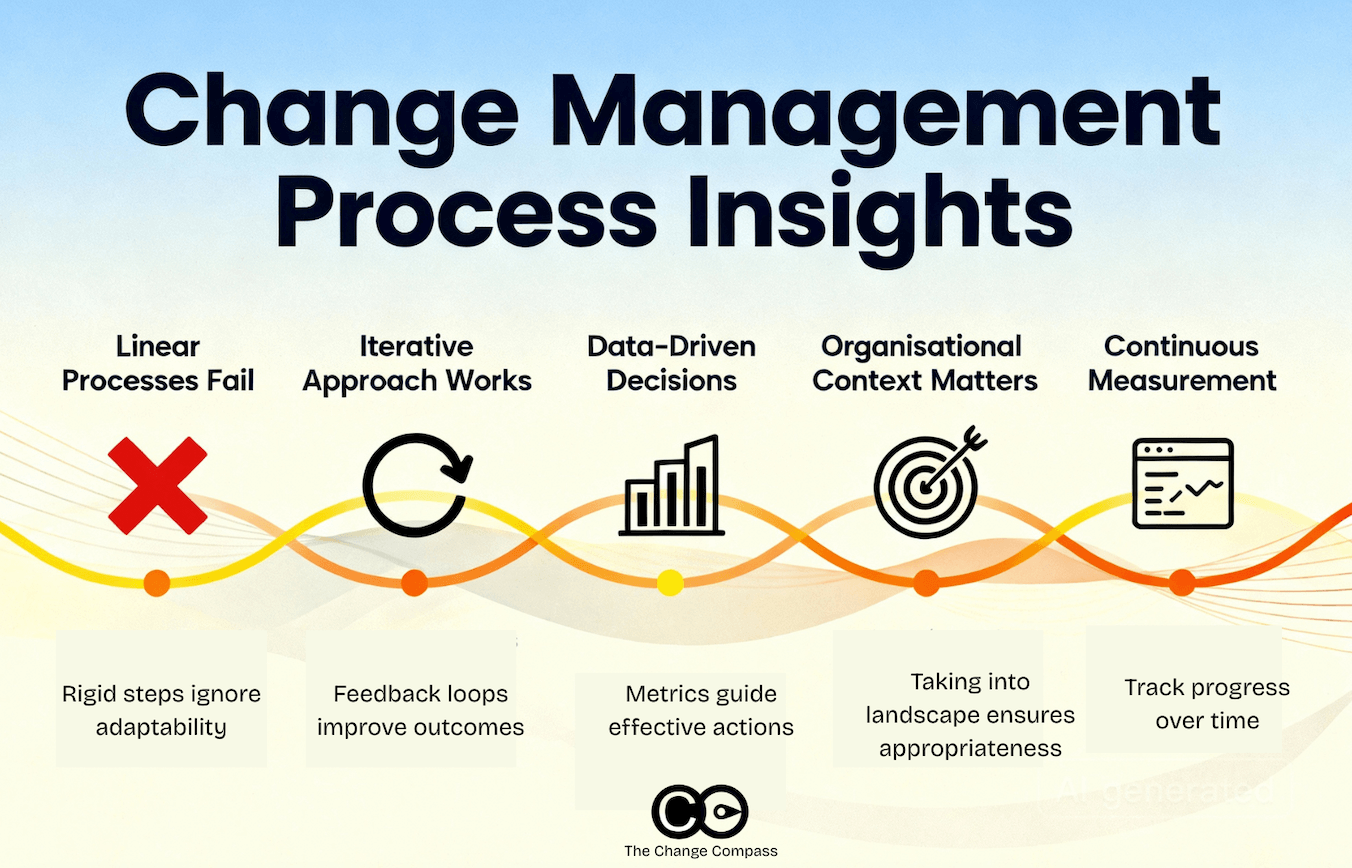
Standard change management frameworks, whether ADKAR, Kotter, or Prosci, were designed for changes with defined endpoints: a new system goes live, a restructure is announced, a policy changes. The change effort has a start, a middle, and a completion point. Communication and training are planned around a timeline. Success is measured at a defined moment.
AI transformation does not work this way. Several characteristics make it distinct.
The change has no fixed endpoint
AI capabilities are evolving continuously. The change management challenge is not “help people adopt this AI tool.” It is “build the organisational capacity to continuously adopt AI as capabilities evolve.” This is a fundamentally different proposition. It requires building adaptive learning capacity into the organisation, not managing a one-time transition.
Employee relationship with AI is ambivalent, not uniformly resistant
Standard change management wisdom treats resistance as the primary barrier. With AI, the picture is more complex. MIT Sloan research found that employee hope about AI handling certain tasks remains high at 78 to 85% across adoption stages, while fear stays relatively low at 21 to 32%. The challenge is not primarily resistance, it is the gap between positive sentiment and sustained behaviour change in how work is actually done.
The impact is role-specific to an unusual degree
AI affects different roles in fundamentally different ways. A finance analyst and a customer service representative may both be in the same organisation’s AI transformation programme, but the change each needs to make is almost entirely different. Communication and training approaches that work for one will not work for the other. AI change management requires function-level and role-level customisation at a depth that generic programme change management rarely reaches.
Middle management is the critical adoption layer
Gartner’s CHRO research identifies a July 2025 survey finding that 78% of CHROs agree workflows and roles will need to change to get the most out of AI investments. But the barrier to this redesign is not typically executive resistance. It is middle management. Managers whose teams are being asked to work differently face the most immediate and personal disruption from AI adoption. They are simultaneously the key enablers of change at the team level and the group most likely to passively resist if the change management approach does not specifically address their experience.
What effective AI change management looks like
The organisations navigating AI transformation most effectively share several characteristics in their change approach.
They start with work redesign, not tool deployment. Before employees are asked to use AI tools, the question is asked: how should this work actually be done differently with AI available? This question is answered at the process and role level, not the general level. The answer shapes both the change management plan and the training design.
They build internal AI champion networks. The Novo Nordisk model, and many similar examples across industries, shows that peer-led adoption in function-specific contexts substantially outperforms top-down communications. Champions are typically senior individual contributors who understand the function’s work in detail and can translate AI capability into specific, credible use cases for their colleagues.
They manage the midcycle dip actively. AI adoption typically follows a predictable curve: initial enthusiasm, early experimentation, midcycle frustration as the limitations of current tools become apparent, and then either deeper adoption (for organisations that support people through the dip) or abandonment (for those that do not). Effective AI change management plans for the midcycle dip explicitly. It is not a sign of programme failure; it is a predictable stage that requires specific interventions.
They track adoption at role and function level, not just platform usage metrics. Platform usage (how many people opened the tool, how many queries were submitted) is a leading indicator at best and can be deeply misleading. A person can use an AI tool regularly without changing how they work in any meaningful way. Effective AI change management tracks whether the work is actually changing: are decisions being made differently, are time savings being realised, are outputs improving?
They redesign performance frameworks to reflect AI-enabled work. If employees are being asked to do their jobs differently using AI, but their performance frameworks still measure the old way of working, the rational behaviour is to use AI superficially while continuing to work in ways that the performance system recognises and rewards. Aligning performance expectations with AI-enabled ways of working is one of the most powerful and most neglected levers in AI change management.
The change management challenge specific to AI in large enterprises
For enterprise change leaders, AI transformation introduces portfolio complexity that adds to the standard adoption challenge. Most large organisations are running multiple AI initiatives simultaneously: different functions, different vendors, different use cases. The change management challenge is not just managing each initiative, it is managing the cumulative AI-related change burden on employees who are being asked to adopt AI across several areas of their work simultaneously.
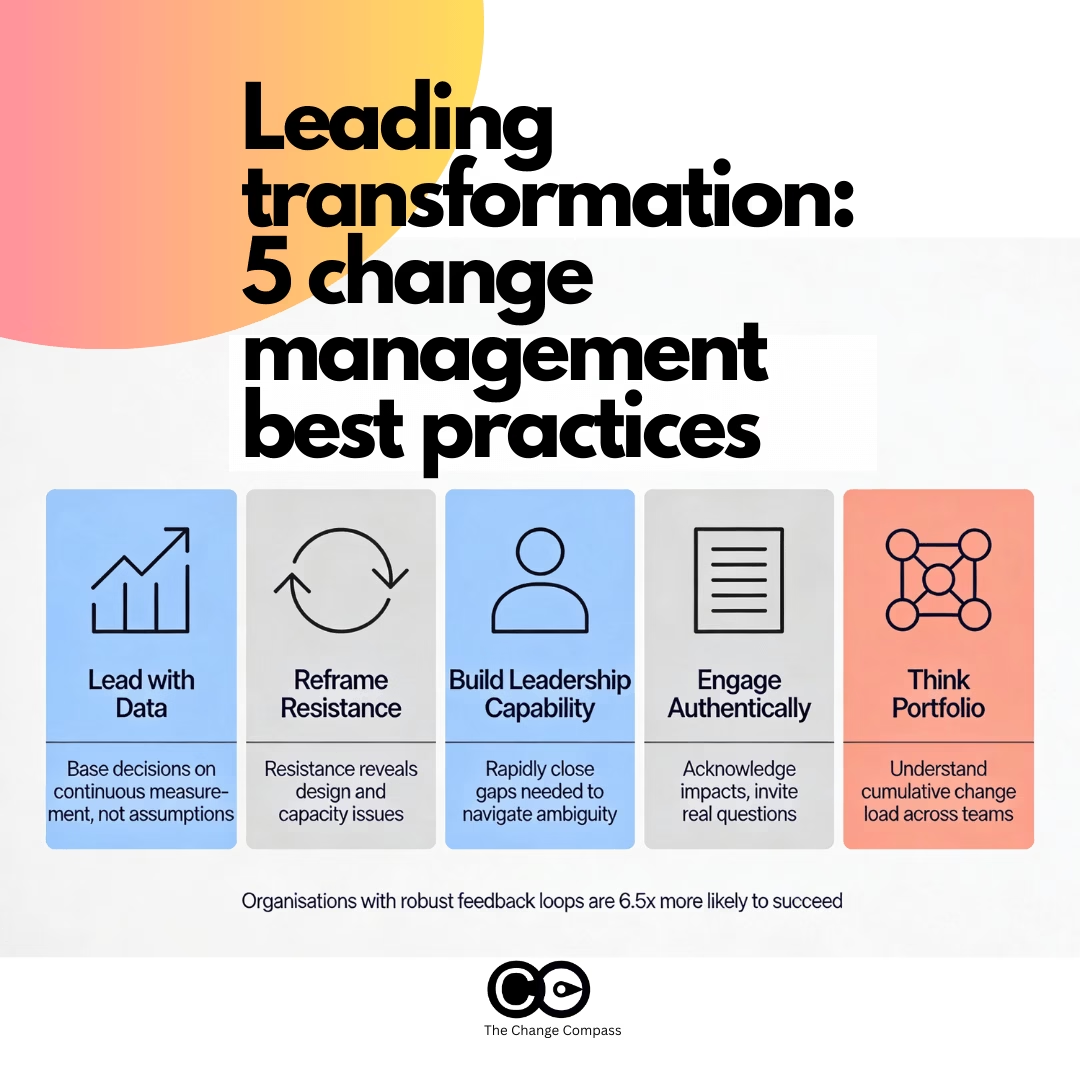
Gartner research found that organisations continuously adapting their change plans based on employee responses are four times more likely to achieve change success. For AI transformation, this adaptive approach is even more important than usual, because the feedback loops are faster. AI tools change rapidly. Employee experience of those tools shifts as capabilities evolve. A change management plan set at programme initiation and not revisited will be misaligned with reality within months.
Using digital platforms in AI change management
The irony of AI change management is that it is one of the highest-complexity change management challenges organisations face, at a moment when most change functions are still operating with manually-compiled data and periodic reporting cycles. Digital change management platforms, such as The Change Compass, enable the continuous adoption tracking and portfolio-level visibility that AI transformation requires: seeing where adoption is progressing by function, identifying which employee groups are experiencing midcycle dips, and generating the data needed to adapt the change approach in real time rather than at fixed review points.
For AI transformation specifically, the combination of role-level adoption tracking and portfolio-level load management is particularly valuable. The change function can see not just whether AI adoption is progressing, but how AI change load interacts with other concurrent changes affecting the same employee groups.
What the research says about AI adoption failure
It is worth being clear about the evidence. A May 2025 Gartner survey of 506 CIOs and technology leaders found that 72% of CIOs report their organisations are breaking even or losing money on AI investments. The primary reasons cited are not technical: they are change-related. People are not working differently. Workflows have not been redesigned. The cultural conditions for AI adoption have not been established.
This is not a technology problem. It is a change management problem of a kind that only becomes soluble when AI transformation is explicitly treated as an organisational change challenge requiring deliberate, sustained change management investment.
Building AI change management capability in your organisation
For change leaders building the case internally for dedicated AI change management investment, the most useful starting point is a portfolio scan: how many AI initiatives are currently active across the organisation, which employee groups are they targeting, what is the cumulative AI-related change load, and what change management support is currently in place for each?
In most large organisations, this scan reveals a significant gap: a large number of AI initiatives, often with substantial investment in technology and training, and limited or no dedicated change management beyond communications. This gap is where the value is. Closing it, by bringing the same rigour to AI adoption management that mature change functions bring to major technology implementations, is the highest-return investment most enterprise change functions can make in 2026.
Frequently asked questions
What is AI change management?
AI change management is the application of organisational change management principles and practices to the challenge of adopting artificial intelligence tools, platforms, and AI-driven ways of working. It goes beyond technology deployment to address the behavioural, cultural, and structural changes required for AI to deliver its intended value.
Why do so many AI transformation initiatives fail to deliver expected value?
The primary causes are change-related, not technical. Workflows are not redesigned to use AI effectively, middle managers are not equipped to lead AI adoption at team level, performance frameworks still incentivise old ways of working, and adoption tracking focuses on platform usage rather than actual behaviour change. Gartner data shows 72% of CIOs report breaking even or losing money on AI investments, largely for these reasons.
How is AI change management different from managing other technology changes?
AI transformation differs in three important ways: there is no fixed endpoint because AI capabilities evolve continuously; the impact is highly role-specific, requiring function-level customisation that generic programmes cannot achieve; and the adoption challenge involves sustained behaviour change in how work is done, not just familiarity with a new tool.
What is the role of middle managers in AI adoption?
Middle managers are the most critical adoption layer. They translate the organisation’s AI strategy into day-to-day working practice for their teams. They are also the group most likely to face personal disruption from AI-driven work redesign. AI change management approaches that specifically address the manager experience, building their capability to lead AI adoption rather than treating them as a communication channel, substantially improve adoption outcomes.
How do you measure AI adoption effectively?
Effective measurement goes beyond platform usage metrics to track whether work is actually changing. This includes time savings realised in specific processes, quality of AI-assisted outputs compared to previous outputs, changes in decision-making patterns, and whether employees in target roles report working differently. Portfolio-level dashboards that aggregate this data by function and role group enable the adaptive approach that drives four times higher change success.
What is an AI champion network?
An AI champion network is a group of senior individual contributors in specific functions who serve as peer advocates and enablers for AI adoption within their teams. Champions are effective because they can translate general AI capability into specific, credible use cases relevant to their colleagues’ actual work, and because peer advocacy is significantly more influential than top-down communications for this type of behaviour change.
References
- McKinsey. Reconfiguring Work: Change Management in the Age of Gen AI. https://www.mckinsey.com/capabilities/quantumblack/our-insights/reconfiguring-work-change-management-in-the-age-of-gen-ai
- Gartner. Gartner Identifies the Top Change Management Trends for CHROs in the Age of AI (March 2026). https://www.gartner.com/en/newsroom/press-releases/2026-3-16-gartner-identifies-top-change-management-trends-for-chros-in-age-of-ai
- Gartner. Gartner Says CHROs’ Top Priorities for 2026 Center Around Realizing AI Value (October 2025). https://www.gartner.com/en/newsroom/press-releases/2025-10-02-gartner-says-chros-top-priorities-for-2026-center-around-realizing-ai-value-and-driving-performance-amid-uncertainty
- MIT Sloan Management Review. How to Scale GenAI in the Workplace. https://sloanreview.mit.edu/article/how-to-scale-genai-in-the-workplace/
- MIT Sloan Management Review. Three Things to Know About Implementing Workplace AI Tools. https://sloanreview.mit.edu/article/three-things-to-know-about-implementing-workplace-ai-tools/