Change management has long operated on assumptions. Traditional linear models as a part of a change management process were built on the premise that if you follow the steps correctly, organisational transformation will succeed. But in recent years, large-scale empirical research has provided something far more valuable than theory: hard evidence that challenges this assumption.
The data is unambiguous. Organisations using iterative, feedback-driven change approaches achieve dramatically higher success rates than those using linear, static methodologies. This isn’t a matter of opinion or preference. It’s quantifiable. And when measuring change management effectiveness and success metrics, the difference is transformational.
The Scale of the Difference: What the Numbers Actually Show
When the Standish Group analysed thousands of project outcomes across 2013-2020, they found something remarkable about change management success. Organisations using Agile (iterative) methodologies succeeded at a 42% rate, compared to just 13% for Waterfall (linear) approaches. That’s not a marginal improvement. That’s a 3.2-fold increase in success likelihood—a critical finding for anyone measuring change management success.
The implications are staggering for change management performance metrics. Failed projects? Agile projects fail at 11%. Linear projects fail at 59% – more than five times higher. These aren’t theoretical predictions. These are outcomes from thousands of real projects across multiple industries and organisational types.
Independent research from Ambysoft’s 2013 Project Success Rates Survey confirmed this change management effectiveness pattern. Agile methodologies achieved a 64% success rate versus 49% for Waterfall – a consistent 15-percentage-point advantage when measuring change management results.
When you aggregate data at this scale, random noise and one-off circumstances wash out. What remains is signal. And the signal is clear: iterative change management approaches beat linear ones by a substantial margin. For organisations seeking to improve change management success metrics, this empirical evidence on change management effectiveness is definitive.
The Serrador & Pinto Landmark Study: Quantifying Why Iterative, Agile Change Management Works
The most comprehensive empirical analysis of change management effectiveness comes from a 2015 study by Pedro Serrador and Jeffrey Pinto, published in the International Journal of Project Management. This research examined 1,002 projects across multiple industries and countries – representing one of the largest field studies directly comparing linear and iterative change management methodologies.
The study measured change success on two dimensions that matter for change management success metrics: efficiency (meeting cost, time, and scope targets) and stakeholder satisfaction (meeting broader organisational goals).
The findings were unequivocal. Agile change management approaches showed statistically significant positive impact on both efficiency and stakeholder satisfaction. But the really important finding came from examining the relationship between degree of Agile implementation and success. There was a positive correlation: the more an organisation embraced iterative change practices, the higher the change success rate.
This is crucial because it means the difference isn’t philosophical – it’s not that iterative practitioners are simply more conscientious. The degree of iteration itself drives change management success. More iteration correlates with better outcomes. For those developing a change management strategy template or measuring change management effectiveness, this empirical relationship is essential.
One nuance from the study deserves particular attention: the research found no significant difference in upfront planning effort between Agile and linear approaches. Both require planning. The critical distinction lies in what happens next. In linear change management processes, planning is front-loaded, then execution follows. In iterative change management approaches, planning continues throughout. Planning isn’t abandoned; it’s distributed. This finding is key for understanding how to design change management processes that optimise both planning and adaptability.
Speed to Delivery: The Change Management Efficiency Multiplier
Empirical research on change management effectiveness consistently demonstrates that iterative change approaches don’t just produce better outcomes – they produce them faster. For organisations measuring change management effectiveness and tracking change management KPIs, this metric is critical.
Meta-analysis of 25 peer-reviewed studies examining change management performance metrics found that iterative projects complete 28% faster than linear projects on average. Companies adopting iterative change initiatives reported a 25% reduction in time-to-market when implementing change management best practices.
This speed advantage compounds. In linear change management processes, scope changes accumulate throughout execution, then pile up at the end when they’re most expensive to address. In iterative change approaches, changes are incorporated continuously, preventing the backlog that creates schedule pressure and derails change management success.
PwC’s 2017 research on change management effectiveness found that iterative projects are 28% more successful than traditional linear approaches. But equally important: they reach viable solutions faster, meaning organisations realize benefits sooner. This directly impacts how to measure change management success and what change management analytics should track.
The Organisational Change Capability Study: Measuring Adaptive Capacity and Change Management Success
More recent empirical research by Vanhengel et al. (2025) developed and validated a measurement scale for organisational change capability across 15 components measuring change processes and content. This research examined multiple organisations implementing change management initiatives and change management best practices.
The key finding for change management success metrics: organisations with higher change capability which is characterized by multidimensional adaptability rather than rigid sequential approaches – achieved significantly higher success rates in change implementation (p < 0.05 across all components). This is critical data for how to measure change management effectiveness.
What constituted “higher change capability” in these organisations using iterative change management approaches? The research identified dimensions including stakeholder engagement, resource allocation, monitoring and feedback mechanisms, and adaptive decision-making. These are iterative, not linear, characteristics. For organisations seeking to design change management processes or develop a change management strategy template, these dimensions should be prioritized.
In other words, empirical measurement of what actually characterizes successful organisational change revealed iterative features as dominant success factors in managing change successfully.
Perhaps the single most actionable empirical finding concerning change management effectiveness concerns feedback loops. McKinsey & Company research (2020) revealed that organisations with robust feedback loops were 6.5 times more likely to experience effective change compared to those without.
That’s a staggering multiple. Not percentage-point improvements. A 6.5-fold increase in likelihood of change management success. For measuring change management effectiveness, this metric is transformational.
The mechanisms are worth examining. In a healthcare case study featured in McKinsey research on change management approaches, involving frontline staff in revising procedures through iterative feedback loops resulted in a 40% improvement in patient satisfaction scores. This wasn’t achieved through better planning before implementation. It was achieved through continuous change monitoring and feedback during implementation.
A tech startup’s case study on implementing change management best practices showed that implementing regular feedback loops and change management initiatives resulted in:
40% increase in employee engagement following implementation of monthly check-ins and anonymous suggestion boxes
Dramatically improved change adoption as teams rallied around collective goals informed by their input
Adecco’s experience with change management success demonstrated that responding to employee feedback through focus groups and integration into change management plan rollout generated a 30% increase in employee engagement and smoother transitions. These findings are central to understanding how to measure change management success.
These aren’t marginal improvements. These are transformational multipliers. And they emerge specifically from continuous feedback mechanisms, which are inherently iterative rather than linear. This is why change monitoring and change management analytics are critical to change management success metrics.
Agile Change Management Work Practices: Empirical Impact on Implementation Success
Rietze et al. (2022) empirically examined agile work practices including iterative planning, incremental delivery, and self-organized teamwork in change management contexts. The research provided specific evidence on how these iterative change management techniques improve outcomes and change management effectiveness:
Iterative planning and short work cycles (1-5 weeks) enable teams to integrate feedback constantly rather than discovering misalignment after extended delivery cycles. This is central to modern change management process design. The empirical implication: problems are caught early when they’re inexpensive to fix, rather than late when they require extensive rework. This directly impacts change management KPIs and how to measure change management success.
Incremental delivery allows experimentation and prototype refinement throughout iterations, reducing late-stage rework. This isn’t just theoretical efficiency in change management approaches. It’s measurable reduction in project churn and missed change management success metrics.
Self-organized teamwork and regular retrospectives enhance team perception of control, increasing perceived efficacy and reducing resistance. This is particularly significant in organisational change contexts, where people often experience change as something done to them. Iterative change management approaches with retrospectives create a sense of agency and participation, key factors in change management success.
Quantitative feedback mechanisms (adoption tracking dashboards, change management KPI scorecards) and demonstration meetings provide visibility of achieved performance at regular intervals, supporting continuous improvement. Critically, this constant change monitoring prevents the false confidence that plagues linear approaches—the situation where everything appears on-track until suddenly it isn’t. This is why change management analytics and change management metrics dashboards are essential for measuring change management results.
The MIT Finding: Efficiency and Adaptability Are Complements, Not Substitutes in Change Management
One of the more surprising empirical discoveries regarding change management effectiveness comes from MIT research on continuous change management processes. The study found that efficiency and adaptability are complements, not substitutes – meaning iterative change management approaches don’t sacrifice efficiency for flexibility. They achieve both simultaneously.
The quantitative finding for change management success metrics: organisations implementing continuous change with frequent measurement and monitoring actually achieved a twenty-fold reduction in manufacturing cycle time while simultaneously maintaining adaptive capacity. This finding is revolutionary for change management approaches and change management best practices.
This directly contradicts the assumption embedded in many linear change management frameworks: that you can be efficient or flexible, but not both. The empirical evidence suggests this is false. When you measure change continuously and adjust iteratively through effective change management processes, you can optimize for both efficiency and adaptability. This is transformational for anyone developing a change management strategy or designing change management methodology.
Implementation Science: The Barriers Discovery Problem in Change Management
A systematic review of implementation outcome measures (Mettert et al., 2020) identified a critical gap in how organisations measure change management effectiveness. Only four of 102 implementation outcome measures had been tested for responsiveness or sensitivity to change over time.
This represents an empirical problem for organisations measuring change management success and change management metrics. Most organisations lack validated instruments to detect whether change implementation efforts are actually working. They measure at the end, not continuously – a significant blind spot in change management analytics.
Iterative change approaches inherently solve this problem through continuous monitoring and change management KPIs. You’re not waiting until go-live to discover barriers. You’re identifying them mid-iteration when they’re addressable. This is why change monitoring and continuous change management assessment are essential to change management objectives.
The Continuous Feedback Multiplier: Large-Scale Evidence on Change Management Effectiveness
Beyond individual studies, the empirical pattern across 25+ peer-reviewed studies examining continuous feedback mechanisms and change management performance metrics is consistent: organisations that institutionalize rapid feedback loops experience 30-40% improvements in adoption rates compared to those with annual or quarterly measurement cycles. This is a critical finding for measuring change management success.
The mechanism is straightforward. In linear change management processes, you discover problems through retrospective analysis. You’ve already missed six months of opportunity to address them. In iterative change management approaches, you discover problems within weeks through continuous change monitoring.
That speed differential compounds across a full change implementation. Each barrier identified early through change management analytics prevents cascading failures downstream. This is why change management metrics dashboards and change management analytics are becoming essential to change management success.
What Empirical Research Reveals About Readiness for Change Model Assessment Failure
Remember the core problem with linear change management approaches: readiness assessments capture a moment in time, not a prediction of future readiness. Empirical research on change readiness models validates this concern and challenges traditional change management process design.
Organisational readiness is dynamic. External factors shift. Market conditions change. Competing priorities emerge. Other organisational change initiatives consume capacity. Leadership changes disrupt continuity. A readiness assessment conducted in Q1 becomes obsolete by Q3. Understanding this is central to developing effective change management strategy template and change management approach.
The empirical solution: continuous reassessment and continuous change monitoring. Organisations that track readiness throughout implementation using iterative cycles and continuous measurement show adoption rates 25-35% higher than those conducting single-point readiness assessments. This finding is transformative for organisations seeking to improve change management success metrics.
This isn’t because continuous reassessment uncovers problems. It’s because continuous change monitoring and iterative change management approaches enable early intervention when problems emerge, preventing them from cascading into adoption failure. For those managing change and seeking to measure change management effectiveness, this continuous approach is essential.
Why Linear Change Models Fail Empirically: Understanding Change Management Challenges
When you examine the empirical research across multiple dimensions, several patterns emerge about why linear change management models struggle – patterns critical for anyone learning about change management or seeking to implement change management best practices.
Static assumptions become invalid. Readiness assessed upfront changes. Capability grows or stalls. Resistance emerges or dissipates. Environment shifts. Linear change management frameworks treat these as either plan failures or execution failures, rather than recognizing them as expected aspects of complex systems. Understanding change management challenges requires this flexibility.
Barriers aren’t discovered until they’re expensive to fix. Linear approaches discover change management implementation barriers during implementation phases, when significant resources have already been committed. Iterative change management approaches discover them in earlier cycles, when adjustment is less costly. This difference is fundamental to how to measure change management success and design effective change management processes.
Feedback isn’t incorporated. Without regular feedback loops and continuous change monitoring, organisations continue executing change plans even when early data suggests misalignment. Empirically, this continuation despite misalignment is a primary driver of change management failure. This is why change management analytics and change management KPIs are so critical to change management objectives.
Problems compound unchecked. In linear change management processes, adoption problems in Phase 1 are addressed only after complete rollout. By then, they’ve cascaded, creating multiple interconnected barriers. Iterative change management approaches address problems in real-time before they compound. This directly impacts how to measure change management success.
Learning isn’t transferred. What works brilliantly in one geography or business unit fails in another. Linear change management frameworks often treat each phase as independent. Iterative change management approaches explicitly transfer learning between phases and segments through continuous change monitoring and change management analytics.
Integrating the Evidence: A Coherent Picture of Change Management Success
Across large-scale quantitative studies (Serrador & Pinto’s 1,002 projects on change management effectiveness), longitudinal surveys (Standish Group’s 15-year analysis of change management success metrics), systematic reviews (25+ studies on change management performance), and focused empirical research (Vanhengel, Rietze, McKinsey on measuring change management effectiveness), a coherent picture emerges about what drives change management success.
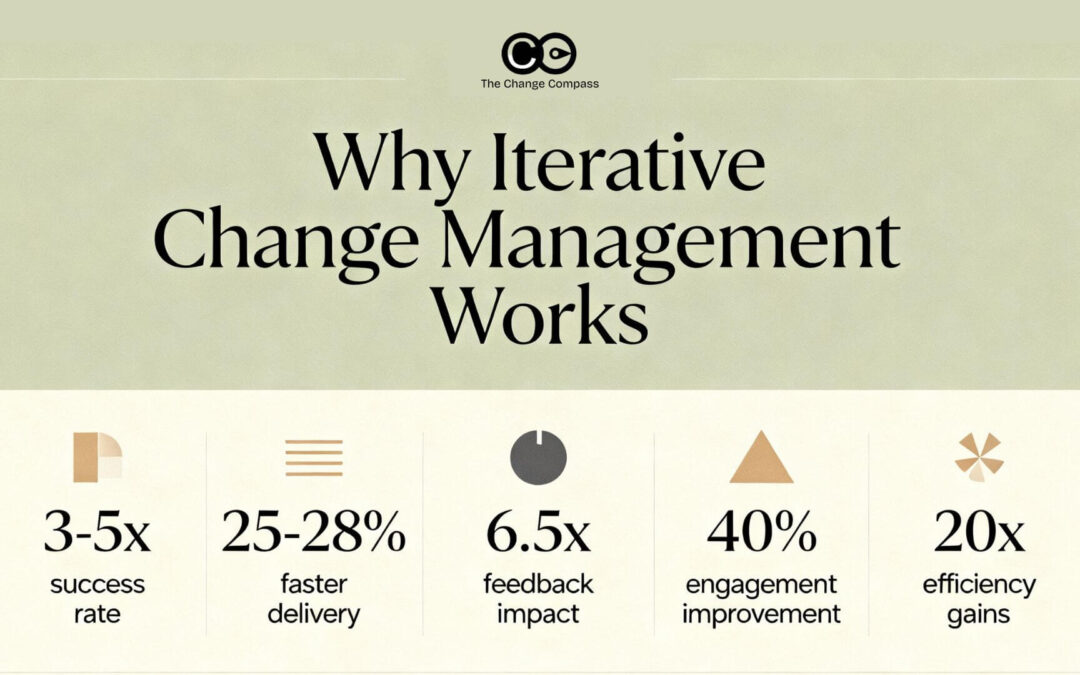
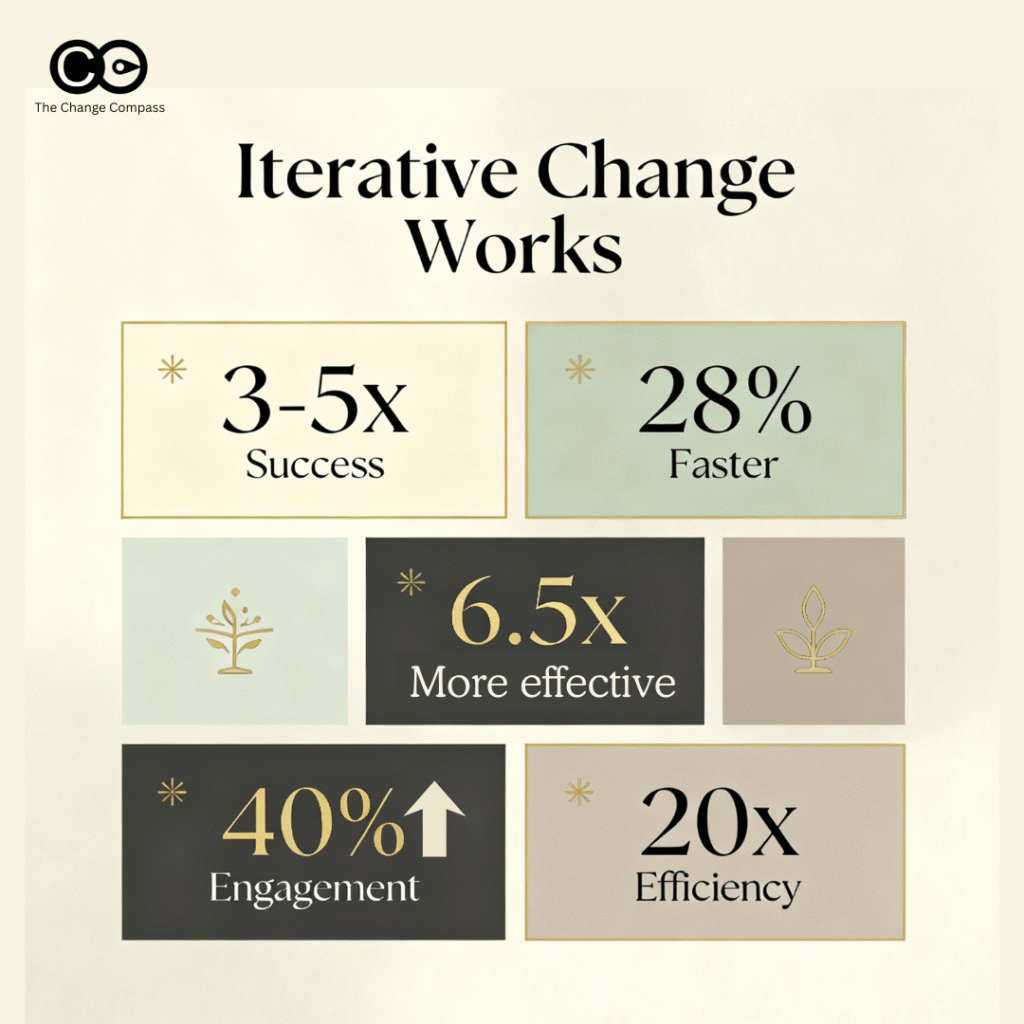
3-5x higher success rates than linear approaches in change management success metrics
25-28% faster time-to-delivery when implementing change management best practices
6.5x higher likelihood of effective change when feedback mechanisms are robust
40% improvement in engagement and adoption when continuous feedback is embedded
20x improvements in both efficiency and adaptability when done well through iterative change management processes
These aren’t marginal improvements in change management effectiveness. They’re transformational multipliers. And they’re consistent across industry, organization size, and geography. Understanding these multipliers is essential for anyone seeking to measure change management success and develop effective change management strategy.
The empirical evidence isn’t suggesting you abandon structured change management. The data shows structured approaches improve outcomes. But the specific structure that works – the change management approach that delivers results is iterative, not linear. It’s feedback-driven, not predetermined. It treats organisational change as an adaptive system that reveals itself through iteration, not a project that follows a predetermined plan.
What This Means for Change Leadership and Practitioners
The empirical findings create an imperative for change leaders and organisations pursuing change management initiatives. The evidence is sufficiently robust that continuing to use linear change management processes despite empirical evidence of inferior outcomes becomes difficult to defend, particularly when measuring change management success is critical to organisational strategy.
But moving to iterative, agile change management approaches and continuous change monitoring creates different challenges. Organisations need:
Continuous measurement capability and infrastructure for change management analytics
Comfort with planning that extends throughout implementation – a key change management principle
Willingness to adjust approaches based on emerging data and change monitoring insights
Organisational readiness to move at the required pace of iterative change management
Governance and leadership comfort with adaptive decision-making in change management strategy
Change management KPI dashboards and metrics to track change management performance
These aren’t trivial requirements. Many organisations will struggle with the shift from traditional change management frameworks to iterative approaches. But the empirical evidence is clear: the investment in this shift to modern change management best practices is repaid through dramatically improved change management success metrics and organisational outcomes.
The Future: Data at Scale and Advanced Change Management Analytics
The empirical findings discussed here are based on measurement at current scale. As organisations invest in digital platforms and AI-powered analytics for change management initiatives, the measurement fidelity will improve. Patterns invisible at current scale will become visible. Predictions of adoption risk and change management success will improve through advanced change management analytics.
But the fundamental finding won’t change. Iterative change management approaches with continuous measurement and feedback outperform linear approaches in achieving change management success. The data has already spoken. The empirical evidence on change management effectiveness is clear.
The only question is whether organisations will listen.
FAQ: Empirical Research on Iterative, Agile vs. Linear Change Management
What is the main empirical finding comparing iterative and linear change management approaches?
Large-scale empirical research, including analysis of over 1,000 projects by Serrador & Pinto (2015), demonstrates that iterative change management approaches achieve 3-5x higher success rates than linear approaches. Organisations using iterative methodologies succeed at rates of 42-64%, compared to just 13-49% for linear methods.
How much faster do iterative change management processes deliver results?
Meta-analysis of 25 peer-reviewed studies shows that iterative change approaches deliver 25-28% faster time-to-market than linear change management processes. This speed advantage compounds because iterative approaches address barriers and incorporate feedback continuously, rather than discovering problems after full rollout.
What is the impact of feedback loops on change management success?
Empirical research from McKinsey & Company found that organisations with robust feedback loops are 6.5 times more likely to experience effective change than those without. Case studies show 40% improvements in adoption metrics when continuous feedback mechanisms are embedded in change management processes.
Do organisations need different planning approaches for iterative vs. linear change management?
The Serrador & Pinto study found no significant difference in upfront planning effort between iterative and linear approaches. The critical difference is that iterative change management distributes planning throughout implementation rather than front-loading it. Both approaches require planning; they differ in when and how.
How does organisational readiness change during implementation?
Empirical research demonstrates that organisational readiness is dynamic, not static. External factors, competing priorities, and personnel changes alter readiness throughout implementation. Organisations using continuous measurement and reassessment achieve 25-35% higher adoption rates than those conducting single-point readiness assessments.
How does MIT’s research on efficiency vs. adaptability challenge traditional change management thinking?
MIT research found that efficiency and adaptability are complements, not substitutes. Organisations implementing continuous change with frequent measurement achieved 20x reductions in cycle time while maintaining adaptive capacity—contradicting the assumption that efficiency requires sacrificing flexibility in change management approaches.
What are change management KPIs and performance metrics I should track?
Critical change management metrics include adoption rates (by phase and segment), time-to-readiness, resistance indicators, feedback response time, implementation fidelity, and benefit realization. Importantly, these should be measured continuously throughout change initiatives, not just at completion. Change management analytics dashboards enable real-time tracking of these change management success metrics.
How do iterative change management approaches handle barriers and resistance?
Iterative approaches identify barriers through continuous change monitoring rather than discovering them after rollout. This enables early intervention when problems are less costly to address. Case studies show that continuous feedback integration achieves 40% higher engagement and smoother adoption compared to linear approaches.
What is organisational change capability, and why does it predict change management success?
Organisational change capability encompasses stakeholder engagement, resource allocation, feedback mechanisms, and adaptive decision-making across 15 measured dimensions. Empirical research found significant positive correlation (p < 0.05) between change capability and change implementation success, suggesting that adaptability and iteration—not rigid adherence to plans—drive organisational change outcomes.
Why do some organisations fail despite following a structured change management framework?
Empirical research shows that simply following a change management methodology (whether Kotter’s 8-step model or another framework) doesn’t guarantee success. How the methodology is used matters more than which methodology is chosen. Organisations that treat frameworks as fixed scripts fail more often than those that adapt frameworks based on emerging data and feedback.
How should organisations transition from linear to iterative change management approaches?
Transitioning requires building continuous measurement infrastructure, extending planning throughout implementation rather than front-loading it, developing comfort with adaptive decision-making, and creating governance structures that support iteration. Organisations also need change management analytics capabilities and regular feedback mechanisms to move from static, linear change management to adaptive, iterative approaches.
References: Peer-Reviewed Academic Research
Mettert, K. D., Saldana, L., Sarmiento, K., Gbettor, Y., Hamiltton, M., Perrow, P., & Stamatakis, K. A. (2020). Measuring implementation outcomes: An updated systematic review. Implementation Science, 15(1), 55.
Rietze, P., Häusle, R., Szymczak, S., & Möhrle, M. G. (2022). Relationships between agile work practices and work outcomes: A systematic review. International Journal of Project Management, 40(1), 1-15.
Serrador, P., & Pinto, J. K. (2015). Does Agile work?—A quantitative analysis of agile project success. International Journal of Project Management, 33(5), 1040-1051.
Vanhengel, R., De Vos, A., Meert, N., & Verhoeven, J. C. (2025). The organizational change capability of public organizations: Development and validation of an instrument. Journal of Organizational Change Management, 38(2), 245-267.
Large-Scale Research and Surveys
Errida, A., & Lotfi, B. (2021). The determinants of organizational change management success. International Journal of Organizational Leadership, 10(1), 37-56.
Serrador, P., Noonan, K., Pinto, J. K., & Brown, M. (2015). A quantitative analysis of agile project success rates and their impact. Project Management Institute, Research Report.
McKinsey & Company. (2020). Building the organization of the future: Organizing feedback loops for faster learning and change. McKinsey & Company.
PwC. (2017). The agile advantage: How organizations are building a competitive advantage through more agile and responsive operations.
Implementation Science References
Mettert, K. D., Saldana, L., Stamatakis, K. A., et al. (2020). Measuring implementation outcomes: An updated systematic review. Implementation Science, 15(1), 55.
Noonan, K., & Serrador, P. (2014). The agile shift: A Comparative study of incremental and waterfall approaches to project delivery. IEEE Software, 31(4), 21-28.
Complex Adaptive Systems and Organisational Change
Vanhengel et al. (2025). Organizational change capability development: Implications for change management practice. Organization Development Journal, 43(1), 22-39.
Healthcare and Case Study Evidence
Harvard Business Review. (2020). The agile approach to change management in healthcare. Harvard Business Review, 98(5), 76-84.
MIT Sloan Management Review. (2019). Continuous change management: Lessons from manufacturing excellence. MIT Sloan Management Review, 60(3), 44-52.
A change management process is the structured sequence of activities that moves an organisation from its current state to an intended future state – while ensuring people have the awareness, capability, and motivation to work in the new way. This guide covers the seven core phases that research and field practice consistently show deliver the highest adoption rates, and explains why the order and interaction of these phases matters as much as the phases themselves.
The traditional image of change management involves a straightforward sequence: assess readiness, develop a communication plan, deliver training, monitor adoption, and declare success. Clean, predictable, linear. But this image bears almost no resemblance to how transformation actually works in complex organisations.
Real change is messy. It’s iterative, often surprising, and rarely follows a predetermined path. What works brilliantly in one business unit might fail spectacularly in another. Changes compound and interact with each other. Organisational capacity isn’t infinite. Leadership commitment wavers. Market conditions shift. And somewhere in the middle of all this, practitioners are expected to deliver transformation that sticks.
The modern change management process isn’t a fixed sequence of steps. It’s an adaptive framework that responds to data, adjusts to organisational reality, and treats change as a living system rather than a project plan to execute.
Why Linear Processes Fail
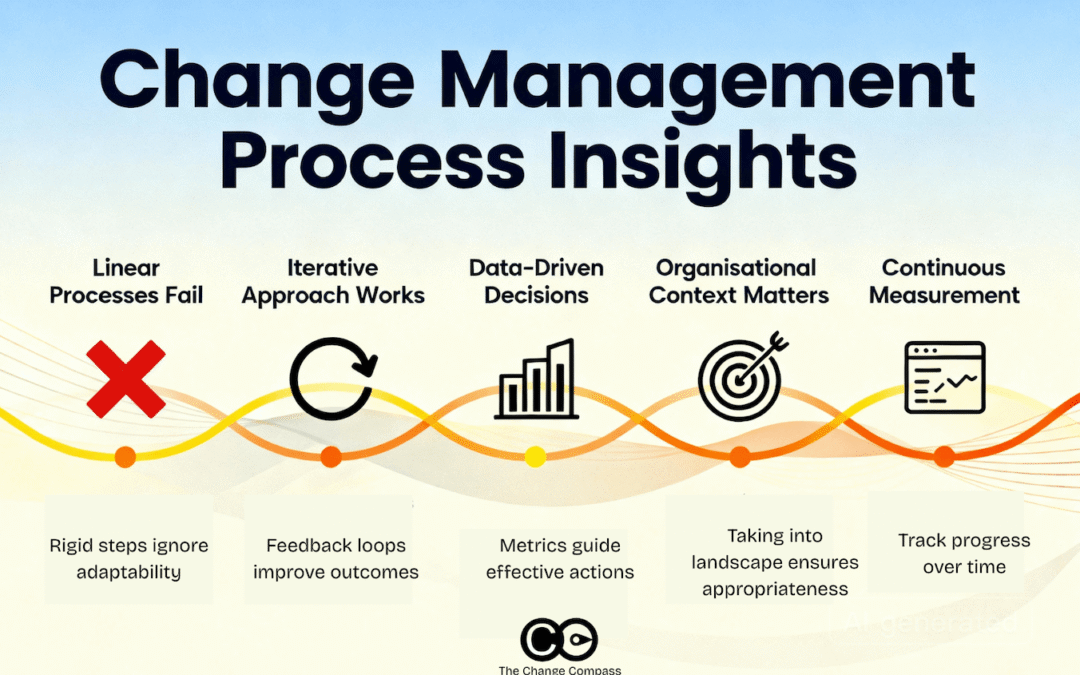
Traditional change models assume that if you follow the steps correctly, transformation will succeed. But this assumption misses something fundamental about how organisations actually work.
The core problems with linear change management approaches:
Readiness isn’t static. An assessment conducted three months before go-live captures a moment in time, not a prediction of future readiness. Organisations that are ready today might not be ready when implementation arrives, especially if other changes have occurred, budget pressures have intensified, or key leaders have departed.
Impact isn’t uniform. The same change affects different parts of the organisation differently. Finance functions often adopt new processes faster than frontline operations. Risk-averse cultures resist more than learning-oriented ones. Users with technical comfort embrace systems more readily than non-technical staff.
Problems emerge during implementation. Linear models assume that discovering problems is the job of assessment phases. But the most important insights often emerge during implementation, when reality collides with assumptions. When adoption stalls in unexpected places or proceeds faster than projected, that’s not a failure of planning – that’s valuable data signalling what actually drives adoption in your specific context.
Multi-change reality is ignored. Traditional change management processes often ignore a critical reality: organisations don’t exist in a vacuum. They’re managing multiple concurrent changes, each competing for attention, resources, and cognitive capacity. A single change initiative that ignores this broader change landscape is designing for failure.
The Evolution: From Rigid Steps to Iterative Process
Modern change management processes embrace iteration. This agile change management approach plans, implements, measures, learns, and adjusts. Then it cycles again, incorporating what’s been learned.
The Iterative Change Cycle
Plan: Set clear goals and success criteria for the next phase
What do we want to achieve?
How will we know if it’s working?
What are we uncertain about?
Design: Develop specific interventions based on current data
How will we communicate?
What training will we provide?
Which segments need differentiated approaches?
What support structures do we need?
Implement: Execute interventions with a specific cohort, function, or geography
Gather feedback continuously, not just at the end
Monitor adoption patterns as they emerge
Track both expected and unexpected outcomes
Measure: Collect data on what’s actually happening
Are people adopting? Are they adopting correctly?
Where are barriers emerging?
Where is adoption stronger than expected?
What change management metrics reveal the true picture?
Learn and Adjust: Analyse what the data reveals
Refine approach for the next iteration based on actual findings
Challenge initial assumptions with evidence
Apply lessons to improve subsequent rollout phases
This iterative cycle isn’t a sign that the original plan was wrong. It’s recognition that complex change reveals itself through iteration. The first iteration builds foundational understanding. Each subsequent iteration deepens insight and refines the change management approach.
The Organisational Context Matters
Here’s what many change practitioners overlook: the same change management methodology works differently depending on the organisation it’s being implemented in.
Change Maturity Shapes Process Design
High maturity organisations:
Move quickly through iterative cycles
Make decisions rapidly based on data
Sustain engagement with minimal structure
Have muscle memory and infrastructure for iterative change
Leverage existing change management best practices
Low maturity organisations:
Need more structured guidance and explicit governance
Require more time between iterations to consolidate learning
Benefit from clearer milestones and checkpoints
Need more deliberate stakeholder engagement
Require foundational change management skills development
The first step of any change management process is honest assessment of organisational change maturity. Can this organisation move at pace, or does it need a more gradual approach? Does change leadership have experience, or do they need explicit guidance? Is there existing change governance infrastructure, or do we need to build it?
These answers shape the design of your change management process. They determine:
Pace of implementation
Frequency of iterations
Depth of stakeholder engagement required
Level of central coordination needed
Support structures and resources
The Impact-Centric Perspective
Every change affects real people. Yet many change management processes treat people as abstract categories: “users,” “stakeholders,” “early adopters.” Real change management considers the lived experience of the person trying to adopt new ways of working.
From the Impacted Person’s Perspective
Change saturation: What else is happening simultaneously? Is this the only change or one of many? If multiple change initiatives are converging, are there cumulative impacts on adoption capacity? Can timing be adjusted to reduce simultaneous load? Recognising the need for change capacity assessment prevents saturation that kills adoption.
Historical context: Has this person experienced successful change or unsuccessful change previously? Do they trust that change will actually happen or are they sceptical based on past experience? Historical success builds confidence; historical failure builds resistance. Understanding this history shapes engagement strategy.
Individual capacity: Do they have the time, emotional energy, and cognitive capacity to engage with this change given everything else they’re managing? Change practitioners often assume capacity that doesn’t actually exist. Realistic capacity assessment determines what’s actually achievable.
Personal impact: How does this change specifically affect this person’s role, status, daily work, and success metrics? Benefits aren’t universal. For some people, change creates opportunity. For others, it creates threat. Understanding this individual reality shapes what engagement and support each person needs.
Interdependencies: How does this person’s change adoption depend on others adopting first? If the finance team needs to be ready before sales can go-live, sequencing matters. If adoption in one location enables adoption in another, geography shapes timing.
When you map change from an impacted person’s perspective rather than a project perspective, you design very different interventions. You might stagger rollout to reduce simultaneous load. You might emphasise positive historical examples if trust is low. You might provide dedicated support to individuals carrying disproportionate change load.
Data-Informed Design and Continuous Adjustment
This is where modern change management differs most sharply from traditional approaches: nothing is assumed. Everything is measured. Implementing change management without data is like navigating without instruments.
Before the Process Begins: Baseline Data Collection
Current state of readiness
Knowledge and capability gaps
Cultural orientation toward this specific change
Locations of excitement versus resistance
Adoption history in this organisation
Change management performance metrics from past initiatives
During Implementation: Continuous Change Monitoring
As the change management process unfolds, data collection continues:
Awareness tracking: Are people aware of the change?
Understanding measurement: Do they understand why it’s needed?
Engagement monitoring: Are they completing training?
Application assessment: Are they applying what they’ve learned?
Barrier identification: Where are adoption barriers emerging?
Success pattern analysis: What’s driving adoption in places where it’s working?
This data then becomes the basis for iteration. If readiness assessment showed low awareness but commitment to change didn’t emerge from initial communication, you’re not just communicating more. You’re investigating why the message isn’t landing. The reason shapes the solution.
How to Measure Change Management Success
If adoption is strong in Finance but weak in Operations, you don’t just provide more training to Operations. You investigate why Finance is succeeding:
Is it their culture?
Their leadership?
Their process design?
Their support structure?
Understanding this difference helps you replicate success in Operations rather than just trying harder with a one-size-fits-all approach.
Data-informed change means starting with hypotheses but letting reality determine strategy. It means being willing to abandon approaches that aren’t working and trying something different. It means recognising that what worked for one change won’t necessarily work for the next one, even in the same organisation.
The 7-Step Change Management Process
While modern change management processes are iterative rather than strictly linear, they still progress through recognisable phases. Understanding these phases and how they interact prevents getting lost in iteration.
Step 1: Pre-Change Planning
Before formal change begins, build foundations:
Assess organisational readiness and change maturity
Map current change landscape and change saturation levels
Identify governance structures and leadership commitment
Conduct impact assessment across all affected areas
Understand who’s affected and how
Baseline current state across adoption readiness, capability, culture, and sentiment
This phase establishes what you’re working with and shapes the pace and approach for everything that follows.
Step 2: Readiness Assessment
Help people understand what’s changing and why it matters. This isn’t one communication – it’s repeated, multi-channel, multi-format messaging that reaches people where they are.
Different stakeholders need different messages:
Finance needs to understand financial impact
Operations needs to understand process implications
Frontline staff need to understand how their day-to-day work changes
Leadership needs to understand strategic rationale
Done well, this phase moves people from unawareness to understanding and from indifference to some level of commitment.
Step 3: Capability Building
Equip people with what they need to succeed:
Formal training programmes
Documentation and job aids
Peer support and buddy systems
Dedicated help desk support
Access to subject matter experts
Practice environments and sandboxes
This phase recognises that people need different things: some need formal training, some learn by doing, some need one-on-one coaching. The process design accommodates this variation rather than enforcing uniformity.
Step 4: Implementation
This is where iteration becomes critical:
Launch the change, typically with an initial cohort or geography
Measure what’s actually happening through change management tracking
Identify where adoption is strong and where it’s struggling
Surface barriers and success drivers
Iterate and refine approach for the next rollout based on learnings
Repeat with subsequent cohorts or geographies
Each cycle improves adoption rates and reduces barriers based on evidence from previous phases.
Step 5: Embedment and Optimisation
After initial adoption, the work isn’t done:
Embed new ways of working into business as usual
Build capability for ongoing support
Continue measurement to ensure adoption sustains
Address reversion to old ways of working
Support staff turnover and onboarding
Optimise processes based on operational learning
Sustained change requires ongoing reinforcement, continued support, and regular adjustment as the organisation learns how to work most effectively with the new system or process.
Step 6: Integration With Organisational Strategy
The change management process doesn’t exist in isolation from organisational strategy and capability. It’s shaped by and integrated with several critical factors.
Leadership Capability
Do leaders understand change management principles? Can they articulate why change is needed? Will they model new behaviours? Are they present and visible during critical phases? Weak leadership capability requires:
More structured support
More centralised governance
More explicit role definition for leaders
Coaching and capability building for change leadership
Operational Capacity
Can the organisation actually absorb this change given current workload, staffing, and priorities? If not, what needs to give? Pretending capacity exists when it doesn’t is the fastest path to failed adoption. Realistic assessment of:
Current workload and priorities
Available resources and time
Competing demands
Realistic timeline expectations
Change Governance
How are multiple concurrent change initiatives being coordinated? Are they sequenced to reduce simultaneous load? Is someone preventing conflicting changes from occurring at the same time? Is there a portfolio view preventing change saturation?
Effective enterprise change management requires:
Portfolio view of all changes
Coordination across initiatives
Capacity and saturation monitoring
Prioritisation and sequencing decisions
Escalation pathways when conflicts emerge
Existing Change Infrastructure
Does the organisation already have change management tools and techniques, governance structures, and experienced practitioners? If so, the new process integrates with these. If not, do you have resources to build this capability as part of this change, or do you need to work within the absence of this infrastructure?
Culture and Values
What’s the culture willing to embrace? A highly risk-averse culture needs different change design than a learning-oriented culture. A hierarchical culture responds to authority differently than a collaborative culture. These aren’t barriers to overcome but realities to work with.
The Future: Digital and AI-Enabled Change Management
The future of change management processes lies in combining digital platforms with AI to dramatically expand scale, precision, and speed while maintaining human insight.
Current State vs. Future State
Current state:
Practitioners manually collect data through surveys, interviews, focus groups
Manual analysis takes weeks
Pattern identification limited by human capacity and intuition
Iteration based on what practitioners notice and stakeholders tell them
Future state:
Digital platforms instrument change, collecting data continuously across hundreds of engagement touchpoints
Adoption behaviours, performance metrics, sentiment indicators tracked in real-time
Machine learning identifies patterns humans might miss
AI surfaces adoption barriers in specific segments before they become critical
Algorithms predict adoption risk by analysing patterns in past changes
AI-Powered Change Management Analytics
AI-powered insights can:
Highlight which individuals or segments need support before adoption stalls
Identify which change management activities are working and where
Recommend where to focus effort for maximum impact
Correlate adoption patterns with dozens of organisational variables
Predict adoption risk and success likelihood
Generate automated change analysis and recommendations
But here’s the critical insight: AI generates recommendations, but humans make decisions. AI can tell you that adoption in Division X is 40% below projection and that users in this division score lower on confidence. AI can recommend increasing coaching support. But a human change leader, understanding business context, organisational politics, and strategic priorities, decides whether to follow that recommendation or adjust it based on factors the algorithm can’t see.
Human Expertise Plus Technology
The future of managing change isn’t humans replaced by AI. It’s humans augmented by AI:
Technology handling data collection and pattern recognition at scale
Humans providing strategic direction and contextual interpretation
AI generating insights; humans making nuanced decisions
This future requires change management processes that incorporate data infrastructure from the beginning. It requires:
Defining success metrics and change management KPIs upfront
Continuous measurement rather than point-in-time assessment
Treating change as an operational discipline with data infrastructure
Building change management analytics capabilities
Investing in platforms that enable measurement at scale
Designing Your Change Management Process
The change management framework that works for your organisation isn’t generic. It’s shaped by organisational maturity, leadership capability, change landscape, and strategic priorities.
Step 1: Assess Current State
What’s the organisation’s change maturity? What’s leadership experience with managing change? What governance exists? What’s the cultural orientation? What other change initiatives are underway? What’s capacity like? What’s historical success rate with change?
This assessment shapes everything downstream and determines whether you need a more structured or more adaptive approach.
Step 2: Define Success Metrics
Before you even start, define what success looks like:
What adoption rate is acceptable?
What performance improvements are required?
What capability needs to be built?
How will you measure change management effectiveness?
What change management success metrics will you track?
These metrics drive the entire change management process and enable you to measure change results throughout implementation.
Step 3: Map the Change Landscape
Who’s affected? In how many different ways? What are their specific needs and barriers? What’s their capacity? What other changes are they managing? This impact-centric change assessment shapes:
Sequencing and phasing decisions
Support structures and resource allocation
Communication strategies
Training approaches
Risk mitigation plans
Step 4: Design Iterative Approach
Don’t assume linear execution. Plan for iterative rollout:
How will you test learning in the first iteration?
How will you apply that learning in subsequent iterations?
What decisions will you make between iterations?
How will speed of iteration balance with consolidation of learning?
What change monitoring mechanisms will track progress?
Step 5: Build in Continuous Measurement
From day one, measure what’s actually happening:
Adoption patterns and proficiency levels
Adoption barriers and resistance points
Performance impact against baseline
Sentiment evolution throughout phases
Capability building and confidence
Change management performance metrics
Use this data to guide iteration and make evidence-informed decisions about measuring change management success.
Step 6: Integrate With Governance
How does this change process integrate with portfolio governance? How is this change initiative sequenced relative to others? How is load being managed? Is there coordination to prevent saturation? Is there an escalation process when adoption barriers emerge?
Effective change management requires integration with broader enterprise change management practices, not isolated project-level execution.
Change Management Best Practices for Process Design
As you design your change management process, several best practices consistently improve outcomes:
Start with clarity on fundamentals of change management:
Clear vision and business case
Visible and committed sponsorship
Adequate resources and realistic timelines
Honest assessment of starting conditions
Embrace iteration and learning:
Plan-do-measure-learn-adjust cycles
Willingness to challenge assumptions
Evidence-based decision making
Continuous improvement mindset
Maintain human focus:
Individual impact assessment
Capacity and saturation awareness
Support tailored to needs
Empathy for lived experience of change
Leverage data and technology:
Baseline and continuous measurement
Pattern identification and analysis
Predictive insights where possible
Human interpretation of findings
Integrate with organisational reality:
Respect cultural context
Work with leadership capability
Acknowledge capacity constraints
Coordinate with other changes
Process as Adaptive System
The modern change management process is fundamentally different from traditional linear models. It recognises that complex organisational change can’t be managed through predetermined steps. It requires data-informed iteration, contextual adaptation, and continuous learning.
It treats change not as a project to execute but as an adaptive system to manage. It honours organisational reality rather than fighting it. It measures continually and lets data guide direction. It remains iterative throughout, learning and adjusting rather than staying rigidly committed to original plans.
Most importantly, it recognises that change success depends on whether individual people actually change their behaviours, adopt new ways of working, and sustain these changes over time. Everything else – process, communication, training, systems, exists to support this human reality.
Organisations that embrace this approach to change management processes don’t achieve perfect transformations. But they achieve transformation that sticks, that builds organisational capability, and that positions them for the next wave of change. And in increasingly uncertain environments, that’s the only competitive advantage that matters.
Frequently Asked Questions: The Modern Change Management Process
What is the change management process?
The change management process is a structured approach to transitioning individuals, teams, and organisations from current state to desired future state. Modern change management processes are iterative rather than linear, using data and continuous measurement to guide adaptation throughout implementation. The process typically includes pre-change assessment, awareness building, capability development, implementation with reinforcement, and sustainability phases. Unlike traditional linear approaches, contemporary processes embrace agile change management principles, adjusting strategy based on real-time adoption data and organisational feedback.
What’s the difference between linear and iterative change management processes?
Linear change management follows predetermined steps: plan, communicate, train, implement, and measure success at the end. This approach assumes that following the change management methodology correctly guarantees success. Iterative change management processes use a plan-implement-measure-learn-adjust cycle, repeating with each phase or cohort. Iterative approaches work better with complex organisational change because they let reality inform strategy rather than forcing strategy regardless of emerging data. This agile change management approach enables change practitioners to identify adoption barriers early, replicate what’s working, and adjust interventions that aren’t delivering results.
How does organisational change maturity affect the change management process design?
Change maturity determines how quickly organisations can move through iterative cycles and how much structure they need. High-maturity organisations with established change management best practices, experienced change leadership, and strong governance can move rapidly and adjust decisively. They need less prescriptive guidance. Low-maturity organisations need more structured change management frameworks, more explicit governance, more support, and more time between iterations to consolidate learning. Your change management process should match your organisation’s starting point. Assessing change maturity before designing your process determines appropriate pace, structure, support requirements, and governance needs.
Why do you need continuous measurement throughout change implementation?
Continuous change monitoring and measurement reveals what’s actually driving adoption or resistance in your specific context, which is almost always different from planning assumptions. Change management tracking helps you identify adoption barriers early, discover what’s working and replicate it across other areas, adjust interventions that aren’t delivering results, and make evidence-informed decisions rather than guessing. Without ongoing measurement, you can’t answer critical questions about how to measure change management success, what change management performance metrics indicate problems, or whether your change initiatives are achieving intended outcomes. Measuring change management throughout implementation enables data-driven iteration that improves adoption rates with each cycle.
How does the change management process account for multiple concurrent changes?
The process recognises that people don’t exist in a single change initiative but experience multiple overlapping changes simultaneously. Effective enterprise change management maps the full change landscape, assesses cumulative impact and change saturation, considers sequencing to reduce simultaneous load, and builds support specifically for people managing multiple changes. Change governance at portfolio level coordinates across initiatives, prevents conflicting changes, monitors capacity, and makes prioritisation decisions. Single-change processes that ignore this broader context typically fail because they design for capacity that doesn’t actually exist and create saturation that prevents adoption.
What are the key phases in a modern change management process?
Modern change management processes progress through five key phases whilst remaining iterative: (1) Step 1: Pre-Change Planning includes readiness assessment, change maturity evaluation, change landscape mapping, and baseline measurement. (2) Step 2: Readiness Assessment builds understanding of what’s changing and why it matters through multi-channel communication. (3) Step 3: Capability Building equips people with training, documentation, support, and practice opportunities. (4) Implementation and Reinforcement Phase launches change iteratively, measures results, identifies patterns, and adjusts approach between rollout cycles. (5) Embedment Phase embeds new ways of working, builds ongoing support capability, and continues measurement to ensure adoption sustains. Each phase informs the next based on data and learning rather than rigid sequential execution.
How do you measure change management effectiveness?
Measuring change management effectiveness requires tracking multiple dimensions throughout the change process: (1) Adoption metrics measuring who’s using new processes or systems and how proficiently. (2) Change readiness indicators showing awareness, understanding, commitment, and capability levels. (3) Behavioural change tracking whether people are actually changing how they work, not just attending training. (4) Performance impact measuring operational results against baseline. (5) Sentiment and engagement indicators revealing confidence, trust, and satisfaction. (6) Sustainability metrics showing whether adoption persists over time or reverts. Change management success metrics should be defined before implementation begins and tracked continuously. Effective measurement combines quantitative data with qualitative insights to understand both what’s happening and why.
What role does AI and technology play in the future of change management processes?
AI and digital platforms are transforming change management processes by enabling measurement and analysis at unprecedented scale and speed. Future change management leverages technology for continuous data collection across hundreds of touchpoints, pattern recognition that surfaces insights humans might miss, predictive analytics identifying adoption risks before they become critical, and automated change analysis generating recommendations. However, technology augments rather than replaces human expertise. AI identifies patterns and generates recommendations; humans provide strategic direction, contextual interpretation, and nuanced decision-making. The most effective approach combines digital platforms handling data collection and change management analytics with experienced change practitioners applying business understanding and wisdom to translate insights into strategy.
Frequently Asked Questions
What are the main steps in a change management process?
While frameworks vary, most effective change management processes follow five to eight phases: pre-change planning, stakeholder and readiness assessment, communication, capability building, implementation, embedment, and performance measurement. The key distinction from a project plan is that each phase focuses on people’s readiness and adoption, not just task completion.
How long does a change management process typically take?
Timeline depends on the scale and complexity of the change. A targeted process change within a single team may be embedded within three to six months. An enterprise-wide transformation typically requires 12 to 24 months of active change management before sustainable adoption is achieved. Prosci research consistently shows that changes with inadequate embedment phases experience the highest rates of reversion.
What is the difference between a change management process and a project plan?
A project plan tracks tasks, milestones, and deliverables. A change management process tracks people: their awareness, willingness, capability, and sustained adoption of the new way of working. The two should run concurrently and be integrated – but they answer different questions. A project plan tells you when the system is live; a change management process tells you whether people are genuinely using it.
What causes a change management process to fail?
The most common failure modes are inadequate sponsorship (leaders who endorse the change but do not actively model it), treating training as the end of the process rather than the beginning of adoption, and declaring success at go-live rather than measuring adoption at 30, 60, and 90 days post-implementation. Starting measurement too late is a consistent predictor of poor outcomes.