

The change management process is the sequence a change travels from decision to daily habit, and the version that delivers adoption treats that sequence as a loop run on evidence rather than a timeline approved in advance. Most organisations still design the process as a straight line: assess readiness, publish a communication plan, run training, monitor, declare success. That picture is tidy, easy to approve and easy to report against, and it bears little resemblance to what happens when a change meets real people with real workloads.
This guide is for change, HR and transformation leaders who are accountable for adoption, not just for delivery. It argues that the seven steps of the process still matter, but that their order, pace and content should be set by what your people data shows during delivery, not by a plan frozen at kickoff. By the end you will be able to design a process that fits your organisation’s maturity, reads the change from the impacted person’s side, measures continuously, and adjusts between rollout cycles instead of after the post-implementation review.
Why linear processes fail
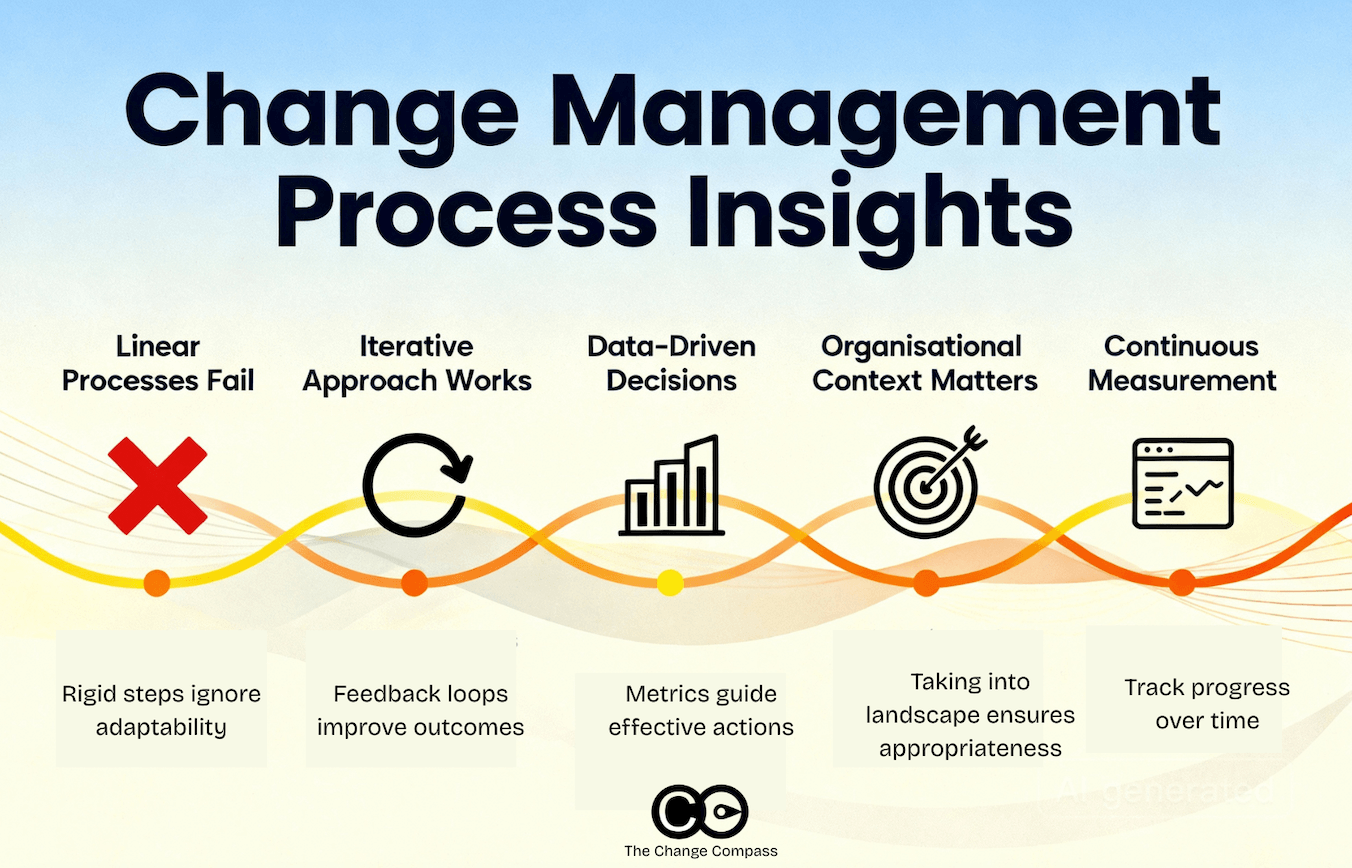
A linear change management process fails because it treats the organisation as stable, the change as isolated and the plan as an accurate forecast, and none of the three holds in a complex organisation. Traditional models assume that if you follow the steps correctly, transformation will succeed. That assumption misses something fundamental about how organisations behave once a change starts to move.
The environment has also become harder to plan against. A 2026 Harvard Business Review analysis by Gartner HR researchers attributes the growing difficulty of leading through change to four converging factors: changes are stacked on top of one another, they are continuous with no clear start or end date, they are larger and interdependent, and they are increasingly driven by external forces such as technology and geopolitics. A process that assumes one change, one timeline and one team is designing for a world that no longer exists.
The core problems with linear change management approaches
- Readiness is not static. An assessment conducted three months before go-live captures a moment in time, not a prediction of future readiness. Organisations that are ready today might not be ready when implementation arrives, especially if other changes have occurred, budget pressures have intensified or key leaders have departed.
- Impact is not uniform. The same change affects different parts of the organisation differently. Finance functions often adopt new processes faster than frontline operations. Risk-averse cultures resist more than learning-oriented ones. Users with technical comfort embrace systems more readily than non-technical staff.
- Problems emerge during implementation. Linear models assume that discovering problems is the job of the assessment phase. But the most important insights often emerge during implementation, when reality collides with assumptions. When adoption stalls in unexpected places or proceeds faster than projected, that is not a failure of planning. It is valuable data about what actually drives adoption in your specific context.
- Multi-change reality is ignored. Traditional change management processes often overlook a critical fact: organisations do not exist in a vacuum. They are managing multiple concurrent changes, each competing for attention, resources and cognitive capacity. A single change initiative that ignores this broader landscape is designing for failure.
The evolution: from rigid steps to an iterative process
An iterative change management process plans, implements, measures, learns and adjusts, then cycles again with what it has learned. Modern change management processes embrace this agile change management approach because complex change reveals itself through delivery, not through analysis beforehand.
The shift is visible in the profession’s own data. Prosci’s latest benchmarking found that fewer than 70% of participants now follow a formal change management methodology, the first time that has been true since 2011, a decline Prosci links to the rise of agile and adaptive approaches. The same study found that practitioners actively managing a portfolio of changes rose from 38% to 43%. Practice is moving from one-off project processes towards continuous, portfolio-level operation. For a deeper look at the research behind this move, see our summary of why iterative, agile change management succeeds where linear approaches fail.
The iterative change cycle
Each pass through the cycle asks the same five questions of a defined cohort, function or geography:
- Plan: Set clear goals and success criteria for the next phase. What do we want to achieve? How will we know if it is working? What are we uncertain about?
- Design: Develop specific interventions based on current data. How will we communicate? What training will we provide? Which segments need differentiated approaches? What support structures do we need?
- Implement: Execute interventions with a specific cohort, function or geography. Gather feedback continuously, not just at the end. Monitor adoption patterns as they emerge, and track both expected and unexpected outcomes.
- Measure: Collect data on what is actually happening. Are people adopting, and are they adopting correctly? Where are barriers emerging? Where is adoption stronger than expected? Which change management metrics reveal the true picture?
- Learn and adjust: Analyse what the data reveals. Refine the approach for the next iteration based on actual findings, challenge initial assumptions with evidence, and apply lessons to improve subsequent rollout phases.
This iterative cycle is not a sign that the original plan was wrong. It is recognition that complex change reveals itself through iteration. The first iteration builds foundational understanding. Each subsequent iteration deepens insight and refines the change management approach, so the fifth cohort should adopt faster and with fewer barriers than the first.
The organisational context matters
The same change management methodology works differently depending on the organisation it is implemented in, which is why copying another company’s process rarely reproduces its results. Change maturity, leadership capability and culture all change what a good process looks like.
The stakes of getting this right are well documented. Prosci’s research on the correlation between change management and project success found that 88% of participants with excellent change management programs met or exceeded their objectives, against only 13% of those with poor programs. Quality of execution, not the mere existence of a process, separates the two groups, and execution quality depends heavily on fit with the organisation’s starting point.
Change maturity shapes process design
High maturity organisations:
- Move quickly through iterative cycles
- Make decisions rapidly based on data
- Sustain engagement with minimal structure
- Have muscle memory and infrastructure for iterative change
- Build on existing change management best practices
Low maturity organisations:
- Need more structured guidance and explicit governance
- Require more time between iterations to consolidate learning
- Benefit from clearer milestones and checkpoints
- Need more deliberate stakeholder engagement
- Require foundational change management skills development
The first step of any change management process is an honest assessment of organisational change maturity. Can this organisation move at pace, or does it need a more gradual approach? Does change leadership have experience, or do they need explicit guidance? Is there existing change governance infrastructure, or does it need to be built?
These answers shape the design of your change management process. They determine the pace of implementation, the frequency of iterations, the depth of stakeholder engagement required, the level of central coordination needed, and the support structures and resources you will have to provide.
The impact-centric perspective
An impact-centric process designs around the lived experience of the person who has to change, not around the project’s categories of “users”, “stakeholders” and “early adopters”. Every change affects real people, and the quality of your design depends on how well you understand what the change asks of each of them, given everything else they carry.
This matters more as changes interlock. The Gartner HR researchers writing in Harvard Business Review describe today’s changes as interdependent rather than separate, which means the effect on one person rarely comes from one initiative alone. A practical way to start is a structured change impact assessment that maps what changes for each group, by how much and when.
From the impacted person’s perspective
- Change saturation: What else is happening simultaneously? Is this the only change or one of many? If multiple initiatives are converging, are there cumulative impacts on adoption capacity? Can timing be adjusted to reduce simultaneous load? Recognising the need for change capacity assessment prevents the saturation that kills adoption.
- Historical context: Has this person experienced successful or unsuccessful change previously? Do they trust that change will actually happen, or are they sceptical based on past experience? Historical success builds confidence; historical failure builds resistance. Understanding this history shapes engagement strategy.
- Individual capacity: Do they have the time, emotional energy and cognitive capacity to engage with this change given everything else they are managing? Change practitioners often assume capacity that does not actually exist. Realistic capacity assessment determines what is achievable.
- Personal impact: How does this change specifically affect this person’s role, status, daily work and success metrics? Benefits are not universal. For some people, change creates opportunity. For others, it creates threat. Understanding this individual reality shapes what engagement and support each person needs.
- Interdependencies: How does this person’s adoption depend on others adopting first? If the finance team needs to be ready before sales can go live, sequencing matters. If adoption in one location enables adoption in another, geography shapes timing.
When you map change from the impacted person’s perspective rather than a project perspective, you design very different interventions. You might stagger rollout to reduce simultaneous load. You might emphasise positive historical examples if trust is low. You might provide dedicated support to individuals carrying a disproportionate change load.
Data-informed design and continuous adjustment
This is where the modern change management process differs most sharply from the traditional one: nothing is assumed, and everything is measured. Implementing change without data is like navigating without instruments. Prosci’s research shows the payoff: among participants who measured compliance and overall performance, 76% met or exceeded project objectives, compared with 24% of those who did not measure.
Before the process begins: baseline data collection
A baseline gives every later iteration something to be compared against. At minimum, capture:
- The current state of readiness
- Knowledge and capability gaps
- Cultural orientation toward this specific change
- Locations of excitement versus resistance
- Adoption history in this organisation
- Change management performance metrics from past initiatives
During implementation: continuous change monitoring
As the process unfolds, data collection continues and tracks the full path from awareness to behaviour:
- Awareness tracking: Are people aware of the change?
- Understanding measurement: Do they understand why it is needed?
- Engagement monitoring: Are they completing training?
- Application assessment: Are they applying what they have learned?
- Barrier identification: Where are adoption barriers emerging?
- Success pattern analysis: What is driving adoption in the places where it is working?
This data then becomes the basis for iteration. If a readiness assessment showed low awareness and commitment did not emerge from initial communication, you are not simply communicating more. You are investigating why the message is not landing, and the reason shapes the solution.
How to measure change management success
Measuring change management success means tracking whether people are using the new way of working, how well, and whether it lasts, then using the answer to change what you do next. A single end-of-project survey cannot do that, and the real value of measurement is diagnostic rather than evaluative.
Consider the common case where adoption is strong in Finance but weak in Operations. You do not just provide more training to Operations. You investigate why Finance is succeeding:
- Is it their culture?
- Their leadership?
- Their process design?
- Their support structure?
Understanding the difference helps you replicate success in Operations rather than trying harder with a one-size-fits-all approach.
Effective measurement covers six dimensions throughout the change, and change management success metrics should be defined before implementation begins:
- Adoption: who is using the new process or system, and how proficiently.
- Readiness indicators: awareness, understanding, commitment and capability levels.
- Behaviour change: whether people are actually changing how they work, not just attending training.
- Performance impact: operational results against the baseline.
- Sentiment and engagement: confidence, trust and satisfaction.
- Sustainability: whether adoption persists over time or reverts.
Defining these is harder than it sounds. Prosci found that 29% of respondents cite difficulty identifying appropriate KPIs as an obstacle to defining change success, and the best answer is to agree success criteria with sponsors early. Combine quantitative data with qualitative insight so you understand both what is happening and why. Our guide to five change management metrics that matter goes deeper on choosing the right ones.
Data-informed change means starting with hypotheses but letting reality determine strategy. It means being willing to abandon approaches that are not working and trying something different. It means recognising that what worked for one change will not necessarily work for the next one, even in the same organisation.
The 7-step change management process
The seven steps are a readiness checklist for an adaptive loop, not a one-way conveyor. Modern change management processes are iterative rather than strictly linear, but they still progress through recognisable phases, and understanding how those phases interact prevents you from getting lost in iteration. Steps 1 to 5 are the cycle every change passes through; Steps 6 and 7 are the organisational conditions that decide whether the cycle can run well.
Step 1: Pre-change planning
Before formal change begins, build foundations:
- Assess organisational readiness and change maturity
- Map the current change landscape and change saturation levels
- Identify governance structures and leadership commitment
- Conduct an impact assessment across all affected areas
- Understand who is affected and how
- Baseline the current state across adoption readiness, capability, culture and sentiment
This step establishes what you are working with and sets the pace and approach for everything that follows.
Step 2: Awareness and readiness building
Help people understand what is changing and why it matters. This is not one communication. It is repeated, multi-channel, multi-format messaging that reaches people where they are, and it should be tested against a readiness assessment so you know whether the message has landed.
Different stakeholders need different messages:
- Finance needs to understand financial impact
- Operations needs to understand process implications
- Frontline staff need to understand how their day-to-day work changes
- Leadership needs to understand the strategic rationale
Done well, this step moves people from unawareness to understanding and from indifference to some level of commitment. The ADKAR model’s first two elements, awareness and desire, describe this movement in individual terms, and Prosci’s ADKAR overview is a useful reference for sequencing it.
Step 3: Capability building
Equip people with what they need to succeed:
- Formal training programmes
- Documentation and job aids
- Peer support and buddy systems
- Dedicated help desk support
- Access to subject matter experts
- Practice environments and sandboxes
This step recognises that people need different things: some need formal training, some learn by doing, some need one-on-one coaching. The process design accommodates this variation rather than enforcing uniformity.
Step 4: Implementation
This is where iteration becomes critical:
- Launch the change, typically with an initial cohort or geography
- Measure what is actually happening through change management tracking
- Identify where adoption is strong and where it is struggling
- Surface barriers and success drivers
- Iterate and refine the approach for the next rollout based on learnings
- Repeat with subsequent cohorts or geographies
Each cycle improves adoption rates and reduces barriers based on evidence from previous cycles.
Step 5: Embedment and optimisation
After initial adoption, the work is not done. Prosci’s best practices research found that 81% of people who planned for reinforcement and sustainment activities met or exceeded project objectives. In practice this step means:
- Embed new ways of working into business as usual
- Build capability for ongoing support
- Continue measurement to ensure adoption sustains
- Address reversion to old ways of working
- Support staff turnover and onboarding
- Optimise processes based on operational learning
Sustained change requires ongoing reinforcement, continued support and regular adjustment as the organisation learns how to work most effectively with the new system or process.
Step 6: Integration with organisational strategy
The change management process does not exist in isolation from organisational strategy and capability. It is shaped by, and integrated with, several critical factors.
Leadership capability
Do leaders understand change management principles? Can they articulate why change is needed? Will they model new behaviours? Are they present and visible during critical phases? Weak leadership capability requires more structured support, more centralised governance, more explicit role definition for leaders, and coaching and capability building for change leadership.
Operational capacity
Can the organisation actually absorb this change given current workload, staffing and priorities? If not, what needs to give? Pretending capacity exists when it does not is the fastest path to failed adoption. A realistic assessment covers:
- Current workload and priorities
- Available resources and time
- Competing demands
- Realistic timeline expectations
If you do not yet have a way to quantify this, start with a change capacity model that compares the load of planned changes against the headroom each group actually has.
Change governance
How are multiple concurrent change initiatives being coordinated? Are they sequenced to reduce simultaneous load? Is someone preventing conflicting changes from landing at the same time? Is there a portfolio view preventing change saturation? Effective enterprise change management requires:
- A portfolio view of all changes
- Coordination across initiatives
- Capacity and saturation monitoring
- Prioritisation and sequencing decisions
- Escalation pathways when conflicts emerge
Our guide to managing change saturation and portfolio failure covers this governance layer in detail.
Step 7: Incorporate existing change infrastructure
Does the organisation already have change management tools and techniques, governance structures and experienced practitioners? If so, the new process integrates with these. If not, do you have the resources to build this capability as part of this change, or do you need to work within the absence of this infrastructure?
Culture and values
What is the culture willing to embrace? A highly risk-averse culture needs a different change design than a learning-oriented culture. A hierarchical culture responds to authority differently than a collaborative culture. These are not barriers to overcome but realities to work with.
The future: digital and AI-enabled change management
The future of the change management process lies in combining digital platforms with AI to expand scale, precision and speed while keeping human judgement in charge. The evidence so far says the hard part of AI adoption is not the technology. Prosci’s study of 1,107 professionals found that 63% of AI implementation challenges stem from human factors rather than technical limitations, which is precisely the territory a change process exists to manage.
Current state versus future state
Current state:
- Practitioners manually collect data through surveys, interviews and focus groups
- Manual analysis takes weeks
- Pattern identification is limited by human capacity and intuition
- Iteration is based on what practitioners notice and stakeholders tell them
Future state:
- Digital platforms instrument change, collecting data continuously across hundreds of engagement touchpoints
- Adoption behaviours, performance metrics and sentiment indicators are tracked in real time
- Machine learning identifies patterns humans might miss
- AI surfaces adoption barriers in specific segments before they become critical
- Algorithms predict adoption risk by analysing patterns in past changes
AI-powered change management analytics
AI-powered insights can highlight which individuals or segments need support before adoption stalls, identify which change management activities are working and where, recommend where to focus effort for maximum impact, correlate adoption patterns with dozens of organisational variables, predict adoption risk and success likelihood, and generate automated change analysis and recommendations. Our complete guide to AI in change management covers the practical use cases.
But here is the critical point: AI generates recommendations, and humans make decisions. AI can tell you that adoption in Division X is 40% below projection and that users in this division score lower on confidence. It can recommend increasing coaching support. A human change leader, understanding business context, organisational politics and strategic priorities, decides whether to follow that recommendation or adjust it based on factors the algorithm cannot see.
Human expertise plus technology
The future of managing change is not humans replaced by AI. It is humans augmented by AI:
- Technology handling data collection and pattern recognition at scale
- Humans providing strategic direction and contextual interpretation
- AI generating insights while humans make nuanced decisions
- Platforms enabling measurement while practitioners apply judgement
This future requires change management processes that build in data infrastructure from the beginning. It requires defining success metrics and change management KPIs upfront, continuous measurement rather than point-in-time assessment, treating change as an operational discipline with data infrastructure, building change management analytics capabilities, and investing in platforms that enable measurement at scale. A change intelligence platform such as Change Compass is built for this: it brings change impacts, capacity and adoption signals into one view, so the loop described in this guide runs on current data rather than on last quarter’s survey.
Designing your change management process
The change management framework that works for your organisation is not generic. It is shaped by organisational maturity, leadership capability, change landscape and strategic priorities. Designing it is a six-part exercise, and each part feeds the next.
Step 1: Assess current state
What is the organisation’s change maturity? What is leadership’s experience with managing change? What governance exists? What is the cultural orientation? What other change initiatives are underway? What is capacity like? What is the historical success rate with change? This assessment shapes everything downstream and determines whether you need a more structured or more adaptive approach.
Step 2: Define success metrics
Before you even start, define what success looks like:
- What adoption rate is acceptable?
- What performance improvements are required?
- What capability needs to be built?
- How will you measure change management effectiveness?
- What change management success metrics will you track?
These metrics drive the entire process and enable you to measure results throughout implementation. Alignment matters here: Prosci found that 40% of respondents named a lack of alignment on goals and objectives as the main reason change success was not defined, so settle the definition with your sponsors before the first iteration.
Step 3: Map the change landscape
Who is affected? In how many different ways? What are their specific needs and barriers? What is their capacity? What other changes are they managing? This impact-centric change assessment shapes:
- Sequencing and phasing decisions
- Support structures and resource allocation
- Communication strategies
- Training approaches
- Risk mitigation plans
Step 4: Design the iterative approach
Do not assume linear execution. Plan for iterative rollout:
- How will you test learning in the first iteration?
- How will you apply that learning in subsequent iterations?
- What decisions will you make between iterations?
- How will the speed of iteration balance with consolidation of learning?
- What change monitoring mechanisms will track progress?
Step 5: Build in continuous measurement
From day one, measure what is actually happening:
- Adoption patterns and proficiency levels
- Adoption barriers and resistance points
- Performance impact against baseline
- Sentiment evolution throughout phases
- Capability building and confidence
- Change management performance metrics
Use this data to guide iteration and make evidence-informed decisions about change management success.
Step 6: Integrate with governance
How does this change process integrate with portfolio governance? How is this change initiative sequenced relative to others? How is load being managed? Is there coordination to prevent saturation? Is there an escalation process when adoption barriers emerge? Effective change management requires integration with broader enterprise change management practices, not isolated project-level execution.
Change management best practices for process design
Five practices consistently improve outcomes when you design a change management process, and they all follow from the adaptive approach above. They also have research behind them: Prosci found that 59% of participants who applied a particular methodology achieved good or excellent change management effectiveness, against 26% without a structured approach. Structure still matters. It just needs to be structure that bends.
Start with clarity on the fundamentals of change management:
- A clear vision and business case
- Visible and committed sponsorship
- Adequate resources and realistic timelines
- Honest assessment of starting conditions
Embrace iteration and learning:
- Plan, do, measure, learn and adjust cycles
- Willingness to challenge assumptions
- Evidence-based decision making
- A continuous improvement mindset
Maintain human focus:
- Individual impact assessment
- Capacity and saturation awareness
- Support tailored to needs
- Empathy for the lived experience of change
Use data and technology:
- Baseline and continuous measurement
- Pattern identification and analysis
- Predictive insights where possible
- Human interpretation of findings
Integrate with organisational reality:
- Respect cultural context
- Work with leadership capability
- Acknowledge capacity constraints
- Coordinate with other changes
The process as an adaptive system
The modern change management process is fundamentally different from traditional linear models. It recognises that complex organisational change cannot be managed through predetermined steps, and it requires data-informed iteration, contextual adaptation and continuous learning.
It treats change not as a project to execute but as an adaptive system to manage. It honours organisational reality rather than fighting it. It measures continually and lets data guide direction. It remains iterative throughout, learning and adjusting rather than staying rigidly committed to original plans.
Most importantly, it recognises that change success depends on whether individual people actually change their behaviours, adopt new ways of working and sustain those changes over time. Everything else (process, communication, training, systems) exists to support that human reality. Organisations that embrace this approach do not achieve perfect transformations. They achieve transformation that sticks, that builds organisational capability, and that positions them for the next wave of change.
What to do before your next change goes live
Take the seven steps you already use and make three changes this quarter. Run the first rollout to a single cohort and agree in advance what result from that cohort would make you alter the plan. Put one adoption measure and one capacity measure on the same page, reviewed fortnightly with sponsors. And check the change against everything else landing on the same people before you confirm a date. None of this requires a new methodology or a new team. It requires deciding, before kickoff, that the process will respond to evidence, and then letting it. Do that, and the review that follows the go-live reads as a record of what you learned and adjusted, not an explanation of why adoption fell short.
Frequently asked questions
What is the change management process?
The change management process is the structured approach for moving individuals, teams and organisations from a current state to a desired future state. It typically includes pre-change planning, awareness building, capability development, implementation with reinforcement, and sustainment. Modern versions are iterative rather than linear, using continuous measurement and agile change management principles to adjust to real-time adoption data.
What is the difference between linear and iterative change management processes?
A linear process follows predetermined steps (plan, communicate, train, implement, measure at the end) and assumes that following the methodology correctly guarantees success. An iterative process repeats a plan, implement, measure, learn and adjust cycle with each cohort or phase. Iterative approaches suit complex change because they let evidence inform strategy, so barriers are found early and what works is replicated.
How does organisational change maturity affect process design?
Change maturity determines how fast an organisation can move through iterative cycles and how much structure it needs. High-maturity organisations with experienced leaders and strong governance can move quickly and adjust decisively. Low-maturity organisations need more explicit governance, more support and more time between iterations to consolidate learning. Assess maturity before designing the process, because it sets the pace, structure and governance you need.
How do you measure change management effectiveness throughout implementation?
Track adoption, readiness indicators, behaviour change, performance impact, sentiment and sustainability, and define the success metrics before implementation begins. Continuous measurement shows what is actually driving adoption or resistance in your context, which is almost always different from planning assumptions. It lets you replicate what works, fix what does not and make evidence-informed decisions with each cycle.
How does the process account for multiple concurrent changes?
Effective enterprise change management maps the full change landscape, assesses cumulative impact and saturation, sequences changes to reduce simultaneous load, and builds support for people managing several changes at once. Portfolio-level governance coordinates initiatives, prevents conflicting changes and monitors capacity. Single-change processes that ignore this context tend to fail because they design for capacity that does not exist.
References
- Gartner HR researchers (Velnoskey, K. and Laman, I.), “Why Keeping Up with Change Feels Harder Than Ever“, Harvard Business Review, January 2026.
- Prosci, “6 Notable Shifts in the Best Practices in Change Management“.
- Prosci, “Best Practices in Change Management“.
- Prosci, “Metrics for Measuring Change Management“.
- Prosci, “The Correlation Between Change Management and Project Success“.
- Prosci, “Why AI Transformation Fails“.
- Prosci, “The Prosci ADKAR Model“.