Every lawyer I have engaged over the course of my career has done the same disconcerting thing in the first meeting: they refused to accept my version of the problem. I would arrive with a situation already framed, a conclusion half-formed, and a preferred outcome. They would put all of that to one side and start somewhere much slower. What exactly is the question here? What are its parts? What does the evidence actually say about each part, one piece at a time, before we decide anything?
That habit used to frustrate me. Now I think it is the single most transferable skill I have watched a professional practise, and it is the one change and transformation practitioners most need to borrow. This article is for change managers, transformation leads and the executives who sponsor them. The argument is simple: lawyers are trained to decompose a complex problem into its elements and test each element against the evidence, and change practitioners can apply that same discipline far more widely than they currently do. By the end you will have a diagnostic method you can use across the change lifecycle, and a clear view of where artificial intelligence genuinely helps you apply it. Analytical thinking is now the skill employers rank above almost every other, and change work is overdue a more rigorous relationship with it.
Why analytical rigour is suddenly the skill that matters
The timing is not incidental. In its Future of Jobs Report 2025, the World Economic Forum found analytical thinking to be the most sought-after core skill among employers worldwide, with roughly seven in ten companies treating it as essential. Independent coverage of the same research confirmed that analytical thinking again topped the list ahead of resilience, flexibility and leadership.
For a profession that has spent two decades defending its value, this should land as good news and as a warning. Change management has always claimed to be evidence-led. In practice, a lot of change work still runs on assertion: a readiness rating that reflects the mood in the room, a stakeholder plan built from an org chart rather than from data, an intervention chosen because it worked somewhere else. As generative tools make it trivial to produce confident-looking change artefacts at speed, the differentiator stops being production and becomes judgement. The practitioner who can take a messy transformation problem apart and reason about it cleanly will be worth far more than the one who can generate a plausible plan in thirty seconds. That analytical capability sits alongside the other under-discussed skills we have written about in the change management skill set for the AI era.
How a lawyer takes a problem apart
Watch a good litigator work and you see a repeatable method, not improvisation. Law schools teach a version of it under the acronym IRAC: Issue, Rule, Application, Conclusion. The American Bar Association describes IRAC as the structure that underpins nearly all legal analysis, and its logic maps almost perfectly onto change diagnosis. Three moves inside it are worth stealing outright.
Define the actual problem, not the presenting one
The first thing a lawyer does is resist the framing you hand them. The client who says “I have a contract problem” might actually have an evidence problem, or a jurisdiction problem, or no viable claim at all. Precision about the real question comes before any analysis, because the wrong question produces a confidently wrong answer.
Change practitioners skip this more often than they admit. A sponsor says “we have an adoption problem” and the team leaps to training and communications. But low adoption might be a capability problem, a workload problem, a conflicting-incentives problem, or a symptom of three other initiatives hitting the same team in the same month. Naming the wrong problem wastes the entire intervention. McKinsey’s long-running research on transformation found that fewer than one in three transformations succeed at both improving performance and sustaining it, and a recurring cause is effort aimed at the wrong target: activity mistaken for outcome, symptoms mistaken for causes.
Break the question into its elements
Once the issue is defined, a lawyer decomposes it into the elements that must each be satisfied. To prove negligence you need duty, breach, causation and damage. Each is a separate sub-question with its own evidentiary test. You cannot wave at the whole and declare it proven; you work element by element.
This is the move change work borrows least often outside of impact assessment. “Is this organisation ready?” is not one question. It is a bundle: does leadership visibly sponsor the change, do affected teams have the capacity to absorb it on top of everything else, do people have the capability, is the operating environment stable enough, are the incentives aligned? Treated as a single gut-feel rating, readiness tells you almost nothing. Decomposed into elements, each with its own evidence, it becomes a diagnosis you can act on.
Test each element against the evidence, one piece at a time
The part I find most instructive is the pace. A lawyer does not evaluate all the evidence at once and form an impression. They take each element and ask what the documents, the timeline and the testimony actually establish about that specific point, considering the contrary reading before settling. Weak evidence on one element is not averaged away by strong evidence on another. It is flagged as the exposure it is.
Change diagnosis tends to do the opposite. We blend everything into a single traffic-light status and lose the detail that mattered. A whole initiative rated amber hides the fact that one business unit is deep red and another is green. Rigour means resisting the premature average and looking at the evidence for each element on its own terms.
Where change practitioners already reason like this
To be fair to the profession, there is one area where change managers already apply genuine analytical discipline: the change impact assessment. Done properly, an impact assessment is exactly the lawyer’s method in disguise. You take a change, break it into the specific shifts it imposes (process, system, role, structure, behaviour), and assess each against the affected groups. You do not declare “this is a big change” and move on; you itemise what changes for whom.
That itemising instinct is the strength to build on. If you can decompose a change into its impacts, you already have the muscle to decompose readiness, stakeholder engagement, intervention choice and adoption the same way. The tragedy is that the rigour usually stops once the impact assessment is filed. The rest of the lifecycle reverts to intuition. Our guide to conducting a change readiness assessment with data rather than surveys alone is really an argument for extending the impact-assessment discipline into the readiness question.
Where the rigour runs out, and how to restore it
Here is where I want to be specific, because “be more analytical” is useless advice on its own. There are four diagnostic decisions across the change lifecycle where practitioners routinely substitute assertion for evidence, and each can be rebuilt element by element.
Change readiness. Instead of a single readiness score, break it into sponsorship, capacity, capability, environment and incentives. Attach evidence to each: sponsorship measured by leaders’ visible actions and diary time, not their stated commitment; capacity measured by how much other change the same people are already carrying.
Stakeholder engagement. Instead of an influence-interest grid drawn from memory, decompose engagement into who is actually affected, how heavily, when, and whether their behaviour is shifting. An org chart tells you who exists. It does not tell you who is overloaded or disengaging.
Intervention choice. Instead of reaching for the familiar training-and-comms package, ask which specific element of the problem each intervention addresses, and what evidence says it will move that element. A communication campaign does not fix a capacity problem.
Measuring success and adoption. Instead of declaring victory at go-live, define in advance what evidence would show the change has actually been adopted and sustained, and track it. Organisations that tracked defined metrics through implementation succeeded far more often than those that did not.
The unifying idea is that each of these is a bundle of elements masquerading as a single judgement. Pull them apart, demand evidence for each, and refuse the premature average.
The premature average is the enemy
If there is one anti-pattern to name, it is the single blended rating. A lawyer would never tell a court “the case is roughly 70 per cent strong”. They would say the duty element is clearly met, breach is contested, and causation is the exposure. Change reporting is full of roughly-70-per-cent statements: one amber dot for an initiative that is thriving in one division and failing in another, one readiness percentage that averages a committed executive with an exhausted frontline. The average feels responsible. It is actually where the signal goes to die.
Consider the contrary reading
The other habit worth importing is the lawyer’s discipline of arguing the other side. Before concluding, they test how the evidence reads against them. Change teams, invested in the change succeeding, rarely do this. Ask deliberately: what would I expect to see if this initiative were in trouble, and do I see it? Framing the disconfirming question is how you catch the missed impact before it lands, which is the whole premise behind detecting change conflicts across initiatives before they derail delivery.
A worked example: The adoption problem that was not
A few years ago I watched a transformation team wrestle with what everyone called an adoption problem. A new system had gone live across a large operations function, usage was well below target, and the reflex was predictable: more training, more communications, a fresh round of floor-walking. The presenting problem had been accepted whole, and the intervention followed automatically from it.
Run the lawyer’s method over the same facts and it comes apart. State the real question: not “how do we lift adoption” but “why are trained, informed people not using the system”. Decompose it: is it a capability gap, a workload gap, an incentive conflict, or a design issue in the system itself? Attach evidence to each, separately. Training completion was high, which weakened the capability explanation. Usage was lowest precisely in the teams carrying two other major changes that quarter, which pointed hard at capacity. And the frontline consistently reported that the new workflow took longer than the one it replaced, which is an incentive-and-design problem no communications campaign can touch.
The disconfirming question sealed it: if this were genuinely a training-and-awareness problem, usage would be uniformly low, but it was not, it tracked capacity almost exactly. The diagnosis was never adoption in the abstract. It was that overloaded teams were rationally protecting their time from a tool that cost them more than it gave. The evidence had been available the whole time. What was missing was the discipline to look at it element by element instead of averaging it into a single red number and reaching for the usual response.
A diagnostic method you can use today
Pulling this together, here is a five-step routine you can run on any change decision, borrowed wholesale from how a lawyer approaches a brief.
State the real question in one sentence. Not the presenting complaint. The actual decision you are trying to make. Write it down and pressure-test it before going further.
Decompose it into elements. List the specific sub-questions that must each be answered for the whole to hold. Readiness becomes five elements; adoption becomes a set of observable behaviours.
Attach evidence to each element separately. For every element, note what evidence you have, how strong it is, and where it is thin. Resist blending.
Argue the contrary case. For your emerging conclusion, ask what you would expect to see if you were wrong, and check whether you see it.
Conclude at the element level, then aggregate transparently. State which elements are solid and which are exposures, and only then form an overall view, keeping the weak elements visible rather than averaged away.
None of this requires a law degree. It requires the willingness to slow down at the point where change work usually speeds up, and to treat a diagnosis as something you build from evidence rather than something you assert from experience.
What AI changes: Rigour at a scale a human cannot reach
There is a natural objection to everything above: this level of rigour is expensive. Decomposing every decision into elements and hunting evidence for each is exactly the painstaking work a busy practitioner does not have time for. This is where the current wave of technology earns its place, and it is worth being precise about what it actually does rather than gesturing at “AI”.
The value is not that a model can write a readiness report. It is that a system holding your organisation’s own change history can do three things a human analyst cannot do at scale. It can draw on the historical record, showing how similar changes actually played out for similar teams in your organisation, so a readiness judgement rests on precedent rather than optimism. It can benchmark against what has worked and what has not, so an intervention is chosen against evidence of effectiveness rather than habit. And it can aggregate evidence across an entire portfolio continuously, surfacing the overloaded team or the colliding initiatives that no manual process would catch in time.
This mirrors legal practice more than it might seem. Precedent is the lawyer’s benchmark data. A litigator reasons from what courts have actually done in comparable cases, not from first principles each time. A change intelligence system gives practitioners their own version of precedent: a searchable, structured record of how change has landed before. The rigour is still yours. The technology removes the excuse that there was no time to be rigorous. It is also why generic tools fall short here: a model with no access to your organisation’s structured change data has no precedent to reason from, a point we have made at length about why generic AI cannot substitute for a purpose-built change intelligence platform.
Where a change intelligence platform fits
This is the problem Change Compass exists to solve. As a change intelligence platform, it holds the structured record of change across an organisation and shows both sides of the equation: your teams’ capacity to deliver change, and the business’s capacity to receive it. That two-sided view is exactly the decomposition this article argues for, made continuous and visible rather than assembled by hand for a single assessment. It lets a practitioner reason from evidence about readiness, collisions, engagement and adoption across the whole portfolio, and translate that evidence into terms an executive will act on. The discipline is the lawyer’s; the platform is what makes it sustainable at enterprise scale.
Where to start
If you take one thing from how lawyers work, make it this: never accept the problem as it was handed to you, and never let a single rating stand in for evidence you have not examined. Pick the next significant change decision on your desk, whatever it is, and run the five-step routine on it before you act. State the real question. Break it into elements. Find the evidence for each, separately. Argue the other side. Conclude transparently, with the exposures still showing. It will feel slower the first time and faster every time after, because you will stop solving the wrong problem. Analytical thinking is the skill the market is now paying for, and change is the domain that stands to gain the most from practising it properly.
Frequently asked questions
What are analytical skills in change management?
Analytical skills in change management are the ability to break a complex change problem into its component parts, attach evidence to each part, and reason to a conclusion rather than assert one. In practice this means decomposing questions like readiness or adoption into specific, evidenced elements instead of relying on a single intuitive rating.
Why is analytical thinking considered a critical skill for change practitioners?
The World Economic Forum’s Future of Jobs Report 2025 ranks analytical thinking as the most sought-after core skill among employers globally. As AI makes it easy to produce change artefacts quickly, the differentiating skill shifts from producing plans to judging them, which depends on rigorous analysis.
How can change managers apply legal reasoning to their work?
Borrow the lawyer’s sequence: define the real question precisely, decompose it into elements that each need to be satisfied, test each element against the evidence one at a time, argue the contrary case, and conclude at the element level before aggregating. This applies to readiness, stakeholder engagement, intervention choice and adoption, not just impact assessment.
Does AI replace analytical skills in change management?
No. AI removes the time constraint that stops practitioners being rigorous, by drawing on an organisation’s historical change records and benchmark data at a scale no individual could manage. The judgement about what the evidence means remains human. Generic AI without access to your organisation’s own change data has no precedent to reason from.
What is the most common analytical mistake in change diagnosis?
The premature average: collapsing many distinct elements into a single blended status, such as one amber rating for an initiative thriving in one division and failing in another. It feels responsible but hides the exact signal that matters. Rigorous diagnosis keeps the weak elements visible rather than averaging them away.
References
World Economic Forum, The Future of Jobs Report 2025: analytical thinking ranked the most sought-after core skill, essential for roughly seven in ten employers.
Latest findings from academic studies reveal the real drivers behind successful organisational transformation
If you’re leading organisational change, you’ve probably wondered why some change initiatives take off while others crash and burn despite having similar resources and executive support. The good news is that decades of academic research have cracked the code on what actually drives change adoption success. And the findings might surprise you.
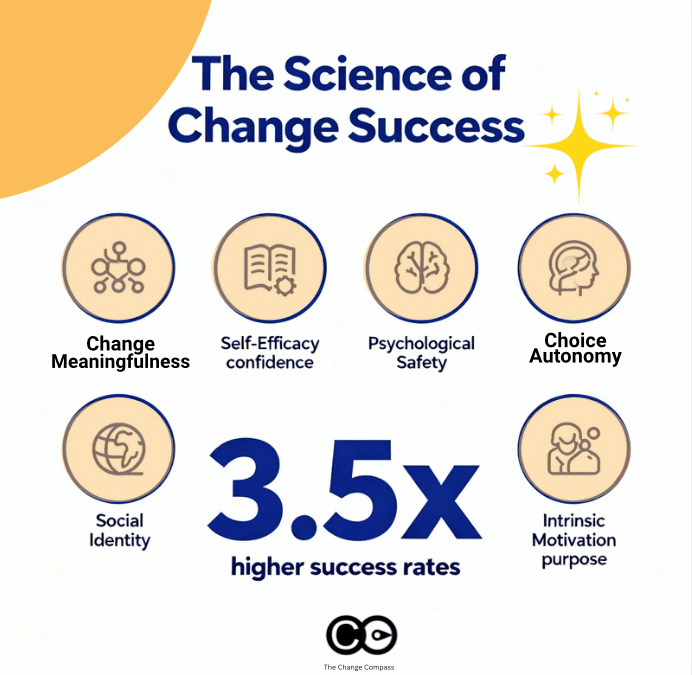
Recent meta-analyses tracking thousands of change initiatives across industries have identified six psychological factors that predict up to 88% of the variance in whether people will embrace or resist organisational change. This isn’t theoretical fluff – these are measurable, actionable insights that can transform your change management approach.
The traditional change management process isn’t enough
Most change management frameworks focus heavily on communication plans, training schedules, and governance structures. While these do matter, research shows they’re not the primary drivers of adoption success. A longitudinal study published in the Journal of Applied Social Psychology found that traditional change management activities only explained about 30% of adoption outcomes.
The real game-changers happen at the psychological level – how people feel about the change, whether they believe they can succeed with it, and if it aligns with their sense of identity and purpose.
What the research reveals about change readiness
The strongest predictor of change adoption isn’t how well you communicate the business case or how comprehensive your training programme is. According to research from Albrecht and colleagues published in Frontiers in Psychology, three psychological conditions together explain 88% of the variance in employee change engagement:
Change-related meaningfulness: Do people understand how this change helps them make a meaningful contribution? When employees see clear connections between the change and their deeper sense of purpose, intrinsic motivation kicks in. This isn’t about vague mission statements – it’s about helping people see tangible ways the change enhances their ability to do work that matters.
Change-related self-efficacy: Do people believe they can successfully navigate and master the change? Confidence in one’s ability to adapt is a powerful predictor of proactive change behaviour. Teams with higher change self-efficacy don’t just comply – they innovate and find better ways to implement changes.
Change-related psychological safety: Can people express concerns, ask questions, and make mistakes without fear? When psychological safety is high, resistance transforms into constructive dialogue. People move from defending against change to collaborating on making it work better.
These three factors work together. You can’t just focus on one and expect miraculous results. But when all three are present, the research shows dramatic improvements in both adoption speed and sustainability.
The autonomy factor that changes everything
Self-determination theory research, with effect sizes sustained over 13-month periods, reveals three autonomy-supportive conditions that dramatically improve change adoption:
• Providing clear rationale: People need to understand not just what’s changing, but why it’s necessary. This goes beyond business cases to help individuals connect the change to broader organisational or societal purposes.
• Offering choices in implementation: Even limited choice in how to implement changes preserves people’s sense of agency. Teams with input into change processes show 65% higher engagement levels.
• Acknowledging feelings and concerns: Counter-intuitively, acknowledging negative emotions about change actually facilitates acceptance. When concerns are heard and addressed, psychological reactance decreases.
This research challenges the traditional “tell and sell” approach to change management. Instead of trying to overcome resistance, successful change leaders create conditions where people can choose to embrace change because it serves their psychological needs.
Social identity: the hidden driver of change success
One of the most overlooked aspects of change management is how changes affect people’s sense of identity and group belonging. Social identity theory research identifies two distinct pathways for successful change adoption:
Identity maintenance pathway: People more readily adopt change when they can preserve core aspects of their existing identity while adapting to new circumstances. This works through continuity mechanisms – maintaining connection to valued aspects of organisational culture and relationships while evolving others.
Identity gain pathway: Alternatively, individuals embrace change when they perceive it will enhance their social identity or provide access to more valued group memberships. This operates through aspiration mechanisms – change becomes attractive when it offers opportunities for growth or alignment with desired characteristics.
The practical implication? Before launching your change initiative, map out how the change affects different groups’ identities (I,e, your change impacts). Then design your approach to either preserve valued identities or provide compelling identity gains.
Rogers’ innovation characteristics still matter
Diffusion of innovation theory, validated across thousands of studies, identifies five characteristics that predict adoption rates and collectively explain 50-90% of adoption variance:
• Relative advantage: The degree to which change is perceived as better than existing approaches • Compatibility: How well change aligns with existing values and experiences • Simplicity: The perceived ease of understanding and implementing change • Trialability: The ability to experiment before full commitment • Observability: The visibility of change results to others
These factors operate through different psychological mechanisms. Relative advantage works through comparison processes, compatibility through cognitive consonance, and observability through social proof. Smart change leaders deliberately design their initiatives to optimise these characteristics.
Measuring what matters: change adoption metrics that predict success
Traditional change management metrics often miss the mark. Tracking training completion rates or communication reach tells you about activities, not outcomes. Research-based change assessment focuses on measuring the psychological conditions that predict adoption:
Early indicators of success: • Meaningfulness ratings: Do people see how the change connects to their purpose? • Self-efficacy scores: How confident are teams about succeeding with the change? • Psychological safety levels: Can people express concerns without fear? • Autonomy support perception: Were rationale, choice, and concerns adequately addressed?
Behavioural indicators: • Proactive change behaviour: Are people finding ways to improve implementation? • Help-seeking behaviour: Are teams asking questions and sharing challenges? • Innovation around the change: Are people adapting the change to work better in their context?
These metrics give you leading indicators of adoption success, allowing you to intervene before problems become entrenched.
The intrinsic motivation advantage
Research consistently shows that intrinsic motivation produces more sustainable change adoption than external incentives. Studies on intrinsic motivation in workplace change show it operates through three fundamental psychological needs:
Autonomy: The need to feel self-directed rather than controlled. Changes that preserve or enhance autonomy see higher sustained adoption rates.
Mastery: The desire to develop competence and skill. Changes that provide growth opportunities tap into learning motivation, making adaptation engaging rather than threatening.
Purpose: The need to contribute to something meaningful. Changes that enhance sense of purpose leverage powerful intrinsic motivators.
Organisations that cultivate intrinsic motivation during change see 83% higher likelihood of innovation, improved retention, and more positive cultures that become self-reinforcing for future changes.
Loss aversion: People psychologically weight potential losses twice as heavily as equivalent gains. This means change communications focusing only on benefits may be insufficient to overcome perceived risks.
Status quo bias: The tendency to prefer current conditions even when alternatives might be superior. This operates through familiarity preferences and psychological comfort with predictability.
Confirmation bias: Selective processing of information that confirms existing beliefs while dismissing contradictory evidence. This particularly affects how people interpret change communications and early experiences.
Successful change initiatives address these barriers directly rather than trying to overpower them with rational arguments. Research shows that change programmes acknowledging and working with psychological barriers have significantly higher success rates.
• Create psychological safety through their own vulnerability and openness to feedback • Provide clear rationale that connects to employees’ values and sense of purpose • Offer genuine choices in how changes are implemented at the team level • Acknowledge the emotional impact of change rather than dismissing concerns • Model the mindset and behaviours they want to see in others
Putting it all together: a psychological systems approach
The most significant finding from this research is that these psychological mechanisms aren’t individual preferences – they represent universal human needs. When addressed systematically, they can dramatically improve change outcomes. Organisations that invest in understanding and supporting these psychological processes see 3.5 times higher success rates in change initiatives.
This research fundamentally challenges traditional change management practice. Instead of an engineering mindset focused on processes and structures, successful change requires a psychological science approach that prioritises human motivation, meaning, and social dynamics.
Practical steps for change leaders:
• Start with meaningfulness: Help people understand how the change enhances their ability to contribute meaningfully • Build confidence: Provide skills, support, and early wins to develop change self-efficacy • Create safety: Establish norms where concerns can be expressed and mistakes are learning opportunities • Preserve autonomy: Provide rationale, offer choices, and acknowledge feelings throughout the process • Consider identity: Map how the change affects group identities and design accordingly • Optimise innovation characteristics: Make changes obviously beneficial, compatible, simple, testable, and visible
The future of change management
Recent studies on the evolution of change management suggest we’re moving toward more psychologically informed approaches. Organisations that integrate these research findings into their change management frameworks are seeing:
• 40% faster adoption rates • 60% higher employee satisfaction during change • 50% lower resistance and turnover • More sustainable behaviour change that persists beyond formal change programmes
The evidence is clear: successful change is fundamentally a human psychological phenomenon. When we address the underlying needs for autonomy, meaning, competence, and social connection, people don’t just comply with change – they embrace it, improve it, and become advocates for future transformation.
As you plan your next change initiative, remember that the most sophisticated project plans and communication strategies won’t overcome basic psychological resistance. But when you create conditions that support human psychological needs, change adoption becomes not just possible, but inevitable.
Understanding what research shows about predicting change adoption isn’t just about improving success rates – it’s about creating more humane, engaging, and sustainable approaches to organisational transformation. And in today’s rapidly changing business environment, that might be the most important competitive advantage you can develop.
If you are looking for a way to easily track change readiness and eventual change adoption leveraging the science of what works through a digital platform, reach out and get in touch.
The topic of change is often inundated with literature stressing that it is about people, feeling, attitudes and behaviour. While these are important, lot of articles centred about the human-nature of change often ignore the importance of data during the change and transformation process. This is no different for the topic of employee readiness for change. People’s attitudes and behaviour need to be observed, measured and tracked during change.
Employee readiness for change is a critical factor that determines the outcome of organisational transformations. By leveraging data-driven insights, companies can proactively assess and enhance their employees’ preparedness, paving the way for smoother transitions and improved business results.
Let’s explore the concept of employee readiness for change and delve into strategies for using data to optimise readiness during transformations. We will discuss key metrics, change readiness assessments, employee engagement techniques, and real-time monitoring to help organisations navigate change effectively.
What is Employee Readiness for Change?
Employee readiness for change refers to the extent to which individuals within an organisation are prepared, willing, and capable of embracing and implementing change. It encompasses their understanding of the change, their motivation to support it, and their ability to adapt and perform effectively in the new environment.
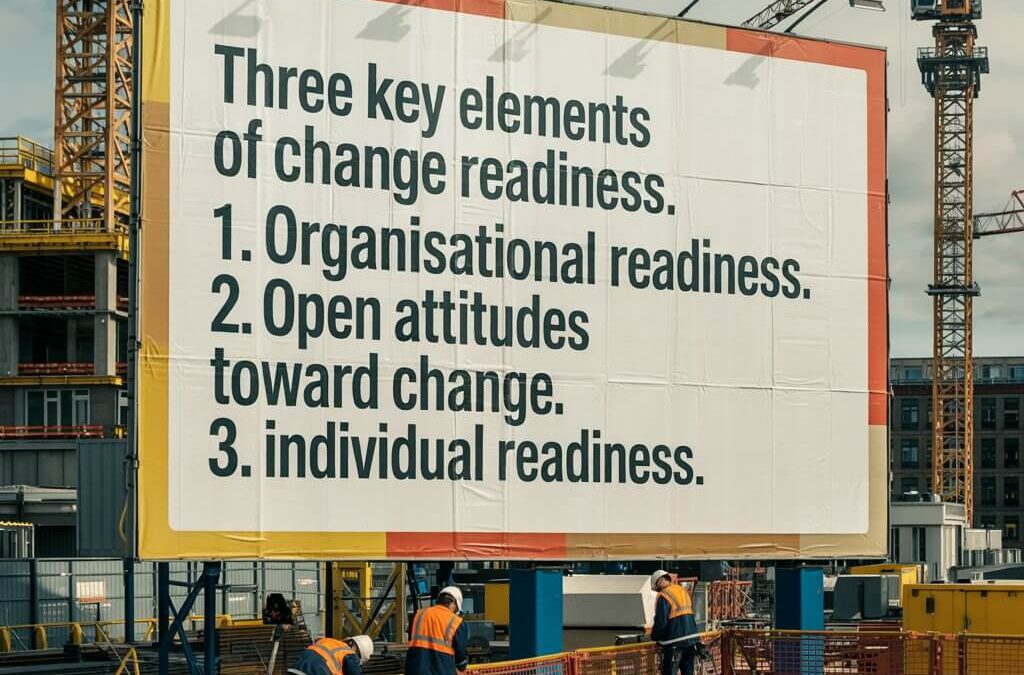
Assessing employee readiness involves evaluating three key elements:
Organisational readiness: This aspect focuses on the company’s overall preparedness for change, including factors such as leadership commitment, resource availability, and clear objectives.
Open attitudes toward change: Gauging employees’ understanding and willingness to embrace change is crucial. Positive attitudes contribute to successful resistance management and building change readiness.
Individual readiness: On a personal level, assessing each employee’s readiness, willingness, and ability to adapt to change is essential. This involves considering their skills, knowledge, and emotional preparedness.
Note that individual readiness is only one component of the overall readiness. A lot of people only focus on this to the detriment of truly assessing the overall readiness.
By conducting a comprehensive assessment of these elements, organisations can gain valuable insights into their employees’ readiness for change. This information serves as a foundation for developing targeted strategies to enhance readiness and facilitate successful transformations.
How to Use Data to Improve Employee Readiness During Transformations
Harnessing the power of data analytics is essential for enhancing workforce preparedness during organisational transformations. By systematically gathering and interpreting relevant data, organisations can uncover potential obstacles and craft bespoke strategies to bolster readiness and ensure seamless transitions.
Determining Critical Metrics for Change Preparedness
To effectively utilize data, organisations must first establish the critical metrics that will serve as indicators of readiness. These metrics provide a foundation for assessing the current state and tracking future progress:
Engagement indices: Measure the degree to which employees are actively involved and invested in organisational activities. High engagement suggests a supportive environment for change initiatives.
Flexibility indicators: Evaluate employees’ capacity to adjust to new roles and technologies. This metric identifies those who may benefit from targeted support.
Completion rates of developmental programs: Monitor the percentage of the workforce completing essential training. This figure highlights areas where skill enhancement is necessary.
Executing a Holistic Change Preparedness Evaluation
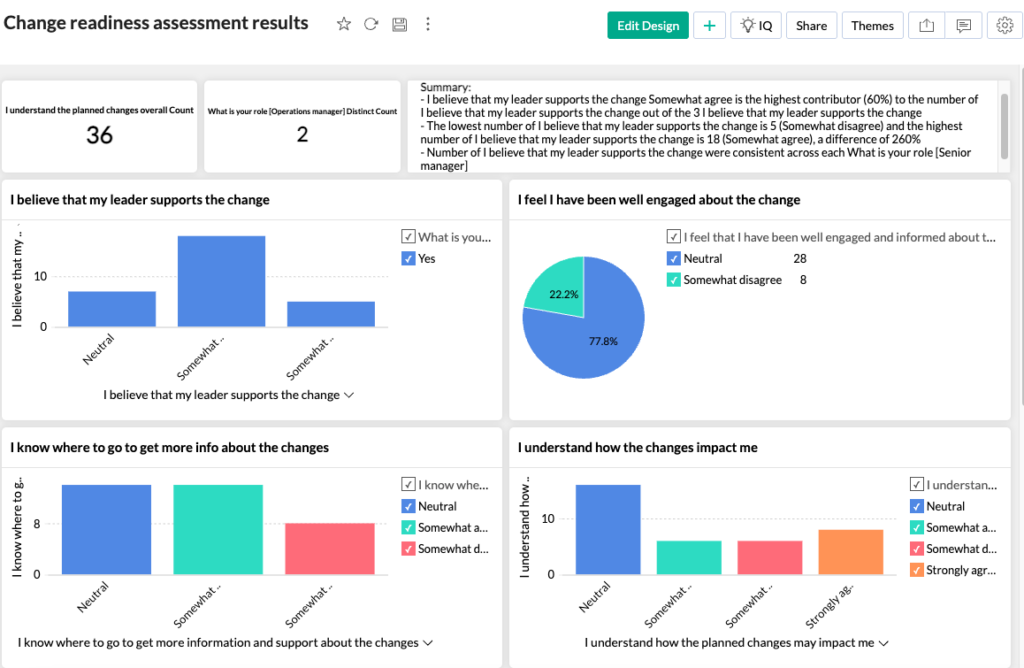
With metrics in place, conduct a thorough evaluation of change preparedness at both organisational and individual levels. Utilize surveys, interviews, and focus groups to gather rich data. This comprehensive approach reveals resistance points and directs attention to intervention opportunities:
Cultural assessment: Analyse underlying cultural traits that influence how change is perceived and implemented. Insights into assertiveness and hierarchy can guide communication strategies.
Leadership analysis: Assess the readiness and skillset of leaders to champion change. Effective leadership is pivotal for the success of transformation efforts.
Enhancing Workforce Involvement Through Data Insights
Data-driven insights can significantly enhance employee involvement during periods of change. By examining workforce data, organisations can tailor communication and training to better resonate with their employees:
Customized messaging: Develop communication that speaks directly to the needs and concerns of various employee segments. This ensures messages are impactful and engaging.
Focused learning initiatives: Identify specific knowledge gaps and create targeted training programs. Customized learning enhances employees’ ability to adapt to change confidently.
Continuous Strategy Adaptation via Real-Time Data
Ongoing monitoring of strategy effectiveness through real-time analytics is vital. This continuous process allows organisations to refine their approaches based on evolving data patterns, maintaining high levels of readiness:
Regular data collection: Actively seek feedback from employees regarding their transition experiences. This input is crucial for identifying areas needing adjustment.
Dynamic decision-making: Leverage real-time (or least recent) data to inform strategic decisions and optimize change management initiatives, ensuring they remain aligned with organisational goals.
1. Identify Key Metrics for Change Readiness
Establishing a robust framework of metrics is fundamental to accurately gauge change readiness within an organisation. These metrics function as critical indicators, allowing leaders to monitor the pulse of their workforce during transformation initiatives. A well-defined set of metrics provides a structured approach to assessing readiness and identifying areas requiring attention.
Engagement Indicators
Evaluating employee engagement is crucial for understanding the workforce’s readiness for change. This involves gathering insights into how employees perceive their roles and the organisation’s objectives. A workforce that demonstrates high levels of commitment and enthusiasm tends to be more agile and supportive of change efforts. Methods such as employee sentiment analysis and engagement surveys can help capture these dynamics, offering a nuanced view of organisational health.
Flexibility Metrics
Flexibility metrics provide a window into the ease with which employees can transition to new processes and systems. This involves examining historical data on change adaptability and using tools like behavioural assessments to gauge employees’ readiness for new challenges. Understanding the flexibility of employees can guide targeted support and interventions, ensuring smoother transitions during organisational shifts.
Completion Rates of Educational Programs
Monitoring the completion rates of educational initiatives is essential to assess how prepared employees are for impending changes. This metric reflects the organisation’s dedication to equipping its workforce with the skills needed for transformation. Analysing completion data, alongside post-training assessments, can offer insights into the effectiveness of learning interventions and highlight areas for development.
Together, these metrics form a comprehensive picture of an organisation’s change readiness. By establishing a baseline for these indicators, organisations can track progress over time, adjusting strategies as necessary to enhance readiness and facilitate successful transformations.
2. Conduct a Comprehensive Change Readiness Assessment
To pave the way for a successful transformation, conducting a comprehensive change readiness assessment becomes imperative. This systematic evaluation delves into the organisation’s preparedness at both the macro and micro levels, providing insights that are critical for shaping effective change strategies. Utilizing a blend of qualitative and quantitative methods, the assessment illuminates the landscape of readiness, offering a strategic foundation for decision-making.
Strategic Evaluation Components
A multifaceted readiness assessment encompasses several strategic components, each designed to gather a holistic understanding of the organisational climate:
Cultural Insight Analysis: Delve into the organisational culture to uncover factors that may affect acceptance of change. This involves exploring existing communication styles, shared values, and prevalent behaviours that could influence the transformation journey. Gaining a clear picture of these cultural dynamics aids in crafting initiatives that resonate with the workforce’s inherent beliefs.
Leadership Capacity Evaluation: Determine the readiness and effectiveness of leadership in spearheading change efforts. Examine their ability to inspire and motivate, as well as their capacity to navigate the complexities of organisational transformation. Strong leadership commitment is essential for instilling confidence and guiding the organisation through change.
Resource Readiness Check: Evaluate the sufficiency and distribution of resources critical for supporting change initiatives. Consider the existing technological capabilities, financial support, and human resources available to drive the transformation. Addressing resource gaps early ensures that the organisation is well-prepared to meet the demands of change.
Analysing Data for Targeted Interventions
Upon gathering data through the readiness assessment, a thorough analysis is essential to uncover insights that inform strategic interventions. This analysis should focus on identifying potential resistance points and areas ripe for development:
Resistance Identification: Detect and chart areas where reluctance to change may manifest. Utilize employee feedback, trends from past projects, and current mood assessments to pinpoint these zones. Understanding these resistance factors allows for proactive measures to encourage acceptance and reduce pushback.
Opportunity Leveraging: Spot areas with high readiness levels that can be used to propel change efforts forward. Recognize organisational strengths and existing competencies that can be harnessed to support the transition. By leveraging these opportunities, organisations can accelerate progress and cultivate a culture of continuous growth.
Conducting a comprehensive change readiness assessment provides a strategic lens through which organisations can navigate the complexities of transformation. By systematically evaluating readiness and leveraging data-driven insights, organisations can craft tailored strategies that enhance employee preparedness and drive successful change outcomes.
3. Utilise Data Analytics to Foster Employee Engagement
Employing data analytics is essential to deepening employee involvement during change processes. By utilizing advanced analytical tools, organisations can uncover key drivers of motivation and engagement within their workforce. This enables the development of strategies that are not only data-informed but also tailored to enhance a culture of commitment and adaptability.
Strategic Communication Approaches
Data analytics offer organisations the ability to refine communication strategies in a way that aligns with the diverse preferences and needs of employees. By examining patterns in communication effectiveness and gathering feedback, companies can create messaging frameworks that are clear and meaningful. This strategic approach ensures that communication is not just disseminated but absorbed, fostering a sense of inclusion and understanding across the organisation.
Customised Development Pathways
Insights from analytics enable the design of development pathways that cater to the specific learning and growth needs of employees. Analysing performance metrics and capability assessments allows organisations to pinpoint where support is most needed, leading to bespoke development initiatives. These pathways not only address skill gaps but also promote a learning culture that equips employees for future challenges.
Ongoing Engagement Assessment
Real-time analytics provide a robust mechanism for continuously assessing employee engagement throughout the transformation journey. Establishing metrics that reflect engagement sentiment and participation levels helps organisations react swiftly to shifts in morale. This proactive engagement assessment ensures that initiatives remain aligned with employee expectations and organisational objectives, fostering a sustained commitment to change.
4. Monitor and Adapt Strategies Using Real-Time Data
Leveraging real-time data analytics is crucial for dynamically guiding change initiatives. This approach enables organisations to continuously evaluate the effectiveness of their strategies, ensuring they remain aligned with shifting business needs and employee expectations. By integrating adaptive feedback mechanisms, companies can refine their tactics, promoting an environment of agility and responsiveness.
Dynamic Data Acquisition
Establishing a robust system for dynamic data acquisition is essential to maintain an accurate understanding of organisational and employee dynamics. Real-time analytics platforms and dashboards provide comprehensive insights into change progress, such as engagement indices, performance metrics, and sentiment analysis. Regularly capturing this data allows organisations to proactively identify patterns and shifts that may influence the success of change initiatives.
Strategic Insights-Driven Adjustments
The insights obtained from real-time data empower organisations to make calculated adjustments to their strategies. This adaptive approach ensures that interventions remain pertinent and effective, addressing emerging challenges and capitalizing on new opportunities:
Incorporating Employee Perspectives: Integrate direct insights from employees into strategic refinements. Understanding their experiences and perceptions offers a nuanced perspective of the change process, allowing for precise enhancements.
Pattern Recognition: Use data patterns to recognize trends that may require strategic shifts. For example, a downward trend in engagement metrics could indicate the need for improved communication or support mechanisms.
Efficient Resource Deployment: Employ data insights to enhance resource deployment, ensuring that efforts are concentrated where they are most impactful. This targeted approach enhances the effectiveness of change initiatives and maximizes results.
Proactive Decision-Making
Real-time data analytics enable proactive decision-making, empowering leaders to swiftly adjust to evolving conditions. This capability is vital for sustaining momentum and ensuring that change efforts remain aligned with organisational objectives. By adopting a data-informed mindset, organisations can navigate the complexities of transformation with confidence and precision.
By harnessing the power of data analytics, organisations can proactively assess and enhance employee readiness during transformations, paving the way for smoother transitions and improved business outcomes. Embracing a data-driven approach to change management is no longer optional; it is a strategic imperative for organisations seeking to thrive in an ever-evolving landscape. If you’re ready to transform your change management processes and unlock the full potential of your workforce, chat to us to explore how we can help you leverage data and insights to navigate change with confidence and precision.
Most organisations that struggle with large-scale change don’t have a capability problem. They have a structural problem. The change practitioners are skilled. The methodology is sound. But the way the change function is organised means it can never move fast enough, influence broadly enough, or demonstrate enough value to earn a permanent seat at the table.
Getting the change management org structure right is one of the most consequential decisions a Head of Transformation or Chief People Officer can make. Done well, it multiplies the impact of every programme in flight. Done poorly, it turns your best change practitioners into glorified project administrators, perpetually reactive and forever underfunded.
This article lays out the structural choices available to enterprise change functions, the factors that determine which model works best, and a practical framework for designing a change management org structure that scales.
Why structure matters more than headcount
The instinct when change initiatives fail is to add more people. Hire another change manager. Bring in contractors. Scale up the programme team. But headcount without the right structure is like adding more lanes to a congested motorway , it doesn’t resolve the underlying problem, it just adds more traffic.
Prosci’s longitudinal research on change management best practices consistently shows that organisations with a dedicated, structured change function are seven times more likely to achieve their change objectives than those relying on ad hoc change support. Yet most large organisations still deploy change management as a project-level add-on rather than an enterprise capability.
The structural question is fundamental: where does change management live, who does it report to, how are resources allocated, and how does it interface with the project management and strategy functions? These decisions shape every other outcome.
The three primary structural models
There is no single right answer to how a change function should be organised. Prosci’s own guidance on the Change Management Office makes clear that the optimal structure depends on organisational culture, strategic priorities, and the maturity of the change capability. That said, most enterprise change functions fall into one of three models.
Centralised model: the change management office
In a centralised structure, change management capability sits in a single, dedicated team , typically called a Change Management Office (CMO) or Centre of Excellence (CoE). This team owns methodology, standards, tools, and resource deployment across the organisation.
The centralised model works best when:
The organisation is running a significant number of concurrent transformation programmes
Leadership wants consistent methodology and quality assurance across all change activity
There is a strong sponsor at the executive level (typically CHRO, COO, or CEO direct report)
The organisation is early in its change maturity journey and needs to build capability systematically
The main risk is that a centralised CMO can become a bottleneck, or worse, a bureaucratic layer that slows programmes down rather than accelerating them.
Federated model: embedded change resources
In a federated structure, change management practitioners are distributed across business units, portfolios, or programmes. Each area maintains its own change capability, with loose coordination at the enterprise level.
This model suits organisations where:
Business units operate with high autonomy and have distinct change contexts
There is already a reasonable level of change maturity across the organisation
Portfolio complexity is high and requires deep contextual knowledge in each area
Speed of deployment matters more than consistency of approach
The risk with a federated model is fragmentation. Without a shared methodology, it becomes difficult to report on change capacity, manage cumulative change load, or build organisational learning across programmes.
Hybrid model: a hub-and-spoke structure
The hybrid model is the most common in mature enterprise organisations , and for good reason. It combines a small central team responsible for methodology, governance, and strategic oversight with embedded change practitioners in each business unit or major programme.
The central hub sets the standards. The spokes execute them, with enough autonomy to adapt to local context.
This model is increasingly favoured by Prosci’s research, which notes that the most effective location for the enterprise CMO is increasingly the Strategy, Transformation and Planning office , rather than HR, as was historically the case , reflecting the shift of change management from a people support function to a strategic business enabler.
Key roles in an enterprise change management structure
Regardless of which structural model you adopt, mature enterprise change functions typically include the following roles. The exact titles will vary by organisation; the functions they perform are consistent.
Head of Change / Director of Organisational Change Management
This is the senior leadership role accountable for the overall change capability. They are responsible for:
Setting strategy for the change function and building its maturity
Engaging executive sponsors and senior leaders
Overseeing portfolio-level change risk and capacity
Championing the value of change management internally
In many organisations, this role is being elevated from Head of Change to Chief Transformation Officer or equivalent, reflecting the growing strategic importance of the function.
Change managers / change leads
These are the practitioners who own change delivery at the programme or project level. Their responsibilities include:
Developing and executing change management plans for specific initiatives
Conducting stakeholder analyses and change impact assessments
Designing and delivering communications and engagement activities
Monitoring adoption and reporting on change progress
Senior change managers typically work across multiple programmes or are allocated to the highest-complexity transformations.
Change analysts
Change analysts provide the data and analytical backbone of the change function. Their work includes:
Maintaining change portfolio data and tracking cumulative change load
Analysing change impact data across the employee population
Producing reporting for programme boards and executive leadership
Supporting the development of measurement frameworks
As change management becomes more data-driven, the change analyst role is increasing in prominence and seniority.
Change champions / change network coordinators
These are typically not full-time change roles, but rather a network of business representatives who support adoption at the ground level. A well-run change champion network can significantly extend the reach of a small central team. The CMO typically designs and manages the champion programme; the champions themselves remain in their business unit roles.
How to determine the right team size
One of the most common questions organisations ask is: how many change practitioners do we need? The honest answer is that there is no universal ratio, but there are sensible parameters.
A useful starting point is to map your change portfolio , the number of concurrent programmes with significant people impact , and assess the complexity and scale of each. As a general guide:
Small, low-complexity programmes: 0.2,0.3 FTE change support
Alongside programme-level resourcing, enterprise functions typically maintain a small strategic overhead for methodology, governance, and capability building , typically 1,2 FTE depending on organisation size.
One critical input to this calculation is cumulative change load. McKinsey research on transformation success consistently highlights that organisations running multiple transformations concurrently face compounding risk , not just from each individual programme, but from the combined demand placed on the employee population. Structural visibility of this cumulative load is one of the most valuable things an enterprise change function can provide.
Reporting line: where should the change function sit?
Where the change function reports has a significant effect on its influence, scope, and budget. The most common reporting lines and their trade-offs are:
Reporting to HR / People & Culture: Provides strong integration with people processes (talent, learning, engagement) but can result in a perception that change management is a “soft” function focused primarily on communication rather than business outcomes.
Reporting to the PMO: Enables tight integration with project governance, budget cycles, and programme reporting. The risk is that change becomes subordinate to project delivery rather than a co-equal discipline.
Reporting to Strategy / Transformation: Positions change as a strategic function with executive visibility. This is the model Prosci’s research increasingly identifies as most effective, as it places change capability at the point where strategic decisions are made.
Reporting directly to the CEO / COO: Common in organisations undergoing significant enterprise transformation. Provides the highest level of authority but requires a senior, commercially credible leader to hold the role.
The role of digital tools in scaling your change function
One of the practical challenges all change functions face is scale. A team of five or six change practitioners cannot manually track the change portfolio, analyse cumulative impact, maintain stakeholder data, and produce meaningful reporting across twenty or thirty concurrent programmes.
This is where a digital change management platform becomes operationally important. Tools like Change Compass allow change functions to centralise change portfolio data, automate impact reporting, and provide leadership with real-time visibility of change load across the organisation , without adding headcount. For enterprise change functions operating a hub-and-spoke model, a shared digital platform also creates consistency between the central team and embedded practitioners.
The Change Compass platform supports everything from individual change impact assessments through to portfolio-level analytics, enabling the change function to make the case for resources and demonstrate measurable value to the business.
A five-step framework for designing your change management org structure
If you are building or redesigning a change function, here is a practical sequence to follow:
Map your change portfolio , Catalogue all programmes currently in flight or planned for the next 18 months. Assess the complexity, scale, and people impact of each. This gives you a baseline for resource requirements.
Assess your change maturity , A centralised, method-heavy CMO is rarely the right starting point for an organisation with low change maturity. Build a structure that is achievable now and scalable as maturity grows.
Choose your structural model , Based on your portfolio size, maturity, and culture, select from centralised, federated, or hybrid. Most enterprise organisations above a certain scale will land on a hybrid hub-and-spoke model.
Define the reporting line , Engage senior leadership to determine where the change function sits. The reporting line determines influence; be explicit about this rather than accepting a default.
Define roles, not just headcount , Specify the function each role performs, not just the title. A Head of Change and two change managers with clearly defined accountabilities will outperform a team of ten with ambiguous responsibilities.
Common structural pitfalls to avoid
Even well-intentioned change functions fall into recurring structural traps:
Embedding change too deep in HR: The function loses commercial credibility and access to early strategic conversations.
Making the CMO the gatekeeper for all change activity: This creates a bottleneck and frustrates programme teams. The CMO’s job is to set standards and build capability, not approve every change plan.
Understaffing the analytical function: Without data, the change function cannot demonstrate value or make the case for its own resourcing.
Treating the champion network as a substitute for professional change management: Champions extend reach , they do not replace it.
Failing to document the charter: Without a clear, documented mandate, the change function’s scope will be contested constantly.
The change management org structure you design will either amplify or constrain everything your practitioners do. Getting it right requires more than drawing an org chart. It requires a clear view of your change portfolio, an honest assessment of your maturity, a deliberate choice about where the function sits in the business, and well-defined roles that reflect the actual work.
For organisations serious about building enterprise change capability, the structural conversation is not a one-time exercise , it evolves as the business grows, the portfolio expands, and maturity deepens. The organisations that treat change capability as a permanent strategic asset, structured and resourced accordingly, are the ones that consistently outperform on the delivery of major transformations.
Frequently asked questions
What is change management org structure?
Change management org structure refers to how an organisation’s change management capability is formally organised , including the team configuration, reporting lines, roles, and accountability arrangements. A well-designed structure ensures that change practitioners have the authority, resources, and visibility needed to support major transformation programmes effectively.
What are the main models for structuring a change management function?
The three primary models are centralised (a single CMO or CoE), federated (change practitioners distributed across business units), and hybrid hub-and-spoke (a small central team with embedded practitioners across the portfolio). Most large enterprises use a hybrid model, balancing consistency of methodology with the contextual agility that embedded roles provide.
Where should the change management function report?
Prosci’s research increasingly points to Strategy, Transformation and Planning as the most effective location, ahead of HR and the PMO. The right reporting line depends on your organisation’s structure, but the key principle is that the change function needs proximity to where strategic decisions are made, not just where people processes are managed.
How many change managers does an enterprise need?
There is no universal ratio, but a useful starting framework is 0.2,0.3 FTE for small/low-complexity programmes, 0.5,1.0 FTE for medium programmes, and 1.5,3.0+ FTE for large enterprise transformations. The total portfolio of concurrent programmes drives the overall requirement, with additional capacity for governance and capability building at the central level.
What is the difference between a Change Management Office and a Centre of Excellence?
A Change Management Office (CMO) typically refers to a team that provides operational change management support and resources to programmes. A Centre of Excellence (CoE) tends to focus more on methodology, capability building, standards, and thought leadership , often with a smaller core team that influences rather than delivers change activity. In practice, the terms are often used interchangeably.
How does change management org structure affect programme outcomes?
Significantly. Prosci research shows that organisations with effective change management are seven times more likely to meet their change objectives. Structure determines whether change management is deployed early, resourced adequately, and given the authority to influence programme design , or whether it is bolted on late as a communications exercise.
We use cookies to improve your experience and understand site use. Marketing cookies stay off until you accept, and in the EU, UK and Switzerland analytics does too. Cookie Policy.
Strictly necessary
Required for the site to work: security, load balancing, and remembering your choices. These cannot be switched off.
Always active
Analytics
Google Analytics and similar, so we can see which pages are useful and where visitors get stuck. Aggregated, never sold.
Marketing
Used to measure campaigns and show relevant content on other platforms such as LinkedIn.