

Organisational change has never been more relentless. Mergers, digital transformations, regulatory shifts, workforce restructuring and the ongoing pressure to do more with less mean that most large organisations are managing multiple significant changes simultaneously at any given time. Yet despite this reality, many organisations still treat change management as a project-level activity – something mobilised when a specific initiative demands it and wound down once the go-live milestone passes. The result is a cycle of reactive change management that exhausts people, produces inconsistent outcomes and fails to build lasting capability.
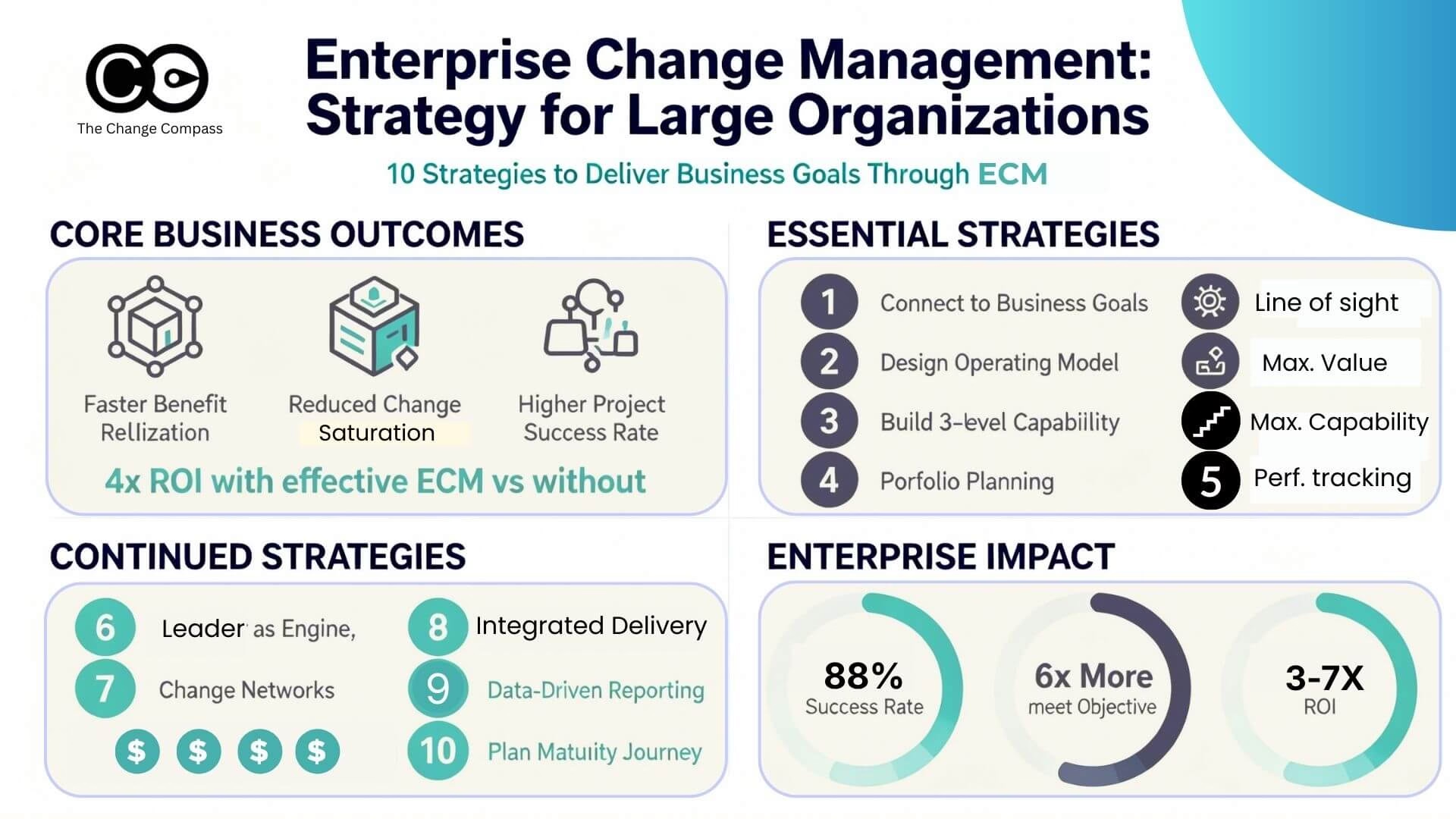
Change maturity describes the degree to which an organisation has embedded disciplined, data-informed change practices into its operating model. Mature organisations do not simply respond to change – they anticipate it, sequence it intelligently, resource it appropriately and learn from it systematically. Research from Prosci consistently shows that organisations at higher levels of change maturity achieve significantly better project outcomes, including higher adoption rates, lower rates of employee resistance and stronger return on investment from transformation programmes.
The gap between reactive and mature change management is not primarily a gap in methodology knowledge – most organisations have access to frameworks like ADKAR or Kotter’s 8 Steps. The real gap is in data, visibility and organisational infrastructure. Without a clear picture of the volume, timing and cumulative impact of change across the enterprise, even the best methodology cannot be applied effectively. This is precisely where The Change Compass operates as a strategic enabler.
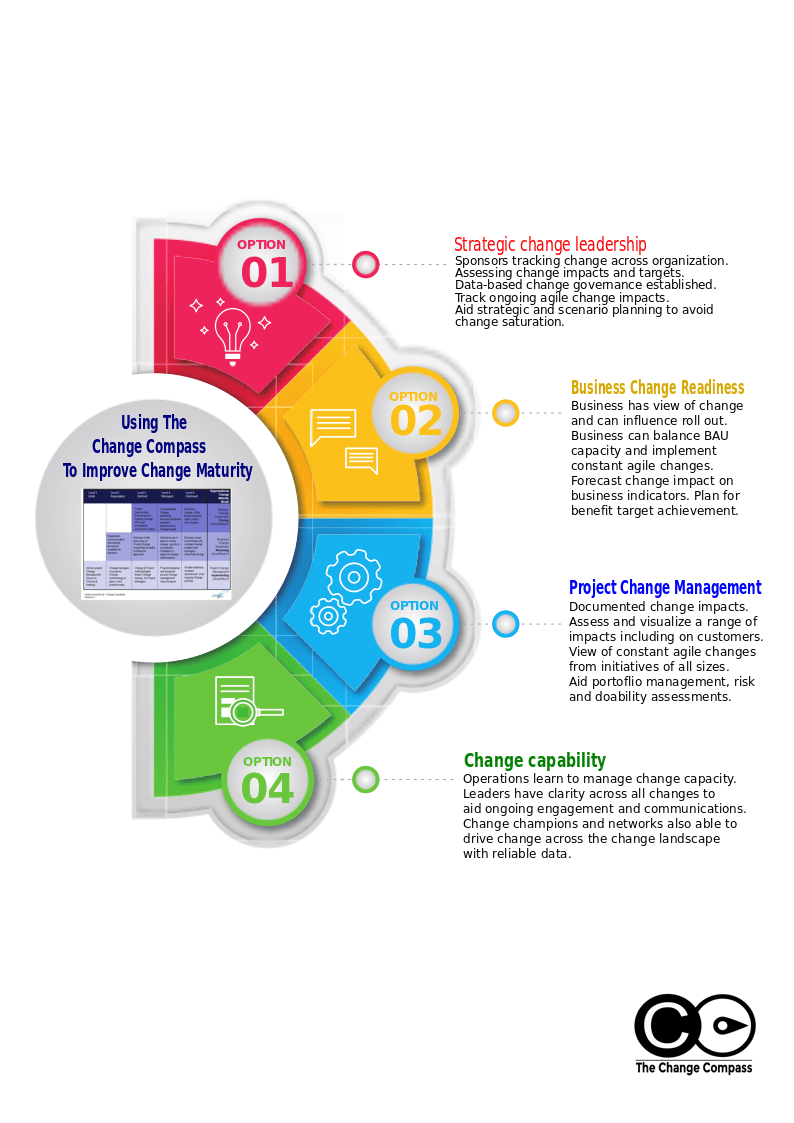
Download the Change Maturity infographic to see how The Change Compass maps to each maturity focus area.
What change maturity means for organisations
Change maturity is not a single capability – it is a multi-dimensional state that spans leadership, governance, planning, execution and learning. A mature change organisation has clarity on what changes are in flight across the enterprise at any given time, how those changes interact and compete for the same people and the same attention. It has leaders who understand their role in sponsoring change, not just approving it. It has project teams that apply change management with rigour, not as an afterthought. And it has a mechanism for continuously improving its approach based on evidence, not anecdote.
Gartner research has highlighted that a majority of change initiatives fail to achieve their intended outcomes not because of technical failure but because of people-related factors – insufficient preparation, poor communication and inadequate leadership alignment. These are precisely the factors that an organisation with genuine change maturity addresses proactively. McKinsey analysis similarly finds that organisations with strong change management capabilities are 3.5 times more likely to outperform their peers in major transformation programmes (McKinsey, 2018).
The Change Compass supports maturity development across five interconnected focus areas: strategic change leadership, business change readiness, project change management, building organisation-wide change capability, and continuous improvement and learning from change. Each area represents a distinct dimension of maturity, and progress in one area reinforces progress in the others.
Focus area 1 – Strategic change leadership
Strategic change leadership is the foundation of change maturity. When senior leaders understand and accept their role as active sponsors of change – not just initiators of it – the entire organisation responds differently. Sponsors who stay visibly engaged throughout a change initiative, who communicate the “why” with conviction and who hold their teams accountable for adoption are consistently linked to better outcomes. The challenge is that most senior leaders do not have the information they need to play this role well.
The Change Compass directly addresses this gap by providing executives and senior leadership teams with a real-time, portfolio-level view of all change activity across the organisation. Rather than relying on project status reports that focus on milestones and budgets, leaders using The Change Compass can see the cumulative change load facing different business units, identify where their people are being asked to absorb too much change at once and make informed decisions about sequencing, prioritisation and resourcing. This shifts leadership engagement from reactive troubleshooting to proactive stewardship.
Strategic change leadership also requires alignment – across the executive team and down through the layers of management. The Change Compass creates a shared language and a shared data set that enables leadership teams to have more productive conversations about change portfolio governance. When everyone is looking at the same data, debates about whether a particular business unit is overloaded with change move from opinion-based to evidence-based. This is a meaningful shift in the quality of leadership decision-making and a clear indicator of improving maturity.
Focus area 2 – Business change readiness
Change readiness is the state of preparedness that individuals, teams and business units have to successfully absorb and adopt a particular change. Readiness is not a binary condition – it varies by person, by role, by the nature of the change and by the concurrent demands placed on a group at any given time. Organisations that treat readiness as a checkbox activity – a survey conducted a few weeks before go-live – are managing at a low level of maturity. Truly mature organisations assess and monitor readiness continuously and use that intelligence to adapt their change approach.
The Change Compass provides the data infrastructure needed to assess readiness at a systemic level. By mapping the volume and timing of changes across specific business units, The Change Compass enables change practitioners and business leaders to identify where readiness risks are highest before they become adoption failures. If a particular business unit is simultaneously absorbing a technology implementation, a restructure and a new compliance requirement, the platform makes that confluence visible and allows proactive decisions about how to sequence communications, training and support.
Readiness also depends on the capacity of managers to lead change at the local level. Middle managers are consistently identified in change management research – including by Harvard Business Review – as the single most important factor in whether employees adopt a change or revert to old behaviours. The Change Compass supports managers by giving them a view of the change demands on their team, enabling them to have honest conversations with their people about what is coming, when and why. This is a practical contribution to readiness that goes beyond any single initiative.
Focus area 3 – Project change management
Project change management is the most familiar dimension of maturity for most organisations – it is the application of structured change management practices within individual projects and programmes. At lower levels of maturity, this is ad hoc and dependent on the awareness of individual project managers. At higher levels, it is systematic, consistently applied and integrated into project governance from the earliest stages of planning.
The Change Compass strengthens project-level change management by connecting individual project planning to a broader organisational context. When a change manager working on a specific initiative can see how that initiative sits within the wider portfolio – which other changes are affecting the same groups, what the communication cadence looks like across all initiatives, where training timelines overlap – they can design a more realistic and effective change plan. This contextual awareness is something most project change managers currently lack, not because they do not want it but because no mechanism exists to provide it.
Beyond planning, The Change Compass supports the tracking and reporting of change activities at the project level in a way that feeds into portfolio-level insights. Change managers can record activities, track progress against plans and capture data that feeds into organisation-wide views of change health. This integration between project-level execution and portfolio-level visibility is a hallmark of higher-maturity change organisations. It ensures that the work done at the project level contributes to a broader organisational understanding of how change is being managed – and how it can be improved.
Focus area 4 – Building organisation-wide change capability
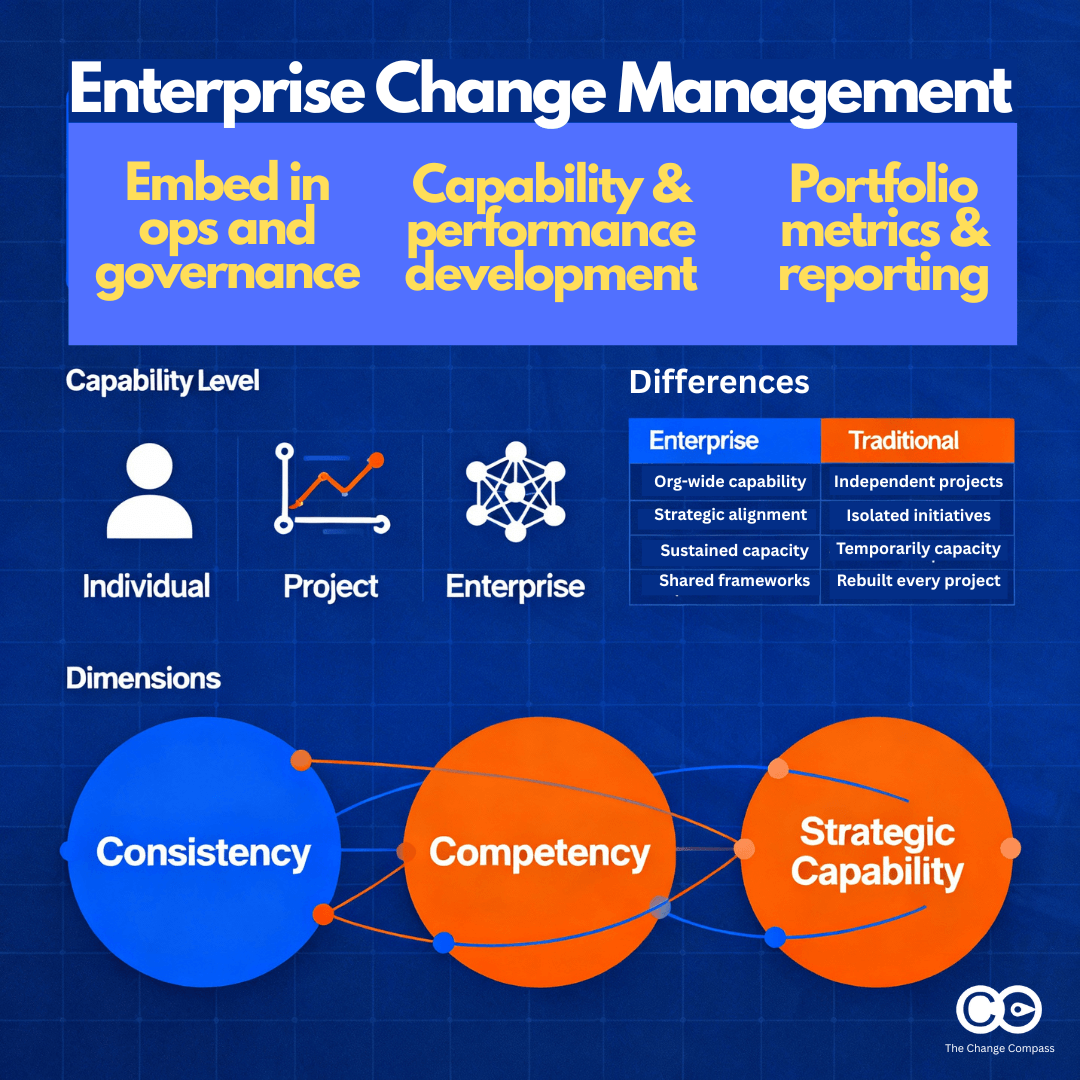
Individual change practitioners and project teams cannot carry an organisation’s change burden alone. As change volumes increase, the ability to embed change capability more broadly – in line managers, in human resources teams, in business leaders at all levels – becomes a critical maturity requirement. Building this distributed capability means shifting change management from a specialist function to a broader organisational competency.
The Change Compass contributes to capability building in a practical way: by making change management concepts and data accessible to people who are not change specialists. When a business leader can log into The Change Compass and see the change load on their business unit presented in clear visual terms, they develop an intuitive understanding of why change management matters and what “too much change at once” actually looks like in practice. This experiential learning is far more powerful than a workshop or a framework document.
The platform also enables change teams to identify where capability gaps are most acute. If certain business units consistently show lower engagement with change activities, higher rates of late adoption or more frequent change fatigue signals, that data can inform targeted capability development efforts. Rather than delivering generic change management training across the organisation, practitioners can use The Change Compass to pinpoint where investment in capability will have the greatest impact. This is a more mature, evidence-based approach to capability development – one that respects the reality that organisations have limited learning and development budgets and must deploy them strategically.
Focus area 5 – Continuous improvement and learning from change
The most advanced dimension of change maturity is the ability to learn systematically from change experiences and apply those lessons to improve future change performance. Organisations at this level do not simply complete a post-implementation review and file it away – they treat each change initiative as a source of data and insight that informs how change is designed, resourced and executed across the portfolio going forward.
The Change Compass is uniquely positioned to support this dimension because of its nature as a persistent change data platform. Over time, the platform accumulates data about change patterns, adoption rates, capacity pressures and the correlation between change management effort and outcomes. This longitudinal data enables organisations to move from qualitative reflection to quantitative analysis when asking questions like: which types of changes consistently create the most disruption for particular groups? What is the optimal change load for a business unit in a given quarter? How does the timing of manager engagement activities correlate with adoption outcomes?
Prosci’s research into change management effectiveness consistently highlights that organisations which measure and learn from their change outcomes outperform those that do not (Prosci, Best Practices in Change Management). The Change Compass provides the data infrastructure to make this kind of systematic learning possible at scale. By maintaining a running record of all change activity across the enterprise, it enables change leaders to identify patterns, test hypotheses and make data-informed adjustments to their approach – the hallmarks of a genuinely mature change organisation.
The maturity journey and how to sequence improvement
Improving change maturity is itself a change programme, and it requires the same thoughtful sequencing and prioritisation that any good change initiative demands. Organisations rarely need to tackle all five focus areas simultaneously – in fact, attempting to do so is one of the most common ways that maturity improvement efforts stall. A more effective approach is to assess current maturity across each dimension, identify the highest-leverage improvement areas and build momentum through early wins.
For most organisations, strategic change leadership is the most powerful starting point. When senior leaders have visibility into the change portfolio and are actively engaged in governance decisions, every other dimension of maturity is easier to develop. The Change Compass is a catalyst for this shift because it gives leaders data they have never had before – and data, more than any framework or training programme, tends to change executive behaviour. Once leaders are engaged, business change readiness and project change management improvements follow more naturally because there is sponsorship and infrastructure to support them.
Building organisation-wide capability and establishing continuous improvement practices tend to be later-stage maturity activities, not because they are less important but because they require the foundations of leadership engagement, consistent project practices and readiness assessment to be in place first. The Change Compass supports all stages of the journey – from the earliest conversations about change portfolio visibility through to the sophisticated analysis of change patterns that characterises a truly mature change organisation. The path is not linear, and progress is not always smooth, but organisations that commit to it consistently report stronger change outcomes, less change fatigue and greater confidence in their ability to absorb and capitalise on the changes that matter most.
Frequently asked questions
What is the difference between change management maturity and change management capability?
Change management capability refers to the skills, knowledge and tools that individuals and teams bring to change work. Change management maturity is broader – it describes the degree to which those capabilities are embedded consistently across the organisation, supported by governance structures, data infrastructure and leadership commitment. An organisation can have highly skilled change practitioners and still operate at a low level of maturity if those practitioners work in isolation, without portfolio visibility or leadership support.
How long does it typically take to improve change maturity?
Meaningful improvement in one or two focus areas can often be achieved within six to twelve months, particularly when there is strong executive sponsorship and a clear data platform like The Change Compass to anchor the effort. Organisation-wide maturity development is typically a two-to-four year journey, involving iterative improvement cycles rather than a single transformation. The key is to sequence improvements logically, build on early wins and maintain momentum through consistent measurement and communication of progress.
How does The Change Compass help with change saturation and change fatigue?
The Change Compass addresses change saturation by making the cumulative volume and timing of change across the enterprise visible to leaders and practitioners. When change load is invisible, decisions about adding new initiatives to an already-stretched business unit are made without full information – and the result is change fatigue. The Change Compass makes these trade-offs explicit, enabling leaders to make informed decisions about sequencing and prioritisation. Over time, this discipline reduces the incidence of change saturation and builds organisational resilience.
Can The Change Compass be used in organisations that are just beginning their change maturity journey?
Absolutely. The Change Compass is valuable at every stage of the maturity journey, but it is particularly impactful for organisations in the early stages because it provides immediate, tangible evidence of the change management challenges they face. Seeing the volume and overlap of changes across the enterprise in a clear visual format is often a catalyst for executive engagement and investment in change management – the essential first step in any maturity improvement effort. The platform scales with the organisation’s growing sophistication, supporting increasingly advanced analysis as maturity develops.
References
Prosci. (2023). Best Practices in Change Management. Retrieved from https://www.prosci.com/blog/roi-change-management
Prosci. (2022). Change Management Maturity Model. Retrieved from https://www.prosci.com/resources/articles/change-management-maturity
McKinsey & Company. (2018). The People Power of Transformations. Retrieved from https://www.mckinsey.com/capabilities/people-and-organizational-performance/our-insights/the-people-power-of-transformations
Harvard Business Review. (2023). Successful Change Management Requires Leaders to Think Differently. Retrieved from https://hbr.org/2023/04/the-most-successful-approaches-to-leading-organizational-change
Gartner. (2022). Change Management Best Practices and Strategies. Gartner Research.