

Organisations invest significantly in change management tools, yet many find themselves asking, months after go-live, why nothing seems different. The data is being entered. The dashboards are populated. But decisions are still made the same way, change fatigue is still invisible until it’s too late, and the PMO is still reacting rather than anticipating. This is not a technology problem. It is a capability problem, and it is far more common than most implementation teams acknowledge.
Research from Prosci’s longitudinal benchmarking studies consistently shows that projects with excellent change management are six times more likely to meet their objectives than those with poor or no change management. Yet the same research reveals that capability gaps, not tool shortages, are the primary reason benefits go unrealised. Buying a platform is the easy part. Building the human systems around it – the habits, the conversations, the governance rhythms – is where organisations tend to stall.
This article is for change leaders and PMO heads who have implemented, or are implementing, a change data tool and want to understand what genuine value realisation actually requires. It maps the journey from basic data collection through to mature, embedded change intelligence – and it is honest about why so many organisations plateau at stage one.
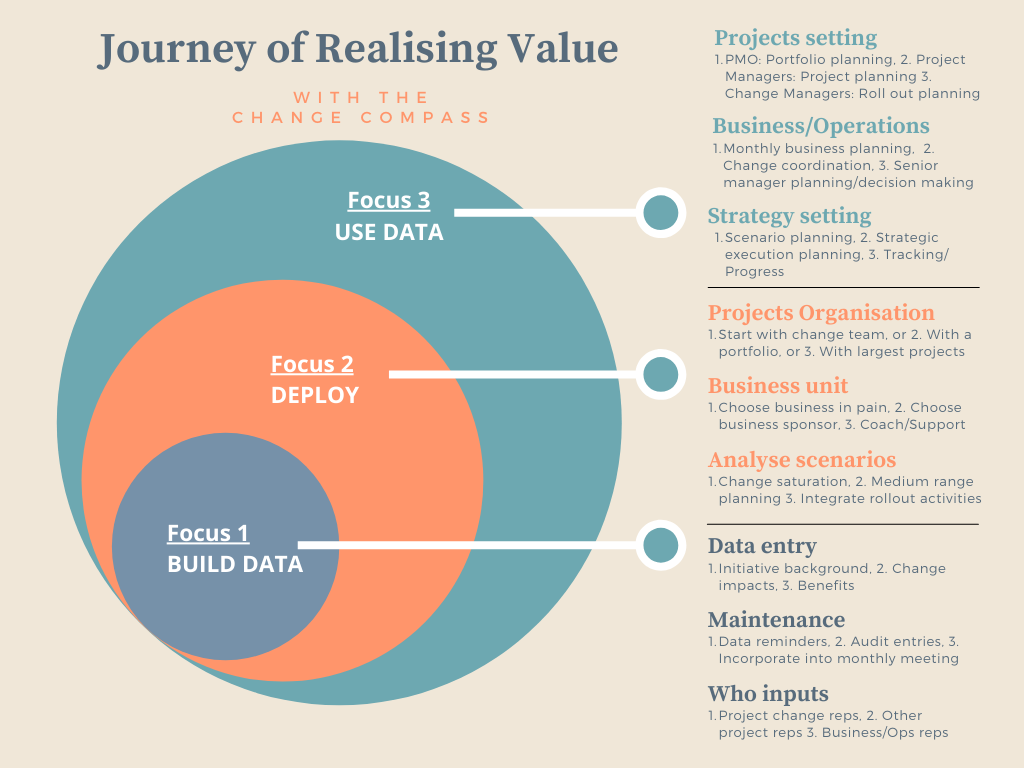
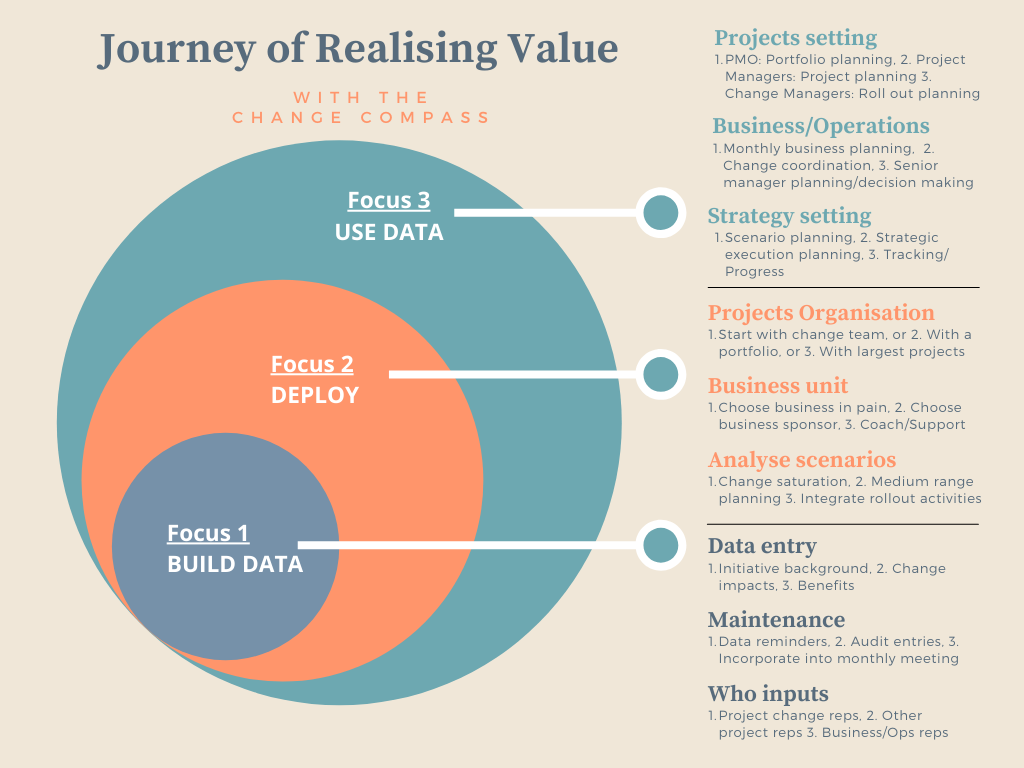
Download the Journey of Realising Change Value infographic for a visual overview of the capability-building stages explored in this article.
What change value realisation means
Value realisation in the context of a change management tool is not simply the act of using the tool. It is the degree to which the organisation’s decision-making, planning, and risk management are genuinely improved because change data is now informing them. This is a meaningful distinction. An organisation can have complete data entry compliance and still make exactly the same poorly-timed, poorly-sequenced change decisions it made before the tool existed. Compliance is not value.
Genuine value realisation looks like this: a senior leader reviews change load data before approving a new initiative’s go-live date and decides to defer by six weeks because the data shows three other significant changes landing in the same business unit at the same time. A PMO uses change saturation trends to have a credible, evidence-based conversation with the executive team about sequencing. A business unit manager notices that their team has been in continuous high-change load for four months and makes resourcing decisions accordingly. These are not data entry outcomes. They are decision-making outcomes, and they require capability that goes well beyond knowing how to log a change in a system.
Gartner’s research on technology value realisation notes that organisations typically capture only 30 to 40 per cent of the expected value from technology investments, with the primary gap being adoption depth rather than feature availability. The same principle applies here. The question is not whether your tool has the right features. It is whether your people have the capability and the habit of using those features to change how decisions are made.
Why benefits are often unrealised after implementation
The most common reason change tool benefits go unrealised is not resistance, poor data quality, or insufficient training – though all of those contribute. The deeper reason is that organisations treat tool implementation as a project with an end date, rather than as the beginning of a capability-building journey. Once the system is live and people know how to log changes, the implementation team moves on. No one owns the question of whether the data is actually being used to make better decisions.
A second common failure pattern is the absence of senior sponsorship for the behavioural change required. Implementing a change data tool asks leaders to do something genuinely difficult: make their change load visible, accept that sequencing decisions may not go their way, and participate in a discipline that feels like overhead before it starts feeling like an advantage. Without a senior champion who models this behaviour and holds others accountable for it, the tool rapidly becomes a compliance exercise managed by a small team that no one senior engages with.
McKinsey research on transformation success identifies leadership commitment as the single most consistent differentiator between transformations that sustain their gains and those that revert. This holds equally true for the more modest but still significant transformation required to embed data-driven change governance. If the executive team is not seen consulting change load data in their own planning forums, the message to the rest of the organisation is that this is an administrative system, not a strategic one.
There is also a coaching gap that is rarely discussed. Change data tools surface information that most organisations have never had before – aggregate change load, saturation risk, sequencing conflicts. Making sense of that information and translating it into action requires analytical capability and organisational confidence that take time to build. Without deliberate coaching of PMO staff, change managers, and business stakeholders on how to interpret and act on change data, the dashboards become wallpaper: visible, but not seen.
The stages of the change value journey
The journey from tool implementation to embedded change intelligence is not linear, but it does follow a recognisable sequence of maturity stages. Understanding where your organisation sits on this journey is the first step toward accelerating progress.
In the earliest stage, the focus is almost entirely on data collection. The organisation is establishing what changes are in flight, who owns them, and what populations they affect. This is foundational and necessary, but it delivers almost no direct business value on its own. It is the equivalent of a hospital installing patient record software and counting it as an improvement in patient outcomes before any clinician has changed how they practice.
The second stage emerges when the data is sufficiently reliable for reporting. Change load dashboards start to be reviewed in governance forums. The PMO can show the executive team what the aggregate picture looks like across the portfolio. This stage produces genuine value, particularly in organisations that previously had no visibility of the overall change burden on their workforce. However, reporting is passive. Stakeholders see the data but do not yet routinely use it to change decisions.
The third stage is where organisations begin using change data to inform planning. A proposed initiative is assessed not just on its own merits but on its cumulative impact alongside what else is already scheduled. The PMO uses saturation data to negotiate sequencing with project sponsors. This requires stakeholders to accept that their change data is subject to collective oversight, which is a behavioural shift that takes sustained coaching and governance support to achieve.
The fourth and most mature stage is embedded change intelligence. At this stage, change data is a standing input to strategic planning, resource allocation, and business unit operating rhythms. Leaders consult it as naturally as they consult financial forecasts. The organisation has built genuine capability – not just in the PMO but across business stakeholders and the senior leadership team – to use change data as a management tool, not just a monitoring tool.
Engaging business stakeholders in data-driven decisions
Business stakeholders – the heads of business units, functional leaders, and operational managers whose teams absorb the impact of change – are frequently the most underserved audience in a change tool implementation. They are asked to provide data, and occasionally shown reports, but rarely coached on how to use change data to manage their own operational risk. This is a missed opportunity, because business stakeholders are the ones who feel the consequences of poor change sequencing most acutely.
Effective engagement of business stakeholders starts with reframing the value proposition. The tool is not asking them to do more administrative work for the PMO. It is giving them a new capability: the ability to see what their team is being asked to absorb, to flag when that load is becoming unmanageable, and to make that case with data rather than anecdote. That is a genuinely useful thing for a business leader to have, but they will not perceive it that way unless someone spends time with them helping them understand what the data means for their specific situation.
Research published in the Harvard Business Review on behavioural change in data-rich environments confirms that simply providing people with data does not change behaviour. What changes behaviour is combining data access with clear guidance on what to look for, coaching on what actions the data should prompt, and accountability mechanisms that make using the data the expected norm rather than the exceptional practice. This is exactly the model that needs to be applied to business stakeholder engagement in a change tool implementation.
Practically, this means running regular working sessions with key business leaders – not to show them dashboards, but to work through a specific decision together using the data. What does the change load for their business unit look like over the next quarter? Are there conflict points they should be aware of? What would they want to escalate or negotiate? When leaders have experienced using change data to make a real decision, the abstract value of the tool becomes concrete, and their engagement typically increases substantially.
Building PMO and leadership change capability
The PMO is often the primary steward of a change data tool, and its capability to interpret and present change data credibly has a direct bearing on how seriously senior leaders engage with the information. A PMO that can only report what the data shows – without offering analytical insight, identifying risk patterns, or recommending sequencing options – will eventually find its change data reports treated as informational rather than actionable. The capability gap here is analytical and advisory, not technical.
Building PMO capability in this area requires deliberate investment in three areas. First, analytical literacy: the ability to look at change load and saturation data and identify what it means for the business, not just what it says about individual projects. Second, stakeholder influence skills: the ability to take an uncomfortable finding – say, that the organisation is planning to deliver seven significant changes to a single business unit in one quarter – and present it in a way that generates a productive conversation rather than defensiveness. Third, governance integration: the knowledge of how to embed change data review into existing planning and decision-making forums rather than creating a parallel governance track that adds overhead without producing change.
For senior leaders, the capability requirement is different but equally important. Leaders need to understand what questions to ask of change data, not how to produce it. A chief operating officer who asks “what is the change load across our customer-facing operations over the next six months, and are there any quarters where we should be deferring new initiatives?” is using change intelligence effectively. Getting leaders to ask those questions habitually requires them to see that the questions get useful answers – which circles back to data quality, PMO analytical capability, and the governance structures that make change data review a standing expectation.
Measuring progress along the value journey
One of the practical challenges in capability-building programmes is that progress is hard to see in the short term. Unlike a technology go-live, which has a binary completion point, building organisational capability is incremental and the signals of progress are behavioural rather than systemic. This makes it easy for momentum to dissipate without anyone noticing until the change tool has quietly reverted to a data entry exercise.
Measuring progress along the change value journey requires a set of leading indicators that track behaviour, not just system activity. Useful measures include the frequency with which change data is referenced in executive planning discussions, the number of sequencing or staging decisions that were demonstrably influenced by change load data, the proportion of business stakeholders who actively review their unit’s change profile prior to major planning cycles, and the quality of PMO analysis as assessed by senior stakeholder feedback.
These are not metrics that come out of the change management tool itself. They require deliberate observation, conversation, and periodic review of whether the intended decision-making behaviours are actually occurring. Organisations that treat capability maturity as something to be actively monitored – rather than assumed – tend to progress through the value journey stages significantly faster than those that do not. A quarterly maturity assessment, conducted honestly with senior stakeholders and PMO leadership, can surface stagnation points before they become entrenched and redirect coaching effort where it is most needed.
How The Change Compass accelerates value realisation
The Change Compass is designed with the value journey in mind, not just the data collection problem. The platform provides real-time visibility of change volume, velocity, and saturation across business units, which creates the foundation for stages two and three of the value journey – reporting and planning – much faster than organisations typically achieve with manual methods or generic project management tools.
Beyond the platform itself, the Change Compass approach includes deliberate support for the capability-building work that determines whether the technology’s potential is actually captured. This includes coaching frameworks for engaging business stakeholders, templates for integrating change data into governance forums, and guidance on how to structure the PMO’s analytical and advisory role. The goal is not a well-populated system. The goal is an organisation where change data informs the decisions that matter – resourcing, sequencing, risk management, and strategic planning – and where that capability is distributed broadly enough that it does not depend on one or two individuals to sustain it.
For organisations that are further along the journey and looking to reach stage four, the platform’s trend analysis and forecasting features provide the inputs for the kind of strategic change intelligence that senior leaders find genuinely compelling. When a chief executive can see not just today’s change load but the projected trajectory over the next twelve months, the conversation about change capacity shifts from reactive to proactive, and the PMO moves from reporting function to strategic adviser.
Frequently asked questions
What is change value realisation?
Change value realisation is the degree to which an organisation actually captures the intended benefits of its change management investment – tools, processes, and capability – in the form of improved business decisions and outcomes. It is distinct from adoption or compliance. An organisation can have high system usage and still fail to realise value if the data being collected is not influencing how sequencing, resourcing, and planning decisions are made.
How long does it take to move from data collection to embedded change intelligence?
Most organisations take between 18 months and three years to move from initial data collection to genuinely embedded change intelligence, depending on the pace of capability investment, the strength of senior sponsorship, and the organisation’s existing change maturity. Organisations that invest deliberately in stakeholder coaching, governance integration, and PMO analytical capability tend to progress significantly faster than those that treat tool implementation as the end goal.
What role should the PMO play in building change capability?
The PMO’s role in change capability building is both analytical and advisory. It should move beyond producing change data reports and develop the capacity to interpret that data, identify risk patterns, and facilitate planning conversations with business stakeholders and senior leaders. The PMO is also typically responsible for embedding change data review into governance rhythms, which is the structural mechanism that makes capability-building sustainable over time.
How do you engage senior leaders in change data?
The most effective way to engage senior leaders is to use change data in the context of a real decision they care about. Rather than presenting a dashboard in isolation, work through a specific planning question – such as the change load on a key business unit during a critical operational period – and show how the data changes the recommendation. Leaders who experience change data as something that gives them better answers to questions they already have tend to seek it out; leaders who only see it as a reporting obligation do not.
References
Prosci. “Change Management ROI and Best Practices Benchmarking Research.”
Gartner. “Technology Value Realisation and Adoption Research.”
McKinsey & Company. “How to Beat the Transformation Success Odds.”
Harvard Business Review. “When Employees See Data, They Change Their Behavior.” September 2022.