

The numbers tell a story that most change leaders already sense. IBM’s 2025 CEO study, surveying 2,000 executives globally, found that only around 25% of AI initiatives deliver expected ROI, and just 16% have scaled enterprise-wide. Investment in AI is accelerating at double-digit rates. The returns are not keeping pace. The gap is not technical. It is human. And it will not be closed by change management practices designed for a different era.
Change management in the digital age faces a challenge that goes beyond scale or speed. The tools, assumptions, and governance models that served change functions well through the ERP rollouts and restructures of the 2000s and 2010s were designed for discrete, definable transformations with identifiable endpoints. Digital transformation, AI adoption, and the automation of work do not have endpoints. They are ongoing conditions. Managing them as projects produces predictable results: partial adoption, underrealised value, and change fatigue that compounds with each successive initiative.
The organisations navigating digital transformation most effectively are not those with the biggest change budgets. They are those that have genuinely updated their change management model for the digital context, treating change capability itself as a strategic asset rather than a delivery function.
The digital transformation gap that change management must close
The scale of underperformance in digital transformation is well documented. Deloitte’s research on digital transformation value identifies three failure patterns that recur across industries: technology deployed without corresponding work redesign, adoption treated as a training problem rather than a behaviour change problem, and benefits realisation measured at go-live rather than at the point where new ways of working are actually embedded.
All three failure patterns are change management failures, not technology failures.
The IBM CEO data reinforces this. In 2026, twice as many workers across age groups say they would embrace greater AI use by their employers rather than resist it. Employee sentiment toward AI is broadly positive. The adoption gap is not about resistance. It is about the absence of the structural, managerial, and environmental conditions that convert positive sentiment into actual behaviour change. This is precisely the domain of change management. And precisely the area where traditional change management approaches are most underpowered.
What makes change management in the digital age different
Three structural characteristics distinguish digital transformation from the changes that traditional change management frameworks were built for.
There is no go-live
Classic change management models, whether ADKAR, Kotter’s 8 steps, or the Prosci methodology, are structured around a transition: a defined current state, a defined future state, and a change journey between them. Digital transformation does not conform to this structure. AI capabilities in use today are materially different from those available 18 months ago, and will be different again 18 months from now. The “future state” keeps moving.
This means that what organisations actually need to build is not a capacity to manage a specific digital change, but an adaptive organisational capability to absorb continuous digital evolution. That is a fundamentally different capability to develop and a fundamentally different change management challenge to address.
The impact is highly fragmented by role
A major ERP implementation affects large groups of employees in broadly similar ways: new system, new processes, new reporting lines. Digital transformation and AI adoption affect different roles in radically different ways. A finance analyst’s experience of AI adoption has almost nothing in common with a customer service representative’s. A supply chain planner and a legal counsel may both be in the same AI transformation programme but need entirely different support.
Generic change communications and enterprise-wide training programmes do not work well in this environment. Effective change management in the digital age requires function-level and role-level customisation at a depth that most change functions have not previously needed to operate at.
Middle management is both the opportunity and the obstacle
Gartner’s 2025 CHRO research found that 78% of CHROs agree workflows and roles will need to change to realise the value of AI investments. The people who must actually make those workflow and role changes happen are middle managers. They translate digital strategy into day-to-day practice. They also face the most immediate personal disruption from the changes they are asked to enable.
Change management approaches that treat managers primarily as a communication channel, rather than as a group with their own adoption challenge and their own need for specific support, consistently underperform. The manager layer is where digital transformation succeeds or stalls.
Data and measurement in the digital age
One of the defining features of digital transformation is the availability of adoption data. Most digital platforms generate detailed usage data. Organisations now have, or can have, precise information about which employees are using new systems and tools, how frequently, in what ways, and with what outcomes.
Traditional change management largely operated without this data. Communications were sent, training was attended, and surveys were occasionally administered. Whether behaviour had actually changed in meaningful ways was often a matter of judgement rather than evidence.
The digital age removes this ambiguity for organisations willing to use the data available. Key metrics that effective change functions track in digital transformation include:
- Active usage rates by role group and function (not just platform access)
- Time savings realised in specific processes, compared against baseline
- Quality or output measures for AI-assisted work versus previous work
- Support ticket and workaround patterns, which indicate where adoption is failing
- Manager-reported team behaviour change, gathered through structured check-ins
The risk with digital adoption data is conflating access with adoption. A person who logs into a platform once a week is not the same as a person who has genuinely changed how they work. Effective measurement tracks the second thing, not the first.
Automation and what it means for the change management function itself
The digital age is also changing how change management work is done, not just what it is managing. Change functions are beginning to automate significant portions of the administrative and analytical work that previously consumed change practitioner time: impact assessment compilation, status reporting, communication scheduling, data aggregation across programmes.
This shift has two implications worth examining.
The first is a productivity gain. Change practitioners who are no longer spending days compiling portfolio heat maps in spreadsheets have time to do the work that requires human judgment: stakeholder conversations, resistance diagnosis, sponsor coaching, and the nuanced facilitation that data analysis cannot replace.
The second is a capability shift. The change practitioner of the digital age needs to be comfortable working with data and platforms in ways that were optional for practitioners in earlier generations. Interpreting adoption dashboards, working with automated workflow tools, and communicating findings in data-fluent ways are becoming baseline expectations rather than specialist skills.
Building a digital-age change management capability
For change leaders building or rebuilding their function’s capability for the digital context, the practical work happens in four areas.
Updating the impact methodology. Traditional impact assessment categories, such as process, role, technology, and structure, need to be extended to capture AI-specific dimensions: the degree to which a role’s core tasks are being automated or augmented, the learning curve associated with AI-enabled ways of working, and the interaction effects when multiple digital changes land simultaneously on the same employee group.
Investing in role-level differentiation. The days of enterprise-wide change communications being the primary engagement mechanism are over for major digital transformations. Effective change functions in the digital age develop function-specific change plans, with tailored messaging, use-case-specific training, and peer champion networks built around specific communities of practice rather than the whole organisation.
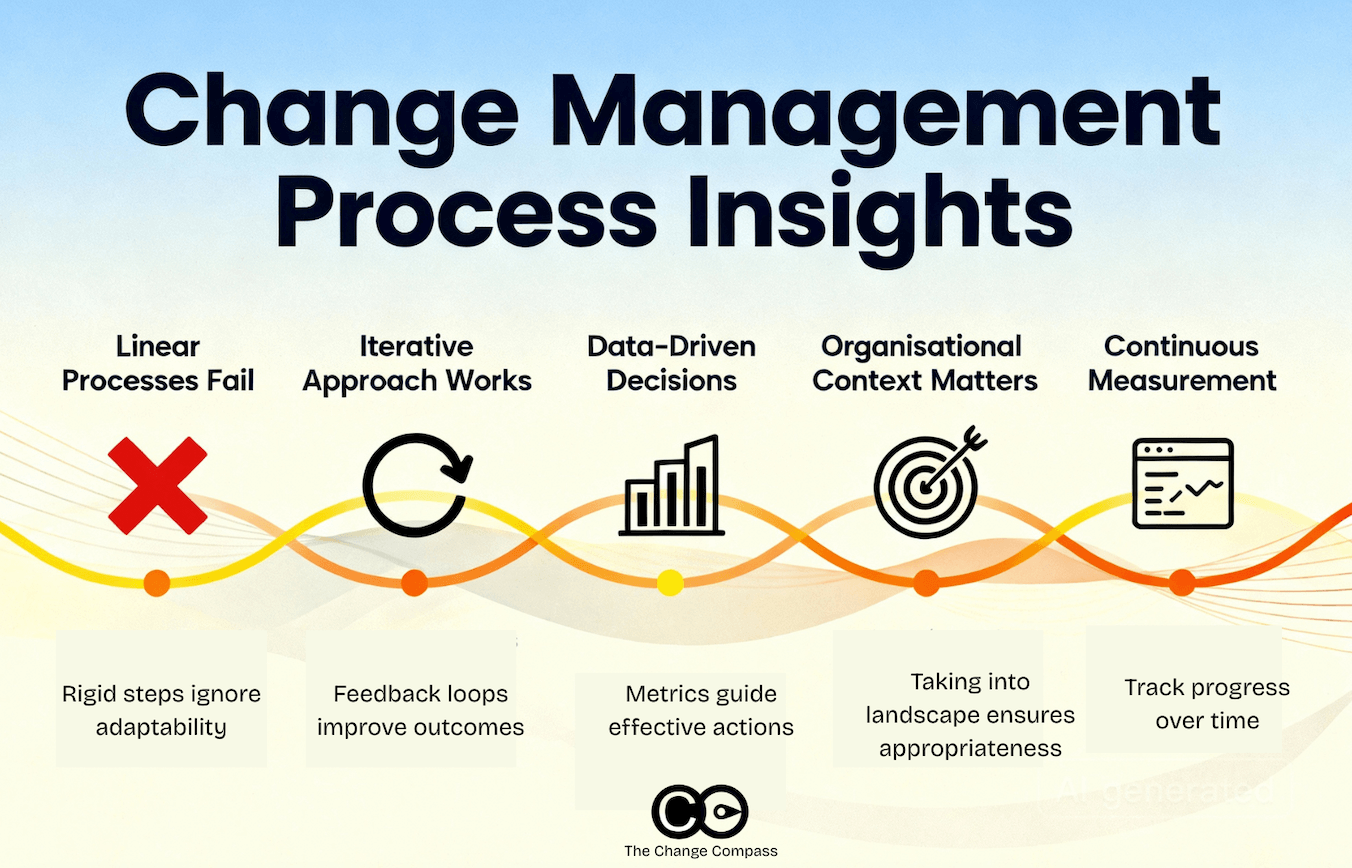
Building adaptive governance. Digital transformation moves faster than traditional programme governance. Change plans written at programme initiation will be outdated within months as capabilities evolve and adoption data comes in. The governance model needs to support continuous plan adaptation: regular portfolio reviews, rolling 90-day action planning, and the authority to reallocate resources based on adoption evidence rather than original project plans.
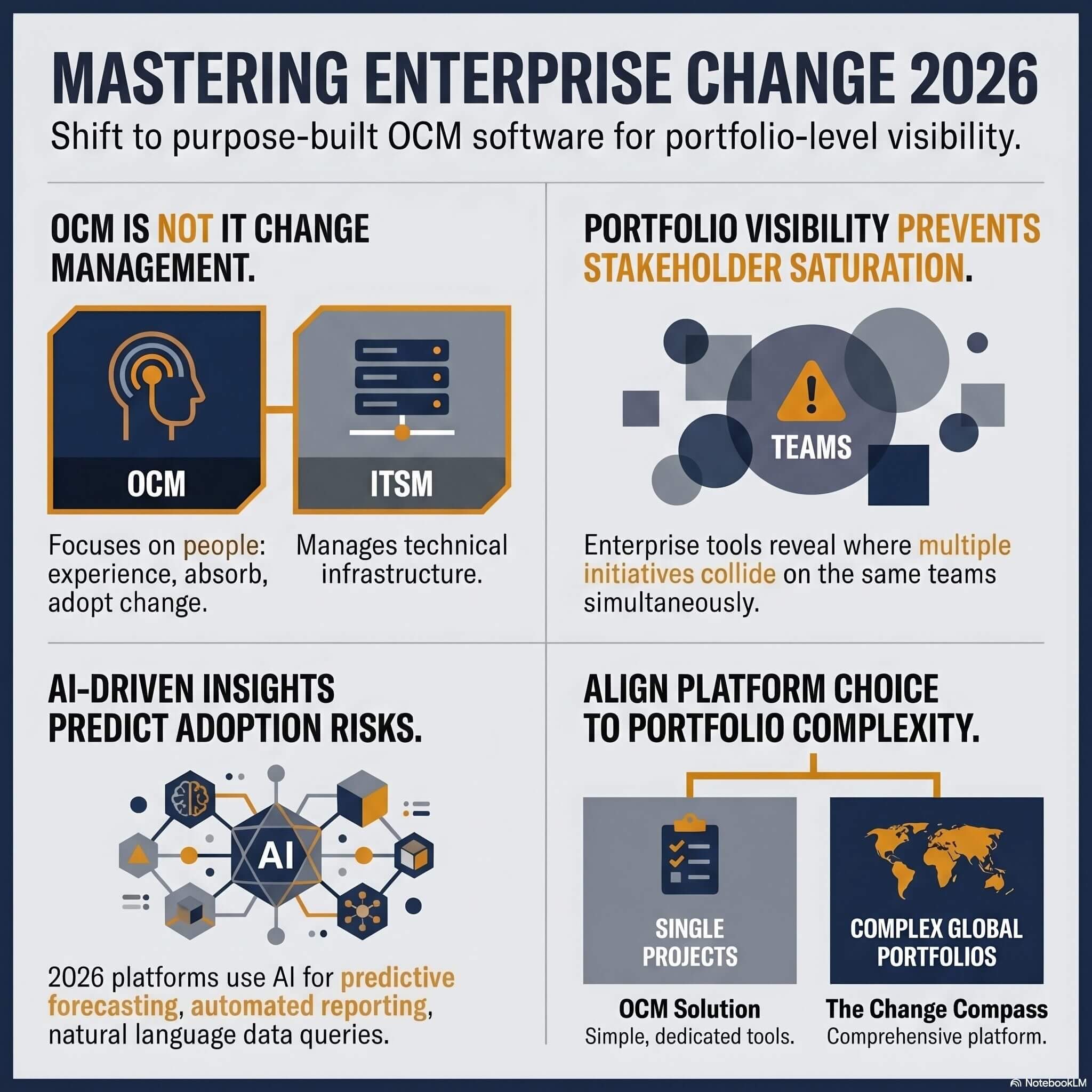
Using digital platforms for portfolio visibility. Managing the cumulative digital change burden on employee groups requires portfolio-level visibility that manual approaches cannot reliably provide. Platforms such as The Change Compass aggregate impact data across programmes, track adoption by function and role group, and enable the continuous monitoring that adaptive change governance requires. This is not a luxury for large change functions. It is the infrastructure that makes portfolio-level decision-making possible.
Where to start
For change leaders whose organisations are in the middle of active digital transformation programmes with traditional change management in place, the most useful first step is a diagnostic of the current approach against the digital age requirements.
The diagnostic questions are practical:
- Are you measuring actual behaviour change or platform access?
- Do you have function-specific change plans, or enterprise-wide plans applied uniformly?
- How are you managing the cumulative digital change load on specific employee groups?
- What is your process for adapting the change approach as adoption data comes in?
- Are your managers being supported as a group with their own adoption challenge, or managed primarily as a change communication channel?
Most change functions running traditional approaches through digital programmes will find significant gaps in these areas. The gap that typically generates the fastest improvement when closed is measurement: moving from activity metrics to adoption metrics creates the feedback loop that enables everything else to improve.
Frequently asked questions
What is change management in the digital age?
Change management in the digital age refers to applying change management principles and practices to the specific challenges of digital transformation, AI adoption, and the automation of work. It extends traditional change management to address the absence of a fixed endpoint, the highly fragmented role-level impact of digital change, and the availability of adoption data that enables evidence-based course correction throughout the change journey.
Why do digital transformation programmes fail to deliver expected value?
The primary causes are change-related, not technical. Workflows are not redesigned to take advantage of new digital capabilities, middle managers are not supported as a group with their own adoption challenge, measurement focuses on system access rather than behaviour change, and change plans are not adapted as adoption evidence accumulates. IBM research found that only around 25% of AI initiatives deliver expected ROI, largely for these reasons.
How is digital transformation different from managing a standard technology change?
Digital transformation differs in three important ways: there is no defined future state because digital capabilities evolve continuously; the impact on different roles is highly fragmented, requiring function-level rather than enterprise-wide approaches; and the adoption data available through digital platforms enables a measurement-led approach that traditional change management rarely applied.
What metrics should you track in digital transformation change management?
The most informative metrics go beyond platform access to measure actual behaviour change: active usage rates by role group, time savings realised in specific processes, quality of AI-assisted output versus previous output, support ticket patterns indicating where adoption is failing, and manager-reported team behaviour change. These give a more honest picture of adoption progress than usage statistics alone.
How do you manage the cumulative digital change load on employees?
Managing cumulative load requires portfolio visibility: knowing what digital changes are landing on which employee groups at what time, and aggregating impact to identify when load is approaching the point where adoption quality begins to deteriorate. Portfolio change management platforms enable this aggregation and provide the early warning signals that allow sequencing adjustments before saturation becomes visible in adoption data.
References
- IBM. CEO Study: CEOs Double Down on AI While Navigating Enterprise Hurdles (2025). https://newsroom.ibm.com/2025-05-06-ibm-study-ceos-double-down-on-ai-while-navigating-enterprise-hurdles
- IBM Institute for Business Value. 5 Trends for 2026. https://www.ibm.com/downloads/documents/us-en/1443d5df79cf4c92
- Deloitte Insights. Unleashing Value from Digital Transformation: Paths and Pitfalls. https://www.deloitte.com/us/en/insights/topics/digital-transformation/digital-transformation-value-roi.html
- Gartner. Gartner Says CHROs’ Top Priorities for 2026 Center Around Realising AI Value and Driving Performance (October 2025). https://www.gartner.com/en/newsroom/press-releases/2025-10-02-gartner-says-chros-top-priorities-for-2026-center-around-realizing-ai-value-and-driving-performance-amid-uncertainty
- AIHR. 15 Important Change Management Metrics To Track in 2026. https://www.aihr.com/blog/change-management-metrics/