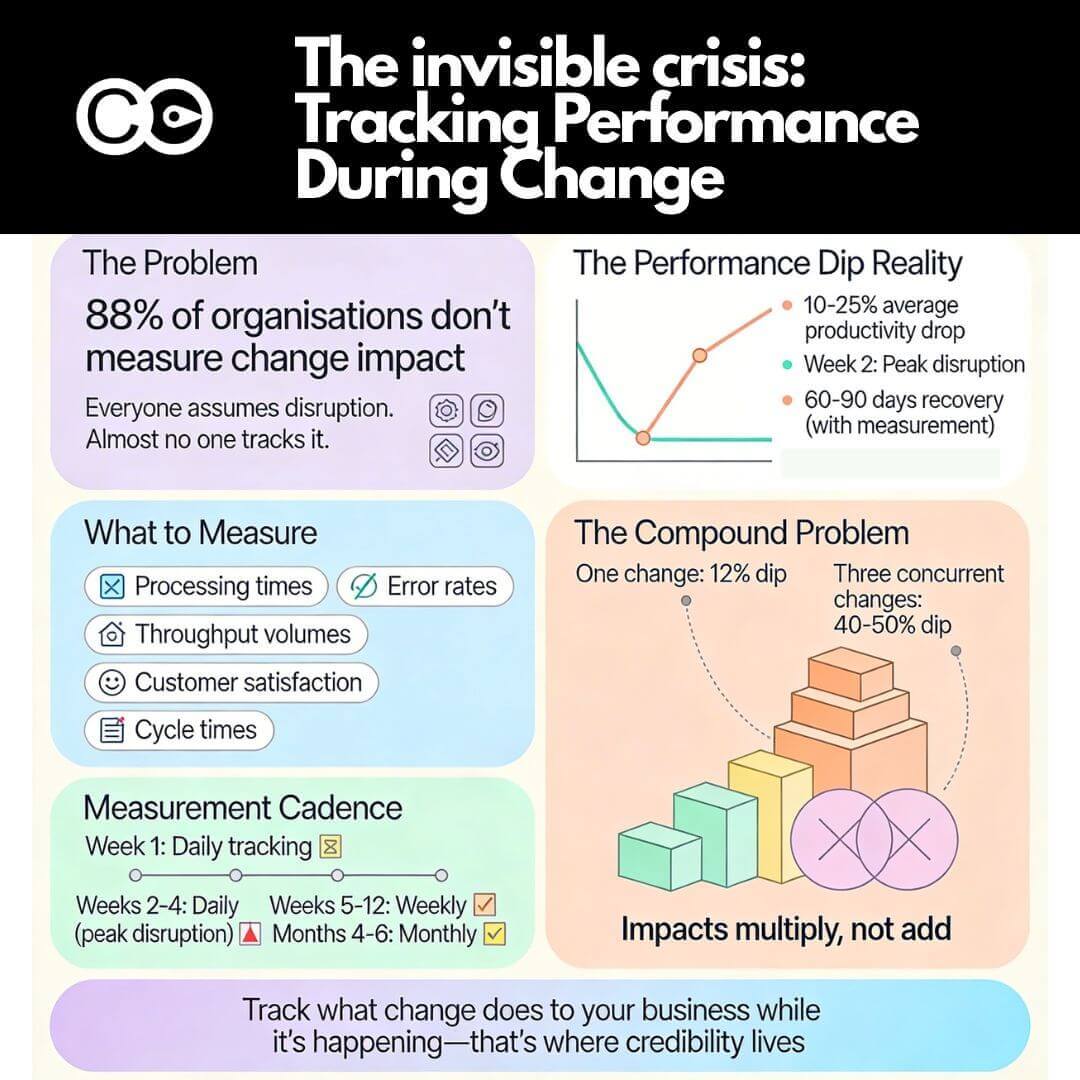
Most organisations today are not managing one change. They are managing many, often simultaneously, and often with little visibility across the full portfolio. A new enterprise resource planning system goes live at the same time as a restructure is announced, while a cultural transformation programme runs in the background and a regulatory compliance initiative demands attention from the same frontline teams. Each initiative is rational on its own terms, yet together they create a pressure that is qualitatively different from anything a single project produces. The result is not simply “more work” — it is a compound effect that erodes employee capacity, dilutes leadership attention, and undermines the very outcomes each programme was designed to achieve.
Research from Prosci consistently shows that change saturation is one of the leading causes of failed transformation. When employees face too many changes at once, their ability to absorb and adopt each one falls sharply. Yet the instinct of most organisations is to treat each initiative as a standalone effort, with its own project team, its own communications plan, and its own timeline. Without a coordinated, portfolio-level view, the combined load on people is never measured, never debated, and never managed until it is too late.
This article explores why successfully landing multiple concurrent changes requires a fundamentally different approach from managing a single programme. It covers how to build shared portfolio visibility, how to sequence and prioritise competing initiatives, how to manage employee capacity across the portfolio, and how to coordinate stakeholder engagement so that no group is overwhelmed by noise from multiple directions at once.
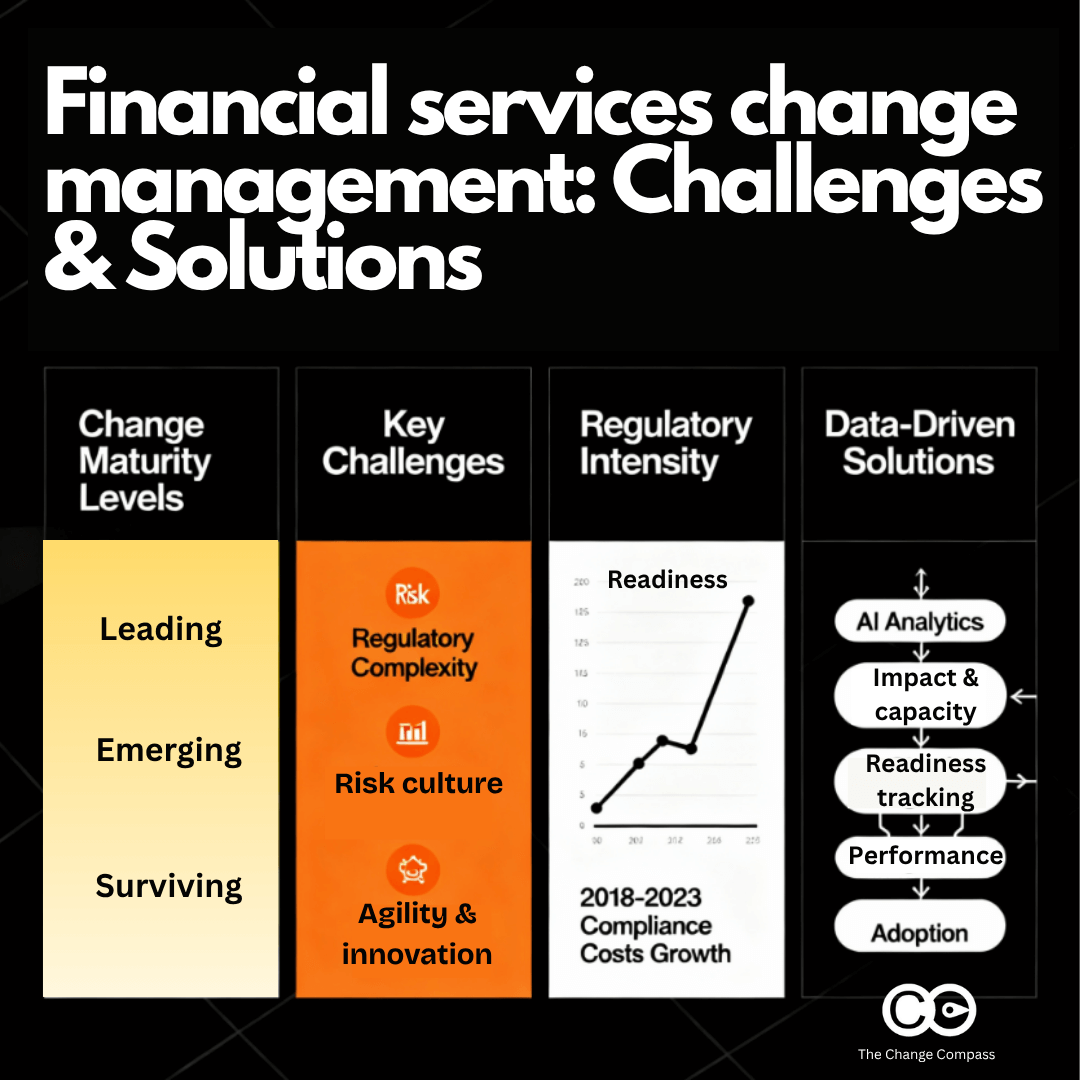
Download the Landing Multiple Changes infographic for a visual summary of the key principles covered in this article.
Why multi-initiative environments are fundamentally different
A single well-managed change initiative operates within a relatively bounded system. The project team can focus all its energy on one set of stakeholders, one set of impacts, and one adoption curve. Communication channels can be dedicated, training can be sequenced logically, and resistance can be addressed without competing messages muddying the waters. The complexity is real, but it is contained.
When multiple initiatives run concurrently, that containment disappears. The same managers who are sponsoring a technology rollout are also being asked to lead their teams through a restructure, absorb a new performance framework, and champion a wellbeing programme. The same frontline workers who are learning new systems are also navigating new reporting lines and new processes. Complexity no longer adds, it multiplies. According to McKinsey, organisations undergoing multiple simultaneous transformations are significantly more likely to see fatigue-driven failure than those managing change in a more deliberate sequence.
The difference is not merely one of volume but of interference. Initiatives collide at the points where they share resources, whether people, budget, or leadership attention. A change that would succeed in isolation can fail simply because the surrounding environment is too noisy for the message to land. Understanding this interference effect is the starting point for managing a multi-initiative portfolio effectively.
The hidden cost of change collision
Change collision occurs when two or more initiatives create competing or contradictory demands on the same people at the same time. It is often invisible at the portfolio level because each project team reports its own progress in isolation. From where the project manager sits, training attendance is adequate and communications are going out on schedule. From where the employee sits, they have received five “change is coming” emails in a fortnight, attended three workshops in a month, and still cannot tell which of the changes they are supposed to prioritise.
The costs of this collision accumulate quietly. Adoption rates fall, not because the changes are poorly designed, but because there is insufficient mental bandwidth to embed them. Managers become change messengers rather than change leaders because they are juggling too many narratives at once. And the projects that do land often do so at significantly higher cost, with more rework, more helpdesk calls, and more re-training cycles than were originally budgeted. Research published in the Harvard Business Review highlights that the failure rate of large-scale change programmes remains stubbornly high, and that organisational fatigue from concurrent initiatives is a primary contributing factor.
There is also a reputational cost. When employees see change after change fail to stick, they develop a learned scepticism. The next initiative, even one that is genuinely well-designed and important, faces an audience that has been conditioned by experience to treat it as noise. Reversing that cynicism is far harder than preventing it in the first place.
Building a shared portfolio view across initiatives
The most immediate practical step an organisation can take is to create a single, shared view of all active change initiatives. This sounds straightforward, but in practice it requires a deliberate effort to break down the silos that typically form around individual programmes. Each project team has an incentive to manage its own plan and protect its own timeline. A portfolio view requires someone, or some function, with the authority and the data to see across all of them.
A meaningful portfolio view does more than list the active initiatives. It maps them against the parts of the organisation that will be affected, showing which business units, which teams, and which roles are being asked to change, and how much. It surfaces the concentration points, those areas of the organisation where multiple changes are landing at once, so that decisions can be made about whether to proceed, stagger, or sequence. Without this visibility, prioritisation decisions are made by each project team independently, always in favour of their own timeline.
Gartner’s research on organisational change management underscores that organisations with a centralised change portfolio function consistently outperform those without one on measures of adoption, speed to benefit realisation, and employee engagement during transformation. The portfolio function does not need to be large. What it needs is data, access, and the authority to raise a flag when the cumulative load on any part of the organisation exceeds a sustainable threshold.
Sequencing and prioritising concurrent changes
Once an organisation has a clear view of its change portfolio, the question becomes how to sequence and prioritise the initiatives within it. Not every change can go first, and not every change needs to. Some initiatives are foundational, in that they create the conditions that make other changes easier to absorb. A technology platform migration, for instance, may need to precede any process redesign that depends on it. A leadership development programme may need to be running before a cultural transformation can gain traction in teams.
Sequencing decisions should be driven by a combination of strategic priority, dependency mapping, and change readiness assessment. Strategic priority establishes which changes matter most to the organisation’s direction. Dependency mapping identifies which changes unlock or block others. Change readiness assessment, conducted at the team or business unit level, identifies which parts of the organisation have the capacity and the willingness to absorb change now, and which need time to consolidate before the next wave arrives.
Prioritisation is often the harder conversation because it requires some initiatives to be deferred or descoped. That can feel like failure to the sponsoring executive whose project is moved to a later tranche. The role of the portfolio function, and of senior leadership, is to frame deferral not as failure but as deliberate pacing, a decision that gives each initiative the best possible conditions for success rather than racing them all to the start line simultaneously and watching each one underperform.
Managing employee capacity across the portfolio
Employee capacity is the most constrained resource in any change portfolio, and it is routinely underestimated. When organisations calculate the cost of a change initiative, they typically account for project team time, technology investment, and training hours. They rarely account for the cognitive and emotional load that change places on the employees who must absorb it. That load is real, it accumulates, and it has a direct effect on performance both during and after the transition period.
Measuring change load requires moving beyond project timelines and looking at the actual experience of the people being asked to change. How many different changes is a given team currently navigating? How much of their working day is being consumed by change-related activities, whether training, new process adoption, system learning, or change communications? At what point does the cumulative demand tip from manageable into overwhelming? These questions cannot be answered by any single project team in isolation; they require a portfolio-level view of the human impact of all active initiatives combined.
Practical approaches to capacity management include change impact heat-maps that visualise load by team and by time period, regular check-ins with change champions embedded in business units, and formal go or no-go decisions before each major tranche of activity that include a capacity assessment as a mandatory input. Where overload is identified, the response should be one of three things: defer the lower-priority initiative, reduce the scope of the current wave, or increase the support resources available to the affected teams. What should not happen is proceeding regardless and hoping that employees will somehow absorb more than they sustainably can.
Coordinating stakeholder engagement across programmes
Stakeholder engagement in a multi-initiative environment requires a level of coordination that most organisations do not build into their programme governance. When each project team manages its own stakeholder engagement plan independently, the result is a stakeholder experience that feels fragmented at best and contradictory at worst. Senior leaders receive multiple briefings from multiple projects, each framed around its own rationale. Middle managers are asked to communicate multiple narratives to their teams, often without a coherent thread connecting them. Frontline employees receive a stream of messages that they cannot easily relate to a single, clear organisational direction.
Coordinated stakeholder engagement means establishing shared communication channels, a common narrative architecture, and a single calendar that tracks when each stakeholder group is being engaged by which initiative. The common narrative matters because employees need to understand how the changes they are experiencing fit together. Each initiative has its own rationale, but if those rationales are presented in isolation, they sound like a series of unrelated demands rather than a coherent transformation journey. Senior leaders play a critical role here: when the CEO or executive team can speak to the portfolio as a whole, explaining how each initiative connects to the organisation’s direction, the individual changes land in a context that makes them feel purposeful rather than arbitrary.
Engagement fatigue is a real risk. When managers are repeatedly pulled into workshops, briefings, and steering committees across multiple projects, the time cost becomes prohibitive and engagement quality declines. Consolidating engagement activities, combining project updates into joint forums, aligning project milestones to a common rhythm of business meetings, and empowering a single point of contact in each business unit to interface with the portfolio function can significantly reduce this burden while improving the quality of two-way dialogue.
How The Change Compass supports multi-initiative management
The Change Compass is a data-driven change management platform designed specifically to address the challenges of multi-initiative environments. Rather than treating each change in isolation, The Change Compass provides a centralised view of all active initiatives across the organisation, mapping the impact of each one against the business units, teams, and roles that will be affected. This portfolio-level visibility is not available from any single project management tool or change plan, because it requires aggregating and comparing data across all concurrent programmes simultaneously.
The platform enables change leaders and portfolio managers to identify where change load is concentrated, which teams are being asked to absorb too much too quickly, and where sequencing decisions need to be revisited. It supports data-driven conversations at the executive level about prioritisation, because the analysis is grounded in actual impact data rather than competing project team advocacy. For organisations managing three, five, or ten concurrent initiatives, this kind of evidence-based portfolio governance is the difference between landing changes successfully and watching adoption rates disappoint across the board.
The Change Compass also supports the coordination of stakeholder engagement by providing a shared view of the engagement calendar across projects. Change practitioners can see at a glance where communications are clustering, where stakeholder groups are being approached by multiple initiatives simultaneously, and where engagement windows are available that have not yet been claimed. This enables the kind of deliberate, considered pacing that multi-initiative environments demand but that is impossible to achieve without shared, real-time data.
Frequently asked questions
How many concurrent change initiatives is too many?
There is no universal threshold because it depends on the size of the organisation, the scale and complexity of each initiative, the change maturity of the workforce, and how the initiatives are sequenced and supported. What matters more than the number is the load placed on specific parts of the organisation. A large corporate function with strong change capability may be able to absorb four or five concurrent changes effectively. A smaller team with limited change experience may be overwhelmed by two. The answer lies in measuring actual impact and capacity at the team level rather than applying a blanket limit to the portfolio.
What is the difference between change portfolio management and project portfolio management?
Project portfolio management focuses on the delivery of projects, tracking timelines, budgets, dependencies, and resource allocation from a delivery perspective. Change portfolio management focuses on the human experience of those projects, measuring the combined impact on the people who must adopt the changes being delivered. Both are necessary, but they answer different questions. Project portfolio management asks “are we delivering on time and on budget?” Change portfolio management asks “are the people affected able to absorb what we are delivering, and are they actually changing their behaviour?” An organisation can score well on the first question and fail entirely on the second.
How do you make the case to executives for delaying a change initiative?
The most effective case is a data-driven one. Rather than presenting a subjective concern about “change fatigue,” present the portfolio heat-map showing the current load on the affected teams, the adoption rates from recent changes in the same part of the organisation, and the projected cost of a failed or partial adoption compared with the cost of a short deferral. Executives respond to business cases, and the business case for sequencing is compelling when it is grounded in evidence. Framing the deferral as a decision to protect the return on investment of the initiative, rather than as a sign that the organisation cannot cope, also tends to land more effectively with executive audiences.
Can change management be centralised without creating bureaucracy?
Yes, if the central function operates as an enabler rather than a gatekeeper. The goal of a change portfolio function is to give decision-makers better information, not to add approval layers to every project. In practice, this means providing shared tools, common impact assessment frameworks, and aggregated data that individual project teams do not have to generate themselves. When project teams see the portfolio function as reducing their burden rather than adding to it, adoption of the shared approach is much faster. The function earns its place by making each project more likely to succeed, not by controlling what projects can do.
References
Prosci. (2023). Change Saturation: What It Is and How to Manage It. Prosci Inc.
McKinsey and Company. (2018). The People Power of Transformations. McKinsey Quarterly.
Gartner. (2022). Organisational Change Management Insights. Gartner Human Resources.
Nohria, N., and Khurana, R. (2010). The Problem with Change Management. Harvard Business Review.