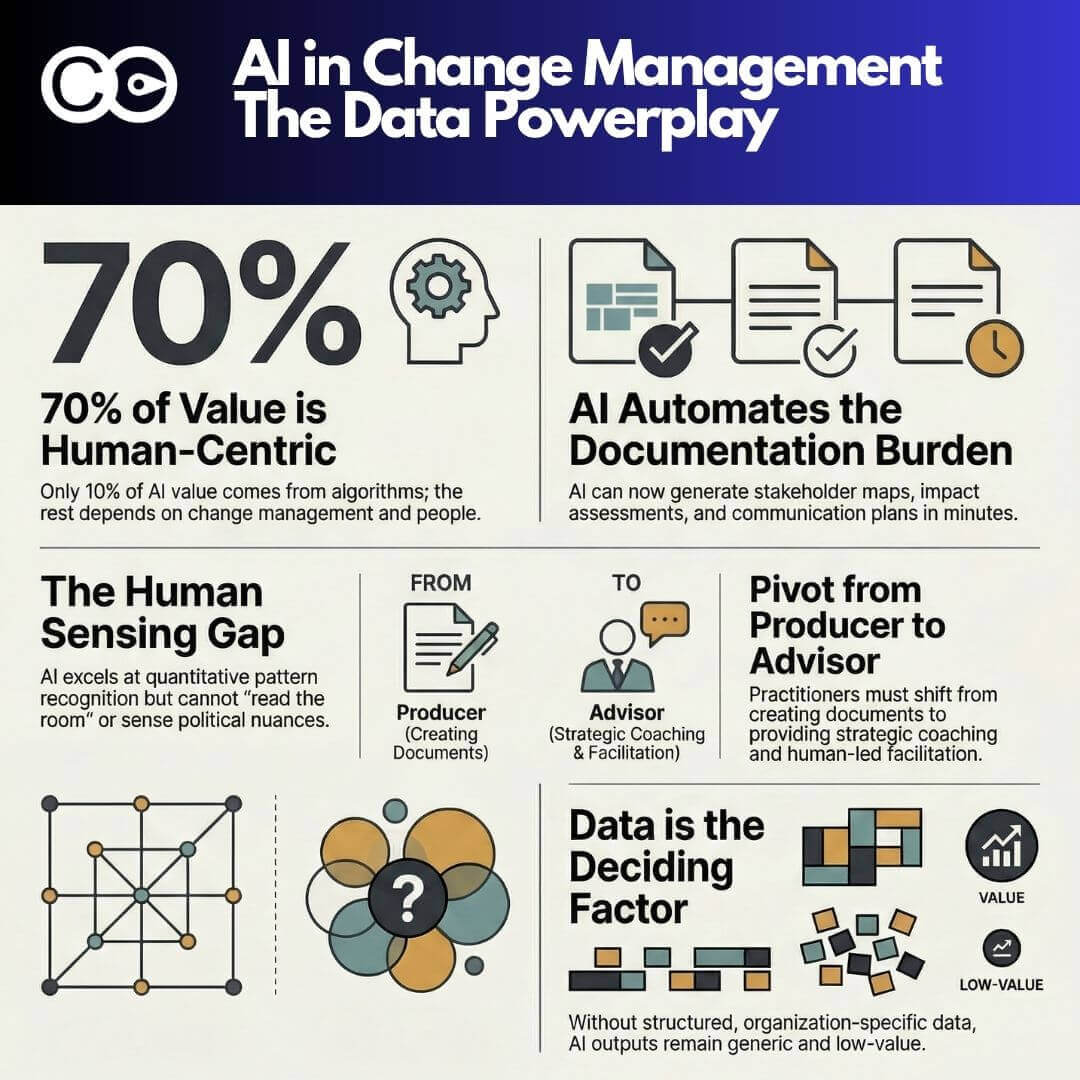


When BCG analysed where AI value actually comes from in enterprise settings, the finding surprised a lot of technology leaders: only 10% of AI value comes from algorithms, and 20% from technology infrastructure, while a full 70% comes from people, processes, and change management. That statistic flips the usual narrative. AI is not primarily a technology problem. It is a people problem, a process problem, and increasingly, a change management problem.
But here is the twist that most commentary on “AI in change management” misses entirely. AI is simultaneously reshaping what change practitioners do, how they do it, and whether organisations even need the same number of them. The technology that creates demand for change management is also automating large parts of it. And the factor that determines whether AI produces genuinely useful outputs or just polished-sounding nonsense? Data. Specifically, your organisation’s data, structured in ways that AI can actually work with.
This article looks at five realities about AI in change management that every practitioner and change leader needs to understand right now, not the generic “AI will change everything” take, but the specific, practical picture of what works, what doesn’t, and where the real value sits.
AI already handles more change management tasks than most practitioners realise
The conversation about AI in change management often starts with cautious optimism: “It can help with a few things.” The reality in 2026 is far more expansive than that. AI is not nibbling at the edges of change management work. It is capable of executing a substantial portion of the planning, analysis, and documentation tasks that consume most practitioners’ working weeks.
Planning and analysis at speed
Consider the tasks that typically eat up the first few weeks of any change initiative: stakeholder mapping, impact assessment scoping, risk identification, and the drafting of change strategies and plans. AI can now perform initial stakeholder analysis by ingesting organisational charts, project documentation, and historical change data, producing a first-pass stakeholder map in minutes rather than days. It can scan previous initiatives to identify patterns in what drove resistance, which groups were most affected, and where adoption stalled.
According to Prosci’s early findings on AI in change management, approximately 48% of change management professionals already incorporate AI tools into their practice. The most commonly cited benefit? Improving change communications and their impact, with 29% of practitioners pointing to this as the primary opportunity. But communications are just the surface layer.
AI is now capable of drafting change impact assessments, producing training needs analyses from role and process data, generating readiness survey questions tailored to specific initiative types, building communication calendars with sequenced messaging, and creating first drafts of sponsor briefing documents. For a seasoned practitioner, these outputs still need review and refinement. But the task has shifted from “create from scratch” to “review and sharpen,” which is a fundamentally different use of time.
Content generation and documentation
The documentation burden in change management is enormous. Plans, playbooks, stakeholder analyses, training materials, leadership talking points, FAQ documents, resistance management strategies: the list runs long. AI compresses this work dramatically.
What matters, though, is the quality of the input. When AI generates a change communication plan based on nothing more than a project name and a vague brief, the output is predictably generic. When it works from structured data, such as a detailed impact register, a stakeholder sentiment baseline, and historical adoption metrics from comparable initiatives, the output becomes specific, contextual, and genuinely useful. This distinction between generic and data-informed AI output is the single most important factor determining whether AI helps or merely creates an illusion of productivity.
What AI still can’t do: the human sensing gap
For all its capability in planning, documentation, and analysis, AI has a significant blind spot. It cannot walk a floor, read body language in a town hall, sense the unspoken anxiety in a leadership team, or pick up on the subtle political dynamics that determine whether a sponsor is genuinely committed or merely compliant.
Reading the room
Change management has always been, at its core, a discipline of human perception. The best practitioners notice what isn’t being said. They recognise when a middle manager’s enthusiastic nodding masks genuine fear about their role. They sense when a leadership team has alignment on paper but not in practice. They pick up on cultural undercurrents that no survey can fully capture.
A March 2026 Gartner analysis of change management trends found that organisations which continuously adapt change plans based on employee responses are four times more likely to achieve change success. The key word is “responses,” and the most valuable responses are often the informal, unstructured, and emotionally complex signals that humans are uniquely equipped to detect.
AI cannot sit in a workshop and notice that the engineering team is disengaged. It cannot sense that a new policy has inadvertently signalled distrust to frontline staff. It cannot read the mood of an organisation in the way an experienced practitioner can after spending two days onsite.
How structured data bridges the gap
Here is where the picture gets more nuanced. While AI cannot replicate human sensing, it can significantly augment it when the right data exists. If your organisation captures structured data on employee sentiment, change saturation levels, adoption progress by team, and operational performance indicators, AI can identify patterns that even experienced practitioners would miss.
For example, AI can flag that a particular division has been subject to three overlapping initiatives in the past quarter and that its adoption scores have been declining progressively, a signal of change fatigue that might not be visible from any single project’s vantage point. It can correlate drops in operational metrics with the timing of change implementations, surfacing connections between cause and effect that would take a human analyst days or weeks to uncover.
The principle is straightforward: AI is exceptional at pattern recognition across large, structured datasets. It is poor at interpreting ambiguous, emotional, and politically loaded human signals. The most effective approach combines both, using human practitioners to gather and interpret qualitative signals, while AI processes the quantitative data at scale.
The uncomfortable reality for change practitioners
This brings us to perhaps the most confronting point for the profession. If AI can handle a substantial portion of planning, documentation, analysis, and communication drafting, what exactly is the role of the change practitioner?
The answer is not reassuring for those whose value proposition rests primarily on producing deliverables. BCG’s AI at Work 2025 report found that only 36% of employees are satisfied with their AI training, even as 72% of leaders and managers are already regular users of generative AI. The skills gap is real, and it extends directly into the change management profession.
Prosci’s research identified that change practitioners avoid AI due to uncertainty and inexperience, lack of relevant use cases, limited access, knowledge gaps, and time constraints. These are not trivial barriers, they represent a profession that risks being overtaken by the very technology it is supposed to help organisations adopt.
The practitioners who will thrive are those who reposition themselves as strategic advisors rather than deliverable producers. This means:
- Moving from creating stakeholder analyses to interpreting them and advising leadership on politically complex stakeholder strategies that AI cannot navigate
- Shifting from drafting communication plans to coaching executives on authentic, trust-building communication that no AI template can replicate
- Evolving from documenting change impacts to orchestrating organisational responses to those impacts, including the messy, human, and often irrational dynamics of resistance
- Building capability in data literacy, so they can configure and interpret AI-generated insights rather than being made redundant by them
The blunt reality is this: if a change practitioner’s primary output is documents that AI can now produce in a fraction of the time, the practitioner needs to find a different source of value, fast. The opportunity is enormous, because strategic change advisory, coaching, and facilitation are precisely the skills that AI cannot replicate. But the profession needs to step up, and the window for doing so is narrowing.
How The Change Compass is putting data-driven AI into practice
The distinction between generic AI and data-driven AI in change management is not theoretical. Several organisations are already building tools that demonstrate what becomes possible when AI operates on structured, organisation-specific change data. The Change Compass, a digital change management platform, is piloting a suite of AI capabilities that illustrate this shift in practice.
AI-generated deliverables synchronised across the change lifecycle
One of the most time-consuming aspects of change management is keeping deliverables consistent as initiatives evolve. A change impact assessment completed in month one becomes outdated by month three, and the communication plan, training strategy, and stakeholder engagement approach all need to reflect those shifts.
The Change Compass is piloting AI generation of content for change management deliverable documents that draws directly from the platform’s structured data, including impact registers, stakeholder maps, and initiative timelines. Because these documents are generated from the same underlying data that feeds tracking, reporting, and dashboards, they stay synchronised automatically. When an impact is updated, the relevant communication plan, training need, and risk register entry can all be regenerated to reflect the change. This eliminates the version control problem that plagues most change management offices and ensures that leadership dashboards and frontline deliverables tell the same story.
Benchmarking and best-practice advisory
A second pilot area uses historical change data, aggregated and anonymised across implementations, to provide benchmarking and best-practice advice for new initiatives. When a change manager begins planning a technology rollout, for instance, the AI can reference data from dozens of comparable implementations: typical impact profiles, common resistance patterns, stakeholder groups that tend to require the most attention, and adoption timelines that reflect realistic expectations rather than optimistic guesses.
This is fundamentally different from asking ChatGPT for “best practices in technology change management.” The generic AI response draws on publicly available content and produces advice that could apply to any organisation. The data-driven approach draws on actual implementation data and produces advice calibrated to similar initiatives, similar organisational sizes, and similar industry contexts. The gap between “generally true” and “specifically useful” is where the real value sits.
Portfolio-level orchestration and capacity risk management
Perhaps the most strategically significant AI application is at the portfolio level. Most organisations run multiple change initiatives simultaneously, and the cumulative impact on employees, teams, and operational performance is rarely well understood. The Change Compass dashboard illustrates how AI can surface critical portfolio-level insights: capacity risks across divisions, initiative timeline overlaps, saturation levels by team, and operational performance impacts.
The AI identifies, for example, that a call centre is approaching capacity risk because three initiatives converge in the same quarter, with utilisation already at 105%. It recommends specific remediation actions: rescheduling a CRM migration, reducing SAP training duration, and adjusting initiative timing to spread the load. These are not generic recommendations. They are specific to the organisation’s data, its people, and its operational reality.
This kind of portfolio orchestration, identifying where change load exceeds organisational capacity and recommending sequencing adjustments, is exactly the type of analysis that is too complex and data-intensive for manual approaches but perfectly suited to AI working on structured data.
Intelligent bots that read your organisational change data
The fourth pilot is perhaps the most forward-looking: AI-powered bots that can read an organisation’s live change data and provide specific, contextual recommendations on demand. Rather than a change manager asking a generic AI tool “how should I manage resistance in my project?” and receiving a textbook answer, they can ask a bot that has access to their initiative’s impact data, stakeholder sentiment scores, adoption metrics, and historical comparisons.
The bot might respond: “Resistance in the finance team is 23% higher than the benchmark for similar ERP implementations. Historical data suggests this correlates with insufficient early engagement of team leads. In comparable initiatives, targeted leader coaching sessions in weeks 3 to 5 reduced resistance scores by an average of 18%.” That is a fundamentally different kind of advice from anything a generic AI can provide.
McKinsey’s research on reconfiguring work in the age of generative AI reinforces this point: the organisations capturing the most value from AI are those that have invested in data infrastructure, process redesign, and the integration of AI into specific workflows, not those simply giving employees access to chatbots.
Data is the difference between useful and useless AI
Across all five of these realities, one theme emerges consistently. AI in change management is only as good as the data it can access. Without structured, organisation-specific change data, AI produces the same generic advice that any practitioner could find in a textbook or a Google search. With that data, it produces insights, recommendations, and deliverables that are specific, contextual, and actionable.
This has implications for how organisations invest in their change management capability. Deloitte’s State of AI in the Enterprise 2026 report notes that leading organisations are shifting investment from technology implementation to organisational change capability, recognising that AI requires heavy lifting around data governance, process redesign, and system integration. McKinsey’s State of AI 2025 research found that 92% of companies plan to increase AI investments over the next three years, with high performers allocating over 20% of their digital budgets to AI.
For change management specifically, this means organisations need to think about their change data infrastructure with the same seriousness they apply to financial or operational data. Digital change management platforms that capture structured impact data, stakeholder information, adoption metrics, and portfolio-level views are not just helpful management tools anymore. They are the foundation that makes AI-powered change management possible.
Without that foundation, you get AI that sounds confident but says nothing specific. With it, you get AI that can genuinely augment and accelerate the work of change practitioners, freeing them to focus on the strategic, human, and politically complex work that no algorithm can replicate.
Where to start
The five realities outlined here, AI’s broad capability in planning and documentation, its limitations in human sensing, the urgent need for practitioners to elevate their strategic value, the emerging examples of data-driven AI in practice, and the centrality of data quality, all point to the same conclusion. The future of change management is not AI versus humans. It is AI plus humans, with data as the bridge.
For change leaders, the practical starting point is threefold. First, audit your current change data infrastructure: do you have structured, accessible data on impacts, stakeholders, adoption, and portfolio load, or is your change intelligence scattered across spreadsheets and SharePoint folders? Second, invest in your practitioners’ data literacy and strategic advisory skills, because the document-production era of change management is ending. Third, explore digital change management platforms like The Change Compass that are purpose-built to capture the structured data that AI needs to deliver genuinely useful, organisation-specific insights.
The practitioners and organisations that act on these shifts now will find themselves with a significant advantage. Those that wait may find that the gap between AI-augmented change capability and traditional approaches becomes impossible to close.
Frequently asked questions
What can AI do in change management today?
AI can currently handle a wide range of change management tasks including stakeholder analysis, change impact assessment drafting, communication planning, training needs identification, risk analysis, and portfolio-level change load modelling. The quality of these outputs depends heavily on the data available, with organisation-specific structured data producing significantly better results than generic prompts.
Can AI replace change management practitioners?
AI is unlikely to fully replace change practitioners, but it will significantly reshape the role. Tasks centred on document production, analysis, and planning will be increasingly automated, while strategic advisory, coaching, facilitation, and the interpretation of complex human dynamics will grow in importance. Practitioners whose primary value is deliverable creation face the most disruption.
Why does data matter so much for AI in change management?
Without structured, organisation-specific data, AI can only produce generic recommendations based on publicly available information. With access to detailed impact registers, stakeholder data, adoption metrics, and historical implementation data, AI can provide specific, contextual, and actionable insights. Data is what transforms AI from a sophisticated search engine into a genuine decision-support tool for change management.
How is AI being used at the portfolio level in change management?
AI is increasingly being applied to portfolio-level change orchestration, where it analyses the cumulative impact of multiple simultaneous initiatives on teams and divisions. This includes identifying capacity risks, flagging initiative timeline overlaps, predicting change saturation, and recommending sequencing adjustments. These applications require structured data across all active initiatives to function effectively.
What skills do change practitioners need to develop for an AI-enabled future?
Change practitioners should prioritise developing data literacy, strategic advisory and coaching capability, AI tool proficiency, and the ability to interpret and act on AI-generated insights. The shift is from being a producer of change deliverables to being an interpreter of change intelligence and a facilitator of human adoption, skills that AI augments but cannot replace.
References
- From Potential to Profit: Closing the AI Impact Gap, BCG, January 2025
- AI in Change Management: Early Findings, Prosci, 2025
- Gartner Identifies the Top Change Management Trends for CHROs in the Age of AI, March 2026
- AI at Work 2025: Momentum Builds, but Gaps Remain, BCG, June 2025
- Reconfiguring Work: Change Management in the Age of Gen AI, McKinsey
- The State of AI in the Enterprise 2026, Deloitte
- The State of AI 2025, McKinsey