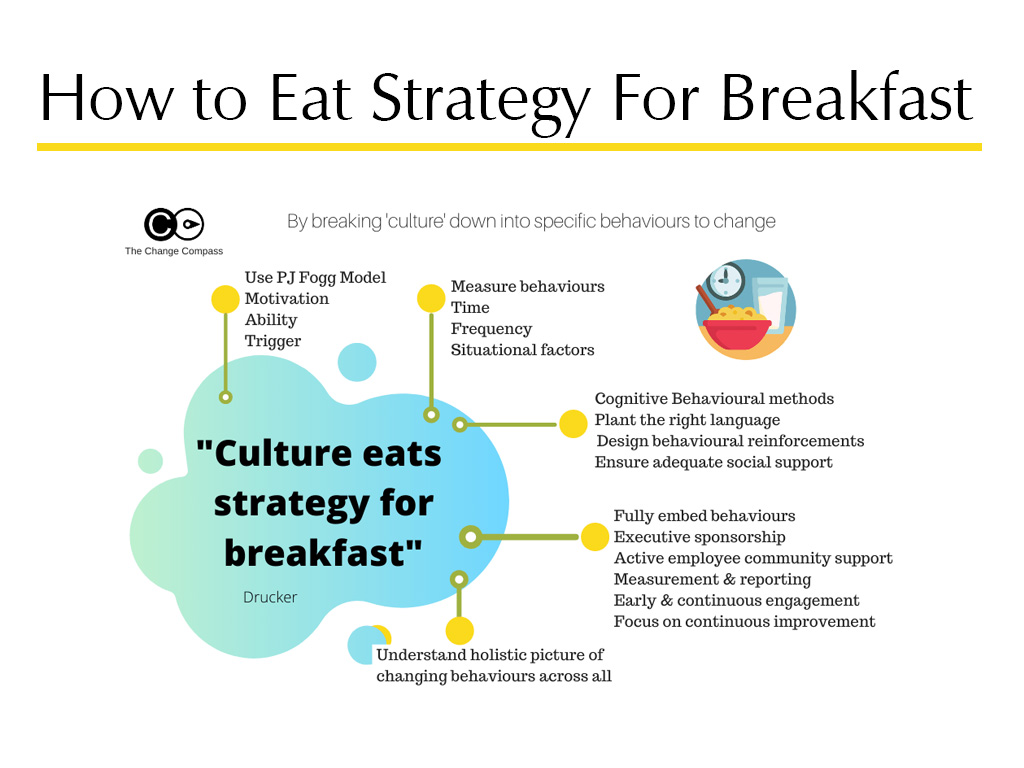


Few phrases in management thinking have proved as durable as Peter Drucker’s famous dictum: “culture eats strategy for breakfast.” First popularised in the early 2000s and widely attributed to Drucker, the saying captures a truth that executives and change practitioners continue to learn the hard way – that even the most carefully crafted strategic plan will be neutralised if the underlying organisational culture is left unaddressed. Strategy lives on paper; culture lives in people. And people, in the end, will always revert to what they know, what they are rewarded for, and what the leaders around them visibly model.
The gap between strategic intent and cultural reality is one of the most persistent challenges in organisational life. A leadership team can articulate a compelling vision, invest significantly in new technology or operating models, and communicate the change through every available channel – yet, months later, find that frontline behaviours have barely shifted. Employees nod in the right meetings, complete the mandatory training modules, and tick the compliance boxes, while quietly continuing to work exactly as they did before. This is surface compliance rather than genuine behavioural change, and it is far more common than most organisations care to admit.
For change management practitioners, understanding the relationship between culture and strategy is not merely an academic exercise – it is the foundation of effective practice. When culture is treated as a backdrop rather than a variable to be actively managed, change programmes routinely fall short of their intended outcomes. Research by McKinsey found that roughly 70 percent of change programmes fail to achieve their goals, and culture-related resistance is among the most frequently cited causes. Addressing this requires a different way of thinking about culture itself, one that moves away from vague notions of “the way we do things around here” and towards a concrete, behavioural framework that leaders and change teams can actually work with.
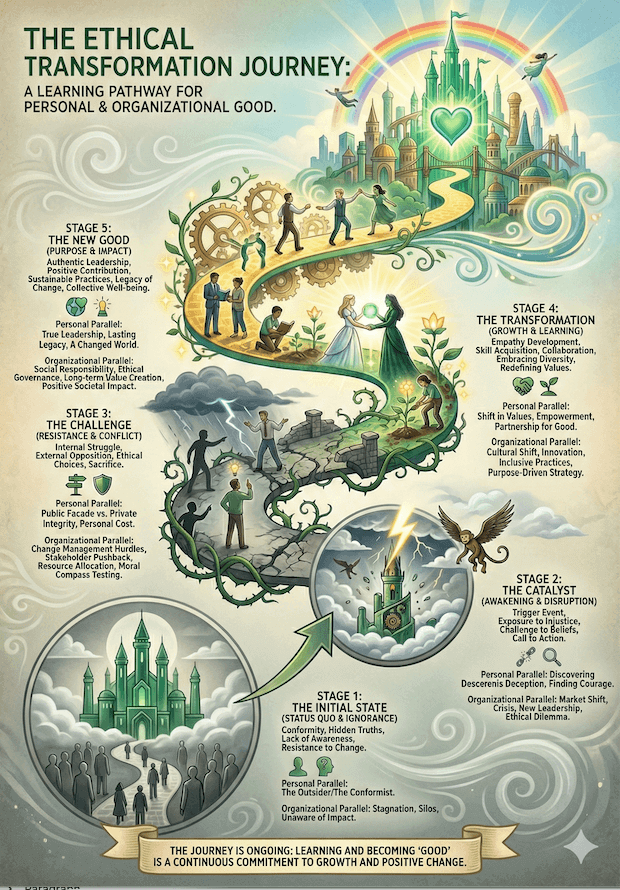
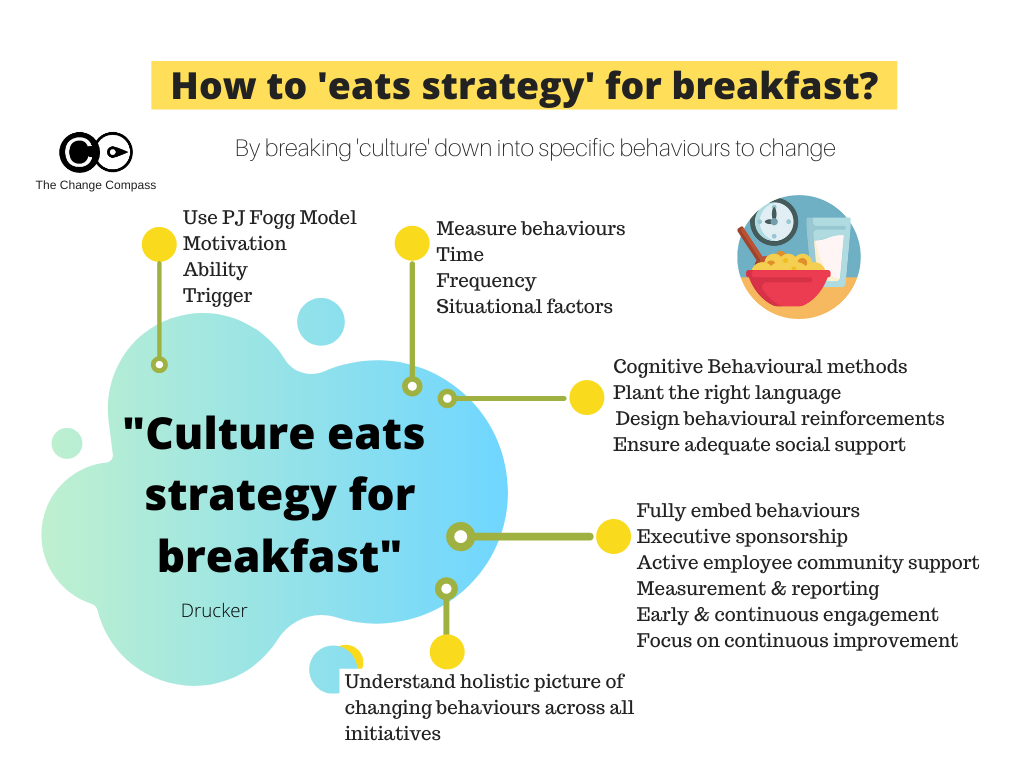
Download the Culture and Behaviour Change infographic for a visual breakdown of how culture can be decomposed into its behavioural elements.
What “culture eats strategy for breakfast” really means
To use this principle effectively, it is worth understanding what it does and does not mean. The dictum is not an argument against strategy. Sound strategic thinking remains essential to organisational success. Rather, the phrase is a warning about sequencing and priority: if you design a strategy without accounting for the cultural conditions in which it will be implemented, the culture will win. The informal rules, rituals, norms, and shared assumptions that constitute culture are more powerful day-to-day forces than any document or directive.
Edgar Schein, widely regarded as one of the foremost scholars of organisational culture, described culture as operating across three levels: visible artefacts (office layouts, rituals, language), espoused values (what the organisation says it believes), and underlying assumptions (what people actually believe, often unconsciously). The critical insight is that most change efforts operate at the level of artefacts and espoused values while leaving underlying assumptions untouched. A new strategy might introduce a new set of stated values, but if the underlying assumptions – about how decisions really get made, who is rewarded and why, what behaviours are actually tolerated – remain unchanged, the culture will absorb and neutralise the strategy.
This is why culture change cannot be mandated from above through a memo or a values poster in the lift lobby. Culture is reproduced through thousands of daily micro-interactions: how a manager responds when someone raises a concern, whether results are celebrated over relationships, whether risk-taking is quietly punished even when it is publicly championed. Changing culture means changing those micro-interactions, which means changing behaviour.
Why strategy fails when culture is neglected
The mechanisms by which culture undermines strategy are well documented. When an organisation attempts to implement a new strategy without addressing culture, it typically encounters one or more of the following failure patterns. The first is value conflict, where the behaviours the new strategy requires are incompatible with what the existing culture actually rewards. An organisation may announce a strategy centred on customer-centricity, but if internal processes still optimise for operational efficiency over customer outcomes, and if employees are measured and promoted on efficiency metrics, the strategy will make little headway.
The second failure pattern is what organisational psychologists call “immunity to change” – a concept developed by Robert Kegan and Lisa Laskow Lahey at Harvard. Organisations, like individuals, hold competing commitments that work against the stated goal of change. A management team may genuinely want to build a culture of psychological safety and candid feedback, while simultaneously holding an unexamined assumption that visible confidence and certainty signal competence. These competing commitments are rarely explicit, which is precisely why they are so hard to dislodge.
A third failure pattern concerns informal influence networks. Every organisation has a formal hierarchy, and it has a parallel informal network of influencers – people whose opinions shape how others interpret and respond to change initiatives. When a strategy is rolled out without engaging these informal networks, and without understanding whether the informal culture is aligned or misaligned with the strategy’s requirements, the informal network will set the actual tone. Gartner research has consistently highlighted the role of informal employee networks in determining whether change lands or stalls, noting that change fatigue and cultural misalignment are amplified when change programmes ignore these dynamics.
Breaking culture down into observable behaviours
One of the most practical advances in thinking about culture change is the shift from treating culture as a monolithic, abstract entity to treating it as a portfolio of observable behaviours. Culture cannot be measured or changed directly, but behaviours can. When we decompose culture into its constituent behavioural elements, we move from the intangible to the manageable.
This behavioural lens asks a deceptively simple question: what would we see people doing differently if this cultural attribute were genuinely present? If we want a culture of continuous improvement, what specific behaviours does that require? It requires team leaders to regularly ask “what could we do better?” in team meetings rather than simply reviewing performance against targets. It requires individuals to surface problems early rather than waiting until they escalate. It requires managers to respond to raised concerns with curiosity rather than defensiveness. Each of these is observable, measurable, and coachable.
Prosci’s research into change management best practices similarly emphasises that the individual dimension of change – shifting what specific people actually do – is the most critical and most often underestimated element of any change effort. The ADKAR model, which focuses on Awareness, Desire, Knowledge, Ability, and Reinforcement, is essentially a behavioural framework: it maps the psychological and practical journey an individual must complete before a new behaviour becomes habitual. This is directly applicable to culture change, where the goal is not simply awareness of a new value, but the embedding of new habitual behaviours across the workforce.
Designing change that addresses cultural barriers
Designing change initiatives that genuinely address cultural barriers requires a deliberate diagnostic phase before any intervention is designed. This means mapping the current culture in behavioural terms – identifying the existing norms, the informal rules, and the unwritten expectations that govern how work actually gets done. It also means identifying which of those existing behaviours are enablers of the desired change and which are inhibitors.
John Kotter’s eight-step change model, while broad in scope, contains important cultural wisdom. The importance Kotter places on creating a guiding coalition, communicating the vision, and generating short-term wins are all, at their core, strategies for shifting the cultural environment in which the change must take root. Short-term wins are particularly significant from a cultural standpoint: they demonstrate that the new behaviours are not only desirable but achievable within the constraints of the existing organisation, which begins to shift the informal narrative from “this isn’t how things work here” to “maybe things really are changing.”
Beyond Kotter’s framework, effective cultural change design also requires attention to the structural elements that reinforce behaviour: performance management systems, recognition and reward mechanisms, hiring and promotion criteria, and meeting norms. These are the environmental levers that make new behaviours easy and old behaviours costly. A change initiative that asks people to behave differently without modifying the structural environment that shapes behaviour is asking them to swim against the current indefinitely. McKinsey’s influence model highlights that consistent role modelling from leaders, combined with reinforcing systems and capability building, creates the conditions for genuine and lasting behavioural change.
Leader behaviours as the primary culture signal
Of all the levers available to organisations trying to shift culture, leader behaviour is the most powerful and the most scrutinised. Employees watch what leaders do far more carefully than they listen to what leaders say. When a senior leader espouses collaboration but consistently makes unilateral decisions, the organisation learns that collaboration is a stated value, not a lived one. When a leader says psychological safety matters and then visibly dismisses someone who raises an uncomfortable truth in a leadership forum, the culture absorbs that signal within hours.
This is not merely anecdotal. Research published in the Harvard Business Review has consistently demonstrated that leader behaviour is the single most influential factor in shaping team and organisational culture. Leaders set the tone for what is acceptable, what is rewarded, what is discussed, and what is avoided. In the context of change management, this means that any culture change programme must include explicit attention to leader behaviour change – not just leader communication of the change message, but visible modelling of the new behaviours in everyday interactions.
Practically, this means change practitioners should work with leaders to identify two or three specific, observable behaviours they will commit to changing and to building accountability mechanisms that make those commitments visible to their teams. It may mean introducing behavioural feedback loops for senior leaders, so that the gap between their intended behaviour and their actual impact is made visible in a psychologically safe way. This is difficult, uncomfortable work, but it is also the highest-leverage activity available to any change programme with cultural ambitions.
Measuring and sustaining behavioural change
One of the most common failure modes in culture change programmes is the absence of rigorous measurement. Culture is often treated as too soft or too complex to measure, which becomes a self-fulfilling prophecy: without measurement, it is impossible to demonstrate progress, which makes it difficult to sustain momentum and executive attention over the multi-year timelines that genuine culture change typically requires.
Effective measurement of behavioural change operates at multiple levels. At the individual level, 360-degree behavioural assessments and structured observations can track whether specific target behaviours are increasing in frequency and quality. At the team level, team health surveys, retrospective practices, and pulse checks on psychological safety indicators provide leading indicators of cultural shift. At the organisational level, tracking the decisions that get made, the stories that get told, and the behaviours that get rewarded or sanctioned reveals whether the cultural operating system is genuinely evolving.
Sustaining behavioural change over time requires active reinforcement. Research in behavioural psychology is unambiguous: behaviours that are not reinforced fade. This means change programmes must build reinforcement mechanisms into the operating rhythm of the organisation – recognition practices that celebrate the new behaviours, team rituals that embed the new ways of working, and performance conversations that explicitly reference the behavioural expectations associated with the desired culture. Without these reinforcement structures, even well-intentioned behavioural change reverts within three to six months as old habits and environmental cues reassert themselves.
How The Change Compass supports cultural and behavioural tracking
The Change Compass platform is designed to address the practical challenge that change practitioners face when managing multiple change initiatives simultaneously: understanding not just what changes are happening, but what collective impact those changes are having on people’s capacity, behaviours, and ways of working. This is directly relevant to the culture challenge, because culture is not shaped by any single change initiative – it is the cumulative product of everything the organisation asks people to do differently, all at once.
When an organisation is running dozens of concurrent change programmes, each with its own behavioural requirements, the risk of change saturation is high. People who are overwhelmed with change demands revert to their most deeply embedded habits – which are, by definition, the habits of the existing culture. The Change Compass enables change leaders to visualise the volume and pace of change across the organisation, identify where change saturation is occurring, and make evidence-based decisions about sequencing, prioritisation, and capacity management.
By tracking change impacts at the team and individual level, The Change Compass also supports the behavioural specificity that effective culture change requires. Rather than treating change as an organisational-level abstraction, the platform helps change practitioners understand which specific groups are being asked to change which specific behaviours, and at what pace – creating the conditions for targeted support, reinforcement, and measurement that are essential to embedding lasting cultural change.
Frequently asked questions
Did Peter Drucker actually say “culture eats strategy for breakfast”?
The phrase is widely attributed to Drucker, but there is no definitive written source confirming he coined it. It was popularised significantly by Mark Fields, former President of Ford Motor Company, who displayed it in the Ford war room around 2006. Regardless of its precise origin, the principle reflects ideas that are consistent with Drucker’s broader body of work on management, people, and organisational effectiveness.
How long does it take to change organisational culture?
Genuine, sustainable culture change typically takes three to seven years in large, complex organisations. This timeline reflects the time needed to shift underlying assumptions, embed new behaviours deeply enough that they become the default, and replace the informal stories and norms that sustain the existing culture. Visible behavioural change can occur more quickly – within 12 to 18 months in focused change programmes – but sustaining those changes and allowing them to become the new cultural baseline requires the longer timeframe.
What is the difference between culture change and behavioural change?
Culture change is the broader, longer-term shift in the shared norms, values, and assumptions that shape how an organisation functions. Behavioural change is the more immediate, observable shift in how specific individuals act in specific situations. The relationship between them is that culture change is achieved through – and evidenced by – sustained behavioural change at scale. You cannot change culture directly; you change it by consistently changing the behaviours that constitute and reproduce it.
Why do so many culture change programmes fail?
The most common reasons culture change programmes fail are: insufficient leadership commitment and visible role-modelling; failure to translate cultural aspirations into specific, measurable behavioural targets; structural systems (performance management, incentives, hiring) that continue to reward old behaviours; underestimating the time and persistence required; and treating culture change as a communications exercise rather than a sustained behavioural intervention. Change fatigue driven by too many concurrent changes also plays a significant role, as it prevents any single set of new behaviours from being sufficiently reinforced to become habitual.
References
- McKinsey & Company – The influence model: A proven approach to change management
- McKinsey & Company – Changing change management
- Harvard Business Review – What is organisational culture? And why should we care?
- Prosci – Best practices in change management research
- Schein, E. H. (2010). Organisational Culture and Leadership (4th ed.). Jossey-Bass.
- Kotter, J. P. (1996). Leading Change. Harvard Business Review Press.
- Gartner – Organisational change management insights