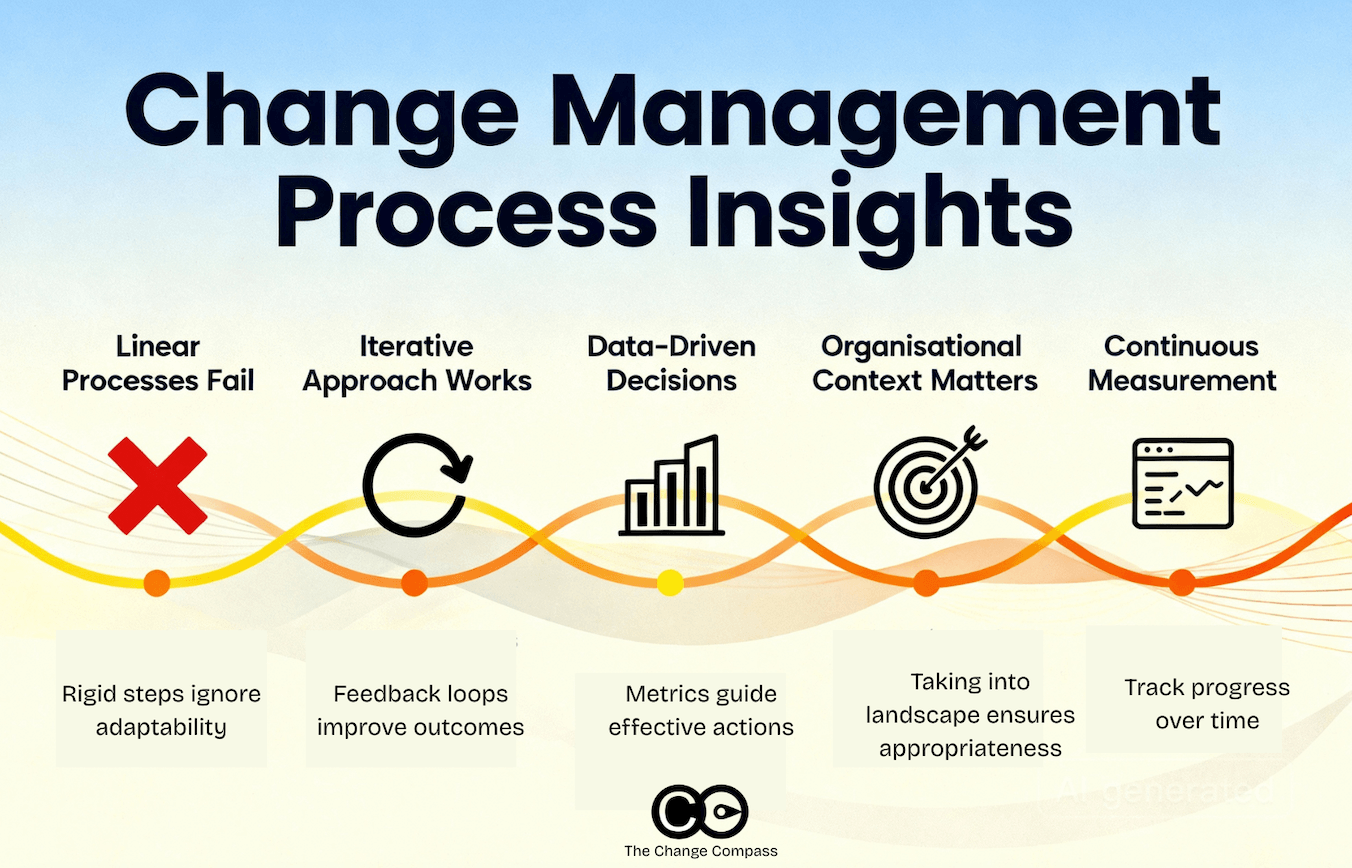


In most modern organisations, data drives decisions. Marketing teams track conversion rates to the decimal point. Finance teams model scenarios with precision. Operations leaders measure throughput, defect rates, and cycle times as a matter of course. Yet change management, a discipline that directly influences whether transformation programmes succeed or fail, has long operated on a different basis. Change leaders frequently rely on anecdote, stakeholder intuition, and high-level readiness surveys that tell them very little about what is actually happening on the ground. The result is a discipline that struggles to justify its value and, more critically, struggles to course-correct when things go wrong.
This gap is not simply a matter of preference or professional culture. It reflects a deeper structural challenge: change management has historically lacked the tools, frameworks, and shared standards required to turn complex human and organisational behaviour into reliable, actionable data. Where a project manager can point to schedule variance and earned value, a change leader has often had to rely on statements like “people seem engaged” or “resistance is lower than last quarter.” These observations may be accurate, but they do not give executives the confidence to invest further, adjust scope, or make time-sensitive decisions about programme delivery.
The good news is that this is changing. A growing number of change leaders are adopting data-driven approaches that connect change activity to measurable business outcomes. Platforms like The Change Compass are making it practical for organisations to collect, visualise, and act on change data in ways that were simply not possible a decade ago. This article explores why data maturity matters in change management, what good change data looks like in practice, and how change leaders can use it to earn executive confidence and drive results.
Why change management lags other disciplines in data maturity
Change management emerged largely from behavioural science, organisational psychology, and consulting practice rather than from the quantitative traditions of engineering or finance. The foundational models – Lewin’s unfreeze-change-refreeze, Kotter’s eight steps, the ADKAR model from Prosci – are deeply valuable, but they were designed as conceptual frameworks rather than measurement systems. This means that while they help practitioners think clearly about change, they do not inherently produce the kind of data that boards and executive committees use to evaluate business performance.
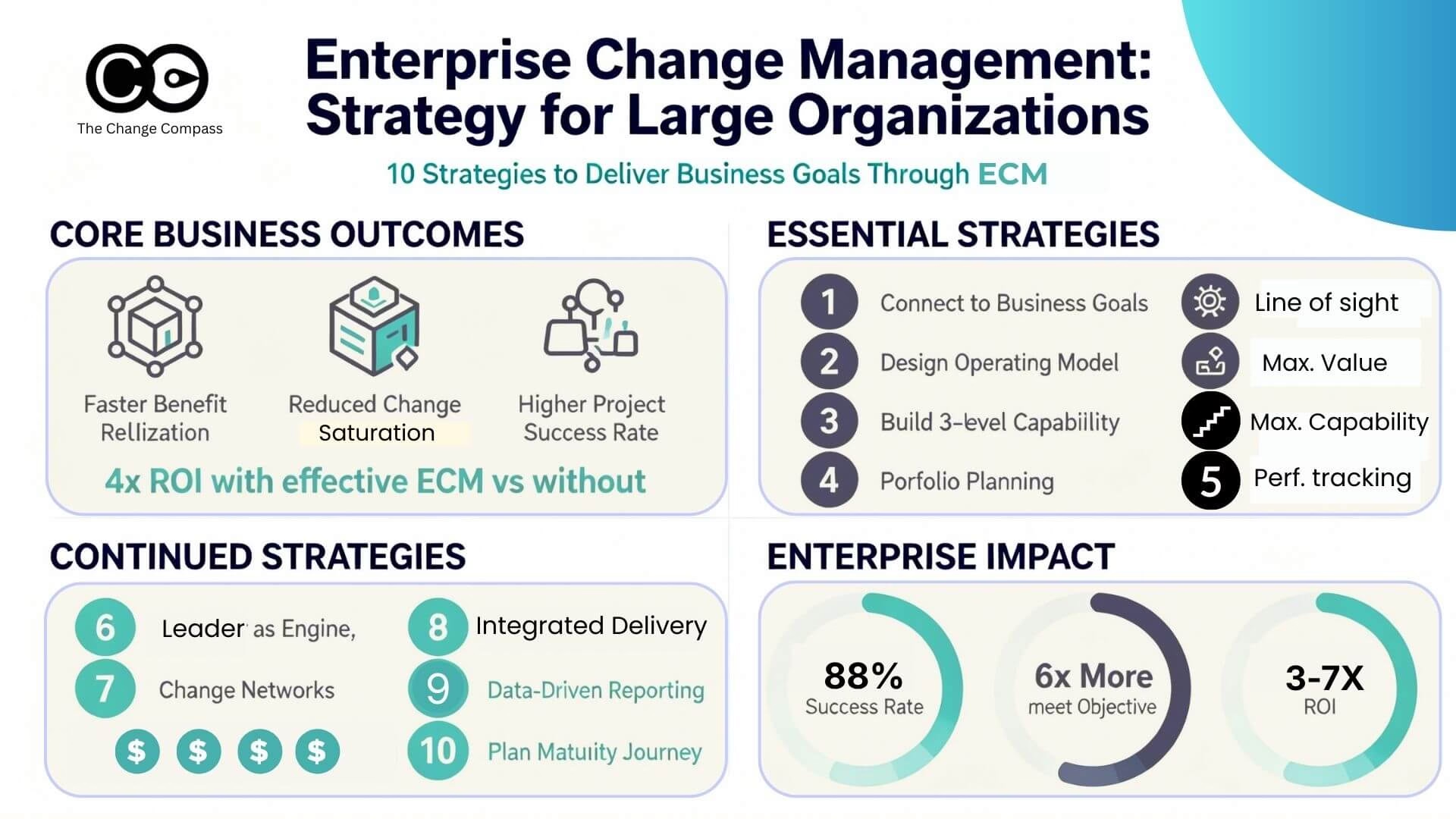
A 2023 Prosci benchmarking report found that organisations with excellent change management programmes are six times more likely to meet project objectives than those with poor change management. Despite this compelling evidence, many organisations still struggle to translate that finding into a data collection discipline within their own programmes. The challenge is partly methodological and partly cultural. Change practitioners are often stretched across multiple concurrent initiatives, leaving little capacity to design and maintain rigorous measurement systems. There is also a widespread belief that human behaviour is simply too complex to quantify in meaningful ways.
Gartner research on digital transformation has consistently highlighted that the human and organisational dimensions of change are the leading cause of programme failure, yet these dimensions receive the least structured measurement attention. When a technology implementation stalls, it is rarely because the software does not work – it is because adoption is lagging, training has not translated to behaviour change, or frontline managers are not reinforcing the new ways of working. Without data, these problems go undetected until they become crises. With data, they can be spotted early and addressed systematically.
What good change data actually looks like
Good change data is specific, timely, and connected to business outcomes. It goes beyond the typical “readiness survey” that asks employees whether they feel prepared for an upcoming change. While readiness surveys have their place, they represent only one dimension of what change leaders need to manage effectively. A robust change measurement system captures data across at least three categories: the volume and complexity of change hitting different parts of the organisation, the progress and effectiveness of change enablement activities, and early indicators of adoption and sustained behaviour change.
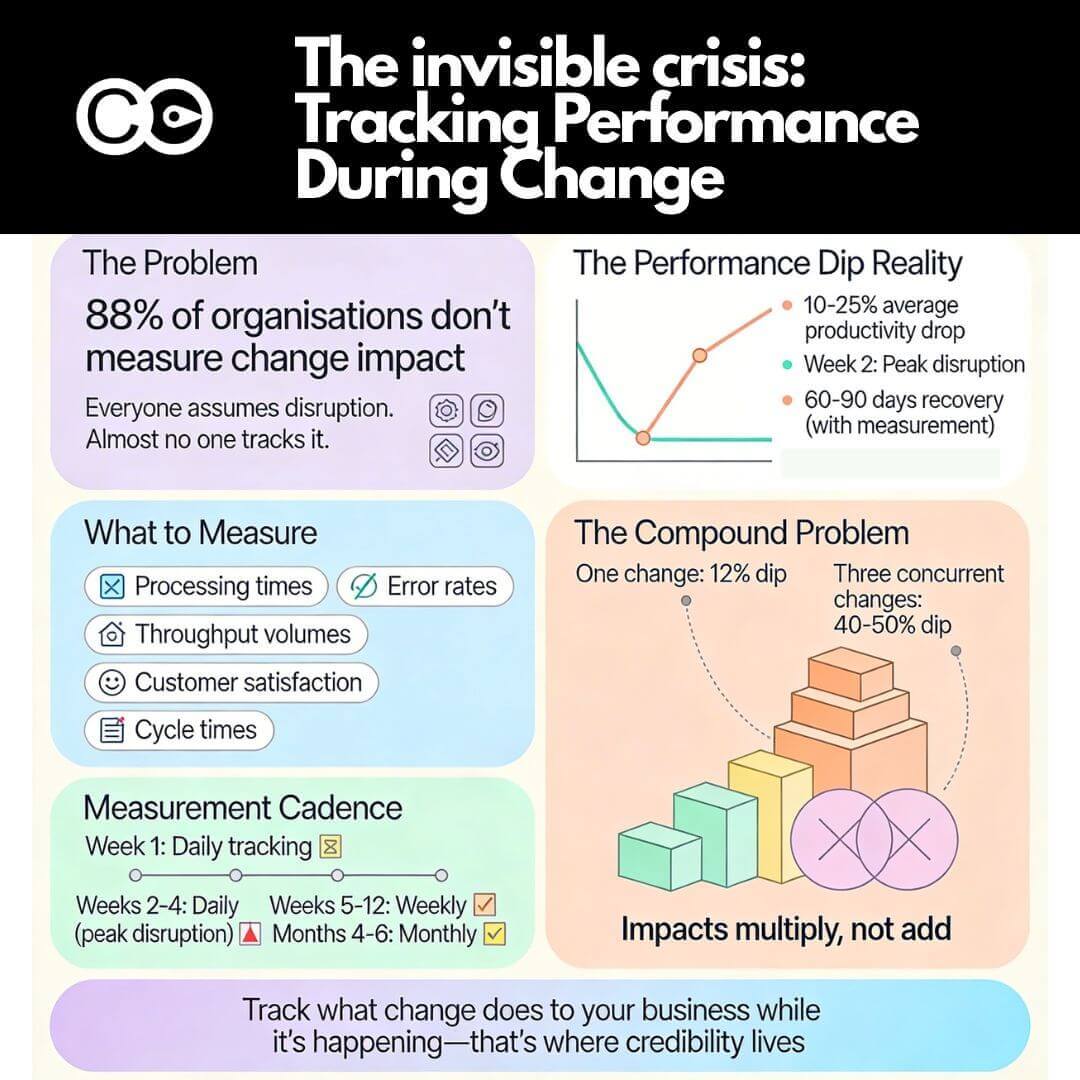
Change volume and complexity data helps leaders understand the cumulative burden being placed on different employee populations. A business unit that is simultaneously navigating a technology replacement, a restructure, and a new performance management framework is under far greater change pressure than one experiencing a single initiative. Without visibility into that cumulative load, leaders may unknowingly overload teams, driving disengagement, absenteeism, and productivity decline. The Change Compass platform was specifically designed to give organisations a consolidated view of their change portfolio, enabling leaders to see where change saturation is occurring and to sequence or reprioritise initiatives accordingly.
Enablement activity data tracks the completion and quality of change management deliverables such as stakeholder engagement sessions, training completions, communications sent, and manager briefings conducted. This data answers the question of whether the change programme is being executed as designed. Adoption indicators, by contrast, measure whether behaviour is actually shifting. These might include system login rates, process compliance metrics, quality scores, or customer satisfaction results that can be directly linked to the changes being implemented. Together, these three data streams give change leaders a genuinely comprehensive picture of how their programmes are progressing.
Using data to influence executive decision-making
One of the most important applications of change data is in executive communications. Senior leaders are accustomed to receiving data dashboards from finance, operations, and technology. When a change leader walks into a steering committee meeting with comparable data – showing adoption rates by business unit, change saturation scores by team, and leading indicators of programme risk – it fundamentally changes the conversation. Instead of providing subjective commentary, the change leader becomes a peer who is contributing to the evidence base the organisation uses to make decisions.
McKinsey research on large-scale transformation has found that programmes with strong senior sponsorship and clear performance data are substantially more likely to deliver their intended value. The data dimension matters because it gives sponsors something tangible to act on. When a change leader can show that adoption in one region is 40 per cent below target and identify the specific barriers driving that gap, a senior sponsor can intervene with authority and specificity. When the only information available is “adoption seems slower in the north,” the sponsor has no clear basis for action and is likely to default to pressure rather than problem-solving.
Building executive influence through data also requires change leaders to understand what executives actually care about. Board members and executive committees are typically focused on financial performance, risk exposure, customer outcomes, and employee engagement. Change data becomes far more compelling when it is framed in those terms. Instead of reporting that “80 per cent of managers have completed their briefings,” a data-driven change leader might show that business units with high manager engagement scores are tracking 25 per cent ahead of adoption targets, with a projected positive impact on the revenue run rate of the new system. That framing connects change activity to the things executives are accountable for delivering.
Connecting change metrics to business performance outcomes
The most sophisticated change measurement systems do not stop at tracking change activities – they create a line of sight between change management inputs and business performance outputs. This is sometimes called the change value chain, and building it requires deliberate design at the outset of a programme rather than an afterthought at the end. Change leaders who wait until a programme is complete to evaluate its impact will always struggle to demonstrate causality. Those who define their measurement framework at the start, identifying which business metrics should move as a result of successful adoption, are in a far stronger position.
Consider a customer experience transformation programme designed to reduce complaint volumes and improve Net Promoter Score. A well-designed measurement framework for this programme would track not only whether employees have completed the required training, but also whether their interactions with customers are changing in observable ways – perhaps through call quality monitoring, customer feedback scores, or first-call resolution rates. If training completion is high but customer metrics are not improving, the data points clearly to a gap between learning and on-the-job application. That insight allows the programme team to investigate and address the specific barrier, whether it is inadequate coaching from team leaders, a process that does not support the desired behaviour, or a cultural norm that is overriding the training content.
A Harvard Business Review analysis of large transformation programmes found that only 30 per cent of them succeed in meeting their original objectives, and the primary differentiator between successful and unsuccessful programmes is not the quality of the strategy but the quality of execution, including the people and change dimensions. Connecting change metrics to business outcomes is the mechanism by which change leaders can demonstrate that they are not just managing the process of change but actively driving the conditions for success.
Building a data-driven change team
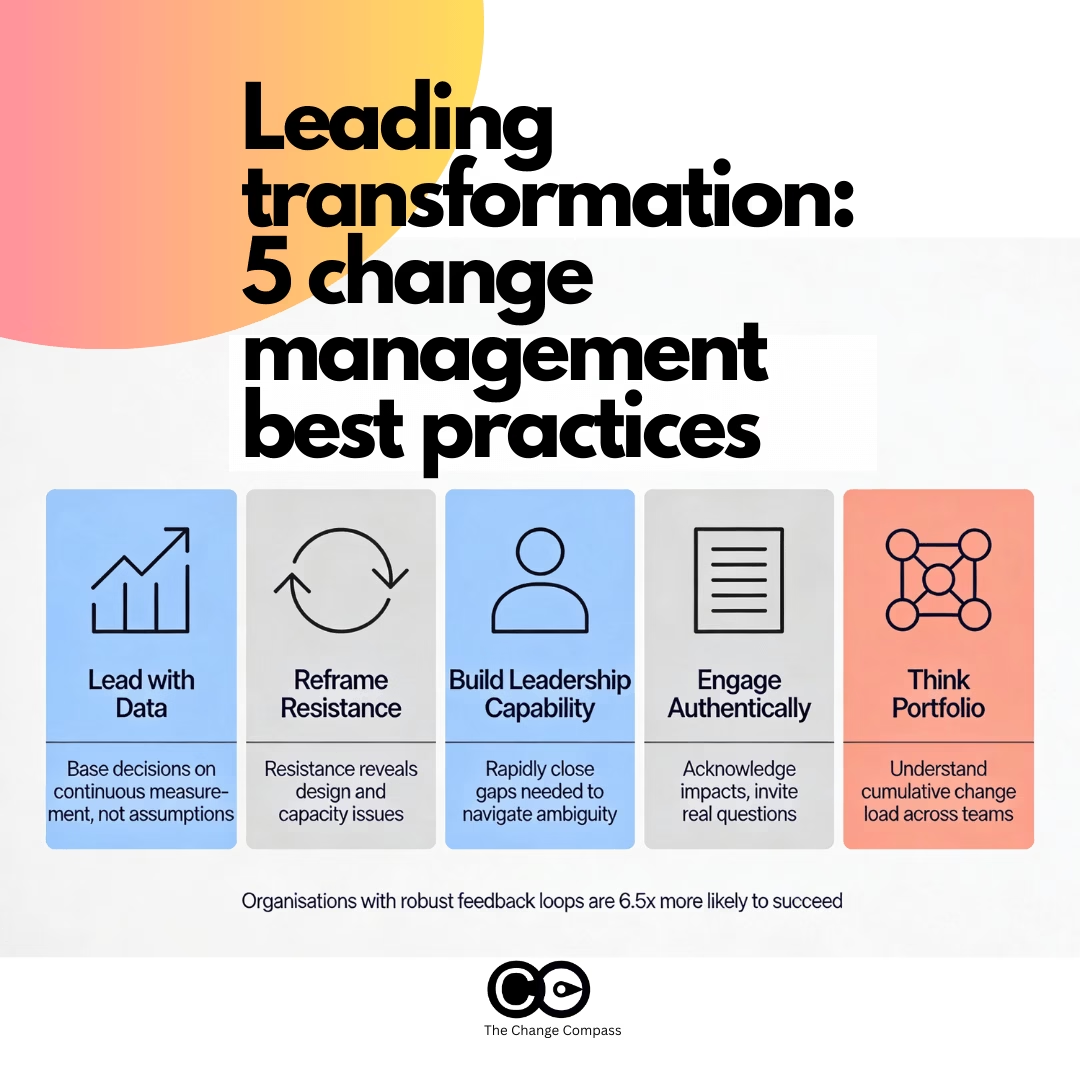
Shifting to a data-driven approach requires more than adopting a new platform or adding a measurement step to existing processes. It requires building a team capability and a team culture that treats evidence as the foundation of professional practice. This is a meaningful cultural shift for many change functions, which have traditionally valued qualitative insight, relationship skills, and experiential wisdom over analytical rigour. The most effective change teams combine both – they do not abandon the human judgment and empathy that good change practice requires, but they augment it with data that improves the quality and confidence of their decisions.
Practically, this means investing in data literacy across the change team. Change practitioners do not need to become data scientists, but they do need to understand how to design measurement frameworks, interpret dashboards, identify patterns in data, and communicate data-driven insights to different audiences. Organisations can support this through targeted skill development, pairing change practitioners with data or analytics colleagues, and building data collection and review into the standard rhythms of programme governance. The Change Compass platform supports this transition by providing change teams with visualisation tools and reporting capabilities that do not require deep technical expertise to operate.
Leadership commitment is equally important. When the head of change or the chief people officer consistently asks for data in programme reviews and holds teams accountable to evidence-based conclusions, it sends a clear signal about what is valued. Conversely, when leaders accept anecdote and opinion as the basis for major programme decisions, they inadvertently undermine the case for building measurement capability. The shift to data-driven change management is ultimately a leadership choice as much as a technical one, and it tends to succeed when it is championed from the top and embedded in the operating model of the change function.
How The Change Compass enables data-driven change leadership
The Change Compass was built specifically to address the data gap that has long held change management back. The platform provides change leaders with a consolidated, visual view of their organisation’s change portfolio, making it possible to assess the volume, complexity, and distribution of change across different business units and employee groups. This portfolio view is one of the most immediately useful capabilities for organisations running multiple concurrent programmes, because it surfaces change saturation risks that are otherwise invisible until they start driving disengagement or resistance.
Beyond portfolio visibility, The Change Compass enables teams to track change readiness and adoption metrics at a programme level, linking activity data to the business outcomes that executive sponsors care about. The platform’s reporting and visualisation features are designed to be accessible to change practitioners who are not data specialists, making it practical to generate executive-ready dashboards without relying on separate analytics support. This reduces the time change leaders spend compiling reports and increases the time they spend acting on what the data reveals.
The platform also supports the benchmarking of change performance over time and across programmes, helping organisations build an institutional understanding of what good change looks like in their specific context. Over time, this benchmarking capability enables more accurate scoping and resourcing of future programmes, reducing both the over-investment that comes from guessing conservatively and the under-investment that comes from underestimating complexity. For organisations serious about building a mature, data-driven change capability, The Change Compass provides both the infrastructure and the discipline to make it happen.
Frequently asked questions
What is the most important change management metric to track?
There is no single most important metric, because the right measures depend on the nature and objectives of the programme. However, adoption rate – the proportion of the target population that has shifted to the new ways of working – is consistently one of the most valuable indicators because it directly reflects whether the change is achieving its intended effect. Adoption data is most useful when it is disaggregated by business unit, role group, or geography, so that low-adoption pockets can be identified and addressed rather than masked by an average figure.
How can change leaders make the case for data investment to sceptical executives?
The most effective approach is to frame data investment in terms of risk reduction and return on programme investment. Executives who have experienced transformation programmes that failed to deliver expected benefits – a common experience, given the research findings on transformation success rates – are typically receptive to an argument that better change measurement would have identified the adoption gap earlier and enabled corrective action. Concrete examples from other organisations, combined with a clear proposal for how a measurement framework would work in practice, tend to be more persuasive than abstract arguments about data maturity.
How does change saturation data help organisations manage their portfolios?
Change saturation data quantifies the cumulative change burden being experienced by different employee groups at any given point in time. When this data is mapped across a programme portfolio, it reveals which teams are approaching or exceeding their capacity to absorb change effectively. Leaders can use this information to sequence initiatives more thoughtfully, delay lower-priority changes when teams are already under significant pressure, or target additional change management support to the most saturated groups. Without this visibility, organisations frequently over-burden their highest-performing teams – those most likely to be involved in multiple change programmes simultaneously – which can drive the very disengagement they are trying to avoid.
Can small change teams realistically adopt a data-driven approach?
Yes, and the investment required is often lower than practitioners expect. A data-driven approach does not require a large analytics team or a complex technology infrastructure. It starts with defining two or three meaningful metrics for each programme, establishing a simple collection method, and reviewing the data consistently in governance forums. Platforms like The Change Compass are specifically designed to be accessible to small and mid-sized change functions, providing out-of-the-box visualisation and reporting that does not require technical expertise to configure or maintain. Starting small and building measurement discipline gradually is far more effective than waiting for a perfect system before beginning.
References
- Prosci. (2023). Best Practices in Change Management: Benchmarking Report. Prosci Inc.
- Gartner. (2023). Organisational Change Management: Overcoming Barriers to Digital Transformation. Gartner Research.
- McKinsey & Company. (2023). The People Power of Transformations. McKinsey & Company.
- Harvard Business Review. (2019). The Hard Side of Change Management. Harvard Business Publishing.