

Ask most senior leaders how they decide to proceed with a major transformation programme, and you will hear words like “gut feel”, “experience”, and “strategic judgement”. Rarely will you hear “the data told us”. A Prosci benchmarking study found that fewer than one in five organisations consistently use quantitative change data to inform portfolio decisions. The remaining four-fifths are making consequential choices about people, timelines, and resources based on professional instinct and political negotiation.
This is not because the data does not exist. Most organisations have the raw ingredients: employee engagement surveys, project status reports, HR attrition numbers, training completion rates. The problem is that these data points are rarely synthesised into something a leader can actually use at a decision point. They live in separate systems, owned by separate teams, and are pulled together — if at all — after the fact.
There are four categories of decisions in change management where switching from instinct to evidence makes a consistent, measurable difference. None of them require a data science team. They require the right framing and, increasingly, the right tools. This article covers each one in practical terms.
Why most change decisions are still made without data
Before getting to the four decisions, it is worth understanding why data-driven change management is still the exception rather than the norm. A McKinsey analysis of people analytics maturity found that most organisations collect people data but rarely act on it. The gap is not measurement — it is interpretation and application at the moment decisions are actually made.
In change management specifically, the decision-making environment makes data harder to use. Timelines are political. Sponsors have competing agendas. Business cases are written to justify decisions that have already been made. In this environment, data that contradicts the preferred narrative tends to be acknowledged and then politely ignored.
The organisations that break this pattern share a common characteristic: they have defined, in advance, which data points will trigger which decisions. They have established thresholds — not as guidelines to consider, but as commitments to act on. Data without a decision framework is just a report. Data embedded in a governance framework is a tool.
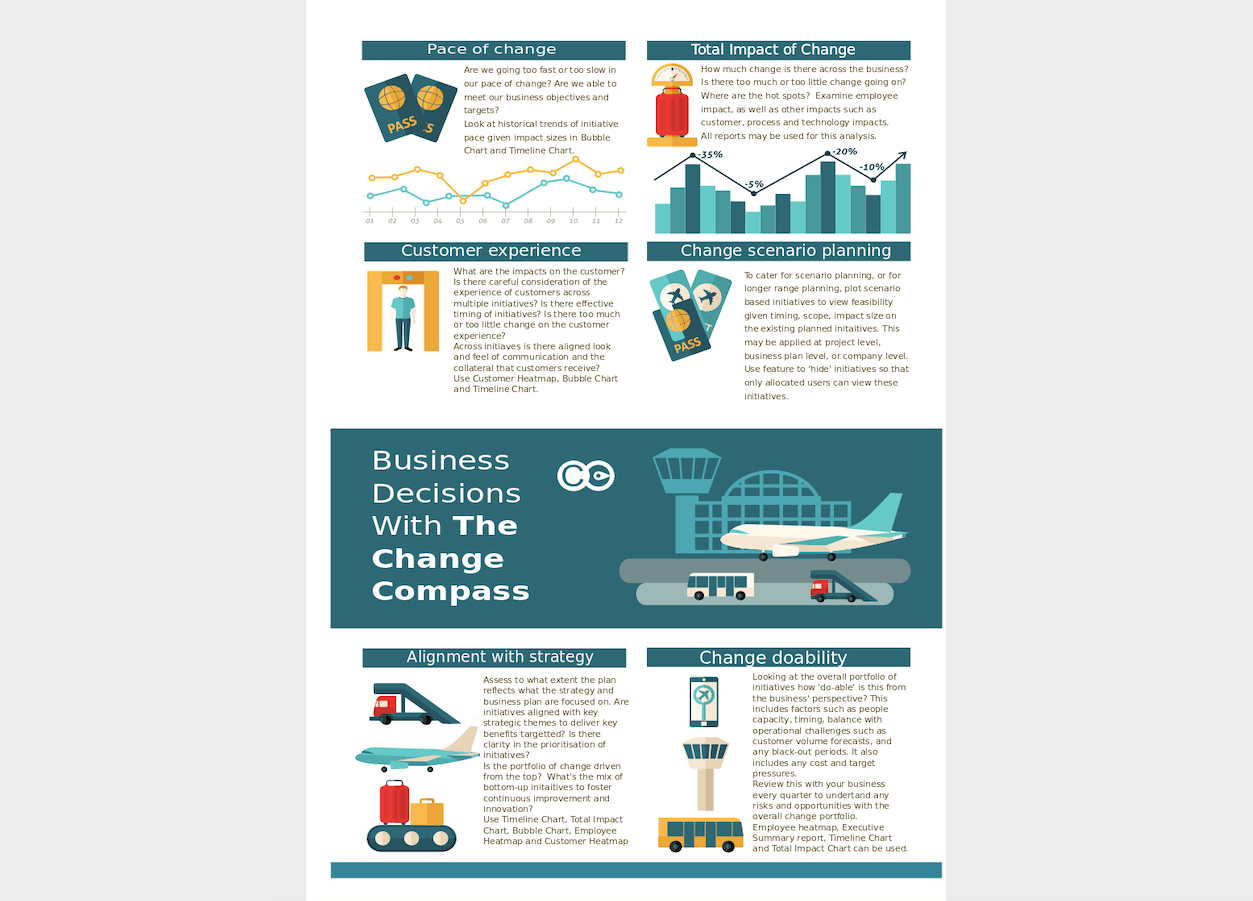
Decision 1: The pace of change
The most common question in any transformation governance forum is some version of: “Are we moving too fast?” Without data, this question is answered by whoever speaks most confidently or has the most senior title. With data, it becomes an empirical question with a defensible answer.
Pace-of-change decisions are fundamentally about the rate at which new demands are being placed on employees relative to their capacity to absorb them. This requires two inputs: a measure of current change load (how many initiatives are landing, and how intensely) and a measure of current adoption quality (are previous changes actually sticking before the next wave arrives).
What the data tells you about timing
When you track change impact by role and time period across your portfolio, patterns emerge that are invisible at the individual initiative level. A team that looks manageable when you assess each project separately may be absorbing change impacts equivalent to three or four additional weeks of disruption per quarter when you aggregate across all concurrent initiatives. Gartner research on change fatigue found that only 43% of employees with high change fatigue plan to stay with their employer, compared to 74% of those with low fatigue — a 31-percentage-point gap that represents a direct financial exposure in any high-change environment.
The actionable version of this insight is a threshold: a defined point at which the data triggers a mandatory review of sequencing rather than a discretionary conversation. Organisations that set these thresholds in advance find it significantly easier to have difficult conversations with programme sponsors, because the trigger is the data, not a change manager’s judgement call.
Decision 2: Where to focus resources based on total impact
One of the most persistent problems in multi-initiative portfolios is that change resources — consultants, business partners, communications capacity — are allocated to initiatives based on political weight rather than actual impact. The biggest project gets the most support. The loudest sponsor gets the most attention. The teams that are quietly drowning in a combination of mid-sized changes get almost none.
Total impact analysis flips this logic. Instead of starting with initiatives and asking “which ones need support?”, you start with stakeholder groups and ask “which groups are absorbing the most change?” The answer frequently surprises leadership teams.
How to build a total impact picture
Effective total impact analysis requires three things working together:
- A common impact taxonomy across all initiatives — so that “medium impact” means the same thing whether it comes from an IT system change or a restructure
- A consistent view of which roles and teams are affected by each initiative — tracked at a granular enough level to identify hotspots
- An aggregation mechanism — a way to sum the impacts across initiatives for each group, by time period, so you can see cumulative load rather than individual project burden
When this data exists, resource allocation decisions become much more defensible. A Deloitte human capital trends study found that organisations with strong workforce data capabilities were 2.3 times more likely to consistently make good people decisions compared to those without. The same principle applies to change: better impact data produces better resourcing decisions, which produces better adoption outcomes.
In practice, total impact analysis often reveals that the teams carrying the highest cumulative change load are mid-level operational groups — the people who run the business day-to-day. They absorb system upgrades, process changes, organisational restructures, and regulatory compliance updates simultaneously, while also being the groups with the least dedicated change management support. Data makes this visible. Without it, it stays invisible until it manifests as attrition, errors, or adoption failure.
Decision 3: Protecting the customer experience during transformation
Most transformation programmes are designed to improve customer outcomes eventually. Many of them degrade customer outcomes in the short to medium term, because the employees who serve customers are too absorbed in change to deliver reliably. This is one of the most under-examined costs of poorly managed portfolios, and it is almost entirely preventable with the right data.
The connection between internal change load and external service quality follows a predictable pattern. When frontline employees are absorbing significant change impacts — learning new systems, changing processes, adapting to restructures — their cognitive bandwidth for complex customer interactions decreases. Response times slow. Error rates increase. Escalations rise. For organisations in competitive markets, this quality dip can have revenue and retention consequences that dwarf the cost of the transformation itself.
Using change data to protect service quality
The data-driven approach to this decision links change impact data (which customer-facing roles are absorbing the most change, and when) to operational performance data (service quality metrics, customer satisfaction scores, complaints). Organisations that do this proactively can make two types of protective decisions:
- Sequencing decisions: Delaying or staggering the rollout of initiatives affecting customer-facing teams during peak service periods or periods of already-high change load
- Resourcing decisions: Temporarily increasing support capacity for customer-facing teams during high-impact change periods — additional coaching, reduced targets, extended hypercare — to buffer the performance dip
Research published in Harvard Business Review on employee experience and customer outcomes found consistent evidence that employee capacity directly predicts customer satisfaction. Organisations that managed employee workload actively during transformation periods saw significantly smaller dips in customer metrics than those that did not. The data does not eliminate the trade-off, but it makes the trade-off visible and manageable rather than invisible until the damage is done.
Decision 4: Choosing between change scenarios before committing
The most strategically valuable use of change data is one that most organisations never attempt: scenario planning before a major programme is approved or a portfolio decision is made. Instead of asking “how do we manage this change?”, the question becomes “which version of this change is most achievable given our current portfolio and capacity?”
Scenario planning with change data allows you to model the impact of different implementation choices before anyone has committed resources or announced timelines. Should we roll this out nationally in Q1, or stagger by region across Q1 and Q2? Should we sequence this after the ERP go-live, or run them in parallel? Should we descope the training component this quarter and invest more in operational support instead?
Without data, these questions are answered by whoever has the strongest view. With a portfolio impact model, each scenario can be assessed against existing capacity, allowing the governance forum to choose the option that delivers the best outcome given real constraints rather than theoretical ones.
The business case for scenario planning
A Prosci study on the value of change management found that initiatives with excellent change management were six times more likely to meet objectives than those with poor change management. The single biggest differentiator in “excellent” change management was proactive planning — making decisions earlier in the initiative lifecycle when options are still open. Scenario planning with portfolio data is the mechanism that makes this possible. It moves change management from a delivery function to a planning function, which is where the real value sits.
Organisations that regularly use scenario data in portfolio governance report a shift in how the change function is perceived at executive level. When change managers can quantify the capacity implications of different initiative timing options, they become contributors to strategic decisions rather than recipients of them. That shift in positioning is not a soft outcome — it directly affects which decisions get made and how well they land.
How digital change management platforms enable these decisions
The four decisions described above share a common requirement: portfolio-level data that is current, comparable, and accessible at the moment decisions are being made. Maintaining this manually, in spreadsheets owned by different project teams, is possible at small scale but unsustainable across a complex portfolio. Purpose-built platforms like The Change Compass are designed specifically to aggregate change impact data across initiatives, visualise cumulative load by team and time period, and enable scenario modelling in real time. They shift the data infrastructure from a reporting exercise to a decision support system, which is the context in which these four decisions actually change.
Making the shift from instinct to evidence
The organisations that consistently make better change decisions are not those with the most sophisticated analytics functions. They are those that have agreed, in advance, on which data points matter for which decisions, and have built those commitments into their governance processes. The four decisions covered in this article — pace, total impact, customer experience, and scenario choice — represent the highest-value opportunities for most organisations. Start with one. Build the measurement capability for pace-of-change decisions, establish a threshold, and commit to acting on it at your next portfolio governance review. That single shift will demonstrate more value than any number of change management frameworks that stay in a document and never reach a governance forum.
Frequently asked questions
What is data-driven change management?
Data-driven change management means using quantitative evidence — such as change impact assessments, adoption rates, capacity utilisation, and stakeholder sentiment scores — to inform decisions about how change is planned, sequenced, resourced, and monitored. It contrasts with the more common practice of relying on professional judgement and political negotiation to make the same decisions.
How do you measure the pace of change in an organisation?
Pace of change can be measured by tracking the number and intensity of change initiatives affecting each stakeholder group across a defined time period. Expressing impact in terms of hours of disruption per week per role group provides a quantifiable measure that can be compared against a capacity threshold. When the aggregated impact crosses that threshold, it signals that the pace of change exceeds the organisation’s absorption capacity.
What is total impact analysis in change management?
Total impact analysis aggregates the change impacts from all concurrent initiatives to show the cumulative burden on specific stakeholder groups. Unlike assessing each initiative in isolation, total impact analysis reveals which teams are absorbing the most change overall — which is often different from which teams are involved in the largest individual projects. This enables more rational resourcing decisions across the portfolio.
How does change scenario planning work?
Change scenario planning involves modelling the portfolio impact of different implementation choices before committing to a specific approach. For example, you might model the cumulative change load on affected teams under a Q1 full rollout versus a Q1-Q2 phased rollout, and choose the scenario that is most achievable given current capacity. This moves change management from a delivery function to a strategic planning input.
Why do most organisations still make change decisions without data?
The primary barriers are not technical but cultural and structural. Change data often sits in separate systems owned by separate teams and is never synthesised into a form that is useful at a decision point. Additionally, in politically charged transformation environments, data that contradicts preferred narratives tends to be acknowledged and then disregarded. Organisations that overcome this typically do so by embedding data thresholds into governance commitments rather than leaving data as an optional input.
References
- Prosci, “Change Management ROI”
- McKinsey, “A recipe for data-driven people strategy”
- Gartner, “This New Strategy Could Be Your Ticket to Change Management Success”
- Deloitte, “The evolving role of human resource management — Human Capital Trends 2021”
- Harvard Business Review, “The Case for Investing More in People”
- Prosci, “The Value of Change Management”