The Danger of Using Go Lives to Report on Change Management Impacts

The Danger of Using Go Lives to Report on Change Management Impacts

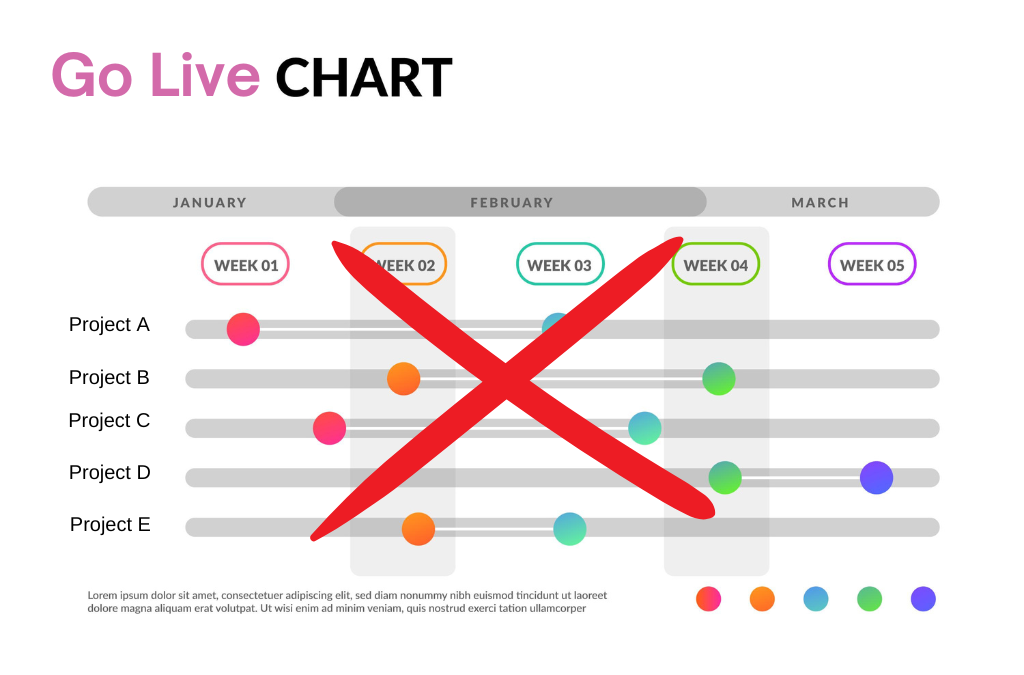
In the world of change management, Go Lives are often seen as significant milestones. For many project teams, these events represent the culmination of months or even years of hard work, signaling that a new system, process, or initiative is officially being launched. It’s common for stakeholders to view Go Lives as a key indicator of the success of a change initiative. However, while Go Lives are undeniably important, relying on them as the primary measure of change impact can be misleading and potentially harmful to the overall change effort.

Go Lives are just one piece of the puzzle. Focusing too heavily on these milestones can lead to an incomplete understanding of the change process, neglecting crucial activities that occur both before and after Go Live. Let’s outline the risks associated with using Go Lives to report on change management impacts and offers best practices for a more holistic approach.

Go Lives: A Double-Edged Sword

Go Lives are naturally a focal point for project teams. They represent a clear, tangible goal, and the success of a Go Live can boost morale, validate the efforts of the team, and provide a sense of accomplishment. From a project delivery perspective, Go Lives are critical. They signal that the project has reached a level of maturity where it is ready to be released to the broader organization. In terms of resourcing and business readiness, Go Lives ensure that everything is in place for the new system or process to function as intended.

However, the very attributes that make Go Lives attractive can also make them problematic as indicators of change impact. The simplicity and clarity of a Go Live event can lead stakeholders to overestimate its significance, from a impacted business perspective. The focus on Go Lives can overshadow the complex and often subtle changes that occur before and after the event. While a successful Go Live is necessary for change, it is not sufficient to guarantee that the change will be successful in the long term.

The Pre-Go Live Journey: Laying the Foundation for Change

A significant portion of the change management journey occurs long before the Go Live date. During this pre-Go Live phase, various engagement and readiness activities take place that are critical to shaping the overall impact of the change. These activities include town hall meetings, where leaders communicate the vision and rationale behind the change, and briefing sessions that provide detailed information about what the change will entail.

Training and learning sessions are also a crucial component of the pre-Go Live phase. These sessions help employees acquire the necessary skills and knowledge to adapt to the new system or process. Discussions, feedback loops, and iterative improvements based on stakeholder input further refine the change initiative, ensuring it is better aligned with the needs of the organization.

These pre-Go Live activities are where much of the groundwork for successful change is laid. They build awareness, generate buy-in, and prepare employees for what is to come. Without these efforts, the Go Live event would likely be met with confusion, resistance, or outright failure. Therefore, it is essential to recognize that the impact of change is already being felt during this phase, even if it is not yet fully visible.

Post-Go Live Reality: The Real Work Begins

While the Go Live event marks a significant milestone, it is by no means the end of the change journey. In fact, for many employees, Go Live is just the beginning. It is in the post-Go Live phase that the true impact of the change becomes apparent. This is when employees start using the new system or process in their daily work, and the real test of the change’s effectiveness begins.

During this phase, the focus shifts from preparation to adoption. Employees must not only apply what they have learned but also adapt to any unforeseen challenges that arise. This period can be fraught with difficulties, as initial enthusiasm can give way to frustration if the change does not meet expectations or if adequate support is not provided.

Moreover, the post-Go Live phase is when the long-term sustainability of the change is determined. Continuous reinforcement, feedback, and support are needed to ensure that the change sticks and becomes embedded in the organization’s culture. Without these ongoing efforts, the change initiative may falter, even if the Go Live event was deemed a success.

The Risk of Misleading Stakeholders

One of the most significant dangers of focusing too heavily on Go Lives is the risk of misleading stakeholders. When stakeholders are led to believe that the Go Live event is the primary indicator of change impact, they may not fully appreciate the importance of the activities that occur before and after this milestone. This narrow focus can lead to a number of issues.

Firstly, stakeholders may prioritize the Go Live date to the exclusion of other critical activities. This can result in insufficient attention being paid to pre-Go Live engagement and readiness efforts or to post-Go Live adoption and support. As a consequence, the overall change initiative may suffer, as the necessary foundations for successful change have not been properly established.

Secondly, stakeholders may develop unrealistic expectations about the impact of the change. If they believe that the Go Live event will immediately deliver all the promised benefits, they may be disappointed when these benefits take longer to materialize. This can erode confidence in the change initiative and reduce support for future changes.

Finally, a narrow focus on Go Lives can create a false sense of security. If the Go Live event is successful, stakeholders may assume that the change is fully implemented and no further action is required. This can lead to complacency and a lack of ongoing support, which are essential for ensuring the long-term success of the change.

Best Practices for Reporting Change Management Impact

To avoid the pitfalls associated with relying on Go Lives as indicators of change impact, change management practitioners should adopt a more holistic approach to reporting. This involves considering the full scope of the change journey, from the earliest engagement activities to the ongoing support provided after Go Live. Here are some best practices for reporting on change management impact:

  1. Integrate Pre-Go Live Metrics:
    • Track and report on engagement activities, such as attendance at town hall meetings, participation in training sessions, and feedback from employees.
    • Monitor changes in employee sentiment and readiness levels throughout the pre-Go Live phase.
    • Report on aggregate pan-initiative change initiative impost on business units, pre-Go Live
  2. Emphasize Post-Go Live Support:
    • Develop metrics to measure the effectiveness of post-Go Live support, such as the number of help desk inquiries, employee satisfaction with the new system, and the rate of adoption.
    • Highlight the importance of continuous feedback loops to identify and address any issues that arise after Go Live.
    • Communicate the need for ongoing reinforcement and support to stakeholders, emphasizing that change is an ongoing process
    • Report on post-Go Live adoption time impost expected across initiatives
  3. Provide a Balanced View of Change Impact:
    • Ensure that stakeholders understand that Go Live is just one part of the change journey and that significant impacts occur both before and after this event.
    • Use a combination of quantitative and qualitative data to provide a comprehensive view of change impact.
    • Regularly update stakeholders on progress throughout the entire change journey, not just at the time of Go Live.
  4. Manage Expectations:
    • Clearly communicate to stakeholders that the full impact of the change may not be immediately visible at the time of Go Live.
    • Set realistic expectations about the timeline for realizing the benefits of the change.
    • Prepare stakeholders for potential challenges in the post-Go Live phase and emphasize the importance of ongoing support.

While Go Lives are important milestones in the change management process, they should not be used as the sole indicator of change impact. The journey to successful change is complex, involving critical activities before, during, and after the Go Live event. By adopting a more holistic approach to reporting on change management impact, practitioners can provide stakeholders with a more accurate understanding of the change journey, manage expectations more effectively, and ensure the long-term success of the change initiative.

The key takeaway is that change management is not just about delivering a project; it’s about guiding an organization through a journey of transformation. Go Lives are just one step in this journey, and it is the responsibility of leaders to ensure that every step is given the attention it deserves.

How To Improve Change Management Outcome Success? One LEGO brick at a time!

How To Improve Change Management Outcome Success? One LEGO brick at a time!

Change Management outcome is the holy grail, and virtually all organisations are undergoing change. Now more than ever, companies are challenged with multiple layers of driving change simultaneously. What is applicable in this situation is not about a particular methodology of implementing a change program. It is all about implementing simultaneous changes, at the same time. There is no luxury of just focusing on one change at a time, the result of competitive, industry, and environmental challenges.

As change practitioners we work closely with our colleagues in Operations to get ready for, implement, and fully embed changes. So how do our colleagues in operations view and manage change initiatives?

Operations as a function is focused on managing performance and delivery to ensure that the business runs smoothly, with little disruptions, and that performance measures are achieved. Operations is focused on resource management, efficiency, and achieving the various operational indicators whether it’s customer satisfaction, turn-around time, average handling time, or cost target.

READ MORE: Top 7 challenges faced by change practioners in generating insights from change data

When times are hectic and a lot is going on with multiple change initiatives, the key focus for Operations is on managing people’s capacity. Key questions would be “Do we have sufficient time to cater for the various changes?”, and “Will we exceed our change saturation level?”. This is a critical question to answer since the business still needs to run and deliver services without negative change disruptions.

From an Operations planning perspective ‘change capacity‘ is often reduced to the time element, especially those impacting frontline staff.

For example:


      • What are the times required to reschedule the call centre consultants off the phone to attend training?

      • How much time is required in the team meeting agenda to outline the changes that are being rolled out?

      • What is the time involvement of change champions?

    Though these are all critical questions clear answers will help Operations plan better to face multiple changes. However, this is not adequate. There is more to planning for multiple changes than just focusing on the time element.

    Using the lego analogy to manage multiple changes

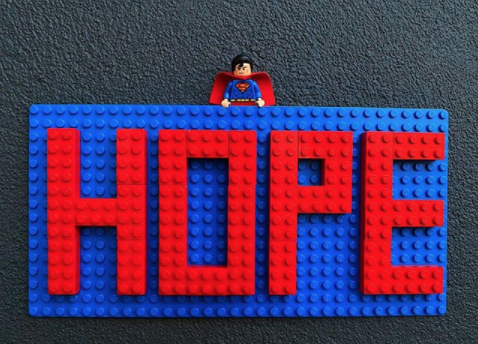
    We all know LEGO as kids. To build a car we start one brick at a time and see how we go. We experiment with different colours, shapes, and sizes. We make do with the bricks we have and use our imagination to come up with what a car would look like. Sometimes we get stuck and we may need to tweak our bricks a little, or sometimes start from scratch.

    It is the same as implementing change initiatives. In order to take people along the journey, we implement a series of activities and interventions so that our impacted stakeholders are aware, ready, committed, and embed the change. The design on the change journey is the process of determining what LEGO bricks to choose. There is no shortcut. It is not possible to build a building without each necessary brick to raise the building up. In implementing change, we also need to lay out each step in engaging our stakeholders.

    McKinsey studies over decades have told us that one of the most critical factors to focus on in ensuring change outcome success is clear organisation-wide ownership and commitment to change across all levels. This means that when we design each change brick we need to ensure we target every level of impacted stakeholders.

    For example:

    Team Leaders: How often do we want Team Leaders to talk about the changes to their teams before the rollout? What content do we want them to use? Do they know how to translate the message in a way that resonates? Do we want them to tell compelling stories that talk to the what, why, and how of the change?

    Managers: How are managers made accountable? What metrics are they accountable for? What mediums do we want them to use to engage their teams? What are the consequences of not achieving the outcomes?

    Senior Managers: Through what mediums do we expect senior managers to engage their teams about the changes? How do we ensure that they are personally accountable for the success of the change? How are they involved to ensure they own the change?

    Looking at the above you can see that for complex change there may need to be a lot of bricks in place to ensure the change outcome is successful!

    Going back to the issue of facing into multiple changes, how do we play around with the bricks to ensure that multiple changes are successful? The same way that we play with LEGO bricks!


        • Look at the colours of the bricks. Do certain colours belong together? When we look across different initiatives, are there similar or common behaviours that can be better linked together to tell a compelling story? Do they support the same strategy? Can there be a joint campaign for these changes?

        • Is the overall LEGO structure going to be intact? What are the impacts of the various changes happening at the same time in terms of focus, performance and change outcome? Have we exceeded the likely ‘mental capacity’ for people to stay focused on a core set of changes at any one time? Will the pieced-together structure collapse due to having too many elements?

        • Look at the sizes of the LEGO structures. During implementation when we have both larger and smaller initiatives being executed at the same time, will the larger ones overshadow the smaller ones? If so what are the risks if any?

        • Re-jig or re-build parts of the LEGO structure as needed to see what it looks like. In a situation where we want to see what the changes look like before we action it, it makes sense to visualise what would happen if we move timelines or change implementation tactics

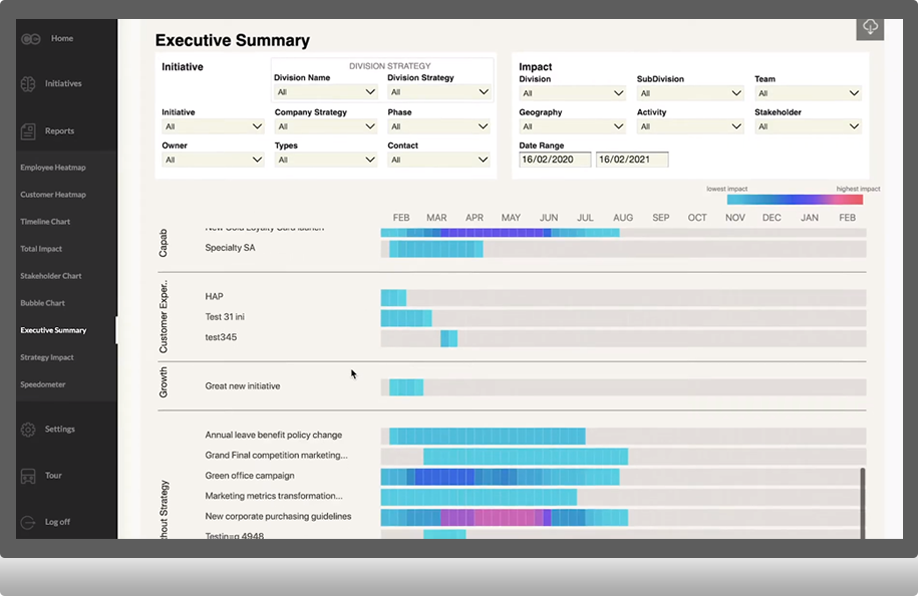
      Example of data visualisation of ‘re-jigging’ change implementation timeline with The Change Compass using different scenarios.

      Change Outcome

      Just like in building LEGO, for change initiatives we need to be agile and be flexible enough to play with and visualise what the change outcome could look like before pulling the trigger. We also need to be able to tweak as we go and adjust our change approaches as needed. In facing the multitude of changes that the organisation needs to be successful, we also need to be able to play with different implementation scenarios to picture how things will look like. Each brick needs to be carefully laid to reach the overall outcome.

      Careful consideration also needs to be how all the bricks connect together – the analogy that the change outcomes across initiatives can be determined by how we’ve pieced together various pieces of LEGO for them to make sense, and result in the ownership and commitment of stakeholders.

      Demonstrate the value of managing change – Case study 3

      Demonstrate the value of managing change – Case study 3

      Turning change chaos into competitive advantage: How a leading insurer mastered peak change with The Change Compass

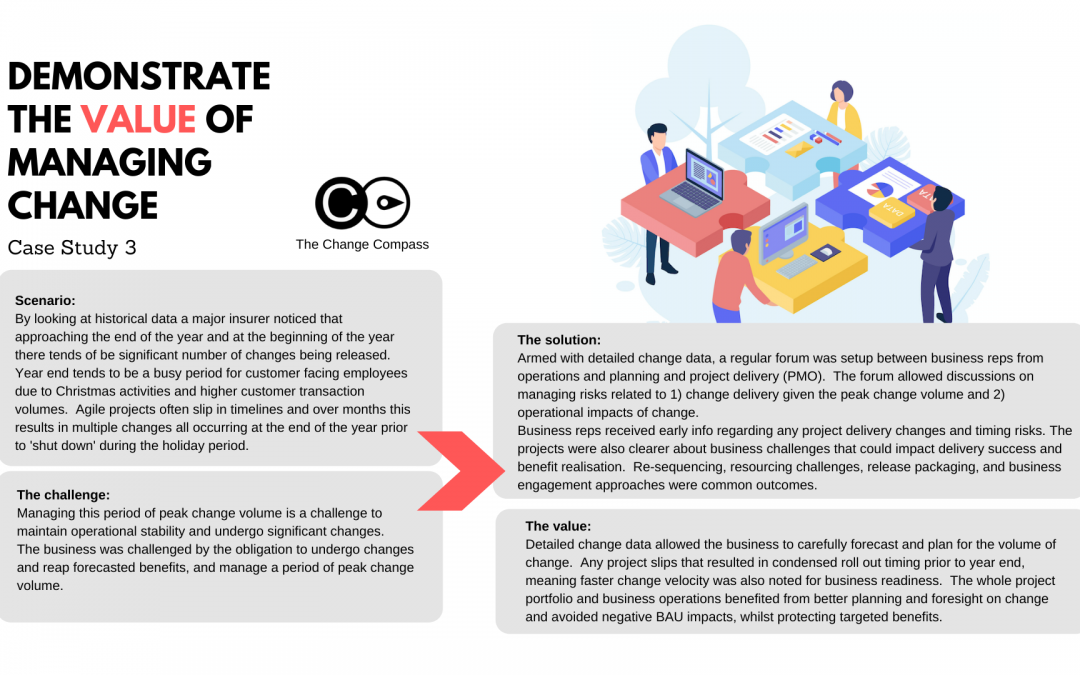
      In today’s fast-paced business environment, change is the only constant – especially in highly regulated, customer-facing sectors like insurance. But what if, instead of being a source of risk, organisational change could become your greatest lever for business performance? That’s the journey one major insurer embarked on, and the results are a blueprint for transformation-driven success.

      The perfect storm: Why peak change periods are so challenging

      Every year, as the calendar ticks towards the December-January holiday season, this insurer encountered a familiar scenario:

      • Customer-facing employees were under pressure, fielding increased transactions and supporting customers through holidays.

      • Multiple agile projects, each designed to drive innovation and process improvement, were slipping in timelines – as often happens in complex transformation portfolios.

      • The result? A flood of change “went live” simultaneously just before the company-wide shutdown.

      For business leaders, this created a daunting balancing act: realising the benefits of innovation, while not overwhelming frontline teams or sacrificing operational stability. Missed deadlines or last-minute rollouts could lead to service disruptions, employee burnout, lost revenue, and eroded customer trust.

      The breakthrough: Data-powered collaboration

      So how did this insurer escape the costly cycle of end-of-year chaos? With The Change Compass, they turned data into their superpower.

      The organisation established a regular, cross-functional forum that brought together operations, planning, and project delivery (PMO). But this wasn’t just another meeting – this was a command centre built around live, detailed change data.

      Key transformations in approach:

      • Shared Early Warning System:

        • Project delays, resource bottlenecks, and clustered change activity were visible weeks or months in advance, not discovered at the last minute.

      • Intelligent Risk Management:

        • The team could scenario-plan, not just react, to delivery risks and operational pinch points.

      • Business-Driven Dialogue:

        • Operations leaders voiced customer realities and BAU needs, shaping project timelines for true business readiness.

      Real-world results: From fire-fighting to future-proofing

      Thanks to this new level of insight and collaboration, the insurer fundamentally changed how it managed periods of peak change. Here’s what set them apart:

      1. Proactive Forecasting and Portfolio Planning

      • The company moved from “gut feel” to data-backed change forecasts, mapping exactly when and where change would impact operations.

      • No more scrambling: resource plans, communications, and business readiness activities were optimised for actual risks and opportunities.

      2. Collaborative Course Correction

      • Instead of viewing project slippage as a crisis, the PMO could re-sequence initiatives, redesign release packages, or reallocate teams before risks materialised.

      • The forum fostered joint problem-solving – turning silos into a unified change-fighting force.

      3. Protecting Business Value

      • With fewer surprises and less disruption, business units delivered on promised benefits even during high-change windows.

      • Change velocity was matched by business readiness, preserving customer experience and employee morale – even during intense periods.

      Key value metrics achieved

      • Savings from BAU cost spike of $1+Mil per annum from change peak periods
      • Protection from productivity dips of 30-45% from change disruptions
      • Prevention of customer churn of $1+Mil per annum from frontline operations disruptions
      • Additional 30-50% gain in change benefits realised through well-coordinated portfolio deployment

      Why this matters: Making change your strategic weapon

      The lesson is clear: Change doesn’t have to feel risky, unpredictable, or exhausting. With The Change Compass:

      • You gain clarity – see the full picture of what’s changing, when, and how it affects your people and customers.

      • You empower teams – from PMO to frontline operations, everyone acts with foresight and confidence, not crisis mode.

      • You realise more value – initiatives deliver lasting outcomes, not headaches or half-finished results.

      This is more than a software platform – it’s a new operating model for change-centric businesses.

      Going Beyond “Surviving Change” to Leading Your Market

      Imagine if your organisation could:

      • Anticipate and neutralise risks long before they disrupt business

      • Execute more strategic projects, faster – without burning out staff or diluting customer experience

      • Align every level of the business around a shared, data-driven roadmap for change

      That’s what The Change Compass unlocks. It’s already helping leading insurers and other organisations turn the “messiness” of change into disciplined, high-impact action – and giving them a real edge on competitors still stuck in fire-fighting mode.

      Ready to step into change leadership using data?

      If you’re tired of peak periods bringing more anxiety than opportunity, it’s time to see what’s possible when you combine collaboration, smart forums, and powerful change analytics.

      Try The Change Compass and:

      • Put yourself in the driver’s seat for every change, no matter how complex.

      • Rally your teams around a data-powered playbook for business performance.

      • Experience smoother, smarter transformation—365 days a year.

      Don’t just survive the next wave of change – lead it with data-backed confidence, outperform your industry, and empower your teams. The Change Compass is ready to help you turn every challenge into achievement.

      Click here to download the case study.

      Demonstrate Value of change 3