Ask a senior leader whether they have adequate sponsorship for each of their change programmes, and most will say yes. Ask them how much cumulative change load their front-line teams are carrying across the full portfolio right now, and very few can answer. This gap, between confidence at the programme level and blindness at the portfolio level, is one of the most consistent and consequential failure patterns in enterprise transformation.
Change portfolio literacy is the ability to read, interpret, and act on a portfolio-level view of organisational change: what is changing, for whom, at what pace, and with what cumulative effect on the people being asked to absorb it all. In most organisations, this literacy is concentrated in change functions, if it exists at all. Senior leaders, the people with the authority to make the sequencing, resourcing, and prioritisation decisions that actually determine portfolio outcomes, typically lack it.
Closing this gap does not require turning executives into change managers. It requires giving them the information and the language to ask different questions of their change portfolios, and to act on the answers.
Why executives default to programme-level thinking
The governance structures that senior leaders use to oversee change are almost universally designed around individual programmes. Investment committees evaluate programmes. Executive sponsors are assigned to programmes. Status reporting comes from programmes. RAG dashboards present programme-level health. The system trains leaders to ask programme-level questions: Is this initiative on track? Is the business case holding? Are the milestones being met?
These are legitimate questions. The problem is that they are the wrong level of analysis for understanding whether organisational change is actually being managed well.
Prosci’s 12th edition Best Practices in Change Management study found that 52% of executive sponsors do not have an adequate understanding of their role in change. More revealing is what they are not being asked to do. Sponsor briefings cover individual initiative progress. They rarely cover cumulative load, portfolio interaction effects, or how a specific programme’s timeline is affecting the absorption capacity of the teams it targets.
This is a literacy problem, not an engagement problem. Most senior leaders are genuinely committed to sponsoring their change programmes. They are simply not equipped to see, or therefore to manage, the portfolio-level dynamics that determine whether the aggregate of those programmes succeeds.
What change portfolio literacy looks like in practice
A change-literate senior leader can engage meaningfully with four categories of information that portfolio-illiterate leaders typically cannot.
Cumulative impact by employee group
The most important thing a senior leader needs to understand about their change portfolio is not what each programme is doing, but how much aggregate change is landing on specific employee groups and when. A front-line operations team handling a systems migration, a restructure, and two new process changes simultaneously is in a materially different position from a team handling one of those changes in isolation. The risks to adoption, productivity, and retention are different. The support investment required is different.
Change-literate executives understand this. They can read a cumulative impact view by business unit or role group, recognise when load is elevated, and ask the right questions about whether the current portfolio plan is creating avoidable saturation risk.
Adoption evidence, not delivery evidence
Delivery reporting, milestones hit, go-lives completed, budgets on track, tells leaders that work is being done. It does not tell them whether change is actually occurring. A programme can be on time, on budget, and fully compliant with its governance requirements, while adoption in the target group is running at 40% of plan.
Change-literate executives insist on seeing adoption data alongside delivery data. They understand that a portfolio where every programme is green from a delivery perspective can simultaneously be in serious trouble from a change perspective, if adoption is consistently underperforming across multiple initiatives.
Change load relative to absorptive capacity
Every employee group has a finite capacity to absorb change over a given period. That capacity is shaped by prior change history, current baseline workload, the quality of management support, and the degree to which prior changes have genuinely embedded. When demand exceeds capacity, adoption quality degrades across the board.
Change-literate executives can engage with the concept of absorptive capacity and understand when their portfolio plan is structurally likely to exceed it for specific groups. This understanding changes how they approach sequencing decisions. Instead of defaulting to the programme that has the most political momentum or the most urgent business driver, they can weigh the organisational cost of proceeding on the current timeline against the cost of adjustment.
Portfolio governance authority
Effective change portfolio management requires a governance body that can make cross-programme decisions: delay a go-live, consolidate two programmes with overlapping target groups, redirect resource from a low-priority initiative to a high-saturation-risk group. Individual programme sponsors cannot make these decisions, because each has a rational incentive to advocate for their programme’s priority.
Gartner’s research indicates that by 2026, 30% of organisations will have invested in the talent and tools needed for strategic portfolio management. Change-literate senior leaders understand that this portfolio governance body needs to exist, what authority it requires, and why it cannot be replaced by bilateral conversations between programme sponsors.
The language executives need to understand
Building change portfolio literacy is partly a matter of vocabulary. Executives who can use these terms precisely are better equipped to ask useful questions of their change functions.
Change load refers to the aggregate demand that active and planned change initiatives place on a specific employee group over a defined period. High load is not inherently bad. Load that exceeds absorptive capacity is the problem.
Change saturation is the condition that occurs when cumulative load has depleted an employee group’s capacity to engage with change meaningfully. Saturated groups show characteristic patterns: disproportionate resistance to new initiatives, declining engagement scores, elevated support demand after go-live, and adoption curves that plateau well below target.
Change collision occurs when two or more initiatives demand significant behavioural change from the same group simultaneously, without coordination of timing or support. Collision reduces adoption outcomes for both initiatives and is almost entirely preventable with adequate portfolio visibility.
Absorptive capacity is a group’s ability to take on and embed new changes given their current and recent change history. It is not a fixed attribute. It is shaped by management quality, support availability, and the embedding status of prior changes.
Portfolio sequencing is the deliberate ordering and timing of change initiatives across the portfolio to minimise collision, respect absorptive capacity, and prioritise strategically important changes when load is high.
Building change portfolio literacy in your senior team
The most effective approach to building executive change portfolio literacy is showing, not telling. Most senior leaders do not become change-literate through briefings or methodology overviews. They become change-literate through repeated exposure to portfolio-level data and the decision-making conversations it enables.
The practical steps that change functions have found most effective include:
Starting with a portfolio view presentation. The first exposure to a cumulative impact map, showing load by business unit across the next two quarters, typically generates immediate questions from executives who have never seen change represented this way. The visual is more effective than any explanation. Use it to introduce vocabulary and invite questions rather than present conclusions.
Integrating portfolio data into existing governance forums. The most sustainable path to change portfolio literacy is connecting it to forums that already have authority: transformation steering committees, executive leadership team meetings, and business unit leadership reviews. A dedicated change forum that sits outside the existing governance structure will struggle to influence sequencing and resourcing decisions.
Framing in the language executives use. Change functions that speak the language of adoption rates, impact dimensions, and change saturation scores when executives are thinking in terms of revenue risk, talent retention, and business case delivery lose the room. The translation layer is the change leader’s job: “this programme’s go-live creates a 12-week window where our customer operations team carries a load equivalent to three major initiatives, based on what we know about their prior absorption rate.”
Making sponsor coaching a regular practice.Prosci’s research consistently finds that active and visible executive sponsorship increases change success rates by up to six times. But sponsorship quality depends on sponsor understanding. Regular, structured coaching conversations with programme sponsors, covering not just their individual programme but the portfolio context their programme sits within, is one of the highest-return investments a change function can make.
What good looks like: the change-literate leadership team
In organisations where change portfolio literacy is genuinely embedded at the senior level, the conversations in governance forums are qualitatively different. Rather than programme-by-programme status reviews, leadership teams engage with portfolio-level questions:
Which employee groups are carrying the highest cumulative load over the next quarter, and is the planned timeline for the new system programme going to push them into saturation risk?
Are our adoption rates across the portfolio consistent with our transformation ambitions, or are we systematically leaving value on the table by treating change management as a delivery function?
What would we need to do differently in the next six months to build absorptive capacity in our most change-impacted groups, rather than continuing to deploy at the current pace?
These are the questions that change-literate leaders ask. They are also the questions that drive the resourcing, sequencing, and investment decisions that determine whether an enterprise transformation programme delivers its intended value.
Developing the digital infrastructure to support these conversations, through portfolio platforms that aggregate impact data, track adoption across programmes, and generate the portfolio views that executive conversations require, is a practical prerequisite. Tools such as The Change Compass are built specifically for this purpose: providing the portfolio visibility that makes change portfolio literacy actionable rather than aspirational.
Where to start
Building change portfolio literacy in a senior team takes time, but the first step is quick. Prepare a single portfolio view: all active and planned change initiatives, mapped against the employee groups they affect, with a simple cumulative load indicator for the next 90 days.
Present it at a senior forum where decisions about transformation investment and sequencing are made. Do not frame it as a change management presentation. Frame it as a risk and capacity picture for the organisation’s transformation programme. The questions it generates will do more to build change portfolio literacy in 20 minutes than any amount of methodology briefing.
From there, the task is to make this view a regular feature of the governance conversation, not a one-off analysis. Literacy builds through repeated engagement with data and the decisions it informs.
Frequently asked questions
What is change portfolio literacy?
Change portfolio literacy is the ability of senior leaders to read and act on a portfolio-level view of organisational change: understanding cumulative change load by employee group, interpreting adoption evidence across multiple programmes, recognising change collision and saturation risk, and making portfolio-level sequencing and resourcing decisions that reflect these dynamics.
Why do senior leaders struggle with change portfolio management?
The governance structures most organisations use for managing change are designed around individual programmes, not portfolios. Status reporting, sponsorship briefings, and investment decisions all happen at the programme level. This structure trains senior leaders to ask programme-level questions and leaves them without the visibility to engage with portfolio-level dynamics, even when they are the primary driver of adoption outcomes.
How is executive sponsorship different from change portfolio literacy?
Executive sponsorship is the active, visible support a senior leader provides to a specific change initiative. Change portfolio literacy operates above this level. It is the ability to understand the collective effect of all change initiatives across the portfolio, and to make cross-programme decisions that optimise overall adoption outcomes rather than individual programme outcomes. Both are necessary for effective enterprise change management.
What data does a change portfolio view need?
At minimum: a list of all active and planned change initiatives, the employee groups affected by each, the intensity and duration of impact, and the current adoption or readiness status. Aggregated across programmes, this data produces the cumulative load view by employee group that is the foundation of portfolio-level decision-making.
How do you develop change portfolio literacy in a senior team?
The most effective approach is repeated exposure to portfolio-level data in governance forums where decisions are made. Starting with a single portfolio view presentation, integrating change data into existing leadership forums, and making sponsor coaching a regular practice are the three interventions that change functions consistently find most effective for building executive change literacy over time.
References
Prosci. Best Practices in Change Management, 12th Edition, Executive Summary. https://empower.prosci.com/best-practices-change-management-executive-summary
Prosci. 5 Strategic Decisions for Building Organizational Change Capability in 2026. https://www.prosci.com/blog/5-strategic-decisions-for-building-organizational-change-capability
Gartner. Top Trends for Program and Portfolio Management Leaders for 2025. https://www.gartner.com/en/documents/6533602
Smartsheet. 2025 Project and Portfolio Management Priorities Report. https://www.smartsheet.com/content-center/inside-smartsheet/research/2025-ppm-priorities-report-key-takeaways
Managing multiple changes simultaneously is not an edge case in enterprise transformation. It is the norm. Most large organisations are running ten, twenty, or more concurrent change initiatives at any point in time. The assumptions that change practitioners rely on to manage this complexity have largely been inherited from single-initiative change management and applied wholesale to the portfolio context. Many of them are wrong.
This matters because wrong assumptions about managing multiple changes lead to specific, predictable, and expensive failures: adoption rates that fall short of targets, employee fatigue that accumulates into resistance, and programme sequencing decisions that look reasonable in isolation but create unnecessary risk in aggregate. Gartner’s research on change adoption found that only 32% of business leaders report achieving healthy change adoption by employees. The gap between change investment and change outcomes is real and persistent.
Working through seven assumptions that are widespread in change management practice, and what the evidence actually shows, offers a clearer picture of where portfolio-level management typically breaks down.
Assumption 1: If each programme is managed well, the portfolio will be managed well
This is the foundational assumption of most enterprise change management: that quality at the programme level aggregates into quality at the portfolio level. It is comforting because it is consistent with how resourcing models work: staff each programme with capable change managers, and the organisation’s change burden is handled.
The evidence suggests otherwise. A programme can have excellent communication, well-designed training, rigorous stakeholder engagement, and still fail to achieve target adoption if it lands in a quarter when the relevant employee group is simultaneously absorbing two other significant changes. The failure is not programme-level. It is portfolio-level. And it is invisible to a resourcing model that assigns one change manager per programme.
The assumption treats change capacity as infinite. Smartsheet’s 2025 Project and Portfolio Management Priorities Report found that 92% of PPM professionals struggle to adapt to workplace changes, and 71% say constant workplace shifts make it difficult to stay productive. Employee capacity to absorb change is finite and varies by group and by history. Portfolio management of change requires treating it as such.
Assumption 2: Change saturation is visible
Most change managers who have worked in large organisations have seen change saturation: the glazed look when a new initiative is announced, the rising resistance that seems disproportionate to the scale of the change, the help desk calls that stay high long after go-live. The assumption is that saturation is detectable when it occurs, and that practitioners will notice it in time to respond.
The problem is that saturation often builds slowly, through the accumulation of changes none of which individually seems overwhelming. By the time the symptoms are visible, the capacity depletion has already occurred and the immediate change is already in trouble.
Managing multiple changes effectively requires measuring cumulative load before saturation becomes visible. This means tracking what is landing on specific employee groups across the full portfolio, quantifying the aggregate impact, and identifying when load is approaching or exceeding historical absorption capacity. This cannot be done by observing individual programmes in isolation. It requires portfolio-level data.
Assumption 3: Communications from different programmes can be managed separately
In organisations running multiple concurrent programmes, each programme typically has its own communications plan, its own channels, and its own messaging cadence. The assumption is that employees can contextualise each communication separately and engage with it on its own terms.
In practice, employees receive communications from multiple change initiatives, often in the same week or the same day. The communications compete for attention. Employees develop filters, often unconsciously, that route change communications directly to low-priority status. The most sophisticated change communication strategy for any individual programme has to work within this noise environment.
Effective management of multiple changes requires cross-programme communication coordination: understanding what employees in specific groups are receiving from all programmes simultaneously, and designing communications that acknowledge the full change context rather than pretending each change exists in isolation. An employee who has received three change communications this week does not need a fourth that opens with “we are excited to announce.” They need a communication that is specific, brief, and gives them exactly what they need to act.
Assumption 4: Training is the primary adoption lever
The allocation of change budget in most programmes is disproportionately weighted toward training design and delivery. This reflects an implicit assumption that knowledge is the primary barrier to adoption: if employees understand the new system or process, they will use it.
Knowledge is necessary but not sufficient. The research on adoption failure consistently finds that employees who have completed training and understand the new way of working often do not adopt it. The barriers are motivational, structural, and environmental, not informational. They include:
Performance frameworks that still measure old behaviours
Line managers who are themselves uncertain about the change and cannot credibly reinforce it
Peer norms that make the old way of working the default
Practical friction in the new process that makes old habits easier
When managing multiple changes, this assumption is compounded because training resources are frequently the binding constraint. Programmes compete for training developer time, LMS bandwidth, and employee training hours. If training is over-weighted as an adoption lever, the resource allocation is wrong in two ways: too much investment in content development, and not enough in manager enablement, environment redesign, and performance alignment.
Assumption 5: Resistance means the change is wrong
When a change encounters significant resistance, the instinctive response is to investigate what is wrong with the change: Is the design flawed? Is the business case unclear? Are sponsors not visible enough? These are legitimate questions. But in a portfolio context, resistance is frequently not a signal about the specific change. It is a signal about cumulative load.
A team that has been through three restructures and two major system implementations in 18 months may resist a relatively modest change with intensity that is disproportionate to the change’s actual impact on their work. The resistance is real and needs to be addressed, but diagnosing it as a problem specific to the current programme leads to misguided responses: more communication, more engagement sessions, more executive visibility. What the team may actually need is a genuine pause in change load, or meaningful acknowledgement of the cumulative burden they have been carrying.
This distinction matters for how change managers advise programme sponsors. When resistance patterns look inconsistent with the scale of the change, the right question is: what is the change history for this group, and what is the current portfolio load they are carrying?
Assumption 6: The sponsor of each programme is the right governance mechanism
In single-programme change management, executive sponsorship is consistently identified as one of the strongest predictors of change success. The programme sponsor provides visibility, resources, decision-making authority, and legitimacy for the change effort.
In a portfolio context, individual programme sponsorship is necessary but not sufficient. Each programme has a sponsor who is rationally motivated to advocate for their programme’s priority. The result is a governance dynamic where each sponsor argues for their programme to go first, receive the most resource, and face the fewest constraints on timeline. Without a portfolio governance mechanism that can make cross-programme trade-offs, these competing claims default to whoever has the most political capital. This is not portfolio management; it is portfolio politics.
Effective management of multiple changes requires a governance structure that sits above the individual programme sponsor level and has the authority to make sequencing and resource allocation decisions that may disadvantage individual programmes in service of better portfolio outcomes. This structure is often a change portfolio board or a change steering committee with cross-programme scope.
Assumption 7: Progress reporting from multiple programmes gives a complete picture
Most organisations aggregate progress reporting from individual programmes into a portfolio status report: traffic lights, milestone tracking, issue logs. This gives a picture of delivery status. What it does not give is a picture of adoption status across the portfolio, cumulative change load by employee group, or the interaction effects between programmes.
A portfolio where every programme is green from a delivery perspective can still be in serious trouble from a change management perspective, if multiple programmes are delivering simultaneously to the same groups, if adoption rates across programmes are uniformly low, or if change fatigue signals are accumulating in the engagement data.
The Change Compass is designed specifically to provide the portfolio-level view that standard project reporting cannot: cumulative impact by business unit and role group, adoption trend lines across multiple initiatives, and early warning signals when load or adoption patterns indicate portfolio risk. The shift from delivery reporting to adoption intelligence is the most significant operational change in how effective change portfolio management differs from traditional programme reporting.
What managing multiple changes well actually looks like
Effective management of multiple changes is defined less by any single practice and more by a shift in orientation: from programme-centric to portfolio-centric. It asks different questions.
Not “is this programme on track?” but “what is the cumulative change load on the groups this programme targets, and how does this programme’s go-live affect their absorption capacity?”
Not “why is this group resistant?” but “what is the change history and current portfolio load for this group, and is the resistance a programme signal or a portfolio signal?”
Not “how do we communicate this change effectively?” but “how does our communication for this programme fit into the total communications these employees are receiving from all sources this month?”
These questions require portfolio visibility. They cannot be answered with programme-level data. And the answers they generate drive meaningfully better decisions about sequencing, timing, resourcing, and intervention design.
Building that portfolio visibility, through consistent impact methodology, aggregated data across programmes, and regular portfolio governance, is the single most valuable investment that enterprise change functions can make in improving their outcomes from managing multiple changes.
Frequently asked questions
Why is managing multiple changes harder than managing individual changes?
Managing multiple simultaneous changes introduces portfolio-level problems that do not exist at the programme level: change collision (multiple demands landing simultaneously on the same groups), change saturation (cumulative load depleting absorption capacity over time), and cross-programme communication noise. Each of these requires portfolio-level management, not just better single-programme execution.
What is change collision?
Change collision occurs when two or more initiatives simultaneously require significant behavioural or process changes from the same employee group, without coordination of timing or support. The demands compete for attention, reinforce each other’s resistance, and result in lower adoption for both initiatives than would have been achieved if they had been sequenced or staggered.
How do you measure the change load on an employee group?
Change load is measured by aggregating the impact assessments from all active initiatives affecting a specific employee group. This requires a consistent impact taxonomy across programmes so that impact severity can be summed and compared meaningfully. High-load groups are those where the cumulative impact score exceeds historical absorption benchmarks for similar periods of change.
What is the right governance structure for managing multiple changes?
Effective governance requires a cross-programme body, typically a change portfolio board or steering committee, with authority to make sequencing and resource allocation decisions across the portfolio. Individual programme sponsors should sit below this level for portfolio decisions. The portfolio body needs consistent data on cumulative load, adoption status, and portfolio risks to make informed decisions.
How should I prioritise changes in a portfolio?
Prioritisation should be based on three factors: strategic importance (which changes are most critical to the organisation’s strategy), adoption readiness (which employee groups have the capacity and readiness to absorb which changes at this time), and interaction effects (which sequencing minimises collision between high-impact initiatives). Data from a portfolio management platform enables all three factors to be assessed systematically rather than through negotiation alone.
What tools help with managing multiple changes?
Portfolio change management platforms such as The Change Compass aggregate impact data across programmes, visualise cumulative load by business unit and role group, and enable the portfolio governance conversations that managing multiple changes well requires. Without this kind of tooling, portfolio management at scale defaults to manual aggregation and informal coordination, neither of which is reliable at the complexity levels most large organisations face.
References
Gartner. Gartner HR Research Finds Just 32% of Business Leaders Report Achieving Healthy Change Adoption by Employees (2025). https://www.gartner.com/en/newsroom/press-releases/2025-07-08-gartner-hr-research-finds-just-32-percent-of-business-leaders-report-achieving-healthy-change-adoption-by-employees
Smartsheet. 2025 Project and Portfolio Management Priorities Report: Teams Are Fatigued, and Executives Need to Pay Attention. https://www.smartsheet.com/content-center/inside-smartsheet/research/2025-ppm-priorities-report-key-takeaways
WTW. Future-Proofing Work: Key Drivers and Strategies for Work Transformation (2024). https://www.wtwco.com/en-us/insights/2024/09/future-proofing-work-key-drivers-and-strategies-for-work-transformation
Prosci. The Correlation Between Change Management and Project Success. https://www.prosci.com/blog/the-correlation-between-change-management-and-project-success
Most large organisations are now somewhere in the process of deploying AI across their operations. Many are discovering, often painfully, that the change management challenge of AI adoption is categorically different from the change management challenges they have navigated before.
The difference is not scale, though AI initiatives are often large. It is speed, depth, and ambiguity. AI changes how work is done, not just which tools people use. It shifts decision-making processes, redistributes responsibilities, and in some cases eliminates roles entirely. And it keeps changing: the capabilities that are state of the art today are different from those of 12 months ago. Managing AI transformation through standard change management frameworks, built for discrete, definable changes, often produces poor results.
McKinsey’s research on change management in the age of gen AI is direct on this point: for CEOs, the charge is clear to plan for a company-wide reconfiguration today so that humans and AI together can achieve extraordinary outcomes tomorrow. And critically, McKinsey notes that upskilling as part of AI transformation is not a training rollout. It is a change management effort.
That reframing from AI deployment as technology change to AI adoption as organisational transformation is where effective AI change management begins.
The adoption gap in AI transformation
The gap between AI investment and AI value is widening in most organisations. Gartner research from 2025 found that business units which redesign how work gets done, rather than simply deploying AI tools and encouraging employees to use them, are twice as likely to exceed revenue goals. Yet most organisations are doing the latter.
This distinction between deploying AI and redesigning work is the core of effective AI change management. When AI is implemented as a tool overlay on existing processes, adoption is partial, benefits are modest, and resistance is higher. When AI implementation is accompanied by genuine redesign of workflows, decision rights, and performance expectations, adoption is deeper and the value is substantially larger.
The research confirms the cost of the gap. MIT Sloan Management Review’s analysis of gen AI scaling found that organisations face a predictable midcycle enthusiasm dip that kills adoption momentum, function-specific resistance that generic communications cannot address, and cultural resistance to working differently. Novo Nordisk’s experience, scaling from a few hundred AI users in January 2024 to more than 20,000 by February 2025, succeeded specifically because they combined champion networks, targeted function-level enablement, and adaptive governance rather than a one-size change communication approach.
Why AI change management is different from standard change management
Standard change management frameworks, whether ADKAR, Kotter, or Prosci, were designed for changes with defined endpoints: a new system goes live, a restructure is announced, a policy changes. The change effort has a start, a middle, and a completion point. Communication and training are planned around a timeline. Success is measured at a defined moment.
AI transformation does not work this way. Several characteristics make it distinct.
The change has no fixed endpoint
AI capabilities are evolving continuously. The change management challenge is not “help people adopt this AI tool.” It is “build the organisational capacity to continuously adopt AI as capabilities evolve.” This is a fundamentally different proposition. It requires building adaptive learning capacity into the organisation, not managing a one-time transition.
Employee relationship with AI is ambivalent, not uniformly resistant
Standard change management wisdom treats resistance as the primary barrier. With AI, the picture is more complex. MIT Sloan research found that employee hope about AI handling certain tasks remains high at 78 to 85% across adoption stages, while fear stays relatively low at 21 to 32%. The challenge is not primarily resistance, it is the gap between positive sentiment and sustained behaviour change in how work is actually done.
The impact is role-specific to an unusual degree
AI affects different roles in fundamentally different ways. A finance analyst and a customer service representative may both be in the same organisation’s AI transformation programme, but the change each needs to make is almost entirely different. Communication and training approaches that work for one will not work for the other. AI change management requires function-level and role-level customisation at a depth that generic programme change management rarely reaches.
Middle management is the critical adoption layer
Gartner’s CHRO research identifies a July 2025 survey finding that 78% of CHROs agree workflows and roles will need to change to get the most out of AI investments. But the barrier to this redesign is not typically executive resistance. It is middle management. Managers whose teams are being asked to work differently face the most immediate and personal disruption from AI adoption. They are simultaneously the key enablers of change at the team level and the group most likely to passively resist if the change management approach does not specifically address their experience.
What effective AI change management looks like
The organisations navigating AI transformation most effectively share several characteristics in their change approach.
They start with work redesign, not tool deployment. Before employees are asked to use AI tools, the question is asked: how should this work actually be done differently with AI available? This question is answered at the process and role level, not the general level. The answer shapes both the change management plan and the training design.
They build internal AI champion networks. The Novo Nordisk model, and many similar examples across industries, shows that peer-led adoption in function-specific contexts substantially outperforms top-down communications. Champions are typically senior individual contributors who understand the function’s work in detail and can translate AI capability into specific, credible use cases for their colleagues.
They manage the midcycle dip actively. AI adoption typically follows a predictable curve: initial enthusiasm, early experimentation, midcycle frustration as the limitations of current tools become apparent, and then either deeper adoption (for organisations that support people through the dip) or abandonment (for those that do not). Effective AI change management plans for the midcycle dip explicitly. It is not a sign of programme failure; it is a predictable stage that requires specific interventions.
They track adoption at role and function level, not just platform usage metrics. Platform usage (how many people opened the tool, how many queries were submitted) is a leading indicator at best and can be deeply misleading. A person can use an AI tool regularly without changing how they work in any meaningful way. Effective AI change management tracks whether the work is actually changing: are decisions being made differently, are time savings being realised, are outputs improving?
They redesign performance frameworks to reflect AI-enabled work. If employees are being asked to do their jobs differently using AI, but their performance frameworks still measure the old way of working, the rational behaviour is to use AI superficially while continuing to work in ways that the performance system recognises and rewards. Aligning performance expectations with AI-enabled ways of working is one of the most powerful and most neglected levers in AI change management.
The change management challenge specific to AI in large enterprises
For enterprise change leaders, AI transformation introduces portfolio complexity that adds to the standard adoption challenge. Most large organisations are running multiple AI initiatives simultaneously: different functions, different vendors, different use cases. The change management challenge is not just managing each initiative, it is managing the cumulative AI-related change burden on employees who are being asked to adopt AI across several areas of their work simultaneously.
Gartner research found that organisations continuously adapting their change plans based on employee responses are four times more likely to achieve change success. For AI transformation, this adaptive approach is even more important than usual, because the feedback loops are faster. AI tools change rapidly. Employee experience of those tools shifts as capabilities evolve. A change management plan set at programme initiation and not revisited will be misaligned with reality within months.
Using digital platforms in AI change management
The irony of AI change management is that it is one of the highest-complexity change management challenges organisations face, at a moment when most change functions are still operating with manually-compiled data and periodic reporting cycles. Digital change management platforms, such as The Change Compass, enable the continuous adoption tracking and portfolio-level visibility that AI transformation requires: seeing where adoption is progressing by function, identifying which employee groups are experiencing midcycle dips, and generating the data needed to adapt the change approach in real time rather than at fixed review points.
For AI transformation specifically, the combination of role-level adoption tracking and portfolio-level load management is particularly valuable. The change function can see not just whether AI adoption is progressing, but how AI change load interacts with other concurrent changes affecting the same employee groups.
What the research says about AI adoption failure
It is worth being clear about the evidence. A May 2025 Gartner survey of 506 CIOs and technology leaders found that 72% of CIOs report their organisations are breaking even or losing money on AI investments. The primary reasons cited are not technical: they are change-related. People are not working differently. Workflows have not been redesigned. The cultural conditions for AI adoption have not been established.
This is not a technology problem. It is a change management problem of a kind that only becomes soluble when AI transformation is explicitly treated as an organisational change challenge requiring deliberate, sustained change management investment.
Building AI change management capability in your organisation
For change leaders building the case internally for dedicated AI change management investment, the most useful starting point is a portfolio scan: how many AI initiatives are currently active across the organisation, which employee groups are they targeting, what is the cumulative AI-related change load, and what change management support is currently in place for each?
In most large organisations, this scan reveals a significant gap: a large number of AI initiatives, often with substantial investment in technology and training, and limited or no dedicated change management beyond communications. This gap is where the value is. Closing it, by bringing the same rigour to AI adoption management that mature change functions bring to major technology implementations, is the highest-return investment most enterprise change functions can make in 2026.
Frequently asked questions
What is AI change management?
AI change management is the application of organisational change management principles and practices to the challenge of adopting artificial intelligence tools, platforms, and AI-driven ways of working. It goes beyond technology deployment to address the behavioural, cultural, and structural changes required for AI to deliver its intended value.
Why do so many AI transformation initiatives fail to deliver expected value?
The primary causes are change-related, not technical. Workflows are not redesigned to use AI effectively, middle managers are not equipped to lead AI adoption at team level, performance frameworks still incentivise old ways of working, and adoption tracking focuses on platform usage rather than actual behaviour change. Gartner data shows 72% of CIOs report breaking even or losing money on AI investments, largely for these reasons.
How is AI change management different from managing other technology changes?
AI transformation differs in three important ways: there is no fixed endpoint because AI capabilities evolve continuously; the impact is highly role-specific, requiring function-level customisation that generic programmes cannot achieve; and the adoption challenge involves sustained behaviour change in how work is done, not just familiarity with a new tool.
What is the role of middle managers in AI adoption?
Middle managers are the most critical adoption layer. They translate the organisation’s AI strategy into day-to-day working practice for their teams. They are also the group most likely to face personal disruption from AI-driven work redesign. AI change management approaches that specifically address the manager experience, building their capability to lead AI adoption rather than treating them as a communication channel, substantially improve adoption outcomes.
How do you measure AI adoption effectively?
Effective measurement goes beyond platform usage metrics to track whether work is actually changing. This includes time savings realised in specific processes, quality of AI-assisted outputs compared to previous outputs, changes in decision-making patterns, and whether employees in target roles report working differently. Portfolio-level dashboards that aggregate this data by function and role group enable the adaptive approach that drives four times higher change success.
What is an AI champion network?
An AI champion network is a group of senior individual contributors in specific functions who serve as peer advocates and enablers for AI adoption within their teams. Champions are effective because they can translate general AI capability into specific, credible use cases relevant to their colleagues’ actual work, and because peer advocacy is significantly more influential than top-down communications for this type of behaviour change.
References
McKinsey. Reconfiguring Work: Change Management in the Age of Gen AI. https://www.mckinsey.com/capabilities/quantumblack/our-insights/reconfiguring-work-change-management-in-the-age-of-gen-ai
Gartner. Gartner Identifies the Top Change Management Trends for CHROs in the Age of AI (March 2026). https://www.gartner.com/en/newsroom/press-releases/2026-3-16-gartner-identifies-top-change-management-trends-for-chros-in-age-of-ai
Gartner. Gartner Says CHROs’ Top Priorities for 2026 Center Around Realizing AI Value (October 2025). https://www.gartner.com/en/newsroom/press-releases/2025-10-02-gartner-says-chros-top-priorities-for-2026-center-around-realizing-ai-value-and-driving-performance-amid-uncertainty
MIT Sloan Management Review. How to Scale GenAI in the Workplace. https://sloanreview.mit.edu/article/how-to-scale-genai-in-the-workplace/
MIT Sloan Management Review. Three Things to Know About Implementing Workplace AI Tools. https://sloanreview.mit.edu/article/three-things-to-know-about-implementing-workplace-ai-tools/
With complex, high-stakes change environments, change leaders know that success hinges on more than just strategies and frameworks. It rests on the ability to transform behaviours into habits—turning deliberate, effortful actions into automatic routines. After all, the core of change is largely the result of a series of behaviour changes. Here we delve into the psychology and practice of habit formation in organisational change, offering actionable insights for senior change leaders.
The Foundation: Belief Fuels Change
Change begins with belief. Stakeholders must believe that change is not only necessary but achievable—and that they themselves are capable of adapting. This foundational belief can be especially elusive in organisations with a history of failed initiatives. Skepticism and fatigue are common barriers.
Leaders play a pivotal role in cultivating belief. They must demonstrate that change is possible through a series of small, achievable wins. For instance, consider a team resistant to adopting a new project management tool. Instead of mandating full adoption from day one, leaders might first encourage the team to use the tool for a single task or project. As the team sees the benefits—improved collaboration, streamlined processes—their belief in the tool and their ability to adapt grows.
Creating belief also involves transparent communication. Leaders need to articulate why the change is necessary and how it aligns with the organisation’s goals. When stakeholders understand the “why,” they are more likely to commit to the “how.”
Additionally, addressing past failures openly can help rebuild trust. Leaders can acknowledge previous shortcomings while emphasising what will be different this time—whether it’s stronger leadership commitment, improved resources, or a more phased approach. By creating an environment where past lessons inform current actions, belief becomes more attainable.
Social Reinforcement: The Power of Community
Humans are inherently social creatures, and the behaviours of others significantly influence our own. This is why social reinforcement is a cornerstone of successful change initiatives. Change champions and team leaders serve as visible examples of the desired behaviours, demonstrating both commitment and success.
Stories are particularly powerful in this context. When change champions share their experiences—challenges faced, strategies employed, and victories achieved—it reinforces the idea that change is possible for everyone. For example, in a digital transformation initiative, a frontline employee who shares how a new system simplified their workflow can inspire others to give it a chance.
Social reinforcement also fosters accountability. When team members see their peers embracing new behaviours, it creates a sense of collective momentum that is hard to resist. Positive peer pressure can become a motivating force, pushing individuals to align with group norms and expectations.
Furthermore, leveraging social proof through team recognition can amplify the impact. Publicly celebrating individuals or teams who exemplify desired behaviours not only rewards them but also encourages others to follow suit. Recognition initiatives, such as “Change Hero of the Month,” can spotlight efforts that align with organisational goals, building a culture of reinforcement and inspiration.
From Behaviour to Habit: The Mechanics of Routine
Turning behaviours into habits involves repetition and reinforcement. According to a 2006 study from Duke University, as much as 40% of our daily actions are based on habit. This underscores the importance of embedding new behaviours deeply enough that they become second nature.
The habit loop, as popularised by Charles Duhigg in The Power of Habit, consists of three components:
Cue: A trigger that initiates the behaviour.
Routine: The behaviour itself.
Reward: The benefit or satisfaction derived from the behaviour.
Let’s apply this framework to a customer complaints initiative. Suppose the goal is to enhance customer satisfaction by encouraging consultants to proactively address complaints. The cue might be specific language from a dissatisfied customer. The routine could involve logging the complaint, initiating a structured conversation, and offering next steps. The reward? The consultant feels confident they’ve resolved the issue and improved the customer’s experience. Over time, this routine becomes habitual, reducing the cognitive load required to execute it. This is also why sufficiently forecasting and estimating the effort and load required as a part of change adoption is critical in initiative planning.
To support habit formation, organisations can utilise tools and reminders. For instance, automated notifications or visual aids like posters can reinforce cues and encourage consistent practice. Technology can also play a vital role by integrating habit-supporting systems, such as digital dashboards that track key behaviours and provide immediate feedback.
Habits are further strengthened when they are tied to personal values and aspirations. For example, a team member who values customer care will find it easier to embrace new routines that align with their intrinsic motivation. Aligning organisational habits with individual and collective values creates a powerful foundation for sustained change.
Scaling Change: Small Wins, Big Impact
Complex, large-scale changes can feel overwhelming. The key to success is to break these initiatives into smaller, manageable changes. Achieving these small wins builds momentum and confidence, laying the groundwork for tackling more significant challenges.
For instance, in an organisation shifting to remote work, a small initial change might involve standardising virtual meeting protocols. Once teams are comfortable with this, leaders can introduce more complex changes, such as remote performance management systems or asynchronous collaboration tools.
Small wins also provide measurable milestones. These visible markers of progress are crucial for maintaining stakeholder engagement and belief in the larger vision. Each success, no matter how minor, contributes to a sense of achievement that propels the team forward.
Moreover, small wins create opportunities for feedback and refinement. As each milestone is achieved, leaders can gather input to identify what’s working and what isn’t, ensuring continuous improvement. Feedback loops keep the change process agile and adaptive, responding to emerging challenges and opportunities.
Keeping the End in Sight: Navigating Obstacles
The journey of change is rarely linear. Delays, setbacks, and unforeseen obstacles are inevitable. To navigate these challenges, leaders must keep the end goal firmly in mind while celebrating progress along the way.
Regularly communicating achievements—both big and small—helps maintain focus and motivation. For example, if the ultimate goal is a 30% increase in operational efficiency, celebrating a 5% improvement early in the process can reinforce commitment and belief.
Visualisation tools such as roadmaps, dashboards, and progress trackers can also help teams see how their efforts contribute to the overall objective. This clarity reduces ambiguity and keeps everyone aligned. Leaders can further use storytelling to paint a vivid picture of the future state, inspiring teams to stay the course. This also helps to put human nuances and experiences into the data shown.
Equally important is maintaining flexibility. Leaders should be prepared to adjust timelines or approaches in response to new challenges without losing sight of the ultimate goal. This adaptability demonstrates resilience and fosters trust among stakeholders. Encouraging a mindset of learning and iteration can transform obstacles into opportunities for growth.
The Role of Measurement: Tracking Success
Measurement is integral to behaviour and habit formation. It provides objective data to assess whether changes are taking root and if progress aligns with strategic goals.
Metrics should be both quantitative and qualitative. For instance, in a customer satisfaction initiative, quantitative measures might include Net Promoter Scores (NPS) or resolution times. Qualitative data could involve customer feedback or employee reflections on their new routines.
Regularly reviewing these metrics allows leaders to adjust strategies as needed, ensuring that small changes cumulatively drive the desired outcomes. Dashboards and reporting tools can provide real-time insights, enabling data-driven decision-making.
In addition to tracking progress, measurement fosters accountability. When individuals and teams know their efforts are being monitored, they are more likely to remain committed to the change process. Transparent reporting also builds trust, showing stakeholders that their efforts are valued and impactful.
Alignment with Strategy: The Bigger Picture
In the midst of multiple concurrent changes, it’s easy for teams to lose sight of how their individual efforts support the broader strategy. Leaders must articulate this alignment clearly and consistently.
Consider an organisation undergoing a digital transformation while also pursuing sustainability goals. Leaders might connect the two by emphasising how digital tools reduce paper usage or improve energy efficiency. This alignment helps employees see the “bigger picture” and understand how their routines contribute to overarching organisational priorities.
Clarity is particularly important when behaviours differ across teams. For example, proactive listening might be a critical behaviour for customer-facing teams, while cross-functional collaboration could be the focus for back-office teams. Leaders need to explain how these distinct behaviours interconnect and drive the overall strategy.
Furthermore, aligning behaviours with the organisation’s values can deepen commitment. When employees see how their actions reflect core values, they are more likely to internalise and sustain the desired changes. Leaders can leverage organisational storytelling to create a compelling narrative that unifies diverse initiatives under a shared vision.
Practical Steps for Change Leaders
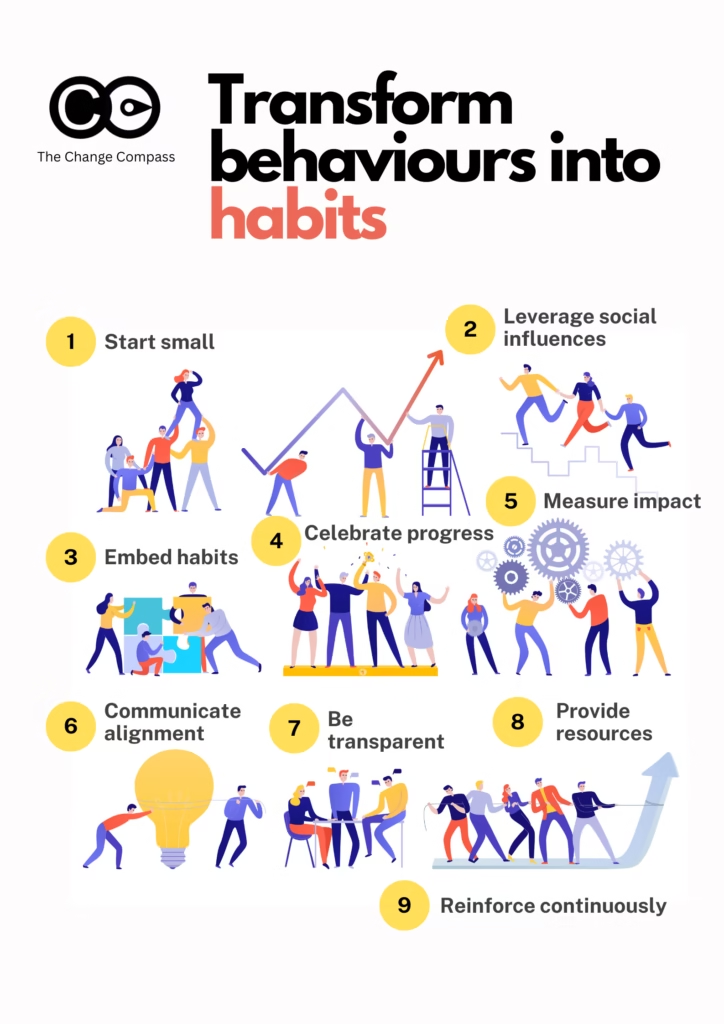
Start Small: Identify a single behaviour to change and build on early successes.
Leverage Social Influence: Empower change champions to share stories and model behaviours.
Embed Habits: Use the habit loop (Cue, Routine, Reward) to make new behaviours automatic.
Celebrate Progress: Recognise achievements, no matter how small, to maintain momentum.
Measure Impact: Regularly track progress against clear, relevant metrics.
Communicate Alignment: Ensure teams understand how their efforts contribute to the overall strategy.
Be Transparent: Share challenges and adjustments to build trust and credibility.
Provide Resources: Equip teams with the tools and training needed to succeed.
Reinforce Continuously: Ensure that reinforcement mechanisms
Transforming behaviours into habits is the cornerstone of sustained organizational change. By fostering belief, leveraging social reinforcement, and breaking complex changes into manageable steps, change leaders can build a culture where new behaviours become second nature. With clear goals, consistent measurement, and strategic alignment, these habits will not only endure but also drive lasting success.
Sustaining change requires patience, persistence, and a deep understanding of human behaviour. By focusing on the incremental steps that lead to lasting habits, senior practitioners can guide their organizations through even the most challenging transformations—one habit at a time.
Improving change adoption is the practice of taking concrete actions before, during and after a change is delivered so that the people affected actually shift to the new ways of working rather than reverting to the old. The improvement levers cluster into five areas: clarifying the change so the target behaviour is unambiguous, equipping leaders and managers to model and reinforce it, redesigning the environment so the new way is easier than the old, building feedback loops that catch slippage early, and measuring adoption continuously rather than at a single post-go-live point. Adoption is a system outcome, not a communications activity.
Change adoption is arguably the most important metric in change management, yet it remains one of the hardest to measure well. Most organisations can tell you how many people attended training or received communications. Far fewer can tell you whether those people actually changed their behaviour, and fewer still can prove that the behavioural change stuck.
This measurement gap has real consequences. Gartner’s 2025 research found that only 32% of business leaders globally report achieving healthy change adoption by employees. Yet the same research revealed that organisations with better-than-average healthy adoption report two times higher year-over-year revenue growth. The business case for measuring and managing adoption is not theoretical; it is a measurable driver of financial performance.
The challenge is that adoption is not a single event. It is a progression from initial awareness through to embedded behaviour. Measuring it requires different approaches at different stages, different data sources, and a clear framework for what “good” looks like at each point. This guide provides that framework.
What change adoption actually means
Before measuring adoption, it helps to define it precisely. Change adoption is the sustained demonstration of new behaviours, processes, or system usage by the target population, to the standard required for the change to deliver its intended business outcomes.
Three elements of this definition matter:
Sustained: Initial compliance is not adoption. If people revert to the old way after 30 days, the change has not been adopted.
To the standard required: Partial usage does not count. If a new system requires data entry in five fields and users consistently skip two, that is not full adoption.
Business outcomes: Adoption is not an end in itself. It only matters to the extent that it drives the performance improvements the initiative was designed to deliver.
This distinction is critical because many organisations declare adoption success at go-live, when all they have actually measured is initial compliance under close supervision.
The four stages of change adoption
Adoption follows a predictable progression. Measuring it effectively requires matching your metrics to the stage the change is in.
Stage 1: Awareness and understanding
Before anyone can adopt a change, they need to understand what is changing, why it matters, and what is expected of them. This stage occurs before and during the initial rollout.
What to measure:
Percentage of affected stakeholders who can accurately describe the change and its purpose
Comprehension scores from short knowledge assessments
Number and quality of questions being asked (engaged questions indicate understanding is building)
What good looks like: 80%+ of the target population can articulate the change, its rationale, and its impact on their role before go-live. Low awareness at this stage is a reliable predictor of adoption failure.
How to measure it: Pulse surveys (5-7 questions), manager check-in reports, town hall Q&A analysis.
Stage 2: Initial usage and compliance
This is the earliest observable adoption behaviour: people begin using the new system, following the new process, or attempting the new behaviour for the first time.
What to measure:
System login rates and basic feature usage within the first 30 days
Process compliance rates (percentage of transactions following the new process)
Training proficiency scores (not just attendance, but demonstrated competency)
Support ticket volumes and nature (high volume is expected; the nature of questions indicates where adoption is struggling)
What good looks like: 70%+ of the target population is demonstrating initial usage within 30 days of go-live. Support tickets shift from “how do I do this?” to “how do I do this more efficiently?” within the first month.
How to measure it: System analytics dashboards, process audit sampling, help desk categorisation reports.
Stage 3: Proficiency and integration
At this stage, users move beyond basic compliance to genuine proficiency. They are not just following the new process; they are integrating it into their daily work patterns with increasing efficiency.
What to measure:
Error and rework rates (declining rates indicate proficiency is building)
Processing time trends (users should be getting faster)
Self-service rates (decreasing reliance on help desk or support teams)
Voluntary usage of advanced features or capabilities beyond the minimum required
Productivity metrics compared to pre-change baselines
What good looks like: By 90 days post-implementation, error rates should be approaching pre-change levels (or better), processing times should show steady improvement, and support ticket volumes should have dropped significantly. See our guide to change management metrics for specific examples by initiative type.
How to measure it: System analytics, quality audit data, productivity dashboards, manager observation reports.
Stage 4: Ownership and advocacy
The highest level of adoption occurs when users no longer see the change as something imposed on them. They own it, improve it, and advocate for it to peers. This is where adoption becomes self-sustaining.
What to measure:
Sustained usage rates at 180+ days (with no active reinforcement)
User-initiated improvements or suggestions for the new process or system
Positive sentiment in employee feedback and surveys
Business outcome achievement against the original benefits case
What good looks like: Usage rates remain stable or increase without active change management intervention. Users identify improvements independently. The “old way” of doing things has been forgotten.
How to measure it: Long-term system analytics, employee engagement surveys, benefits realisation tracking, qualitative interviews.
Adoption metrics by initiative type
Different types of change require different adoption metrics. The table below maps the most relevant metrics to common initiative types.
Initiative type
Primary adoption metrics
Leading indicators
Measurement source
System implementation
Login rates, feature usage, transaction volumes
Training proficiency, awareness scores
System analytics, LMS
Process change
Compliance rates, error rates, processing time
Readiness assessment, manager confidence
Process audits, quality data
Restructure
Role clarity scores, decision speed, handover completion
One of the most common traps in measuring change adoption is over-reliance on self-reported data. Surveys asking employees whether they have adopted the change consistently overstate actual adoption, sometimes dramatically.
Self-reported data tells you what people believe or want you to hear. Behavioural data tells you what people actually do.
Where possible, prioritise behavioural indicators:
System usage data over survey responses about system satisfaction
Process compliance audit results over self-assessments of process adherence
Error rate trends over self-reported confidence levels
Observation data from managers over employee self-ratings
Self-reported data still has value for measuring awareness, sentiment, and perceived barriers, but it should never be the primary measure of adoption. Prosci’s research on metrics for measuring change management emphasises this: organisations that measured actual compliance and overall performance, rather than relying on subjective assessments, were three times more likely to meet project objectives.
Setting adoption targets and thresholds
Not every change needs 100% adoption. The appropriate target depends on the nature of the change and its relationship to business outcomes.
Mandatory compliance changes (regulatory, safety, legal): Target 95-100% adoption. Zero tolerance for non-compliance.
System and process changes: Target 85-90% sustained adoption at 90 days. Accept that a small percentage of edge cases may require workarounds.
Cultural and behavioural changes: Target 70-80% observable behaviour shift at 180 days. Cultural change is slower and more uneven; set realistic thresholds and measure trajectory rather than absolute numbers.
For each target, also define an intervention threshold: the adoption level below which corrective action is triggered. For example, if 30-day adoption falls below 50%, escalate to the sponsor and activate targeted support.
Portfolio-level adoption: measuring across concurrent changes
Organisations running multiple concurrent changes face an additional measurement challenge: understanding adoption at the portfolio level, not just initiative by initiative.
Portfolio-level adoption measurement examines:
Which stakeholder groups face the highest cumulative adoption burden
Whether adoption for one initiative is being achieved at the expense of another
Whether overall change capacity is being respected or overwhelmed
WTW’s 2023 research found that companies taking a proactive, data-driven approach to change management, one that considers the full portfolio rather than individual initiatives, drove nearly three times more revenue. For a deeper exploration of moving beyond single-initiative views, see our guide on graduating from change heatmaps.
How digital tools accelerate adoption measurement
Measuring adoption across a portfolio of concurrent changes, with stage-appropriate metrics, behavioural data, and real-time dashboards, is exceptionally difficult to manage manually.
Digital change management platforms such as The Change Compass enable organisations to track adoption metrics across multiple initiatives in real time, visualise where adoption is lagging and why, and aggregate portfolio-level data that manual methods cannot produce at scale. For organisations managing complex change portfolios, this kind of tooling transforms adoption measurement from periodic reporting into continuous, actionable intelligence. For a complete approach to measurement, see our ultimate guide to measuring change management outcomes.
Conclusion
Measuring change adoption effectively requires moving beyond go-live compliance counts to a staged framework that tracks progression from awareness through to ownership. Use behavioural data wherever possible, match your metrics to the adoption stage and initiative type, set realistic targets with clear intervention thresholds, and measure at the portfolio level, not just initiative by initiative. The organisations that measure change adoption with this rigour do not just deliver better projects; they build the evidence base that demonstrates change management’s direct contribution to business performance.
Frequently asked questions
What is change adoption?
Change adoption is the sustained demonstration of new behaviours, processes, or system usage by the target population, to the standard required for the change to deliver its intended business outcomes. It goes beyond initial compliance or training completion to encompass genuine behavioural change that persists over time.
How do you measure change adoption rates?
Measure adoption using a combination of behavioural data (system usage rates, process compliance audits, error rates) and survey data (awareness levels, sentiment scores). Track these metrics at 30, 90, and 180 days post-implementation to distinguish between initial compliance and sustained adoption. Prioritise observable behavioural indicators over self-reported data.
What is a good change adoption rate?
Target adoption rates depend on the type of change. Mandatory compliance changes should target 95-100%. System and process changes should aim for 85-90% sustained adoption at 90 days. Cultural and behavioural changes should target 70-80% observable behaviour shift at 180 days. The key is to measure trajectory, not just a single point in time.
How long does change adoption take?
Initial adoption typically begins within the first 30 days post-implementation. Proficiency usually develops over 60-90 days. Sustained, embedded adoption, where the new behaviour becomes habitual, typically requires 120-180 days for system and process changes, and 6-12 months for cultural changes. The timeline depends on complexity, support quality, and organisational readiness.
What is the difference between change adoption and change readiness?
Change readiness is the state of preparedness before a change is implemented: whether stakeholders are aware, trained, and supported. Change adoption is what happens after implementation: whether stakeholders actually demonstrate the required behaviours. Readiness is a leading indicator that predicts adoption; adoption is the outcome that readiness aims to enable.
How do you improve change adoption when it stalls?
First, diagnose where in the four-stage model adoption has stalled. If awareness is low, invest in targeted communication. If initial usage is low, investigate barriers (system issues, workflow conflicts, insufficient training). If proficiency is plateauing, provide coaching and peer support. If users are reverting to old behaviours, strengthen reinforcement mechanisms and sponsor engagement.