Most change management software on the market is not built for enterprise scale. It is built for a single project manager running a single initiative, then marketed up-market with the addition of a few user seats and a “team” pricing tier. When a global business with thirty active initiatives, twelve business units, and a regulator looking over its shoulder tries to deploy these tools, the gaps appear within weeks.
The procurement question for enterprise change leaders is not “which tool has the best features?” It is “which tool was actually designed for the operating environment we work in?” Those are different questions, and they produce different shortlists.
This guide is written for PMOs, Heads of Change, and HR leaders who are actively evaluating enterprise change management software in 2026. It sets out the seven non-negotiable features that distinguish enterprise-grade platforms from scaled-up SMB tools, the questions that should appear on every vendor scorecard, the red flags that disqualify a vendor regardless of how good the demo looks, and a structured compliance checklist for procurement and risk teams.
The goal is to help you make a decision that will hold up two years from now, not just to the first contract renewal.
Why enterprise change management software is a different category
The change management software market is broad and crowded, but it splits cleanly into two segments once you look past the marketing. SMB tools are designed around a single change manager working through a single initiative at a time. They optimise for ease of use, lightweight templates, and quick onboarding. For a small organisation running one or two changes a year, they are entirely adequate.
Enterprise change management software solves a fundamentally different problem. Enterprise organisations are running a portfolio of changes, often dozens at a time, against the same employee base. They have compliance obligations that constrain how data is handled and audited. They have integration requirements with HRIS, ITSM, and identity systems that the procurement team will not budge on. They need reporting that satisfies the board, not just the project sponsor.
The cost of treating these as the same category is significant. According to the Prosci 12th Edition Best Practices in Change Management report, the most mature change management functions are characterised by enterprise-wide integration, standardisation, and measurable adoption tracking across the portfolio. None of those capabilities are achievable when each project team is working in a separate tool with no aggregated view, or when a tool that was designed for one initiative gets stretched across thirty.
If your organisation is genuinely operating at enterprise scale, the seven features in the next section are not nice-to-haves. They are the criteria that determine whether the platform will be useful in eighteen months or whether it will be the tool nobody opens.
The seven features enterprise change management software must have
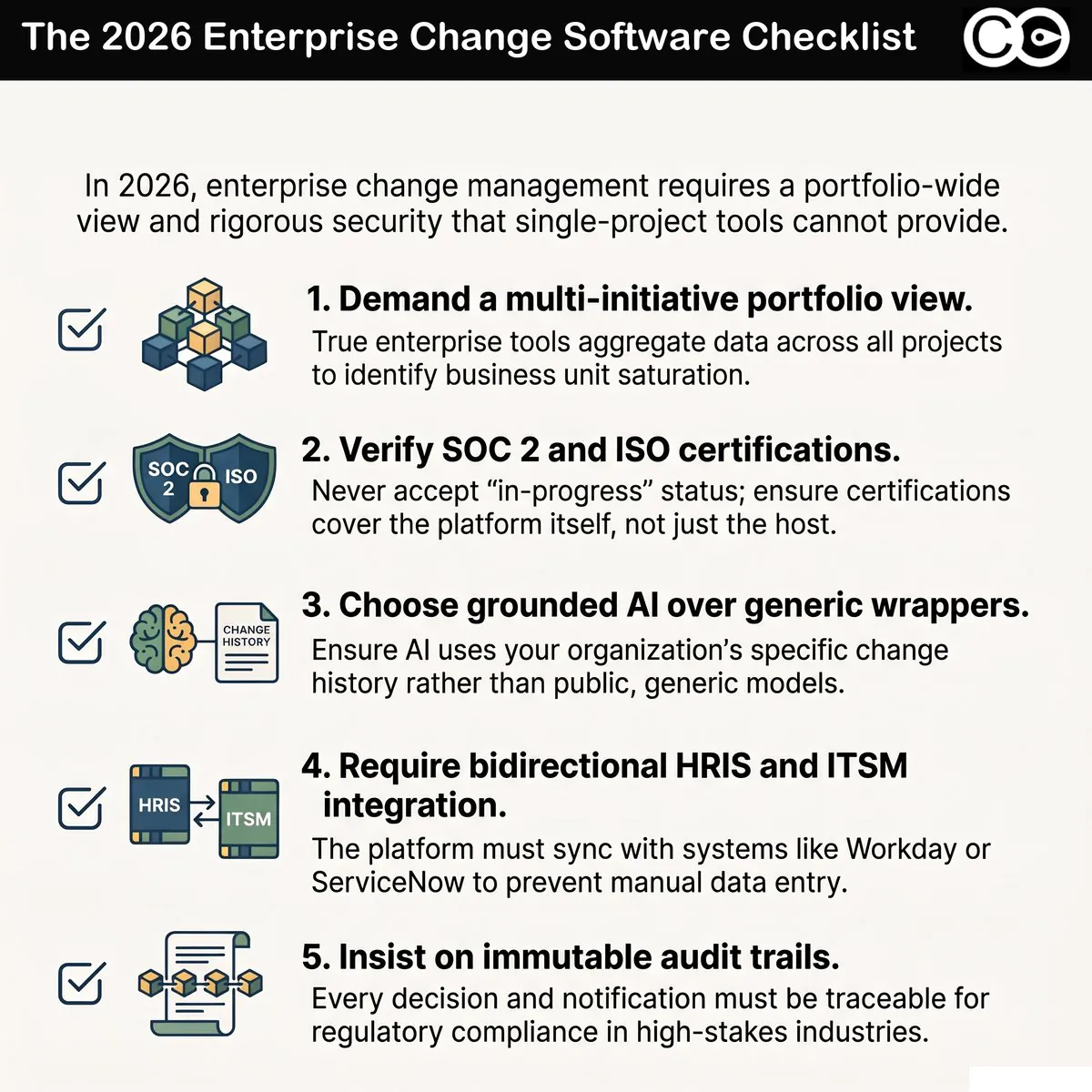
1. Multi-initiative portfolio view
The defining capability of enterprise change management software is the ability to aggregate change activity across every active initiative and present it as a single, coherent portfolio view.
This sounds obvious, but it is the feature most commonly missing. Many tools positioned as “enterprise” are still architecturally single-project. Each initiative lives in its own workspace, with its own data, its own stakeholders, and its own dashboard. Aggregation across initiatives is achieved, if at all, through manual export and consolidation.
The practical test: ask the vendor to show you, in their tool, the total change load on a single business unit across all currently active initiatives. If the demo path involves opening multiple project files and combining them by hand, you are looking at a single-project tool with enterprise pricing.
A genuine portfolio view shows initiatives, business units, and time on the same axes. It allows leaders to see immediately where saturation is approaching, where capacity is available, and where two initiatives are about to land on the same group at the same time. This capability is the foundation everything else depends on. Without it, executive reporting, sequencing decisions, and risk management all collapse back to the project level. For a PMO-focused evaluation framework covering this capability in depth, see our change management portfolio tools buyer’s guide.
2. Role-based access and governance
Enterprise organisations cannot operate on a model where every user sees every piece of data. There are sponsor groups who need executive views, project teams who need their own initiative data, business unit leaders who need their unit’s load profile, and external partners who may need limited read-only access.
A genuine role-based access control system supports configurable roles, granular permission scopes, delegated administration, and the ability to audit who changed what and when. This is not a feature that can be retrofitted. It has to be built into the data architecture from the start.
When evaluating vendors, ask how their access model handles four scenarios:
An external consultant needs read-only access to two specific initiatives but not the rest of the portfolio
A business unit leader needs write access for their division’s data but read-only access for organisation-wide reports
A senior sponsor needs the executive dashboard but no editing rights anywhere
A regulator or auditor needs a structured export of changes affecting a regulated function over a date range
If any of these scenarios produces a “we can configure that” rather than a clear demonstration in the live product, treat that as a signal that the access model is brittle.
3. Audit trail for compliance and reporting
In regulated industries, every material decision affecting the workforce or the operating model has to be traceable. When a regulator asks what change was implemented, who approved it, when employees were notified, and what evidence exists of the rollout, the answer cannot be “let me check our shared drive.”
Enterprise change management software provides a complete, immutable audit trail of changes to initiatives, decisions logged, communications issued, and stakeholder actions taken. This is a compliance requirement in financial services, healthcare, energy, government, and increasingly in any industry subject to operational resilience regulation.
The audit trail must include the user, the timestamp, the action, and the prior state. It must be exportable in a structured format. It must be retained according to the organisation’s data retention policy, and the platform must be able to demonstrate that it has not been tampered with.
This is not the kind of feature that gets demonstrated in a sales call. It needs to be verified during procurement diligence, and the vendor’s response should be a documented audit logging specification, not a verbal assurance.
4. Enterprise SSO and security standards
The procurement team will not approve a platform that requires users to maintain a separate password. Single sign-on integration with the organisation’s identity provider, typically through SAML 2.0 or OpenID Connect, is a baseline requirement. Multi-factor authentication, session management, and integration with the corporate identity lifecycle (so that when an employee leaves, their access is revoked automatically) are non-negotiable.
Beyond SSO, the platform should hold current independent certifications. The two that consistently appear in enterprise procurement requirements are SOC 2 Type II (which demonstrates ongoing operational controls over a sustained period, not just a point-in-time assessment) and ISO 27001 (which certifies the information security management system as a whole). For organisations operating in the EU, GDPR compliance and a published Data Processing Agreement are mandatory. For Australian organisations, alignment with the Australian Privacy Principles and consideration of data residency are essential.
The vendor should be able to provide their current SOC 2 report and ISO 27001 certificate on request, under NDA where appropriate. If the response involves vague language about being “in the process of certification” or relying on the certifications of underlying cloud providers (AWS or Azure being SOC 2 compliant does not make a SaaS platform built on them SOC 2 compliant), the platform is not yet enterprise-ready.
5. AI features that use your organisation’s data, not generic models
This is the feature where vendor differentiation in 2026 has shifted most significantly. Almost every change management platform now claims AI capabilities. The substantive question is what data those AI features are operating on.
Generic AI features that wrap a public large language model and prompt it with the contents of the user’s current screen are not enterprise AI. They produce generic outputs. They cannot reference the organisation’s specific change history, its previous adoption patterns, the impact profile of the affected stakeholder groups, or the load context of other in-flight initiatives. Worse, they introduce data residency and confidentiality concerns that the procurement team will scrutinise heavily.
Purpose-built AI for change management, by contrast, is grounded in the organisation’s own portfolio data, augmented with anonymised industry benchmark data, and constrained to use cases where its outputs are verifiable. It can generate executive narratives that reference real portfolio metrics, suggest sequencing options based on actual capacity data, and produce stakeholder analyses that reflect the organisation’s specific structure.
When evaluating AI features, ask three questions:
What data does the AI feature have access to, and what data is it explicitly excluded from?
Where is the inference happening, and how is the data handled in transit and at rest?
How does the vendor protect against the AI generating outputs that look authoritative but are not grounded in real organisational data?
If the answers are vague, the AI capability is most likely a wrapper, not an integrated system.
6. Executive reporting with one-click export
Senior leaders do not log into change management platforms. They read board packs, executive summaries, and one-page status reports. The platform’s value at the executive level is realised through its ability to produce these artefacts on demand, with high-quality data and minimal manual work.
Enterprise platforms provide pre-built executive reporting templates that pull live data from the portfolio, can be exported to PDF and PowerPoint with formatting intact, and can be configured to match the organisation’s branding and reporting cadence. Critically, the export should be one click, not a manual rebuild.
For a deeper treatment of the executive reporting problem and the questions executives actually need answered, the companion article on the ultimate guide to change management reports sets out a practical framework.
The diagnostic when evaluating: ask the vendor to produce a board-ready report from their tool, using real data, in front of you. If they cannot, or if the output requires manual cleanup in PowerPoint to be presentable, the platform will not save the time it claims to.
7. HRIS and ITSM integration
Enterprise change management software does not exist in isolation. The data needed to identify affected stakeholders, route notifications, and track adoption typically lives in the HRIS (Workday, SAP SuccessFactors, BambooHR) and the ITSM (ServiceNow, Jira Service Management). If the change platform cannot integrate with these systems, the change team becomes a permanent intermediary copying data back and forth.
A genuine integration is bidirectional, configurable, and supported. The vendor publishes the integration capabilities, supports common authentication patterns (OAuth 2.0, API tokens with scoped permissions), provides webhooks for event-driven workflows, and offers either pre-built connectors or a documented API for custom integration work.
The questions to ask: what HRIS integrations are pre-built and supported in production? What ITSM integrations? Is the API rate-limited in ways that would constrain enterprise use? Are integration assets owned by the customer or by the vendor (which matters at contract renewal)?
A platform without serious integration capability will become an island. The data quality will degrade, the manual reconciliation overhead will accumulate, and within a year, the change function will be working around the tool rather than through it.
Questions to ask every vendor before you sign
Vendor sales cycles are designed to highlight the platform’s strongest features. Procurement diligence has to surface the weak ones. The following questions are deliberately uncomfortable, and the quality of the responses tells you more than the polished demo.
Show me a live customer environment with at least twenty active initiatives. Can I see the portfolio view?
What is your average implementation timeline for an enterprise customer? What proportion of customers go live on or before that timeline?
Walk me through a recent enterprise customer churn. Why did they leave, and what would have prevented it?
What is your current SOC 2 Type II report period? Can your security team meet with mine before contract?
Provide three customer references at organisations of similar scale and complexity to ours, including at least one we can call without you on the line.
What does your product roadmap look like for the next twelve months, and how do enterprise customers influence it?
If we need to extract all our data from your platform, how would we do it? In what format, and how long would it take?
What is your incident response process? Show me your last status page outage report.
The answers to these questions tell you whether the vendor has been operating at enterprise scale or whether they are about to learn what that means using your organisation as the case study.
Red flags that should disqualify a vendor for enterprise use
Some signals during evaluation are reliable disqualifiers. Each of these has cost organisations significant amounts of remediation work after the contract was signed:
The product cannot demonstrate a working portfolio view across multiple initiatives in a live environment
The vendor cannot produce a current SOC 2 Type II report on request, under NDA
The data export capability is described in marketing terms but not demonstrated, or produces unstructured output
The reference customers are all SMBs, with no enterprise-scale deployments to point to
The implementation timeline is “weeks” with no enterprise-scale customisation or integration work scoped
The contract terms include automatic data ownership transfer to the vendor, or limit the customer’s ability to extract their own data
The AI capability is presented as a major differentiator but the underlying model and data flow are not disclosed
The integration story is “we have an API” without documented, supported integrations to specific HRIS or ITSM platforms
The pricing model penalises usage growth steeply enough that adopting the tool widely creates significant cost risk
If two or more of these are present, the platform is not ready for enterprise procurement. Polite withdrawal during evaluation is significantly less expensive than discovering the gaps during deployment.
The enterprise compliance checklist
For procurement and risk teams, the following structured checklist captures the controls that should be verified before contract signature. Each item should be evidenced through documentation, not just verbal confirmation.
Information security
[ ] Current SOC 2 Type II report covering a minimum 6-month observation period
[ ] Current ISO 27001 certificate with scope statement covering the platform
[ ] Documented incident response plan and 12-month incident history
[ ] Penetration testing programme with most recent test report available under NDA
[ ] Data encryption in transit (TLS 1.2+) and at rest (AES-256 minimum)
Identity and access
[ ] SAML 2.0 and/or OpenID Connect SSO support
[ ] SCIM 2.0 user provisioning and deprovisioning
[ ] Configurable role-based access control with audit logging
[ ] Three or more reference customers at comparable scale
[ ] Documented business continuity plan covering vendor failure scenarios
[ ] Source code escrow arrangement available for mission-critical use cases
This checklist is designed to be handed to procurement and security teams as a structured assessment artefact, not just a vendor conversation guide.
How Change Compass meets enterprise change management software requirements
Change Compass was built specifically for the enterprise change management software requirements set out in this guide.
The platform’s portfolio view aggregates change activity across all active initiatives and presents it at the business unit, role, and stakeholder group level, with no manual consolidation required. Role-based access control is configurable to enterprise governance models, with delegated administration and full audit logging. The audit trail meets the requirements of regulated industries, with immutable logging and structured export.
On security and compliance, Change Compass holds SOC 2 Type II and ISO 27001 certifications, supports SAML SSO and SCIM provisioning, and offers data residency options aligned to Australian, US, and EU requirements. The platform’s AI capabilities are purpose-built for change management, grounded in customer portfolio data and anonymised industry benchmarks, with documented data handling and no exposure to public model training.
Executive reporting is one-click export to PDF and PowerPoint with branded formatting. Pre-built integrations cover Workday, SuccessFactors, ServiceNow, and Jira, with a documented API for custom work. The platform is currently used by more than 50 enterprise customers, including FINRA, Northwestern Mutual, and Insurance Australia Group.
For organisations evaluating enterprise change management software in 2026, book an enterprise demo to see the platform working with portfolio data at scale.
Making the final decision
Enterprise change management software procurement is rarely about picking the platform with the most features. It is about picking the platform that will still be useful in two years, when the organisation has scaled its change function, signed up to additional regulatory regimes, and integrated change management more deeply into its operating cadence.
The decision rests on three questions. First, has the platform actually been built for enterprise scale, or is it a single-project tool with enterprise pricing? Second, will it pass the procurement and security diligence that a mature enterprise applies to any SaaS purchase? Third, will the change function be working through it or around it in eighteen months?
The vendors that survive that scrutiny are not always the ones with the slickest marketing. If you are building a shortlist, our overview of organisational change management software sets out how The Change Compass approaches these requirements. They are the ones whose product, security posture, and customer base demonstrate that they understand the operational reality of enterprise change management. That is the shortlist worth investing diligence in.
For a comprehensive overview of AI in change management
Enterprise change management software is most powerful when it includes AI capabilities grounded in your organisation’s change data. To understand how AI integrates with platform selection and fits into the broader strategy of AI adoption in change management, see our complete guide: AI in change management: the complete guide (2026).
Frequently asked questions
What is enterprise change management software?
Enterprise change management software is a platform purpose-built to manage organisational change at scale, across a portfolio of concurrent initiatives, in environments with significant compliance, security, and integration requirements. It differs from SMB change management tools by providing aggregated portfolio views, role-based access control, audit trails for regulatory compliance, enterprise SSO, AI features grounded in organisational data, and pre-built integrations with HRIS and ITSM systems.
How is enterprise change management software different from project management software?
Project management software focuses on task delivery: scope, timeline, dependencies, and resourcing for individual projects. Enterprise change management software focuses on the people side of change across the entire portfolio: stakeholder impact, adoption, capacity, sequencing across initiatives, and the cumulative load on the workforce. The two categories are complementary, not interchangeable, and most enterprise organisations need both.
What features should enterprise change management software include?
At minimum: multi-initiative portfolio view, role-based access control, immutable audit trail, enterprise SSO and current security certifications (SOC 2 Type II and ISO 27001), AI features grounded in organisational data rather than generic models, executive reporting with one-click export, and pre-built integrations with major HRIS and ITSM platforms. Tools missing any of these are not yet enterprise-ready, regardless of marketing positioning.
How long does enterprise change management software take to implement?
Typical enterprise implementations run between 8 and 16 weeks, depending on the integration scope, data migration requirements, and the maturity of the organisation’s existing change management practices. Vendors quoting “weeks” without scoping integration work or organisational change adoption are usually describing a software activation, not an enterprise implementation. The implementation is also a change initiative in its own right and should be planned accordingly.
How do you choose between enterprise change management software vendors?
Run a structured evaluation that goes beyond the demo. Insist on a live working session with real data, request reference customers at comparable scale, complete the security and compliance diligence (SOC 2, ISO 27001, audit trail, data export), test the integration capability against your specific HRIS and ITSM environment, and pressure-test the AI capability with questions about data flow and grounding. The vendor that engages substantively with all of these is the vendor that has built for enterprise.
References
Prosci: 12th Edition Best Practices in Change Management
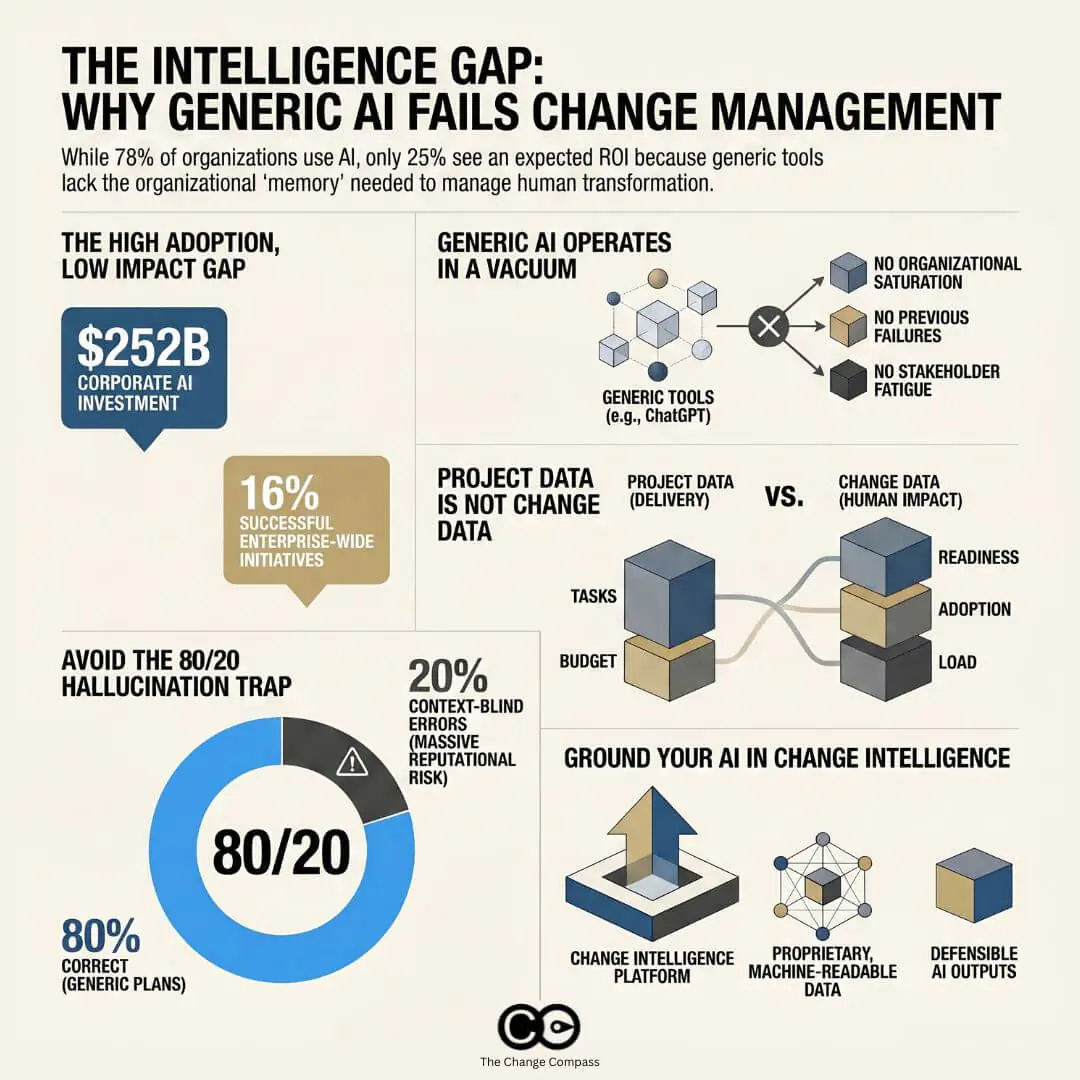
Corporate AI investment hit $252.3 billion in 2024 according to the Stanford HAI AI Index 2025, and 78% of organisations now use AI in at least one business function, up from 55% a year earlier. Yet a May 2025 IBM Institute for Business Value survey of 2,000 CEOs found that only 25% of AI initiatives have delivered the expected return, and just 16% have scaled enterprise-wide. The gap is widest in the disciplines where AI was supposed to help most, and AI for change management is among the clearest examples.
For change leaders, the symptom is familiar. Practitioners draft impact statements in ChatGPT. Project managers ask Microsoft Copilot to summarise stakeholder feedback. Sponsors paste a comms plan into Claude and ask for an executive version. The outputs look fluent, but anyone close to the work sees the same pattern: generic AI cannot reason about an organisation it does not know. It cannot weigh a new initiative against the five already in flight for the same audience. It cannot recall what happened the last time the operations team was asked to absorb a major systems change.
The conclusion most leaders are drawing is the wrong one. The constraint is not the AI model. The constraint is the absence of a system of record for change that the AI can actually reason against. An enterprise change intelligence platform is what fills that gap, and once it does, the relationship between change management and strategic outcomes shifts in a way that no productivity tool can replicate.
The AI productivity trap in change management
The first wave of AI adoption in change management has been characterised by individual practitioners using generic tools to accelerate familiar tasks. This is sensible, and at small scale it works. Drafting a stakeholder email, structuring a training outline, generating five variants of a comms message: these are bounded, low-risk uses where the cost of an inaccurate output is low.
The problem starts when leaders extrapolate from these wins. A practitioner who saves an hour drafting an email assumes the same tool will help them assess saturation across a $40 million transformation portfolio. It will not. The hour saved is a productivity gain. The portfolio question is a data problem. A separate companion guide on what AI can and cannot do in change management sets out the boundary in more detail, but the headline is straightforward: AI is strong on language tasks bounded by the prompt, and weak on reasoning that requires organisation-specific context the model has never been given.
Research by McKinsey on scaling agentic AI puts the structural issue in stark terms: eight in ten companies cite data limitations as the principal roadblock to scaling AI, and the value of large and small language models comes from the ability to train and ground them on the organisation’s own proprietary data. The same study notes that competitive advantage now flows from a small set of well-curated data products, treated as reusable, business-ready assets with clear ownership, semantics, and quality standards.
For change management, the implication is direct. If your organisation has no structured record of what initiatives are in flight, who is affected, what training has been delivered, what readiness scored, and how previous change has landed, no AI tool can reason about it. The model produces a plausible-sounding answer, drawn from generic training data, that may be confidently wrong about your specific context. The Stanford AI Index documented a 56.4% surge in AI incidents in 2024, and public trust in AI companies’ handling of personal data fell from 50% to 47% over the same period. In change management, where decisions hinge on the trust of frontline employees and the credibility of leadership messaging, an AI hallucination is not a quirky output. It is a reputational risk to the entire change function.
The project blinker: why project data is not change data
A predictable objection arises whenever change leaders raise the case for a dedicated change intelligence platform. Senior PMO leaders and programme directors push back with a version of: “we already have all of this. It is in our PPM tool, our project plans, our RAID logs, our portfolio dashboard.” The objection is sincere, and it is wrong. What looks like change data from inside a project office is project data viewed through a project planning and execution lens. The two data sets answer fundamentally different questions, and conflating them is the most common reason organisations under-invest in genuine change infrastructure.
A project plan records what the delivery team will do, by when, with what resources, and against which risks. A RAID log records the issues the project team is managing. A portfolio dashboard records the status, spend, and milestone position of each programme. All of this is necessary, and none of it tells you what is landing on a regional operations manager on the third Tuesday of November, when four systems change at once, on top of the new code of conduct module she completed two months ago, and the two leadership changes her function absorbed in the previous quarter.
Two different unit-of-analysis lenses
Project data is captured from the perspective of the delivery team. Its unit of analysis is the initiative. Its core dimensions are scope, schedule, budget, dependencies, and risks. Change data is captured from the perspective of the impacted business employee. Its unit of analysis is the human being on the receiving end of the entire portfolio. Its core dimensions are stakeholder group, impact type and severity, calendar phasing, training and engagement received, behavioural shift required, and adoption signal. Both are valid, both are needed, and one cannot substitute for the other. A perfectly green portfolio dashboard is entirely compatible with a workforce that is overloaded, disengaged, and quietly failing to adopt.
Why this matters for AI
The project blinker has a direct AI consequence. When AI is layered on top of project data and asked to reason about employee experience, capacity, or adoption risk, the answers it produces are confidently inaccurate. The model is not at fault. The data was never designed to answer those questions. Companion analysis on stakeholder impact analysis sets out the resulting blind spot in more detail, but the principle is straightforward: an AI grounded in project data will tell you a story about projects. It will not tell you a story about people, because the people-side data simply is not there.
This is why a purpose-built change intelligence platform is required even in organisations with mature PMO function and best-in-class PPM tooling. The platform exists to capture the data set the PMO was never set up to collect, and to make that data set available to grounded AI on equal footing with the project data the organisation already has.
The 80/20 trap: why partially-wrong AI recommendations are the real danger
The most commonly discussed AI risk in change management is hallucination, where a model invents a fact, a citation, or a stakeholder group that does not exist. This is the visible failure mode, and it is usually caught quickly by anyone with domain knowledge. The harder failure mode, and the one that actually derails change outcomes, is the partially-wrong recommendation.
A typical generic-AI change plan looks credible. Eighty per cent of it draws on widely accepted best practice and reads as logical advice any senior practitioner would recognise. It is the remaining ten to twenty per cent that creates the risk. Common examples drawn from change plans drafted using generic AI include:
The wrong sequencing for a specific business unit, because the model does not know what else is landing on that unit at the same time
The wrong intensity rating for a stakeholder group that has just absorbed three other initiatives in the same quarter
The wrong assumption about who the actual sponsors are, drawn from public org charts rather than the organisation’s real decision rights
The wrong training cadence for a workforce whose annual learning capacity has been fully booked since March
The wrong communication channel mix, recommended from generic best practice that does not match how this organisation’s frontline actually consumes information
These are not hallucinations. They are reasoned-looking outputs that happen to be wrong for this specific organisation, and they do not announce themselves. The 80% of the plan that is sound creates a halo of credibility around the 20% that is not. A reviewer scanning a plausible-looking document is unlikely to challenge it in a time-pressured governance forum. By the time the misstep is visible in adoption or engagement data, the plan is months into delivery and the cost of intervention has multiplied.
This is the precise problem that organisation-specific data is built to solve. When AI is grounded in the actual portfolio, the actual stakeholder load profile, the actual decision-rights register, and the actual historical adoption pattern, the partially-wrong 20% has nowhere to hide. The platform catches the inconsistency at the point of recommendation, not three months later in the engagement survey.
What an enterprise change intelligence platform actually does that ChatGPT cannot
A change intelligence platform is not a better version of ChatGPT. It is a category of enterprise software that exists upstream of any AI assistant, and it does three structural things that no generic AI tool can replicate.
A single source of truth for change
Every initiative in flight, every stakeholder group affected, every milestone date, every readiness assessment, every training record, captured against a consistent taxonomy. This is the system of record layer, and it is what allows any subsequent analysis, human or AI, to compare like with like across the portfolio rather than across spreadsheets.
Machine-readable structured data
Free-text descriptions of impact, embedded in a slide deck, are unusable to any system. Impact captured against defined categories (process, system, role, organisational structure, behaviour) and scored against a consistent scale becomes the substrate for portfolio analysis. This is the structured-data layer.
Aggregation and visualisation across the portfolio
A heatmap of cumulative change load across business units, a stakeholder fatigue index per audience group, a saturation score per division: these only exist when the system of record and the structured data are in place. They cannot be retrofitted by asking ChatGPT to summarise twelve project plans, because the underlying inputs are not comparable.
This is the foundation that The Change Compass calls a change intelligence platform, and the category exists precisely because the underlying data problem is not solvable with a chatbot. The platform is the data infrastructure that makes AI in change management actually work.
Once that foundation is in place, AI becomes useful in ways it cannot be when used in isolation. A practitioner asking the platform to generate a stakeholder impact summary is no longer relying on the model’s general knowledge. The model is grounded in the organisation’s actual impact data, its actual stakeholder taxonomy, its actual portfolio of initiatives, and its actual historical adoption outcomes. The output stops being plausible-sounding generic prose and starts being a specific, defensible synthesis of the organisation’s own data.
Why proprietary data is the missing piece for AI in change management
This pattern is not unique to change management. It is the same pattern that every enterprise function is now learning the hard way. In their five trends in AI and data science for 2025, MIT Sloan Management Review’s Thomas Davenport and Randy Bean identify retrieval-augmented generation, where an AI model is given access to proprietary documents and data to ground its responses, as the dominant pattern for enterprise AI value creation. They cite Colgate-Palmolive applying RAG to a corpus of proprietary consumer research and third-party data, allowing employees to query the entire knowledge base rather than work from individual reports.
The mechanics matter. A general-purpose language model is trained on publicly available text, which means it knows nothing about your portfolio, your stakeholder groups, your governance structures, your industry-specific compliance rules, or your historical change outcomes. Grounding the model in proprietary data is what closes that gap, and Databricks’ 2025 State of AI analysis reports that the use of vector databases supporting retrieval-augmented generation grew 377% year-on-year as enterprises caught up to this reality.
The IBM CEO Study reinforces the strategic implication. Seventy-two percent of CEOs surveyed said their organisation’s proprietary data is the key to unlocking the value of generative AI, and 68% identified an integrated enterprise-wide data architecture as critical for cross-functional collaboration. These findings are not about the change function in particular, but they apply with unusual force in change management, because the discipline depends on a richer and more diverse data set than almost any other corporate function. It needs initiative data, impact data, capacity data, adoption data, readiness data, and historical context, and it needs them in a shape that supports portfolio-level reasoning, not project-level reporting.
A change intelligence platform is the operational answer to that requirement. It is the data architecture that the IBM and McKinsey research describe, applied specifically to change. Without it, the AI tools your practitioners use are working blind. With it, the same tools can produce outputs that are specific to your organisation, grounded in your actual context, and defensible to the executives reviewing them.
From a pair of hands to a strategic enabler
The shift this unlocks is the one that matters most. For two decades, the change management function has been positioned, internally and externally, as a delivery muscle. Projects spin up, the change team is engaged late, a stakeholder analysis is produced, a comms plan is built, training is delivered, and the team is redeployed. This is the “pair of hands” model, and it is the model that most enterprise change management practices still operate under.
The combination of a change intelligence platform and grounded AI changes the operating model in four ways.
From project-level reporting to portfolio-level intelligence. When every initiative feeds the same data layer, the change function can answer questions no project team can answer. Where is cumulative load highest? Which divisions are approaching saturation? Which stakeholder groups are absorbing change from four directions at once?
From retrospective reviews to predictive analysis. Once historical adoption data, impact data, and readiness data are captured against a consistent taxonomy, the AI can identify patterns in what predicted past outcomes and forecast the trajectory of current initiatives. This is the use case McKinsey describes as competitive advantage moving to those who package data into reusable products.
From reactive sequencing to deliberate scheduling. A grounded AI can model what happens if a new initiative goes live in Q3 vs Q4 against the existing portfolio, and surface the stakeholder groups most likely to be overloaded. The change function moves from being asked to “make this work” to advising governance on what to prioritise.
From advisory voice to evidence-based authority. A recommendation backed by portfolio data, historical evidence, and stakeholder load modelling carries different weight in an executive committee than a recommendation backed by practitioner judgement alone. Strategic projects you might previously have lost the argument on become defensible on the data.
This is what research by the Project Management Institute, in its 2025 Pulse of the Profession report, describes as the shift from operational delivery to strategic value creation. PMI found that organisations whose project professionals demonstrate high business acumen achieve a 72% success rate in meeting business goals, compared with 65% for those who do not, and that the top performers consistently invested in benefits realisation management maturity and adaptability to changing conditions. The change function, properly equipped, sits squarely in this same value creation space. Without the data layer to support it, the function will continue to be positioned as a delivery cost. With it, the function becomes one of the organisation’s primary strategic levers.
How this de-risks the business and protects performance
The strategic case for an enterprise change intelligence platform is also a risk argument. Most large organisations now run between fifteen and forty concurrent change initiatives at any given time, and a meaningful proportion of those initiatives target the same stakeholder groups. When initiatives compete for the same audience without coordination, the consequences are predictable and measurable. Adoption drops. Productivity sags during the transition. Engagement scores fall. Discretionary effort declines. Attrition rises in the most affected teams. The combined effect is a meaningful drag on the business case for every initiative in the cluster.
Trust as the foundation of AI-enabled change
Accenture’s Technology Vision 2025 frames the broader risk picture in a useful way. The report argues that enterprises are building what it calls “cognitive digital brains” by hard-coding workflows, institutional knowledge, value chains, and social interactions into systems that can reason and act with autonomy. The report notes that 77% of executives believe the true benefits of AI can only be unlocked when systems are built on a foundation of trust, and that trust is now the most important measure of an AI system’s viability.
In change management, the foundation of trust is the data layer. An enterprise change intelligence platform makes the underlying assumptions visible, the impact data auditable, and the adoption outcomes traceable. When AI is added on top of that foundation, its recommendations are explainable. When AI is bolted onto an organisation with no system of record, its recommendations are guesses, and the change function carries the reputational risk for every one that turns out to be wrong.
Early warning, not post-mortem
The downstream effect on strategic outcomes is direct. Strategic initiatives are typically the ones with the highest stakes, the most ambitious benefits cases, and the tightest interdependencies. They are also the ones most exposed to the risk of cumulative change load. An organisation that cannot see, in advance, that its top three strategic initiatives all land on the same audience in the same quarter has no early warning system. The first signal arrives in the adoption numbers, by which point the cost of intervention is materially higher than the cost of resequencing.
A change intelligence platform with grounded AI gives leadership that early warning. It is the difference between learning your operating model transformation failed because the relationship managers were drowning, and learning, three months earlier, that the relationship managers were going to be drowning unless something gave. The first is a post-mortem. The second is a governance decision.
Where Change Compass fits
Change Compass is the enterprise change intelligence platform built specifically for this use case. The platform captures every initiative in flight against a consistent change taxonomy, structures impact and stakeholder data so it is machine-readable, and aggregates the result into portfolio-level views including saturation heatmaps, stakeholder fatigue indices, and adoption forecasts. Its AI capabilities are grounded in the customer’s own data and benchmark data from across the platform’s enterprise client base, which means the recommendations a practitioner receives are specific to their organisation’s situation rather than drawn from generic training data. For organisations evaluating whether to invest in a change platform, the companion guide on enterprise change management software walks through the features that distinguish an enterprise-grade platform from a project tool.
For change leaders who have already begun experimenting with generic AI tools, the more useful framing is that the platform is what makes those experiments worth running at scale. Without it, even the best AI is operating on guesswork. With it, the same AI becomes a strategic instrument for the function.
Making the shift
The practical starting point is not a procurement exercise. It is a diagnostic. The questions worth answering, before any tool decision is made, are these.
Can you produce, today, a single view of every change initiative in flight across the organisation, with consistent impact data and stakeholder mapping?
Can you tell the executive sponsor of a new initiative which other initiatives are landing on the same audience, in the same quarter, at what cumulative load?
Do you have a record of how previous change has landed in each business unit that an AI tool, or a human analyst, could reason against?
Do your AI experiments in change management currently produce outputs that are specific to your organisation, or generic outputs that have been lightly contextualised?
If the answer to any of these is no, the gap is the data layer, not the AI model. An enterprise change intelligence platform is the structural fix. The first wave of AI in change management was about productivity. The second wave, and the one that distinguishes organisations that achieve their strategic goals from those that do not, will be about intelligence. And intelligence requires a system of record, structured data, and an architecture that allows AI to do what generic tools can never do alone: reason about the specific organisation it is operating in.
The change function that gets this right stops being a delivery cost and starts being a strategic enabler. That is the shift the next five years of transformation work will reward.
What is an enterprise change intelligence platform?
An enterprise change intelligence platform is a system of record for organisational change that captures every initiative, stakeholder group, impact assessment, and adoption metric against a consistent taxonomy, then uses that structured data to provide portfolio-level intelligence. It is distinct from a project-level change tool because it operates across the entire transformation portfolio, and it is the data foundation that makes AI in change management produce defensible, organisation-specific outputs rather than generic ones.
Why is generic AI like ChatGPT or Microsoft Copilot insufficient for enterprise change management?
Generic AI tools are trained on publicly available data and have no access to an organisation’s specific initiatives, stakeholder groups, historical change outcomes, or cumulative load profile. They can produce plausible-sounding generic text, but they cannot reason about a specific portfolio. For tasks where the value depends on organisation-specific context, such as saturation analysis, stakeholder load modelling, and adoption forecasting, the outputs are unreliable without a grounding data layer.
How does an enterprise change platform improve strategic outcomes?
It does so by giving leadership early visibility of portfolio-level risk before that risk turns up in the adoption numbers. When every initiative is captured against the same taxonomy, the platform can surface cumulative impact on stakeholder groups, model the effect of sequencing decisions, and forecast adoption outcomes. That early warning capability is what allows governance to resequence, pause, or resource initiatives before they fail rather than after.
What is the role of AI in a change intelligence platform?
AI in a properly architected change intelligence platform is grounded in the organisation’s own data, not in generic training corpora. It can summarise stakeholder load, surface convergence patterns across initiatives, draft initiative-specific impact narratives, and forecast adoption based on the organisation’s own historical outcomes. The grounding is what makes the AI usable as a strategic instrument rather than a productivity gadget.
How is this different from just using an AI tool with a custom prompt?
A custom prompt is a thin layer on top of a generic model. It can shape tone and structure, but it cannot give the model access to the organisation’s data. A change intelligence platform provides the structured data layer that an AI model can reason against in real time, using retrieval-augmented generation or equivalent techniques. The difference is the difference between a model that sounds informed and a model that is informed.
When a global bank rolls out a new core banking platform across 50,000 employees, or when a government department restructures three divisions simultaneously, the change management challenge isn’t a lack of frameworks. It’s a lack of visibility. Which teams are carrying the heaviest change load this quarter? Where do two major initiatives collide on the same stakeholder group in the same fortnight? Which readiness risks are climbing, and who needs to know about it before it’s too late?
These are portfolio-level questions, and they are the reason a growing number of organisations are moving beyond spreadsheets, SharePoint sites, and slide decks to invest in purpose-built organisational change management (OCM) software. According to Prosci’s longitudinal research, projects with excellent change management are up to seven times more likely to meet their objectives. Yet most change teams still track their work in tools designed for something else entirely.
This guide compares the dedicated OCM software platforms available to enterprise change teams in 2026. It covers what each tool does well, where it falls short, and how to evaluate them against your organisation’s complexity. If you are responsible for managing change across a portfolio of programmes, rather than a single project, this guide is written for you.
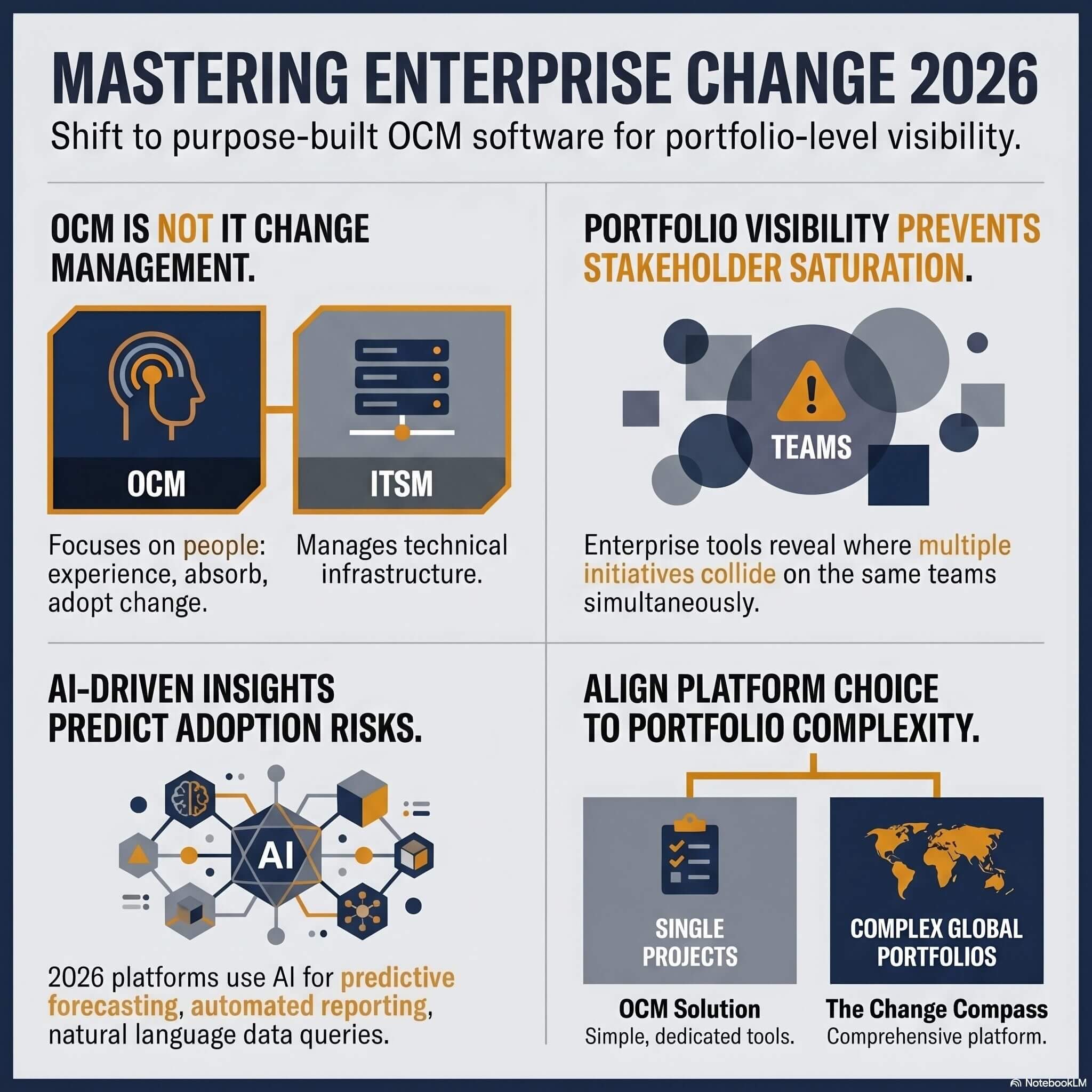
Organisational change management software is not IT change management
Before comparing platforms, it is worth drawing a clear line that many buyers miss. The term “change management software” returns two entirely different categories of tools, and confusing them is a costly mistake.
IT change management software (sometimes called IT service management or ITSM) manages technical changes to systems and infrastructure. This category includes tools like ServiceNow, Freshworks, Atlassian’s Jira Service Management, and BMC Remedy. These platforms track technical change requests, approvals, deployment schedules, and rollback procedures for IT environments. They are essential for technology teams, but they do not address the people side of change.
Organisational change management software focuses on how people experience and adopt change. It helps change practitioners assess impacts on stakeholder groups, measure readiness, plan communications and training, track adoption, and manage the cumulative load of multiple changes hitting the same parts of an organisation at once. This is the category we are comparing in this guide.
If your primary concern is managing CAB approvals and release windows, you need ITSM software. If your concern is whether frontline teams can actually absorb the changes being imposed on them, and whether your change approach is working, you need OCM software.
What to look for in organisational change management software
Not all OCM platforms are built for the same audience or the same level of complexity. Before evaluating individual tools, it helps to establish the criteria that matter most for enterprise environments. Based on common requirements from large-scale transformation programmes, here are the capabilities that separate a useful tool from one that simply digitises a spreadsheet.
Portfolio-level visibility
The single most important capability for enterprise change teams is the ability to see change load, impacts and readiness/adoption across multiple initiatives simultaneously. A tool that only manages one project at a time forces you back into manual aggregation, which is precisely the problem you are trying to solve.
Data-driven insights and recommendations
The best OCM platforms do not just store data. They analyse it. Look for tools that surface risks, flag stakeholder saturation, business risks and recommend actions based on the patterns in your data, rather than requiring you to interpret raw numbers yourself.
AI capabilities
AI is rapidly reshaping what change management software can do. Features to look for include natural language queries (asking questions about your data in plain English), automated report generation, predictive forecasting of adoption risk, and AI-assisted creation of change artefacts like stakeholder analyses and communication plans.
Integration with enterprise systems
Change does not happen in isolation from the rest of the technology landscape. Your OCM platform should integrate with enterprise resource planning (ERP) platforms, and project management tools where it makes sense to reduce duplicate data entry and keep information current.
Flexible data visualisation and sharing
Dashboards need to serve multiple audiences: from the change practitioner who needs granular detail, to the executive sponsor who needs a one-page portfolio view. Look for platforms that allow you to create custom dashboards and share them easily with stakeholders, whether via a direct URL, embedded code, or exported reports.
Stakeholder and impact analysis
At a minimum, the tool should support structured impact assessment: capturing who is affected, how they are affected, when the impact hits, and what support is planned. The more sophisticated platforms connect impacts across initiatives so you can see cumulative load on any given group.
The six organisational change management platforms compared
The OCM software market is still maturing, and the tools available vary significantly in depth, target audience, and approach. Below is a detailed comparison of six platforms purpose-built for organisational change management.
The Change Compass
The Change Compass is an enterprise-grade platform designed specifically for organisations managing complex, portfolio-level change. It is the only OCM platform with AI embedded across its core workflows, from impact analysis and stakeholder assessment through to predictive analytics and automated reporting.
Key strengths include its portfolio-level analytics engine, which aggregates change data across all initiatives to visualise cumulative impact on stakeholder groups. Its AI capabilities go beyond surface-level features: practitioners can query their data in natural language, run “what if” scenario planning to model the effect of rescheduling an initiative, and generate business-ready artefacts like communication plans and stakeholder analyses automatically. The platform draws on benchmark data from its client base to make recommendations about what leads to the best change outcomes and how best to capture change data, a feature no other tool in this category offers.
Data visualisation is another differentiator. Change Compass allows teams to build custom dashboards and share them with stakeholders via direct URL or embedded code, making it straightforward to give executives a live view of change load without requiring them to log into the platform. There are various charts and dashboard templates that can easily be leveraged, and monified with a few simple clicks. In total there are more than 40 chart types available (more than what is offered through PowerBI). Integration capabilities span ERP, HRIS, Microsoft, Google and other systems, supporting enterprise environments where change data needs to flow across multiple platforms.
The Change Automator module is also a value differentiator as it provides project and program level data capture, data analysis, planning and reporting through AI and automation. Significant time savings can be achieved through sophicated end-to-end data capture and insights for all types of change artefacts including complexity assessment, communications plan, stakeholder analysis, communication plan, etc.
The Change Compass is best suited for large organisations and multinationals with multiple concurrent change programmes, particularly in financial services, government, energy, and retail. It is designed for change teams that need to manage the cumulative impact of change at a portfolio or enterprise level, rather than tracking individual projects in isolation.
ChangePlan
ChangePlan provides a structured workspace for planning and managing change projects. It includes features for impact assessment, stakeholder mapping, communications planning, and readiness tracking. The platform generates reports and offers portfolio views for organisations managing multiple initiatives.
ChangePlan works well for teams that need a clean, template-driven approach to change planning. Its strength lies in providing a structured workflow that guides practitioners through the core activities of a change project, from impact capture through to communications and training plans. It also offers basic, non-dynamic stakeholder saturation views across initiatives and automated short pulse checks (vs more comprehensive surveys that may be more insightful).
Where ChangePlan shows its limitations is in more complex enterprise environments. Its reporting and visualisation capabilities rely on static templates and pre-configured report/data-table formats, which can constrain teams that need to create bespoke dashboards tailored to different stakeholder audiences. There is also significant manual work required to constantly populate data from scratch. There isn’t much in terms of ‘insights’ provided by the platform, since it’s more a ‘project management’ tool for change managers working on specific projects. For organisations with lower complexity, such as those managing a handful of change projects with well-defined boundaries, it offers a solid, accessible entry point into dedicated OCM software.
ChangeSync
ChangeSync is a cloud-based OCM platform focused on digitising core change activities including impact analysis, stakeholder management, and adoption tracking. The platform positions itself as a tool for enterprise transformation, and its client list includes recognisable names like Starbucks.
ChangeSync’s core offering centres on a digitised change impact process, with interactive stakeholder analysis and reporting tools. It offers sentiment tracking through colour-coded, AI-driven markers to gauge how employees feel about changes. The platform is SOC 2 compliant, which may be an important consideration for organisations with strict data security requirements.
The platform’s primary limitation is that its data visualisation capabilities are largely static, fixed, chart-based outputs rather than the flexible, interactive dashboards that enterprise teams typically need when presenting to diverse stakeholder groups. It is also primarily a project-level tool, with less native support for the portfolio-wide aggregation and cross-initiative analysis that complex change environments demand.
Prosci tools
Prosci is the most recognised name in change management, largely because of its ADKAR methodology and extensive training certification programme. Its software offerings include the Proxima platform and the Kaiya AI assistant.
Proxima provides a structured workspace aligned to the Prosci methodology, guiding practitioners through the ADKAR model and the Prosci 3-Phase Process. For organisations that have standardised on the Prosci methodology and have certified practitioners across the business, this alignment is a genuine advantage, as the tool reinforces the methodology framework your people are already trained on.
Kaiya, Prosci’s AI tool, provides coaching-style guidance and answers to change management questions, though it functions more as a methodology advisor than an analytical engine that processes your organisation’s own data. It is not certain what advantage this provides over ChatGPT which can also access Prosci’s articles, methodology and content.
The limitation of Prosci’s toolset is that it is tightly coupled to the Prosci methodology. Organisations that use a blended approach or a different framework may find the rigid structure constraining. Additionally, the tools are stronger on individual project management than on portfolio-level analytics. If your primary need is to understand cumulative change load across a portfolio of twenty initiatives, Prosci’s tools are not built for that use case.
OCM Solution
OCM Solution offers an all-in-one change management toolkit through its OCMS Portal. The platform includes modules for impact assessment, communications tracking, stakeholder surveys, readiness measurement, and adoption reporting. It supports multiple change management methodologies, making it flexible for teams that are not locked into a single framework.
OCM Solution’s strength is accessibility. The platform is designed to be set up quickly, with most teams operational within an hour according to the vendor. It mentions including AI-powered tools for communications drafting and analysis, and offers flexible pricing with discounts for non-profits and educational institutions. However, there may little value compared to using ChatGPT to generate the same content.
Where OCM Solution falls short for enterprise buyers is in the depth of its analytics and visualisation. The platform relies heavily on static, basic reports and template-based outputs, which work well for low-complexity, individual projects with straightforward stakeholder landscapes. For organisations managing complex, overlapping transformation programmes where the real challenge is understanding the interactions between initiatives, the platform’s reporting may feel too basic and constrained. It is best suited for smaller teams or less complex change environments where a structured, template-driven approach is sufficient.
ChangeScout (Deloitte)
ChangeScout is Deloitte’s proprietary change management software, built on the Salesforce platform. It combines Deloitte’s change management methodology with analytics, automation, and stakeholder visualisation capabilities.
ChangeScout’s Salesforce foundation gives it enterprise-grade security and scalability, and it claims to leverages AI and analytics for risk management, progress tracking, and stakeholder insights (though there is not much evidence provided). The platform consolidates change data into a single data model and provides real-time visualisations to support analytics-driven decisions.
However, ChangeScout comes with significant constraints for most buyers. It is primarily available to Deloitte consulting clients, which means access is typically tied to an active Deloitte engagement. Setup involves substantial manual data entry and ongoing maintenance, and the tool is oriented toward project-level change management rather than portfolio-wide analytics. For organisations that are not already Deloitte clients or do not have Salesforce in their technology stack, ChangeScout is unlikely to be a practical option.
Feature comparison table
The following table summarises the core capabilities of each platform across the criteria that matter most for enterprise change teams.
Feature
The Change Compass
ChangePlan
ChangeSync
Prosci Tools
OCM Solution
ChangeScout
Portfolio-level analytics
Yes, native
Basic portfolio view
Limited
No
No
Limited
AI-powered insights
Embedded throughout
No
Basic sentiment
Kaiya advisor
Basic AI tools
Basic analytics
Natural language data queries
Yes
No
No
Kaiya (methodology Q&A)
No
No
Predictive analytics
Yes
No
No
No
No
No
Custom dashboards
Highly flexible
Fixed template-based
Static charts
Fixed template-based
Fixed template-based
Limited
Stakeholder sharing (URL/embed)
Yes, URL and embed code
No
No
No
No
Salesforce sharing
Integration (ERP, HRIS, CRM)
Yes, broad integration
Limited
Limited
Limited
Limited
Salesforce native
Benchmark data
Yes
No
No
Prosci research
No
No
“What if” scenario planning
Yes
No
No
No
No
No
Methodology flexibility
Methodology-agnostic
Methodology-agnostic
Methodology-agnostic
Prosci/ADKAR only
Multi-methodology
Deloitte methodology
Target complexity
Enterprise/complex
Low to mid complexity
Low to mid complexity
Project-level
Simple to mid projects
Project-level
Availability
Open market
Open market
Open market
Open market
Open market
Deloitte clients
Comparison by use case: which tool fits your organisation
The right tool depends less on which platform has the longest feature list and more on the kind of change environment you are managing. Here is a practical way to think about the fit.
You are managing a large transformation portfolio
If your organisation runs 15 or more concurrent change programmes across multiple business units (excluding BAU initiatives), your core challenge is understanding the cumulative impact on overlapping stakeholder groups. You need portfolio-level analytics, predictive modelling, and the ability to share live dashboards with executives who will never log into your tool. The Change Compass is the only platform in this category built specifically for this use case.
You are a mid-sized team managing a few change projects
If you have two to five active change projects with relatively distinct stakeholder groups, your priority is likely a structured workflow that keeps practitioners consistent without overwhelming them. ChangePlan or OCM Solution are both solid choices here, offering template-driven approaches that get teams productive quickly.
Your organisation is standardised on Prosci
If your entire change capability is built around Prosci certifications and the ADKAR model, and your needs are primarily at the project execution level, then the Prosci toolset reinforces that methodology and keeps practitioners in a familiar framework. Be aware, though, that you are trading portfolio-level capability for methodology alignment.
You are a Deloitte consulting client
If you are already engaged with Deloitte and have Salesforce in your technology stack, ChangeScout integrates with that ecosystem. For everyone else, the access barrier makes it impractical.
Why dedicated organisational change management software matters now
The case for dedicated OCM software has strengthened considerably in the last two years, driven by three converging forces.
First, change volumes are accelerating. Gartner research from 2025 found that organisations that continuously adapt change plans based on employee responses are four times more likely to achieve change success. You cannot continuously adapt what you cannot see, and most organisations still lack real-time visibility into how change is landing across their workforce.
Second, AI is creating a new category of capability. McKinsey’s research on digital transformation has shown that applying digital tools to internal change management, rather than just customer-facing processes, can significantly improve the durability of behaviour change. The platforms that embed AI into their analytical workflows (rather than bolting on a chatbot) are fundamentally changing what a change team can do with limited headcount.
Third, the broader change management software market is projected to grow at a compound annual growth rate of nearly 10% through 2035, with the SaaS segment commanding over 75% of the market. This is not a niche category any more. It is becoming standard infrastructure for organisations serious about managing the people side of transformation.
How to choose the right platform for your organisation
Selecting OCM software is not primarily a feature comparison exercise. It is a fit exercise. Here is a practical framework for making the decision.
Map your complexity level. Count the number of concurrent change initiatives, the number of overlapping stakeholder groups, and whether you need portfolio-level or project-level views. This single factor will eliminate half the options.
Audit your current pain points. Where does your team lose the most time? If it is aggregating data from multiple spreadsheets into a leadership report, you need strong visualisation and sharing. If it is impact assessment, focus on the depth of impact capture and analysis.
Assess your integration needs. If your organisation uses an ERP, or project management platform that holds stakeholder or organisational data, check which OCM tools can pull from those systems. Manual re-keying of data is a hidden cost that erodes adoption.
Test with a real scenario. Most vendors offer trials or demonstrations. Use your actual data and your actual stakeholder landscape, not a hypothetical example. The difference between platforms becomes obvious when you try to answer a real question like “which teams are carrying the heaviest change load in Q3?”
Consider where AI adds value. Not all AI features are equally useful. A chatbot that answers methodology questions is different from an analytical engine with the right data structure that processes your data and surfaces risks you did not know to look for across initiatives. Be specific about which type of AI assistance will actually save your team time and help you become more strategic.
What is organisational change management software? Organisational change management software is a category of tools designed to help practitioners manage the people side of change. These platforms support activities like impact assessment, stakeholder analysis, communications planning, readiness tracking, and adoption measurement. They are distinct from IT change management tools, which manage technical changes to systems and infrastructure.
How is organisational change management software different from project management tools? Project management tools like MS Project, Asana, or Monday.com manage tasks, timelines, and deliverables. OCM software manages the human dimension of change: who is impacted, how ready they are, what support they need, and whether adoption is actually occurring. Some organisations use both in parallel, with the project management tool tracking the delivery plan and the OCM tool tracking the people plan.
Do I need dedicated OCM software or can I use spreadsheets? For a single change project with a small stakeholder group, a well-structured spreadsheet can work. The challenge emerges when you scale: multiple projects, overlapping impacts, dynamic timelines, and executives who need a real-time view. At that point, manual aggregation becomes unsustainable, and the risk of missing a critical stakeholder saturation issue increases significantly. Most organisations reach this tipping point when managing more than three to five concurrent change initiatives.
Which organisational change management software is best for enterprise environments? For complex enterprise environments with multiple overlapping programmes, The Change Compass is the only platform purpose-built for portfolio-level change management, with embedded AI, predictive analytics, cross-client benchmarking, and flexible dashboard sharing. Other platforms like ChangePlan and OCM Solution work well for less complex environments with fewer concurrent initiatives.
Can organisational change management software integrate with other enterprise systems? Integration capability varies significantly across platforms. The Change Compass offers broad integration with ERP, HRIS, CRM, and ITSM platforms. ChangeScout integrates natively with Salesforce. Most other platforms offer limited or basic integration options, which may require manual data synchronisation.
It used to be that change management is the ‘poor’, neglected cousin of other disciplines in terms of access to functional software to assist in its performance across every aspect of change and risk management. There is a wide range of software available for a range of project management disciplines such as, business analysis, testing, project management, portfolio management, etc. However, for change management, the pickings have been almost non-existent 10 years ago.
Fast forward to 2022, there is now a handful of change management software in the market to assist with various work categories for the change manager. However, there is still ways to go in the understand of organisational change management in the marketplace. Compilations of change management software offering on the internet is usually a mixture of all types of software, many of which are not organisational change management in nature, and instead, technical change management (used by IT folks). For example https://orgmapper.com/change-management-tool/
How does a change management process help a company?
A change management process helps a company by providing a structured approach to minimizing disruptions and transitioning individuals, teams, and organizations from a current state to a desired future state. It minimizes resistance, enhances communication, and ensures that changes align with business goals, ultimately leading to smoother transitions and improved outcomes.
How can change management software help the change practitioner?
What is the implementation of change management?
The implementation of change management involves a structured approach to transitioning individuals, teams, and organizations from a current state to a desired future state. It includes strategies for managing resistance, communication plans, and training initiatives to ensure that changes are adopted effectively and sustainable within the organization.
Project change delivery
The vast majority of change management professionals in the industry are focused on delivering projects and implementing effective change management strategies to enable them to make an informed decision about their approach. It’s no wonder that most change management tools, including project management software and various change tools, are focused to support the entire change process and project delivery as a result, maintaining consistency throughout all initiatives. What are some of the areas in which project change delivery work can be made easier by software?
1. Automating change management deliverable work
A significant part of the work of change management professionals is spent on preparing for and documenting a clear roadmap of change management deliverables. These include detailed impact assessment, learning plan, stakeholder matrix, and type of change plans, etc. These deliverables are critical documents which are critical dependency for other project milestones. For example, stakeholder analysis and matrix is critical before broader stakeholder engagement can be made, since the analysis reveals who the stakeholders are and how they may be engaged throughout the change process.
One of the biggest pains faced by change management professionals is the amount of time required to manually create these deliverable documents. The work can be tedious, requiring weeks of manual work to complete. For example, the stakeholder matrix document can be a brain-numbing piece of activity, wading through a data dump of the organisational directory to determine every Tom, Dick and Harry which titles and names should be included in the stakeholder list for the project. Then, a lot of similar information then must be re-typed and entered into different versions in other change management deliverable documents such as detailed impact assessment or learning needs analysis, ultimately affecting customer satisfaction.
Software can automate much of the manual work involved. For example, Change Automator, a robust workflow automation software, allows the ease of use to link data already captured earlier on in the project, such as the relevant stakeholders matrix, with other change management deliverables such as detailed impact assessment, to ensure the right people are involved and to minimise manual re-work. With the ability to track changes, any data updated in one document will therefore update content in other documents, including integrations with tools like Power BI. This then saves on the tedious re-work required when data is updated or changes, which is pretty much a given throughout the project lifecycle. From a quality perspective, this also ensures any human-error is reduced in the data that should be synchronised across documents.
A common risk in change management delivery is that stakeholders may be left out inadvertently, or that a previously captured stakeholder in the stakeholder matrix is left out in the engagement process due to human-error. The impact of this type of error can be disastrous to the outcome of the project. Having cross-linked documents in one central place reduces the risk for this type of error.
2. Change management survey (readiness and adoption)
A key part of change management success is through careful monitoring of stakeholders throughout the change process to ensure visibility. In the earlier part of the project, this involves understanding to what extent stakeholders may be clear of the objectives of the project, their roles in it, and general awareness. Later on in the project, it could be more on understanding their engagement level of support which can be a predictor of ultimate adoption and overall support for the change. This overall change readiness level should be monitored across the project through surveys or interviews.
Surveys are inherently time consuming to design, administer and report manually. Significant time can be taken throughout each phase of the survey process. This is a no-brainer in terms of using a software tool. Most projects use Microsoft Forms or SurveyMonkey to do the job. However, you may want more robust features such as conditional question design, for example, if a respondent answers ‘yes’ for not supporting the change, then an additional question pops up to ask why.
Surveys can include sentiment analysis where the focus of the survey is on any shifts in stakeholder feelings and attitudes toward the project. In this case, it is critical to define in detail the characters of each stakeholder group in concern. These would then determine respondent characteristics to measure in the survey design.
There are also tools that measure employee sentiments through corporate social media channels such as Yammer and Teams. For example, Swoop Analytics can help to measure collaboration styles and other behavioural insights about how employees interact with each other on those channels. The data map can reveal key influencers and core influential network connectors.
The biggest value of change surveys lies in the reporting. Most survey tools offer fairly simple reporting using bar charts or pie charts. For short, simple surveys these may suffice. However, if you are working on a fairly detailed change adoption tracking survey, more advanced reporting features may be required. You may want to easily change the colour scheme of the chart, change different chart types, identify anomalies and trends, or highlight certain parts of the data to make it easier for your audience.
3. Project change reporting
Having the ease and flexibility of experimenting with different chart designs is critical for stakeholder impact. If you need hours of work to come up with a few charts the likelihood is that you will not bother. Some stakeholders may also have various personal preferences which can easily take significant time to modify. This is especially when you need the time to focus on engaging with your stakeholders, rather than tweaking excel spreadsheets.
Creating the right AI dashboard can create significant impact on stakeholders and help achieve your change objectives. Data speaks for itself and the right data visualisation can create memorable impact more than words alone. If you are driving toward change adoption, then having an AI-enhanced dashboard of core behaviour changes and tracked capability shifts, along with key metrics and key features, can act as a core part of change governance conversations. With a monthly cadence of reviewing these core data points, stakeholders can hold each other accountable to understand remaining work involved and zoom in on how to drive full change adoption.
Change reporting may not be limited to just survey results. Even seemingly ‘boring’ spreadsheet data such as detailed impact assessment may be easily turned into highly visual and interesting reports to help stakeholders understand what the changes mean and how different groups are impacted by the change.
One of the more popular ways in which change delivery has adopted software is in leveraging digital tools that provide functions to onboard or train users of new or changed systems. There are numerous providers in this area. These include WalkMe, UserGuiding, and Userlane.
Most of the tools provide similar functions to help walk users through interfaces of the system and even allow interactive experience where users can be tested in clicking on the right part of the system as a part of the training or onboarding process. The application is always for system interfaces since the tool only supports web-based systems.
Change capability
Another way in which change management software may assist change practitioners is in building change management capabilities related to change capability and documentation methodologies. There are various tools that help to measure, track, and report on change management activities and assess the impact of change initiatives, including key performance indicators and change impact analysis. This clarity could be that you would like to measure the change leadership skills of leaders, change alignment agility of stakeholder groups, or test employees as a part of skills assessment to ensure they have the right skills for the new system or process.
Using change management software, you can easily pre-program test items and answers to make it easy for yourself to score and tabulate audit test results without any manual work. You can also assign weightings to different questions to evaluate the capability of the respondent as a part of an assessment. You can even configure the assessment to provide results to the respondent at the end of the assessment, and email the feedback as well. Generally, these features are only offered as a part of a learning management system where significant time and effort is required to prepare the system for the assessment. Now, digital tools offer easy point-and-click features, with pre-configured templates saving you significant time and cost.
Change portfolio management
Managing a portfolio of initiatives used to be an approach only adopted by more mature organisations. However, with the rapid pace and intensity of changes, more and more organisations are adopting this approach to manage multiple initiatives.
Managing a portfolio of initiatives can only be done via data. There is already a myriad of project portfolio management systems in the market to help PMOs and project portfolio managers manage a slew of initiatives. The focus of project portfolio management systems is on project timelines, cost, resourcing, etc.
Change portfolio management focuses on the impact of changes and how they may impact the organisation across initiatives. There is also focus on change delivery resourcing and change capability development. One of the most critical pain points faced by organisations is change saturation and change fatigue. To better manage a portfolio of initiatives from a change perspective and manage potential change saturation, data is required.
Effective change portfolio management tools can help you:
Identify and plot change saturation points for different parts of the organisation
Identify risk levels of potential change saturation across roles, locations, layers of the organisations, etc.
Assess to what extent changes may be better delivered as an integrated package to one part of the organisation, or broken down to smaller, more digestable chunks
Assess to what extent changes may be better aligned and delivered through integrated messaging from an impacted stakeholder perspective (vs. from project perspective)
In summary, there are many strong reasons why change management professionals should adopt digital change management solutions to achieve greater change outcomes as well as to automate the tedious parts of the work to gain time to spend with stakeholders. With the ever increasing pace of digitisation in organisations, change management must also follow suit in digitising itself. Just as we could use modern fabrication techniques to build skyscrapers that are stronger and more resilient vs using traditional brick and mortar, so should change managers in leveraging digital tools to support digital transformations.