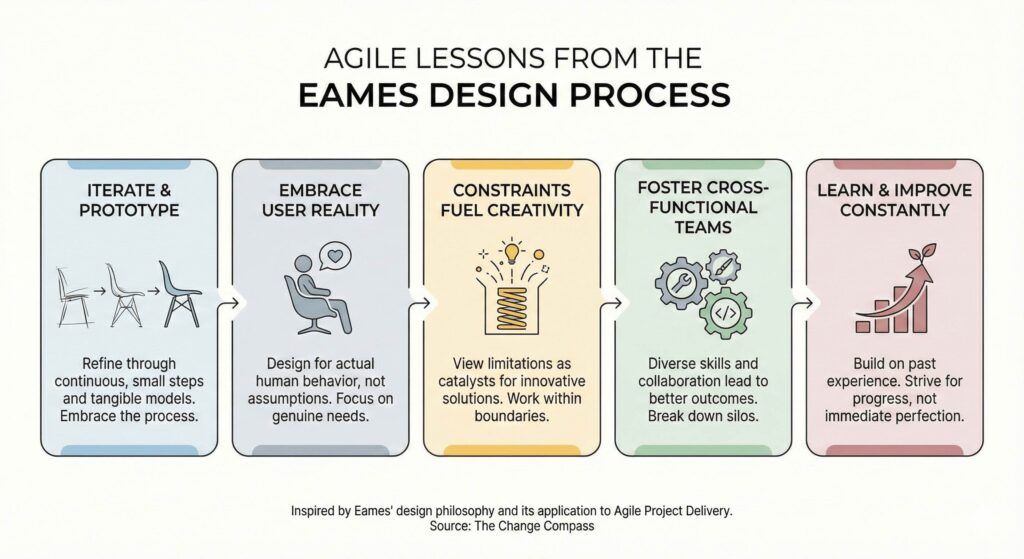
Ray and Charles Eames, legendary mid-century designers, developed creative processes remarkably aligned with modern agile methodologies. Their approach emphasised iteration, resource respect, and systems thinking, offering valuable lessons for today’s project teams facing complex delivery challenges.
This guide explores five key Eames principles and their direct application to agile project delivery. Change practitioners and project leaders gain practical insights to enhance iteration, stakeholder engagement, and systemic success.
What Agile Principles Did Eames Champion?
The Eames duo’s design philosophy prefigured agile concepts by decades. Their methods focused on practical experimentation, collective wisdom, and holistic systems. These are core tenets of contemporary agile delivery.
These principles translate directly to project environments, improving outcomes across technology rollouts, process changes, and organisational transformations.
1. Not Reinventing the Wheel: Leverage Collective Experience
Eames avoided starting from scratch, instead building on proven materials and techniques. Agile teams benefit similarly by tapping organisational knowledge rather than isolated innovation.
Practical Applications in Agile Delivery
Previous rollout lessons: Review past implementations of similar products or services to anticipate adoption challenges and success factors.
Stakeholder group insights: Consult colleagues experienced with specific audience dynamics and communication preferences.
Solution design patterns: Adapt approaches proven effective in prior technical or process solutions.
Timeline strategies: Apply scheduling techniques refined through previous deadline pressures.
Learning intervention successes: Reuse effective training content, delivery methods, and evaluation frameworks.
This principle prevents redundant effort while accelerating delivery through proven foundations.
2. Continuous Testing and Learning: Iterative Refinement
The Eames process featured constant prototyping and feedback, mirroring agile’s iterative cycles. Every team member, not just designers, contributes to this learning loop.
Change Management Testing Examples
Message validation: A/B test communications with target audiences to measure resonance and engagement.
Learning content trials: Pilot training modules with sample groups, gathering feedback on structure, clarity, and delivery medium.
Impact assessment accuracy: Validate change impact analysis directly with end users rather than proxies alone.
3. Respecting the Materials at Hand: Understand Your Resources
Eames emphasised the importance of recognising the capabilities and limitations of available resources. In agile project delivery, this means deeply understanding people, systems, processes, and stakeholder capacities.
Applying Resource Respect in Agile Projects
Assess team skills and system maturity before designing interventions.
Adapt project plans based on stakeholder readiness and local constraints.
Support change leads in gauging the ability levels of different groups to absorb new processes.
Tailor communication and training to maximise relevance and effectiveness given resource realities.
This approach builds realistic, sustainable change strategies aligned with organisational strengths and challenges.
4. Generating New Perspectives and Ideas Through Play and Fun
The Eames valued play as a creative catalyst, fostering new ideas and fresh perspectives. Agile teams benefit from incorporating elements of play, fun, and experimentation into their work.
Practical Ways to Embed Play in Agile Delivery
Run hackathons or innovation sprints encouraging out-of-the-box thinking.
Design team-building activities that mix fun with purposeful reflection on project goals.
Use gamification techniques to increase engagement in learning and adoption tasks.
Foster a psychologically safe environment where experimentation and mistakes are accepted as learning opportunities.
Play enhances creativity, collaboration, and morale, supporting higher-quality outcomes.
5. Eventually Everything Connects: Embrace Systems Thinking
The Eames stressed seeing the broader picture and understanding how various elements interlink to form a larger system. This mindset is vital in agile delivery, where dependencies and impacts extend beyond single teams or projects.
Systems Thinking in Agile Projects
Map connections among processes, systems, communications, training, and branding to ensure cohesive delivery.
Identify how multiple change initiatives intersect and impact shared stakeholders or resources.
Help stakeholders understand how different initiatives support broader organisational strategies.
Use system maps and visualisations to support planning, risk assessment, and communication.
This holistic awareness prevents siloed work and promotes integrated, effective change.
Implementation Roadmap for Eames-Inspired Agile Delivery
Applying These Principles in Modern Projects
Quick-Start Actions for Teams
Conduct knowledge audits to capture previous rollout experiences across the organisation.
Schedule regular testing cycles for communications, training, and impact assessments.
Map resource capabilities and limitations during project kickoff planning.
Plan quarterly innovation sessions incorporating play and experimentation elements.
Create visual system maps showing project interconnections and dependencies.
Building Organisational Support
Train change leads in resource assessment and systems thinking techniques.
Establish cross-project knowledge sharing forums.
Integrate Eames principles into agile training and certification programs.
Use success stories to demonstrate ROI from iterative testing and collective learning.
These steps embed timeless design wisdom into contemporary delivery practices.
Cultural Considerations for Success
Overcoming Common Barriers
Success requires psychological safety for experimentation and leadership support for non-traditional approaches. Traditional organisations may resist play-based innovation, requiring champions to demonstrate tangible benefits first.
Scaling Across Teams
Start with pilot projects showcasing measurable improvements in delivery speed, stakeholder satisfaction, and adoption rates. Use these case studies to expand practice organisation-wide.
Measuring Impact
Track metrics like iteration cycle time reduction, stakeholder engagement scores, knowledge reuse rates, and cross-project collaboration frequency to validate principle effectiveness.
Frequently Asked Questions (FAQ)
What makes Eames principles relevant to modern agile delivery? Their focus on iteration, collective wisdom, resource respect, creativity through play, and systems thinking directly addresses contemporary project complexity and delivery challenges.
How do you implement continuous testing in change management? Use A/B testing for messages, pilot training modules with user groups, and validate impact assessments directly with end users to refine approaches iteratively.
Why is systems thinking essential in agile projects? Modern initiatives rarely operate in isolation. Understanding interconnections prevents siloed work and ensures cohesive delivery across multiple changes.
How can teams incorporate play into serious projects? Run hackathons, gamify learning tasks, and design team activities blending fun with purposeful project reflection to boost creativity and morale.
What is the first step in applying ‘not reinventing the wheel’? Conduct knowledge audits capturing previous rollout lessons, stakeholder insights, and proven solution patterns across the organisation.
In 1977, Ray and Charles Eames, celebrated for their iconic mid-century furniture, embarked on a cosmic journey. Their creation, “The Powers of Ten,” takes viewers from an ordinary picnic on Earth to the edges of the observable universe, showcasing the vastness and intricacy of our cosmos. Beyond its cinematic wonder, this film offers profound insights into change management – a journey of continuity and transformation. Let’s embark on a parallel voyage, learning valuable lessons from the Eames masterpiece. The link to the famous 9-minute video can be found here.
The Power of Change Management Components
Change management, much like the universe depicted in “The Powers of Ten,” encompasses a multitude of components. Let’s explore these components and understand how they relate to effective change management.
Continuity and Change
In “The Powers of Ten,” we witness the dynamic interplay of continuity and change. Just as our universe maintains its constants while evolving, organizations must strike a balance between what remains unaltered and what must adapt. This balance is essential for effective change management. Identify the periods when your frontline staff are pivotal, align your change strategies with these busy phases, and ensure that new initiatives consider these high-activity periods.
Understanding Cultural Context
In “The Powers of Ten,” every frame reveals shifting perspectives. Similarly, when communicating change, acknowledge the diverse lenses through which employees view your messages. Understand their cultural contexts and adapt your approach. One-size-fits-all communication often falls short. Tailor your messages to resonate with various audiences, fostering greater acceptance and engagement.
Cross Collaboration through Context
Change flourishes when change drivers collaborate effectively with change receivers. Drivers must provide vision, intent, resources, and leadership, while receivers offer feedback, support, and behavioral adjustments. Successful collaboration relies on a deep understanding of each other’s contexts. Learn why changes are necessary, how to implement them, and what they require. Acknowledge the cultural context of those impacted by the changes, a crucial aspect often overlooked.
Data-Driven Decision-Making
Statistics reinforce the importance of change management. According to a study by Prosci, organizations using a structured approach to change management are 78% more likely to meet or exceed their project objectives. This statistic underscores the need for a strategic, data-driven approach in change management. Make informed decisions, assess the impact of change initiatives, and use data to guide your strategy.
Stakeholder Engagement and Communication
Effective change management relies on robust stakeholder engagement and clear communication. Just as “The Powers of Ten” engages viewers with its visuals and narration, your change initiatives should engage stakeholders through well-crafted communication strategies. Ensure all stakeholders are informed, involved, and heard throughout the change process.
Leadership and Vision
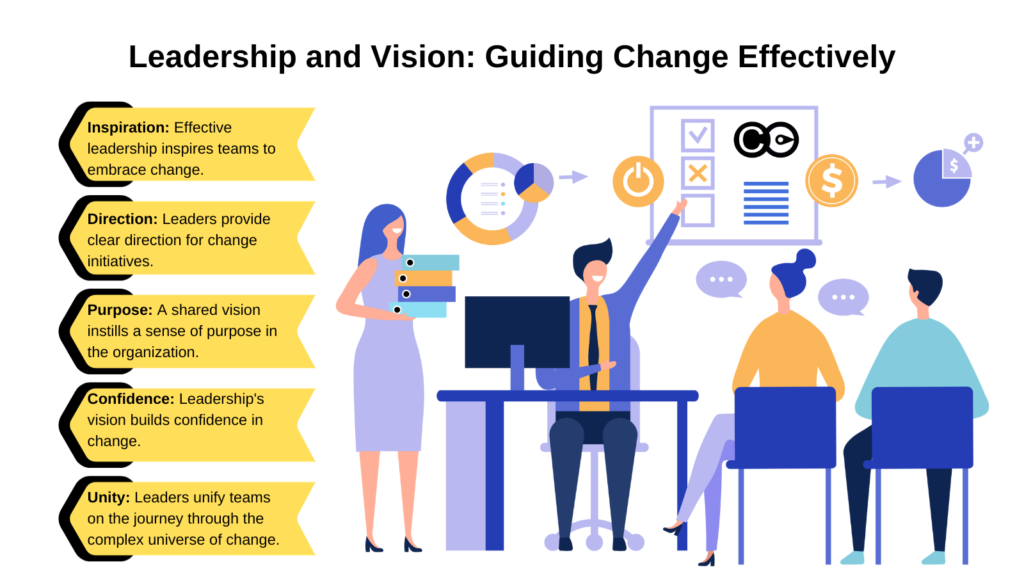
In the Eames film, the journey from picnicking on Earth to exploring the cosmos required a guiding vision. Similarly, successful change management necessitates strong leadership and a clear vision for the future. Leaders must inspire, provide direction, and motivate teams to embrace change.
“The Powers of Ten” is more than a cinematic masterpiece; it’s a guide to navigating change within your organization. Embrace continuity while ushering in change, acknowledging the diverse cultural contexts of your employees. Facilitate collaboration through shared understanding, and maintain a sense of curiosity as you traverse the ever-evolving landscape of change management.
Take your first step into change management’s cosmic universe. Book a weekly demo with us to learn how to navigate the challenges and opportunities effectively.
Most organisations running more than three simultaneous change initiatives are not managing change, they are managing collisions. A new enterprise resource planning system lands at the same time as a workforce restructure and a cultural transformation programme. Each stream has its own change manager, its own communications plan, and its own timeline, and none of them knows what the others are asking of the same group of frontline employees. The result is not failed change, exactly. It is change that technically “lands” by project metrics while producing confusion, fatigue, and quiet resistance in the people it was meant to shift.
This problem is more common than most organisations admit. Prosci’s research on change saturation consistently identifies the volume and pace of simultaneous change as one of the top obstacles to successful adoption, yet the dominant response remains treating each initiative as its own contained project. Change practitioners are asked to be excellent within their lane while the organisation fails to manage the road. Individual programme excellence is necessary, but not sufficient. What is missing is a portfolio-level discipline for landing multiple changes simultaneously.
This article draws on frameworks developed for the ACMP (Association of Change Management Professionals) conference and unpacks what it actually takes to land multiple change initiatives well. The answer is not simply more resources or better project management. It requires a systems thinking approach, a clear-eyed view of cumulative employee load, deliberate sequencing decisions, and governance structures that can make cross-programme calls in real time.
Why landing multiple changes requires a different approach
The traditional change management model is built around a single initiative. You assess the impact, identify the stakeholders, design the engagement plan, and manage resistance along the journey from current state to future state. That model is coherent and well-supported by decades of research and practice. It is also structurally blind to what happens when five versions of it are running simultaneously across the same organisation.
The problem is not that individual change managers are doing their work poorly. It is that the unit of analysis is wrong. When multiple programmes compete for the same leadership attention, the same communication channels, and the same employee bandwidth, the interactions between those programmes become more consequential than the design of any single one. A well-crafted communications plan for Programme A becomes noise when Programme B sends three emails to the same audience on the same day. A training schedule for Programme C creates conflict when Programme D pulls team leaders into workshops during the same fortnight.
McKinsey research on organisational change has repeatedly found that one of the most significant barriers to successful transformation is the failure to coordinate across parallel workstreams. Organisations that treat each initiative as an isolated effort consistently underestimate the cumulative demands placed on the same pools of people. The fix is not project management discipline within each stream. It is a deliberate shift in perspective to the portfolio level, where the interactions between initiatives can be seen and managed.
A systems thinking lens for change portfolio management
Systems thinking offers a more honest way to look at a change portfolio. Rather than treating each initiative as a bounded input-output process, systems thinking asks: what are the interdependencies, feedback loops, and unintended consequences that emerge from the whole? Applied to change management, it means asking not just “will this programme land?” but “what does the system look like when all programmes are running simultaneously, and where are the points of overload or conflict?”
The practical starting point is mapping the portfolio as a system rather than a list. This means identifying which employee groups are touched by each initiative, at what intensity, and over what time period. It means tracing which senior leaders are sponsors of multiple programmes and therefore have divided attention. It means understanding which communication channels are shared across initiatives, and how often those channels are already saturated. This kind of mapping is not an abstract exercise. It surfaces the concrete conflicts that will derail adoption before they happen, rather than after.
A systems lens also changes how you think about success. In a single-programme model, success means the programme achieves its stated outcomes. In a portfolio model, success means the organisation moves forward across all initiatives without destroying the human capacity it needs to sustain them. Gartner’s research on organisational change fatigue found that employees who experience high volumes of change are significantly more likely to report intention to leave, reduced discretionary effort, and lower wellbeing, all of which undermine the very outcomes the change programmes are trying to achieve. Managing the system means managing those risks, not just the project plans.
Understanding cumulative change load on employee groups
The concept of cumulative change load is central to landing multiple initiatives well. Change load refers to the total volume, complexity, and pace of change being asked of a particular employee group at a given point in time. It is not the same as the number of initiatives running in the organisation. It is specific to the experience of a defined group of people, and it varies enormously depending on which programmes touch that group and how intensively.
Frontline team leaders are almost always the most overloaded group in a change portfolio, and they are also the most critical to adoption success. They are typically the key conduit through which every initiative reaches employees on the ground. They attend programme briefings, model new behaviours, coach their teams through transitions, and handle the questions and resistance that employees bring to them. When three programmes ask this of them simultaneously, the cumulative load does not add up linearly. It compounds. Attention splits. Credibility with their teams is at risk if they cannot answer questions about changes they have only partially understood themselves.
Mapping change load by employee group requires moving beyond the programme-level view to an employee-centric view. For each group, you need to understand the total number of active changes affecting them, the degree to which those changes require active behavioural shift versus passive awareness, the timing of key milestones across all programmes, and the existing workload context. This is not a one-time assessment. Change load is dynamic. It shifts as programmes progress, as timelines slip, and as new initiatives are added to the portfolio. Practitioners who treat it as a snapshot rather than a live measure will always be working with outdated information.
Sequencing and timing: the critical decisions
Once you have a clear view of cumulative change load across employee groups, sequencing becomes a strategic tool rather than a scheduling exercise. The question is not just “when can we start?” but “when is this group ready to absorb this change, given everything else they are navigating?” These are different questions, and they lead to different decisions.
Sequencing decisions at the portfolio level typically involve trade-offs that no single programme team is positioned to make. Delaying the go-live of one initiative by six weeks might significantly reduce the load on a critical employee group during a peak period for another programme. But that decision has cost and timeline implications that affect the business case for the delayed programme. Making that call requires a view across the portfolio and authority to act on it. In most organisations, that view and that authority sit in different places, which is why sequencing decisions rarely get made proactively. They get made retrospectively, when something breaks.
Timing also matters at the level of change saturation within the annual cycle. Most organisations have predictable patterns of peak operational demand, whether driven by financial year cycles, product launches, regulatory reporting periods, or seasonal factors. Layering major change activity on top of those peaks is a common and avoidable mistake. A portfolio-level view that maps change milestones against operational calendars gives leaders the information they need to avoid the most predictable collisions. Harvard Business Review has noted that organisations which deliberately pace change, rather than accelerating every initiative simultaneously, achieve significantly better adoption outcomes even if individual programmes take longer to complete.
Building cross-programme stakeholder coordination
Stakeholder management in a portfolio context is categorically different from stakeholder management within a single programme. The same senior leaders appear as sponsors, champions, or key influencers across multiple initiatives. The same middle managers are being asked to role-model change, communicate updates, and embed new processes across several programmes at once. And the same employees are receiving messages from multiple directions about what they need to do differently and why.
Effective cross-programme stakeholder coordination requires a deliberate effort to understand the total demands being placed on shared stakeholders. This means change teams across programmes regularly sharing their stakeholder engagement plans, identifying where they are drawing on the same people, and making collective decisions about how to sequence and rationalise those demands. It sounds straightforward, but in practice it requires a level of transparency and collaboration between programme teams that organisational siloes make difficult.
One practical mechanism is a shared stakeholder engagement calendar that all programme change managers can view and contribute to. This does not eliminate competition for attention, but it makes the competition visible. When a senior leader’s assistant can see that five programmes have each independently scheduled a 90-minute engagement session with their principal in the same month, they can flag the problem. Without that visibility, each session gets booked as if it were the only one. The calendar is a simple tool, but its value is in the shared picture it creates, not the scheduling function it performs.
Cross-programme communication coordination is equally important. Employees receiving multiple streams of change communication need a coherent narrative, not a collection of disconnected announcements. Where possible, programme teams should agree on a shared change story that contextualises each initiative within the broader direction the organisation is moving. This does not mean homogenising all messaging. It means ensuring that when employees ask “why are we doing all of this at once?”, there is a credible answer that connects the dots rather than leaving them to construct their own, often pessimistic, interpretation.
Governance structures that enable portfolio decisions
All of the practices described above, whether mapping change load, making sequencing decisions, or coordinating stakeholder engagement, require a governance structure that can see across the portfolio and act on what it sees. Most organisations do not have this. They have programme steering committees, each of which has a mandate to deliver its own initiative as efficiently as possible. Those committees have no structural incentive to delay or modify their programme for the benefit of another. And so, even when individual programme leaders recognise that the portfolio is overloaded, the governance architecture makes it nearly impossible to do anything about it.
A portfolio change governance function, whether a formal Change Advisory Board or a lighter-touch change portfolio forum, provides the cross-programme view and the decision-making authority to manage the portfolio as a whole. Its mandate is explicitly different from any individual programme’s steering committee. It is not accountable for the delivery of a single initiative. It is accountable for the organisation’s capacity to absorb change across all initiatives, and for protecting the human and leadership resources that every programme depends on.
The critical design question is not what to call this forum, but what authority it has and who sits in it. A portfolio change governance body without authority to delay, re-sequence, or scale back individual programmes is merely a reporting mechanism. It can describe the problem but cannot fix it. Effective portfolio governance requires executives who have accountability across the change portfolio, not just within their own business unit’s initiatives. Prosci’s best practices research consistently finds that active and visible executive sponsorship is the single greatest contributor to change success, and in a portfolio context, that sponsorship must extend to the portfolio level, not just the programme level.
How The Change Compass supports practitioners managing multiple initiatives
Practitioners who are trying to build a portfolio-level view of change often find that the data they need is scattered across multiple project plans, spreadsheets, and stakeholder maps, each maintained by a different programme team and formatted differently. Aggregating that information manually is time-consuming and almost always out of date by the time it is compiled. The Change Compass is a digital platform built specifically to solve this problem. It enables change practitioners to map the change portfolio across employee groups in real time, visualise cumulative change load, and identify the timing conflicts and saturation risks that individual programme views cannot reveal. Rather than replacing the judgement of experienced practitioners, it gives them the information infrastructure to exercise that judgement at the right level. For organisations managing complex, multi-initiative portfolios, having a shared, live view of the change landscape is not a nice-to-have. It is the operational foundation that makes portfolio-level decisions possible.
Frequently asked questions
What is change portfolio management and how is it different from programme management?
Change portfolio management is the discipline of overseeing and coordinating all active change initiatives across an organisation simultaneously, rather than managing each programme in isolation. Where programme management focuses on delivering a defined scope on time and on budget, change portfolio management focuses on the organisation’s total capacity to absorb change and the interactions between initiatives. It asks questions that no single programme team can answer: which employee groups are most overloaded, which sequencing decisions will reduce collision risk, and which governance structures can make cross-programme calls.
How do you measure cumulative change load on employee groups?
Measuring cumulative change load starts with identifying every active change initiative that affects a defined employee group, then assessing the intensity and timing of that impact. Intensity can be measured across dimensions such as the degree of behavioural change required, the volume of training, the frequency of communication, and the level of disruption to existing workflows. These assessments are then aggregated across all initiatives to produce a load profile for the group over time. The key challenge is maintaining this view dynamically, since change load shifts as programmes progress, timelines change, and new initiatives are added.
What governance structure works best for managing a change portfolio?
The most effective governance structure is one that has a cross-portfolio mandate and real decision-making authority, rather than a purely advisory or reporting function. This typically takes the form of a Change Advisory Board or Change Portfolio Forum that meets regularly, includes executives who own accountability across multiple programmes, and has the authority to re-sequence, delay, or modify initiatives based on portfolio-level capacity considerations. The critical factor is that membership and authority must cross business unit boundaries, since portfolio conflicts almost always involve competing priorities from different parts of the organisation.
How should change practitioners prioritise when multiple initiatives compete for the same resources?
Prioritisation in a change portfolio context should be based on a combination of strategic importance, time sensitivity, employee group impact, and dependency sequencing. Where two initiatives compete for the same leadership attention or employee bandwidth, the portfolio governance body should assess which programme’s momentum is more critical to protect at that point in time, and which can absorb delay or reduced intensity without jeopardising its outcomes. Practitioners can support this decision by providing clear data on the impact of delay for each initiative, as well as the cost to employee wellbeing and adoption quality of proceeding with both simultaneously.
At the ACMP (Association of Change Management Professionals) Global Conference in Las Vegas, a recurring theme surfaced across sessions and hallway conversations alike: most organisations are no longer managing one or two significant changes at a time. They are managing dozens, sometimes scores, of concurrent initiatives, each with its own timeline, sponsor, and change team, and very few have a coherent way to think about that complexity at a portfolio level. The conference brought together some of the sharpest practitioners in the field, and what became clear was that the profession’s frameworks, mostly designed for individual change programmes, are straining under the weight of modern organisational reality.
A presentation at the conference tackled this directly using an analogy that landed with unusual force in the room: the airport. Picture a busy international airport on a peak travel day. Dozens of aircraft are inbound at any given moment, each on its own flight path, each carrying its own crew and passengers, each with its own landing requirements. The air traffic control tower does not manage one plane at a time in isolation. It holds a real-time picture of the entire airspace, sequences arrivals to avoid collision, manages runway capacity, and reroutes aircraft when conditions change. That picture, the presentation argued, is precisely what most change functions are missing. They are flying individual planes without a control tower.
The analogy is deceptively simple, and that is exactly what makes it powerful. It gives executives and change leaders a shared mental model for a problem that is genuinely difficult to describe in the abstract. This article unpacks the key insights from that ACMP Conference presentation, explores why the aviation framework resonates so strongly with practitioners, and sets out the practical implications for organisations that are serious about building portfolio-level change capability.
The aviation analogy and why it works for change management
Change management has no shortage of analogies. Burning platforms, navigating white water, unfreezing and refreezing: the field has long relied on metaphor to make abstract concepts tangible. But most of those metaphors describe the experience of a single change initiative. The aviation analogy is different because it captures the system-level problem: what happens when many changes are competing for the same runway at the same time.
In the airport model, each aircraft represents a change initiative. The runway represents the finite change absorption capacity of the organisation, specifically the bandwidth that employees, managers, and business units have to take on new ways of working. The air traffic control tower represents the change portfolio function: the team or mechanism that holds a view across all inbound changes, sequences them intelligently, and makes active decisions about which initiatives land when, which go into a holding pattern, and which need to be redirected entirely.
What makes this analogy particularly useful in conversations with senior executives is that it makes the capacity constraint visceral. Every experienced traveller knows what happens when too many aircraft try to land at once: delays, near-misses, diversions to other airports, and occasionally, catastrophic failure. When a chief executive or a chief operating officer hears that framing applied to their change portfolio, the message lands with a clarity that a spreadsheet of initiative timelines rarely achieves. The analogy also introduces the concept of sequencing as a professional discipline, not a scheduling afterthought. Air traffic controllers are highly trained, deeply respected professionals. The suggestion that change portfolio management deserves the same rigour is exactly the reframing many change functions need when making the case for investment.
Key insights on change portfolio complexity from ACMP
One of the central observations from the conference presentation was that the complexity of a change portfolio is not simply additive. Ten simultaneous initiatives are not just ten times harder to manage than one. They are exponentially harder, because each new initiative interacts with every other one. A technology rollout in one division affects the change capacity of managers who are simultaneously being asked to support a restructure, a new performance framework, and a shift to agile ways of working. The interactions between initiatives create compounding demands on the same people, and those demands are invisible unless someone is actively mapping them.
Research supports this observation. A Prosci benchmarking study found that one of the most frequently cited barriers to successful change is inadequate organisational capacity, with change saturation among employees and managers identified as a primary cause of initiative failure. When multiple changes land simultaneously on the same employee population without coordination, the result is not just fatigue, it is active disengagement. Employees who are asked to absorb too much too quickly tend to comply superficially with the most visible demands while quietly abandoning the rest.
The conference presentation also highlighted the role of interdependencies between initiatives as a source of underestimated risk. When Initiative A depends on the completion of Initiative B, and Initiative B is running three months late, the downstream effects ripple through the portfolio in ways that no individual project team can see or manage. Portfolio-level visibility is the only defence against this kind of systemic risk. Without it, organisations are essentially flying blind in a crowded airspace.
From individual change programmes to coordinated portfolio management
The shift from managing individual change programmes to managing a portfolio of concurrent changes is not merely a scaling exercise. It requires a different mindset, different tools, and a different organisational structure. At the individual programme level, the change manager’s primary orientation is toward a specific group of stakeholders affected by a specific initiative. At the portfolio level, the orientation must shift to the organisation as a whole, with the change function acting as a steward of overall change capacity rather than an advocate for any single initiative.
This shift mirrors a well-documented evolution in project management. The discipline of project portfolio management emerged precisely because organisations recognised that managing projects in silos produced suboptimal results at the organisational level, even when individual projects were executed well. According to Gartner research on portfolio management, organisations with mature portfolio management capabilities consistently deliver better strategic alignment and resource utilisation than those managing initiatives independently. Change management is now at the same inflection point that project management reached a decade ago.
The practical implication is that the change function needs to develop two distinct competencies in parallel: the ability to deliver high-quality support to individual initiatives, and the ability to manage the portfolio as a system. Neither competency substitutes for the other. An organisation that is excellent at individual change management but lacks portfolio coordination will still suffer from change saturation and sequencing failures. An organisation that has a sophisticated portfolio view but weak initiative-level change capability will plan well and execute poorly. Both are required.
The role of change data in multi-initiative environments
One of the most striking themes to emerge from the ACMP Conference was the degree to which effective portfolio change management depends on data. Not opinion, not intuition, and not the loudest programme sponsor’s view of how their initiative is tracking. Actual data: about the volume of change hitting specific employee populations, about the pace at which those populations are absorbing change, about which parts of the organisation are approaching saturation and which have capacity to absorb more.
The aviation analogy maps directly onto this data requirement. Air traffic controllers operate with real-time data feeds covering aircraft position, speed, altitude, weather conditions, and runway status. They do not guess. They do not rely on reports that are three weeks old. They have a live picture of the airspace and they act on it continuously. For change portfolio management to function with comparable rigour, change functions need access to current, structured data about the state of every initiative in the portfolio and its impact on the people it is touching.
A Harvard Business Review analysis of change analytics found that organisations using data-driven approaches to managing change were significantly more likely to achieve their intended outcomes, particularly in environments where multiple initiatives were running simultaneously. The discipline of building change impact data, tracking adoption metrics across initiatives, and using that data to make sequencing decisions is still nascent in most organisations, but it is the direction the profession is clearly moving. The ACMP Conference made this trajectory unmistakably clear.
Building organisational capability for portfolio change management
Developing portfolio change management capability is a long-term investment, not a quick structural fix. Organisations that do it well tend to build it through a deliberate sequence of steps, rather than attempting to implement a fully mature model overnight. The ACMP presentation outlined several building blocks that are consistently present in organisations with mature portfolio change capability.
The first is governance. Effective portfolio change management requires a forum where decisions about sequencing, resourcing, and initiative prioritisation are made with visibility across the full portfolio. This is typically a change governance committee or equivalent body, with representation from HR, programme management, and senior business leaders. Without this forum, even the best data and frameworks will sit unused, because there is no mechanism to act on them.
The second building block is a shared language. The aviation analogy itself is a tool for building this shared language. When executives, programme managers, and change practitioners all use the same framework to describe portfolio dynamics, conversations about sequencing and capacity become markedly more productive. Shared language reduces the friction of cross-functional portfolio decisions and makes it easier to surface conflicts early, when they are still manageable.
The third building block is standardised change impact assessment. For a portfolio view to be meaningful, there needs to be a consistent way of measuring and describing the change load that each initiative places on each part of the organisation. Without that consistency, aggregating data across initiatives is like trying to add apples and oranges. McKinsey’s research on organisational change effectiveness consistently points to the importance of structured, comparable assessment methods as a foundation for portfolio-level decision making.
Practical frameworks for coordinating concurrent initiatives
The ACMP presentation offered a set of practical framings for change portfolio coordination that practitioners can apply directly in their own organisations. At its core, the portfolio coordination challenge has three distinct dimensions: volume, velocity, and interdependency. Volume refers to the total number of initiatives and the aggregate change load they represent. Velocity refers to the pace at which changes are being introduced, and specifically whether that pace exceeds the organisation’s absorption rate. Interdependency refers to the relationships between initiatives, including shared stakeholder populations, sequential dependencies, and resource conflicts.
Effective portfolio coordination requires active management of all three dimensions simultaneously. On volume, the key discipline is maintaining a complete and current inventory of all active change initiatives, mapped to the employee populations they affect. This sounds straightforward, but in large organisations with multiple business units and dozens of concurrent programmes, maintaining that inventory is a significant undertaking in its own right. Many organisations discover, when they first attempt this exercise, that they have considerably more active initiatives than anyone realised.
On velocity, the key discipline is establishing explicit thresholds for change absorption capacity and using those thresholds to drive sequencing decisions. This is the runway management function from the aviation analogy. Just as a runway has a fixed throughput capacity, the organisation’s change absorption capacity is finite. When planned initiative timelines would breach that capacity, something has to give: either the timeline adjusts, the scope of an initiative reduces, or a deliberate decision is made to accept higher risk in a specific part of the organisation.
On interdependency, the key discipline is mapping the relationships between initiatives before they create conflicts, not after. This requires a portfolio view that extends at least twelve months forward, with enough granularity to identify where two or more initiatives will be making simultaneous demands on the same teams or the same managers. Catching those conflicts in the planning stage, when adjustments are relatively cheap, is far preferable to discovering them during delivery, when the cost of adjustment is typically much higher.
How The Change Compass supports change portfolio coordination
Translating these frameworks from presentation slides into day-to-day practice requires tools that can hold the portfolio view and make it accessible to the people who need to act on it. The Change Compass is a digital platform designed specifically for this purpose. It enables change functions to build a consolidated view of all active and planned initiatives, mapped against the employee populations they affect, so that portfolio-level patterns, capacity constraints, and sequencing conflicts become visible before they become problems. The platform supports the kind of data-driven portfolio coordination that the ACMP Conference highlighted as the next frontier for the change management profession, giving change leaders the equivalent of an air traffic control system for their organisation’s change airspace.
Frequently asked questions
What is change portfolio management? Change portfolio management is the discipline of overseeing all active and planned change initiatives across an organisation as an integrated portfolio, rather than managing each programme in isolation. It involves assessing the aggregate change load on different parts of the organisation, sequencing initiatives to avoid overloading specific teams or employee groups, and making active governance decisions about the timing and prioritisation of concurrent changes.
Why do organisations struggle with managing multiple concurrent change initiatives? Most change management frameworks and tools were developed for single-initiative contexts. When multiple changes run simultaneously, they compete for the same finite change absorption capacity within the organisation, and their interactions create compounding complexity that no individual programme team can see or manage. Without a portfolio-level view, organisations tend to discover sequencing conflicts and capacity breaches only after they have already caused problems.
How does the aviation analogy help explain change portfolio management to executives? The airport and air traffic control analogy gives executives a concrete and intuitive picture of a problem that is otherwise difficult to communicate in the abstract. It makes the capacity constraint visible (the runway), establishes the role of active coordination (the control tower), and frames sequencing as a professional discipline rather than an administrative function. Executives who travel frequently find the analogy immediately resonant and often use it themselves once they have encountered it.
What data does a change portfolio management function need to operate effectively? At minimum, an effective change portfolio function needs a current inventory of all active and planned initiatives, a consistent assessment of the change load each initiative places on each affected employee group, and forward visibility of at least twelve months to identify where initiative timelines will create capacity conflicts. Over time, organisations also benefit from tracking actual adoption rates across the portfolio, to compare planned versus real absorption and adjust future sequencing decisions accordingly.