

Cultural change is among the most ambitious and misunderstood undertakings in organisational life. It is invoked frequently — in strategy documents, in transformation programmes, in leadership town halls — and it is achieved far less frequently than the invocations imply. In this exclusive interview, Richard Bates, CEO of Manulife Philippines, speaks candidly about what it actually took to shift the culture at one of Asia’s most significant financial services organisations. His account is not a framework or a model. It is a practitioner’s view of cultural change as it is experienced from the top: the choices, the setbacks, the moments where the organisation either moved or didn’t.
What emerges from his account is a picture of cultural change that bears very little resemblance to the way it is typically presented in management literature. It is slower, more personal, more dependent on individual leadership behaviour, and more sensitive to organisational history than any model suggests. It is also more achievable than cynics claim — but only when leaders treat it as the primary work, not as a parallel track running alongside other priorities.
Why cultural change requires CEO-level ownership
One of the clearest themes in Richard Bates’ account is the degree to which cultural change requires visible, personal commitment from the most senior leader in the organisation. This is not a new observation — it has been a consistent finding in change management research for decades. But it remains one of the most consistently under-delivered commitments in practice. CEOs endorse cultural transformation programmes. They do not always lead them.
The distinction matters because employees read leadership behaviour, not leadership communications. When a CEO espouses values of transparency and then makes a major restructuring decision without consultation, the cultural signal is clear, regardless of what the values posters say. When a CEO demonstrates the target behaviours consistently — especially in high-pressure situations where reverting to old patterns would be easier — the signal is equally clear in the other direction.
Research published in Harvard Business Review on cultural change found that the single most powerful driver of sustainable cultural shift is the visible alignment between stated values and the observable behaviour of senior leaders. Employees calibrate their own behaviour against what they see, not what they are told. This means the CEO’s daily conduct — how they run meetings, how they respond to bad news, how they treat people who disagree with them — is more powerful than any cultural programme the organisation can design.
Starting with the honest diagnosis
A recurring theme in the Manulife Philippines story is the importance of an honest assessment of the existing culture before attempting to change it. This sounds straightforward but is routinely skipped. Organisations commission cultural programmes based on a desired destination — the values and behaviours they want to see — without a clear-eyed account of where they are actually starting from and why the current culture developed the way it did.
Current cultures are not accidents. They are the accumulated result of years of management decisions, incentive structures, tolerated behaviours, and unspoken rules about what it takes to succeed or survive in the organisation. Understanding these underlying drivers is essential because it reveals which elements of the existing culture are functional and worth preserving, and which are genuinely dysfunctional and need to change. It also reveals which formal systems — performance management, promotion criteria, resource allocation — are reinforcing the behaviours the organisation is trying to move away from.
Without this diagnosis, cultural change programmes often target the visible symptoms of a culture rather than its structural causes. They address communication styles without changing what is rewarded. They promote collaboration without removing the competitive incentive structures that make collaboration irrational. The result is surface-level behavioural change that reverts when the programme’s attention moves elsewhere.
The mechanics of influencing cultural behaviour over time
Cultural change is not an event. It is a process of gradually shifting what is normal in an organisation — what behaviours are expected, what is tolerated, what is recognised, and what is sanctioned. This process operates across multiple timeframes simultaneously, and leaders who are impatient for visible results often undermine it by changing direction before the longer-cycle elements have had time to take effect.
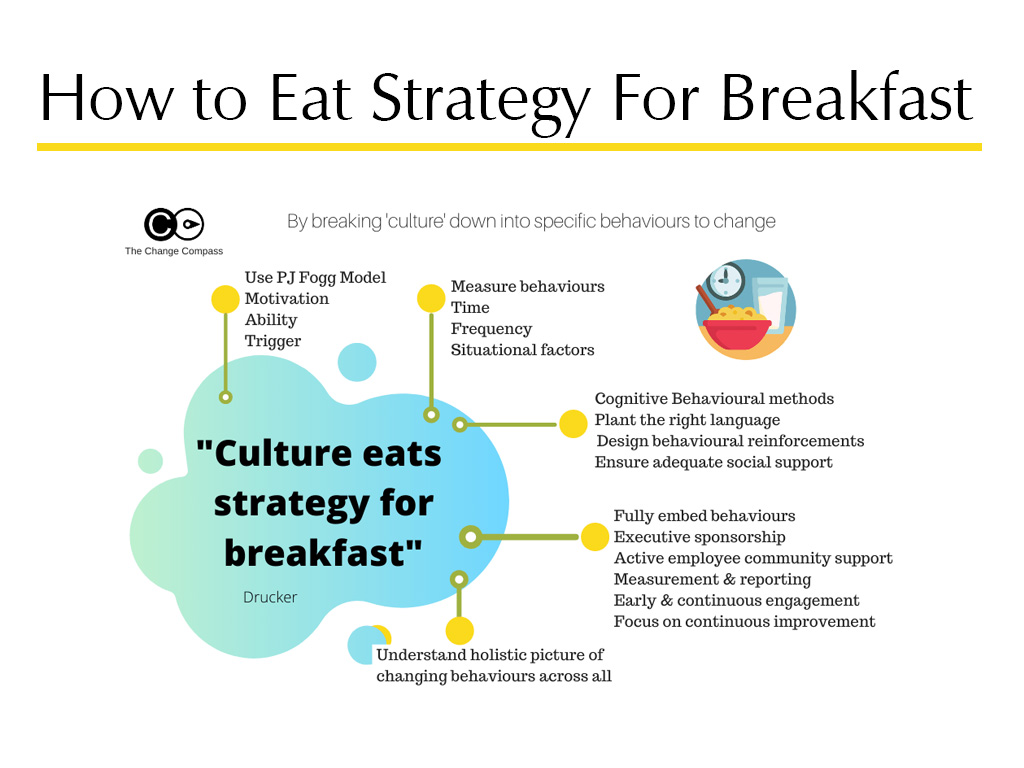
The mechanisms that actually shift culture operate at three levels. The first is symbolic — the signals sent by leadership behaviour, by which stories get told and celebrated, by what gets acknowledged in public forums. These signals update employees’ mental model of what the organisation values, and they operate continuously and informally. They cannot be manufactured but they can be managed, through deliberate attention to the symbolic weight of leadership decisions.
The second level is structural — the formal systems that shape behaviour over time. Performance management criteria determine what people are measured on. Promotion decisions reveal what the organisation actually values versus what it says it values. Resource allocation decisions signal which priorities are real and which are aspirational. Changing the culture without changing these structural signals produces a gap between the espoused values and the experienced reality that erodes employee trust.
The third level is social — the norms that operate within teams and peer groups. Cultural change ultimately becomes real when the informal social environment in a team reinforces the target behaviours, not when a formal programme endorses them. This means cultural change is a distributed leadership challenge: it requires middle managers and team leaders to model and reinforce the target behaviours in their day-to-day interactions, not just the executive team in formal communications.
What sustains cultural change through leadership transitions
One of the most challenging dimensions of cultural change is making it resilient enough to survive leadership transitions. Many cultural transformations are genuinely fragile — they depend on the personal commitment and behavioural modelling of a specific leader, and they fade or reverse when that leader moves on. The Manulife Philippines experience offers relevant insights into what makes cultural change durable rather than personality-dependent.
The key is institutional embedding. Cultural change that is held in place primarily by a leader’s personal presence is not yet cultural change in the meaningful sense — it is behavioural compliance driven by proximity to authority. For culture to become genuinely self-reinforcing, the target behaviours need to be embedded in the formal systems (who gets promoted, what gets recognised, how decisions are made), in the informal social norms (what teams expect of each other), and in the stories the organisation tells about itself and its history.
McKinsey research on the building blocks of cultural change found that organisations which successfully embed cultural change share a common pattern: they invest in changing the formal role modelling and capability requirements for leadership positions, so that each successive generation of leaders is selected and developed on the basis of the target culture rather than the legacy one. This is a multi-year commitment that extends well beyond the tenure of any individual transformation programme.
The role of patience and consistency
Perhaps the most counterintuitive insight from practitioners like Richard Bates is the degree to which cultural change depends on consistency over speed. Most leaders underestimate how long genuine cultural change takes, and this underestimation leads them to declare success prematurely, redirect attention before the change has consolidated, or pivot to a new cultural initiative before the first one has taken root.
The research on cultural change timescales consistently points to a range of three to five years for meaningful, measurable cultural shift in a large organisation — and that is under conditions of active, sustained leadership commitment. The implication is that cultural transformation cannot be treated as a programme with a defined end date. It needs to be treated as an ongoing leadership responsibility that is managed through a cadence of reinforcement, measurement, and adjustment rather than a project plan with milestones.
Consistency is equally important and equally underdelivered. Employees are highly sensitive to inconsistency between stated values and observed behaviour, and a single visible inconsistency — a moment where the leader behaves in a way that contradicts the target culture — can undo months of positive signalling. This does not mean leaders need to be perfect. But it does mean that when inconsistencies occur, they need to be acknowledged and addressed explicitly, rather than glossed over, precisely because the organisation is watching how the leader responds to their own imperfections.
How change management tools support cultural transformation
Cultural change programmes often struggle with measurement. Unlike operational changes where adoption can be tracked through system usage or process compliance data, cultural change involves shifts in attitudes, behaviours, and informal norms that are inherently harder to quantify. This measurement gap makes it difficult for leaders to know whether the change is gaining traction, whether specific interventions are working, and where in the organisation the cultural shift is proceeding more slowly.
Portfolio-level change management platforms like The Change Compass provide a structured way to track not just the activity of cultural programmes — how many workshops have been run, how many leaders have been briefed — but the cumulative change load that cultural initiatives are contributing to alongside other concurrent programmes. This portfolio view is particularly valuable in large organisations where cultural transformation is running in parallel with significant operational or technology change, and where the aggregate demand on employee attention and adaptive capacity may be undermining both.
Key takeaways from the Manulife Philippines experience
Several themes from Richard Bates’ account of driving cultural change at Manulife Philippines are broadly applicable to any large-scale cultural transformation effort. The first is that cultural change is leadership work, not programme work. The design of a cultural programme matters less than the quality and consistency of leadership behaviour in reinforcing it. Second, honest diagnosis precedes effective intervention. Organisations that skip the uncomfortable work of understanding why the current culture developed the way it did tend to target symptoms rather than causes. Third, structural alignment is non-negotiable. Cultural change that is not reflected in performance management, promotion criteria, and resource allocation is aspirational messaging, not transformation. Fourth, patience is a strategic requirement. Three to five years is a realistic timeframe for genuine cultural shift, and organisations that treat this as a two-year programme consistently underdeliver. Fifth, embedding is the measure of success. When cultural change survives leadership transitions without regression, the transformation has become genuinely organisational rather than personality-dependent.
Frequently asked questions
How long does cultural change take in a large organisation?
Research consistently points to three to five years as a realistic timeframe for meaningful, measurable cultural change in a large organisation, under conditions of active, sustained leadership commitment. Organisations that set shorter timelines tend to declare success prematurely based on early behavioural compliance rather than genuine cultural shift. Cultural change that is robust enough to survive leadership transitions typically requires longer, as institutional embedding takes time to permeate selection criteria, promotion decisions, and informal social norms.
What is the most important factor in successful cultural transformation?
The most important factor is the visible alignment between stated values and the observable behaviour of senior leaders — particularly the CEO. Employees calibrate their own behaviour against what they see rather than what they are told. Leadership consistency in demonstrating target behaviours, especially in high-pressure situations, is more powerful than any formal programme. This is consistently the finding of both academic research and practitioner experience.
Why do so many cultural change programmes fail to stick?
Most cultural change programmes fail to stick because they target visible behaviour without changing the structural systems that drive it. Performance management criteria, promotion decisions, and resource allocation patterns are the real signals of what the organisation values. When these structural signals remain aligned with the old culture while communications and training promote the new one, employees experience a gap between the espoused values and the experienced reality. That gap erodes trust and makes sustained behavioural change unlikely.
How do you make cultural change resilient to leadership transitions?
Cultural change becomes resilient to leadership transitions when it is embedded in formal systems rather than held in place by a single leader’s personal commitment. This means changing the criteria by which leaders are selected and developed, embedding target behaviours in performance frameworks, ensuring the stories the organisation tells about itself reinforce the cultural direction, and building social norms within teams that make the target behaviours the expected default. When these elements are in place, each successive generation of leaders reinforces the culture rather than depending on the founding transformation leader to maintain it.