

Here is a number that rarely appears in transformation business cases: the productivity cost of the change itself.
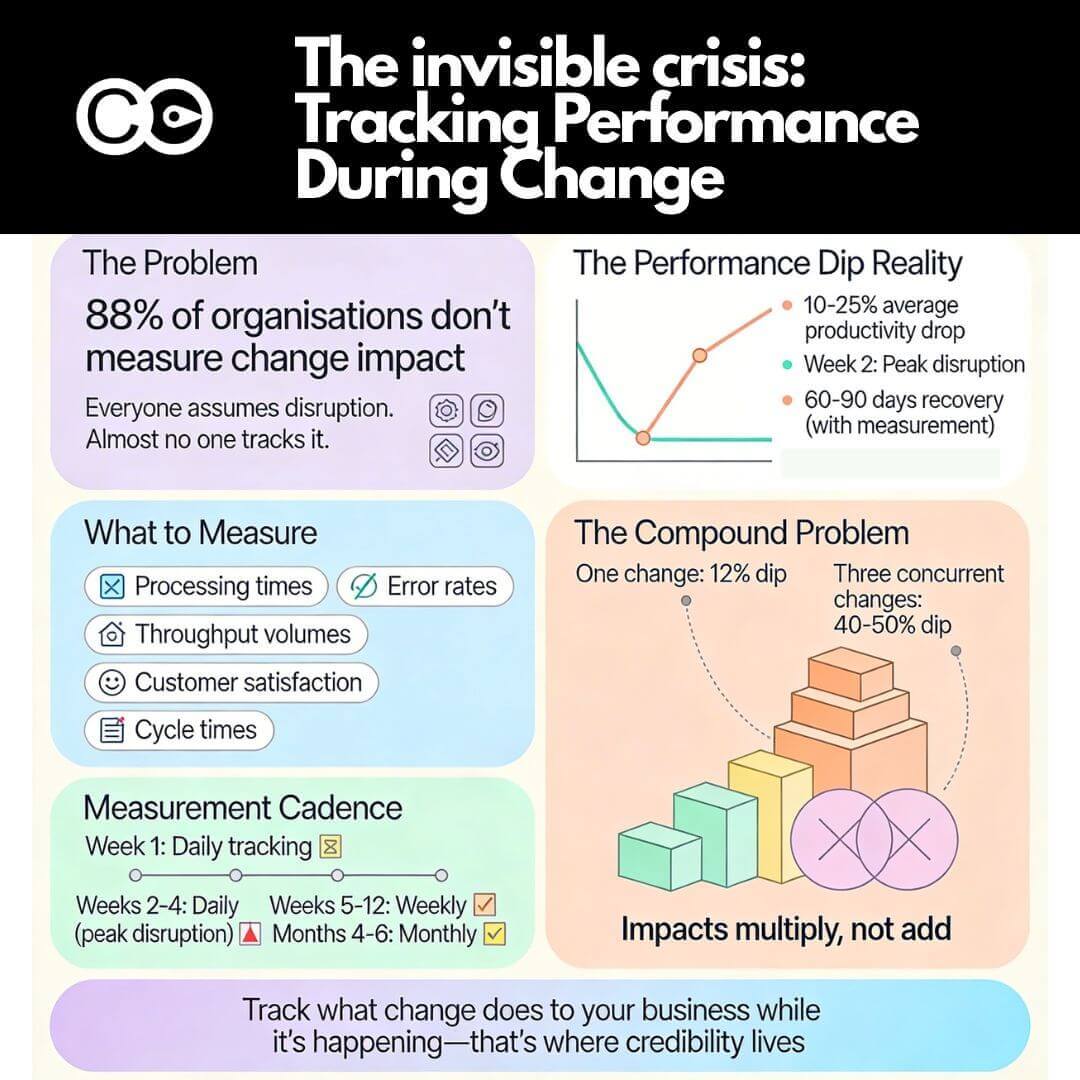
Organisations routinely model the financial benefits of a new system or operating model. They calculate the headcount savings, the efficiency gains, the revenue uplift. What they rarely model is the six to twelve months during which the productivity of their workforce will fall , sometimes sharply , before those benefits are realised.
This is the productivity dip. Every major change initiative creates one. The question is not whether it will happen, but how severe it will be, how long it will last, and whether you have done enough to shorten it. This article examines what drives the productivity dip during change, what the evidence says about its scale, and what practitioners can do to manage it.
What the data says about productivity loss during change
The productivity impact of organisational change is well-documented, even if it remains chronically underestimated in programme planning.
Willis Towers Watson’s research on workplace transformation found that over a third of employers experienced a measurable decline in productivity as a result of significant organisational change. More than half reported high to moderate anxiety among employees during major transitions, and two-thirds reported work distraction , a leading indicator of productivity loss.
Gallup’s State of the Global Workplace research quantifies the broader disengagement effect: global employee disengagement costs the global economy an estimated $438 billion in lost productivity annually. When organisations run poorly managed change programmes, they accelerate this disengagement among their most affected employee groups.
A 2025 analysis by ActivTrak found that the share of employees at risk of disengagement increased by 23% between 2024 and 2025, with research suggesting that disengagement and attrition could cost a median-size S&P 500 company between $228 million and $355 million per year. Not all of this is attributable to change management failures, but programme-driven change saturation is consistently identified as a contributing factor.
The implication is clear: the productivity dip is not a minor footnote to a transformation programme. For large organisations, it is a multi-million-dollar risk that deserves the same analytical rigour as any other programme cost.
Why the productivity dip happens: the mechanics of transition
Understanding why productivity falls during change is the first step to managing it. The dip is not a single phenomenon , it has several distinct causes that often compound each other.
The learning curve effect
When people are asked to work in new ways , using new systems, following new processes, operating in new team structures , they inevitably take longer to do what they could previously do almost automatically. This is the classic learning curve. Productivity falls in the short term because competence takes time to build.
The steeper the change, the steeper the learning curve. A minor process update might create a negligible dip. An enterprise-wide ERP implementation that changes how every transaction is processed can create a performance trough that lasts months.
The uncertainty and anxiety effect
Change creates uncertainty, and uncertainty is cognitively expensive. Research on workplace anxiety during transformation consistently shows that when employees are uncertain about their role, their job security, or how they are expected to perform in the new environment, their capacity for focused work drops significantly.
People spend time processing the change , discussing it with colleagues, seeking information, managing anxiety , rather than delivering at their normal pace. This is not irrational behaviour. It is a predictable response to an uncertain environment.
The cumulative change load effect
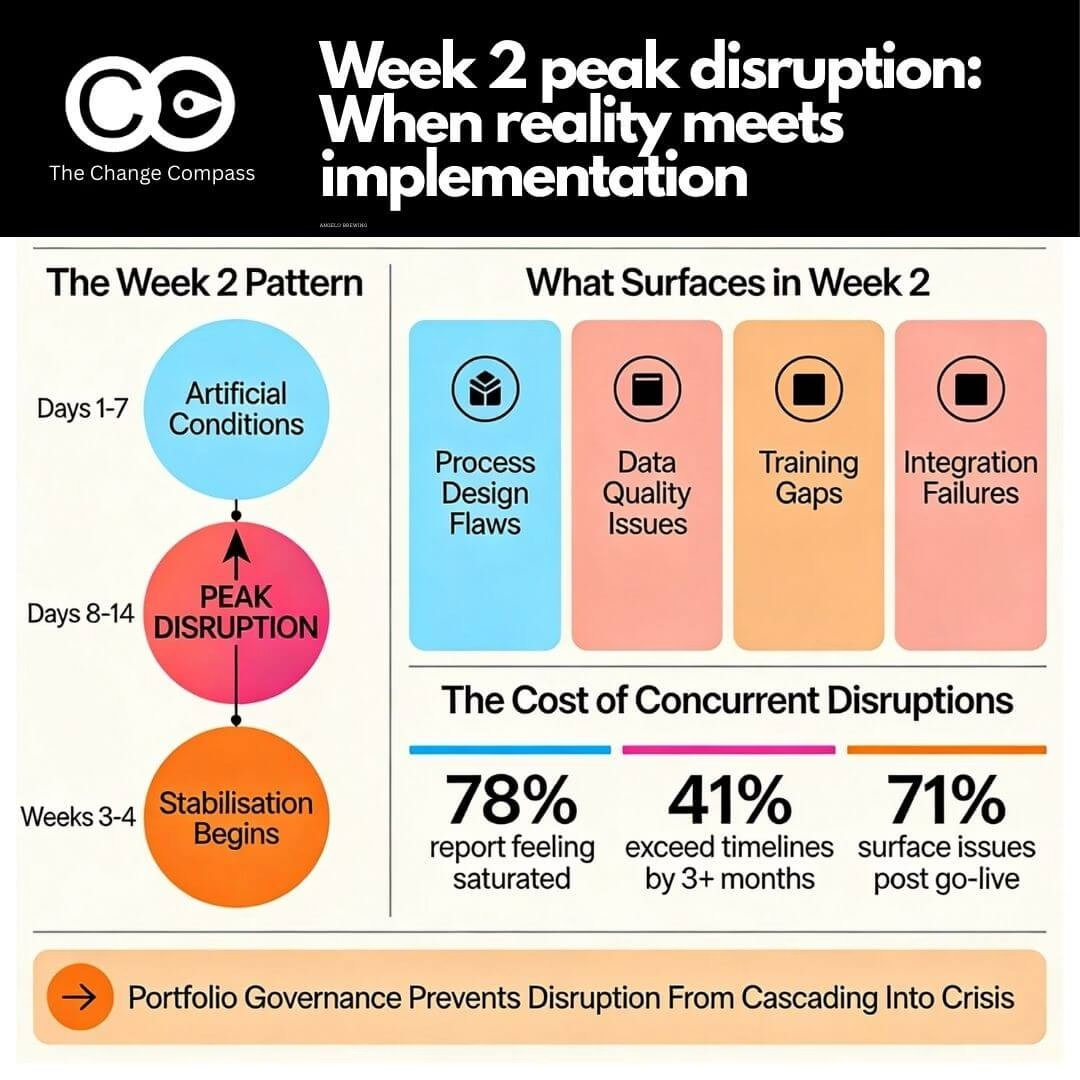
The productivity dip is significantly amplified when employees are experiencing multiple significant changes simultaneously. A team navigating a restructure, a new performance management framework, and a technology platform migration at the same time is not facing three manageable changes , they are facing a compounding load that can exceed their capacity to absorb and adapt.
McKinsey’s 2024 research on transformation highlights this directly: organisations running multiple transformations concurrently face compounding risk that goes beyond what individual programme risk assessments typically capture. Managing cumulative change load is one of the most important, and most underinvested, aspects of enterprise change management.
The disengagement effect
Not all employees who struggle with change become disengaged, but a significant proportion do , particularly those who feel the change was poorly communicated, who did not feel involved in the process, or who do not understand the rationale for what is being asked of them.
Disengaged employees are not simply less productive in a quantifiable sense. They are also more likely to resist the change actively or passively, to share negative sentiment with peers, and to leave the organisation , taking institutional knowledge and capability with them.
Five evidence-based strategies to minimise the productivity dip
The productivity dip cannot be eliminated entirely. But it can be shortened, shallowed, and managed. Here are five strategies supported by research and practitioner experience.
1. Quantify the expected dip in the business case
The single most important thing you can do to prepare your organisation for the productivity dip is to make it visible before the programme begins.
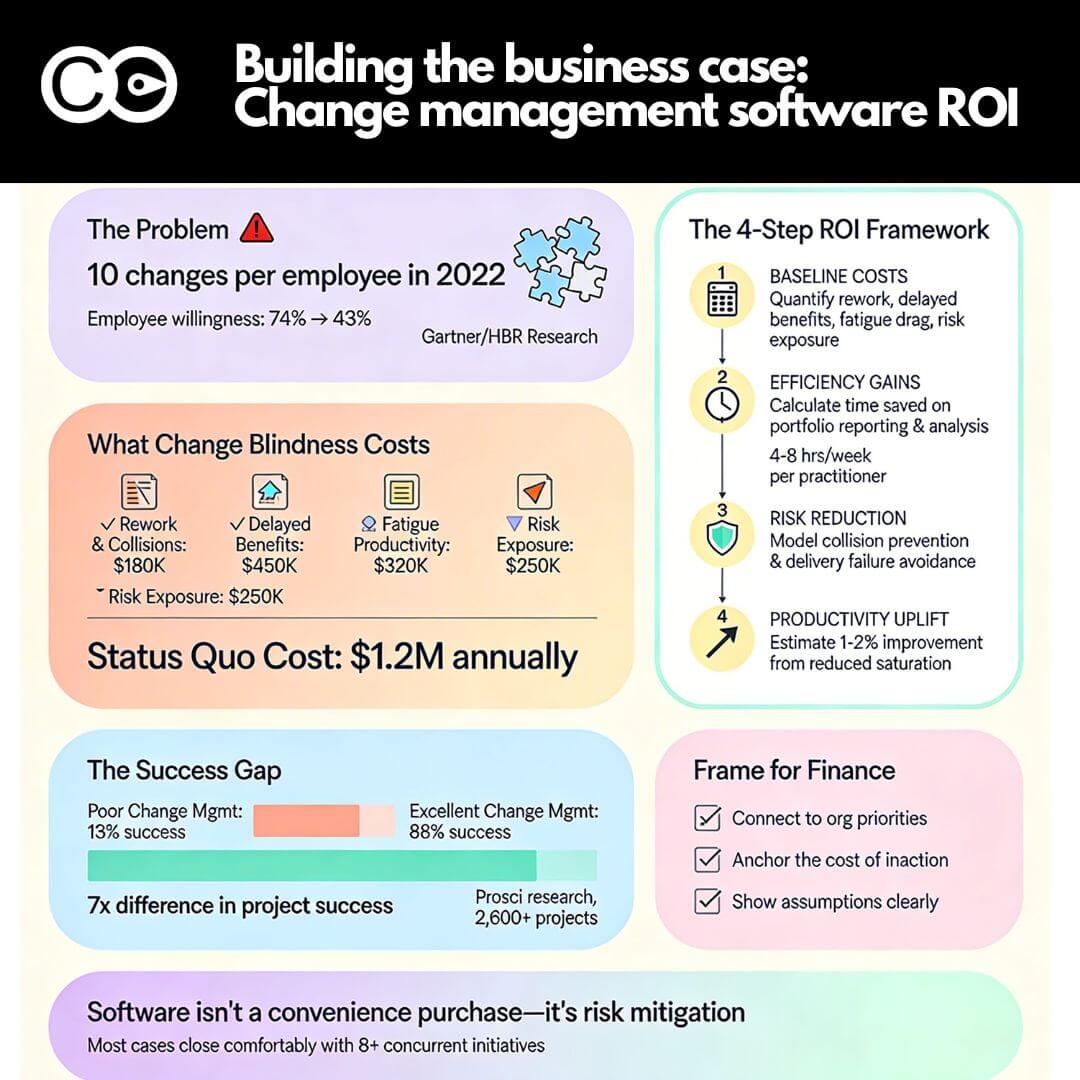
Build a productivity impact model into the programme business case. Estimate the duration and depth of the dip for the most affected groups, and translate it into financial terms. This does two things: it sets realistic expectations with leadership, and it creates a budget case for investment in change management support.
A business case that shows a twelve-month payback period based solely on benefit realisation, without accounting for a six-month productivity trough, is presenting a misleadingly optimistic picture. Making the dip explicit is not pessimism , it is intellectual honesty, and it protects the programme when the inevitable short-term performance decline materialises.
2. Invest in change management earlier, not later
Prosci’s research on change management timing consistently shows that change management deployed early in a project lifecycle , during design, not just implementation , is significantly more effective than change support added after go-live.
By the time productivity is visibly declining, the window for the most impactful interventions has usually passed. Early change management focuses on leader alignment, employee awareness, and readiness building , all of which reduce the depth of the dip at go-live.
The organisations that minimise productivity loss are those where change practitioners have been involved in programme design, not just programme delivery.
3. Manage cumulative change load deliberately
If your employees are experiencing three, four, or five significant changes simultaneously, no amount of good communication will fully offset the cognitive and emotional load they are carrying.
Change portfolio management , the discipline of tracking and managing the total volume of change across an organisation , is a practical response to this problem. By mapping which groups are affected by which initiatives, and sequencing or pacing change to avoid overload in any single group, organisations can meaningfully reduce the cumulative impact on productivity.
This kind of portfolio visibility requires data , specifically, change impact data aggregated across programmes in a consistent format. Platforms like Change Compass are built precisely for this purpose, enabling enterprise change teams to identify which groups are most at risk of change saturation and to make evidence-based decisions about pacing and prioritisation.
4. Invest in targeted capability building, not just training
The standard response to the learning curve effect is training. But generic, volume-led training programmes are one of the least efficient ways to address a productivity dip. The most effective interventions are targeted to the specific capability gaps created by the change, delivered in a format that matches how each group actually learns, and timed to when people are ready to apply the new capability.
This requires a clear picture of what each affected group needs to know and be able to do differently. The change impact assessment drives this, as discussed earlier in this series. The key principle is that training design should follow impact analysis, not precede it.
Just-in-time training , delivered close to the point where new capability is needed , consistently outperforms early, front-loaded training for productivity recovery. People forget what they learned two months ago. They retain what they practise immediately.
5. Build a visible measurement and recovery framework
One of the reasons productivity dips persist longer than they need to is that organisations lack the mechanisms to detect them early and respond quickly. If you are waiting for quarterly performance data to identify that productivity has declined, you are months behind where you need to be.
Build a measurement framework that includes leading indicators of the dip , early adoption rates, support ticket volumes, manager-reported confidence levels, self-reported readiness surveys , alongside lagging indicators of business performance. Monitor these indicators weekly during and immediately after go-live, and have a response protocol for groups showing early warning signs.
Research by Gartner on change management success suggests that the organisations with the best change outcomes have systematised their response to performance signals, rather than treating each dip as a unique event requiring an ad hoc response.
The role of leadership in managing the productivity dip
No technical change management strategy will fully compensate for leaders who are not genuinely present during a transition. One of the strongest predictors of how quickly productivity recovers is whether employees’ direct managers are visible, informed, and actively supporting the change.
This matters for a specific reason: the primary source of information and reassurance for most employees during a change is their direct manager, not a central communications team. If managers are uncertain, avoidant, or visibly resistant, that signals to their teams that the change is more threatening than the official messaging suggests.
Equipping managers to lead through change , with clear information, talking points, and personal support , is one of the highest-return activities in a change programme. The productivity cost of a disengaged middle-management layer is far higher than the cost of a structured manager engagement programme.
Monitoring productivity recovery in real time
One of the practical challenges of managing the productivity dip is knowing when you are actually through it. Without consistent measurement, organisations often assume recovery has occurred before it has , and withdraw change support too early as a result.
Effective recovery monitoring combines quantitative data (system usage rates, process cycle times, quality metrics) with qualitative signals (employee confidence surveys, manager assessments, support volumes). Tracking both allows you to distinguish between apparent recovery (people have stopped complaining) and actual recovery (performance has returned to baseline or better).
Digital change management platforms like Change Compass can support this monitoring by consolidating adoption data across the programme portfolio, flagging groups where adoption is lagging behind plan, and providing a single view of change health across the organisation.
The productivity dip during change is predictable, quantifiable, and manageable. It is not an inevitable cost of doing business. Organisations that treat it as such , accepting performance decline as unavoidable , are leaving value on the table and creating unnecessary difficulty for their employees.
The key disciplines are: building the dip into your business case so it is expected and budgeted for, investing in change management early rather than reactively, managing cumulative change load at the portfolio level, targeting capability building to actual gaps, and measuring recovery with enough granularity to respond when groups fall behind.
None of these is technically complex. What they require is the conviction that the productivity dip matters enough to plan for , and a change function with the data and the mandate to act.
Frequently asked questions
What is the productivity dip during change?
The productivity dip is the temporary decline in workforce output that occurs when an organisation implements significant change. It is caused by the combined effects of learning new processes or systems, the cognitive cost of uncertainty, and the disruption of established working patterns. The depth and duration of the dip vary depending on the scale of change, the level of preparation, and the quality of change management support.
How long does the productivity dip typically last?
Duration varies considerably by change type and management quality. Minor process changes may create a dip of days to weeks. Major technology implementations or structural reorganisations can produce a productivity trough lasting three to nine months. With strong change management, including early preparation, targeted training, and leadership engagement, the dip can be shortened significantly compared to unmanaged transitions.
How do you measure the productivity dip during change?
Effective measurement combines leading and lagging indicators. Leading indicators include system adoption rates, self-reported confidence surveys, support ticket volumes, and manager-assessed readiness. Lagging indicators include output metrics, quality measures, and cycle times. Tracking both provides early warning of groups at risk and confirms when genuine recovery has been achieved.
Can the productivity dip be avoided entirely?
Not entirely , some degree of performance decline is inherent in the transition to new ways of working. However, the depth and duration of the dip can be reduced substantially through proactive change management. Organisations with excellent change management support are documented to achieve significantly better project timelines and outcomes than those with poor or absent change management.
What role does cumulative change load play in the productivity dip?
Cumulative change load , the total volume of change being asked of an employee or group at any one time , is one of the strongest amplifiers of the productivity dip. A group experiencing three significant changes simultaneously faces a compounding burden that can exceed their capacity to adapt. Managing cumulative load through change portfolio visibility and deliberate sequencing is one of the most effective structural interventions available.
How does leadership behaviour affect the productivity dip?
Leadership behaviour is a critical moderating factor. Visible, informed leaders who actively communicate the rationale for change and support their teams through transition consistently produce faster recovery curves than absent or resistant leaders. Equipping managers with the information and tools to lead through change is one of the highest-return investments in the change management toolkit.
References
- Willis Towers Watson. (2021). 2021 Employee Experience Survey. https://www.wtwco.com/en-us/insights/2021/07/2021-employee-experience-survey
- Gallup. (2024). State of the Global Workplace Report. https://www.gallup.com/workplace/349484/state-of-the-global-workplace.aspx
- McKinsey & Company. (2024). Change is changing: How to meet the challenge of radical reinvention. https://www.mckinsey.com/capabilities/people-and-organizational-performance/our-insights/change-is-changing-how-to-meet-the-challenge-of-radical-reinvention
- Gartner. (2024). Leaders Today Must Routinize, Not Inspire, Change. https://www.gartner.com/en/articles/this-new-strategy-could-be-your-ticket-to-change-management-success
- Prosci. (2024). Change Management Best Practices. https://www.prosci.com/blog/change-management-best-practices
- ActivTrak. (2026). State of the Workplace 2026. https://www.activtrak.com/resources/state-of-the-workplace/