

Most change managers have tried using AI for something in the past twelve months. Drafting a stakeholder communication. Generating a change impact summary. Running a change plan through ChatGPT. And most have found that the output was adequate, occasionally impressive, but rarely transformative.
That experience has left the profession in an ambiguous position: aware that AI matters, unclear on what it should actually do, and uncertain whether the tools available today are fit for serious change work or are just productivity shortcuts dressed up as something more important.
This guide cuts through that ambiguity. It explains what AI in change management actually means, where it genuinely adds value, where it does not, and what it takes to move from ad hoc AI experimentation to a structured capability that improves outcomes. It maps the full landscape of AI applications in the field, from basic generative tools through to purpose-built change intelligence platforms, so you can make an informed decision about where to invest and in what sequence.
The two ways AI shows up in change management
Before evaluating any AI application, it helps to be precise about what we are talking about. AI appears in change management in two structurally different forms, and conflating them is the source of most of the confusion and disappointment organisations experience.
Generative AI for task acceleration
The first form is generative AI: large language model tools like ChatGPT, Microsoft Copilot, and Google Gemini applied to the drafting and synthesis tasks change managers do every day. This includes generating first drafts of stakeholder communications, producing change impact summaries from meeting notes, synthesising training content, drafting executive briefings, and producing change plans from a brief.
These tools are capable at this work when the inputs are specific, the task is well-defined, and someone experienced reviews and edits the output. They reduce the blank-page friction that slows down delivery teams and can meaningfully accelerate the documentation-heavy early stages of a change programme.
They are not, by themselves, a change management capability. Output quality depends entirely on the quality of the inputs, and those inputs are only as good as the person providing them.
Purpose-built AI embedded in change platforms
The second form is purpose-built AI: algorithms and analytical models embedded in change management platforms designed specifically for the data and decision types that change managers face at portfolio level. This includes saturation forecasting (predicting when aggregate change load will breach absorption capacity), adoption likelihood scoring (identifying which stakeholder groups are at risk of non-adoption), fatigue indexing (tracking cumulative exposure per group across all concurrent initiatives), and narrative generation grounded in your organisation’s actual change data.
This form of AI is structurally different from a general-purpose language model. It is grounded in your organisation’s change data, which is what makes it capable of producing recommendations that are specific rather than generic.
Understanding this distinction is the starting point for making sound decisions about AI adoption in change management. For a detailed analysis of where each type delivers and where it falls short, our article on what AI can and can’t do in change management works through the specifics across each use case.
What AI genuinely delivers for change managers
Setting aside the hype, there are three categories where AI creates real and measurable value for change practitioners today.
Drafting speed and cognitive offload
The most straightforward and proven benefit is acceleration of drafting work. Research from Asana’s State of AI at Work 2025 found that knowledge worker AI usage doubled from 36% to 70% between 2023 and 2025, with workers delegating approximately 27% of their workload to AI-assisted tools. For change managers, the highest-value delegation targets are the time-consuming mid-complexity tasks: stakeholder communication first drafts, change plan outlines, training needs summaries, and status report synthesis.
The key word is “drafting.” These outputs require domain review and context-specific editing before they are usable. But the productivity gain from a 70% complete, structurally sound first draft is real, especially on high-volume programmes with multiple concurrent workstreams and limited resourcing.
The discipline required is not adopting AI. It is building a review process that catches what AI gets wrong, which is always something.
Cross-initiative pattern recognition at portfolio scale
The second benefit is harder to achieve with generic tools but significant where it is available: the ability to detect patterns across multiple initiatives simultaneously. No human change manager can hold the full picture of a 30-initiative portfolio in their head, cross-referenced by impacted stakeholder group, timing, and impact type. Purpose-built AI can.
This matters because the failure modes in large portfolios are systemic, not project-level. A scheduling conflict between two initiatives landing on the same business unit in the same fortnight is invisible from inside either initiative. Behavioural contradictions, where two changes ask the same group to adopt incompatible working patterns, are nearly impossible to spot without aggregated data.
AI-powered conflict detection, as described in detail in our article on change conflict detection, surfaces these patterns before they reach the delivery phase, when they are still sequenceable rather than crisis-manageable.
Adoption forecasting and early warning
The third capability is predictive: using historical engagement, survey, and impact data to generate early-warning signals on adoption risk. Adoption forecasts at the initiative level are useful for sequencing decisions and sponsor attention. At the portfolio level, they become a governance instrument, identifying which clusters of change activity are likely to generate systemic resistance before the rollout is committed.
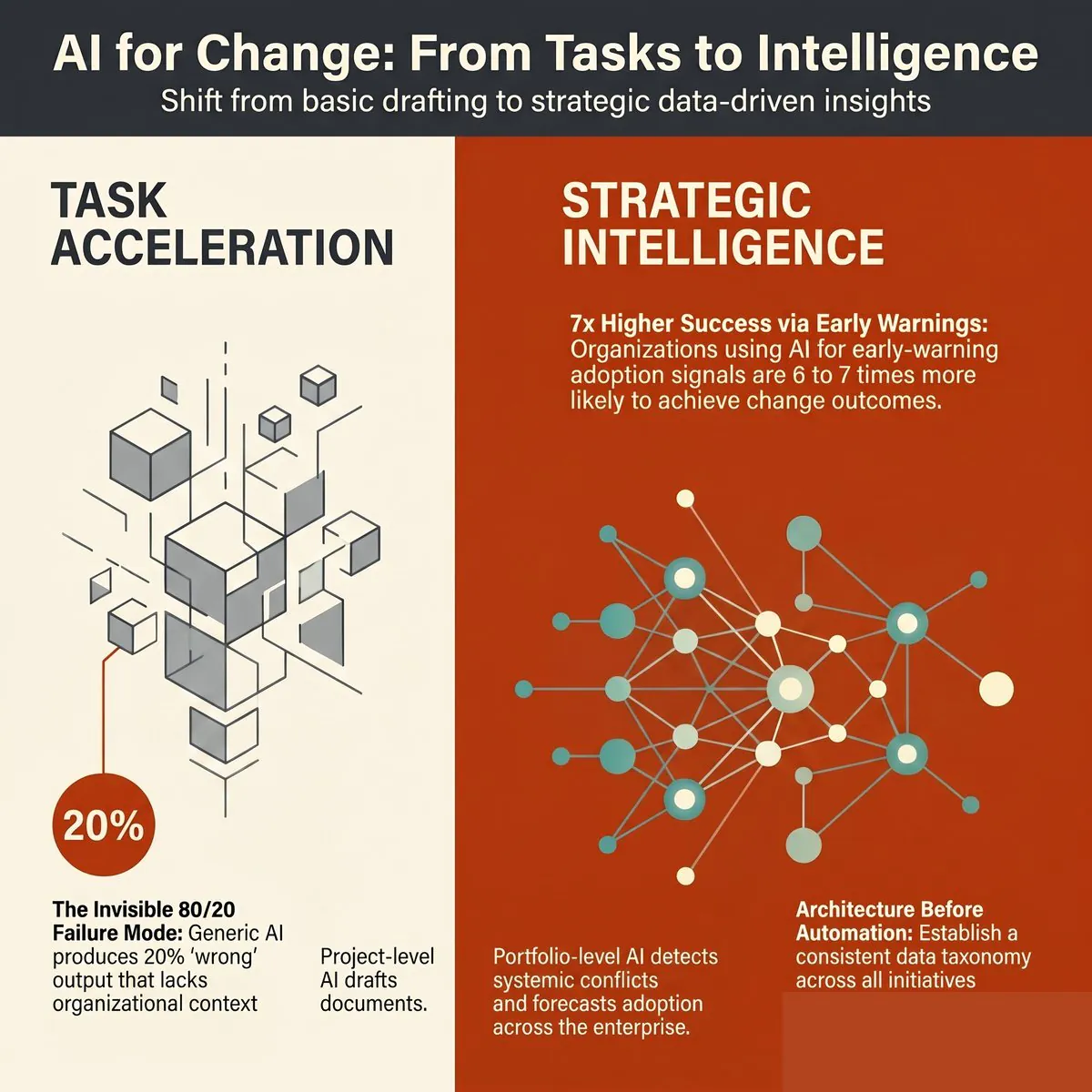
Prosci’s 12th Edition Best Practices in Change Management, drawing on data from over 10,800 change practitioners, identifies early-warning capability as one of the most significant differentiators between high-performing and low-performing change functions. Organisations that can identify adoption risk before deployment are 6 to 7 times more likely to achieve their intended change outcomes than those responding reactively.
Where AI misleads change managers (and why)
The same capabilities that make AI appealing also make it dangerous when used without the right foundations.
The 80/20 problem
Generic AI tools trained on change management best practice produce output that is typically 80% sound and 20% wrong for the specific organisation. The problem is that the wrong 20% does not announce itself. The credible 80% creates a halo effect that carries the whole output through governance.
Common manifestations include: change plans that assume sponsorship structures the organisation does not have, sequencing that does not account for the organisation’s change history, training approaches that do not match the workforce’s capability profile, and communication channels that bypass the organisation’s actual influence networks. None of these failures are obvious to anyone without deep contextual knowledge, which is precisely the knowledge that generic AI lacks.
This is distinct from hallucination, which is visible and correctable. The 80/20 failure mode is invisible at the point of output and becomes apparent only when the change reaches the impacted population. By then, the cost of correction is significantly higher than it would have been at the planning stage.
The project data trap
A related problem is the confusion between project data and change data. Most organisations have extensive project data: scope documents, risk registers, milestone trackers, budget reports. Almost none of this data describes what the change looks like from the perspective of the impacted employee.
AI grounded only in project data produces recommendations about projects. It cannot describe how 47 employees in the Melbourne operations team will experience a systems migration stacked on top of a restructure and a performance review cycle change, because that information does not exist in any project management tool.
The structural distinction between project data and change data is the most important issue to resolve before investing in any AI tool for change management. It determines whether your AI investment will produce portfolio-level intelligence or just faster versions of the same project-level documents you already had.
The two-tier model: Project-level and portfolio-level AI
The clearest framework for understanding where AI adds value in change management is the two-tier model.
Project-level AI operates within a single initiative. It accelerates task execution: generating change plans, impact assessments, stakeholder matrices, communications, and status reports from project-specific inputs. The Change Compass’s Change Automator is a purpose-built example of this, using your organisation’s structured change data as context to produce artefacts that are organisation-specific rather than generic.
Portfolio-level AI operates across all active initiatives simultaneously. It aggregates stakeholder impact, calculates saturation scores, detects scheduling and behavioural conflicts, forecasts adoption likelihood by stakeholder group, and generates executive narratives grounded in real portfolio data. This is the layer that generic AI cannot reach, because it requires a cross-initiative data architecture that no project management tool or general language model maintains.
The two tiers are complementary, not competitive. Project-level AI reduces the time change managers spend on documentation. Portfolio-level AI improves the quality of strategic decisions made by transformation leaders and executives. Together, they constitute a change management AI automation model that shifts the operating rhythm of a mature change function from reactive and document-heavy to predictive and intelligence-driven.
The most common mistake in AI adoption for change management is using only the project-level tier. This is understandable because project-level tools are more immediately tangible, but it misses the most significant value: the strategic intelligence that only a cross-portfolio view can generate.
The case for purpose-built platforms over generic AI
The logical implication of the two-tier model is that AI in change management becomes most valuable when it is grounded in structured, organisation-specific change data. This is not achievable through prompt engineering alone. It requires a data architecture designed specifically for change.
A Change Intelligence Platform is purpose-built for this requirement. It creates and maintains the system of record for change data across all initiatives, with a consistent taxonomy, structured impact fields, and aggregation capabilities that make portfolio-level AI feasible. The AI in a change intelligence platform is not a general-purpose language model with a change management persona. It is grounded in your organisation’s actual change data.
Why the data question is decisive
A 2025 IBM CEO Study, drawing on responses from 2,000 CEOs globally, found that only 25% of AI initiatives had delivered their expected ROI, and just 16% had successfully scaled. The most commonly cited obstacle was data readiness: 72% of CEOs identified proprietary data as the key to GenAI value, and 68% named integrated enterprise-wide data architecture as critical to success.
In change management terms, the bottleneck is identical. Generic AI cannot deliver portfolio-level value because the data it needs, organised change impact data aggregated across initiatives with a consistent taxonomy, does not exist in a general-purpose tool. Building that data layer is the prerequisite for the AI to do anything strategically useful.
What this means for AI adoption
The progression from “we are experimenting with ChatGPT” to “AI is improving our change outcomes” is not primarily a technology question. It is a data architecture question. Organisations that skip the data foundation step and invest directly in AI tooling find that the tools produce output that is faster but not better. The quality ceiling is set by the data, not the algorithm.
This is why early AI experimentation in change management so often disappoints: practitioners are running sophisticated tools on inadequate data, and no amount of prompt refinement resolves a structural data gap.
How to evaluate AI tools for change management
Given the two-tier model and the data architecture requirements, evaluating AI tools for change management requires a different lens than most technology evaluations. The relevant questions are not about the AI’s features in isolation but about whether the AI can access the data it needs to produce useful output.
The key evaluation criteria are:
- Data grounding: Does the AI use your organisation’s actual change data as context, or does it produce generic output from training data alone?
- Portfolio scope: Does the tool operate across all initiatives simultaneously, or only within individual projects?
- Taxonomy consistency: Does the platform enforce a consistent classification of impact types, stakeholder groups, and change phases across all initiatives? Without this, aggregation is unreliable.
- Output specificity: Can the AI produce recommendations that reference specific stakeholder groups, business units, and initiatives from your portfolio, or does it produce change management advice that could apply to any organisation anywhere?
- Integration: Does the platform connect to your HRIS, project management tools, and survey platforms to enrich the change data layer with real organisational signals?
Our detailed enterprise change management software buyer’s guide covers these criteria in depth, including the compliance, security, and integration requirements that enterprise procurement and IT teams will need to address.
The most important red flag when evaluating AI tools for change management is confident specificity without data grounding. If a tool produces highly specific recommendations about your organisation’s change programme without access to your organisation’s data, it is either applying generic best practice with a superficial wrapper of specificity or generating plausible-sounding output that has not been validated against your actual context. Both produce the 80/20 problem at scale.
How Change Compass implements AI in change management
Change Compass implements the two-tier model through two connected capabilities.
At the project level, the Change Automator generates change management artefacts from your organisation’s structured change data. Change plans, stakeholder matrices, communications plans, training needs analyses, and status reports are produced using the organisation’s taxonomy, change history, and stakeholder data as context. The output is organisation-specific, which means the editing required before it is usable is significantly less than for generic AI output.
At the portfolio level, Change Compass aggregates impact data across all active initiatives to generate saturation heatmaps, per-group fatigue indices, adoption likelihood scores, and portfolio-wide conflict alerts. The AI layer operates on top of this structured data, enabling capabilities that are not achievable with a standalone language model: forecasting saturation risk before a new initiative is launched, detecting when two initiatives are creating behavioural contradictions for the same stakeholder group, and generating executive narrative that is grounded in real portfolio data.
The data flywheel between the two tiers compounds over time. Every project-level artefact a change manager creates in the platform enriches the portfolio-level data that the AI uses to generate insights and forecasts. The more consistently teams use the platform, the more specific and accurate the portfolio intelligence becomes.
Where to start: a practical adoption roadmap
For change teams at the beginning of their AI journey, a sequenced approach is significantly more reliable than attempting to adopt both tiers simultaneously or investing in tooling before the data foundation exists.
- Standardise your change data model. Before AI can add portfolio-level value, you need consistent data across initiatives. Agree on a taxonomy for impact types, a classification system for stakeholder groups, and a common format for impact severity and timing. This can begin in a spreadsheet, but the goal is to move toward a platform that enforces consistency at data entry rather than relying on manual conventions.
- Adopt project-level AI for acceleration. Introduce generative AI at the project level for task acceleration: communications drafting, change plan generation, and status synthesis. Establish a clear editing discipline, recognising that AI output requires domain review before it is usable. Track the time saved per task to build the internal case for further investment.
- Aggregate into a portfolio view. Once you have consistent data across initiatives, aggregate it into a portfolio view. Even a static quarterly view of impacted stakeholder groups by initiative and timing provides significant value for sequencing decisions. This is the foundation on which portfolio-level AI can later operate.
- Deploy portfolio-level AI for strategic decisions. With consistent data and a portfolio view established, purpose-built portfolio AI becomes feasible. Start with saturation forecasting and conflict detection, as these produce the clearest and most immediately actionable signals for senior leaders.
This progression takes most change functions 12 to 24 months to complete, depending on the starting maturity of their data practices. The investment is front-loaded in steps 1 and 3, but the strategic value compounds significantly in step 4 and beyond.
Making AI work in practice
AI in change management is not primarily a technology adoption challenge. The change managers and functions that get the most from AI are those that have already invested in the data practices that give AI something useful to work with: structured impact data, consistent stakeholder taxonomy, and cross-initiative visibility maintained in a single system of record.
The organisations that will be genuinely differentiated by AI over the next three years are not those that adopted the most tools earliest. They are those that built the data foundation that makes AI output specific, accurate, and grounded in real organisational context.
That foundation is worth building whether or not AI is the primary motivation. The visibility and strategic intelligence it creates are valuable in their own right. AI acceleration is an additional return on the same investment, and a significant one as the tools mature.
Frequently asked questions
What is AI in change management?
AI in change management refers to the application of artificial intelligence, including generative AI tools and purpose-built analytics platforms, to improve the speed, quality, and strategic value of change management work. It encompasses task-level applications such as drafting communications and generating change plans, and portfolio-level applications including saturation forecasting, adoption risk scoring, and conflict detection across concurrent initiatives.
Can AI replace a change manager?
No. AI tools accelerate documentation and surface portfolio-level patterns, but they cannot substitute for the stakeholder relationships, political navigation, and adaptive judgement that define effective change management. Research from Workday found that while 75% of workers are comfortable working alongside AI agents, only 30% are comfortable being managed by one. The human role in change management shifts from document production to sense-making, relationship management, and strategic counsel, which AI cannot replace.
What data does AI need to be useful in change management?
AI in change management needs structured, organisation-specific change data: standardised impact classifications, stakeholder group definitions, change history, and timing data across all concurrent initiatives. Without this data, AI tools produce generic output that may be technically sound but contextually wrong for the specific organisation, producing the 80/20 problem described above.
What is the difference between a change management AI tool and a Change Intelligence Platform?
A change management AI tool typically applies generative AI to individual change tasks within a single project. A Change Intelligence Platform is a purpose-built system that maintains a cross-initiative data architecture, enabling portfolio-level AI applications including saturation forecasting, conflict detection, and adoption risk scoring. The platform provides the data layer that makes AI recommendations organisation-specific rather than generic.
How long does it take to see real value from AI in change management?
Project-level benefits such as drafting acceleration and time savings on documentation are typically visible within weeks of adoption. Portfolio-level benefits require consistent data collection across initiatives, which takes most organisations 12 to 24 months to establish. The strategic payoff, including predictive adoption forecasting and portfolio conflict detection, compounds significantly after the data foundation is in place.
References
- Asana. (2025). State of AI at Work 2025. Asana.
- IBM. (2025, May 6). IBM study: CEOs double down on AI while navigating enterprise hurdles. IBM Newsroom.
- Prosci. (2024). 12th Edition Best Practices in Change Management. Prosci.
- Workday. (2025, August 12). New Workday global research: AI agents are here, but don’t call them boss. Workday Newsroom.