

In 2015, the Change Management Institute published its Employment and Salary Survey for the Australian market. Buried in the data was a figure that should have sparked genuine debate in the profession: 77 per cent of change management roles in Australia were held by contractors. Not permanent employees. Not internal capability. Contractors brought in for a project, then gone. A decade later, that structural reality has barely shifted, and it raises a question that the Australian change management community has been reluctant to ask directly: does the way we resource change management actually undermine our ability to get better at it?
This is not a critique of individual contractors, many of whom are highly skilled and deeply experienced. It is a critique of the model. When three out of four change management practitioners are hired on a transactional basis, it tells you something important about how organisations perceive the discipline. Not as a core competency to be developed and retained, but as a specialist service to be procured when needed and released when the project closes. The implications of that perception are more significant than they might first appear.
Compare that posture with companies consistently ranked among the world’s most admired: Intel, Apple, Microsoft, Johnson and Johnson. These organisations do not treat change capability as something you rent. They build it into the operating rhythm of the business, into the expectations of line managers, into leadership development frameworks that persist across years and cycles. The gap between how Australian organisations approach change and how these companies approach it is not a gap in methodology. It is a gap in philosophy. And until we examine that gap honestly, we will keep importing contractors, running projects, and wondering why organisational resilience to change remains stubbornly low.
What the 77% contractor figure reveals
Numbers like this are easy to read as a simple market dynamic: change management is project work, so it attracts project-based resourcing. That explanation is not wrong, but it is incomplete. The more revealing question is why Australian organisations have not followed the same trajectory as, say, project management or business analysis, disciplines that began in a similar place and have steadily moved toward embedded internal capability. Most large Australian organisations now carry permanent project managers and business analysts on their payroll as a matter of course. Change management has not made that transition at the same rate, and the reason is not purely structural.
The underlying issue is that change management in Australia has largely been positioned as a deliverable, not a discipline. A contractor arrives with their change management plan, their stakeholder map, their communications calendar. They execute. They leave. The outputs exist but the learning does not transfer. The next project starts from scratch because the person who holds the knowledge is no longer there. This is not a failure of individual practitioners. It is a systemic failure of how organisations think about the relationship between change and capability.
McKinsey’s 2023 research on perpetual organisational upheaval surveyed 2,500 business leaders across Asia, Europe and North America and found that only about half said their organisations were well prepared for the change needed. In Australia, where the dominant model essentially resets change capability at the end of every project cycle, that readiness problem is structural, not incidental. You cannot build preparedness for an era of continuous change by repeatedly starting from zero.
The transactional model and its limitations
The contractor model offers genuine advantages that are worth acknowledging. It provides flexibility in a labour market where demand for change capability is uneven. It gives organisations access to specialists who have worked across multiple industries and can bring cross-pollinated insights. For a one-off, time-bounded transformation with a clear end date, it can be entirely appropriate. The problem arises when this model becomes the default rather than the exception, when it is applied not because it is the right tool for the situation but because the organisation has never seriously considered building the alternative.
The deeper limitation of the transactional model is what it does to learning. Every major change initiative generates knowledge, what worked in this organisation, what the stakeholder landscape looks like, which leaders are genuine sponsors and which are performative ones, where the cultural fault lines sit. In an embedded model, that knowledge accumulates. It becomes organisational memory. In a contractor model, it walks out the door. The next programme begins without the benefit of what the last one taught, and the organisation pays the same learning costs repeatedly without ever banking the returns.
There is also a question of accountability. A contractor’s primary obligation is to deliver the defined scope of work within the engagement period. That is not a moral failing; it is the nature of the contract. But genuine change capability requires something more than scope delivery. It requires ownership of outcomes that extend beyond the project close date, the willingness to be held accountable for whether change actually landed in the organisation, not just whether the plan was executed. That kind of accountability is structurally difficult when the person responsible for change has already moved on to their next engagement.
Gartner’s 2026 research on change management trends for CHROs found that organisations that continuously or regularly adapt change plans based on employee responses are four times more likely to achieve change success. Continuous adaptation requires continuity of presence. You cannot adapt intelligently to what you are no longer around to observe.
How globally admired companies approach change capability
Intel’s approach to change management has been studied extensively in organisational behaviour literature, and what makes it distinctive is precisely what makes it unfamiliar to most Australian practitioners. Rather than deploying specialist change resources on a project-by-project basis, Intel invested heavily in building change capability into the management layer itself. Line managers were trained and held accountable for managing the people-side of change as part of their standard operating responsibilities. Change was not something that happened to the business while the managers watched from the side. It was something managers were expected to lead, with support from a smaller internal centre of excellence that provided tools, coaching and frameworks.
This model is harder to stand up. It requires patient investment in manager capability, clear accountability frameworks, and the organisational will to hold leaders to behavioural standards that are harder to measure than project delivery. But the return is compounding. Each change cycle builds on the last, managers become more skilled, resistance patterns become better understood, and the organisation develops a genuine immune response to the failure modes that derail most transformations.
Microsoft’s cultural transformation under Satya Nadella is another instructive case. The shift from a “know it all” to a “learn it all” culture was not delivered by a fleet of external change contractors. It was driven through a sustained internal effort to change how leaders led, embedding a growth mindset into performance management, development conversations and the day-to-day operating model. Johnson and Johnson similarly integrates change thinking into its leadership development architecture, treating the ability to lead people through change as a core leadership competency rather than a specialist skill reserved for a separate function.
Apple’s approach is characteristically opaque, but its structural signature is visible: extraordinarily tight integration between product, operations and people strategy, with change absorbed into the operating model rather than managed as a separate workstream. The common thread across all of these companies is a refusal to treat change as an episodic challenge requiring episodic resourcing. They treat it as a permanent condition requiring permanent capability.
The case for the embedded change model
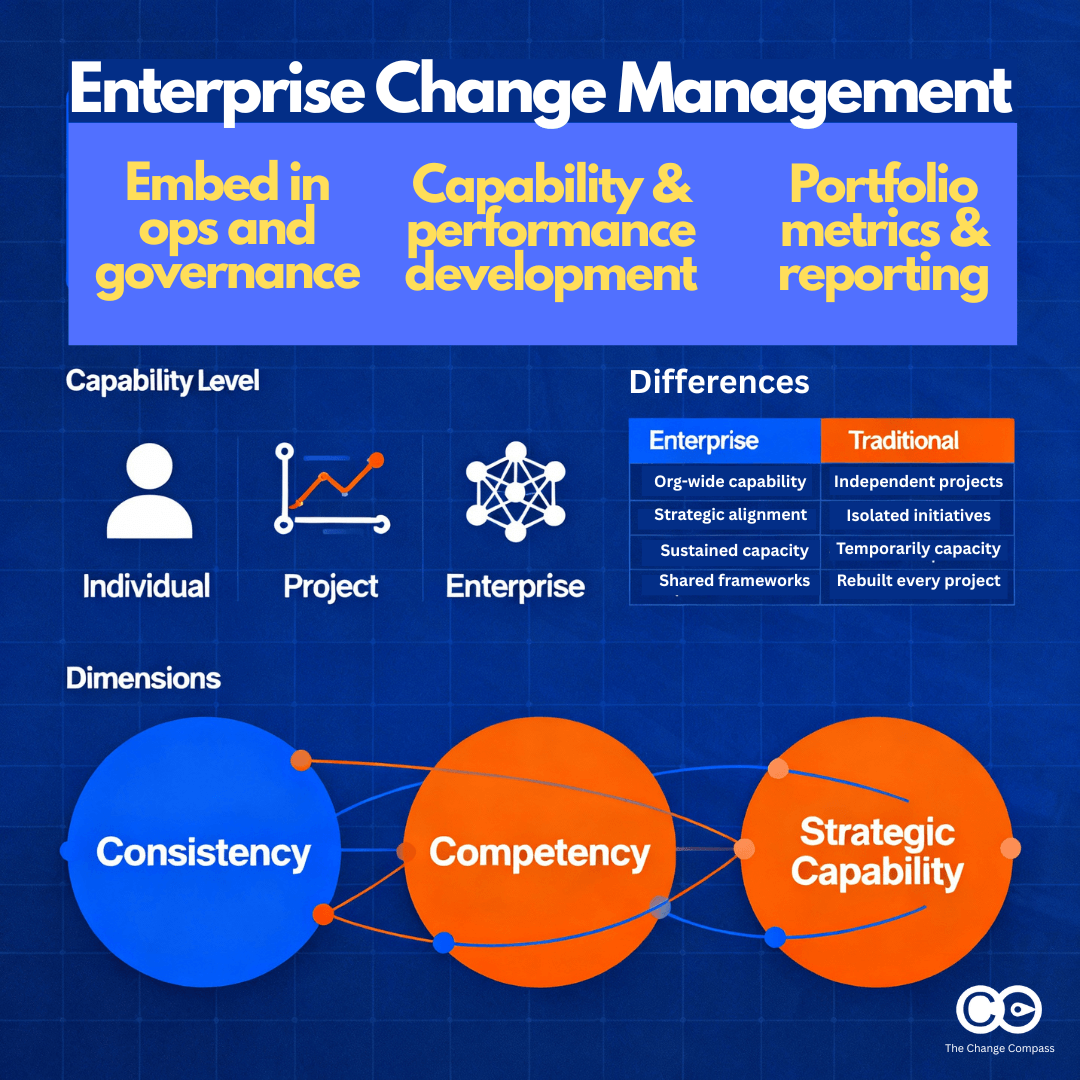
The embedded model does not mean eliminating external expertise. It means changing its role. In a mature embedded model, external practitioners might be brought in to support particularly complex or novel transformations, to provide specialist coaching, or to help build internal capability during a transition period. What they are not doing is substituting for internal capability that should exist but does not. The centre of gravity sits inside the organisation, not outside it.
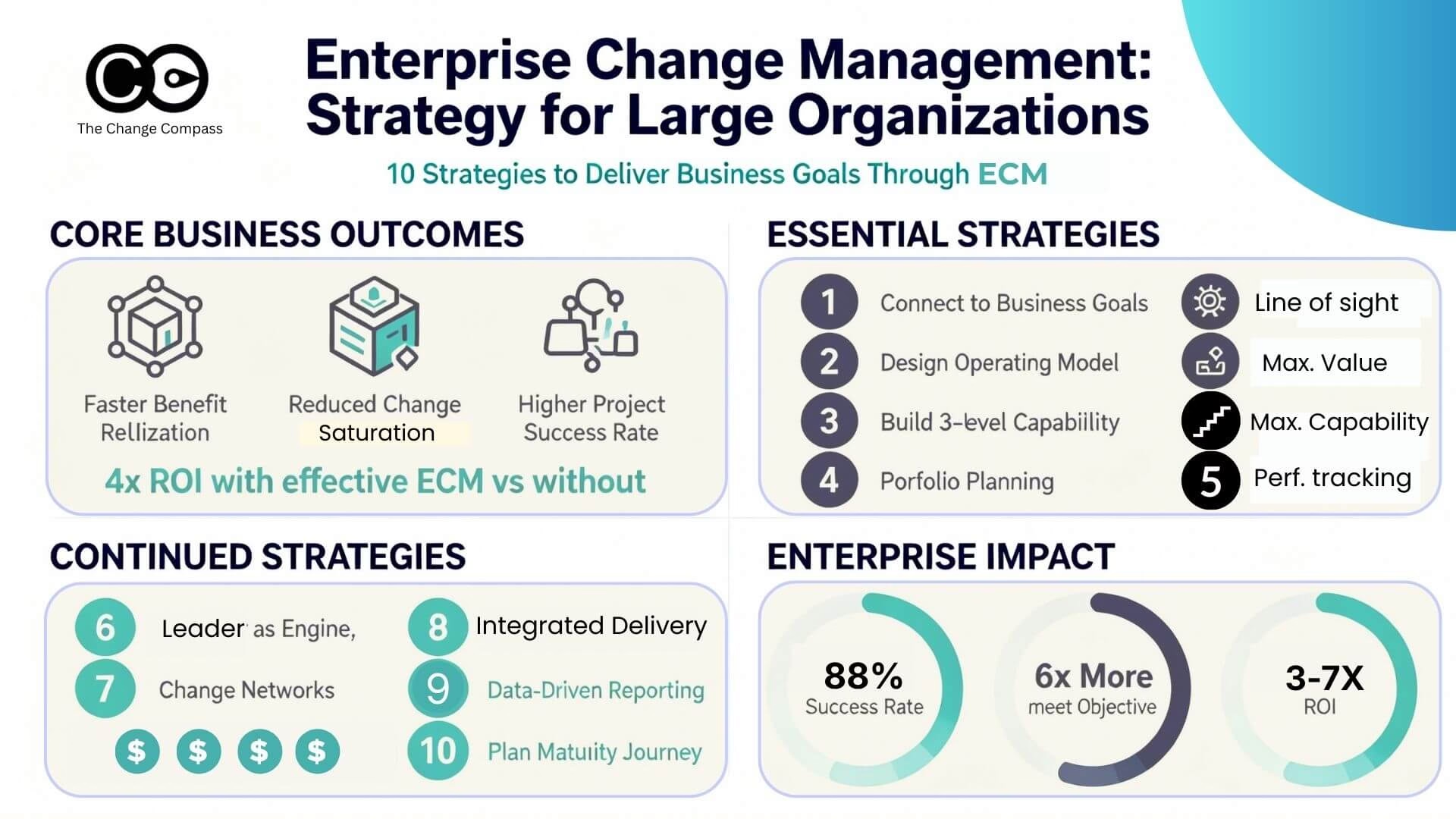
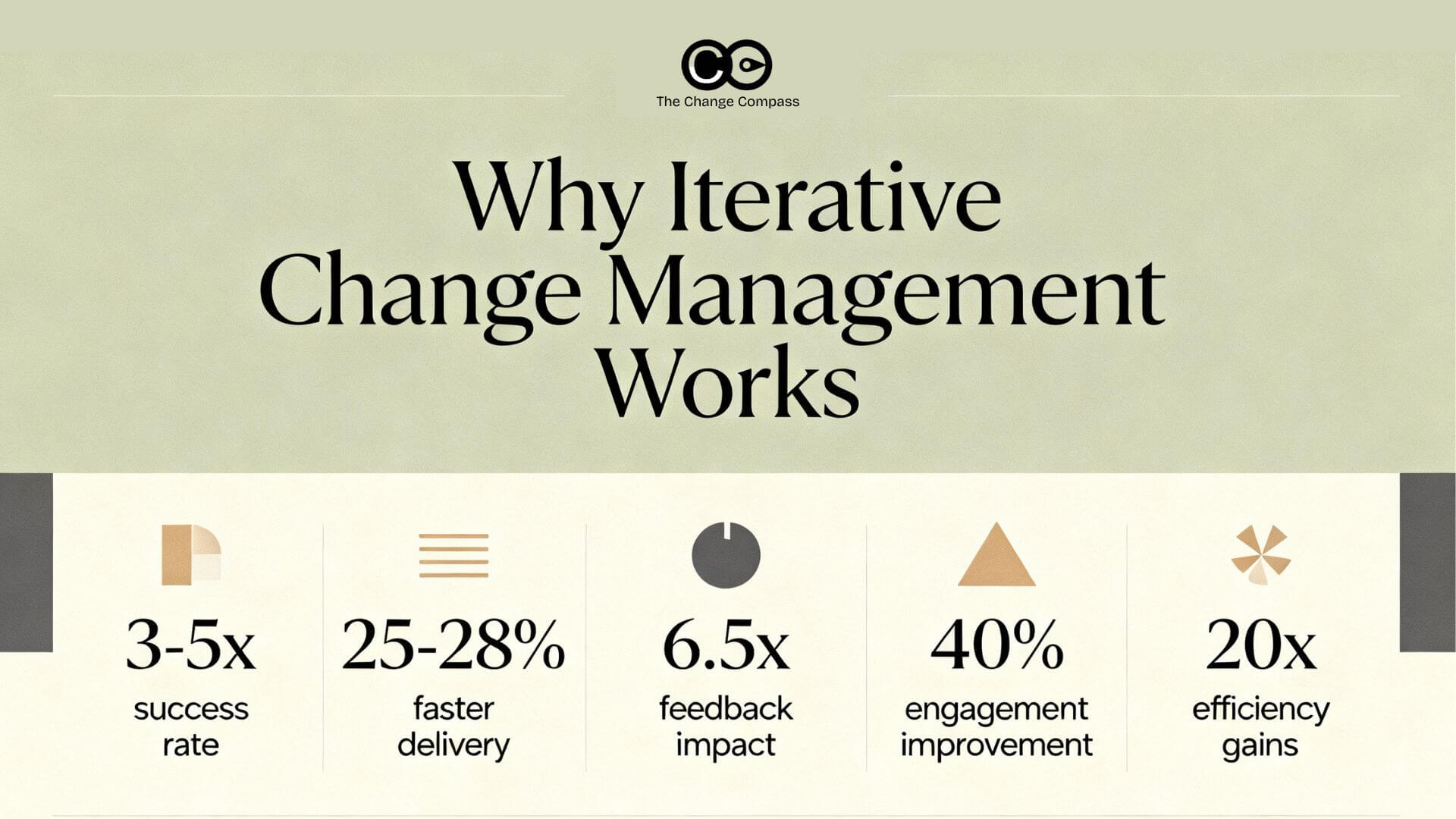
Prosci’s Change Management Maturity Model, which assesses organisations across five levels from ad hoc practice to organisational competency, makes the distinction clearly. At the higher maturity levels, change management is not a project function but an organisational one. It is integrated into governance, into leadership expectations, into the way programmes are structured from the outset. Crucially, Prosci’s Best Practices in Change Management research (12th edition) found that projects with excellent change management are up to seven times more likely to achieve their objectives. The question is not whether embedded capability is worth building. The question is why more Australian organisations have not built it.
Part of the answer is short-termism. The contractor model is visible and immediate: you need change support, you hire a contractor, the invoice is paid, the project closes. The costs of not building internal capability are diffuse and deferred. You see them in transformation fatigue, in repeated change failures, in the organisation’s growing resistance to the next initiative, in the senior leaders who have stopped believing that large-scale change is achievable. Those costs are real but they rarely appear on a project budget. They appear in culture surveys, in engagement scores, in strategy execution data, and in the quiet exodus of talented people who simply cannot sustain another poorly managed transition.
What the shift from contractor to embedded capability requires
Moving from a predominantly contractor model to a genuinely embedded one is not a quick transition, and it would be misleading to suggest it is simply a matter of converting contract headcount to permanent headcount. The structural shift is necessary but not sufficient. Alongside it, organisations need to make four interconnected moves.
The first is leadership commitment that goes beyond rhetoric. Embedding change capability means holding line managers accountable for people outcomes during transitions, not just delivery milestones. That requires executive sponsors who are willing to tie performance expectations to change leadership behaviours and to maintain that accountability when the pressure to deliver is highest.
The second is investment in change literacy across the management population. This is not about turning every manager into a certified change practitioner. It is about giving managers enough understanding of how people respond to change, what resistance signals, and what effective sponsorship looks like that they can play their role intelligently. McKinsey research on successful transformations found that among initiatives that failed to engage line managers, only 3 per cent of respondents reported success. The management layer is not peripheral to change. It is the primary mechanism through which change either takes hold or fails.
The third move is building a smaller but highly skilled internal change function that acts as a centre of excellence, setting standards, coaching managers, maintaining tools and frameworks, and keeping organisational learning alive between initiatives. This function is not a delivery team. It is a capability infrastructure.
The fourth, and perhaps most overlooked, is establishing the organisational processes that allow change capability to compound over time. That means after-action reviews that are genuinely analytical rather than performative, change impact lessons that are captured and reused, and a structured way of passing organisational knowledge from one initiative to the next. None of this happens automatically. It requires deliberate design and consistent commitment from leadership.
The role of data and measurement in enabling embedded capability
One of the less obvious reasons the contractor model persists is that organisations lack the data infrastructure to make the embedded model credible. When you cannot measure your organisation’s current change load, you cannot make a coherent case for why permanent change capability is needed. When you cannot track adoption rates across initiatives, you cannot demonstrate the value of the capability you are building. When each project operates in its own data silo, you cannot learn systematically from what has come before. Data poverty makes the case for embedded capability invisible.
The organisations that have successfully built embedded change capability share a common characteristic: they invest seriously in measurement. They track not just delivery outputs, which are the traditional domain of project management, but people outcomes. How many employees are aware of the change? How many understand what it means for their role? How many are actively adopting the new ways of working? How does the current change load compare to what this part of the organisation has absorbed before, and is it approaching a saturation point that will cause the next initiative to fail regardless of how well it is managed?
These are not exotic questions. They are basic questions that any organisation genuinely invested in change capability should be able to answer. But without the measurement infrastructure to surface the answers, they remain rhetorical. And when the answers are rhetorical, the conversation about change management defaults to anecdote and instinct, which is precisely the environment in which the contractor model thrives, because anecdote cannot distinguish between a capable contractor and a capable internal function.
How The Change Compass supports organisation-owned change maturity
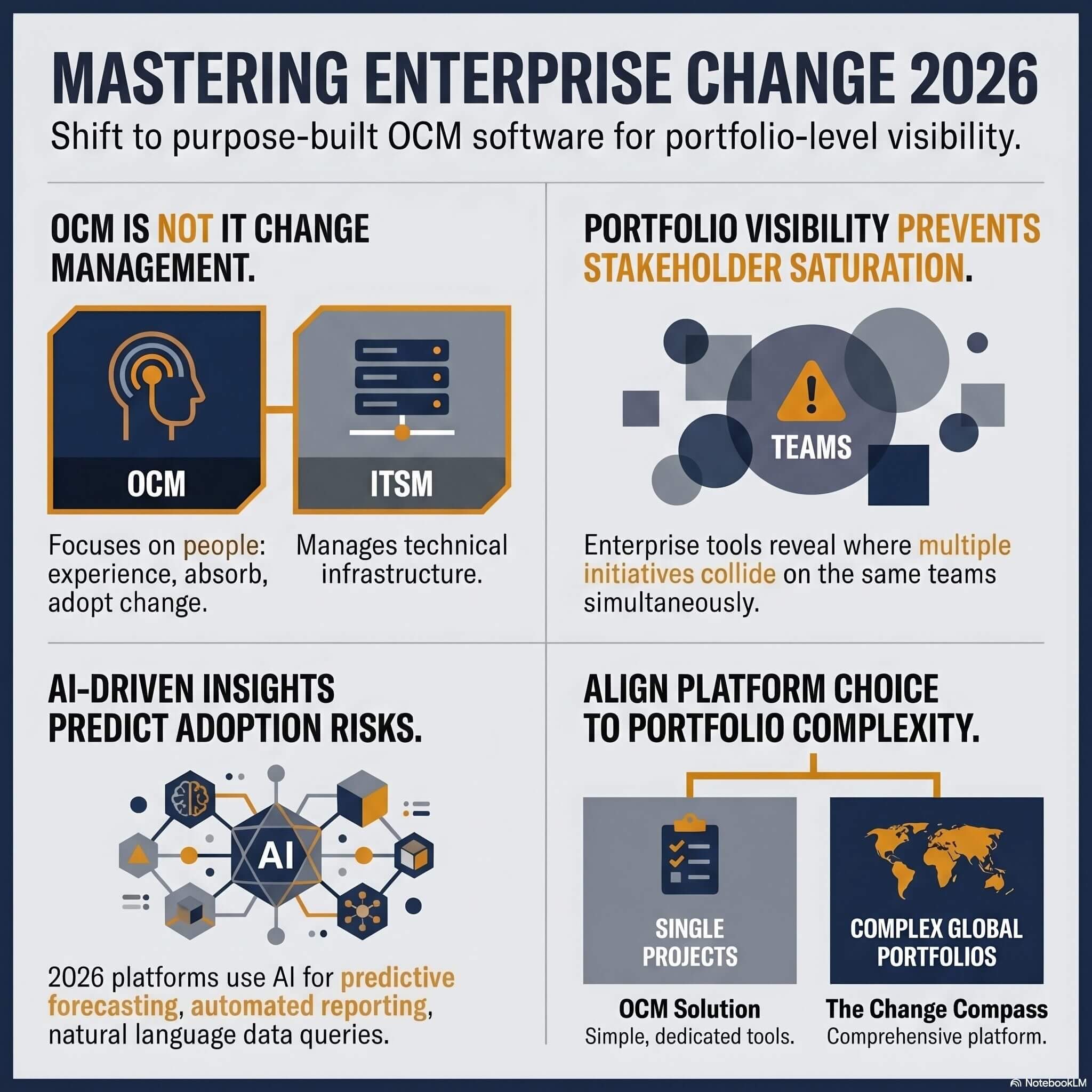
The Change Compass is built on the premise that organisations cannot manage what they cannot see. Its core function is to give internal change teams and senior leaders a real-time view of the change portfolio across the organisation: what is happening, where, at what pace, and with what cumulative impact on the people being asked to absorb it. This kind of portfolio visibility is foundational to the embedded model, because it makes the case for change capability in a language that senior leaders and finance functions understand. It turns a qualitative argument about organisational resilience into a quantitative picture of change load, adoption progress and risk.
For organisations making the transition from a contractor-heavy model to a more embedded one, The Change Compass provides the data layer that internal capability needs to function credibly. It allows change practitioners within the organisation to track adoption across initiatives, identify where employee capacity is being exceeded before failure becomes visible, and demonstrate the cumulative value of sustained investment in people-led change. It also creates the institutional memory that the contractor model destroys: because data lives in the platform rather than in an individual’s head, the knowledge does not leave when the project closes. That is not a minor feature. It is the difference between an organisation that learns from change and one that keeps relearning the same lessons at the same cost.
Frequently asked questions
Is it ever appropriate to use contractors for change management?
Yes, and this article is not arguing otherwise. External contractors bring genuine value in specific circumstances: highly complex or novel transformations where specialist expertise is scarce internally, surge periods where the volume of change exceeds internal capacity, or capability-building engagements where an external practitioner is helping to develop internal skills. The problem arises when the contractor model is the default rather than a deliberate choice, particularly when it substitutes for internal capability that the organisation should be building and retaining over time.
What does “embedded change capability” actually mean in practice?
It means that the knowledge, skills and accountability for managing the people-side of change are distributed across the organisation rather than concentrated in external specialists brought in on a project basis. In practice, this includes line managers who understand how to lead their teams through transitions, a small internal centre of excellence that maintains standards and tools, leadership behaviours that model and reinforce change management as a core competency, and measurement systems that allow the organisation to learn across initiative cycles rather than starting from scratch each time.
How long does it take to build genuine internal change capability?
There is no universal answer, but organisations that have made this transition successfully tend to describe a multi-year journey rather than a programme with a defined end date. Early stages typically focus on establishing a small internal team, introducing measurement infrastructure, and building change literacy into the management population. Maturity develops as the discipline becomes integrated into governance processes, leadership expectations and programme design from the outset. Prosci’s maturity model research suggests that reaching the higher levels of organisational competency typically requires sustained commitment over three to five years, with visible returns beginning to accumulate well before that milestone.
Why has Australia been slower than other markets to adopt embedded change models?
Several factors are likely at play. Australia’s relatively small population and geographically dispersed business environment have historically made it easier to access a deep pool of contract practitioners than to build internal pipelines. Short-term budget cycles and a strong project management culture that separates delivery from ongoing operations have also reinforced the transactional model. There is also a cultural dimension: Australian organisations have tended to be pragmatic and risk-averse in their investment decisions, which makes the long-term, compounding return of embedded capability harder to justify against the immediate, visible cost of a contractor engagement. Changing this will require leaders who are willing to make the case for long-term capability investment in a business environment that more readily rewards short-term delivery.
References
Change Management Institute. (2015). Change Management Employment and Salary Survey – Australia. Change Management Institute.
McKinsey and Company. (2023). All change: The new era of perpetual organizational upheaval. McKinsey and Company.
McKinsey and Company. (2023). The science behind successful organizational transformations. McKinsey and Company.
Prosci. (2023). Five levels of change management maturity. Prosci.
Prosci. (2023). Best practices in change management – 12th edition executive summary. Prosci.
Gartner. (2026). Gartner identifies the top change management trends for CHROs in the age of AI. Gartner.