

Telling effective stories is one of the most critical and most underused skills in change management. Data and logical arguments are necessary, but they rarely generate the emotional commitment that sustained behaviour change requires. A well-crafted change story creates urgency, clarifies the rationale, and gives employees a human reason to engage with transformation. A poorly crafted one, or no story at all, leaves people with facts but no motivation — and facts without motivation rarely move anyone.
This distinction matters more than most change practitioners recognise. Organisations invest heavily in communications plans, change impact assessments, and readiness surveys, but comparatively little in developing the narrative architecture that ties everything together. The result is change programmes that are well-documented but poorly understood — where employees can recite the key messages but cannot explain why the change matters to them personally or what will genuinely be different when it succeeds.
Why stories work where data alone does not
The neuroscience of persuasion is clear on this point: stories engage the brain in ways that data presentation simply does not. When we hear a compelling narrative, the brain releases oxytocin — a chemical associated with empathy, trust, and social bonding — that makes us more receptive to the message and more likely to act on it. Factual information, by contrast, activates primarily the language-processing centres of the brain, without triggering the emotional engagement that drives behaviour change.
For change management this has a direct practical implication. Employees who understand the why of a change through a compelling story are substantially more likely to support it, adopt new behaviours, and sustain those behaviours over time than employees who receive only factual information. The story does not replace the data — it makes the data meaningful by giving it human context. A heatmap showing peak change loading in Q3 is a fact. A story about what that loading meant for the frontline team that experienced it last time, and what the organisation learned from the impact, is a reason to act differently.
To build an effective change story, practitioners need to draw on both quantitative and qualitative evidence. What happened before that prompted the change? What did the journey look like? What was the outcome, and what did it mean for the people involved? Anecdotal information gives texture, but data and facts form the structural backbone that makes a story credible to senior stakeholders and rigorous enough to withstand scrutiny.
A change story in practice: the Intel example
A useful illustration of effective change storytelling comes from Intel in the early 2000s. At that time, the company was facing a fundamental challenge to its core operating model. Moore’s Law — the prediction by Intel co-founder Gordon Moore that the number of transistors on a microchip would double approximately every two years — had driven decades of innovation and shaped the entire computer industry’s expectations of progress.
By 2004, there was serious concern within Intel that continuing to shrink transistors further was no longer physically viable. Packing more transistors into the same space was generating heat and energy consumption at levels that made the traditional approach unsustainable. The company faced a genuine strategic crisis: continue as before and hit a wall, or find a fundamentally different approach to fulfilling Moore’s prophecy.
The story of how Intel resolved this challenge — by shifting from transistor miniaturisation to the concept of processor cores, eventually producing dual-core and then multi-core architectures — is a textbook change narrative. It has all the elements of a compelling story: a clear protagonist (the engineering community), a specific and credible threat (the physical limits of transistor miniaturisation), a turning point that required a genuinely different approach, and a resolution that was both technically innovative and strategically meaningful. Leaders who could tell this story authentically had a far more powerful tool for driving internal change than any strategy document or project plan.
Recognising the story formats available to change leaders
Not all change stories follow the same arc, and understanding the different narrative structures available helps practitioners choose the right format for the situation. Three formats are particularly common in organisational change contexts.
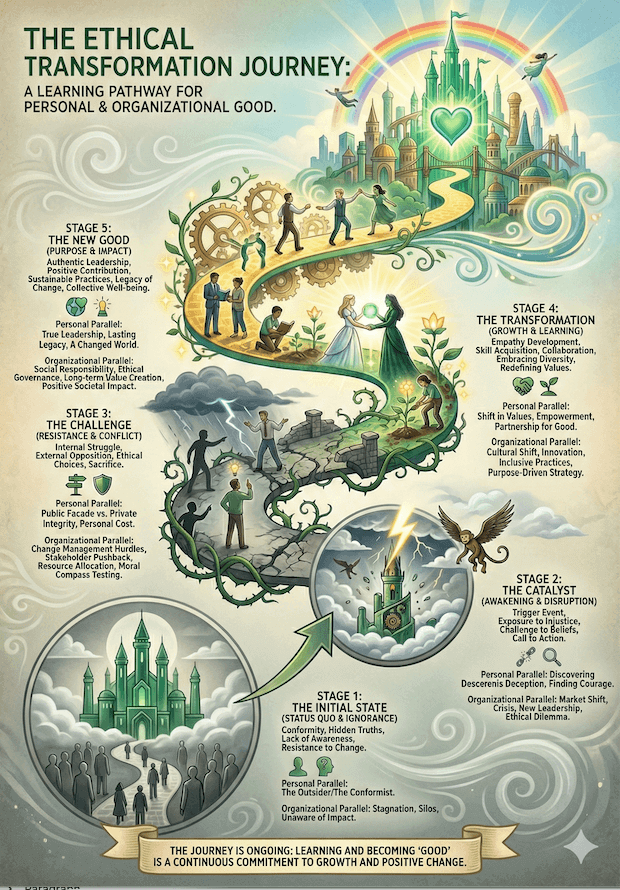
The quest story positions the organisation or team as a hero pursuing a meaningful goal. The journey involves challenges, setbacks, and moments where success is uncertain — but through persistence and collective effort the goal is achieved. This format works well for transformation programmes with a clear aspiration and a long implementation horizon. It frames difficulty as part of the journey rather than evidence that the change is failing.
The rebirth story acknowledges that the current state is no longer working and frames the change as a necessary transformation of how the organisation operates. Rather than presenting the past as simply inferior, a well-crafted rebirth narrative honours what was valuable about the previous way of working while making a compelling case for why it is no longer sufficient. This format is particularly effective when change fatigue is high and employees are sceptical of yet another initiative that promises transformation.
The overcoming the monster story names a specific threat — competitive disruption, regulatory pressure, a customer experience problem — and frames the change as the organisation’s response to that threat. It creates urgency by making the status quo feel dangerous rather than merely comfortable. This format is most effective when the external threat is genuine and visible, and when employees are at risk of under-estimating it.
Each of these formats has a place, and skilled change communicators learn to select and blend them depending on the audience, the change context, and the stage of the programme. A single transformation programme might use a rebirth story with the executive team, a quest story with middle managers, and an overcoming the monster story with frontline employees — because the same change means different things to different groups, and the story needs to connect with the specific concerns and motivations of each audience.
Using data to give the story structure and credibility
One of the most common mistakes in change storytelling is treating data and narrative as separate activities — producing analytical reports for senior leaders and emotional narratives for frontline employees. The most effective change stories integrate both, using data to provide credibility and structure while narrative provides human meaning.
A data-informed change story typically follows a recognisable structure. It begins with context: the industry pressures, competitive dynamics, or operational challenges that make the change necessary. It then introduces quantitative evidence — change impact data, workforce loading analysis, performance metrics from previous transformation programmes — that demonstrates the scale and seriousness of the situation. It incorporates qualitative evidence from employees, managers, and customers that brings the numbers to life. It frames the resulting challenges as a clear problem statement, and it concludes with a specific, credible solution rather than a vague aspiration.
This structure is particularly powerful when organisations have access to portfolio-level change data. A story that shows a specific team facing peak change loading across multiple concurrent programmes — grounded in actual impact data from the change portfolio — is far more compelling to both senior leaders and frontline employees than a general narrative about the importance of managing change well. The specificity makes it credible. The human context makes it motivating.
Platforms like The Change Compass give change leaders the data infrastructure to build exactly these kinds of evidence-based narratives. By aggregating impact data across the portfolio and making cumulative change load visible by team and time period, the platform provides the quantitative backbone that turns a general story about transformation into a specific, credible account of what the organisation is asking of its people — and why managing that load strategically matters.
Common change story themes beyond volume and pace
The most visible change story in many organisations is the one about too much change — about change fatigue, overloaded teams, and the risk of adoption failures when the pace of transformation exceeds employees’ adaptive capacity. This is an important story, but it is not the only one change practitioners need to be able to tell.
A second common theme is about pace and urgency: the story that change is not happening fast enough, that the organisation’s competitive position is eroding while transformation programmes move slowly, and that the cost of delay is higher than the cost of acceleration. This story requires different data and different emotional framing — it needs to make the status quo feel dangerous rather than comfortable, and it often needs to be told differently to different audiences depending on their natural inclination toward caution or ambition.
A third theme concerns the customer experience of change. When multiple initiatives are changing different aspects of how customers interact with an organisation — new systems, new processes, new service models — the risk is that changes that make sense individually create a disjointed and confusing experience in aggregate. The story here is about integration and coherence: what the customer is experiencing as a result of how the organisation is managing its transformation portfolio, and what a better-coordinated approach would make possible.
A fourth theme addresses change conflicts: situations where different initiatives are making competing demands on the same teams, systems, or customer touchpoints. This story is often politically sensitive because it requires naming the conflicts explicitly, which can feel like criticism of individual programmes. But it is frequently the most important story to tell at the portfolio governance level, because the conflicts will not resolve themselves and the cost of ignoring them compounds over time.
Visualising data to support the story
The way data is presented is as important as the data itself. Visual representations of change impact, portfolio loading, and adoption progress are substantially easier for stakeholders to understand and remember than tables of numbers or dense written analysis. Choosing the right visualisation for the right data is a skill that change practitioners often underinvest in, with the result that accurate data fails to create the impression it deserves.
Key principles for effective change data visualisation include selecting the graph type that best represents the relationship in the data — line charts for trends over time, bar charts for comparisons between groups, heat maps for showing concentration of impact across teams and time periods. Colour should be used purposefully to represent meaningful dimensions, not decoratively. Layouts should avoid overcrowding: a visualisation that tries to show everything simultaneously typically communicates nothing clearly. And where multiple visualisations are used together, consistent conventions across graphs — the same colour scheme, the same time axis scale, the same team hierarchy — reduce cognitive load and help audiences see connections between different elements of the story.
The goal of data visualisation in change storytelling is not to impress stakeholders with the sophistication of the analysis. It is to make the story visible in a way that is immediately comprehensible to people who are not change professionals — executives making portfolio decisions, managers navigating competing demands on their teams, and frontline employees trying to understand what the next six months will require of them.
Frequently asked questions
Why is storytelling important in change management?
Storytelling is important in change management because data and logical arguments alone rarely generate the emotional commitment that sustained behaviour change requires. Compelling narratives trigger neurological responses — including oxytocin release — that create empathy, trust, and motivation in ways that data presentation does not. Employees who understand the why of a change through a human story are substantially more likely to engage with, adopt, and sustain new behaviours than those who receive only factual information about what is changing.
What are the main story formats used in change management?
Three formats are most commonly used: the quest story, which frames the organisation as pursuing a meaningful goal through challenges; the rebirth story, which acknowledges that the current way of working is no longer sufficient and frames change as necessary transformation; and the overcoming the monster story, which names a specific external threat and frames the change as the organisation’s response. Skilled communicators select and blend these depending on the audience and the stage of the programme.
How should data be used in change storytelling?
Data should provide structure and credibility to the narrative rather than replace it. An effective data-informed change story combines quantitative evidence — impact data, portfolio loading, performance metrics — with qualitative evidence from employees and customers, framed within a clear narrative arc: context, challenge, specific problem, and credible solution. The data makes the story believable; the narrative makes the data meaningful.
What are the most important principles for visualising change data?
Select the graph type that best represents the relationship in the data, use colour purposefully rather than decoratively, avoid overcrowding visualisations with too much information, and maintain consistent conventions across multiple charts so audiences can see connections between elements. The goal is immediate comprehensibility for non-specialists, not technical sophistication. A stakeholder who cannot quickly grasp what a visualisation is saying will not act on it.