Workplace stress is a common topic in organisational wellbeing programmes. Change-related stress is less commonly addressed as a distinct category, even though it has a different profile, different causes, and requires a different organisational response. Most wellbeing initiatives are designed to help individuals cope with stress after it has developed. The more significant opportunity for organisations is upstream: understanding how change-related stress is created at the organisational level, and designing change delivery in a way that reduces it before it accumulates.
This article examines what change-related work stress actually is, why it differs from general workplace stress, and what organisations can do at the structural level to manage it. It is written primarily for change managers and HR practitioners who are positioned to influence how change is designed and delivered, not just how employees cope with it.
What makes change-related stress distinct
General workplace stress is associated with workload, role ambiguity, interpersonal conflict, and poor management. These are chronic conditions that develop over time. Change-related stress has a different mechanism. It is driven primarily by uncertainty and perceived loss of control, and it is episodic rather than chronic — triggered by specific change events and often resolving once those changes are understood and absorbed.
Research from the American Psychological Association consistently identifies organisational change as one of the top contributors to workplace stress, distinct from workload and interpersonal factors. The specific drivers are well established: uncertainty about job security, concern about capability to perform in a new environment, loss of established routines and social connections, and lack of perceived voice in decisions that affect daily working life.
What makes this distinct from general stress is that many of these drivers are not primarily psychological — they are organisational. The uncertainty is real. The loss of control is real. Employees are not misperceiving a manageable situation as threatening. They are responding rationally to conditions that are genuinely uncertain. Approaches that focus purely on individual resilience and coping skills miss this point. The most effective interventions address the organisational conditions that create the stress in the first place.
The role of change saturation in accumulating stress
A single well-managed change programme rarely creates serious stress for most employees. The more common pattern in large organisations is that employees are absorbing the effects of multiple changes simultaneously, across different areas of their work, while also trying to maintain business-as-usual performance. This accumulation effect — what practitioners refer to as change saturation — is the primary structural driver of change-related stress at scale.
Gartner research on change fatigue found that employees who experienced high change fatigue were 43 percentage points less likely to intend to stay with their organisation compared to those with low fatigue — a finding that reflects not just short-term stress but a sustained erosion of organisational commitment. The mechanism is cumulative: each additional change draws from the same pool of adaptive capacity, and when that pool is depleted, even well-designed changes land poorly.
The practical implication is that managing change-related stress requires a portfolio-level view, not just a programme-level one. An individual programme may be well-designed, well-communicated, and well-supported — and still contribute to stress if it is landing on a team that is already absorbing significant change from other directions. Monitoring the aggregate change load on specific groups of employees is the only way to identify this risk before it manifests.
Uncertainty as the primary psychological driver
Of the various factors that contribute to change-related stress, uncertainty is consistently the most potent. Research published in Harvard Business Review on uncertainty and the brain found that uncertainty activates the same neural pathways as direct threat — the body cannot easily distinguish between “something bad might happen” and “something bad is happening.” This means that a period of organisational ambiguity, where employees do not know how a change will affect their role, is physiologically stressful in the same way as a direct negative event.
The implication for communication is important: the goal of change communication should not primarily be to generate positive sentiment about the change. It should be to replace uncertainty with clarity as quickly as possible, even when the clarity involves difficult news. Employees consistently handle confirmed bad news better than ongoing ambiguity, because the ambiguity activates a sustained stress response whereas clarity — even negative clarity — allows the cognitive system to shift into problem-solving mode.
Five organisational approaches that reduce change-related stress
The following approaches address change-related stress at the organisational level, targeting the structural conditions that create it rather than individual coping responses.
1. Sequence changes to manage cumulative load
The most direct organisational lever for reducing change-related stress is managing the pace and sequencing of changes affecting any given group of employees. This requires a cross-portfolio view: understanding not just how much change each individual programme is asking of its affected groups, but how much change those groups are absorbing in total across all concurrent programmes.
Where data shows that a particular team or role group is approaching or exceeding reasonable absorption capacity, the organisation has two options: reduce the load by deferring or descoping a programme, or increase the support provided to the affected group. Both require a governance decision. Neither is visible without cross-portfolio impact data.
2. Communicate earlier and more directly about what is known
Most change communication waits until there is certainty — until the design is finalised, the decision is approved, or the announcement is ready. This approach, while understandable from a message management perspective, prolongs the period of uncertainty that drives stress. A better approach is to communicate what is known at each stage of the programme, explicitly acknowledging what is not yet known and when it will be. This gives employees a reliable framework for understanding the situation rather than having to infer it from rumour and silence.
The specific elements that employees most want to know — and that reduce stress most when communicated clearly — are: why the change is happening, what it means for their specific role, when key decisions will be made, and how they can ask questions or raise concerns. McKinsey research on effective change communication found that transparency about the reason for a change, including the honest business case rather than the sanitised messaging, produces significantly stronger employee engagement than carefully crafted positive framing.
3. Give employees genuine voice in how change is implemented
One of the most reliable ways to reduce the stress associated with loss of control is to restore some degree of meaningful control. This does not require giving employees a veto over strategic decisions. It means genuinely involving them in decisions about how a change is implemented: the design of new processes, the structure of training, the timeline of transition, the support model during stabilisation.
The key word is “genuine.” Consultation that is designed to satisfy a process requirement, where outcomes are predetermined and feedback is not reflected in the final design, is counterproductive. Employees who participate in a process and see that their input had no influence experience greater distress than those who were not consulted at all, because the consultation process raised and then denied the expectation of control. Genuine co-design, where the scope for employee input is clearly defined and that input demonstrably shapes the outcome, reduces stress because it converts the experience of being done to into the experience of participating.
4. Invest in manager capability to support teams through change
The immediate manager is the most significant variable in how employees experience organisational change. The same change, delivered through a manager who communicates proactively, acknowledges difficulty, and advocates for their team, will be absorbed very differently than through a manager who is uninformed, avoidant, or dismissive of concerns.
Prosci’s research on the manager’s role in change found that employees who rated their manager as effective at supporting change were five times more likely to report successful personal adoption of the change compared to those with ineffective managers. This makes investment in manager capability one of the highest-return activities available to change and HR practitioners. Specifically: equipping managers with the answers to the questions their teams are likely to ask, giving them sufficient notice to have informed conversations before formal announcements, and providing them with guidance on how to acknowledge and normalise the emotional responses their teams are experiencing.
5. Monitor stress signals during implementation, not just at the end
Most organisations measure employee wellbeing through annual engagement surveys, which are far too infrequent to be useful for managing change-related stress. By the time an annual survey captures the impact of a change programme, the damage is done and the programme has moved on.
Effective monitoring of change-related stress requires more frequent signals: pulse checks aligned to major programme milestones, manager-reported observations from team discussions, operational metrics that correlate with stress (error rates, absenteeism, informal support requests), and direct observation channels like facilitated Q&A sessions or drop-in forums. These signals need to be reviewed by someone with both the authority to act and a clear process for escalating concerns to programme sponsors when the data indicates intervention is needed.
How change management platforms support stress prevention
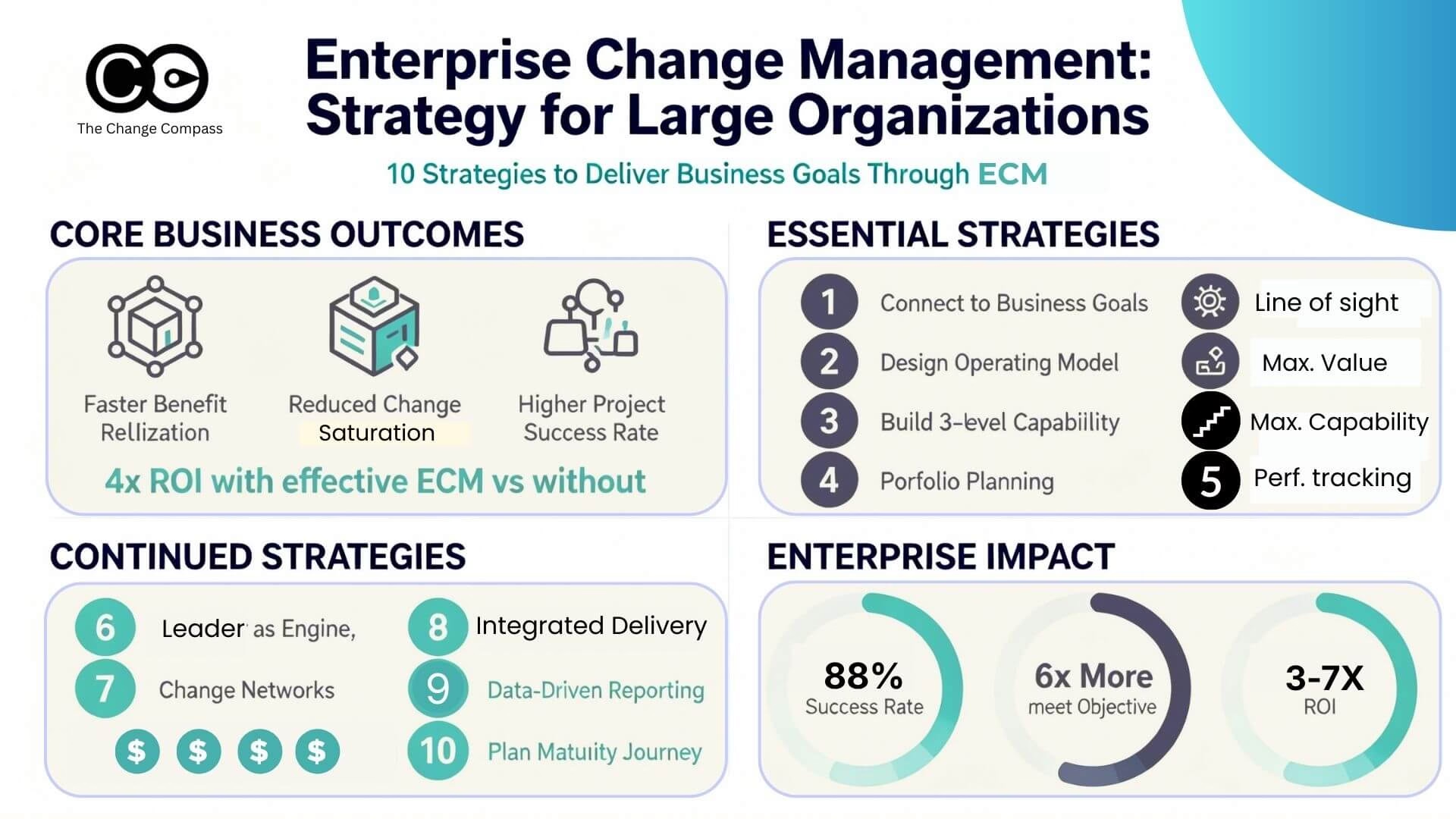
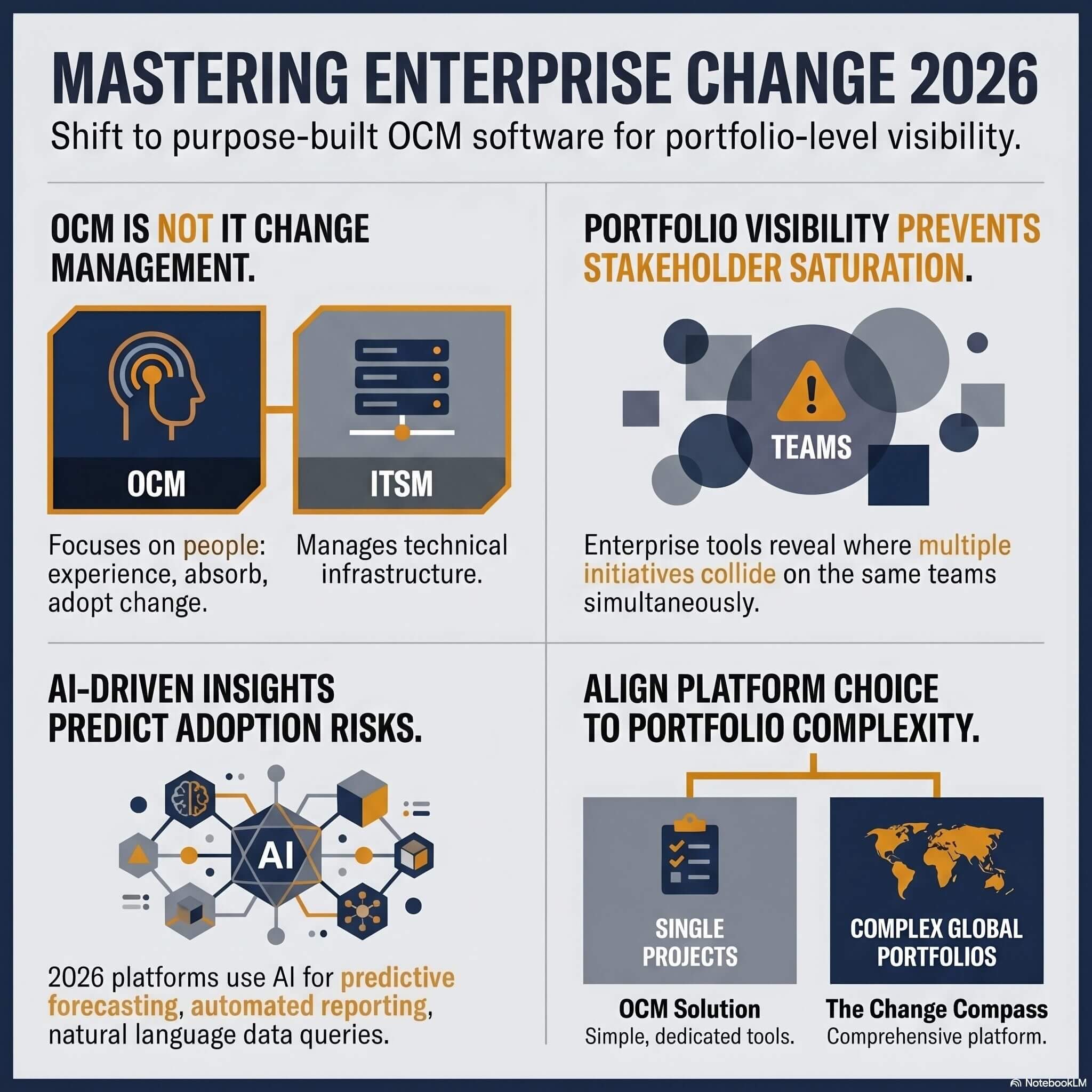
Managing change-related stress at scale requires visibility into the cumulative change load on specific employee groups across the portfolio. Without this visibility, stress prevention is reactive rather than structural. Platforms like The Change Compass provide exactly this portfolio view: aggregating change impact data across concurrent programmes to show which teams are absorbing the most change at any given point in time. This data enables the proactive sequencing and resourcing decisions that prevent change saturation before it translates into stress, rather than responding to the symptoms after they appear.
From coping to prevention: where the real opportunity lies
Individual resilience training, mindfulness programmes, and EAP services have a role in supporting employees through difficult change experiences. But they address the symptoms of a structural problem rather than the cause. Organisations that consistently manage change-related stress effectively are those that approach it as a design challenge: understanding the conditions that produce stress, and building those conditions into the governance and delivery processes for change. The five approaches outlined above are not particularly complex. What they require is the organisational discipline to treat change load as a measurable constraint that shapes decisions, rather than an invisible force that employees are expected to absorb without limit.
Frequently asked questions
What causes change-related work stress?
Change-related work stress is caused primarily by uncertainty about how a change will affect an individual’s role, perceived loss of control over decisions that shape their work environment, and the accumulation of multiple concurrent changes that exceed the individual’s adaptive capacity. Unlike general workplace stress, which is often chronic, change-related stress tends to be episodic and resolves as changes are understood and absorbed — though when multiple changes overlap, the cumulative effect can become chronic.
How does change saturation contribute to employee stress?
Change saturation occurs when the volume and pace of organisational change across multiple programmes exceeds an employee group’s capacity to absorb and adapt. Each change draws from the same pool of cognitive and emotional resources. When that pool is depleted by simultaneous changes, even well-designed new changes land poorly, producing resistance, errors, and disengagement. Managing saturation requires a portfolio-level view of the aggregate change load on specific teams, not just programme-by-programme assessments.
What is the most effective organisational response to change-related stress?
The most effective response addresses the structural conditions that produce stress rather than just supporting individual coping. This means sequencing changes to prevent accumulation, communicating early and clearly about what is known (including what is not yet known), involving employees meaningfully in implementation decisions, equipping managers to support their teams, and monitoring stress signals throughout implementation rather than only at the end.
Why is manager capability so important in managing change stress?
The immediate manager mediates how employees experience organisational change more than any other factor. A manager who communicates proactively, acknowledges difficulty, and supports their team through transitions significantly reduces the uncertainty and loss of control that drive stress. Research shows employees with effective change managers are substantially more likely to adopt changes successfully. Investment in manager capability is therefore one of the highest-return activities available to change and HR practitioners.
References
- American Psychological Association, “Workplace Stress”
- Gartner, “This New Strategy Could Be Your Ticket to Change Management Success”
- Harvard Business Review, “Managing Yourself: Dealing with Uncertainty”
- McKinsey, “Good Leadership Is About Asking Good Questions”
- Prosci, “Change Management and the Role of Managers”