

When a CFO asks “what’s the return on this software?” most change practitioners freeze. They know the tool will help. They’ve seen the chaos it would prevent. But translating that instinct into a credible, defensible number is where most business cases fall apart.
The problem is not that change management software lacks ROI. The problem is that most business cases frame the investment incorrectly. They open with a list of features and a licence fee, instead of opening with the cost of the problem the software solves. And in most organisations, that problem is significant, measurable, and growing.
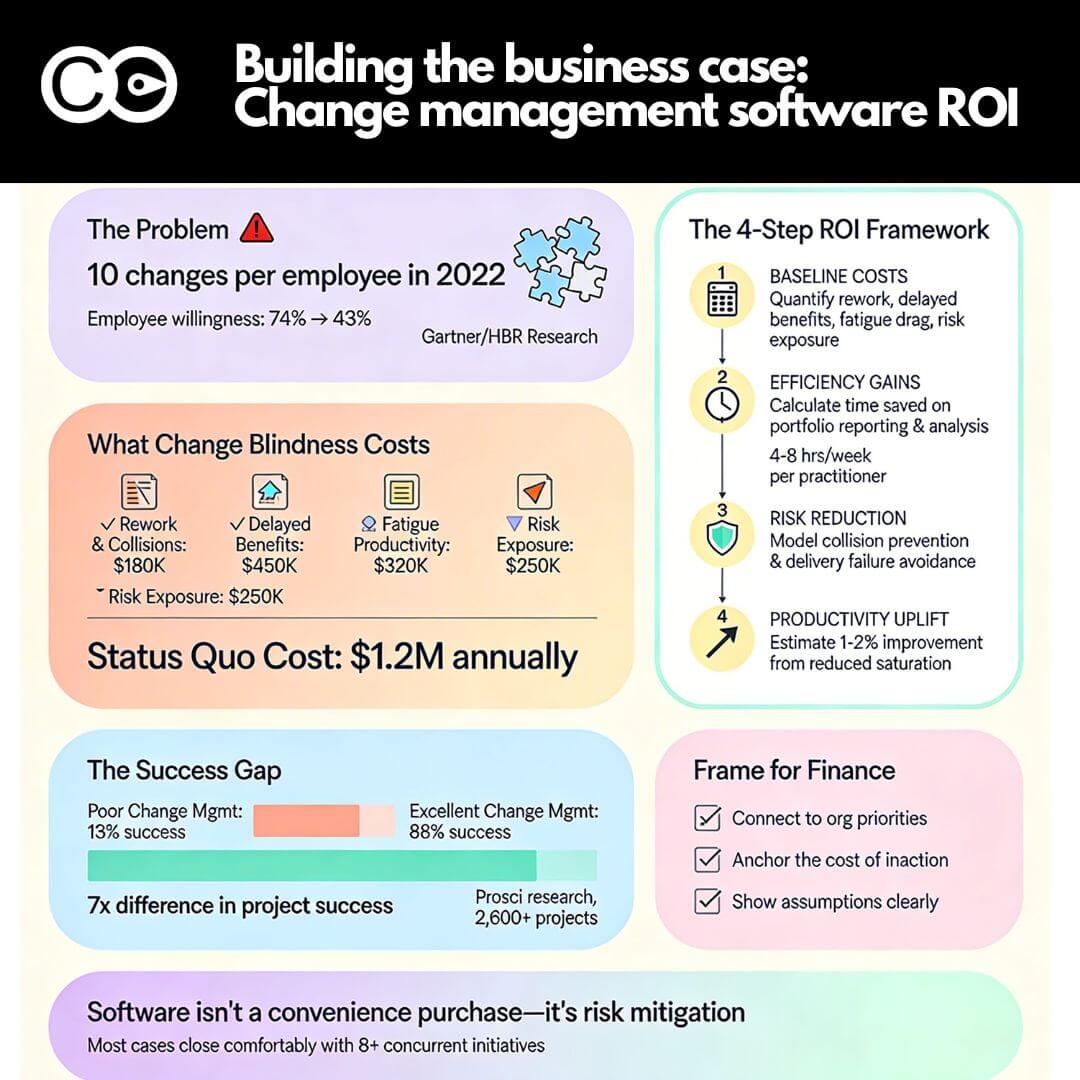
According to Gartner research cited in Harvard Business Review, the average employee experienced ten planned enterprise changes in 2022, up from just two in 2016. Over the same period, employee willingness to support change collapsed from 74% to 43%. Your organisation is running more change with far less employee capacity to absorb it. The software is not a convenience purchase. It is a risk mitigation decision.

This article gives you a practical, four-step ROI framework you can take directly into a finance conversation, plus guidance on how to frame the narrative so that your business case survives contact with a sceptical executive.
Why business cases for change tools rarely survive the CFO meeting
Most change management software business cases are written from the perspective of a change practitioner who already understands the value. They assume the reader shares the same mental model of what “poor change visibility” costs an organisation. Finance leaders do not share that model, at least not until someone shows them the numbers.
There are three common failure patterns.
First, the case is written as a feature comparison rather than a problem statement. “The tool provides a consolidated view of all change activity across the portfolio” is a feature. “We currently have no visibility into how many changes are landing on our frontline teams in any given month, and we have experienced two major change collisions in the last year that together cost an estimated $X in rework and delayed benefits” is a problem, and it commands attention.
Second, the ROI is vague. Phrases like “improved efficiency” and “better decision-making” do not belong in a business case. Finance teams are used to seeing precise calculations, even if those calculations carry assumptions. A number with a clearly stated assumption is far more persuasive than an adjective.
Third, the case is compared against the wrong baseline. Change teams often compare the software cost against the cost of doing nothing, as if “nothing” is a stable situation. The more compelling comparison is against the cost of the status quo, which is itself expensive and getting more expensive as change volume increases.
The four-step framework below is designed to address all three of these failure patterns.
What change blindness is actually costing your organisation
Before you can quantify the ROI of change management software, you need to quantify the cost of not having it. This is the step most practitioners skip, and it is the most important one.
“Change blindness” is the operating state in which a change portfolio cannot be seen, mapped, or managed as an integrated whole. Individual projects are tracked in silos. No one has a clear view of the cumulative change load hitting any given business unit or role group. Change collisions, where multiple initiatives compete for the same people’s attention at the same time, are discovered late or not at all.
The costs of change blindness fall into four categories.
Rework and late collision remediation. When two or more initiatives land on the same group simultaneously without coordination, teams are forced to rework communications, training schedules, and deployment plans. The time spent on this unplanned remediation is rarely captured anywhere, but it is real. Organisations that begin tracking it are often surprised by the scale.
Benefits delayed or unrealised. Prosci’s research across more than 2,600 change practitioners found that projects with excellent change management are 88% likely to meet or exceed their objectives, compared to just 13% for those with poor change management. That is a sevenfold difference. Every project in your portfolio that falls in the “fair” or “poor” category because of capacity overload rather than technical failure represents delayed or unrealised benefits that can be traced back to poor portfolio visibility.

Productivity loss from change fatigue. Change-fatigued employees perform measurably worse. Research compiled by Mooncamp and drawing on Gartner data indicates that change-fatigued employees perform approximately 5% worse than the organisational average, and 32% of them report feeling less productive. With ten enterprise changes per employee per year now the norm, fatigue is no longer an edge case. It is a structural drag on performance.
Risk from unmanaged change saturation. When change teams lack visibility into total change load, they cannot flag capacity risk to the executive team before it becomes a delivery failure. The conversation happens after the fact, in a post-mortem, rather than as a proactive decision. This exposure is a governance risk, particularly in regulated industries.
A practical ROI framework for change management software
This framework produces a defensible business case in four steps. Each step has a calculation prompt you can complete using data that already exists in your organisation, or that can be estimated with reasonable assumptions.
Step 1: Baseline your current state costs
The goal here is to put a number on change blindness. Pull three data points.
First, calculate the rework cost from your last major change collision. Identify one or two recent examples where two initiatives hit the same team simultaneously without adequate coordination. Estimate the hours spent by change practitioners, project managers, communications teams, and business unit managers to remediate. Multiply by average loaded hourly rate. This is a conservative proxy for annual rework cost.
Second, estimate your benefits realisation gap. Take your change portfolio for the past twelve months. Identify projects that are rated “fair” or “poor” on their change management effectiveness. Using the Prosci benchmarks, estimate the additional benefits that would have been realised if those projects had moved from “fair” to “excellent.” Even a conservative estimate of moving one or two projects from 39% to 88% likelihood of meeting objectives typically produces a material dollar figure.
Third, estimate the productivity drag from change fatigue. Take the number of employees in your most change-affected business units. Apply a conservative 3% to 5% productivity reduction (supported by the research cited above). Multiply by average loaded annual salary. This gives you an annual cost of change saturation.
Total these three figures. This is your status quo cost, and it is the baseline against which the software investment will be compared.
Step 2: Project the efficiency gains
Change management software creates direct efficiency gains by eliminating manual work. Estimate how much time your change team currently spends on activities the software would automate or significantly accelerate. Common examples include: building consolidated change impact views from multiple spreadsheets, producing portfolio-level reports for steering committees, tracking change readiness assessments across multiple workstreams, and manually cross-referencing initiative timelines to identify conflicts.
A reasonable estimate for a team managing a portfolio of ten or more concurrent initiatives is between four and eight hours per practitioner per week. Multiply by team size, hourly rate, and 48 working weeks. This figure represents the direct labour efficiency gain from the software.
Step 3: Calculate the risk reduction value
This step requires a conversation with your risk and compliance function, but it is often the most compelling part of the business case for an executive audience.
Quantify two risk scenarios. First, what is the estimated cost of one major delivery failure caused by change saturation? Include delayed benefits, rework, and any regulatory or reputational consequences. Second, what is the probability of that failure occurring in the next twelve months without improved portfolio visibility? Even a modest probability applied to a material failure cost produces a significant expected value of risk.
Insurance logic applies here. Organisations routinely spend money on systems that reduce the probability of costly events, even when those events have not yet occurred. A change management platform that materially reduces the probability of a delivery failure is making the same argument.
Step 4: Model the productivity uplift
If the software will help your organisation reduce change fatigue, there is an uplift case to be made. Estimate the number of employees in your highest-change-load business units. Estimate what a 1% to 2% improvement in productivity would be worth at average loaded salary cost. This is not a claim that the software directly motivates people. It is a claim that reducing unnecessary change collisions and giving employees more predictable change timelines reduces the overload that drives fatigue. The software is one input into a better-managed system.
Sum the four components: status quo cost (Step 1) minus efficiency gain (Step 2) plus risk reduction value (Step 3) plus productivity uplift (Step 4). Compare to the annual licence and implementation cost. In most organisations managing more than eight concurrent change initiatives, the case closes comfortably.
Building the narrative that finance and the exec team need to hear
Numbers matter, but framing matters more. A well-constructed ROI model that is presented in the wrong narrative frame will still fail to get approval.
The frame that works best with a CFO or COO audience is this: “We are currently running change at scale with no portfolio-level visibility. That creates financial exposure we can quantify. This investment closes that exposure.”
The frame that fails: “This tool will help our change team do their jobs better.” That positions the investment as a departmental preference, not an organisational risk decision.
Three narrative principles apply.
Connect to what the organisation already cares about. If the executive team is tracking transformation programme delivery, connect your case to programme outcomes. If they are focused on workforce productivity, lead with change fatigue. If they are in a regulated environment, lead with governance risk. The ROI numbers are the same, but the opening frame should speak to the audience’s existing priorities.
Anchor the cost, not just the benefit. Most business cases spend too long on the benefit side and not enough time making the cost of inaction vivid. Spend equal time on what continued change blindness is costing the organisation. The most effective business cases make the reader uncomfortable about the status quo before they present the solution.
Show your assumptions clearly. Finance teams are accustomed to models with assumptions. A business case that says “we estimate rework cost at $180,000 per year, based on X hours at Y average loaded rate, from two documented collision events in FY25” is far more credible than one that claims “rework costs hundreds of thousands of dollars annually.” Show your working.
Common objections and how to address them
“We already track changes in spreadsheets / our project management tool.”
Acknowledge the existing process, then quantify its limitations. How long does it take to produce a portfolio-level change impact view? How often is that view out of date by the time it reaches a decision-maker? What happened the last time two initiatives collided because the spreadsheet was not current? The argument is not that the existing tool is useless; it is that it cannot scale with the organisation’s change volume.
“The team is too busy to implement new software right now.”
This is an argument for urgency, not delay. The team is too busy precisely because they are managing change volume with inadequate tools. The implementation investment is finite. The cost of the status quo is ongoing. A phased implementation plan that delivers value progressively helps address the short-term capacity concern.
“Can’t we just hire another change manager instead?”
This is a useful comparison to make explicit. Additional headcount at a comparable experience level typically costs $120,000 to $160,000 per year in Australia in fully loaded terms, and adds linear capacity without adding portfolio visibility. A change management platform adds visibility, analytical capability, and repeatability at a fraction of that cost. The two are complementary, but if the organisation’s primary problem is portfolio visibility rather than practitioner capacity, software addresses the root cause more efficiently.
“Our change initiatives are too complex / unique to be standardised in a tool.”
Software that is designed specifically for organisational change management, rather than generic project management platforms, is built to handle the complexity of multi-stakeholder, portfolio-level change. The objection often reflects experience with generic tools being misapplied. Requesting a demo with a real scenario from the organisation’s own portfolio is the fastest way to address this.
How digital change tools can strengthen the ROI case
Building a compelling business case is one thing. Sustaining it through the post-approval phase, by demonstrating that the benefits are actually being realised, is where many software investments fall short. This is where purpose-built change management platforms add an often-overlooked dimension.
Platforms such as Change Compass are designed not just to manage change delivery, but to generate the kind of portfolio-level data that makes benefit realisation visible. When your executive team can see change load by business unit, track readiness scores over time, and view which initiatives are at risk of collision, the ROI conversation shifts from a one-time business case to an ongoing performance conversation. That shift, from justification to evidence, is what moves change management from a project support function into a strategic capability.
The business case is a change initiative too
Securing approval for change management software requires change management. You are asking a finance or executive team to shift their mental model of what change management is: from a set of practitioner activities to a data-driven portfolio capability. That shift takes evidence, narrative, and the right conversation at the right time.
The four-step ROI framework in this article gives you the evidence. Your job is to find the moment when the organisation’s pain with change blindness is visible enough that the evidence lands. In most organisations navigating ongoing digital transformation, that moment is not far away.
Start with a single, recent, documented collision event. Quantify it precisely. Use that number as the opening line of your business case. Then build outward from there.
Frequently asked questions
What is a business case for change management software?
A business case for change management software is a structured financial and strategic argument for investing in a platform that provides portfolio-level visibility, change impact analysis, and delivery tracking across concurrent change initiatives. It quantifies both the cost of operating without such a platform and the expected return on the investment.
How do you calculate the ROI of change management software?
The ROI is calculated by comparing the total cost of the investment (licence, implementation, training) against the value of four components: rework cost reduction, improved benefits realisation across the change portfolio, productivity uplift from reducing change fatigue, and risk reduction value from avoiding major delivery failures. Even conservative estimates typically produce a positive return for organisations managing eight or more concurrent change initiatives.
How long does it take to see ROI from change management software?
Most organisations see measurable efficiency gains within the first three to six months, primarily from time saved on manual portfolio reporting and collision detection. Benefits realisation improvements and productivity uplift take longer to measure, typically six to twelve months, because they depend on project outcomes that play out over a full delivery cycle.
What is change saturation, and why does it matter for the business case?
Change saturation is the condition in which the volume and pace of change initiatives exceeds employees’ capacity to absorb and adopt them effectively. Gartner research shows that the average employee experienced ten planned enterprise changes in 2022, five times the volume of 2016. Saturation is directly linked to reduced productivity, higher resistance, and lower change adoption rates, all of which have measurable financial consequences that belong in a change management software business case.
What should a change management software business case include?
A strong business case should include a clearly defined problem statement, a quantification of the current cost of poor change visibility, a four-component ROI model with stated assumptions, a narrative framed around the organisation’s strategic priorities, a response to likely objections, and a proposed implementation timeline with phased value delivery milestones.
References
- Prosci. “The Correlation Between Change Management and Project Success.” https://www.prosci.com/blog/the-correlation-between-change-management-and-project-success
- Harvard Business Review. “Employees Are Losing Patience with Change Initiatives.” May 2023. https://hbr.org/2023/05/employees-are-losing-patience-with-change-initiatives
- Mooncamp. “65+ Change Management Statistics for Success in 2026.” https://mooncamp.com/blog/change-management-statistics
- The Business Research Company. “Change Management Software Global Market Report 2025.” https://www.giiresearch.com/report/tbrc1847319-change-management-software-global-market-report.html
- Prosci. “Best Practices in Change Management — 12th Edition.” https://empower.prosci.com/best-practices-change-management-executive-summary
- Gartner. “Leaders Today Must Routinize, Not Inspire, Change.” https://www.gartner.com/en/articles/this-new-strategy-could-be-your-ticket-to-change-management-success