Most change managers have tried using AI for something in the past twelve months. Drafting a stakeholder communication. Generating a change impact summary. Running a change plan through ChatGPT. And most have found that the output was adequate, occasionally impressive, but rarely transformative.
That experience has left the profession in an ambiguous position: aware that AI matters, unclear on what it should actually do, and uncertain whether the tools available today are fit for serious change work or are just productivity shortcuts dressed up as something more important.
This guide cuts through that ambiguity. It explains what AI in change management actually means, where it genuinely adds value, where it does not, and what it takes to move from ad hoc AI experimentation to a structured capability that improves outcomes. It maps the full landscape of AI applications in the field, from basic generative tools through to purpose-built change intelligence platforms, so you can make an informed decision about where to invest and in what sequence.
The two ways AI shows up in change management
Before evaluating any AI application, it helps to be precise about what we are talking about. AI appears in change management in two structurally different forms, and conflating them is the source of most of the confusion and disappointment organisations experience.
Generative AI for task acceleration
The first form is generative AI: large language model tools like ChatGPT, Microsoft Copilot, and Google Gemini applied to the drafting and synthesis tasks change managers do every day. This includes generating first drafts of stakeholder communications, producing change impact summaries from meeting notes, synthesising training content, drafting executive briefings, and producing change plans from a brief.
These tools are capable at this work when the inputs are specific, the task is well-defined, and someone experienced reviews and edits the output. They reduce the blank-page friction that slows down delivery teams and can meaningfully accelerate the documentation-heavy early stages of a change programme.
They are not, by themselves, a change management capability. Output quality depends entirely on the quality of the inputs, and those inputs are only as good as the person providing them.
Purpose-built AI embedded in change platforms
The second form is purpose-built AI: algorithms and analytical models embedded in change management platforms designed specifically for the data and decision types that change managers face at portfolio level. This includes saturation forecasting (predicting when aggregate change load will breach absorption capacity), adoption likelihood scoring (identifying which stakeholder groups are at risk of non-adoption), fatigue indexing (tracking cumulative exposure per group across all concurrent initiatives), and narrative generation grounded in your organisation’s actual change data.
This form of AI is structurally different from a general-purpose language model. It is grounded in your organisation’s change data, which is what makes it capable of producing recommendations that are specific rather than generic.
Understanding this distinction is the starting point for making sound decisions about AI adoption in change management. For a detailed analysis of where each type delivers and where it falls short, our article on what AI can and can’t do in change management works through the specifics across each use case.
What AI genuinely delivers for change managers
Setting aside the hype, there are three categories where AI creates real and measurable value for change practitioners today.
Drafting speed and cognitive offload
The most straightforward and proven benefit is acceleration of drafting work. Research from Asana’s State of AI at Work 2025 found that knowledge worker AI usage doubled from 36% to 70% between 2023 and 2025, with workers delegating approximately 27% of their workload to AI-assisted tools. For change managers, the highest-value delegation targets are the time-consuming mid-complexity tasks: stakeholder communication first drafts, change plan outlines, training needs summaries, and status report synthesis.
The key word is “drafting.” These outputs require domain review and context-specific editing before they are usable. But the productivity gain from a 70% complete, structurally sound first draft is real, especially on high-volume programmes with multiple concurrent workstreams and limited resourcing.
The discipline required is not adopting AI. It is building a review process that catches what AI gets wrong, which is always something.
Cross-initiative pattern recognition at portfolio scale
The second benefit is harder to achieve with generic tools but significant where it is available: the ability to detect patterns across multiple initiatives simultaneously. No human change manager can hold the full picture of a 30-initiative portfolio in their head, cross-referenced by impacted stakeholder group, timing, and impact type. Purpose-built AI can.
This matters because the failure modes in large portfolios are systemic, not project-level. A scheduling conflict between two initiatives landing on the same business unit in the same fortnight is invisible from inside either initiative. Behavioural contradictions, where two changes ask the same group to adopt incompatible working patterns, are nearly impossible to spot without aggregated data.
AI-powered conflict detection, as described in detail in our article on change conflict detection, surfaces these patterns before they reach the delivery phase, when they are still sequenceable rather than crisis-manageable.
Adoption forecasting and early warning
The third capability is predictive: using historical engagement, survey, and impact data to generate early-warning signals on adoption risk. Adoption forecasts at the initiative level are useful for sequencing decisions and sponsor attention. At the portfolio level, they become a governance instrument, identifying which clusters of change activity are likely to generate systemic resistance before the rollout is committed.
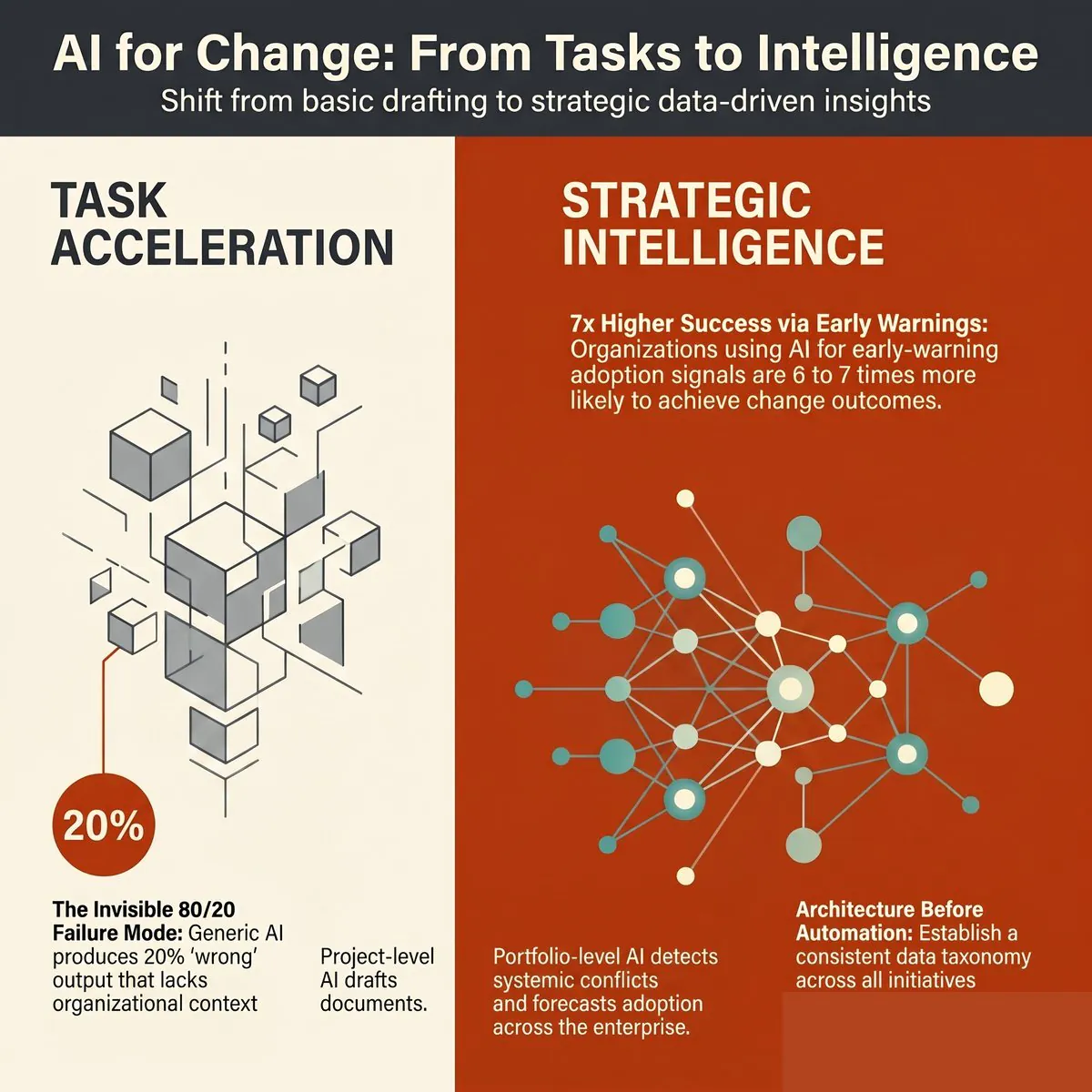
Prosci’s 12th Edition Best Practices in Change Management, drawing on data from over 10,800 change practitioners, identifies early-warning capability as one of the most significant differentiators between high-performing and low-performing change functions. Organisations that can identify adoption risk before deployment are 6 to 7 times more likely to achieve their intended change outcomes than those responding reactively.
Where AI misleads change managers (and why)
The same capabilities that make AI appealing also make it dangerous when used without the right foundations.
The 80/20 problem
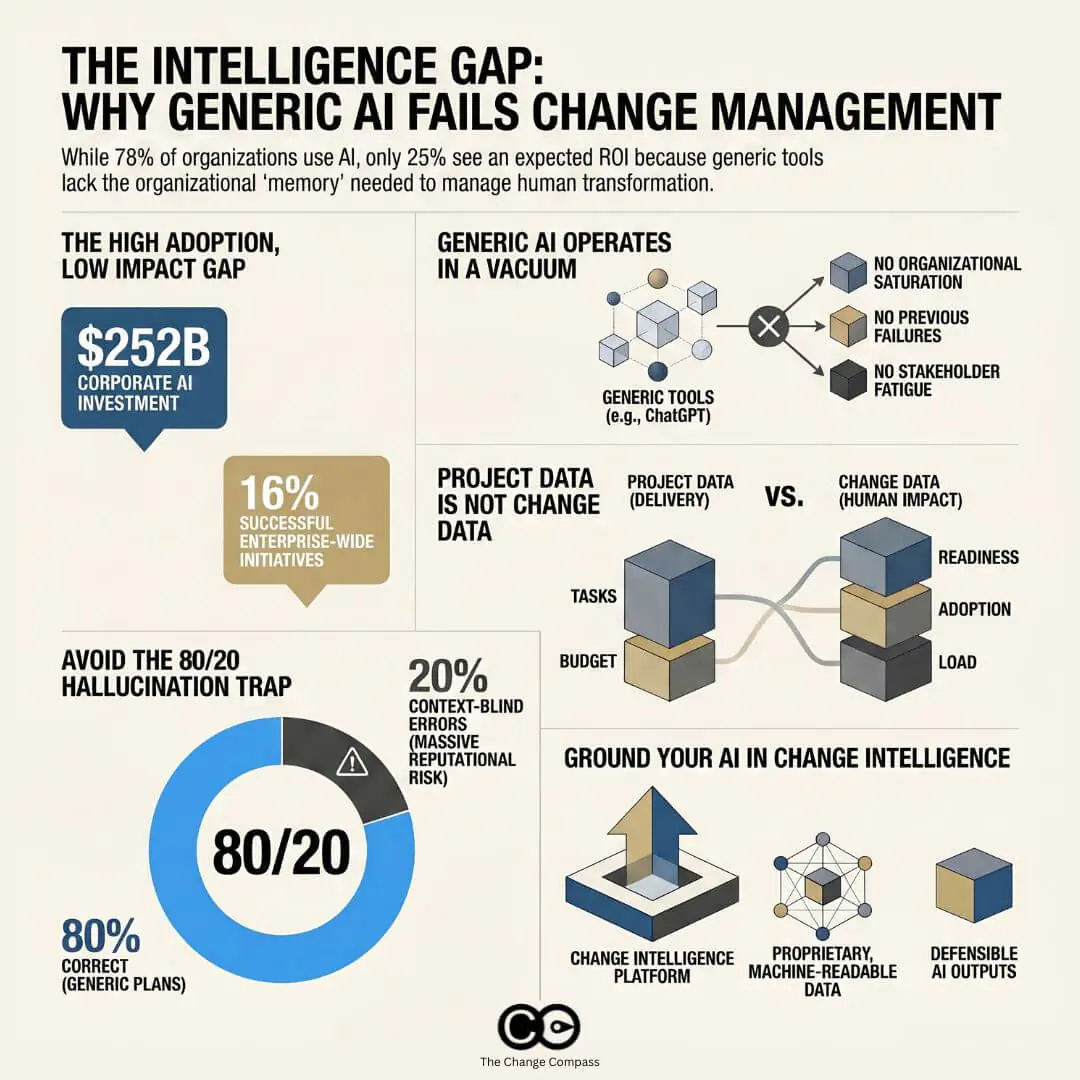
Generic AI tools trained on change management best practice produce output that is typically 80% sound and 20% wrong for the specific organisation. The problem is that the wrong 20% does not announce itself. The credible 80% creates a halo effect that carries the whole output through governance.
Common manifestations include: change plans that assume sponsorship structures the organisation does not have, sequencing that does not account for the organisation’s change history, training approaches that do not match the workforce’s capability profile, and communication channels that bypass the organisation’s actual influence networks. None of these failures are obvious to anyone without deep contextual knowledge, which is precisely the knowledge that generic AI lacks.
This is distinct from hallucination, which is visible and correctable. The 80/20 failure mode is invisible at the point of output and becomes apparent only when the change reaches the impacted population. By then, the cost of correction is significantly higher than it would have been at the planning stage.
The project data trap
A related problem is the confusion between project data and change data. Most organisations have extensive project data: scope documents, risk registers, milestone trackers, budget reports. Almost none of this data describes what the change looks like from the perspective of the impacted employee.
AI grounded only in project data produces recommendations about projects. It cannot describe how 47 employees in the Melbourne operations team will experience a systems migration stacked on top of a restructure and a performance review cycle change, because that information does not exist in any project management tool.
The structural distinction between project data and change data is the most important issue to resolve before investing in any AI tool for change management. It determines whether your AI investment will produce portfolio-level intelligence or just faster versions of the same project-level documents you already had.
The two-tier model: Project-level and portfolio-level AI
The clearest framework for understanding where AI adds value in change management is the two-tier model.
Project-level AI operates within a single initiative. It accelerates task execution: generating change plans, impact assessments, stakeholder matrices, communications, and status reports from project-specific inputs. The Change Compass’s Change Automator is a purpose-built example of this, using your organisation’s structured change data as context to produce artefacts that are organisation-specific rather than generic.
Portfolio-level AI operates across all active initiatives simultaneously. It aggregates stakeholder impact, calculates saturation scores, detects scheduling and behavioural conflicts, forecasts adoption likelihood by stakeholder group, and generates executive narratives grounded in real portfolio data. This is the layer that generic AI cannot reach, because it requires a cross-initiative data architecture that no project management tool or general language model maintains.
The two tiers are complementary, not competitive. Project-level AI reduces the time change managers spend on documentation. Portfolio-level AI improves the quality of strategic decisions made by transformation leaders and executives. Together, they constitute a change management AI automation model that shifts the operating rhythm of a mature change function from reactive and document-heavy to predictive and intelligence-driven.
The most common mistake in AI adoption for change management is using only the project-level tier. This is understandable because project-level tools are more immediately tangible, but it misses the most significant value: the strategic intelligence that only a cross-portfolio view can generate.
The case for purpose-built platforms over generic AI
The logical implication of the two-tier model is that AI in change management becomes most valuable when it is grounded in structured, organisation-specific change data. This is not achievable through prompt engineering alone. It requires a data architecture designed specifically for change.
A Change Intelligence Platform is purpose-built for this requirement. It creates and maintains the system of record for change data across all initiatives, with a consistent taxonomy, structured impact fields, and aggregation capabilities that make portfolio-level AI feasible. The AI in a change intelligence platform is not a general-purpose language model with a change management persona. It is grounded in your organisation’s actual change data.
Why the data question is decisive
A 2025 IBM CEO Study, drawing on responses from 2,000 CEOs globally, found that only 25% of AI initiatives had delivered their expected ROI, and just 16% had successfully scaled. The most commonly cited obstacle was data readiness: 72% of CEOs identified proprietary data as the key to GenAI value, and 68% named integrated enterprise-wide data architecture as critical to success.
In change management terms, the bottleneck is identical. Generic AI cannot deliver portfolio-level value because the data it needs, organised change impact data aggregated across initiatives with a consistent taxonomy, does not exist in a general-purpose tool. Building that data layer is the prerequisite for the AI to do anything strategically useful.
What this means for AI adoption
The progression from “we are experimenting with ChatGPT” to “AI is improving our change outcomes” is not primarily a technology question. It is a data architecture question. Organisations that skip the data foundation step and invest directly in AI tooling find that the tools produce output that is faster but not better. The quality ceiling is set by the data, not the algorithm.
This is why early AI experimentation in change management so often disappoints: practitioners are running sophisticated tools on inadequate data, and no amount of prompt refinement resolves a structural data gap.
How to evaluate AI tools for change management
Given the two-tier model and the data architecture requirements, evaluating AI tools for change management requires a different lens than most technology evaluations. The relevant questions are not about the AI’s features in isolation but about whether the AI can access the data it needs to produce useful output.
The key evaluation criteria are:
Data grounding: Does the AI use your organisation’s actual change data as context, or does it produce generic output from training data alone?
Portfolio scope: Does the tool operate across all initiatives simultaneously, or only within individual projects?
Taxonomy consistency: Does the platform enforce a consistent classification of impact types, stakeholder groups, and change phases across all initiatives? Without this, aggregation is unreliable.
Output specificity: Can the AI produce recommendations that reference specific stakeholder groups, business units, and initiatives from your portfolio, or does it produce change management advice that could apply to any organisation anywhere?
Integration: Does the platform connect to your HRIS, project management tools, and survey platforms to enrich the change data layer with real organisational signals?
Our detailed enterprise change management software buyer’s guide covers these criteria in depth, including the compliance, security, and integration requirements that enterprise procurement and IT teams will need to address.
The most important red flag when evaluating AI tools for change management is confident specificity without data grounding. If a tool produces highly specific recommendations about your organisation’s change programme without access to your organisation’s data, it is either applying generic best practice with a superficial wrapper of specificity or generating plausible-sounding output that has not been validated against your actual context. Both produce the 80/20 problem at scale.
How Change Compass implements AI in change management
Change Compass implements the two-tier model through two connected capabilities.
At the project level, the Change Automator generates change management artefacts from your organisation’s structured change data. Change plans, stakeholder matrices, communications plans, training needs analyses, and status reports are produced using the organisation’s taxonomy, change history, and stakeholder data as context. The output is organisation-specific, which means the editing required before it is usable is significantly less than for generic AI output.
At the portfolio level, Change Compass aggregates impact data across all active initiatives to generate saturation heatmaps, per-group fatigue indices, adoption likelihood scores, and portfolio-wide conflict alerts. The AI layer operates on top of this structured data, enabling capabilities that are not achievable with a standalone language model: forecasting saturation risk before a new initiative is launched, detecting when two initiatives are creating behavioural contradictions for the same stakeholder group, and generating executive narrative that is grounded in real portfolio data.
The data flywheel between the two tiers compounds over time. Every project-level artefact a change manager creates in the platform enriches the portfolio-level data that the AI uses to generate insights and forecasts. The more consistently teams use the platform, the more specific and accurate the portfolio intelligence becomes.
Where to start: a practical adoption roadmap
For change teams at the beginning of their AI journey, a sequenced approach is significantly more reliable than attempting to adopt both tiers simultaneously or investing in tooling before the data foundation exists.
Standardise your change data model. Before AI can add portfolio-level value, you need consistent data across initiatives. Agree on a taxonomy for impact types, a classification system for stakeholder groups, and a common format for impact severity and timing. This can begin in a spreadsheet, but the goal is to move toward a platform that enforces consistency at data entry rather than relying on manual conventions.
Adopt project-level AI for acceleration. Introduce generative AI at the project level for task acceleration: communications drafting, change plan generation, and status synthesis. Establish a clear editing discipline, recognising that AI output requires domain review before it is usable. Track the time saved per task to build the internal case for further investment.
Aggregate into a portfolio view. Once you have consistent data across initiatives, aggregate it into a portfolio view. Even a static quarterly view of impacted stakeholder groups by initiative and timing provides significant value for sequencing decisions. This is the foundation on which portfolio-level AI can later operate.
Deploy portfolio-level AI for strategic decisions. With consistent data and a portfolio view established, purpose-built portfolio AI becomes feasible. Start with saturation forecasting and conflict detection, as these produce the clearest and most immediately actionable signals for senior leaders.
This progression takes most change functions 12 to 24 months to complete, depending on the starting maturity of their data practices. The investment is front-loaded in steps 1 and 3, but the strategic value compounds significantly in step 4 and beyond.
Making AI work in practice
AI in change management is not primarily a technology adoption challenge. The change managers and functions that get the most from AI are those that have already invested in the data practices that give AI something useful to work with: structured impact data, consistent stakeholder taxonomy, and cross-initiative visibility maintained in a single system of record.
The organisations that will be genuinely differentiated by AI over the next three years are not those that adopted the most tools earliest. They are those that built the data foundation that makes AI output specific, accurate, and grounded in real organisational context.
That foundation is worth building whether or not AI is the primary motivation. The visibility and strategic intelligence it creates are valuable in their own right. AI acceleration is an additional return on the same investment, and a significant one as the tools mature.
Frequently asked questions
What is AI in change management? AI in change management refers to the application of artificial intelligence, including generative AI tools and purpose-built analytics platforms, to improve the speed, quality, and strategic value of change management work. It encompasses task-level applications such as drafting communications and generating change plans, and portfolio-level applications including saturation forecasting, adoption risk scoring, and conflict detection across concurrent initiatives.
Can AI replace a change manager? No. AI tools accelerate documentation and surface portfolio-level patterns, but they cannot substitute for the stakeholder relationships, political navigation, and adaptive judgement that define effective change management. Research from Workday found that while 75% of workers are comfortable working alongside AI agents, only 30% are comfortable being managed by one. The human role in change management shifts from document production to sense-making, relationship management, and strategic counsel, which AI cannot replace.
What data does AI need to be useful in change management? AI in change management needs structured, organisation-specific change data: standardised impact classifications, stakeholder group definitions, change history, and timing data across all concurrent initiatives. Without this data, AI tools produce generic output that may be technically sound but contextually wrong for the specific organisation, producing the 80/20 problem described above.
What is the difference between a change management AI tool and a Change Intelligence Platform? A change management AI tool typically applies generative AI to individual change tasks within a single project. A Change Intelligence Platform is a purpose-built system that maintains a cross-initiative data architecture, enabling portfolio-level AI applications including saturation forecasting, conflict detection, and adoption risk scoring. The platform provides the data layer that makes AI recommendations organisation-specific rather than generic.
How long does it take to see real value from AI in change management? Project-level benefits such as drafting acceleration and time savings on documentation are typically visible within weeks of adoption. Portfolio-level benefits require consistent data collection across initiatives, which takes most organisations 12 to 24 months to establish. The strategic payoff, including predictive adoption forecasting and portfolio conflict detection, compounds significantly after the data foundation is in place.
Corporate AI investment hit $252.3 billion in 2024 according to the Stanford HAI AI Index 2025, and 78% of organisations now use AI in at least one business function, up from 55% a year earlier. Yet a May 2025 IBM Institute for Business Value survey of 2,000 CEOs found that only 25% of AI initiatives have delivered the expected return, and just 16% have scaled enterprise-wide. The gap is widest in the disciplines where AI was supposed to help most, and AI for change management is among the clearest examples.
For change leaders, the symptom is familiar. Practitioners draft impact statements in ChatGPT. Project managers ask Microsoft Copilot to summarise stakeholder feedback. Sponsors paste a comms plan into Claude and ask for an executive version. The outputs look fluent, but anyone close to the work sees the same pattern: generic AI cannot reason about an organisation it does not know. It cannot weigh a new initiative against the five already in flight for the same audience. It cannot recall what happened the last time the operations team was asked to absorb a major systems change.
The conclusion most leaders are drawing is the wrong one. The constraint is not the AI model. The constraint is the absence of a system of record for change that the AI can actually reason against. An enterprise change intelligence platform is what fills that gap, and once it does, the relationship between change management and strategic outcomes shifts in a way that no productivity tool can replicate.
The AI productivity trap in change management
The first wave of AI adoption in change management has been characterised by individual practitioners using generic tools to accelerate familiar tasks. This is sensible, and at small scale it works. Drafting a stakeholder email, structuring a training outline, generating five variants of a comms message: these are bounded, low-risk uses where the cost of an inaccurate output is low.
The problem starts when leaders extrapolate from these wins. A practitioner who saves an hour drafting an email assumes the same tool will help them assess saturation across a $40 million transformation portfolio. It will not. The hour saved is a productivity gain. The portfolio question is a data problem. A separate companion guide on what AI can and cannot do in change management sets out the boundary in more detail, but the headline is straightforward: AI is strong on language tasks bounded by the prompt, and weak on reasoning that requires organisation-specific context the model has never been given.
Research by McKinsey on scaling agentic AI puts the structural issue in stark terms: eight in ten companies cite data limitations as the principal roadblock to scaling AI, and the value of large and small language models comes from the ability to train and ground them on the organisation’s own proprietary data. The same study notes that competitive advantage now flows from a small set of well-curated data products, treated as reusable, business-ready assets with clear ownership, semantics, and quality standards.
For change management, the implication is direct. If your organisation has no structured record of what initiatives are in flight, who is affected, what training has been delivered, what readiness scored, and how previous change has landed, no AI tool can reason about it. The model produces a plausible-sounding answer, drawn from generic training data, that may be confidently wrong about your specific context. The Stanford AI Index documented a 56.4% surge in AI incidents in 2024, and public trust in AI companies’ handling of personal data fell from 50% to 47% over the same period. In change management, where decisions hinge on the trust of frontline employees and the credibility of leadership messaging, an AI hallucination is not a quirky output. It is a reputational risk to the entire change function.
The project blinker: why project data is not change data
A predictable objection arises whenever change leaders raise the case for a dedicated change intelligence platform. Senior PMO leaders and programme directors push back with a version of: “we already have all of this. It is in our PPM tool, our project plans, our RAID logs, our portfolio dashboard.” The objection is sincere, and it is wrong. What looks like change data from inside a project office is project data viewed through a project planning and execution lens. The two data sets answer fundamentally different questions, and conflating them is the most common reason organisations under-invest in genuine change infrastructure.
A project plan records what the delivery team will do, by when, with what resources, and against which risks. A RAID log records the issues the project team is managing. A portfolio dashboard records the status, spend, and milestone position of each programme. All of this is necessary, and none of it tells you what is landing on a regional operations manager on the third Tuesday of November, when four systems change at once, on top of the new code of conduct module she completed two months ago, and the two leadership changes her function absorbed in the previous quarter.
Two different unit-of-analysis lenses
Project data is captured from the perspective of the delivery team. Its unit of analysis is the initiative. Its core dimensions are scope, schedule, budget, dependencies, and risks. Change data is captured from the perspective of the impacted business employee. Its unit of analysis is the human being on the receiving end of the entire portfolio. Its core dimensions are stakeholder group, impact type and severity, calendar phasing, training and engagement received, behavioural shift required, and adoption signal. Both are valid, both are needed, and one cannot substitute for the other. A perfectly green portfolio dashboard is entirely compatible with a workforce that is overloaded, disengaged, and quietly failing to adopt.
Why this matters for AI
The project blinker has a direct AI consequence. When AI is layered on top of project data and asked to reason about employee experience, capacity, or adoption risk, the answers it produces are confidently inaccurate. The model is not at fault. The data was never designed to answer those questions. Companion analysis on stakeholder impact analysis sets out the resulting blind spot in more detail, but the principle is straightforward: an AI grounded in project data will tell you a story about projects. It will not tell you a story about people, because the people-side data simply is not there.
This is why a purpose-built change intelligence platform is required even in organisations with mature PMO function and best-in-class PPM tooling. The platform exists to capture the data set the PMO was never set up to collect, and to make that data set available to grounded AI on equal footing with the project data the organisation already has.
The 80/20 trap: why partially-wrong AI recommendations are the real danger
The most commonly discussed AI risk in change management is hallucination, where a model invents a fact, a citation, or a stakeholder group that does not exist. This is the visible failure mode, and it is usually caught quickly by anyone with domain knowledge. The harder failure mode, and the one that actually derails change outcomes, is the partially-wrong recommendation.
A typical generic-AI change plan looks credible. Eighty per cent of it draws on widely accepted best practice and reads as logical advice any senior practitioner would recognise. It is the remaining ten to twenty per cent that creates the risk. Common examples drawn from change plans drafted using generic AI include:
The wrong sequencing for a specific business unit, because the model does not know what else is landing on that unit at the same time
The wrong intensity rating for a stakeholder group that has just absorbed three other initiatives in the same quarter
The wrong assumption about who the actual sponsors are, drawn from public org charts rather than the organisation’s real decision rights
The wrong training cadence for a workforce whose annual learning capacity has been fully booked since March
The wrong communication channel mix, recommended from generic best practice that does not match how this organisation’s frontline actually consumes information
These are not hallucinations. They are reasoned-looking outputs that happen to be wrong for this specific organisation, and they do not announce themselves. The 80% of the plan that is sound creates a halo of credibility around the 20% that is not. A reviewer scanning a plausible-looking document is unlikely to challenge it in a time-pressured governance forum. By the time the misstep is visible in adoption or engagement data, the plan is months into delivery and the cost of intervention has multiplied.
This is the precise problem that organisation-specific data is built to solve. When AI is grounded in the actual portfolio, the actual stakeholder load profile, the actual decision-rights register, and the actual historical adoption pattern, the partially-wrong 20% has nowhere to hide. The platform catches the inconsistency at the point of recommendation, not three months later in the engagement survey.
What an enterprise change intelligence platform actually does that ChatGPT cannot
A change intelligence platform is not a better version of ChatGPT. It is a category of enterprise software that exists upstream of any AI assistant, and it does three structural things that no generic AI tool can replicate.
A single source of truth for change
Every initiative in flight, every stakeholder group affected, every milestone date, every readiness assessment, every training record, captured against a consistent taxonomy. This is the system of record layer, and it is what allows any subsequent analysis, human or AI, to compare like with like across the portfolio rather than across spreadsheets.
Machine-readable structured data
Free-text descriptions of impact, embedded in a slide deck, are unusable to any system. Impact captured against defined categories (process, system, role, organisational structure, behaviour) and scored against a consistent scale becomes the substrate for portfolio analysis. This is the structured-data layer.
Aggregation and visualisation across the portfolio
A heatmap of cumulative change load across business units, a stakeholder fatigue index per audience group, a saturation score per division: these only exist when the system of record and the structured data are in place. They cannot be retrofitted by asking ChatGPT to summarise twelve project plans, because the underlying inputs are not comparable.
This is the foundation that The Change Compass calls a change intelligence platform, and the category exists precisely because the underlying data problem is not solvable with a chatbot. The platform is the data infrastructure that makes AI in change management actually work.
Once that foundation is in place, AI becomes useful in ways it cannot be when used in isolation. A practitioner asking the platform to generate a stakeholder impact summary is no longer relying on the model’s general knowledge. The model is grounded in the organisation’s actual impact data, its actual stakeholder taxonomy, its actual portfolio of initiatives, and its actual historical adoption outcomes. The output stops being plausible-sounding generic prose and starts being a specific, defensible synthesis of the organisation’s own data.
Why proprietary data is the missing piece for AI in change management
This pattern is not unique to change management. It is the same pattern that every enterprise function is now learning the hard way. In their five trends in AI and data science for 2025, MIT Sloan Management Review’s Thomas Davenport and Randy Bean identify retrieval-augmented generation, where an AI model is given access to proprietary documents and data to ground its responses, as the dominant pattern for enterprise AI value creation. They cite Colgate-Palmolive applying RAG to a corpus of proprietary consumer research and third-party data, allowing employees to query the entire knowledge base rather than work from individual reports.
The mechanics matter. A general-purpose language model is trained on publicly available text, which means it knows nothing about your portfolio, your stakeholder groups, your governance structures, your industry-specific compliance rules, or your historical change outcomes. Grounding the model in proprietary data is what closes that gap, and Databricks’ 2025 State of AI analysis reports that the use of vector databases supporting retrieval-augmented generation grew 377% year-on-year as enterprises caught up to this reality.
The IBM CEO Study reinforces the strategic implication. Seventy-two percent of CEOs surveyed said their organisation’s proprietary data is the key to unlocking the value of generative AI, and 68% identified an integrated enterprise-wide data architecture as critical for cross-functional collaboration. These findings are not about the change function in particular, but they apply with unusual force in change management, because the discipline depends on a richer and more diverse data set than almost any other corporate function. It needs initiative data, impact data, capacity data, adoption data, readiness data, and historical context, and it needs them in a shape that supports portfolio-level reasoning, not project-level reporting.
A change intelligence platform is the operational answer to that requirement. It is the data architecture that the IBM and McKinsey research describe, applied specifically to change. Without it, the AI tools your practitioners use are working blind. With it, the same tools can produce outputs that are specific to your organisation, grounded in your actual context, and defensible to the executives reviewing them.
From a pair of hands to a strategic enabler
The shift this unlocks is the one that matters most. For two decades, the change management function has been positioned, internally and externally, as a delivery muscle. Projects spin up, the change team is engaged late, a stakeholder analysis is produced, a comms plan is built, training is delivered, and the team is redeployed. This is the “pair of hands” model, and it is the model that most enterprise change management practices still operate under.
The combination of a change intelligence platform and grounded AI changes the operating model in four ways.
From project-level reporting to portfolio-level intelligence. When every initiative feeds the same data layer, the change function can answer questions no project team can answer. Where is cumulative load highest? Which divisions are approaching saturation? Which stakeholder groups are absorbing change from four directions at once?
From retrospective reviews to predictive analysis. Once historical adoption data, impact data, and readiness data are captured against a consistent taxonomy, the AI can identify patterns in what predicted past outcomes and forecast the trajectory of current initiatives. This is the use case McKinsey describes as competitive advantage moving to those who package data into reusable products.
From reactive sequencing to deliberate scheduling. A grounded AI can model what happens if a new initiative goes live in Q3 vs Q4 against the existing portfolio, and surface the stakeholder groups most likely to be overloaded. The change function moves from being asked to “make this work” to advising governance on what to prioritise.
From advisory voice to evidence-based authority. A recommendation backed by portfolio data, historical evidence, and stakeholder load modelling carries different weight in an executive committee than a recommendation backed by practitioner judgement alone. Strategic projects you might previously have lost the argument on become defensible on the data.
This is what research by the Project Management Institute, in its 2025 Pulse of the Profession report, describes as the shift from operational delivery to strategic value creation. PMI found that organisations whose project professionals demonstrate high business acumen achieve a 72% success rate in meeting business goals, compared with 65% for those who do not, and that the top performers consistently invested in benefits realisation management maturity and adaptability to changing conditions. The change function, properly equipped, sits squarely in this same value creation space. Without the data layer to support it, the function will continue to be positioned as a delivery cost. With it, the function becomes one of the organisation’s primary strategic levers.
How this de-risks the business and protects performance
The strategic case for an enterprise change intelligence platform is also a risk argument. Most large organisations now run between fifteen and forty concurrent change initiatives at any given time, and a meaningful proportion of those initiatives target the same stakeholder groups. When initiatives compete for the same audience without coordination, the consequences are predictable and measurable. Adoption drops. Productivity sags during the transition. Engagement scores fall. Discretionary effort declines. Attrition rises in the most affected teams. The combined effect is a meaningful drag on the business case for every initiative in the cluster.
Trust as the foundation of AI-enabled change
Accenture’s Technology Vision 2025 frames the broader risk picture in a useful way. The report argues that enterprises are building what it calls “cognitive digital brains” by hard-coding workflows, institutional knowledge, value chains, and social interactions into systems that can reason and act with autonomy. The report notes that 77% of executives believe the true benefits of AI can only be unlocked when systems are built on a foundation of trust, and that trust is now the most important measure of an AI system’s viability.
In change management, the foundation of trust is the data layer. An enterprise change intelligence platform makes the underlying assumptions visible, the impact data auditable, and the adoption outcomes traceable. When AI is added on top of that foundation, its recommendations are explainable. When AI is bolted onto an organisation with no system of record, its recommendations are guesses, and the change function carries the reputational risk for every one that turns out to be wrong.
Early warning, not post-mortem
The downstream effect on strategic outcomes is direct. Strategic initiatives are typically the ones with the highest stakes, the most ambitious benefits cases, and the tightest interdependencies. They are also the ones most exposed to the risk of cumulative change load. An organisation that cannot see, in advance, that its top three strategic initiatives all land on the same audience in the same quarter has no early warning system. The first signal arrives in the adoption numbers, by which point the cost of intervention is materially higher than the cost of resequencing.
A change intelligence platform with grounded AI gives leadership that early warning. It is the difference between learning your operating model transformation failed because the relationship managers were drowning, and learning, three months earlier, that the relationship managers were going to be drowning unless something gave. The first is a post-mortem. The second is a governance decision.
Where Change Compass fits
Change Compass is the enterprise change intelligence platform built specifically for this use case. The platform captures every initiative in flight against a consistent change taxonomy, structures impact and stakeholder data so it is machine-readable, and aggregates the result into portfolio-level views including saturation heatmaps, stakeholder fatigue indices, and adoption forecasts. Its AI capabilities are grounded in the customer’s own data and benchmark data from across the platform’s enterprise client base, which means the recommendations a practitioner receives are specific to their organisation’s situation rather than drawn from generic training data. For organisations evaluating whether to invest in a change platform, the companion guide on enterprise change management software walks through the features that distinguish an enterprise-grade platform from a project tool.
For change leaders who have already begun experimenting with generic AI tools, the more useful framing is that the platform is what makes those experiments worth running at scale. Without it, even the best AI is operating on guesswork. With it, the same AI becomes a strategic instrument for the function.
Making the shift
The practical starting point is not a procurement exercise. It is a diagnostic. The questions worth answering, before any tool decision is made, are these.
Can you produce, today, a single view of every change initiative in flight across the organisation, with consistent impact data and stakeholder mapping?
Can you tell the executive sponsor of a new initiative which other initiatives are landing on the same audience, in the same quarter, at what cumulative load?
Do you have a record of how previous change has landed in each business unit that an AI tool, or a human analyst, could reason against?
Do your AI experiments in change management currently produce outputs that are specific to your organisation, or generic outputs that have been lightly contextualised?
If the answer to any of these is no, the gap is the data layer, not the AI model. An enterprise change intelligence platform is the structural fix. The first wave of AI in change management was about productivity. The second wave, and the one that distinguishes organisations that achieve their strategic goals from those that do not, will be about intelligence. And intelligence requires a system of record, structured data, and an architecture that allows AI to do what generic tools can never do alone: reason about the specific organisation it is operating in.
The change function that gets this right stops being a delivery cost and starts being a strategic enabler. That is the shift the next five years of transformation work will reward.
What is an enterprise change intelligence platform?
An enterprise change intelligence platform is a system of record for organisational change that captures every initiative, stakeholder group, impact assessment, and adoption metric against a consistent taxonomy, then uses that structured data to provide portfolio-level intelligence. It is distinct from a project-level change tool because it operates across the entire transformation portfolio, and it is the data foundation that makes AI in change management produce defensible, organisation-specific outputs rather than generic ones.
Why is generic AI like ChatGPT or Microsoft Copilot insufficient for enterprise change management?
Generic AI tools are trained on publicly available data and have no access to an organisation’s specific initiatives, stakeholder groups, historical change outcomes, or cumulative load profile. They can produce plausible-sounding generic text, but they cannot reason about a specific portfolio. For tasks where the value depends on organisation-specific context, such as saturation analysis, stakeholder load modelling, and adoption forecasting, the outputs are unreliable without a grounding data layer.
How does an enterprise change platform improve strategic outcomes?
It does so by giving leadership early visibility of portfolio-level risk before that risk turns up in the adoption numbers. When every initiative is captured against the same taxonomy, the platform can surface cumulative impact on stakeholder groups, model the effect of sequencing decisions, and forecast adoption outcomes. That early warning capability is what allows governance to resequence, pause, or resource initiatives before they fail rather than after.
What is the role of AI in a change intelligence platform?
AI in a properly architected change intelligence platform is grounded in the organisation’s own data, not in generic training corpora. It can summarise stakeholder load, surface convergence patterns across initiatives, draft initiative-specific impact narratives, and forecast adoption based on the organisation’s own historical outcomes. The grounding is what makes the AI usable as a strategic instrument rather than a productivity gadget.
How is this different from just using an AI tool with a custom prompt?
A custom prompt is a thin layer on top of a generic model. It can shape tone and structure, but it cannot give the model access to the organisation’s data. A change intelligence platform provides the structured data layer that an AI model can reason against in real time, using retrieval-augmented generation or equivalent techniques. The difference is the difference between a model that sounds informed and a model that is informed.
Organisational transformations are essential for staying competitive in today’s fast-paced world, but they often come with challenges that can derail progress. One of the most pressing issues is change overload—when employees and stakeholders are overwhelmed by the sheer volume or pace of changes being implemented. This can lead to burnout, disengagement, resistance, and ultimately, failure to achieve transformation goals.
Artificial intelligence (AI) offers a powerful solution to combat change overload. By leveraging AI tools and strategies, organisations can streamline processes, personalise communication, optimise workflows, and make data-driven decisions that reduce stress and improve adoption rates. This guide provides actionable steps to harness AI effectively in managing large-scale transformations while preventing change fatigue.
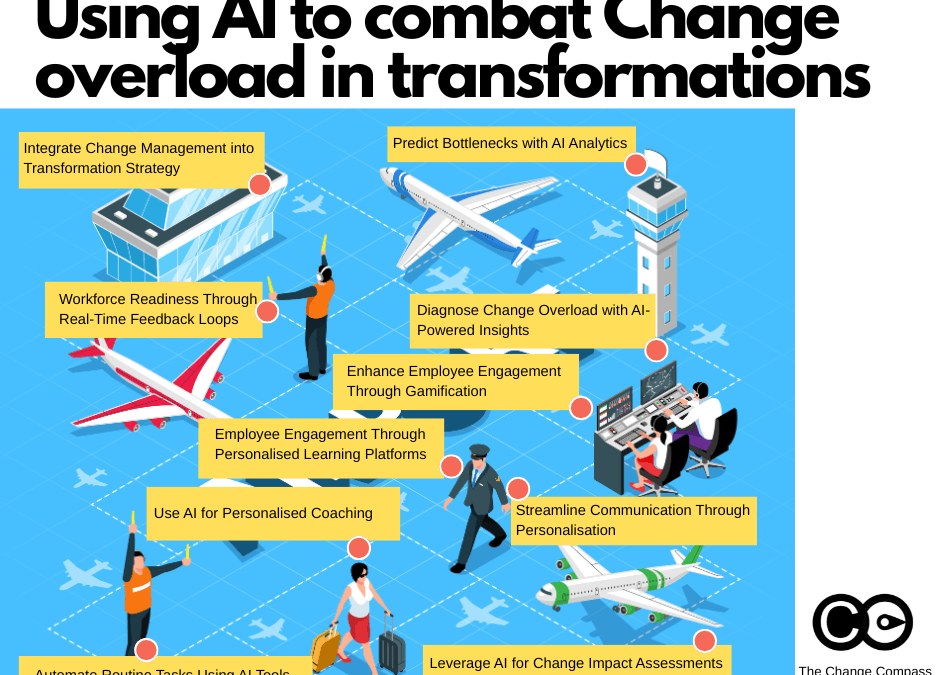
1. Diagnose Change Overload with AI-Powered Insights
Before addressing change overload, you need to identify where it exists and how it impacts your organisation. AI-powered analytics tools can provide real-time data on employee sentiment, workload distribution, and engagement levels—helping you pinpoint areas of concern before they escalate.
How to Apply This:
Use Sentiment Analysis Tools: Platforms like Microsoft Viva Insights or Qualtrics EmployeeXM can analyse employee feedback from surveys, emails, or chat platforms to detect patterns of stress or disengagement. For example:
If sentiment analysis reveals a spike in negative feedback during a specific project phase, it may indicate that employees are overwhelmed by unclear communication or unrealistic deadlines.
Monitor Workload Distribution: Tools such as Workday or Asana’s workload management feature can highlight individuals or teams carrying disproportionate workloads. This allows leaders to redistribute tasks more equitably.
Track Change Saturation Metrics: Use metrics like the number of concurrent projects per team or the average time spent on change-related activities per week may be a start. AI dashboards can automatically calculate these metrics and flag when thresholds are exceeded.
Visualise Change Saturation: Tools such as The Change Compass can help to easily capture change impacts across initiatives and turn these into data visualisation to support decision making. Embedded AI tools help to interpret the data and call out key risk areas and recommendations.
🔍 Example: A retail organisation undergoing digital transformation used AI sentiment analysis to discover that frontline employees felt excluded from decision-making processes. Leaders adjusted their communication approach to involve key frontline change champions which improved morale and reduced resistance.
2. Streamline Communication Through Personalisation
One-size-fits-all communication often adds to change fatigue by overwhelming employees with ineffective or irrelevant information. AI can help tailor messages based on individual roles, preferences, and needs—ensuring that employees only receive what’s most relevant to them.
How to Apply This:
Leverage Natural Language Processing (NLP): Tools like IBM Watson can analyse employee communication styles and suggest tone adjustments for clearer messaging.
Segment Audiences Automatically: Use platforms like Poppulo or Dynamic Signal to categorise employees by role, department, or location and deliver targeted updates accordingly. For instance:
IT teams might receive detailed technical updates about new systems being implemented, while frontline staff get simplified instructions on how the changes will impact their day-to-day tasks.
Automate Feedback Loops: Chatbots powered by AI (e.g., Tidio or Drift) can collect ongoing feedback from employees about the clarity and usefulness of communications during transformation initiatives.
💡 Pro Tip: Combine AI-driven personalisation with human oversight to ensure messages remain empathetic and aligned with organisational culture.
3. Predict Bottlenecks with AI Analytics
One of AI’s greatest strengths is its ability to analyse historical data and predict future outcomes—a capability that’s invaluable for managing change timelines and resource allocation effectively. Predictive analytics can help you anticipate bottlenecks before they occur and adjust your strategy in real time. For example, there could be cyclical periods of the year where the change volume tends to be higher. From our research at The Change Compass, we’ve seen that across different industries, October-November, and February-March tend to be high change volume periods.
How to Apply This:
Forecast Employee Capacity: If you already have the data you can use tools like Tableau or Power BI to predict when teams will be overstretched based on upcoming project timelines and historical workload data. Alternatively, utilise The Change Compass’ forecasting capabilities to predict trends.
Identify High-Risk Areas: Predictive models can flag departments or teams likely to experience resistance based on past behaviours or current engagement levels.
Scenario Planning: Use AI simulations (such as those offered by AnyLogic) to test different implementation strategies for your transformation initiative. The Change Compass also has a scenario planning feature to help you model changes before making the decision.
📊 Example: A financial services firm used predictive analytics during its digital transformation to identify that Q4 was historically the busiest period for its customer service team. By rescheduling non-critical training sessions for later Q1, they reduced employee stress and maintained service quality.
4. Enhance Employee Engagement Through Personalised Learning Platforms
Engaged employees are more likely to embrace change rather than resist it. AI-powered learning platforms offer personalised training pathways that equip employees with the skills they need for new roles or technologies introduced during transformation.
How to Apply This:
Create Adaptive Learning Journeys: Platforms like Degreed or EdCast use AI algorithms to recommend training modules based on an employee’s current skill set and career aspirations.
Gamify Learning Experiences: Incorporate gamification elements such as badges or leaderboards into your training programs using tools like Kahoot! or Quizizz.
Monitor Training Effectiveness: Use analytics within learning management systems (LMS) like Cornerstone OnDemand to track completion rates, quiz scores, and time spent on modules.
🎯 Action Step: Pair training initiatives with clear career progression opportunities tied directly to the transformation goals—for example, offering certifications for mastering new software systems being implemented.
5. Automate Routine Tasks Using AI Tools
Repetitive tasks drain employees’ energy and time—resources that could be better spent on strategic initiatives during transformations. Automation powered by AI can alleviate this burden by handling routine tasks efficiently. This not only reduces workload but also empowers employees to focus on higher-value activities that drive transformation success.
Note that this approach is assuming the organisation has the appetite to leverage AI and automation to reduce workload.
How to Apply This:
Automate Administrative Tasks: Tools like UiPath or Zapier can automate workflows such as data entry, meeting scheduling, or report generation. For example:
Automating the creation of weekly project status reports allows project managers to spend more time addressing risks and engaging with stakeholders.
Streamline Onboarding Processes: Implement chatbots like Leena AI or Talla that guide employees through onboarding steps during organisational changes. These tools can answer FAQs, provide training schedules, and even send reminders for task completion.
Enable Self-Service Options: Deploy virtual assistants (e.g., Google Dialogflow) that allow employees to access FAQs about new policies, systems, or procedures without waiting for human support.
💡 Pro Tip: When automating tasks, ensure transparency with employees about what is being automated and why. This helps build trust and prevents fears about job security.
6. Foster Workforce Readiness Through Real-Time Feedback Loops
Continuous feedback is essential during transformations—it helps leaders course-correct quickly while keeping employees informed and engaged. However, traditional feedback mechanisms like annual surveys are often too slow to capture real-time issues. AI tools enable organisations to collect and analyse feedback at scale in real time, creating a more agile approach to managing change fatigue.
How to Apply This:
Deploy Pulse Surveys: Platforms like Culture Amp or Peakon use AI algorithms to analyse survey responses instantly and provide actionable insights. For example:
If a pulse survey reveals low morale in a specific department, leaders can intervene immediately with targeted support or communication efforts.
Monitor Collaboration Metrics: Tools such as Slack Insights or Microsoft Teams Analytics track engagement levels within collaboration platforms. If metrics show a drop in activity or participation, it could indicate disengagement or confusion about transformation goals.
Close Feedback Loops Quickly: Use automated workflows triggered by feedback results. For instance:
If employees flag a lack of clarity about a new system rollout, an automated workflow can schedule additional training sessions or send out simplified guides.
📌 Key Insight: Real-time feedback not only identifies issues early but also demonstrates that leadership values employee input—a critical factor in building trust during change.
7. Leverage AI for Change Impact Assessments
One of the most overlooked aspects of managing change is understanding its cumulative impact across the organisation. Many organisations fail to consider how multiple simultaneous changes affect employee capacity and morale. AI tools can help conduct comprehensive change impact assessments by analysing data across projects, teams, and timelines.
How to Apply This:
Map Change Dependencies: Use AI-powered tools like The Change Compass to visualise how different initiatives overlap and interact. For example:
If two major IT upgrades are scheduled for the same quarter, the tool can flag potential conflicts and recommend rescheduling one of them as well as locating the right timing.
It could also be a series of smaller initiatives all being executed at the same time, again leading to the risk that key messages may not be absorbed by impacted employees
Analyse Historical Data: Predict how similar changes have impacted the organisation in the past using predictive analytics tools mentioned previously.
Simulate Scenarios: Run simulations to test different implementation strategies (e.g., phased vs big-bang rollouts) and predict their impact on employee workload and engagement.
🔍 Example: A global logistics company used AI-driven impact assessments to identify that rolling out a new CRM system during peak holiday season would overwhelm its sales team. By postponing the rollout until after the busy period, they avoided unnecessary stress and ensured smoother adoption.
8. Enhance Employee Engagement Through Gamification
AI can make transformation initiatives more engaging by incorporating gamification elements into training programs, communication strategies, and performance tracking systems. Gamification taps into employees’ intrinsic motivation by rewarding participation and progress—making change feel less daunting and more rewarding.
How to Apply This:
Gamify Training Programs: Use platforms like Kahoot! or Quizizz to create interactive quizzes and challenges related to new systems or processes being introduced.
Incentivise Participation: Offer digital badges, points, or leaderboards for completing key milestones in transformation initiatives (e.g., attending training sessions or adopting new tools).
Track Progress Automatically: AI-powered LMS platforms like Degreed can track employee progress in real time and provide personalised recommendations for next steps.
🎯 Action Step: Pair gamification efforts with tangible rewards such as gift cards or extra leave days for top performers.
💡 Pro Tip: Ensure gamification efforts are inclusive—design challenges that appeal to all personality types, not just competitive individuals.
9. Use AI for Personalised Coaching
AI-powered coaching platforms are revolutionising how organisations support their employees during transformations. These tools provide personalised guidance tailored to each employee’s role, skills, and career aspirations—helping them navigate change more effectively while feeling supported.
How to Apply This:
Deploy Virtual Coaches: Platforms like BetterUp or CoachHub use AI algorithms to match employees with virtual coaches who provide tailored advice on navigating change.
Provide Role-Specific Guidance: Use AI tools that offer customised recommendations based on an employee’s role within the organisation. For instance:
A sales representative might receive tips on leveraging new CRM features, while a manager gets guidance on leading their team through uncertainty.
Monitor Coaching Effectiveness: Track metrics such as employee satisfaction scores or performance improvements after coaching sessions.
🔍 Example: A tech company implementing agile methodologies used an AI coaching platform to train managers on fostering collaboration within cross-functional teams. The result was a smoother transition with fewer bottlenecks.
10. Integrate Change Management into Your Digital Transformation Strategy
AI should not operate in isolation; it must be embedded into your broader change management framework for maximum impact. This includes aligning AI initiatives with existing change management methodologies.
How to Apply This:
Centralise Data Sources: Use platforms like The Change Compass to consolidate insights from various data sources into a single dashboard, think data sources such as system usage, performance KPIs and employee survey results. It also enables you to capture your change data and deliverables according to your preferred methodology and populate data with generative AI.
Align Metrics Across Teams: Ensure KPIs related to change readiness (e.g., adoption rates) are consistent across departments.
Train Leaders on AI Capabilities: Equip managers with basic knowledge of how AI works so they can champion its use within their teams.
🌟 Final Thought: The integration of AI into change management isn’t just about technology—it’s about creating a culture of adaptability where data-driven decisions empower people at every level of the organisation.
Call-to-Action: Start Your Journey Towards Smarter Change Management
The challenges of large-scale transformations don’t have to result in burnout or disengagement when you harness the power of artificial intelligence effectively. Begin by assessing your current change portfolio environment—what tools are you already using? Where are the gaps? Then explore how AI solutions can fill those gaps while aligning with your organisational goals.
Ready to take the next step? Dive deeper into strategies for agile change portfolio management here and discover how data-driven insights can revolutionise your approach today!
Most large organisations are now somewhere in the process of deploying AI across their operations. Many are discovering, often painfully, that the change management challenge of AI adoption is categorically different from the change management challenges they have navigated before.
The difference is not scale, though AI initiatives are often large. It is speed, depth, and ambiguity. AI changes how work is done, not just which tools people use. It shifts decision-making processes, redistributes responsibilities, and in some cases eliminates roles entirely. And it keeps changing: the capabilities that are state of the art today are different from those of 12 months ago. Managing AI transformation through standard change management frameworks, built for discrete, definable changes, often produces poor results.
McKinsey’s research on change management in the age of gen AI is direct on this point: for CEOs, the charge is clear to plan for a company-wide reconfiguration today so that humans and AI together can achieve extraordinary outcomes tomorrow. And critically, McKinsey notes that upskilling as part of AI transformation is not a training rollout. It is a change management effort.
That reframing from AI deployment as technology change to AI adoption as organisational transformation is where effective AI change management begins.
The adoption gap in AI transformation
The gap between AI investment and AI value is widening in most organisations. Gartner research from 2025 found that business units which redesign how work gets done, rather than simply deploying AI tools and encouraging employees to use them, are twice as likely to exceed revenue goals. Yet most organisations are doing the latter.
This distinction between deploying AI and redesigning work is the core of effective AI change management. When AI is implemented as a tool overlay on existing processes, adoption is partial, benefits are modest, and resistance is higher. When AI implementation is accompanied by genuine redesign of workflows, decision rights, and performance expectations, adoption is deeper and the value is substantially larger.
The research confirms the cost of the gap. MIT Sloan Management Review’s analysis of gen AI scaling found that organisations face a predictable midcycle enthusiasm dip that kills adoption momentum, function-specific resistance that generic communications cannot address, and cultural resistance to working differently. Novo Nordisk’s experience, scaling from a few hundred AI users in January 2024 to more than 20,000 by February 2025, succeeded specifically because they combined champion networks, targeted function-level enablement, and adaptive governance rather than a one-size change communication approach.
Why AI change management is different from standard change management
Standard change management frameworks, whether ADKAR, Kotter, or Prosci, were designed for changes with defined endpoints: a new system goes live, a restructure is announced, a policy changes. The change effort has a start, a middle, and a completion point. Communication and training are planned around a timeline. Success is measured at a defined moment.
AI transformation does not work this way. Several characteristics make it distinct.
The change has no fixed endpoint
AI capabilities are evolving continuously. The change management challenge is not “help people adopt this AI tool.” It is “build the organisational capacity to continuously adopt AI as capabilities evolve.” This is a fundamentally different proposition. It requires building adaptive learning capacity into the organisation, not managing a one-time transition.
Employee relationship with AI is ambivalent, not uniformly resistant
Standard change management wisdom treats resistance as the primary barrier. With AI, the picture is more complex. MIT Sloan research found that employee hope about AI handling certain tasks remains high at 78 to 85% across adoption stages, while fear stays relatively low at 21 to 32%. The challenge is not primarily resistance, it is the gap between positive sentiment and sustained behaviour change in how work is actually done.
The impact is role-specific to an unusual degree
AI affects different roles in fundamentally different ways. A finance analyst and a customer service representative may both be in the same organisation’s AI transformation programme, but the change each needs to make is almost entirely different. Communication and training approaches that work for one will not work for the other. AI change management requires function-level and role-level customisation at a depth that generic programme change management rarely reaches.
Middle management is the critical adoption layer
Gartner’s CHRO research identifies a July 2025 survey finding that 78% of CHROs agree workflows and roles will need to change to get the most out of AI investments. But the barrier to this redesign is not typically executive resistance. It is middle management. Managers whose teams are being asked to work differently face the most immediate and personal disruption from AI adoption. They are simultaneously the key enablers of change at the team level and the group most likely to passively resist if the change management approach does not specifically address their experience.
What effective AI change management looks like
The organisations navigating AI transformation most effectively share several characteristics in their change approach.
They start with work redesign, not tool deployment. Before employees are asked to use AI tools, the question is asked: how should this work actually be done differently with AI available? This question is answered at the process and role level, not the general level. The answer shapes both the change management plan and the training design.
They build internal AI champion networks. The Novo Nordisk model, and many similar examples across industries, shows that peer-led adoption in function-specific contexts substantially outperforms top-down communications. Champions are typically senior individual contributors who understand the function’s work in detail and can translate AI capability into specific, credible use cases for their colleagues.
They manage the midcycle dip actively. AI adoption typically follows a predictable curve: initial enthusiasm, early experimentation, midcycle frustration as the limitations of current tools become apparent, and then either deeper adoption (for organisations that support people through the dip) or abandonment (for those that do not). Effective AI change management plans for the midcycle dip explicitly. It is not a sign of programme failure; it is a predictable stage that requires specific interventions.
They track adoption at role and function level, not just platform usage metrics. Platform usage (how many people opened the tool, how many queries were submitted) is a leading indicator at best and can be deeply misleading. A person can use an AI tool regularly without changing how they work in any meaningful way. Effective AI change management tracks whether the work is actually changing: are decisions being made differently, are time savings being realised, are outputs improving?
They redesign performance frameworks to reflect AI-enabled work. If employees are being asked to do their jobs differently using AI, but their performance frameworks still measure the old way of working, the rational behaviour is to use AI superficially while continuing to work in ways that the performance system recognises and rewards. Aligning performance expectations with AI-enabled ways of working is one of the most powerful and most neglected levers in AI change management.
The change management challenge specific to AI in large enterprises
For enterprise change leaders, AI transformation introduces portfolio complexity that adds to the standard adoption challenge. Most large organisations are running multiple AI initiatives simultaneously: different functions, different vendors, different use cases. The change management challenge is not just managing each initiative, it is managing the cumulative AI-related change burden on employees who are being asked to adopt AI across several areas of their work simultaneously.
Gartner research found that organisations continuously adapting their change plans based on employee responses are four times more likely to achieve change success. For AI transformation, this adaptive approach is even more important than usual, because the feedback loops are faster. AI tools change rapidly. Employee experience of those tools shifts as capabilities evolve. A change management plan set at programme initiation and not revisited will be misaligned with reality within months.
Using digital platforms in AI change management
The irony of AI change management is that it is one of the highest-complexity change management challenges organisations face, at a moment when most change functions are still operating with manually-compiled data and periodic reporting cycles. Digital change management platforms, such as The Change Compass, enable the continuous adoption tracking and portfolio-level visibility that AI transformation requires: seeing where adoption is progressing by function, identifying which employee groups are experiencing midcycle dips, and generating the data needed to adapt the change approach in real time rather than at fixed review points.
For AI transformation specifically, the combination of role-level adoption tracking and portfolio-level load management is particularly valuable. The change function can see not just whether AI adoption is progressing, but how AI change load interacts with other concurrent changes affecting the same employee groups.
What the research says about AI adoption failure
It is worth being clear about the evidence. A May 2025 Gartner survey of 506 CIOs and technology leaders found that 72% of CIOs report their organisations are breaking even or losing money on AI investments. The primary reasons cited are not technical: they are change-related. People are not working differently. Workflows have not been redesigned. The cultural conditions for AI adoption have not been established.
This is not a technology problem. It is a change management problem of a kind that only becomes soluble when AI transformation is explicitly treated as an organisational change challenge requiring deliberate, sustained change management investment.
Building AI change management capability in your organisation
For change leaders building the case internally for dedicated AI change management investment, the most useful starting point is a portfolio scan: how many AI initiatives are currently active across the organisation, which employee groups are they targeting, what is the cumulative AI-related change load, and what change management support is currently in place for each?
In most large organisations, this scan reveals a significant gap: a large number of AI initiatives, often with substantial investment in technology and training, and limited or no dedicated change management beyond communications. This gap is where the value is. Closing it, by bringing the same rigour to AI adoption management that mature change functions bring to major technology implementations, is the highest-return investment most enterprise change functions can make in 2026.
Frequently asked questions
What is AI change management?
AI change management is the application of organisational change management principles and practices to the challenge of adopting artificial intelligence tools, platforms, and AI-driven ways of working. It goes beyond technology deployment to address the behavioural, cultural, and structural changes required for AI to deliver its intended value.
Why do so many AI transformation initiatives fail to deliver expected value?
The primary causes are change-related, not technical. Workflows are not redesigned to use AI effectively, middle managers are not equipped to lead AI adoption at team level, performance frameworks still incentivise old ways of working, and adoption tracking focuses on platform usage rather than actual behaviour change. Gartner data shows 72% of CIOs report breaking even or losing money on AI investments, largely for these reasons.
How is AI change management different from managing other technology changes?
AI transformation differs in three important ways: there is no fixed endpoint because AI capabilities evolve continuously; the impact is highly role-specific, requiring function-level customisation that generic programmes cannot achieve; and the adoption challenge involves sustained behaviour change in how work is done, not just familiarity with a new tool.
What is the role of middle managers in AI adoption?
Middle managers are the most critical adoption layer. They translate the organisation’s AI strategy into day-to-day working practice for their teams. They are also the group most likely to face personal disruption from AI-driven work redesign. AI change management approaches that specifically address the manager experience, building their capability to lead AI adoption rather than treating them as a communication channel, substantially improve adoption outcomes.
How do you measure AI adoption effectively?
Effective measurement goes beyond platform usage metrics to track whether work is actually changing. This includes time savings realised in specific processes, quality of AI-assisted outputs compared to previous outputs, changes in decision-making patterns, and whether employees in target roles report working differently. Portfolio-level dashboards that aggregate this data by function and role group enable the adaptive approach that drives four times higher change success.
What is an AI champion network?
An AI champion network is a group of senior individual contributors in specific functions who serve as peer advocates and enablers for AI adoption within their teams. Champions are effective because they can translate general AI capability into specific, credible use cases relevant to their colleagues’ actual work, and because peer advocacy is significantly more influential than top-down communications for this type of behaviour change.
References
McKinsey. Reconfiguring Work: Change Management in the Age of Gen AI. https://www.mckinsey.com/capabilities/quantumblack/our-insights/reconfiguring-work-change-management-in-the-age-of-gen-ai
Gartner. Gartner Identifies the Top Change Management Trends for CHROs in the Age of AI (March 2026). https://www.gartner.com/en/newsroom/press-releases/2026-3-16-gartner-identifies-top-change-management-trends-for-chros-in-age-of-ai
Gartner. Gartner Says CHROs’ Top Priorities for 2026 Center Around Realizing AI Value (October 2025). https://www.gartner.com/en/newsroom/press-releases/2025-10-02-gartner-says-chros-top-priorities-for-2026-center-around-realizing-ai-value-and-driving-performance-amid-uncertainty
MIT Sloan Management Review. How to Scale GenAI in the Workplace. https://sloanreview.mit.edu/article/how-to-scale-genai-in-the-workplace/
MIT Sloan Management Review. Three Things to Know About Implementing Workplace AI Tools. https://sloanreview.mit.edu/article/three-things-to-know-about-implementing-workplace-ai-tools/