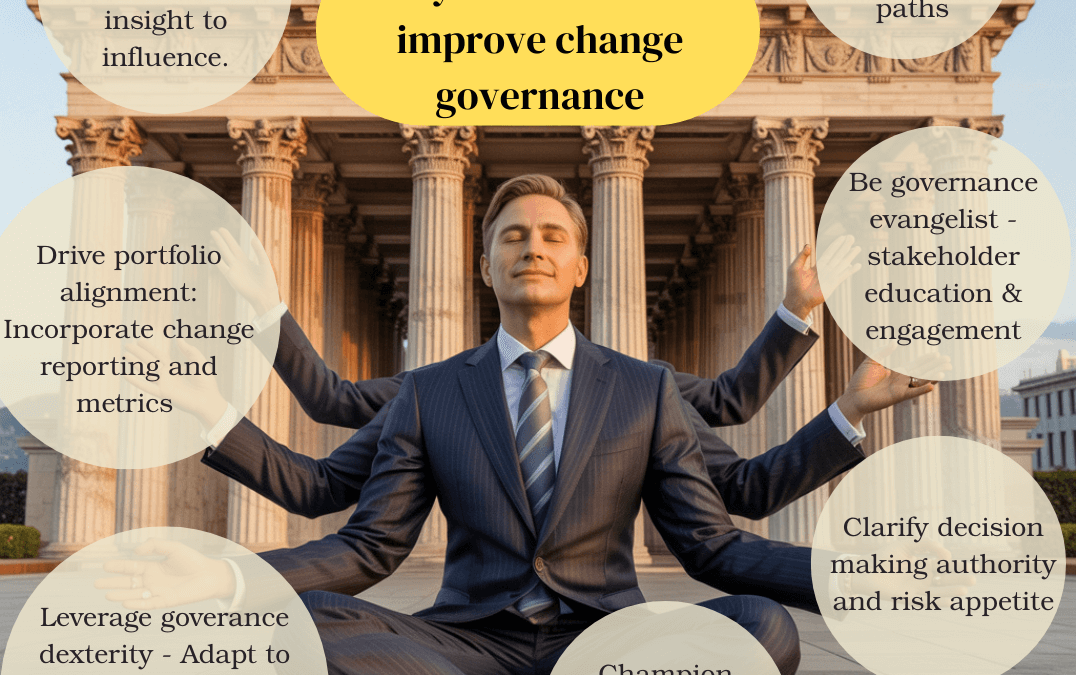
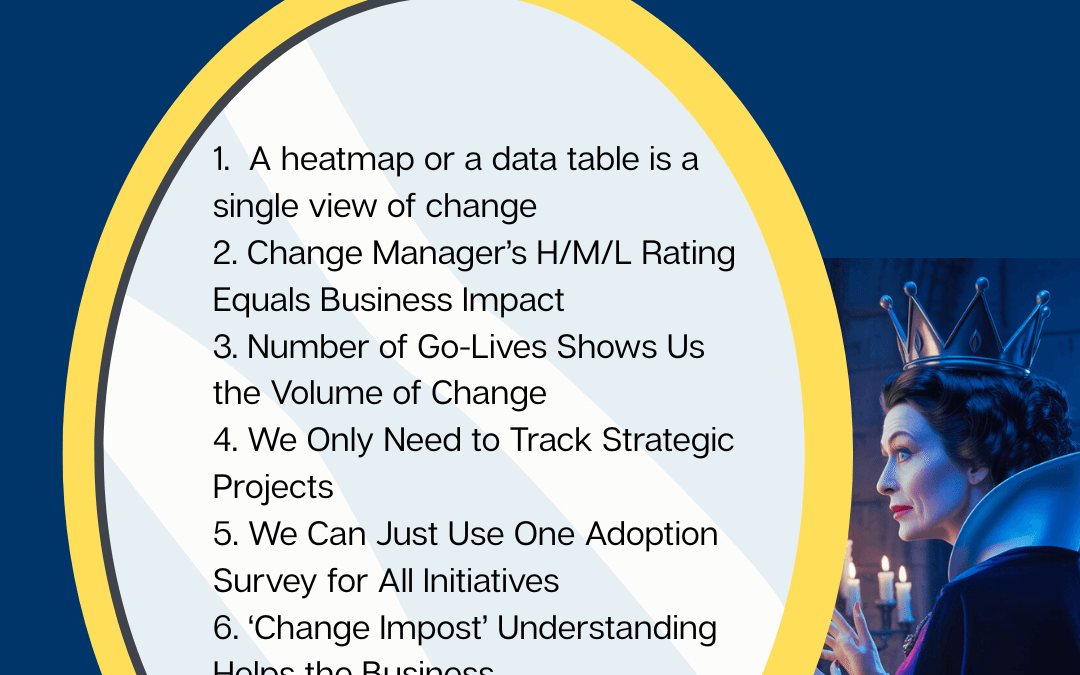
Change governance maturity varies widely across organizations – from those with established PMOs and formal governance structures to others that rely on existing operational and executive forums without formal change governance setups. Change managers must tailor their influence strategies to fit this maturity spectrum while empowering governance that supports change transformation success. Here we outline practical tips and approaches relevant whether you operate within high-maturity governance or in environments still building foundational capabilities.
1. Leverage Governance Dexterity – Adapt to Your Maturity Context
For organizations with mature PMOs and governance:
Encourage maintaining cadence with purpose – weekly flash checks for quick updates, monthly value reviews to keep benefits front of mind, and quarterly strategic moments for big-picture alignment and celebration. This reduces fatigue and keeps governance tightly connected to business outcomes.
Share frameworks that provide agility within formal governance so cadence remains flexible without diminishing control. For example, leverage agile change management principles to:
Embedding lightweight, iterative review processes that emphasize timely feedback and rapid decision-making without heavy documentation or unnecessary meetings.
Using tools like RACI matrices and decision-rights grids to clarify who has authority and responsibility, so governance can flex in how often or how deeply it engages, but never loses accountability.
Allowing governance forums to scale their activity up or down based on change program phase, risk, or complexity, rather than sticking to a rigid calendar or process.
For less mature organizations without dedicated governance forums:
Propose leveraging existing operational or executive forums to introduce lightweight governance rhythms that do not overburden people. For example, brief monthly check-ins during established leadership meetings or quarterly presentation slots to highlight change progress and risks.
Use simple tools like cadence checklists or short-status emails tailored for existing leaders who may not be change specialists. Position these rhythms as value-adds to existing meetings to gain buy-in.
Practical tips:
Offer templates for flash checks and value meetings that can be easily integrated into the existing meeting culture.
Advocate building urgency without burnout by linking cadence to visible outcomes rather than just process compliance.
2. Drive Enterprise PMO & Portfolio Alignment – Fit Your Organization’s Governance Model
For organizations with established PMOs:
Partner closely with PMO and portfolio managers to ensure change work is fully integrated. Act as a bridge between change activities and portfolio governance to align priorities effectively.
Encourage shared dashboards that combine project and change metrics, giving leadership clarity on both deliverables and adoption risks.
Advocate for change governance representation in portfolio decision forums to embed change risk and opportunities in prioritization.
For organizations without formal PMOs:
Identify operational units or executive groups with portfolio oversight responsibilities and seek informal relationships with key members.
Suggest practical ways to leverage existing governance bodies for change oversight by embedding change highlights in their agenda.
Provide simple portfolio mapping or status tools that don’t require heavy infrastructure but help visualize transformation across initiatives.
Practical tips:
Offer to co-create change input templates that non-PMO forums can use to review change risk, interdependencies and impact.
Share success stories illustrating how integrated PMO-change governance drives consistent messaging and prioritization.
3. Shape Executive Reporting – From Insight to Influence
For organizations with mature reporting processes:
Help refine executive dashboards by ensuring a balance between project status and change readiness/adoption metrics.
Coach change teams to translate data into compelling narratives that highlight risks, opportunities, and decision points.
Push for reporting formats that enable proactive governance action rather than reactive compliance.
For organizations with limited or no formal executive reporting:
Influence existing executive communications by proposing change-related content for leadership newsletters, briefings, or standing meeting updates.
Develop concise, jargon-free reports that fit into current executive reading habits and spotlight what matters most.
Advocate for simple visual reporting tools, e.g., impact bar charts or risk registers that executives can quickly interpret.
Practical tips:
Provide sample executive report templates tailored for different maturity levels.
Offer coaching sessions on storytelling with data to change teams who may be new to executive reporting.
4. Champion Scenario Planning to Build Resilience
Scenario planning is a powerful tool that helps organizations prepare for uncertainty by imagining multiple plausible futures, assessing their impact, and planning appropriate responses. For change practitioners, influencing scenario planning within change governance is critical to making transformation resilient to volatile conditions and unexpected challenges.
For organizations with mature change governance and PMO structures:
Advocate for formal inclusion of scenario planning in governance cycles, such as quarterly strategy reviews or portfolio risk assessments.
Collaborate with PMO, risk, and strategy functions to develop integrated scenario frameworks that tie external uncertainties with change delivery risks.
Use structured tools and templates to develop 2-3 distinct scenarios based on critical uncertainties impacting change programs (e.g., regulatory shifts, technology adoption rates, cost pressures, market dynamics).
Ensure scenario outputs include clear implications for adoption risk, resource allocation, and contingency triggers to inform governance decision-making.
For organizations with limited formal governance:
Promote lightweight scenario planning approaches that can fit into existing forums or leadership discussions without requiring new committees.
Facilitate workshops or brown bag sessions with key stakeholders to brainstorm “what-if” scenarios that highlight risks and opportunities in their own language.
Use simple scenario templates capturing scenario description, key assumptions, impacts, and early warning signs to keep the process manageable and relevant.
Position scenario planning as a practical alternative to reactive firefighting, reinforcing its value for anticipating and mitigating disruption to change efforts.
Practical Tips for All Maturity Levels:
Focus scenario development on a small number (2-3) of meaningful scenarios that highlight material differences rather than an exhaustive list.
Use scenario planning to identify robust strategies that perform well across multiple futures, reducing overcommitment to any single pathway.
Regularly review and update scenarios to reflect new information and organizational shifts, embedding this as a governance cadence.
Engage diverse viewpoints in scenario sessions to challenge assumptions and broaden organizational readiness.
Example Scenario Planning Framework (in brief):
Step
Action
Identify Key Drivers
Pinpoint external and internal uncertainties: economic, technological, regulatory, organizational
Develop Scenarios
Build 2-3 narrative futures exploring combinations of drivers
Analyze Impact
Assess effects on change timelines, adoption, resources
Define Responses
Create contingency plans and decision points
Monitor & Update
Track relevant indicators and review scenarios regularly
5. Clarify Decision Making Authority, and Risk Appetite – Influence Without Direct Control
One of the most frequent governance pitfalls in transformation is unclear decision rights, leading to duplicated effort or “decision limbo,” which stalls progress. Change practitioners can significantly influence clarity around decision making even when not formally leading governance forums.
For organizations with high governance maturity:
Advocate for or refine delegation charters that grant clear authority boundaries across change roles and governance tiers.
Promote use of decision-rights grids paired with RACI matrices, documenting decisions by type, level, and role to eliminate ambiguity.
Encourage articulation of organization’s risk appetite in governance policies to guide decisions on escalation and investment.
Work with governance leads to socialise these tools regularly and embed them in operational processes.
For organizations with emerging or informal governance:
Educate stakeholders about the value of explicit decision clarity through workshops or short guides.
Propose simple RACI templates tailored for key initiatives to clarify roles on responsibility, accountability, consultation, and information sharing.
Introduce a basic decision-rights grid to categorize decisions (routine operational, tactical, strategic) and assign decision tiers even if informally.
Frame this work as risk mitigation: reducing delays and confusion frees leaders to focus on strategic priorities.
Practical Tips Across Maturity Levels:
Develop easy-to-use templates and cheat sheets for RACI and decision grids to distribute widely.
Use storytelling and real case examples to illustrate consequences of unclear decision-making (e.g., project delays, duplicated efforts).
Regularly revisit and update decision frameworks as governance evolves, ensuring ongoing relevance.
Encourage governance sponsors to visibly support and enforce these clarity tools.
6. Define and Promote Clear Escalation Paths
Clear escalation paths empower teams to raise concerns timely and guide issues to the appropriate governance levels without clogging decision forums or escalating unnecessarily. Change managers can champion and embed escalation discipline through influence, education, and practical tools.
For organizations with mature governance:
Collaborate with governance teams to map all escalation routes related to change risks, decisions, and resource conflicts.
Promote communication plans ensuring every contributor understands when and how to escalate – down to roles and contact points.
Incorporate escalation workflows into governance charters, RACI matrices, and decision-rights grids to reinforce paths.
Champion periodic training or refresh sessions aligned with governance cadence to maintain escalation readiness.
For organizations with limited governance forums:
Identify natural escalation points in existing leadership or operational forums and propose embedding change escalation protocols there.
Provide clear documentation and quick-reference escalation flow diagrams for frontline teams and managers.
Coach teams and middle managers on recognizing escalation triggers and the best mode of communication to avoid bottlenecks.
Frame escalation discipline as a way to safeguard both operational pace and leadership bandwidth.
Practical Tips Usable in All Environments:
Use visual flowcharts to depict escalation paths, making them highly accessible and easy to recall.
Set guidelines on what kinds of issues require escalation vs. local resolution to reduce unnecessary escalations.
Promote handling low-level risks swiftly through informal escalation while preserving formal routes for major decisions.
Encourage transparency in escalation outcomes to build trust and learning across the organization.
7. Invest in Stakeholder Education & Engagement – Be the Governance Evangelist
The success of change governance depends as much on people’s understanding and buy-in as on structures and processes. Senior change managers have a vital role in educating stakeholders, increasing governance literacy, and fostering engagement – especially in organizations where governance maturity varies or formal forums are limited.
For organizations with mature governance:
Develop formal stakeholder education programs that provide regular training on governance roles, decision frameworks, escalation processes, and how governance aligns with transformation outcomes.
Use targeted communications that frame governance benefits in terms relevant to each stakeholder group – showing “what’s in it for them.”
Implement forums like governance clinics or Q&A sessions where stakeholders can clarify their roles, raise concerns, and share governance success stories.
Collaborate with governance sponsors to visibly champion these initiatives to prevent stakeholder fatigue and increase participation.
For organizations with emerging or informal governance:
Start small with bite-sized governance literacy sessions embedded in existing communication channels such as team meetings or newsletters – keep it jargon-free and highly practical.
Translate complex governance concepts into everyday language, storytelling, and case examples that resonate with different stakeholder groups.
Identify and coach governance champions within teams who can help cascade key messages informally.
Use tools such as quick reference guides, checklists, and simplified RACI matrices to embed governance knowledge across operational levels.
Practical Tips Across All Maturity Levels:
Conduct a stakeholder governance literacy audit to understand knowledge gaps and tailor education efforts accordingly.
Develop short governance video clips or Q&A hosted by trusted leaders explaining key governance principles and benefits.
Regularly gather feedback through surveys or informal conversations to refine education efforts ensuring they meet stakeholder needs.
Emphasize the connection between good governance practices and the successful delivery of benefits, reducing resistance and increasing advocacy.
Change governance is often viewed as a formal, top-down function but, as change managers, you are uniquely positioned to influence its design and execution regardless of your direct access to governance forums. The key lies in adapting your approaches to the maturity and structure of your organization’s governance, leveraging existing forums and networks, and focusing on clear communication, collaboration, and practical tools.
By championing governance dexterity, bridging PMO and portfolio governance gaps, shaping executive reporting, embedding scenario planning, clarifying decision rights, defining escalation paths, and investing in stakeholder education, you create a foundation where governance truly supports transformation velocity, clarity, and resilience. You also create a strategic change contribution to help the organisation reach its transformation benefit goals.
Tools & Templates for Influence and Education
Cadence Checklists: Ready-to-use templates to propose weekly flash checks, monthly value meetings, and quarterly strategic reviews tailored for different governance forums and maturity.
Sample RACI Matrix & Decision-Rights Grid: Simplified versions that can be adapted for routine and strategic decisions, supporting role clarity and authority distribution.
Escalation Flow Diagram: Visual maps suitable for team briefings and leader coaching in both formal and informal governance contexts.
Stakeholder Education Plan Outline: A scalable framework for assessing needs, designing education content, and measuring engagement impact.
Here is a paradox that plays out in large organisations with uncomfortable regularity. The more complex and frequent the change environment becomes, the more pressure falls on the enterprise change management function to deliver results. And yet, precisely when that pressure peaks, these same functions often face budget scrutiny, headcount reductions, and questions about their strategic value. They are asked to prove their worth at exactly the moment when the proof is hardest to produce.
The root cause is not a capability problem. Most enterprise change management (ECM) functions contain skilled practitioners who understand how to support change. The problem is strategic positioning. ECM has historically been framed as a support function, something you add to a project to improve its odds, rather than as a capability that operates at the enterprise level to improve the organisation’s overall capacity to change. That framing shapes what ECM functions measure, how they deploy their resources, and crucially, how business leaders perceive their value.
This article sets out what a genuine enterprise change management strategy looks like, why the most effective ECM functions are repositioning from tactical support to strategic advisory, and what the practical steps are to make that shift happen in your organisation.
The current state of enterprise change management
Most ECM functions have evolved to deliver two primary services: capability building and project resourcing. These are foundational and they matter. But they are also insufficient as the totality of an enterprise change management strategy.
Capability building and project resourcing
Capability building involves developing the organisation’s change skills over time. This typically includes training programmes for project managers and people leaders, establishing communities of practice, developing change management frameworks and toolkits, and coaching practitioners. The goal is to improve the organisation’s change capability so that each successive initiative is better managed than the last.
Project resourcing involves supplying skilled change practitioners to specific initiatives. When a major technology programme, restructure or merger needs change management support, the ECM function either deploys its own practitioners or coordinates the engagement of external consultants. This service is operationally essential in most large organisations, where the demand for change practitioners consistently outstrips the available supply.
Why these activities are necessary but not sufficient
Both capability building and project resourcing are valuable. Neither positions the ECM function as indispensable. The reason is structural: both services are episodic and project-dependent. When the project succeeds, the change management contribution is rarely isolated from the overall project success. When the project struggles, change management is often the first area to be de-scoped. And when business conditions tighten, capability building programmes are frequently the first overhead line to be cut.
Research consistently shows that projects with excellent change management are six times more likely to meet their objectives than those with poor or absent change management support. Yet this finding has not translated into secure strategic positioning for most ECM functions. The reason is that the value of change management remains largely invisible because it is embedded within projects and not independently measured.
The strategic blind spot in most enterprise change management strategy
The most significant gap in the typical ECM function is not what it does, but what it does not do. Two services in particular represent the highest-value activities available to enterprise change management functions, and most organisations are not delivering them at scale.
Enterprise change performance measurement
The first high-value service is systematic measurement of change performance across the organisation’s entire portfolio of initiatives. Not project-by-project reporting, which happens within individual programmes, but enterprise-level analytics that aggregate and interpret change data across all concurrent initiatives to surface patterns, risks and opportunities that are invisible at the project level.
This kind of measurement capability allows an ECM function to answer the questions that most matter to senior leaders:
Which business units are carrying the highest change load, and is that load sustainable?
Which change initiatives are showing the strongest adoption signals, and what is different about how they are being managed?
Where are the change bottlenecks in the organisation, not within specific projects but across the portfolio as a whole?
How is the organisation’s change capacity evolving over time, and are the current resourcing models keeping pace?
These are strategic questions. They are also questions that no individual project team can answer, because the data that would answer them sits across multiple programmes simultaneously. The ECM function is uniquely positioned to aggregate and interpret this data, but only if it has invested in the measurement infrastructure to do so.
Strategic and operational change planning
The second high-value service is genuine strategic partnership with leadership teams on change planning. This moves well beyond advising on communications plans and training design. It means being present in strategic planning conversations to model the change implications of different strategic choices, to surface capacity constraints before investments are committed, and to help leaders make realistic assessments of what the organisation can absorb and in what sequence.
According to McKinsey research on large-scale transformations, the majority of transformation failures trace back to underestimating the people and organisational dimensions of change, not the technical execution. Companies where leaders are equipped to navigate the people side of change are significantly more likely to deliver transformation outcomes. ECM functions that position themselves as strategic advisors, rather than project support resources, are better placed to prevent those failures.
What a strategic enterprise change management strategy looks like in practice
Enterprise change performance measurement at portfolio level
A strategic ECM function builds and maintains a portfolio-level view of change across the organisation. This means tracking not just which projects are in flight, but what those projects are asking of employees in terms of behaviour change, system adoption, process redesign and role adjustment. It means understanding how that demand is distributed across the organisation’s business units, teams and roles, and how it shifts over time as programmes progress.
This measurement capability enables two things that are otherwise impossible. First, it allows the ECM function to identify change saturation risks before they translate into programme failures. When a business unit is simultaneously managing a technology migration, a reporting structure change, and a new customer service protocol, the aggregate demand on its people may be unsustainable, even if each individual project’s impact assessment looks manageable. Enterprise-level data surfaces this pattern. Project-level data cannot.
Second, it allows the ECM function to build an evidence base for its own value proposition. When measurement data shows a consistent correlation between the quality of change support provided and the speed and completeness of adoption, the argument for change management investment stops being an assertion and becomes an empirical finding. That is a fundamentally different position to occupy in leadership conversations.
Strategic change planning and governance
A strategic ECM function participates in planning cycles at the enterprise level, not just the project level. This means having a seat at the table when investment decisions are made about which initiatives to prioritise, when to sequence them, and what resourcing they require. It means being able to present a portfolio view of change load and capacity, and to model the implications of different sequencing choices.
This is change governance in its most valuable form. Rather than retrospectively managing the change implications of decisions already made, the ECM function is shaping the decision-making process itself. It brings a perspective that no other function provides: an integrated view of the organisation’s change capacity and the aggregate demands that the portfolio of initiatives is placing on that capacity.
Gartner research highlights that 77% of HR leaders report employee fatigue as a significant barrier to transformation success, and 82% believe managers are not fully equipped to lead change. These are enterprise-level problems that require enterprise-level solutions. A change governance function that is embedded in strategic planning is far better positioned to address them than one that is deployed project by project.
Advisory services for senior leaders
The third component of a strategic ECM function is a genuine advisory capability for senior leaders, particularly Heads of Transformation, Chief Operating Officers, and business unit leaders who are managing significant change portfolios. This advisory service goes beyond supporting individual programmes to helping leaders understand and manage the change environment they are responsible for.
This is the kind of work that positions ECM as a strategic partner rather than a project resource. It requires the ECM function to have credible enterprise-level data, analytical capability, and the organisational standing to have direct conversations with senior leaders about difficult topics, including whether specific initiatives should proceed as planned, whether the sequencing of the portfolio makes sense, and whether the organisation’s change capacity is being systematically built or systematically eroded.
Building the business case for strategic enterprise change management
Repositioning an ECM function from tactical support to strategic advisory requires a business case, and the business case requires data. This creates a bootstrapping challenge: the very data that would prove the value of strategic ECM is often not available because the ECM function has not yet built the measurement infrastructure to collect it.
The most effective approach is to start with a narrow, high-visibility measurement initiative that demonstrates value quickly. Choose a part of the organisation, a specific business unit or a cluster of related initiatives, where you can build a comprehensive change impact picture. Use that picture to support a planning conversation with the relevant business leader. If the conversation produces a different decision, or prevents a predictable problem, you have your proof of concept.
From there, extend the measurement capability progressively, adding business units, adding dimensions, and building the analytical infrastructure that makes enterprise-level insight possible. The goal is not to build a comprehensive measurement system before you have anything to show for it. The goal is to demonstrate the strategic value of measurement incrementally, building credibility and investment case as you go.
It is also worth being explicit about the commercial case. Research from Prosci’s benchmarking studies indicates that projects meeting their objectives are significantly more likely to deliver the financial benefits underpinning the initial investment decision. When change management is well executed and benefit realisation improves, the ROI on change management investment is straightforward to demonstrate. Most ECM functions have not done this calculation explicitly. Doing so is a powerful step toward strategic repositioning.
Common obstacles and how to overcome them
The data problem
The most common obstacle is the absence of reliable, granular change impact data. Without it, the ECM function cannot produce the portfolio-level insights that would demonstrate strategic value. The solution is to invest in data infrastructure early, even if the initial data quality is imperfect. A rough, enterprise-wide picture of change load is more useful for strategic planning than a highly polished view of one or two projects.
The positioning problem
ECM functions that have operated as project support resources for years often find it difficult to be taken seriously as strategic advisors. Business leaders have a mental model of what the change team does, and it does not include portfolio-level analytics or strategic planning advice. Changing that mental model requires consistent, credible demonstrations of the value the function can provide at the enterprise level. This takes time and requires the support of an executive sponsor who understands and advocates for the strategic ECM model.
The resource constraint
With limited budgets and headcount, ECM functions often cannot do everything, and defaulting to immediate project demands is understandable. The response to this constraint is not to add more capacity before repositioning, but to actively shift the balance of activity. Every hour spent on project-specific support that could be provided by a well-equipped project sponsor or line manager is an hour not spent on enterprise-level measurement and planning. The shift requires deliberate reprioritisation, not just additional resources.
Digital tools that enable strategic enterprise change management
The practical challenge of managing enterprise-level change data, across multiple initiatives, business units and time periods, is significant. Manual approaches using spreadsheets and documents cannot scale to the complexity of a genuine portfolio-level measurement and planning function.
The Change Compass is a digital platform purpose-built for enterprise change management functions. It enables change teams to capture, aggregate and analyse change impact data across the entire portfolio, producing the enterprise-level insights that support strategic planning and governance. For Heads of Transformation and ECM leaders who want to move beyond the heat map and the project status report, it provides the analytical infrastructure to make that shift practical.
The platform supports both the measurement and the planning dimensions of strategic ECM: tracking change load and capacity across business units, monitoring adoption and readiness at the portfolio level, and producing the kind of leadership-ready analytics that shift the conversation from “are we doing enough change management on this project?” to “what does our organisation’s change capacity tell us about the right sequencing and investment for this portfolio?”
Enterprise change management strategy, done well, is not about adding more project support resources or expanding capability building programmes. It is about repositioning the ECM function as a strategic partner that provides enterprise-level insight, governance and advisory services that no other function is equipped to deliver.
That repositioning requires investment in measurement infrastructure, a clear-eyed business case built on evidence, and the organisational standing to have difficult conversations with senior leaders about capacity, sequencing and risk. It also requires patience, because the shift from tactical support to strategic advisory is not a single programme but a sustained evolution.
The organisations that get this right build something durable: an enterprise change management function that is indispensable not because it is embedded in every project, but because it provides the strategic intelligence that makes the portfolio of projects more likely to succeed. That is the function worth building.
Frequently asked questions
What is an enterprise change management strategy?
An enterprise change management strategy is a deliberate approach to building and deploying change management capability at the organisational level, rather than project by project. It includes investment in enterprise-level measurement of change performance, strategic planning and governance services for senior leaders, and advisory capability that helps organisations make better decisions about the sequencing, resourcing and design of their change portfolio.
How does enterprise change management differ from project-level change management?
Project-level change management focuses on supporting a specific initiative, ensuring that the people affected by that project are ready and willing to adopt the change. Enterprise change management operates across the entire portfolio of initiatives, providing a portfolio-level view of change load and capacity, identifying systemic risks that are invisible at the project level, and advising leadership on portfolio decisions that affect the organisation’s overall change capacity.
Why do most enterprise change management functions struggle to demonstrate strategic value?
Most ECM functions struggle because they have positioned themselves primarily as project support and capability building resources, both of which are episodic and difficult to attribute to specific outcomes. Strategic value requires an independent measurement and advisory capability that produces insights unavailable from any other function. Without that capability, ECM remains a cost centre rather than a strategic partner.
What are the highest-value services an enterprise change management function can provide?
The two highest-value services are enterprise change performance measurement, which provides portfolio-level analytics on change load, adoption and capacity, and strategic change planning and governance, which provides a seat at the table in investment and sequencing decisions. Both require a level of data and analytical capability that goes beyond what most ECM functions currently have.
How can an ECM function start repositioning itself as a strategic partner?
The most effective approach is to start with a narrow, high-visibility measurement initiative that demonstrates enterprise-level value quickly. Build a comprehensive change picture for a specific business unit or cluster of initiatives, use it to support a planning conversation with a senior leader, and demonstrate that the insight changes a decision or prevents a predictable problem. Then extend the capability progressively, building the evidence base for broader investment.
What digital tools support strategic enterprise change management?
Digital change management platforms that enable portfolio-level data capture, aggregation and analysis are central to a strategic ECM capability. They allow change teams to produce the enterprise-level insights, across multiple business units, projects and time periods simultaneously, that are impossible to generate with manual approaches. The key is choosing a platform that connects change impact data with adoption and readiness data, providing an integrated view of the organisation’s change environment.
References
Prosci. The Correlation Between Change Management and Project Success. https://www.prosci.com/blog/the-correlation-between-change-management-and-project-success
McKinsey & Company. The People Power of Transformations. https://www.mckinsey.com/capabilities/people-and-organizational-performance/our-insights/the-people-power-of-transformations
Gartner. Organisational Change Management Research and Insights. https://www.gartner.com/en/human-resources/topics/organizational-change-management
Prosci. 5 Strategic Decisions for Building Organisational Change Capability in 2026. https://www.prosci.com/blog/5-strategic-decisions-for-building-organizational-change-capability
IMPLEMENTATION NOTES
Post ID: 21541
Suggested title: Enterprise change management strategy: repositioning from tactical support to strategic powerhouse
Meta description: Learn how to build an enterprise change management strategy that moves your ECM function from tactical project support to strategic leadership partner.
The numbers tell a story that most change leaders already sense. IBM’s 2025 CEO study, surveying 2,000 executives globally, found that only around 25% of AI initiatives deliver expected ROI, and just 16% have scaled enterprise-wide. Investment in AI is accelerating at double-digit rates. The returns are not keeping pace. The gap is not technical. It is human. And it will not be closed by change management practices designed for a different era.
Change management in the digital age faces a challenge that goes beyond scale or speed. The tools, assumptions, and governance models that served change functions well through the ERP rollouts and restructures of the 2000s and 2010s were designed for discrete, definable transformations with identifiable endpoints. Digital transformation, AI adoption, and the automation of work do not have endpoints. They are ongoing conditions. Managing them as projects produces predictable results: partial adoption, underrealised value, and change fatigue that compounds with each successive initiative.
The organisations navigating digital transformation most effectively are not those with the biggest change budgets. They are those that have genuinely updated their change management model for the digital context, treating change capability itself as a strategic asset rather than a delivery function.
The digital transformation gap that change management must close
The scale of underperformance in digital transformation is well documented. Deloitte’s research on digital transformation value identifies three failure patterns that recur across industries: technology deployed without corresponding work redesign, adoption treated as a training problem rather than a behaviour change problem, and benefits realisation measured at go-live rather than at the point where new ways of working are actually embedded.
All three failure patterns are change management failures, not technology failures.
The IBM CEO data reinforces this. In 2026, twice as many workers across age groups say they would embrace greater AI use by their employers rather than resist it. Employee sentiment toward AI is broadly positive. The adoption gap is not about resistance. It is about the absence of the structural, managerial, and environmental conditions that convert positive sentiment into actual behaviour change. This is precisely the domain of change management. And precisely the area where traditional change management approaches are most underpowered.
What makes change management in the digital age different
Three structural characteristics distinguish digital transformation from the changes that traditional change management frameworks were built for.
There is no go-live
Classic change management models, whether ADKAR, Kotter’s 8 steps, or the Prosci methodology, are structured around a transition: a defined current state, a defined future state, and a change journey between them. Digital transformation does not conform to this structure. AI capabilities in use today are materially different from those available 18 months ago, and will be different again 18 months from now. The “future state” keeps moving.
This means that what organisations actually need to build is not a capacity to manage a specific digital change, but an adaptive organisational capability to absorb continuous digital evolution. That is a fundamentally different capability to develop and a fundamentally different change management challenge to address.
The impact is highly fragmented by role
A major ERP implementation affects large groups of employees in broadly similar ways: new system, new processes, new reporting lines. Digital transformation and AI adoption affect different roles in radically different ways. A finance analyst’s experience of AI adoption has almost nothing in common with a customer service representative’s. A supply chain planner and a legal counsel may both be in the same AI transformation programme but need entirely different support.
Generic change communications and enterprise-wide training programmes do not work well in this environment. Effective change management in the digital age requires function-level and role-level customisation at a depth that most change functions have not previously needed to operate at.
Middle management is both the opportunity and the obstacle
Gartner’s 2025 CHRO research found that 78% of CHROs agree workflows and roles will need to change to realise the value of AI investments. The people who must actually make those workflow and role changes happen are middle managers. They translate digital strategy into day-to-day practice. They also face the most immediate personal disruption from the changes they are asked to enable.
Change management approaches that treat managers primarily as a communication channel, rather than as a group with their own adoption challenge and their own need for specific support, consistently underperform. The manager layer is where digital transformation succeeds or stalls.
Data and measurement in the digital age
One of the defining features of digital transformation is the availability of adoption data. Most digital platforms generate detailed usage data. Organisations now have, or can have, precise information about which employees are using new systems and tools, how frequently, in what ways, and with what outcomes.
Traditional change management largely operated without this data. Communications were sent, training was attended, and surveys were occasionally administered. Whether behaviour had actually changed in meaningful ways was often a matter of judgement rather than evidence.
The digital age removes this ambiguity for organisations willing to use the data available. Key metrics that effective change functions track in digital transformation include:
Active usage rates by role group and function (not just platform access)
Time savings realised in specific processes, compared against baseline
Quality or output measures for AI-assisted work versus previous work
Support ticket and workaround patterns, which indicate where adoption is failing
Manager-reported team behaviour change, gathered through structured check-ins
The risk with digital adoption data is conflating access with adoption. A person who logs into a platform once a week is not the same as a person who has genuinely changed how they work. Effective measurement tracks the second thing, not the first.
Automation and what it means for the change management function itself
The digital age is also changing how change management work is done, not just what it is managing. Change functions are beginning to automate significant portions of the administrative and analytical work that previously consumed change practitioner time: impact assessment compilation, status reporting, communication scheduling, data aggregation across programmes.
This shift has two implications worth examining.
The first is a productivity gain. Change practitioners who are no longer spending days compiling portfolio heat maps in spreadsheets have time to do the work that requires human judgment: stakeholder conversations, resistance diagnosis, sponsor coaching, and the nuanced facilitation that data analysis cannot replace.
The second is a capability shift. The change practitioner of the digital age needs to be comfortable working with data and platforms in ways that were optional for practitioners in earlier generations. Interpreting adoption dashboards, working with automated workflow tools, and communicating findings in data-fluent ways are becoming baseline expectations rather than specialist skills.
Building a digital-age change management capability
For change leaders building or rebuilding their function’s capability for the digital context, the practical work happens in four areas.
Updating the impact methodology. Traditional impact assessment categories, such as process, role, technology, and structure, need to be extended to capture AI-specific dimensions: the degree to which a role’s core tasks are being automated or augmented, the learning curve associated with AI-enabled ways of working, and the interaction effects when multiple digital changes land simultaneously on the same employee group.
Investing in role-level differentiation. The days of enterprise-wide change communications being the primary engagement mechanism are over for major digital transformations. Effective change functions in the digital age develop function-specific change plans, with tailored messaging, use-case-specific training, and peer champion networks built around specific communities of practice rather than the whole organisation.
Building adaptive governance. Digital transformation moves faster than traditional programme governance. Change plans written at programme initiation will be outdated within months as capabilities evolve and adoption data comes in. The governance model needs to support continuous plan adaptation: regular portfolio reviews, rolling 90-day action planning, and the authority to reallocate resources based on adoption evidence rather than original project plans.
Using digital platforms for portfolio visibility. Managing the cumulative digital change burden on employee groups requires portfolio-level visibility that manual approaches cannot reliably provide. Platforms such as The Change Compass aggregate impact data across programmes, track adoption by function and role group, and enable the continuous monitoring that adaptive change governance requires. This is not a luxury for large change functions. It is the infrastructure that makes portfolio-level decision-making possible.
Where to start
For change leaders whose organisations are in the middle of active digital transformation programmes with traditional change management in place, the most useful first step is a diagnostic of the current approach against the digital age requirements.
The diagnostic questions are practical:
Are you measuring actual behaviour change or platform access?
Do you have function-specific change plans, or enterprise-wide plans applied uniformly?
How are you managing the cumulative digital change load on specific employee groups?
What is your process for adapting the change approach as adoption data comes in?
Are your managers being supported as a group with their own adoption challenge, or managed primarily as a change communication channel?
Most change functions running traditional approaches through digital programmes will find significant gaps in these areas. The gap that typically generates the fastest improvement when closed is measurement: moving from activity metrics to adoption metrics creates the feedback loop that enables everything else to improve.
Frequently asked questions
What is change management in the digital age?
Change management in the digital age refers to applying change management principles and practices to the specific challenges of digital transformation, AI adoption, and the automation of work. It extends traditional change management to address the absence of a fixed endpoint, the highly fragmented role-level impact of digital change, and the availability of adoption data that enables evidence-based course correction throughout the change journey.
Why do digital transformation programmes fail to deliver expected value?
The primary causes are change-related, not technical. Workflows are not redesigned to take advantage of new digital capabilities, middle managers are not supported as a group with their own adoption challenge, measurement focuses on system access rather than behaviour change, and change plans are not adapted as adoption evidence accumulates. IBM research found that only around 25% of AI initiatives deliver expected ROI, largely for these reasons.
How is digital transformation different from managing a standard technology change?
Digital transformation differs in three important ways: there is no defined future state because digital capabilities evolve continuously; the impact on different roles is highly fragmented, requiring function-level rather than enterprise-wide approaches; and the adoption data available through digital platforms enables a measurement-led approach that traditional change management rarely applied.
What metrics should you track in digital transformation change management?
The most informative metrics go beyond platform access to measure actual behaviour change: active usage rates by role group, time savings realised in specific processes, quality of AI-assisted output versus previous output, support ticket patterns indicating where adoption is failing, and manager-reported team behaviour change. These give a more honest picture of adoption progress than usage statistics alone.
How do you manage the cumulative digital change load on employees?
Managing cumulative load requires portfolio visibility: knowing what digital changes are landing on which employee groups at what time, and aggregating impact to identify when load is approaching the point where adoption quality begins to deteriorate. Portfolio change management platforms enable this aggregation and provide the early warning signals that allow sequencing adjustments before saturation becomes visible in adoption data.
References
IBM. CEO Study: CEOs Double Down on AI While Navigating Enterprise Hurdles (2025). https://newsroom.ibm.com/2025-05-06-ibm-study-ceos-double-down-on-ai-while-navigating-enterprise-hurdles
IBM Institute for Business Value. 5 Trends for 2026. https://www.ibm.com/downloads/documents/us-en/1443d5df79cf4c92
Deloitte Insights. Unleashing Value from Digital Transformation: Paths and Pitfalls. https://www.deloitte.com/us/en/insights/topics/digital-transformation/digital-transformation-value-roi.html
Gartner. Gartner Says CHROs’ Top Priorities for 2026 Center Around Realising AI Value and Driving Performance (October 2025). https://www.gartner.com/en/newsroom/press-releases/2025-10-02-gartner-says-chros-top-priorities-for-2026-center-around-realizing-ai-value-and-driving-performance-amid-uncertainty
AIHR. 15 Important Change Management Metrics To Track in 2026. https://www.aihr.com/blog/change-management-metrics/
Ask a senior leader whether they have adequate sponsorship for each of their change programmes, and most will say yes. Ask them how much cumulative change load their front-line teams are carrying across the full portfolio right now, and very few can answer. This gap, between confidence at the programme level and blindness at the portfolio level, is one of the most consistent and consequential failure patterns in enterprise transformation.
Change portfolio literacy is the ability to read, interpret, and act on a portfolio-level view of organisational change: what is changing, for whom, at what pace, and with what cumulative effect on the people being asked to absorb it all. In most organisations, this literacy is concentrated in change functions, if it exists at all. Senior leaders, the people with the authority to make the sequencing, resourcing, and prioritisation decisions that actually determine portfolio outcomes, typically lack it.
Closing this gap does not require turning executives into change managers. It requires giving them the information and the language to ask different questions of their change portfolios, and to act on the answers.
Why executives default to programme-level thinking
The governance structures that senior leaders use to oversee change are almost universally designed around individual programmes. Investment committees evaluate programmes. Executive sponsors are assigned to programmes. Status reporting comes from programmes. RAG dashboards present programme-level health. The system trains leaders to ask programme-level questions: Is this initiative on track? Is the business case holding? Are the milestones being met?
These are legitimate questions. The problem is that they are the wrong level of analysis for understanding whether organisational change is actually being managed well.
Prosci’s 12th edition Best Practices in Change Management study found that 52% of executive sponsors do not have an adequate understanding of their role in change. More revealing is what they are not being asked to do. Sponsor briefings cover individual initiative progress. They rarely cover cumulative load, portfolio interaction effects, or how a specific programme’s timeline is affecting the absorption capacity of the teams it targets.
This is a literacy problem, not an engagement problem. Most senior leaders are genuinely committed to sponsoring their change programmes. They are simply not equipped to see, or therefore to manage, the portfolio-level dynamics that determine whether the aggregate of those programmes succeeds.
What change portfolio literacy looks like in practice
A change-literate senior leader can engage meaningfully with four categories of information that portfolio-illiterate leaders typically cannot.
Cumulative impact by employee group
The most important thing a senior leader needs to understand about their change portfolio is not what each programme is doing, but how much aggregate change is landing on specific employee groups and when. A front-line operations team handling a systems migration, a restructure, and two new process changes simultaneously is in a materially different position from a team handling one of those changes in isolation. The risks to adoption, productivity, and retention are different. The support investment required is different.
Change-literate executives understand this. They can read a cumulative impact view by business unit or role group, recognise when load is elevated, and ask the right questions about whether the current portfolio plan is creating avoidable saturation risk.
Adoption evidence, not delivery evidence
Delivery reporting, milestones hit, go-lives completed, budgets on track, tells leaders that work is being done. It does not tell them whether change is actually occurring. A programme can be on time, on budget, and fully compliant with its governance requirements, while adoption in the target group is running at 40% of plan.
Change-literate executives insist on seeing adoption data alongside delivery data. They understand that a portfolio where every programme is green from a delivery perspective can simultaneously be in serious trouble from a change perspective, if adoption is consistently underperforming across multiple initiatives.
Change load relative to absorptive capacity
Every employee group has a finite capacity to absorb change over a given period. That capacity is shaped by prior change history, current baseline workload, the quality of management support, and the degree to which prior changes have genuinely embedded. When demand exceeds capacity, adoption quality degrades across the board.
Change-literate executives can engage with the concept of absorptive capacity and understand when their portfolio plan is structurally likely to exceed it for specific groups. This understanding changes how they approach sequencing decisions. Instead of defaulting to the programme that has the most political momentum or the most urgent business driver, they can weigh the organisational cost of proceeding on the current timeline against the cost of adjustment.
Portfolio governance authority
Effective change portfolio management requires a governance body that can make cross-programme decisions: delay a go-live, consolidate two programmes with overlapping target groups, redirect resource from a low-priority initiative to a high-saturation-risk group. Individual programme sponsors cannot make these decisions, because each has a rational incentive to advocate for their programme’s priority.
Gartner’s research indicates that by 2026, 30% of organisations will have invested in the talent and tools needed for strategic portfolio management. Change-literate senior leaders understand that this portfolio governance body needs to exist, what authority it requires, and why it cannot be replaced by bilateral conversations between programme sponsors.
The language executives need to understand
Building change portfolio literacy is partly a matter of vocabulary. Executives who can use these terms precisely are better equipped to ask useful questions of their change functions.
Change load refers to the aggregate demand that active and planned change initiatives place on a specific employee group over a defined period. High load is not inherently bad. Load that exceeds absorptive capacity is the problem.
Change saturation is the condition that occurs when cumulative load has depleted an employee group’s capacity to engage with change meaningfully. Saturated groups show characteristic patterns: disproportionate resistance to new initiatives, declining engagement scores, elevated support demand after go-live, and adoption curves that plateau well below target.
Change collision occurs when two or more initiatives demand significant behavioural change from the same group simultaneously, without coordination of timing or support. Collision reduces adoption outcomes for both initiatives and is almost entirely preventable with adequate portfolio visibility.
Absorptive capacity is a group’s ability to take on and embed new changes given their current and recent change history. It is not a fixed attribute. It is shaped by management quality, support availability, and the embedding status of prior changes.
Portfolio sequencing is the deliberate ordering and timing of change initiatives across the portfolio to minimise collision, respect absorptive capacity, and prioritise strategically important changes when load is high.
Building change portfolio literacy in your senior team
The most effective approach to building executive change portfolio literacy is showing, not telling. Most senior leaders do not become change-literate through briefings or methodology overviews. They become change-literate through repeated exposure to portfolio-level data and the decision-making conversations it enables.
The practical steps that change functions have found most effective include:
Starting with a portfolio view presentation. The first exposure to a cumulative impact map, showing load by business unit across the next two quarters, typically generates immediate questions from executives who have never seen change represented this way. The visual is more effective than any explanation. Use it to introduce vocabulary and invite questions rather than present conclusions.
Integrating portfolio data into existing governance forums. The most sustainable path to change portfolio literacy is connecting it to forums that already have authority: transformation steering committees, executive leadership team meetings, and business unit leadership reviews. A dedicated change forum that sits outside the existing governance structure will struggle to influence sequencing and resourcing decisions.
Framing in the language executives use. Change functions that speak the language of adoption rates, impact dimensions, and change saturation scores when executives are thinking in terms of revenue risk, talent retention, and business case delivery lose the room. The translation layer is the change leader’s job: “this programme’s go-live creates a 12-week window where our customer operations team carries a load equivalent to three major initiatives, based on what we know about their prior absorption rate.”
Making sponsor coaching a regular practice.Prosci’s research consistently finds that active and visible executive sponsorship increases change success rates by up to six times. But sponsorship quality depends on sponsor understanding. Regular, structured coaching conversations with programme sponsors, covering not just their individual programme but the portfolio context their programme sits within, is one of the highest-return investments a change function can make.
What good looks like: the change-literate leadership team
In organisations where change portfolio literacy is genuinely embedded at the senior level, the conversations in governance forums are qualitatively different. Rather than programme-by-programme status reviews, leadership teams engage with portfolio-level questions:
Which employee groups are carrying the highest cumulative load over the next quarter, and is the planned timeline for the new system programme going to push them into saturation risk?
Are our adoption rates across the portfolio consistent with our transformation ambitions, or are we systematically leaving value on the table by treating change management as a delivery function?
What would we need to do differently in the next six months to build absorptive capacity in our most change-impacted groups, rather than continuing to deploy at the current pace?
These are the questions that change-literate leaders ask. They are also the questions that drive the resourcing, sequencing, and investment decisions that determine whether an enterprise transformation programme delivers its intended value.
Developing the digital infrastructure to support these conversations, through portfolio platforms that aggregate impact data, track adoption across programmes, and generate the portfolio views that executive conversations require, is a practical prerequisite. Tools such as The Change Compass are built specifically for this purpose: providing the portfolio visibility that makes change portfolio literacy actionable rather than aspirational.
Where to start
Building change portfolio literacy in a senior team takes time, but the first step is quick. Prepare a single portfolio view: all active and planned change initiatives, mapped against the employee groups they affect, with a simple cumulative load indicator for the next 90 days.
Present it at a senior forum where decisions about transformation investment and sequencing are made. Do not frame it as a change management presentation. Frame it as a risk and capacity picture for the organisation’s transformation programme. The questions it generates will do more to build change portfolio literacy in 20 minutes than any amount of methodology briefing.
From there, the task is to make this view a regular feature of the governance conversation, not a one-off analysis. Literacy builds through repeated engagement with data and the decisions it informs.
Frequently asked questions
What is change portfolio literacy?
Change portfolio literacy is the ability of senior leaders to read and act on a portfolio-level view of organisational change: understanding cumulative change load by employee group, interpreting adoption evidence across multiple programmes, recognising change collision and saturation risk, and making portfolio-level sequencing and resourcing decisions that reflect these dynamics.
Why do senior leaders struggle with change portfolio management?
The governance structures most organisations use for managing change are designed around individual programmes, not portfolios. Status reporting, sponsorship briefings, and investment decisions all happen at the programme level. This structure trains senior leaders to ask programme-level questions and leaves them without the visibility to engage with portfolio-level dynamics, even when they are the primary driver of adoption outcomes.
How is executive sponsorship different from change portfolio literacy?
Executive sponsorship is the active, visible support a senior leader provides to a specific change initiative. Change portfolio literacy operates above this level. It is the ability to understand the collective effect of all change initiatives across the portfolio, and to make cross-programme decisions that optimise overall adoption outcomes rather than individual programme outcomes. Both are necessary for effective enterprise change management.
What data does a change portfolio view need?
At minimum: a list of all active and planned change initiatives, the employee groups affected by each, the intensity and duration of impact, and the current adoption or readiness status. Aggregated across programmes, this data produces the cumulative load view by employee group that is the foundation of portfolio-level decision-making.
How do you develop change portfolio literacy in a senior team?
The most effective approach is repeated exposure to portfolio-level data in governance forums where decisions are made. Starting with a single portfolio view presentation, integrating change data into existing leadership forums, and making sponsor coaching a regular practice are the three interventions that change functions consistently find most effective for building executive change literacy over time.
References
Prosci. Best Practices in Change Management, 12th Edition, Executive Summary. https://empower.prosci.com/best-practices-change-management-executive-summary
Prosci. 5 Strategic Decisions for Building Organizational Change Capability in 2026. https://www.prosci.com/blog/5-strategic-decisions-for-building-organizational-change-capability
Gartner. Top Trends for Program and Portfolio Management Leaders for 2025. https://www.gartner.com/en/documents/6533602
Smartsheet. 2025 Project and Portfolio Management Priorities Report. https://www.smartsheet.com/content-center/inside-smartsheet/research/2025-ppm-priorities-report-key-takeaways
Managing multiple changes simultaneously is not an edge case in enterprise transformation. It is the norm. Most large organisations are running ten, twenty, or more concurrent change initiatives at any point in time. The assumptions that change practitioners rely on to manage this complexity have largely been inherited from single-initiative change management and applied wholesale to the portfolio context. Many of them are wrong.
This matters because wrong assumptions about managing multiple changes lead to specific, predictable, and expensive failures: adoption rates that fall short of targets, employee fatigue that accumulates into resistance, and programme sequencing decisions that look reasonable in isolation but create unnecessary risk in aggregate. Gartner’s research on change adoption found that only 32% of business leaders report achieving healthy change adoption by employees. The gap between change investment and change outcomes is real and persistent.
Working through seven assumptions that are widespread in change management practice, and what the evidence actually shows, offers a clearer picture of where portfolio-level management typically breaks down.
Assumption 1: If each programme is managed well, the portfolio will be managed well
This is the foundational assumption of most enterprise change management: that quality at the programme level aggregates into quality at the portfolio level. It is comforting because it is consistent with how resourcing models work: staff each programme with capable change managers, and the organisation’s change burden is handled.
The evidence suggests otherwise. A programme can have excellent communication, well-designed training, rigorous stakeholder engagement, and still fail to achieve target adoption if it lands in a quarter when the relevant employee group is simultaneously absorbing two other significant changes. The failure is not programme-level. It is portfolio-level. And it is invisible to a resourcing model that assigns one change manager per programme.
The assumption treats change capacity as infinite. Smartsheet’s 2025 Project and Portfolio Management Priorities Report found that 92% of PPM professionals struggle to adapt to workplace changes, and 71% say constant workplace shifts make it difficult to stay productive. Employee capacity to absorb change is finite and varies by group and by history. Portfolio management of change requires treating it as such.
Assumption 2: Change saturation is visible
Most change managers who have worked in large organisations have seen change saturation: the glazed look when a new initiative is announced, the rising resistance that seems disproportionate to the scale of the change, the help desk calls that stay high long after go-live. The assumption is that saturation is detectable when it occurs, and that practitioners will notice it in time to respond.
The problem is that saturation often builds slowly, through the accumulation of changes none of which individually seems overwhelming. By the time the symptoms are visible, the capacity depletion has already occurred and the immediate change is already in trouble.
Managing multiple changes effectively requires measuring cumulative load before saturation becomes visible. This means tracking what is landing on specific employee groups across the full portfolio, quantifying the aggregate impact, and identifying when load is approaching or exceeding historical absorption capacity. This cannot be done by observing individual programmes in isolation. It requires portfolio-level data.
Assumption 3: Communications from different programmes can be managed separately
In organisations running multiple concurrent programmes, each programme typically has its own communications plan, its own channels, and its own messaging cadence. The assumption is that employees can contextualise each communication separately and engage with it on its own terms.
In practice, employees receive communications from multiple change initiatives, often in the same week or the same day. The communications compete for attention. Employees develop filters, often unconsciously, that route change communications directly to low-priority status. The most sophisticated change communication strategy for any individual programme has to work within this noise environment.
Effective management of multiple changes requires cross-programme communication coordination: understanding what employees in specific groups are receiving from all programmes simultaneously, and designing communications that acknowledge the full change context rather than pretending each change exists in isolation. An employee who has received three change communications this week does not need a fourth that opens with “we are excited to announce.” They need a communication that is specific, brief, and gives them exactly what they need to act.
Assumption 4: Training is the primary adoption lever
The allocation of change budget in most programmes is disproportionately weighted toward training design and delivery. This reflects an implicit assumption that knowledge is the primary barrier to adoption: if employees understand the new system or process, they will use it.
Knowledge is necessary but not sufficient. The research on adoption failure consistently finds that employees who have completed training and understand the new way of working often do not adopt it. The barriers are motivational, structural, and environmental, not informational. They include:
Performance frameworks that still measure old behaviours
Line managers who are themselves uncertain about the change and cannot credibly reinforce it
Peer norms that make the old way of working the default
Practical friction in the new process that makes old habits easier
When managing multiple changes, this assumption is compounded because training resources are frequently the binding constraint. Programmes compete for training developer time, LMS bandwidth, and employee training hours. If training is over-weighted as an adoption lever, the resource allocation is wrong in two ways: too much investment in content development, and not enough in manager enablement, environment redesign, and performance alignment.
Assumption 5: Resistance means the change is wrong
When a change encounters significant resistance, the instinctive response is to investigate what is wrong with the change: Is the design flawed? Is the business case unclear? Are sponsors not visible enough? These are legitimate questions. But in a portfolio context, resistance is frequently not a signal about the specific change. It is a signal about cumulative load.
A team that has been through three restructures and two major system implementations in 18 months may resist a relatively modest change with intensity that is disproportionate to the change’s actual impact on their work. The resistance is real and needs to be addressed, but diagnosing it as a problem specific to the current programme leads to misguided responses: more communication, more engagement sessions, more executive visibility. What the team may actually need is a genuine pause in change load, or meaningful acknowledgement of the cumulative burden they have been carrying.
This distinction matters for how change managers advise programme sponsors. When resistance patterns look inconsistent with the scale of the change, the right question is: what is the change history for this group, and what is the current portfolio load they are carrying?
Assumption 6: The sponsor of each programme is the right governance mechanism
In single-programme change management, executive sponsorship is consistently identified as one of the strongest predictors of change success. The programme sponsor provides visibility, resources, decision-making authority, and legitimacy for the change effort.
In a portfolio context, individual programme sponsorship is necessary but not sufficient. Each programme has a sponsor who is rationally motivated to advocate for their programme’s priority. The result is a governance dynamic where each sponsor argues for their programme to go first, receive the most resource, and face the fewest constraints on timeline. Without a portfolio governance mechanism that can make cross-programme trade-offs, these competing claims default to whoever has the most political capital. This is not portfolio management; it is portfolio politics.
Effective management of multiple changes requires a governance structure that sits above the individual programme sponsor level and has the authority to make sequencing and resource allocation decisions that may disadvantage individual programmes in service of better portfolio outcomes. This structure is often a change portfolio board or a change steering committee with cross-programme scope.
Assumption 7: Progress reporting from multiple programmes gives a complete picture
Most organisations aggregate progress reporting from individual programmes into a portfolio status report: traffic lights, milestone tracking, issue logs. This gives a picture of delivery status. What it does not give is a picture of adoption status across the portfolio, cumulative change load by employee group, or the interaction effects between programmes.
A portfolio where every programme is green from a delivery perspective can still be in serious trouble from a change management perspective, if multiple programmes are delivering simultaneously to the same groups, if adoption rates across programmes are uniformly low, or if change fatigue signals are accumulating in the engagement data.
The Change Compass is designed specifically to provide the portfolio-level view that standard project reporting cannot: cumulative impact by business unit and role group, adoption trend lines across multiple initiatives, and early warning signals when load or adoption patterns indicate portfolio risk. The shift from delivery reporting to adoption intelligence is the most significant operational change in how effective change portfolio management differs from traditional programme reporting.
What managing multiple changes well actually looks like
Effective management of multiple changes is defined less by any single practice and more by a shift in orientation: from programme-centric to portfolio-centric. It asks different questions.
Not “is this programme on track?” but “what is the cumulative change load on the groups this programme targets, and how does this programme’s go-live affect their absorption capacity?”
Not “why is this group resistant?” but “what is the change history and current portfolio load for this group, and is the resistance a programme signal or a portfolio signal?”
Not “how do we communicate this change effectively?” but “how does our communication for this programme fit into the total communications these employees are receiving from all sources this month?”
These questions require portfolio visibility. They cannot be answered with programme-level data. And the answers they generate drive meaningfully better decisions about sequencing, timing, resourcing, and intervention design.
Building that portfolio visibility, through consistent impact methodology, aggregated data across programmes, and regular portfolio governance, is the single most valuable investment that enterprise change functions can make in improving their outcomes from managing multiple changes.
Frequently asked questions
Why is managing multiple changes harder than managing individual changes?
Managing multiple simultaneous changes introduces portfolio-level problems that do not exist at the programme level: change collision (multiple demands landing simultaneously on the same groups), change saturation (cumulative load depleting absorption capacity over time), and cross-programme communication noise. Each of these requires portfolio-level management, not just better single-programme execution.
What is change collision?
Change collision occurs when two or more initiatives simultaneously require significant behavioural or process changes from the same employee group, without coordination of timing or support. The demands compete for attention, reinforce each other’s resistance, and result in lower adoption for both initiatives than would have been achieved if they had been sequenced or staggered.
How do you measure the change load on an employee group?
Change load is measured by aggregating the impact assessments from all active initiatives affecting a specific employee group. This requires a consistent impact taxonomy across programmes so that impact severity can be summed and compared meaningfully. High-load groups are those where the cumulative impact score exceeds historical absorption benchmarks for similar periods of change.
What is the right governance structure for managing multiple changes?
Effective governance requires a cross-programme body, typically a change portfolio board or steering committee, with authority to make sequencing and resource allocation decisions across the portfolio. Individual programme sponsors should sit below this level for portfolio decisions. The portfolio body needs consistent data on cumulative load, adoption status, and portfolio risks to make informed decisions.
How should I prioritise changes in a portfolio?
Prioritisation should be based on three factors: strategic importance (which changes are most critical to the organisation’s strategy), adoption readiness (which employee groups have the capacity and readiness to absorb which changes at this time), and interaction effects (which sequencing minimises collision between high-impact initiatives). Data from a portfolio management platform enables all three factors to be assessed systematically rather than through negotiation alone.
What tools help with managing multiple changes?
Portfolio change management platforms such as The Change Compass aggregate impact data across programmes, visualise cumulative load by business unit and role group, and enable the portfolio governance conversations that managing multiple changes well requires. Without this kind of tooling, portfolio management at scale defaults to manual aggregation and informal coordination, neither of which is reliable at the complexity levels most large organisations face.
References
Gartner. Gartner HR Research Finds Just 32% of Business Leaders Report Achieving Healthy Change Adoption by Employees (2025). https://www.gartner.com/en/newsroom/press-releases/2025-07-08-gartner-hr-research-finds-just-32-percent-of-business-leaders-report-achieving-healthy-change-adoption-by-employees
Smartsheet. 2025 Project and Portfolio Management Priorities Report: Teams Are Fatigued, and Executives Need to Pay Attention. https://www.smartsheet.com/content-center/inside-smartsheet/research/2025-ppm-priorities-report-key-takeaways
WTW. Future-Proofing Work: Key Drivers and Strategies for Work Transformation (2024). https://www.wtwco.com/en-us/insights/2024/09/future-proofing-work-key-drivers-and-strategies-for-work-transformation
Prosci. The Correlation Between Change Management and Project Success. https://www.prosci.com/blog/the-correlation-between-change-management-and-project-success