Change heatmaps have become the default visualisation tool for organisations trying to understand the scale of transformation activity hitting their workforce. They are useful – they make the volume of concurrent change visible in a way that project lists and programme registers do not. But they represent only one dimension of a more complex picture. Organisations that manage change using heatmaps alone are navigating with an incomplete instrument panel, and the dimensions they are missing are among the most consequential for predicting change outcomes and managing employee wellbeing through periods of intense transformation.
The pace of change is a distinct concept from the volume of change, and conflating them leads to systematic miscalculations in how change portfolios are managed. A single major change sustained over two years imposes a very different kind of demand on employees than twelve months of rapid, sequential changes even if the cumulative disruption is equivalent. Similarly, a surge of changes concentrated in a single quarter creates a different organisational stress pattern than the same number of changes spread across eighteen months. Understanding pace – not just volume – is what separates organisations that manage change as a strategic capability from those that merely count it.
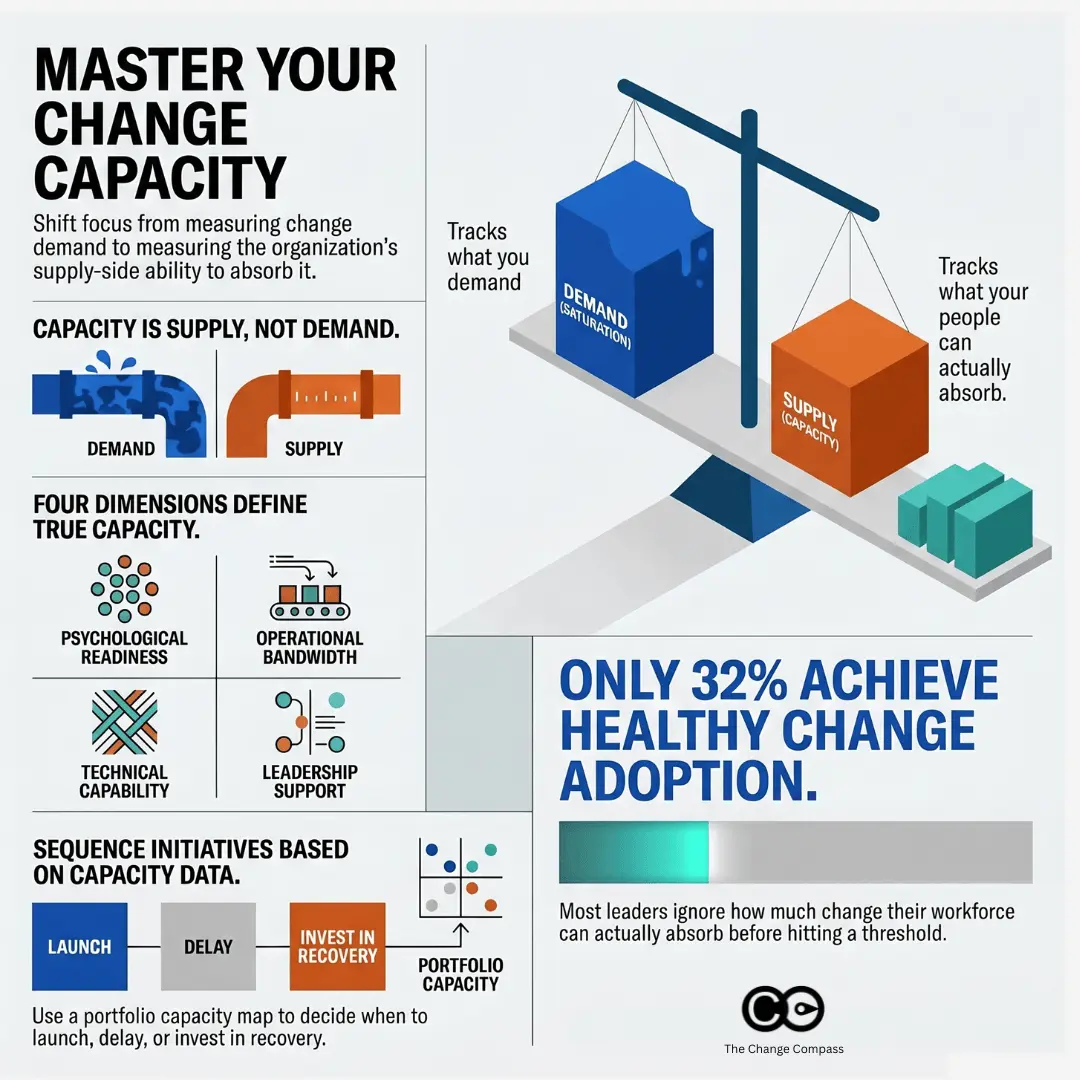
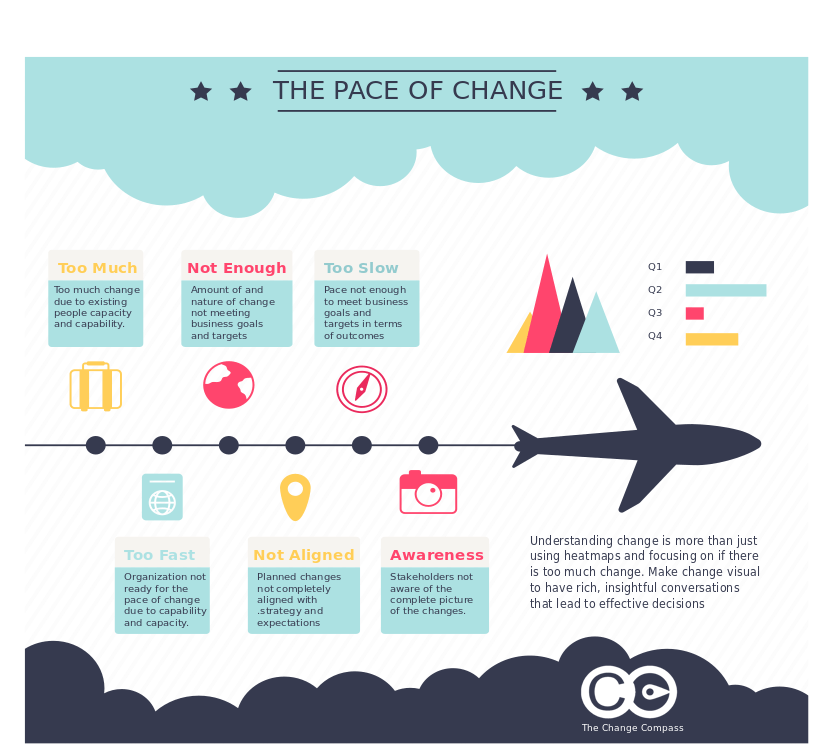
Download the Understanding the Pace of Change infographic for a visual summary of the key concepts explored in this article.
What pace of change actually means
Pace of change refers to the rate at which change demands are introduced to a given group of employees over a defined period of time. It encompasses both the frequency of new changes being initiated and the velocity at which those changes require employees to shift from their current way of working. High pace does not necessarily mean high volume in aggregate – it means that the interval between significant change demands is short, leaving employees insufficient time to stabilise in a new state before the next wave of change arrives.
This distinction matters because the human psychology of adaptation is fundamentally a sequential process. When a person adopts a new way of working – learns a new system, internalises a new process, builds capability in a new skill – they go through a predictable arc from initial disruption through experimentation, competence building, and eventual proficiency. This arc takes time, and it cannot be substantially compressed regardless of how well the change is designed or communicated. Introducing a new significant change before this arc is complete does not simply add to the load – it interrupts the adaptation process itself, resetting the person’s progress and compounding the psychological cost of the transition.
Prosci’s ADKAR model describes the individual change journey across five dimensions: awareness, desire, knowledge, ability, and reinforcement. The reinforcement phase – embedding the new behaviour until it becomes the default – is the one most frequently truncated by high pace of change. When a new change is introduced before reinforcement of the previous one is complete, the organisation is effectively asking employees to build on an unstable foundation. The result is not just slow adoption of the new change. It is regression in the previous one.
Why heatmaps alone are insufficient
Change heatmaps typically visualise which teams or roles are affected by which programmes at which points in time. They answer the question of coverage: who is touched by change, and when. What they typically do not answer is the question of pace: how rapidly are change demands arriving for specific employee groups, and how much stabilisation time is available between them?
The limitation becomes acute when a heatmap shows that a team is affected by multiple programmes across a twelve-month period. The heatmap may show this as a continuous band of change impact – useful for identifying overall load – but it does not distinguish between a pattern where changes are sequenced with meaningful recovery time between them and a pattern where changes are simultaneous or closely stacked. These two patterns impose very different demands on employees, and they require very different management responses. The first is manageable with strong communication and targeted support. The second creates the conditions for change fatigue regardless of how well any individual change is managed.
A related limitation of heatmaps is their tendency to treat all change impacts as equivalent in terms of the adaptation effort they require. A process change that affects how an employee fills in a form is captured the same way as an organisational restructure that changes their reporting line, their team composition, and the fundamental nature of their role. Effective pace measurement needs to account for the depth of change – the degree of behavioural shift required – not just its presence or absence.
The organisational consequences of unsustainable pace
When the pace of change consistently exceeds employees’ adaptive capacity, the consequences are well documented and significant. The most visible is change fatigue – a state of exhaustion, cynicism, and disengagement that develops when employees are asked to sustain high levels of change-related effort over extended periods without adequate recovery time. Change fatigue is not simply tiredness. It is a fundamental reduction in an individual’s willingness and ability to engage with further change, even changes they might otherwise have supported.
Gartner research on change fatigue found that employees experiencing high fatigue are significantly more likely to consider leaving the organisation and substantially less likely to adopt changes successfully. The performance implications extend beyond individual wellbeing: teams in a state of change fatigue show reduced productivity, increased error rates, higher absenteeism, and degraded customer outcomes during peak change periods. These costs are almost never attributed to the pace of change in standard business reporting, because organisations lack the measurement frameworks to make the causal connection.
The consequence at the portfolio level is equally significant. When change programmes are sequenced without regard to pace, the organisation effectively subsidises its most ambitious change initiatives with the adaptive capacity of its employees – a resource that is finite and that does not regenerate quickly once depleted. Senior leaders who approve programme portfolios without visibility into the pace implications for specific employee groups are making resource allocation decisions with an incomplete picture of what those decisions cost.
Measuring pace: what good looks like
Effective pace measurement requires data that goes beyond the change calendar. It needs to capture the intensity of impact by employee group across time, not just the presence or absence of change. This means collecting structured information about each change programme’s impacts on specific roles and teams – the nature of the change, its depth, the degree of behavioural shift required, and the timeline over which those shifts are expected to occur. This data, aggregated across the portfolio, allows organisations to construct a picture of change pace that heatmaps alone cannot provide.
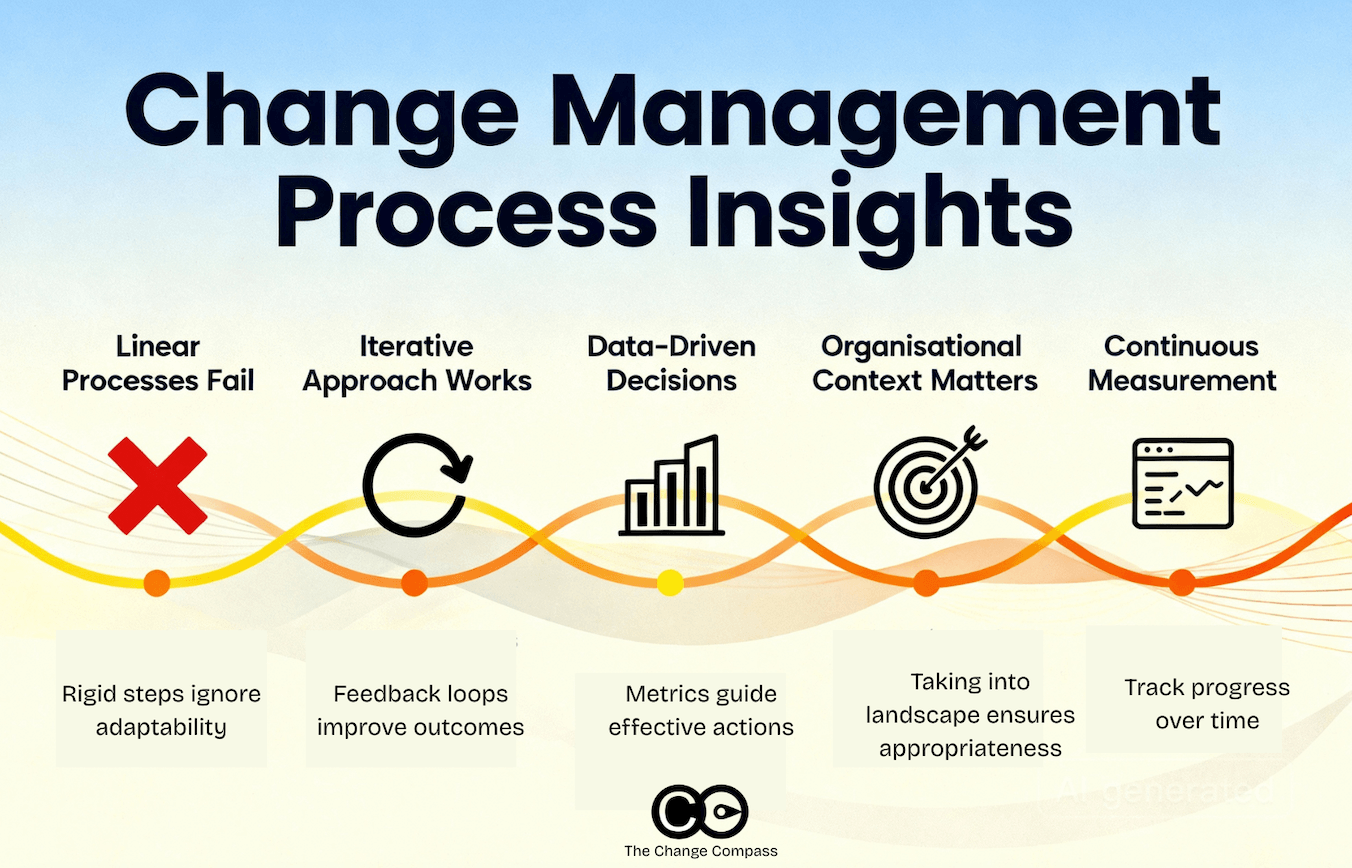
Several dimensions are useful in assessing pace. The first is interval analysis: how much time exists between significant change demands on a given employee group, and is that interval sufficient for stabilisation? Research from organisational psychology suggests that meaningful stabilisation – the point at which employees have returned to baseline productivity in the previous change – typically requires between three and six months following a major change, depending on its depth and the support provided. Portfolios that do not build these stabilisation windows into their sequencing are likely to generate compounding adaptation costs.
The second dimension is depth weighting: treating impacts that require significant behavioural shift as more demanding than those requiring minor adjustment. A system upgrade that changes how employees log information is a different order of adaptation challenge from a role redesign that changes what they do, who they report to, and what skills they need. Effective pace measurement accounts for this difference rather than treating all change impacts as equivalent.
The third dimension is cumulative load tracking: monitoring the aggregate pace of change on specific employee groups across all concurrent programmes, not just within individual programme boundaries. This is the dimension that is most frequently absent from change measurement frameworks because it requires cross-portfolio data infrastructure that no single programme team can produce. It is also the dimension most likely to reveal the patterns that drive change fatigue before they become crises.
Managing pace as a strategic decision
Once pace is visible, it becomes manageable. The governance decisions that follow from pace data are among the highest-value decisions available to senior change leaders: whether to defer a programme because a specific team is approaching or exceeding its sustainable pace threshold, whether to sequence changes so that stabilisation time is protected, whether to invest additional change support resources in teams carrying the heaviest pace burden, and whether to restructure a programme’s delivery timeline to create recovery space.
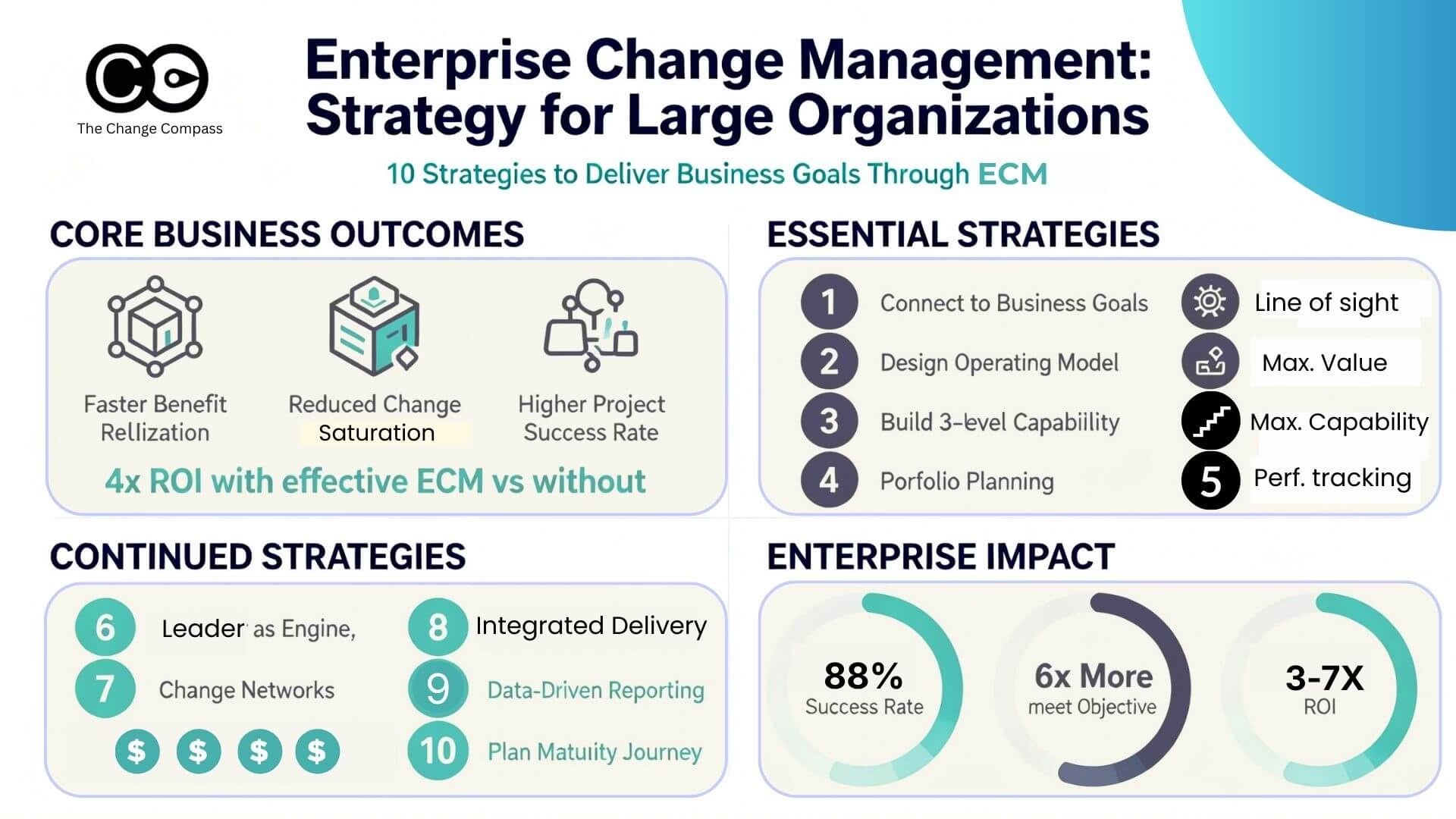
These decisions are qualitatively different from the programme-level decisions that most change governance structures are designed to make. Programme governance focuses on whether an individual change is on track. Portfolio governance focuses on whether the aggregate change load is manageable and whether the sequencing of programmes is optimised for sustainable adoption. McKinsey research on transformation outcomes consistently finds that portfolio-level change governance – including explicit management of change pace and sequencing – is a significant predictor of transformation success at the enterprise level.
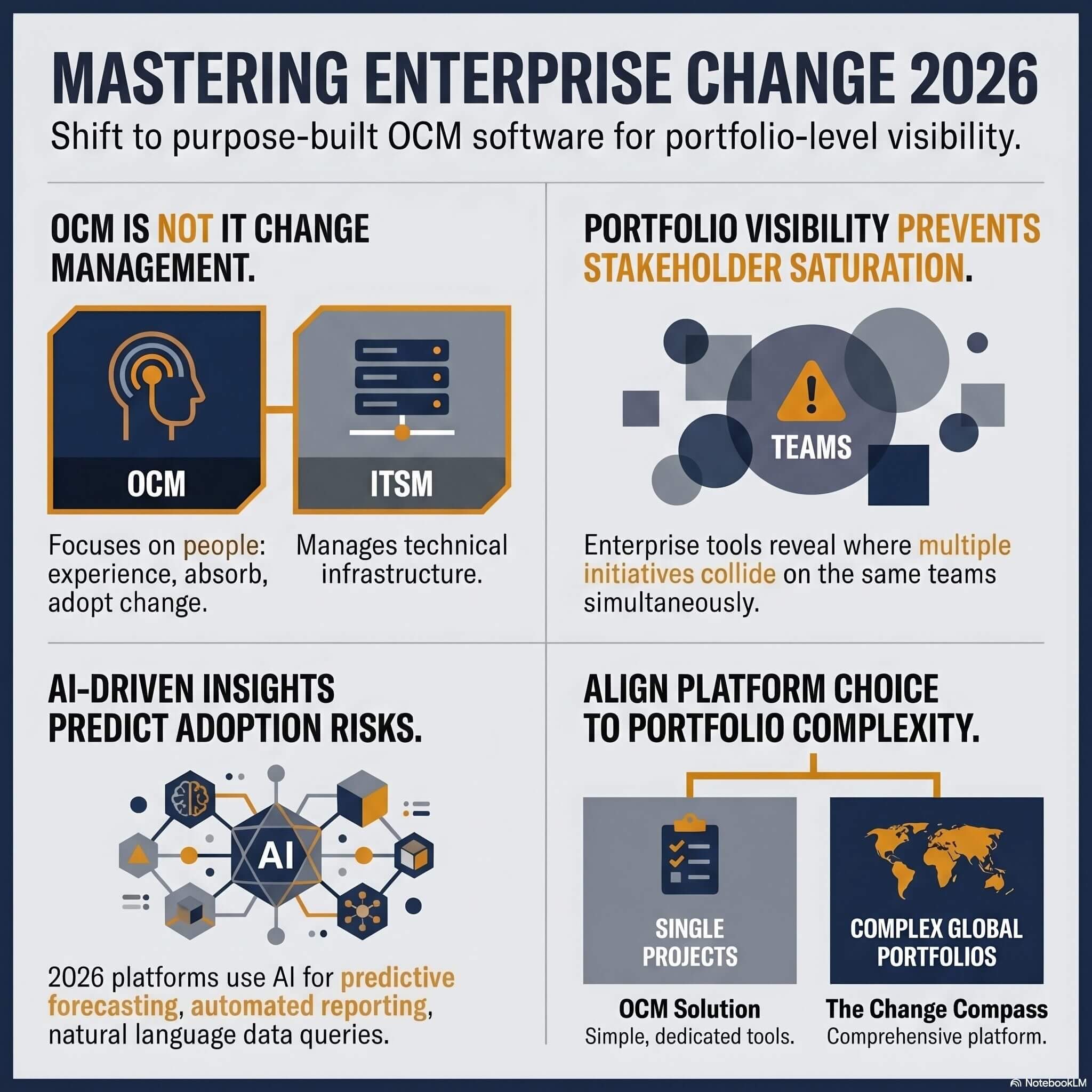
Platforms like The Change Compass are designed specifically to make pace visible and actionable at the portfolio level. By collecting structured impact data from each programme and aggregating it across employee groups, the platform allows change leaders and executives to see cumulative pace of change in real time – and to model the pace implications of proposed portfolio adjustments before making governance decisions. This turns pace management from an intuitive judgement call into a data-informed discipline.
Building pace awareness into change planning
The most effective point at which to address pace is before a change programme enters execution – in the planning phase, when sequencing decisions are still malleable and when the portfolio governance structure has the most flexibility to respond. Organisations that wait until pace becomes a visible problem – until change fatigue is measurable in engagement surveys and attrition data – have already paid a significant cost that better planning could have avoided.
Building pace awareness into change planning means incorporating pace impact assessment as a standard component of programme initiation. Before a programme is approved and resourced, the change team should be able to answer: which employee groups are most affected by this programme, what is the current pace of change on those groups from existing programmes, and what is the projected pace implication of adding this programme to the portfolio? If the honest answer is that certain groups are already at or near their sustainable pace threshold, that finding should inform the programme’s sequencing and delivery design – not be noted and set aside.
Research on organisational decision quality consistently finds that access to comprehensive, timely data is the primary differentiator between organisations that make sound portfolio decisions and those that default to optimism. Pace data is not complex to collect, but it requires a consistent approach across programmes and a shared infrastructure for aggregation. Organisations that invest in this infrastructure gain a systematic advantage in managing one of the most significant and underappreciated determinants of change programme success.
Frequently asked questions
What is the pace of change and why does it matter?
The pace of change refers to the rate at which change demands are introduced to employees over time – how frequently new changes arrive and how little stabilisation time exists between them. It matters because human adaptation to change is a sequential process that requires time to complete. When changes arrive faster than employees can stabilise in each new state, adaptive capacity depletes, change fatigue develops, and adoption outcomes deteriorate even for well-designed changes. Managing pace is therefore as important as managing volume when structuring a change portfolio.
Why aren’t change heatmaps enough?
Change heatmaps show which teams are affected by which programmes at which points in time, but they do not distinguish between changes that are well-sequenced with recovery time between them and changes that are stacked so closely together that stabilisation is impossible. They also typically treat all change impacts as equivalent regardless of depth, and they operate within individual programme boundaries rather than aggregating across the portfolio. Effective pace management requires data that addresses all three of these limitations.
What are the signs that the pace of change is unsustainable?
The most common indicators of unsustainable change pace include declining engagement scores during change-heavy periods, rising attrition among the employee groups most heavily affected by concurrent changes, low adoption rates for new changes even where the design and communication have been strong, regression to old ways of working in recently completed changes, and anecdotal reports of change fatigue and cynicism from managers and employees. By the time these indicators are visible in standard business reporting, the adaptive capacity depletion has usually been developing for months.
How can organisations better manage the pace of change?
Effective pace management requires portfolio-level visibility into the cumulative rate of change on specific employee groups – data that no single programme team can produce alone. It requires incorporating pace impact assessment into programme planning and approval processes, so that sequencing decisions are informed by evidence about current pace rather than made optimistically. It requires governance structures with the authority to defer or descope programmes when pace data shows that specific groups are at or near their absorption limit. And it benefits significantly from purpose-built platforms that aggregate change impact data across the portfolio and make pace trends visible to decision-makers in real time.