In the ever-evolving landscape of project management and software development, Agile has transcended its origins and become a versatile approach applied not only in software development but also in project and operations management. As Agile gains popularity, change practitioners are increasingly aligning their strategies to support Agile environments. This article explores the fundamental principles of Agile and how they dovetail with change management, highlighting the valuable lessons we can draw from Agile’s evolution.
The Convergence of Agile and Change Management
Agile’s Expansion Beyond Software Development
Agile, initially conceived for software development, has expanded its horizons to encompass project management and operations. The principles that underpin Agile, outlined in the Agile Manifesto, have become a guiding light for many across various industries. With methodologies like Scrum, Kanban, and Refactoring, Agile can be applied at different levels, from project teams to program and portfolio management.
Change Management and Agile: A Harmonious Union
Having personally gone through the Scaled Agile certification process, I was struck by how many fundamental change management principles are deeply embedded within Agile. In my multi-day training course, case studies, and examination, I realized that many concepts that are considered common sense in change management are sometimes perceived as ‘new’ for technical leads or project managers in an Agile context. Agile inherently incorporates principles that change managers have advocated for a long time.
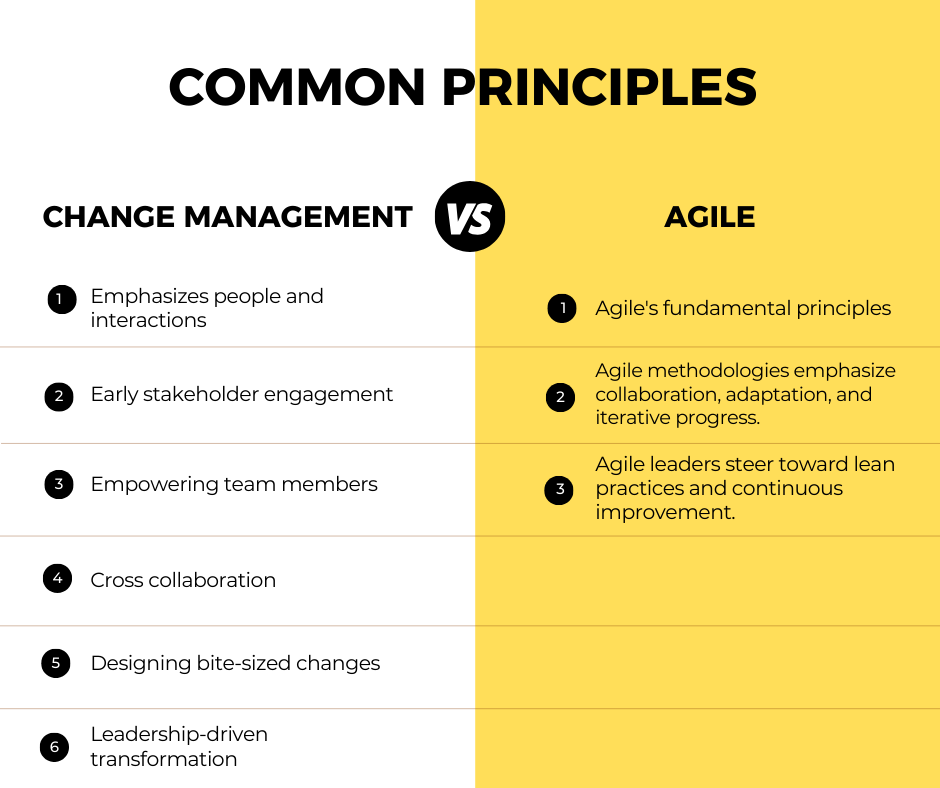
Foundational Change Management Principles in Agile
1. Individual Interactions Over Processes and Tools
In technology-driven environments, technical professionals are highly regarded for their problem-solving skills. The typical response to issues or improvement opportunities is to seek technical solutions. However, the Agile Manifesto focuses on people and interactions. It stresses that teams perform at their best when they maintain constant interaction to ensure effective communication, clarity, and understanding of the work at hand. For instance, a study by McKinsey found that projects with strong team interactions deliver on their objectives 95% of the time, while those lacking strong collaboration only succeed 50% of the time. This principle resonates strongly with change managers, who have consistently advocated for a focus on people and behaviors as central to change management success.
2. Early Involvement of Stakeholders
Agile projects move swiftly, making it crucial to involve stakeholders early in the project development lifecycle. Early engagement ensures clear alignment, fosters relationships among team members, and helps draw out assumptions and set expectations. For example, a survey conducted by Prosci revealed that projects involving early stakeholder engagement had a 74% success rate, compared to only 31% for projects that did not engage stakeholders early. This aligns with change management practices, which emphasize engaging stakeholders early to secure buy-in and alignment. Beyond formal communication, it encourages open dialogue and the testing of assumptions for early clarity across the project team.
3. Empowering Team Members
Traditionally, project managers held the reins in decision-making across all aspects of a project, including solution features and task allocation. Agile challenges this command-and-control model by empowering teams to make these decisions. Effective Agile teams are often self-organized, with project managers transitioning to coaching and enabling roles. For example, a study by Gallup found that empowered teams have 21% higher productivity and 28% less absenteeism. This empowerment aligns with the core principles of change management, which emphasize team dynamics and employee empowerment as essential for team development and engagement.
4. Cross Collaboration
Agile projects thrive on the diverse collaboration of team members from different disciplines and departments. This diversity of thought leads to more innovative ideas, as it brings different perspectives to problem-solving. For example, a report by Deloitte found that organizations with cross-functional teams are 1.7 times more likely to be leaders in innovation. Agile practices, such as cross-team daily stand-ups, release planning, and retrospectives, require different disciplines to come together and contribute to the project. Change management has long focused on breaking down silos and promoting collaborative behaviors, using workshops, communication, campaigns, and leadership influence to foster the right culture and behaviors for successful outcomes.
5. Designing Bite-Sized Changes
One of Agile’s fundamental principles is the idea that, instead of launching large, all-encompassing changes, it’s better to break them down into smaller, iterative pieces. This approach allows for continuous learning and improvement and mitigates the risk of major failures. Change management aligns with this principle by assessing the change capability and capacity of impacted audience groups. For instance, a case study by Prosci showed that an organization that implemented small, incremental changes had a 20% higher user adoption rate compared to organizations that introduced major changes all at once. Smaller, bite-sized changes are easier for users to accept, preventing change fatigue and disruptions to business as usual.
6. Leadership
Agile explicitly acknowledges that organizational managers and leaders bear the ultimate responsibility for the adoption, success, and continuous improvement of lean practices. Leaders must steer the organization towards agile and lean behaviors, role-model the right behaviors, create an environment conducive to team success, and ensure continuous team learning. Leadership plays a central role in change management, driving transformation, and cannot be delegated.
Agile and Change Management in Action: Best Practices
As we’ve explored the evolving landscape of project management and software development, it’s clear that Agile is no longer confined to its origins. It has become a versatile approach, expanding beyond software development to encompass project and operations management. With Agile’s growing popularity, change practitioners are increasingly aligning their strategies to support Agile environments. In this article, we’ve delved into the fundamental principles of Agile and how they seamlessly integrate with change management. Now, let’s take a closer look at real-world best practices with actionable advice and examples that illustrate the power of combining Agile and change management in practical scenarios.
What’s more, we provide actionable advice that you can apply directly to your projects. Whether you’re leading a software development team or managing a complex change initiative, the best practices we showcase can be tailored to suit your specific needs. From effective stakeholder engagement techniques to strategies for empowering your teams, you’ll find practical steps to ensure your projects thrive. For example, implementing daily stand-up meetings for cross-functional teams can significantly enhance collaboration and idea exchange within your projects.
By incorporating these best practices, organizations can harness the full potential of Agile and change management to adapt, innovate, and achieve exceptional results. With expert guidance and empirical evidence of successful benchmarks, you can confidently implement these principles in your projects, ensuring success in even the most complex and dynamic environments.
The synergy between Agile and change management is undeniable. Agile principles, which emphasize people, collaboration, empowerment, and adaptability, align remarkably well with the foundational principles of change management. Whether transitioning from a technical background to Agile or integrating Agile into change management practices, it’s essential to recognize that Agile is more about mindset and principles than specific technicalities. By embracing these shared principles, change management and Agile become a harmonious partnership, working together to drive successful transformations and project outcomes.
To learn more about how The Change Compass can help you bridge the gap between Agile and change management, book a weekly demo with us.
The change management profession has grown by leaps and bounds. This is proportional to the speed and magnitude of change that organisations are currently going through. To manage this complexity, a lot of large organisations have created ‘enterprise change management’ or ‘portfolio change management roles’ to tackle this.
In the same way that there are portfolio managers to manage a suite of projects, organisations are realizing that portfolio change managers may be needed to effectively drive change success. Like the portfolio manager, the portfolio change manager also manages a particular group of initiatives. This grouping is usually done based on the size of change initiatives and or business groups. There are also examples of groupings by ‘value stream’ or program clusters. For example, a portfolio change manager may be in charge of all technology projects and supporting the technology group, whilst another portfolio change manager support sales and marketing initiatives or back office groups.
To download our infographic on how to manage a change portfolio click here.
As a new field, there is not a lot of ‘how-do’ guides for the new portfolio change manager. A quick scan of the internet found very little substance in term of all facets of the work of the portfolio change manager. This guide is written to fill this gap and to help those starting out in this role or decisions makers considering creating such roles to build change effectiveness.
To effectively manage the change initiatives within the portfolio, the change portfolio manager needs to proactively work on the below 7 key areas:
Marketing group working on presentation. Scrum meeting, teamwork, task list. Business concept. Vector illustration can be used for presentation slides, landing pages, and posters
1) Service offering
Defining the service you are offering to the organization is one of the most critical activities. To do this, you need to conduct an assessment of where the organization is at and its various needs for change management services. Key questions to ask include:
How mature is the organization in managing change? You may want to refer to the Change Management Institute’s model of Change Maturity here to understand the different stages of organisational change maturity
How much change is the organization going through? This will help determine the capacity of services required
How much investment is the organization willing to make to support change management? There may be a budget already set or you may need to make a recommendation based on any available internal or external benchmarks
What are the most critical needs? Conduct stakeholder interviews or workshops with senior managers, middle managers and frontline groups to understand current change challenges holistically.
After understanding the needs of the organisations and where the organization would like to head to in its change management objectives, one can then define services required.
Common services offered by a portfolio change manager or portfolio change management function includes:
Coaching and advisory (e.g. for managers and leaders in driving change)
2) Service Delivery
After defining the service provision, the next activity to focus on is how these services will be delivered. This depends on organisational needs, resources available and the skills of available practitioners in the group. Examples of service delivery options include:
Low involvement – Consultation
Change activities are managed and driven by the business or project teams with targeted support from the Change group
The change group is engaged as required over the life cycle of the project to provide guidance and consultation
In terms of change capability, this involves advising and consulting with the business as required
Moderate involvement – Partnering
Change activities are mostly delivered by the Change group with ongoing involvement from the business and the project team
A resource is assigned to support the initiative over the whole life cycle. However, this may not require 100% full-time support and involvement may ramp up or down depending on project needs
In terms of change capability, this involves working on significant pieces of deliverables such as change capability intervention design and delivery
High involvement – Full Delivery
Under the full delivery model the Change group is directly accountable for managing all change deliverables, working alongside the project and business teams
One or more full-time Change resource may be assigned to the whole project lifecycle, including specialists such as communications, learning or even organization design leads
In terms of change capability, this involves significant work on a range of change capability interventions such as a range of learning programs, building air traffic control systems and individual leadership effectiveness assessment and coaching
3) Manage resourcing & Forecasting demand
Depending on the services offered and business requirements, the Change team composition may look different. For example, for some organisations where the need is more on coaching and advisory services, fewer but more senior Change practitioners may be needed. On the other hand, for another organization where the focus is more on project delivery, the focus may be placed on a number of Change Managers and Change Analysts to support initiative delivery.
Key decision should be placed on achieving a balance of permanent headcounts versus contractors. Permanent in-house practitioners will have a deeper understanding of organisational needs and how the organization works. Contractor staffing is beneficial so as to allow the flexing or resources up or down across initiatives. Organisations that only rely on Change contractors usually fail to significantly build business change capability and maturity over time. This is because over time Change Management is seen by the business to be an activity done by contractor practitioners, thus not diluting their accountability. The group may also leverage external providers as needed for specialist skills or to offset any requirement peaks.
Forecasting demand is an important activity to get right so as not to set stakeholder expectations that cannot be fulfilled. Demand forecasting for Change services involves the following:
Extrapolating any change capability organisational requirements into anticipated FTE resource levels. This may be done in consultation with the project management office (PMO), Human Resources and Senior Managers
In resourcing for project delivery, the team needs to work closely with the PMO and project portfolio managers to anticipate demand. The Change group should also align with the PMO on any prioritization processes so as to be ‘joint-at-the-hip’ in focusing on critical initiatives that have been agreed to be the most strategic and valuable first and foremost.
In scoping for each initiative the Change group needs to ensure that it is included and involved in the inception of the initiative. Often Change professionals are engaged when the project is well into implementation and when it may be too late to ‘fix’ any change issues. To adequately scope an initiative key questions to be asked include:
How many parts of the business is impacted? How many employees?
What is the magnitude of the impact?
What is the complexity of the change? Is it innovative or disruptive? Do we anticipate significant transitional efforts involved?
What are the behavioural impacts?
Are customers impacted?
How are key stakeholder groups impacted? Could there be potential for stakeholder sensitivities?
To support purely agile projects, the Change group needs to define change deliverables throughout each phase of the initiative delivery cycle. From then, determine the resource requirement. Foundational change management work will still be applicable within an agile environment, including conducting change impact assessment, planning for change, measuring readiness for change and building business transition capability.
4) Portfolio management
At the lower end of the maturity curve, the Portfolio Change Manager may spend most of the time scoping for change resources, managing delivery, managing change professionals and liaising with key stakeholders. These are absolutely necessary activities. However, to really move up the strategic ladder the Portfolio Change Manager also needs to be able to influence the planning of the initiative portfolio versus only focusing on the delivery end of the curve.
In most organisations the PMO is tasked with managing the initiative investment and planning process. Most would refer to strategic objectives and goals and through this define the overall slate of initiatives for the coming year. Key data used include financial targets, initiative benefits, initiative resourcing and investment cost, and timing. The Portfolio Change Manager is often not involved in this process at all, or best, invited for comments around ‘change saturation’ or ‘change collision’ that are not substantiated by hard data.
To be at the decision table in planning effectively for change, the Portfolio Change Manager needs to be equipped with data to aid insight and decision making. How? By building an integrated view of change impacts. Currently, a lot of organisations still use a series of disjointed spreadsheets to try and articulate the change impacts across initiatives. The problem with this is is that:
The data is based on a person’s judgment in terms of whether an initiative has high, medium or low impacts, and not linked to structured impact assessments
The three categories of high, medium and low are mostly inadequate when the organization is going through a significant number of initiatives. Each category could include such a big range of impacts that it may not be precise enough for the business to use this data. Can the business use this data to forecast frontline impact and resourcing levels? Definitely no.
The spreadsheet is also extremely manual, consuming significant time. And it also becomes out of date very quickly and so may not be trusted by senior leaders or the PMO. Large companies often have more than 100 initiatives. At this scale, a manual spreadsheet is inadequate to meet business needs.
To address this problem, The Change Compass is a digital tool designed to make it easier for the Change Portfolio Manager or the PMO to piece together all the change impacts across change initiatives. Each initiative owner inputs change impact data and the system prompts the user to update the data. The interface is intuitive and draws out the impacts step by step. The Portfolio Change Manager and other managers are able to instantly generate various reports. In a nutshell it helps the organization to manage the ‘air traffic control’ of landing initiatives. Moreover, it enables:
Single view of change impacts on the business, and allows diagnostic view at different organisational levels, e.g. team, sub-division, divisional and enterprise levels
Forecast business operations readiness and resourcing impacts from changes, e.g. frontline resourcing required, engagement channels required, stakeholder groups impacted, etc.
Measure/Model impact of changes on business performance indicators. Understand correlation between change impact and customer satisfaction, service availability or other measures
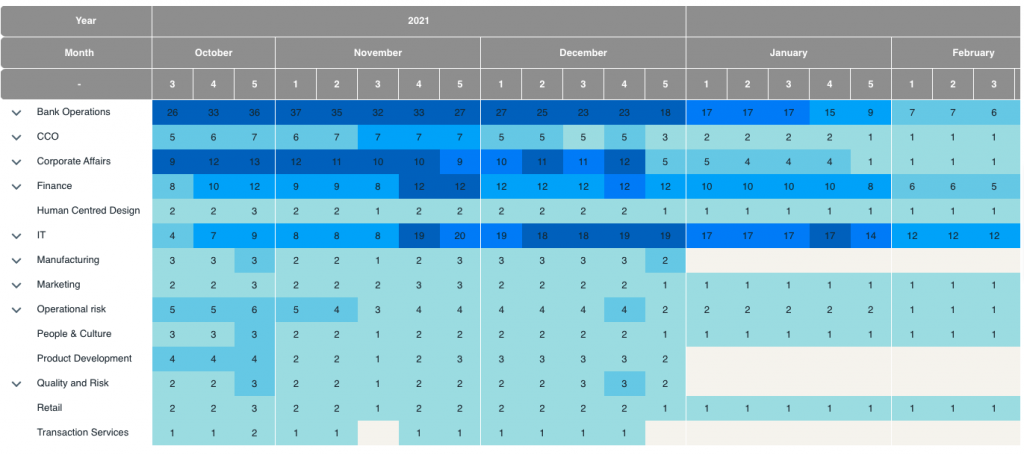
View integrated heat map of all change impacts on customer experience, customer segment by customer segment
Build business change capability through change data and effective routines
Upgrade change work to become more strategic, leveraging data to have strategic conversations and support data-based business decision making
Support agile ways of working through managing iterative and continuous change across the board
To check out our article on how to better manage a change portfolio click here.
5) Change Governance
The Portfolio Change Manager should work with the PMO and senior managers to ensure the appropriate governance and routines are designed and set up. To do this, analyse the business requirements in connecting different stakeholder groups to ensure alignment, buy-in, visibility and ownership of the initiative slate. Portfolio change governance bodies should include attendance by PMO, senior business leaders and the Portfolio Change Manager should focus on reporting and tracking on business impacts, business readiness, delivery milestones and delivery risk identification and mitigation.
Typical routines that the Portfolio Change Manager should assist in establishing include:
Business unit level change planning and cadence (focused on initiative delivery)
Business unit level change capability and program intervention planning and tracking (focused on change maturity)
Initiative portfolio level planning, risk management and tracking
Change team meeting
As needed, enterprise level change planning and cadence
6) Change metrics and reporting
Whilst change impact data is critical to support the work of change governance bodies, there are other initiative-level metrics that the Portfolio Change Manager needs to be focused on in tracking and reporting. These include:
Change readiness surveys
Learning and development tracking and results
Communication metrics such as hit rate or readership rate
Stakeholder confidence ratings
7) Methodology & tools
Currently, there is a significant trend of moving towards agile project methodology in most large organisations. This means that there are less focus and reliance on documentation, long planning cycles but more on effective conversations, stakeholder alignment, and constant iteration and learning. On top of this, a lot of organization are also moving toward scaled agile methodology (agile at organisational level vs. within an initiative). The Portfolio Change Manager needs to define key change deliverables and work approaches that suit his/her organization (acknowledging that agile may not suit every organization or every initiative).
Having effective change tools means that the business can self-help and the change practitioner can better coach and develop the business. For the Portfolio Change Manager useful tools may include:
Change scoping assessment tool for initiatives
Change resource estimation tool
Change Impact Assessment template/tool
Change plan template. For agile environments this would be the Change Canvas
Capability and skills assessment
Change readiness assessment
Change framework for the business to help uplift change capability. This should focus on key change outcomes and competencies for any change leader, written in a language they can understand
The Portfolio Change Manager is tasked with a complex set of tasks in driving a set of change initiatives for the organization. He/she needs to have the people skills to influence a range of stakeholders to transition to the new state. In addition, the person needs to possess business acumen and analytical skills to support the PMO and senior managers to make the right decisions to drive change across initiatives. Whilst not exhaustive, this guide calls out key critical areas undertaken by the Portfolio Change Manager. To be successful going forward, the Portfolio Change Manager needs to constantly deliver value and provide insight through leveraging digital tools and hard data to be at the decision-making table.
If you’ve found this article useful please like this on Linkedin
If you’ve found this article interesting, please ‘like’ and share this with your connections.
Comparing Change Portfolio Operating Models
Model
Structure
Best suited to
Key advantage
Key risk
Centralised
Single change function owns all CM delivery
Organisations with mature CM capability and a consistent methodology
Consistency, standards, clear accountability
Can become a bottleneck; may lose business unit context
Federated
Embedded practitioners within business units, coordinated centrally
Large, diverse organisations with distinct business unit cultures
Business unit relevance, speed to act
Inconsistent standards; risk of siloed practice
Hybrid
Core central function plus embedded BU practitioners
Organisations scaling from centralised to federated
Balances consistency with proximity
Requires clear role boundaries and strong governance
Centre of Excellence (CoE)
Small central team sets standards and provides tools; delivery is decentralised
Organisations building CM capability broadly across business units
Scales capability broadly without central delivery overhead
Requires high change management maturity across all BUs
Frequently Asked Questions
What is the difference between change portfolio management and project portfolio management?
Project portfolio management prioritises and resources a set of projects based on strategic value, cost, and capacity. Change portfolio management focuses on the human side of those same projects – assessing the cumulative change load on impacted groups, identifying capacity constraints, managing change saturation risk, and ensuring the portfolio of changes can actually be absorbed by the organisation. The two disciplines are complementary: effective organisations integrate them so that change capacity is a factor in project portfolio prioritisation decisions, not an afterthought.
How do you measure change portfolio health?
Portfolio health is typically assessed across three dimensions: delivery health (are change management activities being executed to plan across the portfolio?), adoption health (are people in impacted groups genuinely adopting the changes they are being asked to absorb?), and capacity risk (is the cumulative change load within the organisation’s ability to absorb, or are critical groups approaching saturation?). Digital change management tools that aggregate data across initiatives make portfolio health reporting practical at scale.
What causes change portfolio management to fail?
The most common failure mode is a visibility problem: organisations cannot manage what they cannot see. When change initiatives are planned and tracked independently, no one has a complete picture of cumulative impact on any given business unit or employee group. The result is change saturation, failed adoptions, and reactive crisis management. The second most common failure is insufficient governance – without a clear mandate and senior sponsorship, the portfolio change management function lacks the authority to intervene when individual initiatives are creating combined capacity risks.
Managing a portfolio of organisational change is a fundamentally different challenge from managing any individual change programme. A single programme can be governed with a clear scope, a dedicated team, a defined methodology, and a project plan that tracks progress from initiation to close. A change portfolio cannot. It is dynamic, multi-authored, unevenly resourced, and perpetually incomplete – with new programmes entering as others are closing, competing for the attention of the same people, and landing on the same employee groups in ways that no single programme team can see.
Most organisations have developed reasonably mature capability for managing individual change programmes. The same organisations frequently have almost no systematic capability for managing the aggregate. They know which programmes are in flight. They rarely know what those programmes add up to for specific teams, what the cumulative demand is on the employees absorbing multiple simultaneous changes, or whether the sequencing of their portfolio is coherent in any meaningful sense. This gap between programme management maturity and portfolio management maturity is one of the most consequential and underaddressed issues in organisational change.
A change portfolio is the complete set of change programmes and initiatives an organisation is running at any given time, viewed as an aggregate whole rather than as a collection of independent workstreams. It encompasses technology implementations, structural reorganisations, process redesigns, cultural transformation programmes, regulatory compliance initiatives, and any other structured effort to shift how the organisation operates. In a large enterprise, this portfolio is typically substantial – often dozens of concurrent programmes of varying scale, all competing for the finite adaptive capacity of the workforce.
The portfolio perspective is important because it reveals dimensions of the change landscape that are invisible at the programme level. Individual programmes see their own impacts on specific teams and roles. They do not see – and cannot see – the cumulative impact of all programmes on those same teams and roles. The team that is simultaneously implementing a new ERP system, absorbing a structural reorganisation, and preparing for a new regulatory compliance regime is experiencing a very different change reality from what any single programme’s readiness assessment will capture. The portfolio view makes this cumulative reality visible.
What distinguishes effective portfolio management from a simple aggregation of programme management is the introduction of cross-programme decision-making: the ability to sequence, prioritise, defer, or descope programmes based on their combined impact on the organisation’s people, rather than evaluating each programme solely on its individual business case and delivery timeline.
The most common failures in change portfolio management
Organisations that struggle with change portfolio management typically exhibit a recognisable set of failure patterns. Understanding these patterns is the starting point for building more effective capability.
The first and most pervasive failure is the absence of a shared portfolio view. Programme teams work in silos, each with visibility into their own change and limited awareness of what else is happening to the same employee groups. This creates a situation where each programme independently assesses its change impact and independently plans its stakeholder engagement, without anyone aggregating those assessments to see what the combined picture looks like. The result is predictable: employees experience a collision of simultaneous changes that no one designed and no one can see coming.
The second failure is impact assessment inconsistency. When different programmes use different methodologies and taxonomies to assess their change impacts, the resulting data cannot be aggregated. A heatmap that shows which teams are affected by which programmes tells you something useful. But if the underlying impact ratings are based on incompatible definitions across programmes, the aggregate picture is misleading – teams with genuinely high impact loads may appear comparable to those with moderate loads because the ratings were calibrated differently. Consistent, shared impact taxonomies are a prerequisite for meaningful portfolio-level analysis.
The third failure is the absence of portfolio governance with real authority. Many organisations have change governance committees that review individual programmes for compliance with methodology and that receive programme status reports. Far fewer have governance structures that make portfolio-level decisions: adjusting programme sequencing based on employee capacity data, deferring a programme because another programme has depleted the adaptive capacity of the same workforce, or descoping a programme to protect the stabilisation time that a recently completed change requires. Without authority to make these cross-programme decisions, portfolio governance is administrative rather than strategic.
Prosci’s longitudinal research on change management best practices identifies portfolio-level change governance as one of the clearest differentiators between high-maturity change organisations and those at the lower end of the maturity spectrum. The presence of a cross-portfolio view, consistently applied methodology, and governance authority that extends beyond individual programmes is a hallmark of the organisations that consistently deliver better change adoption outcomes.
Building a structured portfolio view
The foundation of effective change portfolio management is a reliable, structured view of what the portfolio contains and what it is doing to the people who have to absorb it. This requires three things: a complete inventory of change programmes, structured impact data from each programme, and an aggregation mechanism that combines that data into a cross-portfolio picture organised by employee group and time period.
The complete inventory sounds straightforward but is frequently elusive in large organisations. Change programmes are initiated through multiple channels – business unit initiatives, central project offices, IT delivery teams, HR and OD functions – and there is often no single register that captures them all. Building this complete picture requires deliberate effort across organisational boundaries and a sponsorship level high enough to compel participation from all parts of the organisation. An incomplete portfolio inventory produces a misleading view – one that makes the total change load appear more manageable than it actually is.
Structured impact data is the second requirement. For portfolio aggregation to be meaningful, each programme needs to assess its impacts using a consistent taxonomy that allows comparison across programmes. This means agreeing, at the portfolio level, on how impact types are defined and rated – what counts as a high-intensity versus moderate-intensity impact, what dimensions of change (process, technology, structure, capability, behaviour) are captured, and which employee groups are the unit of analysis. Without this consistency, the aggregated data is an average of apples and oranges.
The aggregation mechanism is the third requirement, and it is where technology plays a critical enabling role. Aggregating impact data across a portfolio of a dozen or more concurrent programmes is not a spreadsheet task that human analysts can maintain reliably alongside their programme responsibilities. It requires a shared data infrastructure that each programme populates and that produces the portfolio view automatically as the underlying programme data is updated.
Sequencing and prioritisation in the change portfolio
Once the portfolio view is established, the most consequential management decisions concern sequencing: in what order, and at what pace, should changes be delivered to specific employee groups? Sequencing decisions that ignore the portfolio view produce collision patterns – multiple significant changes landing on the same teams simultaneously – that are entirely preventable with better information. Sequencing decisions informed by portfolio data can protect stabilisation time between major changes, distribute the change load more evenly across the year, and target high-intensity periods of change at teams with the greatest remaining adaptive capacity.
Prioritisation within the portfolio is a related but distinct decision. When the total change load on a specific employee group exceeds what can be managed sustainably, something has to give. Prioritisation means making explicit choices about which changes proceed on their current timeline and which are deferred – and it requires a governance authority that can make those choices based on the portfolio data rather than allowing each programme sponsor to advocate for their own programme’s priority independently.
McKinsey’s research on organisational transformations consistently finds that sequencing and prioritisation failures – specifically, attempting to run too many significant changes simultaneously – are among the most common causes of transformation underperformance. The programmes that fail in these portfolios are rarely poorly designed. They fail because the organisation’s adaptive capacity was already depleted by the time they arrived, and even a well-supported change cannot overcome the fatigue and cynicism that accumulate when the pace of change has been unsustainable for an extended period.
Change capacity as a portfolio management discipline
Effective change portfolio management treats employee adaptive capacity as a finite and measurable resource – one that needs to be managed as deliberately as financial resources or technology infrastructure. This means establishing baselines for what constitutes sustainable change load for different employee groups, monitoring actual change load against those baselines in real time, and building the governance mechanisms to act when specific groups approach or exceed their capacity thresholds.
Adaptive capacity is not uniform across the organisation. Teams that have recently absorbed major changes are typically operating with depleted capacity, regardless of whether the previous changes have technically been completed. Teams in high-pressure operational roles – where the daily baseline workload is itself demanding – have less spare capacity to absorb transformation activity. Teams undergoing significant structural change simultaneously with major technology or process changes face a compounding challenge that requires specific attention and support.
Gartner research on change fatigue identified a clear relationship between the number of concurrent changes affecting an employee group and their willingness to engage effectively with any individual change. When the cumulative change demand exceeds a critical threshold – which varies by context but is reliably real – employees shift from active engagement to passive compliance or active resistance, and even the best change management support cannot compensate for the capacity deficit.
Using data to manage the portfolio
The transition from intuitive to data-informed change portfolio management is one of the most significant capability improvements available to large organisations. The data required is not exotic – it is the structured impact data that each programme should be collecting for its own change management purposes, aggregated across the portfolio and connected to workforce demographic data that allows the analysis to be sliced by business unit, role type, geography, or whatever dimensions are most decision-relevant.
With this data in place, portfolio managers can answer questions that are currently unanswerable in most organisations: which employee groups are experiencing the highest current change load? Which parts of the organisation have the most capacity to absorb a new change initiative? What would happen to the cumulative load on specific teams if the proposed start date for a particular programme were deferred by two quarters? What are the adoption trend lines across recently completed changes, and do they indicate that specific teams have stabilised sufficiently to absorb the next wave?
Platforms like The Change Compass are designed specifically to make this kind of data-informed portfolio management operationally viable. By providing a shared platform where all programme teams capture their structured impact data and where that data is automatically aggregated into portfolio views by employee group, business unit, and time period, the platform eliminates the manual aggregation burden that makes portfolio-level change management impractical in most organisations. The result is portfolio managers who can see the full picture and make evidence-informed decisions about sequencing, capacity allocation, and programme prioritisation in real time.
Frequently asked questions
What is a change portfolio and how is it different from a project portfolio?
A change portfolio is the complete set of change programmes and initiatives an organisation is running at a given time, viewed in terms of their combined human impact on the workforce rather than solely their delivery timelines and costs. A project portfolio focuses on the delivery of outputs – on time, on budget, within scope. A change portfolio focuses on the absorption capacity of the people who have to adopt those outputs. Both views are necessary, but most organisations invest heavily in project portfolio management and very little in change portfolio management, which is why they frequently deliver projects successfully while failing to achieve the behaviour change and adoption that determines actual business value.
What data do you need to manage a change portfolio effectively?
Effective change portfolio management requires three types of data: a complete inventory of all change programmes currently in flight or planned, structured impact data from each programme that captures the nature, timing, and intensity of impacts on specific employee groups, and an aggregation mechanism that combines programme-level impact data into a cross-portfolio view organised by team or role group. Without consistent impact taxonomy across programmes, the aggregated data is unreliable. Without an aggregation mechanism, the portfolio view requires unsustainable manual effort to maintain.
How should change portfolio governance work?
Effective change portfolio governance requires a body with authority that extends across individual programmes – the authority to adjust sequencing, defer programmes, and reallocate change support resources based on portfolio-level data rather than programme-by-programme advocacy. This governance body needs access to current portfolio-level change load data by employee group, and it needs to meet with a cadence aligned to the decision windows that matter: typically quarterly for strategic portfolio decisions and more frequently for operational sequencing and resourcing decisions. Governance that can only review individual programmes without adjusting the portfolio as a whole is administrative, not strategic.
How do you know when the change portfolio is overloaded?
The clearest indicators of an overloaded change portfolio are declining adoption rates for new changes even where design and support are strong, regression in previously completed changes as employees struggle to sustain new behaviours alongside additional change demands, rising attrition among the groups carrying the heaviest change load, and anecdotal fatigue and cynicism that managers report from their teams. Leading indicators – visible before these outcomes materialise – include cumulative change load data showing specific groups at or above their capacity threshold, and pulse survey data showing declining readiness despite adequate training completion. Organisations with portfolio-level measurement infrastructure can detect overload before it becomes a crisis.
A typical scenario for a lot of program meetings goes something like this. The program spends the bulk of the time discussing program cost, delivery progress, technical risks and resourcing challenges. And when it comes to Change Management reporting, we are often left with a few anecdotes from stakeholder interviews, and often the only real quantitative reporting comes in the forms of training completion, readiness surveys, and email communications hit rates.
One wonders why Change Management is often glossed over as fluffy and soft vs. strategic and quantitative. Even for those who intuitively believe that managing change ought to be important, most lack quantitative data that demonstrate clearly how change progress directly impacts business outcomes.
How does a business manager, program or a change practitioner demonstrate the true strategic value of tracking change initiatives in order to highlight any risks and achievements? In particular with a group of initiatives.
Here are a few ways in which change impacts may be captured and reported in a quantitative way to support strategic decision making, starting with a birds-eye-view and sequentially drill down deeper to understand the scenario to aid strategic decisions:
1. Customer Experience Impact
One of the most profound ways in which change progress may be reported at a strategic level is by the extent to which initiative change impacts are shaping customer experiences. How are customer experiences shaped as a result of the suite of changes taking place?
Do initiatives result in a positive or negative impact on customer experience? E.g. does it improve or worsen a service delivery speed, functionality, quality, etc. Legislative initiatives for example may result in negative experiences depending on the nature of the change. Is there too much change going on at the same time? Does the customer give a damn about the change?
2. Change Impact dashboard
A good high-level view of various change impact data for an executive dashboard may include:
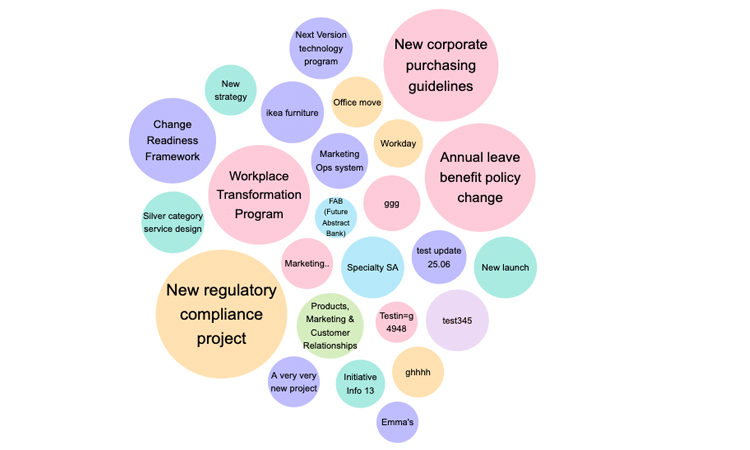
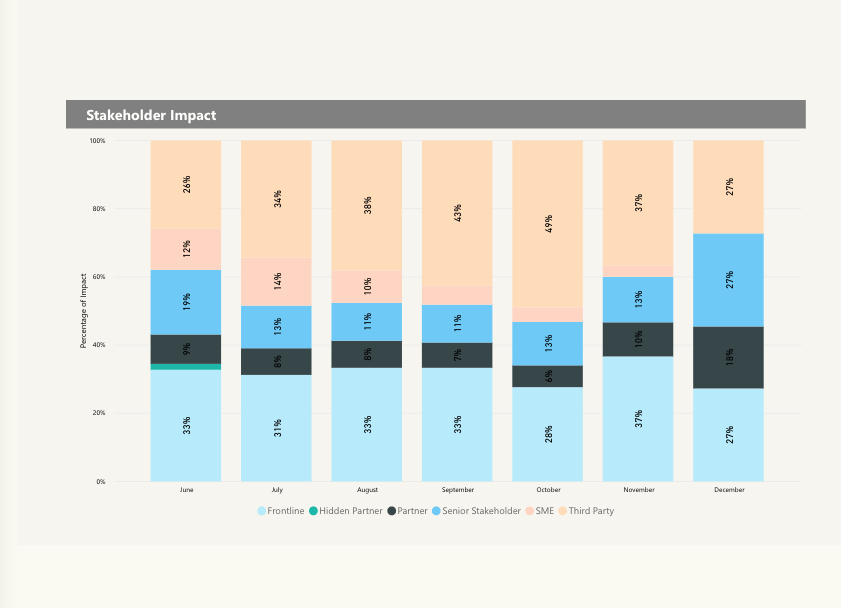
Initiative quantity and type (technology, product, policy, etc.) throughout the calendar year Impact level and type (go-live, training, customer, etc.) At-a-glance pie charts and bar graphs are ideal for summarizing multiple axes of data within a 1-pager
3. Change impact heat map
A good heatmap can be one of the most visually memorable reports on change impact with options to drill down into colour-coded divisional and sub-divisional impacts across the timeline indicating both the number of initiatives as well as the levels of impact.
4. Detailed initiative schedule
A detailed initiative schedule is helpful as we start to drill down to analyze which initiatives are contributing to business and delivery risks. Data may include initiative names, impact level, impact type, and impact dates across the calendar year. One starts to get a detailed understanding of which initiatives are high impact, contributing to change fatigue or could be better communicated and in synchronisation with other initiatives to reduce complexity for the audience.
5. Initiative report
After we have a clear understanding of the initiatives that we need to work on aligning to improve the overall execution and delivery effectiveness we then move to clarify the details of each initiative. At this level, the reporting contains a description of the initiative, contact persons, delivery timeline and business impact data. The report, therefore, should contain sufficient details to allow very actionable steps to connect, discuss, and plan for change alignment between initiative, portfolio and business owners.
To read more about change analytics follow these links: