There’s a moment in Wicked the Movie when the main character Elphaba stands on the ramparts of Shiz University, green skin and all, and realises that the world has been lying to her. Glinda, her unlikely friend and mirror image, is learning something different: that comfort and popularity sometimes require staying silent. Both characters embark on profoundly internal journeys, discovering their values, questioning their assumptions, and eventually choosing paths that fundamentally reshape who they are and how they lead. One defies gravity. The other chooses the easier road, only to live with the cost of that choice.
This is not just a story about friendship or redemption. It’s a masterclass in ethical transformation, where internal struggle, conflict, and resistance become the very catalysts for meaningful change. And whilst Elphaba and Glinda’s story unfolds on stage, business leaders and organisations undergoing significant change experience remarkably similar journeys.
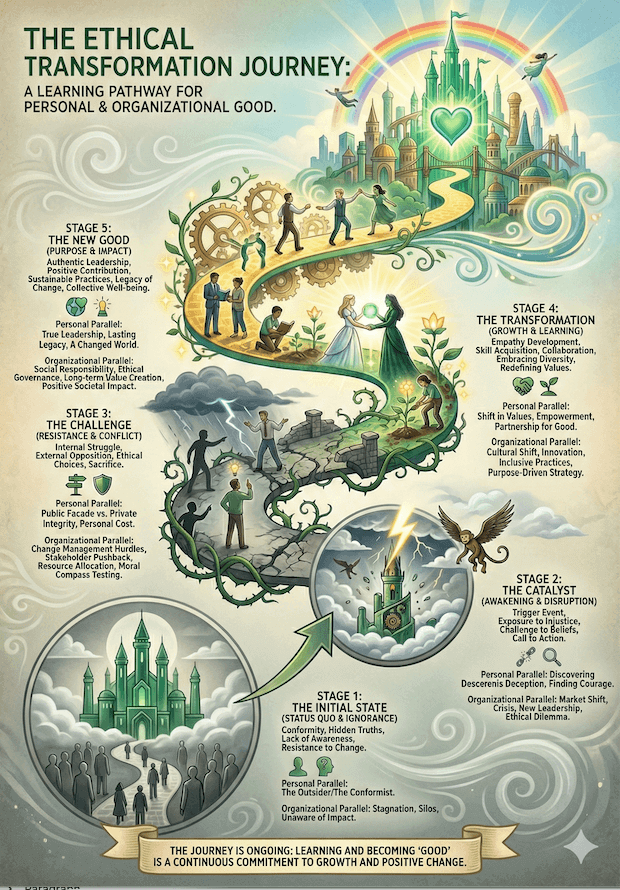
The infographic that inspired this content explores five distinct stages of ethical transformation. What’s fascinating is that this framework mirrors something referenced in Wicked: transformation is rarely linear, comfortable, or solitary. Internal struggle, moral questioning, and resistance to the easy path are not obstacles to transformation. They are its fuel.
Why Organisations Are Linking Ethical Leadership With Change Management
For decades, change management has focused on processes, systems, and adoption metrics. The evolution of change management as a discipline has largely centred on structured methodologies and linear implementation frameworks. But recent research on ethical leadership in organisational transformation reveals something more fundamental: ethics is not a nice-to-have alongside transformation. It is foundational to whether change actually sticks and whether employees genuinely embrace new ways of working.
A 2024 study on ethical leadership and organisational change found that organisations embedding ethical frameworks into their change initiatives saw significantly higher rates of employee readiness and affective commitment to transformation. When employees understand not just what is changing, but why it matters and whether the change aligns with shared values, they move from reluctant compliance to genuine engagement.
Research from the CIPD (Chartered Institute of Personnel and Development) highlights a troubling gap: many current organisational change management programmes are not managed ethically in a way that pays attention to the social and human environment of the workplace. This oversight creates what researchers call “ethics placebos” – surface-level initiatives that look good on paper but leave organisations vulnerable when real pressures hit. The contrast is striking: organisations with mature ethical transformation practices see significantly better outcomes than those treating change as purely operational or technical.
Check our other article discussing managing change as an ethical obligation, rather than simply as an operational initiative, is what separates organisations that deliver lasting transformation from those where changes fade after the initial implementation phase. How an organisation manages change fundamentally impacts its human rights record, its employee wellbeing, whether it builds or erodes trust across stakeholder groups, and ultimately whether employees see the organisation as worthy of their commitment and effort.
Understanding the Five Stages of Ethical Transformation: A Roadmap for Change Leadership
The ethical transformation journey moves through five interconnected stages, each building on the previous one. Each stage has both a personal dimension (how individuals evolve) and an organisational dimension (how systems and cultures shift). This five-stage model is increasingly recognised by transformation leadership experts as essential to understanding how sustainable change actually occurs.
Stage 1: The Initial State (Status Quo and Ignorance).
This is where most organisations and individuals sit. Conformity, hidden truths, lack of awareness, and resistance to change are the default conditions. Like Glinda in the early scenes of Wicked, everything appears fine. The system is working. There’s no pressing reason to question the status quo. Organisationally, this manifests as stagnation, siloed working, and a general lack of awareness about the impact of current practices. Individuals may operate with unexamined assumptions. Teams work in isolated units. Leadership decisions are made without full visibility of downstream effects.
Stage 2: The Catalyst (Awakening and Disruption).
Something disrupts the comfortable narrative. A trigger event, such as exposure to injustice, a market crisis, or evidence that current practices are causing harm, creates what Kurt Lewin’s change model called the “unfreeze” moment. Suddenly, the old way of operating feels unsafe or unjustifiable. This catalyst phase in change leadership is critical because it is when people first recognise the need for change. Elphaba’s moment comes when she learns about the plight of the animals and realises the Wizard is complicit in their subjugation. In organisational transformation, catalysts might include a stakeholder crisis, new regulatory requirements, or internal discovery of unethical practices.
Stage 3: The Challenge (Resistance and Conflict).
This is where resistance gets real. Internally, individuals face conflict between their emerging values and their comfort with the old ways. Externally, organisations face significant pushback from stakeholders invested in the status quo. Research on change resistance and conflict in organisations shows this phase is critical: how organisations and leaders handle it determines whether people move forward or retreat. Managing change resistance effectively requires understanding that resistance is not a problem to eliminate – it is information. Elphaba faces both the Wizard’s power and her own fear. Glinda faces social pressure to dismiss Elphaba’s concerns. In the workplace, this stage manifests as change management hurdles, stakeholder pushback, resource allocation tensions, and moral compass testing.
Stage 4: The Transformation (Growth and Learning).
Through the turmoil, new skills emerge. Empathy grows. Collaboration deepens. Values clarify. Individuals and organisations begin to experiment with new ways of working that align with their emerging ethical commitments. This is where people learn, practise, and gradually embed new behaviours. Skill acquisition happens here, as does cultural shift and innovation in inclusive practices. This phase requires leaders to coach, support, and reinforce new ways of thinking.
Stage 5: The New Good (Purpose and Impact).
Here, the transformation is not an initiative anymore. It is embedded in how the organisation operates, the decisions it makes, and the leaders it develops. Authentic leadership, purpose-driven strategy, and genuine collective wellbeing become the baseline. The personal and organisational parallels converge: individuals have become the leaders they needed to be, and organisations have become the ones they aspired to be. At this stage, the focus is on sustainable value creation and lasting social impact.
Why These Stages Matter for Change Leaders
Understanding these stages of ethical transformation is essential for anyone leading organisational change or serving in a change management office. Why? Because each stage contains its own form of resistance, its own internal struggle, and its own opportunity for meaningful growth. Traditional change management frameworks often treat resistance as an obstacle to overcome. But when you understand the ethical transformation journey, you see resistance differently. It becomes a sign that people are genuinely grappling with values, meaning, and purpose. That is precisely where transformation happens.
The Personal and Organisational Parallels
One of the most powerful aspects of this framework is that it recognises two parallel journeys occurring simultaneously:
The Personal Parallel. At Stage 1, individuals are conformists, operating on autopilot. By Stage 5, they have become authentically courageous leaders with a sense of legacy and the desire to create positive change. In between, they move from discovering dissonance and finding courage, through shifting values and empowerment, to partnership for the greater good.
The Organisational Parallel. Organisations move from stagnation and lack of awareness, through crisis and market shift, into the depths of change management hurdles and ethical dilemmas. They then gradually shift their culture, embrace innovation, adopt inclusive practices, and ultimately develop purpose-driven strategy and positive social impact. At the organisational level, governance, decision-making, and leadership capability all shift along the journey.
This dual perspective means that ethical transformation is not something imposed on people from above. It is something that unfolds through genuine struggle, learning, and growing alignment between personal values and organisational purpose.
Let’s now explore each stage in detail.
Stage 1: The Initial State (Status Quo and Ignorance)
Stage 1, the Initial State, is where most organisations quietly sit before ethical transformation begins. Conformity to existing processes, siloed teams, and a lack of visibility into stakeholder impact create a sense of comfort that masks hidden risks and ethical blind spots. Research on status quo bias shows people naturally prefer familiar systems because they have invested time and identity into them, which makes change feel like a personal loss even when the new approach is clearly better.
For change leaders, this means resistance at Stage 1 is usually self‑protection, not sabotage. Employees are often defending their competence, routines, and sense of control, so early change activity should focus on raising awareness of impact, surfacing “hidden truths”, and acknowledging the real emotional cost of leaving the familiar behind.
Stage 2: The Catalyst (Awakening and Disruption)
Every meaningful transformation begins with a disruption to the comfortable narrative that “everything is fine.” This catalyst moment is what separates organisations that evolve from those that stagnate indefinitely.
The catalyst can take many forms: exposure to injustice, a market crisis, new regulatory requirements, internal discovery of unethical practices, or increasing stakeholder pressure on environmental, social, and governance issues. In Wicked, Elphaba’s catalyst moment comes when she learns about the plight of the animals and realises the Wizard is complicit in their oppression. In organisational settings, the catalyst is equally concrete: discovering that a product or practice is causing harm, receiving whistleblower complaints, facing public criticism, or recognising that top talent is leaving because they do not see ethical alignment between their personal values and the organisation’s practices.
Kurt Lewin’s classic change management model describes this as the “unfreeze” phase. When the status quo is challenged by evidence or experience that contradicts the comfortable narrative, people become psychologically ready to consider alternatives. This is not a comfortable state, but it is a necessary precondition for genuine transformation.
Research on organisational change catalysts shows that trigger events create cognitive dissonance – employees must hold two contradictory beliefs simultaneously: “I work for a good organisation” and “this practice is harmful.” The discomfort of that contradiction creates psychological pressure to resolve it, either by dismissing the evidence or by reimagining their understanding of the organisation.
How Leaders Frame the Catalyst
The way a catalyst is communicated shapes whether it becomes a catalyst for real transformation or a crisis that leaders attempt to manage away. Research on crisis communication shows that transparency and authenticity matter enormously. When senior leaders acknowledge the problem directly, explain what went wrong, and articulate clearly what will change as a result, employees are significantly more likely to move toward genuine commitment rather than resignation or cynicism.
For change leaders engaged in enterprise change management, the catalyst phase presents both opportunity and risk. Done well, it mobilises genuine commitment. Done poorly, it triggers defensive responses and entrenches resistance.
Stage 3: The Challenge (Resistance and Conflict)
This is where many transformation initiatives falter. It is also precisely where understanding ethical transformation as a natural, necessary process becomes essential.
Stage 3 is characterised by genuine internal struggle and external resistance. Internally, individuals face conflict between emerging values and comfort with the familiar. Externally, organisations encounter pushback from stakeholders invested in the status quo. Resources become tight. Decision-making becomes political. Moral dilemmas emerge that do not have clean solutions.
Research on resistance to change reveals a critical insight: resistance is not the opposite of change. It is part of change. In fact, organisations experiencing no resistance during transformation initiatives should be concerned, because it suggests the change is not being authentically integrated. Real transformation always involves letting go of something, and people’s resistance signals what they value and what they fear losing.
Sources of Resistance and the Role of Change Leadership
Research identifies multiple sources of resistance during this challenging stage:
- Psychological loss, where people have invested identity and competence in current ways of working
- Uncertainty about the future state and whether individuals will succeed in it
- Lack of trust in leadership or contradiction between leaders’ words and past actions
- Competing values and logics, where new directions conflict with existing professional identity
- Practical barriers around resources, time, or capability
For Elphaba, Stage 3 involves struggle against institutional power, growing isolation as others distance themselves, and internal conflict about the personal cost of standing for her beliefs. Glinda faces a different but equally real form of Stage 3 resistance: social pressure, desire to belong, and the seductive appeal of the comfortable path.
Managing Resistance as Strategic Information
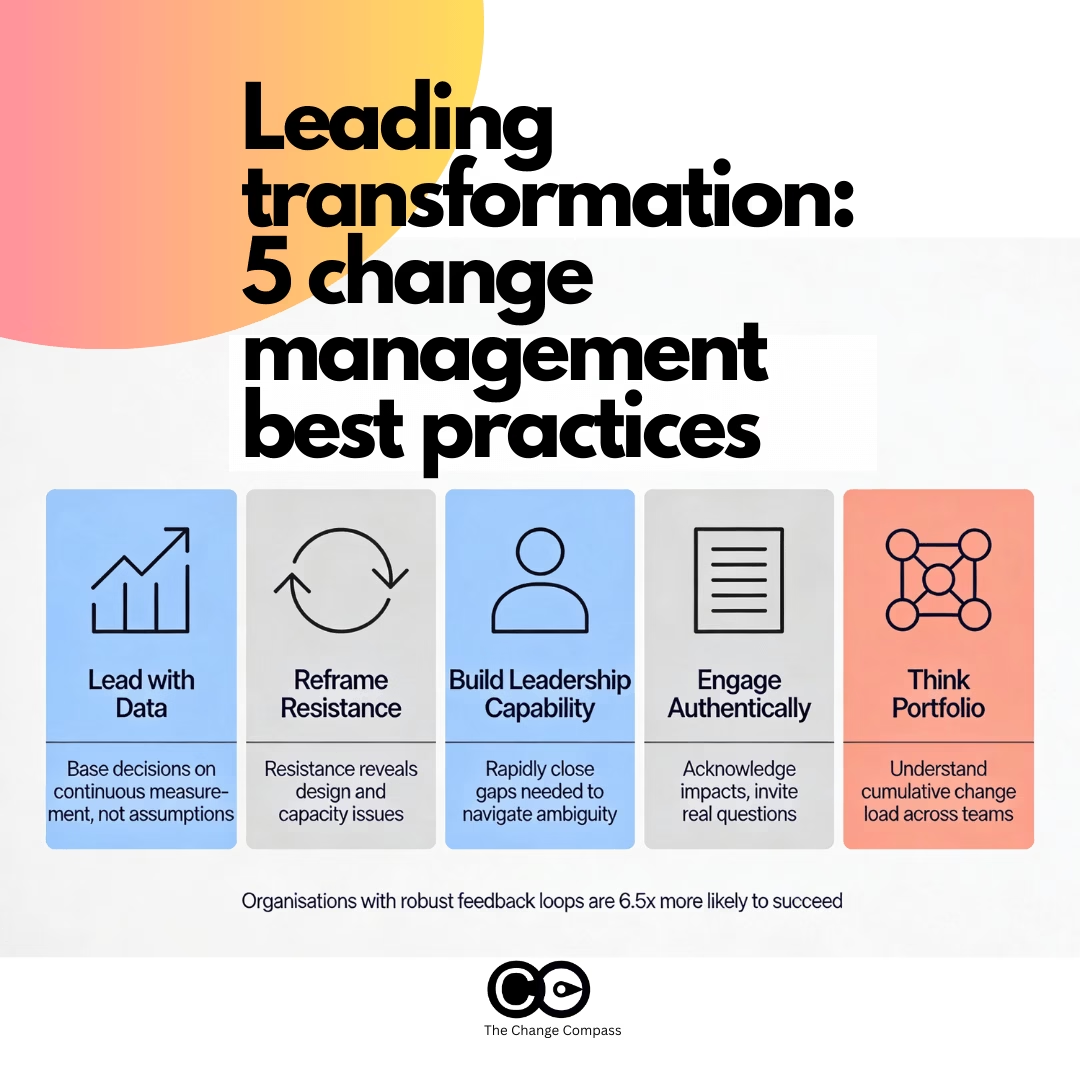
One of the most powerful reframes in modern change leadership and enterprise transformation is treating resistance not as an enemy, but as strategic information. When people resist, they signal what they value, what they fear, and what barriers they perceive.
Research on resistance management demonstrates that organisations applying appropriate techniques increase adoption by 72% and decrease employee turnover by almost 10%. But “appropriate” does not mean suppressing resistance. It means understanding it, acknowledging real concerns, and co-creating solutions that address both practical and emotional dimensions.
Research on organisational justice shows that procedural fairness – the sense that the change process itself is fair, transparent, and inclusive – significantly reduces resistance even when people do not fully like the direction. When people feel heard, when their concerns are genuinely considered, and when they have agency in how transformation unfolds, they move more readily through the discomfort of change.
Stage 3 frequently brings ethical dilemmas to the surface. How far do you push change when stakeholders are suffering? Do you prioritise transformation speed or people’s adjustment pace? When you discover current systems have caused harm, do you prioritise fixing that harm or moving forward? These are not rhetorical questions. They are live dilemmas that challenge leaders and organisations to clarify what they actually value. The moral compass testing that happens at Stage 3 is not a distraction from transformation. It is the essence of ethical transformation.
Stage 4: The Transformation (Growth and Learning)
Through the turmoil of Stage 3, something fundamental shifts. New skills emerge. Empathy grows. Collaboration deepens. Values clarify. Individuals and organisations begin experimenting with new ways of working that align with emerging ethical commitments.
This is the “change” phase in Lewin’s model – where people learn, practise, and gradually embed new behaviours. Organisational capability shifts. Cultural norms begin to reorient. What felt uncomfortable becomes normalised through repetition, social reinforcement, and visible success.
Research on empathetic leadership shows that leaders cultivating empathy as a core competency during transformation see significantly higher rates of employee engagement, innovation, and adoption of new ways of working. Empathy at this stage is not merely emotional sentiment. It is a strategic capability that enables leaders to understand diverse stakeholder needs, anticipate resistance, and co-design solutions that work across different contexts and perspectives.
Skill Acquisition and Cultural Shift
Stage 4 requires deliberate investment in capability building. Training programs, coaching support, and peer learning networks become essential. The Change Management Institute’s research emphasises that sustainable change capability requires structured competency development rather than relying on enthusiasm and goodwill.
Organisations embedding inclusive practices during Stage 4 see measurable improvements in innovation, collaboration, and long-term sustainability. Diversity is not treated as a compliance box but as a legitimate accelerator of ethical transformation – different perspectives identify ethical blind spots and generate more robust solutions.
Benefit realisation processes become critical at this stage. Organisations that actively track and reinforce benefit realisation see significantly higher success rates in translating change initiatives into sustained operational performance. This involves clear metrics, regular monitoring, and leadership discussions about obstacles and support required to drive realisation forward.
Research shows that organisations implementing continuous change with frequent measurement achieve remarkable results – a twenty-fold reduction in manufacturing cycle time whilst maintaining adaptive capacity. The pattern is clear: measurement and learning during Stage 4 accelerate the pace and depth of transformation.
Leadership Behaviour During Stage 4
Authentic leadership becomes increasingly critical during Stage 4. Research demonstrates that authentic leaders – those embodying transparency, integrity, and commitment to core values – generate significantly higher levels of organisational commitment, engagement, and openness to change. Employees perceive authentic leaders as genuine and reliable, which boosts mutual respect, openness, and willingness to experiment with new approaches.
Organisations with authentic leadership experience 21% higher profitability, 17% greater productivity, and 20% higher employee engagement compared to organisations where leaders prioritise image management. These outcomes highlight authenticity as a driver of both organisational performance and sustainable competitive advantage.
Stage 5: The New Good (Purpose and Impact)
Here, transformation is no longer an initiative. It is embedded in how the organisation operates, the decisions it makes, and the leaders it develops. Authentic leadership, purpose-driven strategy, and genuine collective wellbeing become the organisational baseline.
At this stage, personal and organisational parallels converge. Individuals have become the leaders they needed to be. Organisations have become the ones they aspired to be. The transformation is no longer external work. It is the organisation’s way of operating.
Embedding Sustainable Value Creation
The New Good is characterised by long-term value creation that extends beyond financial metrics to encompass social impact and environmental sustainability. Organisations at this stage embed ethical governance, inclusive decision-making, and accountability for stakeholder wellbeing into their operating model.
Research on social impact organisations shows they enjoy significantly higher levels of employee engagement and retention, with employees reporting greater sense of purpose and pride in their work. This engagement translates to lower recruitment costs, higher innovation, and enhanced workplace morale – creating a virtuous cycle where purpose drives performance, which reinforces purpose.
Building Organisational Legacy
Stage 5 organisations are intentional about the legacy they build. They ask not just “what value did we create this quarter?” but “what enduring positive change are we creating for communities, stakeholders, and future generations?” This forward-thinking approach reduces exposure to risks associated with climate change, resource scarcity, and social unrest, whilst enhancing ability to adapt to changing market conditions.
Research on sustainable leadership emphasises that organisations balancing profit with genuine commitment to social and environmental wellbeing are better positioned for long-term resilience and growth. They attract purpose-driven talent, access new markets, and build strong brand reputation amongst consumers and employees increasingly demanding authentic social responsibility.
Measuring Impact at Scale
Organisations at Stage 5 move beyond traditional change management metrics to measure impact comprehensively. They track benefit realisation rigorously, monitoring whether promised outcomes translate into sustained operational and social performance. They measure return on investment across financial, employee, and stakeholder dimensions.
But they also recognise that measurement serves purpose, not the reverse. The goal is not to measure everything, but to measure what matters – what signals whether the organisation is genuinely delivering on its purpose and creating positive change.
Why Transformation Is Never “Done”
The most critical insight from understanding these five stages is that ethical transformation is not a destination. It is a continuous journey. Organisations that reach Stage 5 do not stop. They deepen. They evolve. They face new ethical questions that yesterday’s answers do not resolve. They discover new stakeholders with needs they had not previously considered. They encounter new technologies and social changes that require reimagining what “the new good” means.
Research on organisational learning shows that organisations creating feedback loops, fostering experimentation, and building learning networks sustain their transformation far more effectively than those treating transformation as a one-time initiative. The learning culture embedded at Stage 4 becomes the operating system that enables continuous evolution at Stage 5.
The Personal and Organisational Parallels, Revisited
Understanding these parallels is what makes this framework particularly powerful for leaders and organisations.
The personal journey moves from conformity and hidden values, through discovery and disruption, into the depths of internal struggle and resistance. Then through genuine learning and growth, people emerge into authentic leadership – not always comfortable, but finally aligned with their values and capable of creating meaningful impact.
The organisational journey mirrors this precisely. From stagnation and siloed operating, through exposure and market pressure, into change management chaos and ethical dilemmas. Then through deliberate capability building and cultural shift, organisations emerge as purpose-driven, ethically grounded entities where decisions are made with genuine stakeholder consideration and long-term value creation.
What makes this journey authentic is that both personal and organisational transformation require passing through resistance, conflict, and moral complexity. There is no shortcut around Stage 3. The organisations and leaders who try to skip it or manage it away end up creating what researchers call “change theatre” – the appearance of transformation without the reality of it.
Applying This Framework: What Change Leaders Should Do Now
For change practitioners, transformation leaders, and those guiding enterprise change management, this framework offers several practical implications:
Diagnose where your organisation actually sits. Many organisations claim to be at Stage 4 or 5 when they are actually still in Stage 1 or 2 in disguise. Use this framework to assess honestly: what triggers resistance? What do people actually value? What ethical dilemmas remain unresolved?
Treat resistance and conflict as information, not obstacles. When you encounter pushback, pause and listen. What is the resistance telling you about values, concerns, or barriers? Often, the answer reveals where transformation needs to go deeper.
Embed authentic leadership practices. Research consistently shows that authentic leadership – characterised by transparency, integrity, and genuine stakeholder consideration – accelerates movement through the stages and enables sustainable change. Model this behaviour visibly, and develop it in your leadership pipeline.
Create feedback loops and learning networks. Organisations that create spaces for people to learn together, share insights, and solve problems collaboratively accelerate their transformation and build the capability to navigate future changes.
Measure what matters. Track not just activity completion, but benefit realisation, engagement, capability growth, and impact on stakeholders. Measurement should inform leadership decision-making and course correction, not become an end in itself.
Remember the journey is ongoing. Organisations at Stage 5 continue evolving, deepening, and extending their impact. The question is not “how do we finish?” but “how do we sustain, deepen, and continuously reimagine the good we are creating?”
Learning to Be Good
At the heart of Wicked is a deceptively simple truth: becoming “good” is not straightforward. It requires internal struggle, moral questioning, and willingness to pay a personal cost. It requires confronting uncomfortable truths about systems and oneself. It means choosing integrity even when comfort and social approval point elsewhere.
The ethical transformation journey for organisations and leaders is precisely this. It is not a neat change management process. It is a real journey, with real struggle, real learning, and real growth. And that is exactly what makes it meaningful.
For leaders navigating this journey, for organisations in the midst of transformation, and for teams building change capability across their enterprises: the path forward is not about avoiding the struggle. It is about understanding where you are in the journey, treating every stage – including the difficult ones – as essential, and maintaining authentic commitment to the values and impact you are trying to create.
Because sustainable change always requires becoming something more authentic, more awake, and more genuinely committed to the good you say you believe in. Just like Elphaba. Just like all of us.
Frequently Asked Questions: Ethical Transformation and Change Leadership
1. What is an ethical transformation journey in organisations?
An ethical transformation journey is a staged process where organisations move from unexamined status quo and hidden impacts to purpose-led, values-driven ways of working that prioritise stakeholder wellbeing, social impact and long-term value creation.
2. Why should change leaders care about ethics in change management?
Research shows ethical leadership and an ethical climate significantly increase employees’ readiness for change, commitment, and constructive behaviours such as organisational citizenship, which directly improve change outcomes.
3. How does resistance to change fit into ethical transformation?
Resistance is a natural, information‑rich part of transformation, often driven by status quo bias, fear of loss and concerns about fairness rather than simple stubbornness. Treating resistance as data about values and risks helps leaders design more humane and effective change strategies.
4. What leadership behaviours support ethical transformation?
Studies highlight authentic and ethical leadership – marked by transparency, integrity, empathy and consistency between words and actions – as critical for building trust, psychological safety and openness to change.
5. How can organisations measure the success of an ethical transformation?
Effective measurement goes beyond delivery milestones to track adoption, behaviour change, stakeholder trust, wellbeing and social or environmental impact using clear, agreed metrics and benefit realisation frameworks.
6. Can popular stories like Wicked be used to explain ethical leadership?
Using well-known stories as metaphors or case illustrations is a common practice in education and leadership development, as long as plots and characters are described briefly in original words and not copied from protected material.FAQ