Change saturation has become one of the most searched concepts in change management practice – and one of the most inconsistently understood. In its simplest definition, change saturation occurs when the cumulative demand of concurrent change programmes on a specific employee group exceeds that group’s adaptive capacity. The employees in question do not simply slow down in their adoption of any individual change. They enter a qualitatively different state in which their willingness and ability to engage with any further change demand is fundamentally reduced. This state – characterised by fatigue, cynicism, and disengagement – is what distinguishes change saturation from ordinary change challenge, and it is why measuring it accurately matters for how organisations manage their change portfolios.
The problem is that most organisations measure change saturation using subjective methods – asking managers or employees whether they feel “overloaded,” collecting anecdotal feedback in town halls, or relying on pulse survey questions that do not produce data comparable across teams or time periods. These approaches are better than nothing, but they produce results that are difficult to act on because they cannot be disaggregated by programme, by employee group, or by change type. They tell an organisation that saturation is a problem. They do not tell it where, why, or what to do about it.
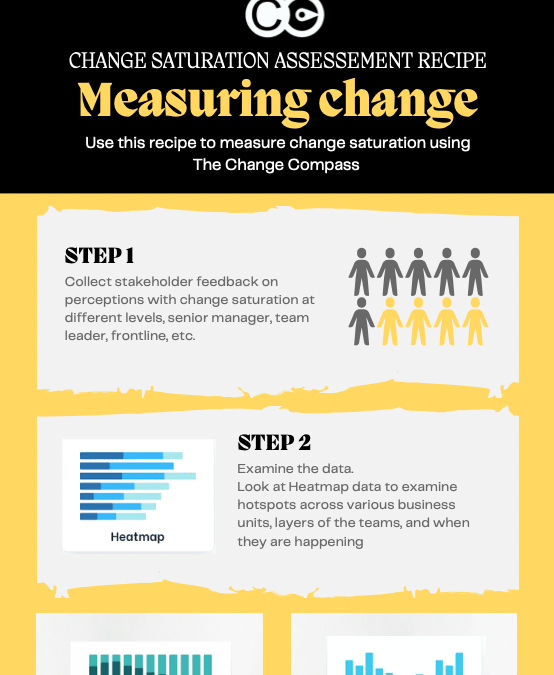
A more structured approach – a measurement recipe that produces actionable, comparable data – is what effective change saturation management requires. Download the Change Saturation Assessment Recipe for a step-by-step guide to measuring change saturation using The Change Compass.
Why personal opinion is an unreliable saturation measure
The instinct to measure change saturation through personal opinion – asking people whether they feel overwhelmed – has an obvious appeal. People experiencing saturation know it. Their self-report seems like direct access to the phenomenon being measured. The problem is that self-reported saturation is systematically biased in ways that make it unreliable for portfolio management decisions.
The first bias is social desirability. Employees who are experiencing genuine saturation may not report it accurately in formal measurement contexts if they believe reporting saturation will reflect negatively on their resilience or capability, or if they believe the organisation is not genuinely open to reducing the change load. In cultures where maintaining a positive front through adversity is valued, saturation is consistently underreported through self-report mechanisms.
The second bias is anchoring. Employees’ assessment of their saturation is relative to their recent experience. A team that has been operating at high saturation for an extended period may rate their current state as normal – because it is normal for them – even though it would be rated as high saturation by an objective measure. Conversely, a team that has recently experienced a significant increase in change load may rate themselves as highly saturated even if their objective load is within a manageable range, simply because the change from their recent baseline feels dramatic.
The third bias is aggregation. Even when individual self-reports are reasonably accurate, aggregating them across teams produces a misleading picture because the teams most likely to underreport saturation – those with the most competitive cultures, the most pressure to appear capable – are also those most likely to be genuinely saturated. The aggregate measure therefore understates saturation precisely where it is most severe.
The components of a structured saturation measurement approach
An effective change saturation measurement recipe builds the saturation assessment from objective components rather than deriving it from subjective opinion. The core components are: the volume of change programmes affecting a specific employee group, the intensity of those impacts (how much behavioural shift each change requires), the timing concentration of those impacts (how many significant changes are happening simultaneously versus sequenced), and a capacity baseline against which the aggregate load can be assessed.
Volume is the most commonly measured dimension – it is what heatmaps capture. But volume alone is insufficient, for the reasons described in change measurement literature. A single high-intensity change requiring employees to completely redesign their workflows is a fundamentally different saturation driver than five low-intensity changes requiring minor process adjustments. A measurement approach that counts changes without weighting them by intensity will misclassify teams’ saturation risk: overestimating the saturation of teams with many minor changes and underestimating it for teams with fewer but more transformative ones.
Prosci’s ADKAR model provides a useful framework for thinking about impact intensity – the degree to which a change requires employees to develop new knowledge, new capability, and new habitual behaviours, as distinct from simply being aware that something has changed. Changes that require new knowledge and capability development impose a substantially higher saturation load than those that require awareness and comprehension only. Structuring impact assessment around these ADKAR dimensions allows intensity to be captured in a way that reflects the actual cognitive and behavioural demand on employees.
Establishing capacity baselines and thresholds
Saturation is a relative concept – it describes the relationship between demand and capacity, not demand alone. Measuring demand without reference to capacity produces a number with no meaning. The second essential component of a structured saturation measurement recipe is a capacity baseline: an estimate of how much change demand a specific employee group can absorb sustainably over a defined period.
Capacity baselines can be established from multiple sources. Research-derived benchmarks – the published estimates of sustainable change load from organisations like Gartner and Prosci – provide starting points that can be calibrated to the specific context. Historical data – the correlation between past change load levels and subsequent adoption rates, attrition data, and engagement score movements – provides an empirical basis for establishing what level of change demand has historically been sustainable for specific employee groups in this organisation. And contextual factors – the current operational pressure on a team, their recent change history, their access to change support resources – adjust the baseline upward or downward based on factors the generic benchmarks do not capture.
Gartner research on change fatigue provides one of the most widely referenced frameworks for understanding capacity thresholds – specifically the finding that the average employee can effectively absorb a limited number of concurrent major changes before saturation occurs. Using this research as a calibration reference, combined with organisational-specific data, allows change leaders to establish saturation thresholds that are both research-grounded and contextually valid.
From measurement to actionable recommendations
The purpose of change saturation measurement is not to produce a number. It is to produce recommendations that stakeholders can act on. The measurement recipe therefore needs to specify not just how to assess saturation but how to translate the assessment into specific governance decisions and operational interventions.
At the governance level, saturation data should inform three types of decision: sequencing decisions (should this programme’s implementation be deferred because the affected teams are currently at or near their saturation threshold?), descoping decisions (can this programme be redesigned to reduce its saturation impact on the most overloaded employee groups without materially compromising its intended outcomes?), and resourcing decisions (does this programme require additional change support investment because the teams it is landing on have limited remaining adaptive capacity?).
At the programme level, saturation data should inform stakeholder engagement prioritisation (which teams need the most intensive support?), communication design (what communication approach is appropriate for teams in a high-saturation state versus those with ample capacity?), and the structure of transition support (what is the right blend of training, peer support, manager coaching, and post-go-live stabilisation for teams at different saturation levels?).
Platforms like The Change Compass support the full saturation measurement recipe by providing the data infrastructure – structured impact collection, portfolio aggregation by employee group, and visualisation of saturation against capacity thresholds – that makes this analysis operationally viable. Rather than assembling the measurement manually from programme-level spreadsheets, change leaders can access the saturation picture in real time and model the saturation implications of proposed portfolio decisions before committing to them.
Common mistakes in change saturation measurement
Several recurring errors undermine change saturation measurement efforts even in organisations that have invested in structured approaches. The first is measuring saturation at the wrong level of granularity. A division-level saturation score conceals the variation between teams within that division – a team experiencing extreme saturation may be averaged out by adjacent teams with much lighter loads, producing a comfortable aggregate that masks a genuine crisis at the team level. Effective saturation measurement requires the resolution to be at the team or role group level, not the business unit level.
The second mistake is measuring saturation at a single point in time rather than tracking it over a rolling period. A team that appears to be within its capacity threshold today may be accumulating load from changes that are about to peak simultaneously in the next quarter. Saturation measurement that shows only the current state rather than the projected trend line provides insufficient warning for the governance decisions that require lead time to implement.
The third mistake is treating the saturation assessment as separate from the portfolio governance process. Saturation data that is produced and then not connected to a decision-making process – where the data sits in a report that no governance body is empowered to act on – is not a management tool. It is a documentation exercise. McKinsey research on change programme failure consistently identifies the absence of in-flight decision authority as a primary cause of poor change outcomes – the data exists but no one has the authority or the process to act on what it shows. Connecting saturation measurement to governance structures with real authority to defer, descope, or resource programmes accordingly is what converts measurement from a reporting activity into a management capability.
Frequently asked questions
What is change saturation and how is it measured?
Change saturation occurs when the cumulative demand of concurrent change programmes on a specific employee group exceeds that group’s adaptive capacity. It is measured by combining three components: the volume of changes affecting the group, the intensity of those changes (the degree of behavioural shift each requires), and the timing concentration (how many significant changes overlap simultaneously). This demand measure is then compared against a capacity baseline to determine whether the group is operating within, at, or above its saturation threshold. Subjective self-report alone is insufficient as a saturation measure due to systematic biases in how saturation is perceived and reported.
How do you establish a capacity baseline for change saturation measurement?
Capacity baselines can be established from published research benchmarks (such as Gartner’s research on change fatigue and sustainable change load), from historical organisational data showing the relationship between past change load levels and adoption outcomes, and from contextual calibration factors such as the current operational pressure on the team, their recent change history, and their access to change support. The most reliable baselines combine all three sources, using the research as a starting point and calibrating it to the specific organisational context.
What decisions should change saturation data inform?
At the portfolio governance level, saturation data should inform decisions about programme sequencing (deferring changes to groups at or near saturation), descoping (reducing impact intensity for overloaded groups), and resourcing (allocating additional change support to high-saturation teams). At the programme level, it should inform stakeholder engagement prioritisation, communication design, and the structure of transition support. Saturation measurement that is not connected to a governance process with authority to act on its findings is a reporting activity rather than a management tool.
Why is team-level granularity important in change saturation measurement?
Business unit or division-level saturation scores conceal the variation between teams within those units. A team experiencing extreme saturation may be averaged out by adjacent teams with much lighter loads, producing an apparently comfortable aggregate score that masks a genuine crisis at the team level. Effective saturation measurement requires team or role group-level granularity to surface the concentrated saturation patterns that require targeted management responses and that business unit aggregates systematically obscure.
Most change managers still measure transformation the way accountants balanced ledgers before spreadsheets: manually, periodically, and at the project level. The data arrives late, reflects only what was easy to capture, and serves reports more than decisions. Change management software has changed this significantly, but the full potential of software-enabled measurement is still underused in most large organisations.
This is a practical gap, not just a philosophical one. Gartner research found that only 32% of business leaders report achieving healthy change adoption among employees, despite most having change management frameworks in place. The gap between having a methodology and achieving adoption is, in large part, a measurement problem. If you cannot see adoption in real time, you cannot respond to it in time to make a difference.
Change management software measurement closes this gap. But understanding what software actually measures, what that data tells you, and how to apply it to your practice is where most teams need more depth.
The problem with manual change measurement
Before we get into what software enables, it is worth being clear about why the manual approach falls short.
The most common manual measurement approach involves stakeholder surveys at project milestones, training completion spreadsheets, and periodic progress reports compiled by each change manager. The problems are well-documented:
Data is collected at points in time, not continuously, so you only know what was true when you asked
Each project team uses slightly different scales and questions, making portfolio-level comparison impossible
The data tends to reflect perceptions of process activity (training done, communications sent) rather than actual adoption behaviour
By the time data reaches a report, it is often too old to act on
The result is that change functions often have a lot of data but limited insight. They can demonstrate activity but struggle to demonstrate impact.
Why this matters more than ever
Organisations are running more change programmes simultaneously than at any point in the last decade. Prosci’s correlation research consistently shows that projects with excellent change management are approximately seven times more likely to meet their objectives than those with poor change management. At the portfolio level, the difference between rigorous and ad-hoc change measurement is increasingly the difference between transformation programmes that land well and those that stall mid-delivery.
What change management software actually measures
Not all change management software measures the same things. It helps to understand the distinct measurement categories before evaluating any particular platform.
Adoption and readiness tracking
The most mature change management platforms enable real-time tracking of adoption across stakeholder groups, business units, or geographies. Rather than a single survey at go-live, you get a time-series view: where adoption is accelerating, where it is plateauing, and which groups are lagging. This allows your team to intervene before adoption failure becomes irreversible.
Readiness tracking operates similarly. Instead of a single readiness assessment six weeks before a programme goes live, software-enabled readiness measurement gives you a running picture of readiness across multiple dimensions: leadership alignment, process readiness, capability readiness, and technology readiness. Each dimension can be weighted and scored differently depending on the nature of the change.
Change impact and load
One of the most significant measurement capabilities that only software can reasonably provide at scale is change impact measurement across a portfolio. When you are running 15 or 20 change initiatives simultaneously, manually aggregating impact data across those programmes is practically impossible. Software platforms designed for portfolio change management, such as The Change Compass, enable impact data to be consolidated across the portfolio and visualised at the business unit or role group level.
This matters because the cumulative change load on a group of employees is often the single biggest predictor of adoption problems. An employee group facing five simultaneous changes, each individually manageable, may be at saturation point in aggregate. Manual measurement almost never surfaces this risk. Software measurement can.
Activity and engagement metrics
Beyond adoption outcomes, change management software tracks the activities that drive adoption: training attendance and completion rates, communication engagement (opens, clicks, responses), stakeholder engagement session attendance, and feedback loops. When tracked systematically, these activity metrics serve as leading indicators of adoption. A drop in training completion is a signal; a drop combined with declining stakeholder engagement attendance and decreasing survey participation is an early warning system.
Delivery tracking and change team performance
For change functions operating at scale, software also tracks the delivery of change management work itself: are plans being executed, are deliverables completed on schedule, are change budgets being spent as intended. This type of tracking serves accountability and continuous improvement within the change function.
Four measurement capabilities that separate good from great
Based on what the best-performing change functions in enterprise organisations do differently, four specific capabilities distinguish rigorous change management software measurement from basic reporting.
Baseline and benchmark data. Without a starting point, all measurement is relative to nothing. Software platforms that capture baseline readiness and adoption data before a change goes live allow you to compare ‘before’ and ‘after’ states with credibility. This is not just useful for internal learning, it is the data that change leaders need when demonstrating value to executives.
Role-level granularity. Organisation-level averages hide the distribution. A 72% adoption rate across the business might feel acceptable until you learn that three critical user groups are at 40%. Software measurement should provide role and business unit breakdown as a standard view, not a custom report.
Portfolio aggregation. The ability to see cumulative change load, adoption rates, and delivery status across all active programmes simultaneously is the most strategically valuable measurement capability a change function can have. It enables portfolio-level decision-making that is simply not possible with project-level spreadsheets.
Real-time alerting. The purpose of measurement is to enable decisions. Software that surfaces alerts when adoption drops below thresholds, when change load in a business unit exceeds safe limits, or when delivery milestones are missed turns measurement from a retrospective activity into a proactive management tool.
From manual measurement to decision intelligence
The shift from manual to software-enabled change measurement is not primarily about efficiency, though it is substantially more efficient. It is about the quality and timeliness of the decisions the measurement supports.
Capgemini Invent’s change management study surveyed 1,175 professionals across industries and found that organisations with high data maturity in their change programmes experienced 27% higher change success rates. The study identified data-driven leadership as adding a further 23% lift. These are not marginal improvements; they are the difference between change programmes that achieve their business cases and those that fall short.
The implication for your change function is practical. Where are you on the manual-to-software measurement spectrum? Do your decisions about change priority, resource allocation, and stakeholder intervention rely on real data or on informal knowledge and experience? Both matter, but experience without data is a ceiling that software can help you raise.
Using The Change Compass for change management software measurement
The Change Compass is designed specifically for enterprise change measurement challenges. It addresses portfolio-level change impact tracking, cumulative load visualisation, and adoption measurement in a single platform, with dashboards configured for different stakeholders: change teams need granular data, executives need portfolio health signals.
The platform’s measurement architecture is built around the insight that most change failures are not programme-specific; they are portfolio-level saturation problems that no one saw coming because no one was measuring load in aggregate. Software-enabled measurement changes the nature of the conversation you can have with business leaders from “our programme is on track” to “the combined change load on your customer service team is at risk level, and here is what we need to adjust.”
That is a fundamentally different conversation, and it is one that elevates the strategic contribution of the change function.
Making the shift in your organisation
If your change function is still primarily relying on manual measurement, a few practical steps can start the transition toward software-enabled measurement without requiring a complete overhaul of your existing approach.
Start with the portfolio view. Even if individual programme measurement remains manual, creating a centralised view of all active changes and their impact on key employee groups is a significant improvement. This does not require sophisticated software at first, but it clarifies what data you would need to collect consistently to make this view meaningful.
Standardise your baseline metrics. Before you can measure change across projects, you need a standard set of measures that every project uses. Readiness dimensions, adoption stage definitions, and impact categories need to be consistent across the portfolio. This standardisation is a prerequisite for any aggregated measurement.
Choose software that fits your portfolio complexity. The right change management software for a team running three projects simultaneously is different from what you need when running 25. Evaluate platforms based on the measurement use cases that matter most in your context: adoption tracking, portfolio load, or delivery management.
Where measurement should take you
Change management software measurement is not an end in itself. The goal is better decisions, sooner. When your measurement system is telling you that a business unit is approaching change saturation three months before a major go-live, you have time to act. When adoption data shows that a specific stakeholder group is consistently lagging while others are progressing, you have the basis for a targeted intervention.
The change functions that are most valued by their organisations are those that can show, with data, what the change landscape looks like and what it means for the business. Software-enabled measurement is what makes that possible.
Frequently asked questions
What is change management software measurement?
Change management software measurement refers to the use of digital platforms to systematically capture, aggregate, and analyse data about change adoption, readiness, stakeholder engagement, and change impact across one or more change programmes. It replaces or supplements manual spreadsheet-based tracking with real-time dashboards and portfolio-level visibility.
Can software really measure something as intangible as change adoption?
Yes, with the right design. Adoption is measured through a combination of leading indicators (training completion, engagement activity, survey participation) and lagging indicators (system usage data, process adherence, performance metrics). Software platforms aggregate these signals into a coherent adoption picture across stakeholder groups over time.
What is the difference between project-level and portfolio-level change measurement?
Project-level measurement tracks adoption and readiness for a single initiative. Portfolio-level measurement aggregates data across all active change programmes to reveal cumulative impacts, such as which business units are carrying the heaviest combined change load at any given point. Portfolio measurement is substantially more complex but significantly more strategically valuable.
How does change management software measurement improve ROI?
Prosci research shows that projects with excellent change management are seven times more likely to meet their objectives than those with poor change management. Software measurement supports excellent change management by providing real-time visibility that enables faster, better-informed interventions, directly improving adoption outcomes and benefits realisation.
What should I look for in change management software for measurement purposes?
Look for: role-level and business unit breakdown of adoption data, portfolio aggregation across multiple simultaneous programmes, baseline and trend data (not just point-in-time snapshots), configurable dashboards for different stakeholder audiences, and alert functionality that surfaces issues before they become crises.
Do I need to replace my existing tools to use change management software?
Not necessarily. Many change management platforms are designed to integrate with or complement existing project management and HR systems. The key requirement is data consistency, specifically standardising how adoption, readiness, and impact are defined and measured across your portfolio so that aggregated views are meaningful.
References
Prosci. The Correlation Between Change Management and Project Success. https://www.prosci.com/blog/the-correlation-between-change-management-and-project-success
Gartner. Gartner HR Research Finds Just 32% of Business Leaders Report Achieving Healthy Change Adoption by Employees (2025). https://www.gartner.com/en/newsroom/press-releases/2025-07-08-gartner-hr-research-finds-just-32-percent-of-business-leaders-report-achieving-healthy-change-adoption-by-employees
Capgemini Invent. Change Management Study 2023. https://www.capgemini.com/insights/research-library/change-management-study-2023/
Capgemini. Data-Driven Change Management is Crucial for Successful Transformation. https://www.capgemini.com/news/press-releases/data-driven-change-management-is-crucial-for-successful-transformation/
The Change Compass. How to Measure Change Management Success: 5 Metrics Leaders Actually Use. https://thechangecompass.com/how-to-measure-change-management-success-5-key-metrics-that-matter/
When change management operates strategically, it looks nothing like what most change practitioners spend most of their time doing. Strategic change management is not better communication planning or more rigorous impact assessment, though both of those things matter. It is a fundamentally different relationship between the change function and the organisation, one where change capability is treated as a competitive asset rather than a project service.
The gap between tactical and strategic change management has never been more consequential. McKinsey’s State of Organizations 2026 report, drawing on input from more than 10,000 executives across 15 countries, found that organisations can no longer treat transformation as a finite project. Transformation has become a permanent condition. The old model of launching a change programme and then returning to business as usual is no longer viable. McKinsey frames the new normal as “business as change.”
For change leaders, this is both an opportunity and a challenge. The demand for strategic change capability has never been higher. The organisations that develop it will build a durable advantage. Those that remain stuck in project execution mode will struggle to keep pace.
What makes change management strategic
The distinction between strategic and tactical change management is not about scale. A large, complex programme managed in a reactive, project-centric way is still tactical change management. Strategic change management is defined by four characteristics.
Integration with organisational strategy. Strategic change management connects the work of the change function directly to the organisation’s strategic priorities. It answers the question: which of our strategic goals require significant behavioural and cultural change to be realised, and are we managing those changes in a way that reflects their strategic importance? This requires change leaders to have a clear understanding of strategy, not just the change programmes that implement it.
Portfolio-level thinking. Strategic change management operates at the level of the change portfolio, not the individual initiative. It assesses cumulative change load, sequences initiatives to minimise saturation, and makes resource allocation decisions based on strategic priority rather than individual project demands. This is fundamentally different from providing project-level change support, even very well-executed project-level support.
Proactive anticipation. Tactical change management is typically reactive: a change is announced, and the change team responds. Strategic change management anticipates organisational change demand, builds change capacity ahead of need, and develops the conditions for adoption before specific initiatives are launched. This requires ongoing relationship with business strategy and executive planning rather than engagement at the point of project mobilisation.
Contribution to organisational capability. Strategic change management builds lasting capability in the organisation, not just in the change team. It develops change leadership capability in line managers, creates shared understanding of change at executive level, and leaves behind processes and tools that the organisation can apply independently. The measure of success is not how well any individual change was managed, but how much better the organisation has become at managing change over time.
Why strategic change management is harder than it sounds
There is a well-documented tension between the strategic ambition of most change functions and the tactical reality of how they operate day to day. Gartner research found that organisations adapting their change plans continuously based on employee responses are four times more likely to achieve change success , yet in practice, most change plans are set at programme initiation and rarely revisited.
Several structural factors push change functions toward tactical operation.
The resourcing model traps change in delivery mode
Most change functions are staffed to deliver change programmes, not to manage organisational change capability. When demand increases, headcount increases. When programmes finish, people are redeployed. This model makes it very difficult to develop and maintain the strategic view. There is no slack in the system for the kind of reflection, analysis, and planning that strategic change management requires.
The more sustainable model is a hybrid: a small, permanent core team responsible for portfolio management, change capability development, and executive engagement, supported by programme-specific resources that scale with demand. The core team is the strategist; the programme resources are the delivery engine.
Change functions are often engaged too late
A recurring pattern in large organisations is that change functions are brought into major programmes after key design decisions have already been made. By the time change management is engaged, the scope is fixed, the timeline is set, and the change team’s role is essentially to prepare people for a change they had no part in shaping.
Strategic change management requires a different entry point. Change leaders need to be involved in programme business cases, not just programme execution. The question of whether employees in specific roles can absorb a given change, and what it will take for them to do so effectively, is a design input, not an afterthought.
Measurement remains activity-focused
Many change functions measure activity: communications sent, training sessions delivered, stakeholder engagements completed. These metrics demonstrate that work is being done; they do not demonstrate that change is happening. Strategic change management requires outcome-based measurement, specifically adoption rates, readiness progress, and benefits realisation attributable to the quality of change management.
McKinsey’s research found that two-thirds of leaders say their organisations are overly complex and inefficient, and nearly 40% say redefining process flows is the biggest unlock over the next one to two years. Change functions that cannot demonstrate, in outcome terms, what they contribute to navigating this complexity are vulnerable to being treated as optional overhead.
A framework for making the shift
Moving a change function from tactical to strategic operation requires work in three areas simultaneously: positioning, process, and proof.
Positioning: establish the right relationships
Strategic change management requires a seat in conversations where strategy is made and where organisational decisions are taken. This means regular engagement with the executive team and senior HR leadership, not just the programme sponsors of individual initiatives. It means having a point of view on the organisation’s change landscape as a whole, and the ability to articulate what that landscape means for the organisation’s strategic ambitions.
For many change leaders, this requires deliberately building new relationships. The first step is often securing a recurring forum with HR and business leadership where the portfolio change view is presented and discussed. This forum does not need to be large or formal; the important thing is that it exists and that change leaders show up with data, not just anecdotes.
Process: build the portfolio view
The foundation of strategic change management is visibility of the full change portfolio. This means knowing, at any point in time, what changes are active or planned, which employee groups are bearing the heaviest cumulative load, and where the highest adoption risks sit across the portfolio.
Building this view typically requires:
A consistent taxonomy for classifying change types and impact dimensions
A standard approach to impact assessment that produces comparable data across programmes
A portfolio management process that aggregates individual programme data into a single view
A review cadence (usually monthly at portfolio level, quarterly at executive level) where the aggregated view informs decisions
Platforms like The Change Compass are designed specifically for this portfolio management challenge, enabling change functions to visualise cumulative load, adoption status, and delivery risk across all active programmes in a single view. The value of purpose-built software here is that it makes the aggregation work tractable at scale, and it generates the kind of consistent, credible data that executive conversations require.
Proof: measure and communicate outcomes
Strategic change management requires a measurement approach that connects change work to business outcomes. The most powerful framing is: what would have happened to this programme’s adoption, benefits realisation, and timeline if change management had not been applied, or had been applied less rigorously?
This counterfactual is rarely available in pure form, but proxy measures are. How did adoption in groups that received intensive change support compare to groups that received standard support? How do benefits realisation timelines compare between programmes with strong change management and those without? These comparisons, accumulated over time, build a compelling evidence base for the value of strategic change investment.
Strategic change management in practice: what it looks like differently
The practical differences between tactical and strategic change management are visible in the questions that change leaders ask.
Tactical questions focus on the programme: “Are stakeholders aware? Is training designed? Is the communication plan approved?” These are necessary questions, but they do not establish strategic contribution.
Strategic questions focus on the organisation: “What is the total change load on our customer operations team over the next 90 days, and can they absorb the go-live we have scheduled? Are we building change leadership capability in our line managers, or are we creating dependency on the change team? Are the programmes in our portfolio sequenced in a way that reflects strategic priority, or in the order they happened to be funded?”
The shift to asking strategic questions is the most visible sign that a change function is developing strategic orientation. And it is visible to executives, who notice the difference between a change leader who talks about programme activities and one who talks about organisational capability and portfolio risk.
Where to start
The most common mistake in attempting to shift toward strategic change management is trying to do everything at once: restructure the team, redesign the measurement approach, and renegotiate the function’s role with executives simultaneously. This rarely works. The conditions for each of these changes take time to develop.
A more effective approach is to start with one highly visible, credible intervention that demonstrates the value of the strategic orientation. Building the first portfolio-level change view, even if it is imperfect, and presenting it to executive leadership with a clear “here is what this means for our organisation” narrative, is the most powerful single step most change functions can take.
From there, the strategic orientation deepens. Each successive executive engagement that demonstrates portfolio-level thinking builds credibility. Each outcome measurement that connects change work to business performance builds the evidence base. Over 12 to 18 months, the function’s positioning shifts from programme delivery partner to strategic change leadership capability.
Frequently asked questions
What is strategic change management?
Strategic change management is the practice of applying change capability at the organisational level rather than the individual programme level. It involves managing the full portfolio of change initiatives, anticipating and building change capacity ahead of demand, and positioning the change function as a contributor to strategic outcomes rather than a project service provider.
How is strategic change management different from tactical change management?
Tactical change management focuses on executing change well at the programme level: good communication, effective training, rigorous stakeholder engagement. Strategic change management operates above this level, managing the total change load on the organisation, integrating with strategic planning, and building lasting change capability. Both are necessary; strategy without execution is ineffective, and execution without strategy is misaligned.
Why do most change functions operate tactically even when they aspire to be strategic?
Three structural factors are most common: resourcing models that are built entirely around programme delivery, leaving no capacity for strategic work; late engagement in programmes, meaning change teams inherit decisions rather than informing them; and activity-based measurement systems that reward doing rather than outcomes. Shifting away from these requires deliberate decisions by change leadership and sponsorship from HR and executive levels.
What data does a change function need to operate strategically?
At minimum: a consistent view of all active and planned change initiatives, their impact on specific employee groups, and their current adoption and readiness status. Portfolio-level aggregation of this data is what enables the strategic conversations that distinguish the function from project-level service delivery.
How long does the shift to strategic change management take?
Meaningful progress is visible within 12 months for functions that make deliberate investment in the transition. Full repositioning, where the change function is routinely engaged in strategic planning and its value is measured in outcome terms, typically takes two to three years. The most important accelerant is one credible early win: a portfolio-level intervention or data-driven executive conversation that demonstrates the value of the strategic orientation.
What tools support strategic change management?
Portfolio management platforms designed for change, like The Change Compass, are the most significant enabler of the shift to strategic operation. They make the data aggregation and portfolio visualisation work tractable that would otherwise require substantial manual effort, and they generate the consistent, reliable data that strategic change leadership requires.
References
McKinsey. The State of Organizations 2026: Three Tectonic Forces That Are Reshaping Organizations. https://www.mckinsey.com/capabilities/people-and-organizational-performance/our-insights/the-state-of-organizations
Gartner. Gartner Identifies the Top Change Management Trends for CHROs in the Age of AI (2026). https://www.gartner.com/en/newsroom/press-releases/2026-3-16-gartner-identifies-top-change-management-trends-for-chros-in-age-of-ai
Gartner. Gartner Says CHROs’ Top Priorities for 2026 Center Around Realizing AI Value and Driving Performance Amid Uncertainty. https://www.gartner.com/en/newsroom/press-releases/2025-10-02-gartner-says-chros-top-priorities-for-2026-center-around-realizing-ai-value-and-driving-performance-amid-uncertainty
Prosci. The Correlation Between Change Management and Project Success. https://www.prosci.com/blog/the-correlation-between-change-management-and-project-success
Capgemini Invent. Change Management Study 2023. https://www.capgemini.com/insights/research-library/change-management-study-2023/
Showing the value of change management is something that change practitioners have yearned for. Some senior leaders do not understand the value of change management and either see it as a normal part of general business management or don’t even understand what it is. For less mature organisations, change practitioners often need to spend significant time educating stakeholders and explaining why they are doing the work that they are hired for. Calculating and showing the financial value of change portfolio management can be the ultimate ‘proof’.
Calculating the value of change management has been a difficult task to accomplish since a lot of the work of managing change is deemed as ‘soft’ and about people and leadership. There are various attempts to calculate in financial terms the value of managing change. These approaches include ROI (return on investment) and cost-benefit analysis. However, this approach is purely focused on a cost level and does not look at the value of the impact of change management work.
At a change portfolio level, there is even less in the literature. Not only is there not a lot of content on how to manage a portfolio of changes, but there is also almost no mention in the literature on how to calculate the financial value of managing a change portfolio.
A lot of organisations do not invest in managing initiatives across the portfolio from a change management perspective. This could be due to a lack of change management maturity or experience. Managing initiatives across a portfolio requires not only senior leader sponsorship but also having the right change governance, operational routines, change management analytics and decision-making capability in conducting ‘air traffic control’, sequencing, and resource prioritisation.
One of the difficulties is in trying to measure the value of the whole discipline, which may be too complex and wide in breadth to take into account. A better approach may be to look at the tangible parts of value created from managing a portfolio of changes.
One of the key values of effectively managing a portfolio of changes is helping the organisation better prioritise the right initiatives, the right sequencing of initiative implementation, and therefore the right resources to support these initiatives. This includes not just the right resource focus and allocation from a project implementation perspective, but also from a business perspective when it comes to change readiness and adoption.
A McKinsey study showed that companies that are better at prioritising resources to support initiatives can reap an average of 40% more value than other companies. Note that this is not ‘up to 40%’ but an ‘average of 40%’. This is a significant finding and shows how much this impacts the value of the company.
How do we calculate this change portfolio financial value?
Step 1 – Calculating the value of the company
One simple way to calculate the value of a company can be calculated by using this simple equation:
Value = Earning after tax x P/E (price to earnings) Ratio
Earnings after tax = This number you should be able to get from Finance, or for public companies, this figure should be available in the published Income Statement.
Price to earnings ratio = There are several ways to get this figure. Market value per share divided by earnings per share. Or if this number is not available you can use the average P/E ratio number of 14 as the average for S&P 500.
Let’s take a few examples.
Your company’s earnings after tax is $100 million. And if your P/E ratio is not available, then the value of the company is $100 million x 14 = $1.4 billion.
Your company’s earnings after tax is $300 million. And if you’re P/E ratio is not available, then the value of the company is $300 million x 14 = $4.2 billion.
Step 2 – Calculating the value of prioritising resources to support your initiative portfolio
In the McKinsey study, the 40% increase in company value was over a 15 year period. Let’s assume this is taking into account the compounded effect of incremental value year in and year out. Using a reverse compounded interest calculator would equate to 2% per year in incremental value.
In the example where the value of company is $1.4 billion.
$1.4 billion x 0.02 (2%) = $28 million
In the example where the value of the company is $4.2 billion
$4.2 billion x 0.02 (2%) = $84 million
You can see now that we are talking about a significant chunk of money. This is because of the increase in the value of the company from making the right decisions in focusing and appropriately resourcing the prioritised set of initiatives and having the right business focus to support these initiatives. Creating the right focus, the right change sequences, the right change ‘packages’, and changes that are ‘bite-sized’ as needed can all contribute to optimised change outcomes.
Resources and organisational energy are also not wasted on initiatives that are less critical and perhaps more likely to fail or achieve less adoption. These then translate to enhanced overall benefit realisation, and therefore improved value creation for the company overall.
This contrasts significantly with the focus on individual projects and the calculation of ROI where change management is viewed as a cost to the business. At a per-project level this may make sense, however, most companies are executing multiple projects at the same time. Sure, you can try and calculate the change management ROI for every project and still not capture the total value. This is because “the sum is greater than its parts” to quote Aristotle.
How do we use this value?
There are many ways to use this financial calculation:
Business leaders who don’t understand the value of managing change across the portfolio and struggle to see the relevance or business benefit of investment in this area
Project portfolio managers who would like to better understand and articulate the ‘prize’ in focusing on change portfolio management beyond the existing project portfolio management focus areas
Operational leaders who would like to understand the value of ‘air traffic control’ of the various initiatives that impact their business units
Change practitioners who have been asked to prove the value of managing across the portfolio and why this is needed across multiple initiatives
Delivering constant changes is a requirement in implementing agile change management. With each iteration, a change is being designed and released as a part of ongoing agile development and project implementation. However, there is little mention in change management literature of how to go about delivering change constantly and be able to achieve optimum change adoption.
Continuous delivery pipeline
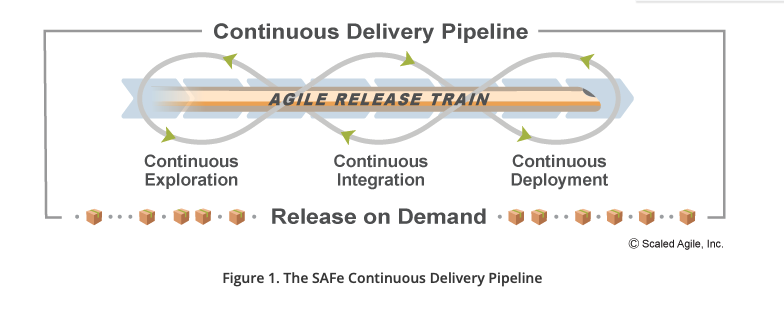
The concept of a ‘continuous delivery pipeline’ is a core part of the agile methodology. It refers to having a structured pipeline of continuous changes being released as required by the organisation. The pipeline contains a set of features and changes to be worked on, and the resulting prioritised changes are released when and as needed.
The three components of a continuous delivery pipeline that forms an agile release train include:
Continuous exploration – This is about defining and scoping what needs to be built using human centred design approaches to design the problem that needs to be solved from the user perspective
Continuous integration – This step involves taking those prioritised features from the backlog and investigating further to understand what development work is required to turn them into solutions for the user.
Continuous deployment – This is about turning the completed changes from the staging environment into production, meaning the live product that is ready to be used by the user. After the technical part of the solution is ready to be released, the business then determines when is a good time for this release to go ahead.
The ‘technical side’ of the agile team is fairly well defined in terms of the roles and responsibilities of each member, including project manager, developer, QA/testing, business analyst, business owner, etc. However, the role of the change manager is much less defined and black and white. This does not mean that there is no role for the change manager though. It just means that the agile literature has not well defined the details for the role of the change manager in an agile team. ‘Agile change management’ still has some work to do to make itself better known to other agile team members.
So how does the change manager get ready to deliver a series of constant changes?
Delivering a series of constant changes is no easy feat. The main issue is that most businesses are not designed to face multiple changes, and nor are they designed to face a series of continual changes either.
Change approaches are primarily written for working on one change at a time, and not in a setting where there are continual releases of changes going on. On the other hand, how many organisations do you know that are only facing one change? Or that only deals with one change within a month? This type of stable change environment may have been the norm years ago when the business environment was much more predictable and stable. Hence, using a waterfall project approach was appropriate at the time. Fast-forwarding to the 2020s most organisations are juggling with constant and multiple changes as the norm.
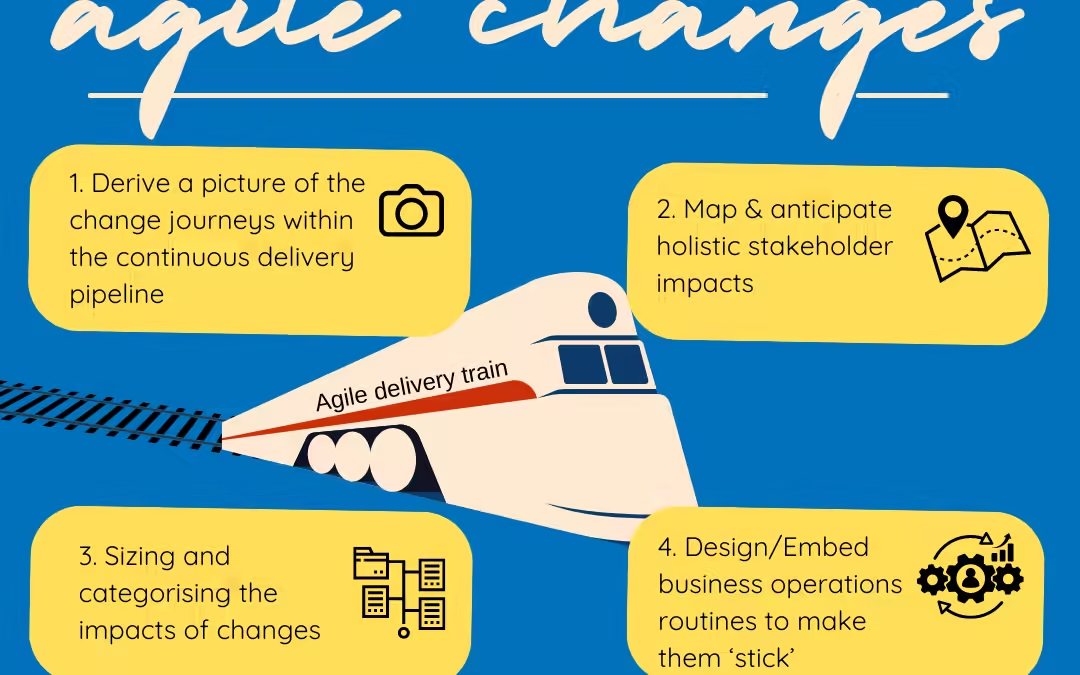
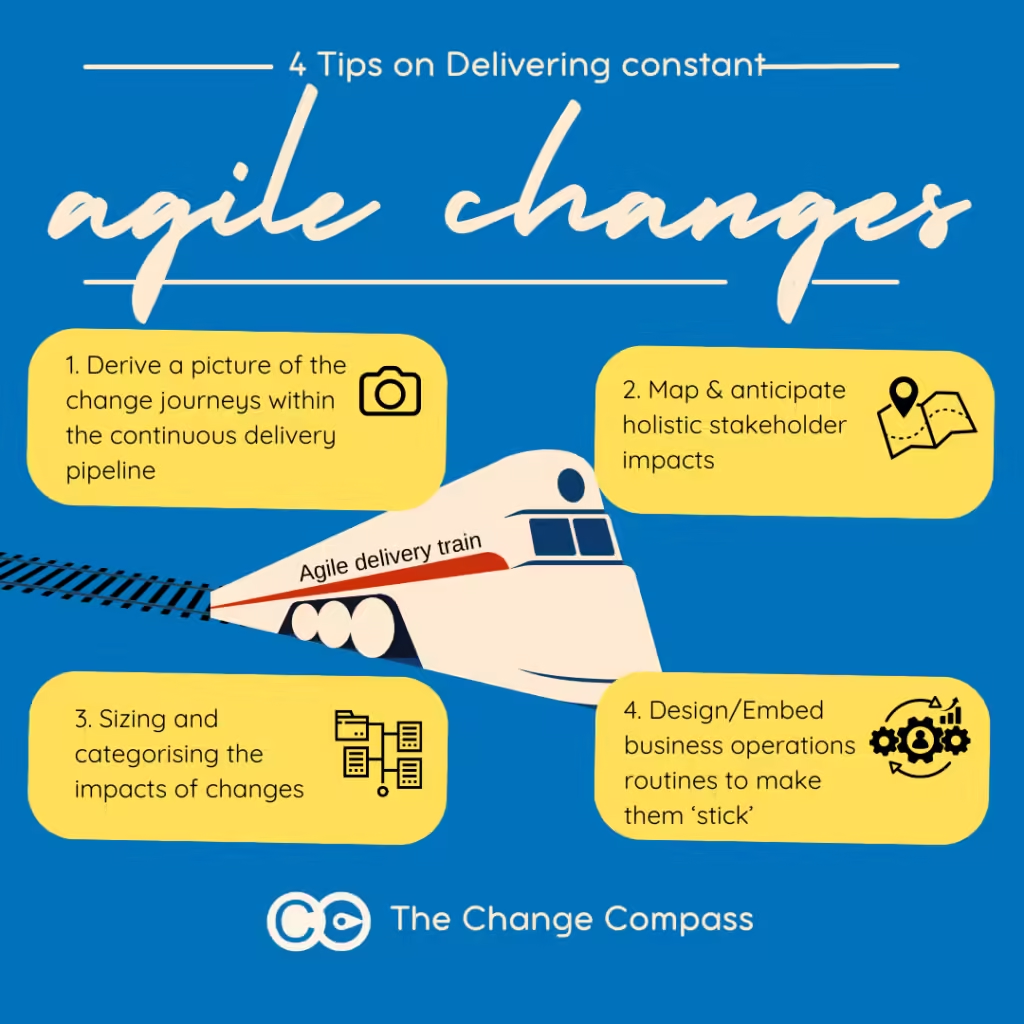
1. Derive a picture of the changes within the continuous delivery pipeline.
Deriving a clear picture of what changes look like within a project is critical. Without this, you will not be able to clearly communicate to your stakeholders what changes are coming down the pipeline.
To create this picture, use a human-centred approach and illustrate what the user will go through throughout the change journey. This is similar to a user journey map. However, a change-focused picture goes beyond just what the user will be going through. It also includes not just person-based changes, but also process, policy, system, governance, reporting and other changes. Outlining these changes will complete the whole picture of what each change release may look like.
A key problem in creating a picture of the changes early on is that the project team may not even know what the solution looks like. And without particular details of every change release and solution design, it may be hard to create this picture.
The recommended approach is to focus on what the outcome could look like versus focusing on various technical or process solutions. This means you may even need to make particular assumptions in defining what these changes look like. For example:
Release 1: Ability to turn recorded customer conversations into text. With this feature, there will be new risk and privacy processes and governance be put in place in the monitoring and storage of customer data.
Release 2: Ability to search for customer conversation history and flag follow up actions required. Specialist roles may be required to audit customer conversation text. Behaviour shifts in proactively checking on customer history and knowing what to look for in trends is critical.
Release 3: Ability to use analytics to predict customer turnover and use this to minimise customer turnover. Significant capability uplift is required to ensure that consultants are able to know how to use analytics to help minimise customer turnover. Analytics capability uplift is also required at operations management, supervisor and team leader levels.
2. Map holistic stakeholder impacts.
In order to implement constant ongoing changes, it is critical to understand holistically what the stakeholders are undergoing across all types of changes and other BAU impacts. Without taking these into account it is not possible to truly understand the capacity of stakeholders and when changes will best ‘stick’ when released.
Some of the items that should be inventoried and mapped include:
Impacts from the current project that you are working on
Other project impacts that affect the stakeholder at the same time as your project, including any benefit realization periods post project implementation
BAU-led initiatives that could include business improvement or quality, and may not classified as ‘funded projects’ per se
Key high work volume periods such as end of financial year, holiday season, etc.
Audits, planning or reviews where additional work volumes are forecasted
It does take investment and effort to collect all these types of data and most change managers do not bother to do this. However, it is not possible to implement a successful change when you do not understand what other changes or work priorities your stakeholders are undergoing during the change process.
It is also important to note that this type of impact data can change constantly and once the data is collected it needs to be verified on a timely basis with any changes and updates reflected over time. Doing this activity manually can be quite cumbersome so we advise using digital tools such as The Change Compass.
The collected data on what stakeholders are undergoing can be significantly valuable. Often stakeholders themselves have not undertaken this exercise to truly understand the change journeys and work priorities added together holistically. They may be surprised by the picture you are presenting to them. At the minimum, they will value this since it shows that you have a deep understanding of what they will be going through and therefore create more stakeholder confidence.
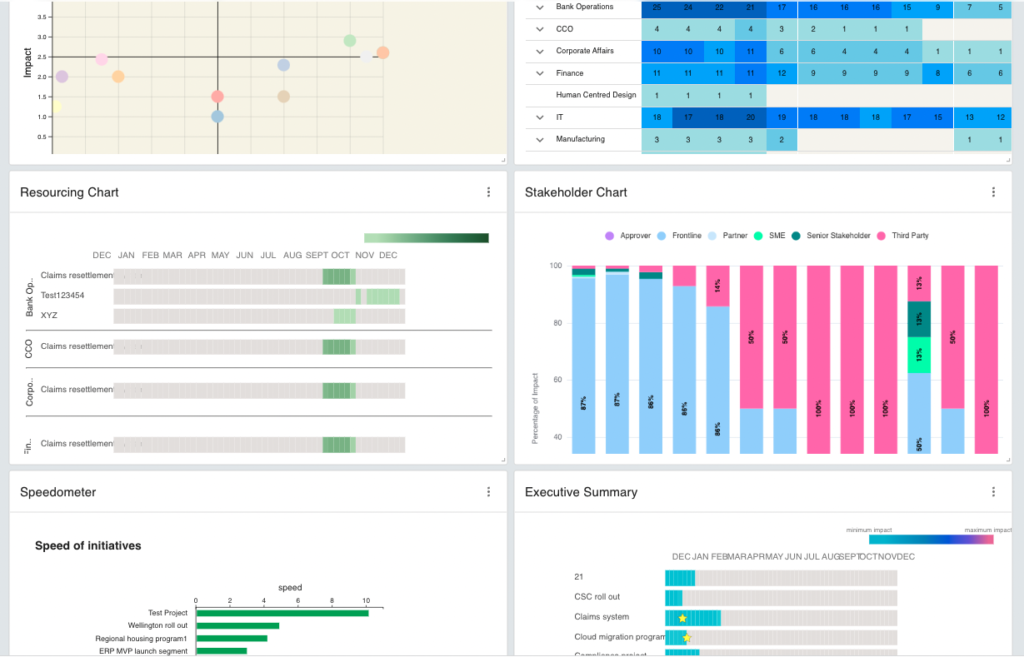
Examples of data visualisation from The Change Compass
3. Sizing and categorising the impacts of changes
After getting a clear picture of holistic change environment that the stakeholders will be undergoing the next step is to analyse the impacts from your project. In analysing the change impacts you should be ascertaining the nature of these change impacts including:
Size of the impact
How long the impacts will last
How much time these impacts translate to
Types of these impacts (e.g. people, process, system, customer, etc.)
To whom the impacts will be on
Quantitatively sizing your impacts makes them concrete and easily understood. Armed with this information you are able to examine to what extent the planned releases are the right ‘size’ for the impacted stakeholder groups. This is another critical part of agile change management. In determining this, the following stakeholder factors are critical:
Capacity bandwidth
Potential overlaps across various impacts either within the same or with other projects or initiatives
Change maturity level and experience with similar changes in the past
Leadership support and other change reinforcement mechanisms
Overall change readiness
Engagement level with the particular change initiative
When you have considered all of these factors you are ready to engage with your project manager, the PMO, and business representatives to assess to what extent the roadmap laid out is effective and will work to maximise the targeted initiative benefits.
4. Business operations routines
Now you understand clearly the change environment of your impacted stakeholders, various changes within yours’ and other initiatives, and the categories of the various change impacts. The next step is to clarify to what extent your impacted business units have the right operational process to receive ongoing changes. This is often a neglected part of agile change management.
More change mature business units have over time developed the right routines and processes to absorb changes, especially ongoing ones. What are some of these?
Effective engagement processes. Engagement processes are not just one-way communication channels. Having effective communications channels such as newsletters and town halls are a minimum for employees to hear about what is coming down the pipeline. Engagement processes include such as effectively choreographed Yammer channels, skip-level meetings (where managers meet with employees 2 levels down), focus group sessions with a small group of select employees, and effective team meetings where information is passed both up and down the chain of command
Effective learning processes. Effective learning processes at a business unit level includes business operations routines whereby employees have individual development plans (from which training plans can be incorporated), ongoing monitoring of development tracking against targets (e.g. completion rates), virtual learning processes (e.g. employee familiarity with virtual ways of self-initiated learning)
Change champion network. Most change champion networks are project-based and therefore have a limited shelf-life. This means that business change champions have a limited time to learn and develop as effective change champions. They also have limited time to practice and experience what it is like to lead and support change. A better design for business units undergoing ongoing changes is to have business unit based change champions that can support a myriad of changes across the board. This flexes their capability. Also, with constant exposure to changes over time, they are able to continuously develop and become better change champions. Organisations that have done this well, have positioned this as a ‘talent pool’ for frontline employees seeking to grow into other challenging roles.
Benefit realisation processes. Tracking and reinforcing benefit realisation is one of the most critical ingredients for success in the impacted business unit. Usually a month after go-live, the project would have already wrapped up and the business is left to continue the rest of the change journey and achieve the targeted benefits. To do this the business unit needs to have clear benefit realisation tracking and reinforcing mechanisms, involving Finance and business leaders. There needs to be constant oversight of how the benefit tracking is trending and leader discussions on resolving any obstacles and providing adequate managerial support to drive the benefit realisation process.
If your impacted business unit lacks one or more of these ingredients, it is critical that you work on this upfront. Highlight to business leaders the risk of not having these ingredients in place within the business. These processes may take significant time and investment to build up. Therefore, factor in the time required to develop these. Often, within the challenges of agile changes, these are left until the end, by which time it is too late to try and establish quickly to support the identified project changes.