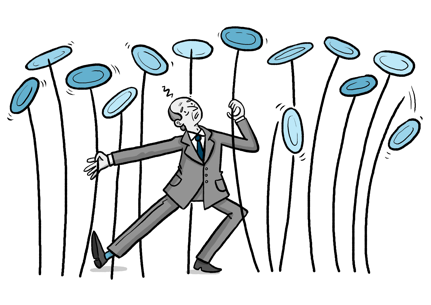
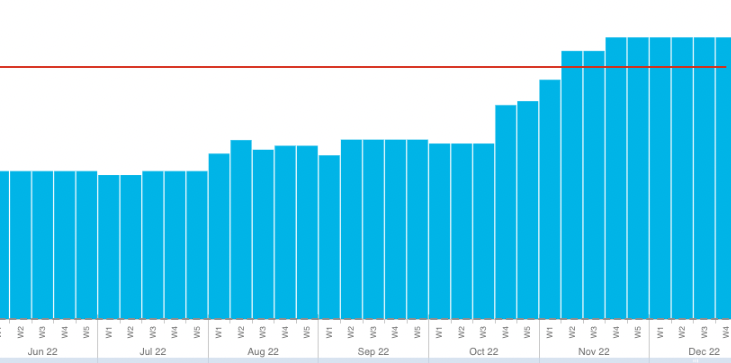
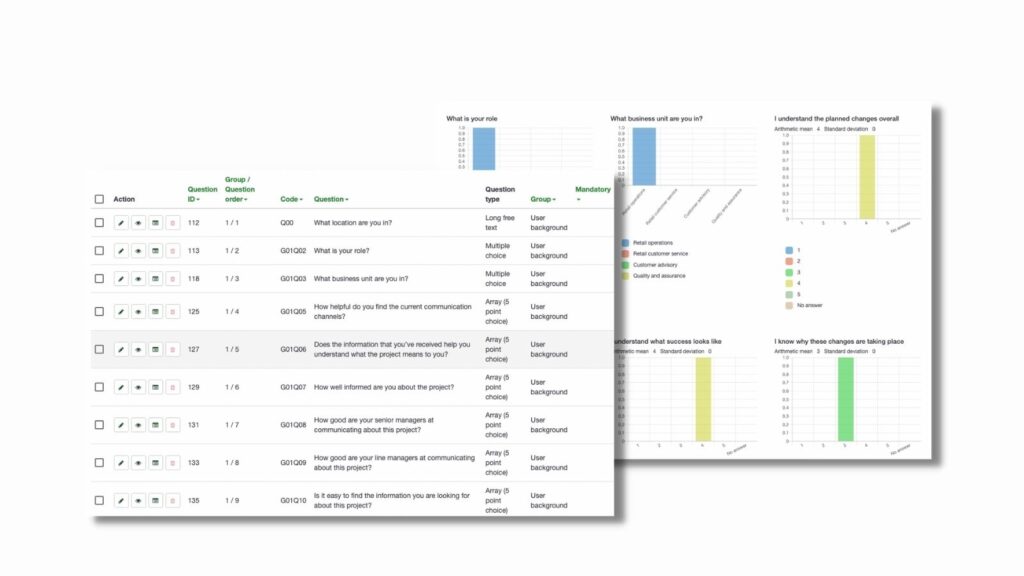
We’ve all heard about how change is the only constant and that change is intensifying and not going away. On top of increasing digitisation, we have Covid, extreme weather disruptions as well as other company changes. Not all changes can be planned for. Change is a balancing act, requiring significant skill and management. The analogy comes to mind of a spinning plate circus act. Each plate needs attention and constant spinning. The problem is when you have 10, 50, or 100+ plates, it becomes almost impossible to pay attention to every single one across the company.
This is exactly why it is so critical to have a single view of change. When you are only spinning a few plates you can easily see them all and have enough attention and bandwidth to ensure they are all spinning effectively. When the number and intensity of change multiply, this becomes tricky. Without a single view of change, how can any organisation manage change across the board? This is exactly the problem.
For most companies, each project team is organised as a separate team, with a separate set of stakeholders. Multiply this by the number of projects and you get the problem. The number of silos that is each project creates significant complexity for the organisations. These include:
At any one time, there will be multiple projects impacting the same part of the business. Since each project is only focused on its activities, they are mostly not aware of project activities from other projects that are impacting the same stakeholders.
For the same group of stakeholders, there may be very different ways of engagement and change journeys required. Too many different types of change can make it difficult for the impacted stakeholders to digest. Also, these changes, when combined, may or may not support the business objectives of that particular part of the business.
Some PMOs try to contain this complexity by creating different portfolios in which to group projects. The thinking is that each of the portfolio managers can manage a set of projects and can try to help join the dots where possible to coordinate the various releases and implementation of projects within each portfolio. However, managing too many portfolios can create even more complexity and thereby be less agile for the organisation. Also, most project portfolio managers are typically focused more on technical activities and releases, and less on resultant people impacts.
Why create a single view of change?
1. Change saturation and limited capacity
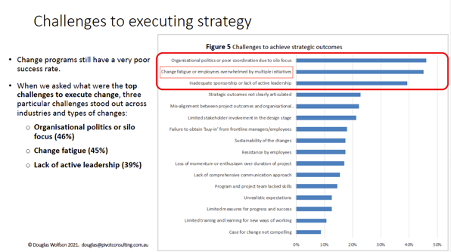
The first reason for creating a single view of change is to assess the risk for and avoid change saturation. There is evidence from several surveys including that from Prosci showing that change saturation/fatigue is one of the biggest challenges for organisations in changing. The pressure to change fast and still maintain business performance is real and impacts a wide range of industries.
Research highlighting change fatigue as a key change challenge
2. Business capacity.
Even if there was not a risk of change saturation and fatigue, there is constantly a challenge of limited business capacity to change versus ‘keeping the lights on’ activities or executing business-as-usual tasks. This includes both the capacity to change for those impacted by the change, and also for subject-matter-experts from the business who may be pulled by multiple projects and thereby have limited bandwidth.
3. Change portfolio management
The first 2 points are of a business lens, in terms of business-related change impacts across projects. However, from a change portfolio perspective, it also makes sense to have a single view of change to better manage a change portfolio.
What is offered by a single view of change that is meeting a gap with the data captured by existing PMO is, change impact. This change impact includes types of stakeholders, roles, the parts of the organisations, and how they are impacted by the change. Data may capture the extent of the change effort required, the time required to undergo change activities, and even behaviours required as a part of the transformation.
With a single view of change, the project portfolio can be better managed in terms of:
Project change resource allocation
Project release coordination and harmonisation and how they impact stakeholders
Change execution design across projects
Examine opportunities to create ‘change bundles’ where it makes sense, or to break down change releases into smaller pieces if that is a better fit for the business
Monitor operational risks across change releases
4.Change adoption
The ultimate goal of creating a single view of change is to maximize change adoption across the board. An impacted stakeholder group is likely going to experience multiple changes. If there is a way to design a change adoption process that makes it easier for the stakeholders it will significantly increase the likelihood of achieving full change adoption.
As a real example, at a major bank, the same group of stakeholders was asked by one project led by the Product division to prepare for the end of life of a credit card. They were asked to tell customers that this card will not only be sold after a certain date. On the other hand, another project led by Marketing was telling the same groups of stakeholders to sell more of this credit card to try and meet their quarterly target. Needless to say, this type of confusing message will not serve well to achieve any of the project change adoption targets.
5. Risk in change
Change risk management is an emerging discipline and growing in importance for Chief Risk Officers. This is particularly the case for financial services corporations. Risk in change is about how the organisation manages the risks by undergoing the committed changes in a way that allows them to operate safely. A key challenge is the visibility of the various changes presented in a way that allows the business to visualise these changes to be able to see the associated risks. A single view of change can add significant value from a risk lens.
If having a single view of change is so critical why is it that not more organisations have this? Here are some key reasons:
Perceived difficulty in capturing a single view of change. Most change practitioners will think of the vast number of projects that need to be engaged to create this view and the time it takes to do this.
How to capture the single view of change. With the various types of data available in each initiative some get overwhelmed and are not able to pinpoint exactly what information is required to be captured.
How to report on a single view of change. Most opt for a simple traffic light showing red, amber, and green of the varying levels of impact of each project. The problem is that this is not always based on data (instead, based on personal judgment), and is often not quite granular enough to make this useful.
One of the key benefits of a single view of change is that it is critical in supporting the work of managing a change portfolio to make the right decisions to manage change holistically. To find out more about how to calculate the financial benefit of managing a change portfolio visit our article here.
Solution on building a single view of change quickly
There are several approaches to building a single view of change quickly. As a first step, it’s important to define what outcome is required and how the artifacts might be used to make impactful business decisions. Focus on capturing the impact of change per initiative as a starter, detailing different levels of impact of the initiative based on actual impact activities of each initiative, versus using high-level personal judgment (which may be hard to defend in front of senior managers).
1. Focus on one part of the business to capture a single view of change
It’s important to note that a single view of change should always be showing the view from the business stakeholders’ perspective, versus from a project/program perspective. A way to kickstart the process with a more achievable target is to select one part of the business to start focusing on. Ideally, choose a part of the business that is concerned about change volume and would like to use the reports developed with a single view of change.
Ensure you get these stakeholders onboard, and involve those who ‘feel the pain’ of change complexity. These stakeholders can be your change champions in supporting the development and utilisation of a single view of change.
2. Focus on a smaller set of initiatives as a start
Again, rather than trying to capture every initiative in one go, start by selecting a group of initiatives, either within a portfolio or a large program. It can also be that you start by focusing on the more ‘strategic initiatives that are of higher visibility to stakeholders. These initiatives are also easier to define.
3. Conduct workshops to quickly gather data
One of the best ways to collect data quickly is to gather these in structured workshops. In each of the workshops you have a representative from each project attending, either a change manager or a project manager. In the workshop, you talk through the data you are trying to capture and work with the group to capture them. During the session, it is also a good idea to view the data collected and clarify as needed to ensure the data is spot on.
It is a good idea before the workshop to provide a simple template for participants to do the pre-work, identifying the change impact activities for their respective projects. Be clear in defining what these change impact activities mean, providing examples to show them the types of data you are after.
Here is a sample timeline for creating a single view of change:
Week 1: Align with sponsors and senior stakeholders on the ‘why’ of creating a single view of change Week 2-3: Conduct workshops to collate data cross initiatives Week 4: Create data visualisation and share with stakeholders
3. Utilise digital tools to automate and speed up the process
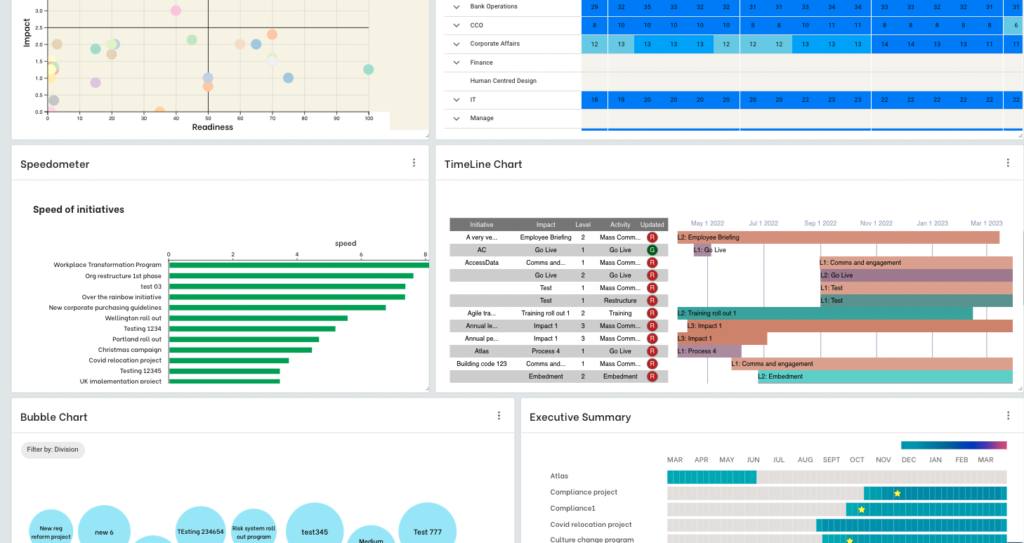
Using an Excel spreadsheet may be a good way to go in the beginning, but for organisations that have a digital focus, leveraging digital tools make perfect sense. Using change management tools that help you piece together a single view of change with all the fields and reports already built can save significant time and effort. With the ease of support for ongoing data collection, and reporting significant time and resources are saved. In addition, a good tool can help provide additional insight into what is happening to the organisation that manual ways may not generate. The ability to add significant value through data-backed insight that can significantly influence change implementation is one of the key advantages of leveraging a digital tool.
Different examples of a single view of change visualization
Moreover, a single view of change should not be a static artifact. Instead, it should be a live data source that is constantly changing as the organisation undergoes various changes. In a fast-paced change environment, it is even more critical to have the right digital tool to provide clear tracking and reporting.
Practical Tips and Strategies for Implementing a Single View of Change
Implementing a single view of change requires a systematic approach and careful consideration of various factors. Here are detailed practical tips and strategies to facilitate the process:
Define Clear Objectives:
Start by clearly defining the objectives of implementing a single view of change. Determine what outcomes the organization hopes to achieve, such as improved coordination, enhanced decision-making, or increased change adoption rates.
Ensure that the objectives are specific, measurable, achievable, relevant, and time-bound (SMART), providing a clear roadmap for implementation and evaluation.
Engage Stakeholders:
Conduct Impact Assessments:
Conduct comprehensive impact assessments for each change initiative to understand its potential effects on stakeholders, processes, systems, and the organization as a whole.
Identify and analyze potential conflicts, dependencies, and overlaps between projects to mitigate risks and ensure effective coordination and alignment.
Utilize tools and methodologies such as stakeholder analysis, risk assessment, and change impact analysis to gather and analyze relevant data.
Utilize Change Management Tools:
Leverage change management tools and technologies to streamline the process of capturing, analyzing, and managing change data.
Choose tools that align with the organization’s needs and capabilities, providing features such as data visualization, workflow automation, collaboration, and reporting.
Train users on how to effectively utilize these tools and provide ongoing support and maintenance to ensure their optimal functionality.
Establish Clear Communication Channels:
Establish clear communication channels and protocols for sharing information, updates, and feedback related to change initiatives.
Implement regular meetings, newsletters, intranet portals, and other communication tools to keep stakeholders informed and engaged throughout the implementation process.
Encourage two-way communication, soliciting input and feedback from stakeholders and addressing any concerns or questions in a timely and transparent manner.
Provide Training and Support:
Offer comprehensive training and support to employees and stakeholders to help them navigate and adapt to change effectively.
Develop and deliver training programs, workshops, and resources focused on building change management skills, resilience, and readiness.
Provide ongoing support and guidance to individuals and teams as they navigate the complexities of change, offering coaching, mentoring, and access to relevant resources and expertise.
Monitor and Adapt:
Continuously monitor the effectiveness of the single view of change implementation and be prepared to adapt and refine strategies as needed.
Establish key performance indicators (KPIs) and metrics to track progress, measure success, and identify areas for improvement.
Solicit feedback from stakeholders and project teams regularly, incorporating insights and lessons learned into ongoing iterations and updates of the single view of change.
Engage key stakeholders from across the organization in the process of establishing a single view of change. This includes representatives from project teams, senior management, frontline employees, HR, IT, and other relevant departments.
Foster open communication and collaboration among stakeholders, encouraging them to share insights, concerns, and feedback throughout the implementation process.
Consider forming a dedicated change management team or steering committee to oversee the implementation and ensure alignment with organizational goals.
By implementing these practical tips and strategies, organizations can establish a robust and effective single view of change that enhances coordination, alignment, and success in managing change initiatives across the organization.
Addressing Potential Objections or Challenges
While implementing a single view of change offers numerous benefits, organizations may encounter objections or challenges along the way. Here are detailed strategies for addressing common concerns:
Resource Allocation:
Address concerns about resource allocation by conducting a thorough assessment of the time, budget, and personnel required for implementing a single view of change.
Prioritize resources based on the strategic importance and potential impact of change initiatives, focusing efforts on high-priority projects with the greatest potential for success.
Consider leveraging external expertise or resources, such as consultants, trainers, or change management professionals, to supplement internal capabilities and ensure successful implementation.
Resistance to Change:
Proactively address resistance to change by fostering a culture of openness, transparency, and collaboration within the organization.
Communicate the rationale behind the single view of change initiative, highlighting the benefits and opportunities it presents for stakeholders and the organization as a whole.
Provide training, education, and support to help employees and stakeholders understand and embrace the changes, addressing concerns, fears, and misconceptions along the way.
Involve stakeholders in the decision-making process and empower them to contribute to the development and implementation of the single view of change, fostering ownership and commitment to its success.
Organizational Culture Barriers:
Recognize that organizational culture can influence the success of change initiatives and take proactive steps to address cultural barriers.
Assess the current organizational culture and identify any values, beliefs, or norms that may hinder the adoption of a single view of change.
Align the implementation of the single view of change with the organization’s values and cultural priorities, emphasizing collaboration, innovation, and continuous improvement.
Engage cultural change champions and influencers within the organization to champion the initiative, build momentum, and overcome resistance to cultural change.
By proactively addressing potential objections or challenges, organizations can mitigate risks and obstacles to implementing a single view of change, paving the way for greater success and effectiveness in managing change initiatives.
In conclusion, establishing a single view of change is not merely an advantageous undertaking for change practitioners; it’s a fundamental necessity for navigating the complexities of modern organizational change. When executed effectively, a single view of change has the potential to significantly enhance the management of change portfolios and drive higher levels of change adoption across initiatives.
While the process of gathering and organizing data for a single view of change may seem daunting, structured approaches such as workshops can expedite this process, allowing organizations to achieve results within weeks rather than months.
However, it’s essential to recognize that a single view of change should not be viewed as a one-time endeavor. Instead, it should be embraced as an ongoing process, continuously evolving to meet the dynamic needs of the organization. By consistently generating engaging and impactful data visualizations, organizations can leverage their single view of change to glean valuable business insights and inform strategic decision-making.
In essence, a single view of change isn’t just a tool; it’s a transformative capability that empowers organizations to thrive amidst the ever-evolving landscape of change.
If you are about to embark on creating a single view of change and are thinking about whether or how to leverage a digital offering to support your efforts reach out and have a chat with us.
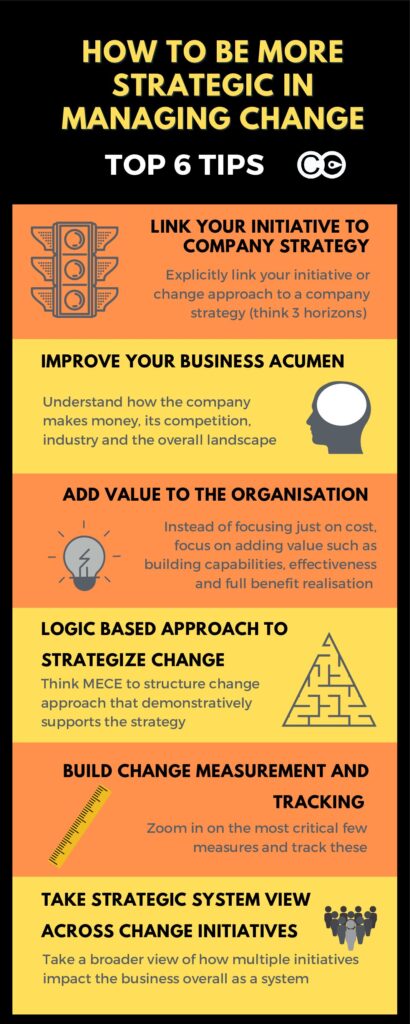
Most change practitioners are hired to support an initiative whilst others are supporting the business. Irrespective of the role, there are ways to be more strategic in managing change.
Here in this infographic we highlight the top 6 tips in being more strategic in managing change.
For the section on ‘Logic based approach to strategize change’, the MECE approach is mentioned. MECE stands for ‘Mutually Exclusive, Collectively Exhaustive’. This is a technique used by strategy consultants to brainstorm and map potential solutions to solve a problem. To read up more about how to apply the MECE technique refer to this article.
The question of whether change management software makes a difference is no longer really open. The data is consistent and has been replicated across multiple credible research bodies. The more interesting question, for a change practitioner evaluating software for their organisation, is: which specific outcomes does software improve, under what conditions, and what do you need to do differently to realise those benefits?
Prosci’s research on change management and project outcomes found that 88% of projects with excellent change management met or exceeded their objectives, compared to just 13% with poor change management. Software does not by itself create excellent change management, but it creates conditions that make excellence significantly easier to achieve at scale. For large organisations running multiple concurrent programmes, the manual approach has a ceiling. Software breaks through it.
This article examines the specific benefits that change management software delivers, the outcome categories where the evidence is strongest, and what conditions need to be in place for those benefits to materialise in your organisation.
Why the ‘change management software benefits’ conversation has changed
Five years ago, the primary benefit proposition for change management software was efficiency: do what you already do, but faster and with less administrative burden. Automate the stakeholder matrix, centralise communication plans, streamline reporting. These remain real benefits.
The conversation has shifted substantially, however, because the problems large organisations now face in managing change are fundamentally different from ten years ago. The volume of concurrent change is dramatically higher. Employee change fatigue is a measurable risk factor, not just a vague concern. Executive teams are demanding evidence of adoption outcomes, not just change activity. And the complexity of tracking all of this manually, across a programme portfolio of 15 or 25 active initiatives, is simply beyond what spreadsheets and surveys can reliably handle.
Gartner research found that organisations with better than average healthy change adoption report two times higher year-over-year revenue growth, and for companies with more than 50,000 employees, this can represent up to $2.2 billion USD annually. The stakes are significant enough that “we do not have a budget for software” is an increasingly difficult position to defend when the cost of poor adoption is quantified.
The three outcome categories where change management software makes the biggest difference
Not all change management software benefits are equal in magnitude or consistency. Based on the research and the patterns visible in organisations that have implemented dedicated platforms, three outcome categories show the clearest impact.
Adoption rate and speed
The most directly measurable change management software benefit is improvement in adoption rates and the speed at which target groups move through adoption stages. Software enables this in several ways. Real-time adoption tracking means that teams know, within days or weeks rather than months, which stakeholder groups are progressing and which are not. Early signals of lagging adoption trigger targeted interventions that manual approaches typically identify too late to act on effectively.
Organisations that measure adoption continuously, with software-enabled dashboards updated from multiple data sources, can run intervention cycles during a programme rather than only at go-live and post-implementation review. The difference in outcomes is significant: adoption that might plateau at 60% without intervention can reach 80-85% when lagging groups are identified early and supported specifically.
Portfolio risk management and change saturation prevention
The most strategically valuable change management software benefit for large organisations is portfolio-level visibility. When a single team or business unit is simultaneously managing the impacts of five, ten, or more concurrent changes, the risk of change saturation is high and largely invisible unless you are measuring cumulative load systematically.
A Capgemini Invent study surveying 1,175 professionals globally found that organisations with high data maturity in their change programmes achieve 27% higher change success rates. The ability to see total change load by business unit, role group, or geography, and to adjust sequencing and resourcing decisions based on that data, is a direct change management software benefit that manual approaches cannot replicate at scale.
Consider what this means in practice. A head of transformation who can see, in a single view, that their customer operations team will be absorbing three major systems changes and a structural reorganisation in the same six-week window has actionable information. They can advocate for sequencing adjustments, flag the risk to executives, or redirect change resource to that team before saturation occurs. Without software, that visibility requires someone to manually aggregate impact data across four separate project plans, assuming those plans even use consistent impact categories.
Reporting credibility and executive confidence
A less-discussed but practically important change management software benefit is the improvement in the quality and credibility of change management reporting to executive stakeholders. Manual change reports are typically narrative-heavy and data-light. They describe what has been done rather than demonstrating what has been achieved. Executive audiences, particularly those with P&L accountability, have limited patience for activity reports.
Software-enabled dashboards that show adoption trends, compare current performance to baseline, and flag portfolio risks change the nature of the executive conversation. Change leaders who can show, with data, that adoption in their highest-priority stakeholder groups has moved from 45% to 72% since go-live, and that two specific groups remain at risk, are having a categorically different conversation from those who report that “stakeholder engagement is progressing well.”
This credibility benefit has a compounding effect. Change functions that demonstrate impact through data receive more resourcing, earlier engagement, and greater executive sponsorship, which in turn further improves outcomes. The measurement capability becomes a strategic asset, not just an operational tool.
What needs to be in place for software benefits to materialise
Change management software benefits are not automatic. They require certain conditions in your change function and organisation to become real.
Standardised data frameworks. Software can only aggregate and compare data across programmes if the underlying data uses consistent definitions. What does “high adoption” mean? How is readiness scored? What categories describe change impact? These definitions need to be agreed and applied consistently across all programmes before portfolio-level measurement is meaningful. Implementing software without this standardisation typically results in beautiful dashboards full of incomparable data.
A culture that acts on measurement. Software that generates data no one uses is expensive reporting infrastructure. The change management software benefits described in this article are realised when measurement data actively drives decisions: resourcing adjustments, sequencing changes, targeted stakeholder interventions. This requires change leaders who are willing to act on what the data shows, including when the data contradicts existing plans or assumptions.
Adequate baseline data. The comparison between ‘before’ and ‘after’ states is what makes adoption measurement credible. Software platforms need baseline readiness and adoption data captured before programmes launch, not just post-implementation surveys. Organisations that skip baselining lose one of the most valuable capabilities software provides.
Consistent data input discipline. Like any system, change management software produces quality outputs when teams input quality data consistently. If some programme managers update their adoption data fortnightly and others quarterly, portfolio views become unreliable. This is a governance question as much as a technology question.
Outcome data: what the research shows
The evidence base for change management software benefits has strengthened considerably in recent years. Some specific data points worth noting:
Prosci’s research finds that projects with excellent change management are nearly five times more likely to be on or ahead of schedule than those with poor change management, and 135% more likely to achieve or exceed planned benefits realisation
Capgemini Invent’s 2023 study found that data-driven leadership in change programmes increases success rates by 23%, and organisations with data-driven change cultures see a 26% improvement in change outcomes
Gartner research indicates that organisations experiencing ‘ungovernable change’ are 1.6 times less likely to achieve high change trust among employees, and 79% of employees currently have low trust in change, partly because change feels arbitrary and poorly managed rather than evidence-based
These findings collectively point to the same conclusion: the organisations that manage change well are those that can see what is happening in their change portfolios in real time and respond accordingly. Software is the mechanism that makes this possible at scale.
Using digital platforms to deliver these benefits
The Change Compass is a digital change management platform purpose-built for the portfolio-level measurement challenges described in this article. It enables change functions in large organisations to visualise cumulative change load by business unit or role group, track adoption in real time across multiple programmes, and generate executive-ready dashboards that demonstrate change impact rather than just change activity.
Organisations using The Change Compass shift from reactive change management, where problems become visible only after they have affected adoption, to proactive management where leading indicators allow intervention before impact accumulates. This shift is the core of the software’s value proposition, and it maps directly to the outcome categories where the research shows the strongest evidence of change management software benefits.
If your change function is evaluating software options, the most useful questions to ask any vendor are: how does your platform handle portfolio-level load aggregation across concurrent programmes, how does it support real-time adoption tracking, and what does the executive reporting layer look like. The answers reveal whether a platform is built for the portfolio challenges most large organisations face or whether it is primarily a project-level tool.
Making the case internally
For change leaders building an internal business case for change management software, the most compelling approach is to anchor the value conversation in specific, recent organisational examples. Did a recent transformation programme fall short of adoption targets? What was the estimated cost of that shortfall, in productivity loss, rework, or benefits delayed? How might earlier visibility of adoption data have changed the outcome?
This specificity is more persuasive than generic statistics. The research provides a credible framework; your own organisation’s experience provides the compelling case.
Frequently asked questions
What are the main benefits of change management software?
The three most significant benefits are improved adoption rates and speed, portfolio-level visibility that prevents change saturation, and more credible data-driven reporting to executive stakeholders. Secondary benefits include efficiency gains in change planning and documentation, standardisation across change teams, and improved ability to demonstrate the value of change management investment.
How does change management software improve adoption rates?
Software improves adoption through real-time tracking that identifies lagging stakeholder groups early, enabling targeted interventions before adoption problems become entrenched. Rather than learning at the post-implementation review that a key group never fully adopted, software surfaces the signal weeks earlier when there is still time and resource to respond.
Is change management software only useful for large organisations?
Large organisations with multiple concurrent programmes benefit most from portfolio aggregation features. However, mid-sized organisations also gain significant value from adoption tracking, standardised measurement frameworks, and data-driven reporting capabilities. The minimum viable use case is typically a team managing two or more significant change programmes simultaneously.
What is the ROI of change management software?
The ROI depends on the organisation, programme size, and current state of change management capability. However, Prosci research showing a seven-fold improvement in project success rates with excellent change management provides a useful benchmark. If a single major programme failing to meet adoption targets costs your organisation $2-5 million in delayed benefits or rework, the investment in software that reduces this risk substantially is straightforward to justify.
How long does it take to see benefits from change management software?
Portfolio-level visibility benefits can be realised within the first programme cycle after implementation, typically within three to six months. Adoption tracking benefits are visible from the first programme that runs with software-enabled measurement. The compound benefits, particularly around executive credibility and resourcing, typically build over 12-18 months as the change function establishes a track record of data-driven reporting.
How is change management software different from project management software?
Project management software tracks tasks, timelines, budgets, and resources. Change management software tracks the human adoption side of change: stakeholder readiness, adoption rates, change impact on different employee groups, and cumulative change load. The two are complementary but address fundamentally different questions. Project management asks “is the work being done?”; change management software asks “are people changing in the way the project requires?”
References
Prosci. The Correlation Between Change Management and Project Success. https://www.prosci.com/blog/the-correlation-between-change-management-and-project-success
Gartner. Gartner HR Research Finds Just 32% of Business Leaders Report Achieving Healthy Change Adoption by Employees (2025). https://www.gartner.com/en/newsroom/press-releases/2025-07-08-gartner-hr-research-finds-just-32-percent-of-business-leaders-report-achieving-healthy-change-adoption-by-employees
Capgemini Invent. Change Management Study 2023. https://www.capgemini.com/insights/research-library/change-management-study-2023/
Change saturation is a common term used by change practitioners to describe a picture where there may be too many changes being implemented at the same time. The analogy is that of a cup with limited capacity, where if too much change is poured into a fixed volume, the rest will not stay in the cup or be ‘embedded’ as adopted changes.
At the end of 2020, Pivot Consulting conducted extensive research where they asked a range of different roles in organisations about implementing change. When questioned about key challenges to executing strategy and driving change, change fatigue or employees being overwhelmed by multiple initiatives is identified as one of the top 2 most critical challenges. It can be seen that change saturation is not just a popular discussion topic but a serious focus area that is posing significant challenges to a range of organisations.
Research from Pivot Consulting, 2020
There are many common ways of understanding and approaching change saturation. However, many of these are not always correct with some being quite misleading. In this article, we aim to review the 5 key incorrect assumptions about change saturation that are downright misleading and should be directly challenged. These may be assumptions that are widely held and assumed to be ‘facts’ and are not questioned.
Incorrect assumptions:
In the following, we outline the key assumptions that should be challenged when approaching change saturation.
1. Change is disruption
The first assumption is that change is always ‘disruption’. Change can be dynamic. There is also a range of different types of changes. Therefore, change does not always need to be negative and cause chaos or impede normal ways of working.
Take, for example, agile teams. A part of the work of an agile team is to drive continuous improvement. The team establishes regular routines to try something new, i.e. a change. They then execute it and examine the data to see the effect of the change on business. For these teams, ‘planned’ changes are just part of normal ways of working, and therefore not necessarily viewed as ‘disruptions’ to their work since this is part of their work.
On the other hand, change is also not always ‘negative’. Some changes may be there to make it easier for the employee or the customer. For example, it may be that the organisation is implementing system-driven automation to save employees time in entering manual information. These changes are typically welcomed by the impacted employees and are not perceived as ‘disruptions’ to their work. Instead, they are typically perceived as positive changes.
As a result, change needs to be understood by its specific impact on the various stakeholders, and not by its ‘disruption’. A more useful way to understand the impact of the changes on end stakeholders may be to understand the various activities required for them to undergo the change and shift their behaviours.
For example, it could be that a customer service rep may need to undergo training sessions, team briefing sessions, review documentation, and receive team leader feedback, in the overall change journey. These activities may be ‘on top’ of existing normal business routines, or they may be a part of existing business routines, and therefore not ‘adding’ to the ‘saturation level’.
2. Change capacity is determined by capability
It is a commonly held belief that change capacity is determined by change capability at individual, team and organisational levels. Yes, factors such as change leadership, individual change capability and skills can improve change capacity. However, change capacity is not only determined by capability.
Indeed, there are other factors that determine change capacity.
a. Biological.
Humans are designed to have a limited attention span. When there are too many things happening at the same time, we can only focus on a limited number of things at the same time. There are many studies that show if we keep switching focus between different tasks, we are likely to not have full focus and attention which will leave us to making mistakes.
This also applies to learning. The more we focus on multiple tasks, the more we are not able to tune out and therefore engage in deeper processing and learning.
What about thinking about multiple initiatives? According to University of Oregon researchers, professors Edward Awh and Edward Vogel, the human brain has a built-in limit on the number of discrete thoughts it can entertain at one time. The limit for most individuals is four. It does not matter how much capability development one focuses on, there is a limit to how much capacity can be created. Therefore, there is a cap on to what extent capability may lift change capacity. After all, no matter how skillful someone is, biological tendencies and restrictions remain.
b. Expectation.
The level of expectation of the extent to which one can change can determine the outcome. Studies have shown the individual negativity or positivity can impact the outcome. The more negative an individual of the outcome, the more negative the outcome becomes. However, if the expectations are unrealistically high, they may lead to disappointment.
Think back to the impacts of Covid, and how what would have seemed almost impossible in terms of virtual working has suddenly become a reality overnight. Often what companies had imagined taking 10 years to achieve, is suddenly achieved overnight out of necessity. The expectation that there is no other way and that there is no choice leads to the acceptance of the change scenario.
3. Basing saturation points purely on opinions
As change practitioners, we often aim to be the ‘people’ representative. Many think of themselves as the ‘social worker’ or ‘welfare worker’ who are there to be the voice of employees. Whilst, it is true that we need to be the voice of people, the definition of ‘people’ should not just include employees, but a range of stakeholders including managers.
Especially when the change environment is complex and challenging, there may be a tendency for people to ‘over-inflate’ the reality of the situation. Sometimes it may be easier to call out that there is too much change in the hope that this feedback will result in less change volume, thereby making work ‘easier’.
Change practitioners need to be aware of political biases or tendencies for people to report on feedback that is not substantiated by data. Interviews with stakeholders may need to be supplemented by surveys or focus groups to test the validity of the results. We should not simply assume that anything stakeholders tell us are ‘truths’ per se, especially since there is political motivation in biased reporting.
Example from The Change Compass – Plotting change saturation line against change impact levels
4. Focus on capability vs systems and processes to manage saturation
An overt focus on capability, knowledge and skills, may lead to gaps in the overall ability to manage change saturation. This is because skills and competencies are just one of many elements that supports change execution. Beyond this, effective organisations also need to focus on having the right systems and processes established to support ongoing change execution.
Systems and processes include such as:
Learning operations processes whereby there is a clear set of steps for the business to communicate, undertake, and embed training/learning activities. These include the right channel to organise people capacity to attend sessions, communication channels regarding the nature of scheduled training sessions and monitoring the effectiveness of these sessions
Communication processes include having a range of effective channels that promote dynamic communication between employees and managers, as well as across different business units and teams.
Data and reporting mechanisms to visualise change impacts, measurement on change saturation levels, and report on change delivery tracking and change adoption progress
Governance established to examine change indicators including change saturation, risks identified, and make critical decisions on sequencing, prioritisation, and capacity mitigation
Skills and competencies are one element, but without processes and systems established to execute the change and track/report on change saturation, there will be limited business outcomes achieved.
Outlined in this article are just 5 of the common assumptions about change saturation that are misleading. There are many more other assumptions. The key for change practitioners is not to blindly rely on ‘methodologies’ or concepts, but instead to focus on data and facts to make decisions. Managing change saturation needs to be data-driven. Otherwise, stakeholders may easily dismiss any change saturation claims (as is often the case with senior managers). Armed with the right data and insights, the change practitioner has the power to influence a range of change decisions to achieve an optimal outcome for the organisation.
An important part of measuring meaningful change is to be able to design effective communication effectiveness change management surveys that measure the purpose of the survey it has set out to measure the level of understanding of the change. Designing and rolling out change management surveys is a core part of what a change practitioner’s role is. However, there is often little attention paid to how valid and how well designed the survey is. A survey that is not well-designed can be meaningless, or worse, misleading. Without the right understanding from survey results, a project can easily go down the wrong path. This is how this survey can be a powerful tool to ensure smooth transition for the change initiative.
Why do change management surveys need to be valid?
A survey’s validity is the extent to which it measures what it is supposed to measure. Validity is an assessment of its accuracy. This applies whether we are talking about a change readiness survey, a change adoption survey, employee engagement, employee sentiment pulse survey, or a stakeholder opinion survey.
What are the different ways to ensure that a organizational change management survey can maximise its validity and greater success?
Face validity. The first way in which a survey’s validity can be assessed is its face validity. Having good face validity is that in the view of your targeted respondents the questions measure what they aimed to measure. If your survey is measuring stakeholder readiness, then it’s about these stakeholders agreeing that your survey questions measure what they are intended to measure.
Predictive validity. If you really want to ensure that your survey questions are scientifically proven to have high validity, then you may want to search and leverage survey questionnaires that have gone through statistical validation. Predictive validity means that your survey is correlated with those surveys that have high statistical validity. This may not be the most practical for most change management professionals.
Construct validity. This is about to what extent your change survey measures the underlying attitudes and behaviours it is intended to measure. Again, this may require statistical analysis to ensure there is construct validity.
At the most basic level, it is recommended that face validity is tested prior to finalising the survey design.
How do we do this? A simple way to test the face validity is to run your survey by a select number of ‘friendly’ respondents (potentially your change champions) and ask them to rate this, followed by a meeting to review how they interpreted the meaning of the survey questions.
Alternatively, you can also design a smaller pilot group of respondents before rolling the survey out to a larger group. In any case, the outcome is to test that your survey is coming across with the same intent as to how your respondents interpret them.
Techniques to increase survey validity
1. Clarity of question-wording.
This is the most important part of designing an effective and valid survey. This is a critical part of the change management strategy. The question wording should be that any person in your target audience can read it and interpret the question in exactly the same way.
Use simple words that anyone can understand, and avoid jargon where possible unless the term is commonly used by all of your target respondents
Use short questions where possible to avoid any interpretation complexities, and also to avoid the typical short attention spans of respondents. This is also particularly important if your respondents will be completing the survey on mobile phones
Avoid using double-negatives, such as “If the project sponsor can’t improve how she engages with the team, what should she avoid doing?”
2. Avoiding question biases
A common mistake in writing survey questions is to word them in a way that is biased toward one particular opinion which may lead to biased employee feedback. This assumes that the respondents already have a particular point of view and therefore the question may not allow them to select answers that they would like to select.
Some examples of potentially biased survey questions (if these are not follow-on questions from previous questions):
Is the information you received helping you to communicate effectively to your team members through appropriate communication channels?
How do you adequately support the objectives of the project
From what communication mediums do your employees give you feedback about the project
3. Providing all available answer options
Writing an effective employee survey question means thinking through all the options that the respondent may come up with regarding the upcoming change. After doing this, incorporate these options into the answer design. Avoid answer options that are overly simple and may not meet respondent needs in terms of choice options.
4. Ensure your chosen response options are appropriate for the question.
Choosing appropriate response options may not always be straightforward. There are often several considerations, including:
What is the easiest response format for the respondents?
What is the fastest way for respondents to answer, and therefore increase my response rate?
Does the response format make sense for every question in the survey?
For example, if you choose a Likert scale, choosing the number of points in the Likert scale to use is critical.
If you use a 10-point Likert scale, is this going to make it too complicated for the respondent to interpret between 7 and 8 for example?
If you use a 5-point Likert scale, will respondents likely resort to the middle, i.e. 3 out of 5, out of laziness or not wanting to be too controversial? Is it better to use a 6-point scale and force the user not to sit in the middle of the fence with their responses?
If you are using a 3-point Likert scale, for example, High/Medium/Low, is this going to provide sufficient granularity that is required in case there are too many items where users are rating medium, therefore making it hard for you to extract answer comparisons across items?
5. If in doubt leave it out
There is a tendency to cram as many questions in the survey as possible because change practitioners would like to find out as much as possible from the respondents. However, this typically leads to poor outcomes including poor completion rates. So, when in doubt leave the question out and only focus on those questions that are absolutely critical to measure what you are aiming to measure.
6.Open-ended vs close-ended questions
To increase the response rate of change readiness survey questions, it is common practice to use closed-ended questions where the user selects from a prescribed set of answers. This is particularly the case when you are conducting quick pulse surveys to sense-check the sentiments of key stakeholder groups. Whilst this is great to ensure a quick, and painless survey experience for users, relying purely on closed-ended questions may not always give us what we need.
It is always good practice to have at least one open-ended question to allow the respondent to provide other feedback outside of the answer options that are predetermined. This gives your stakeholders the opportunity to provide qualitative feedback in ways you may not have thought of. This may include items that indicate employee resistance, opinions regarding the work environment, new ways of working, or requiring additional support.
Writing an effective and valid change management survey best practices for a specific change initiative is often glanced over as a critical skill. Being aware of the above 6 points will get you a long way in ensuring that your survey addresses areas of concern in a way that aligns with your change management process and strategy and will measure what it is intended to measure. As a result, the survey results will be more bullet-proof to potential criticisms and ensure the results are valid, providing information that can be trusted by your stakeholders.